
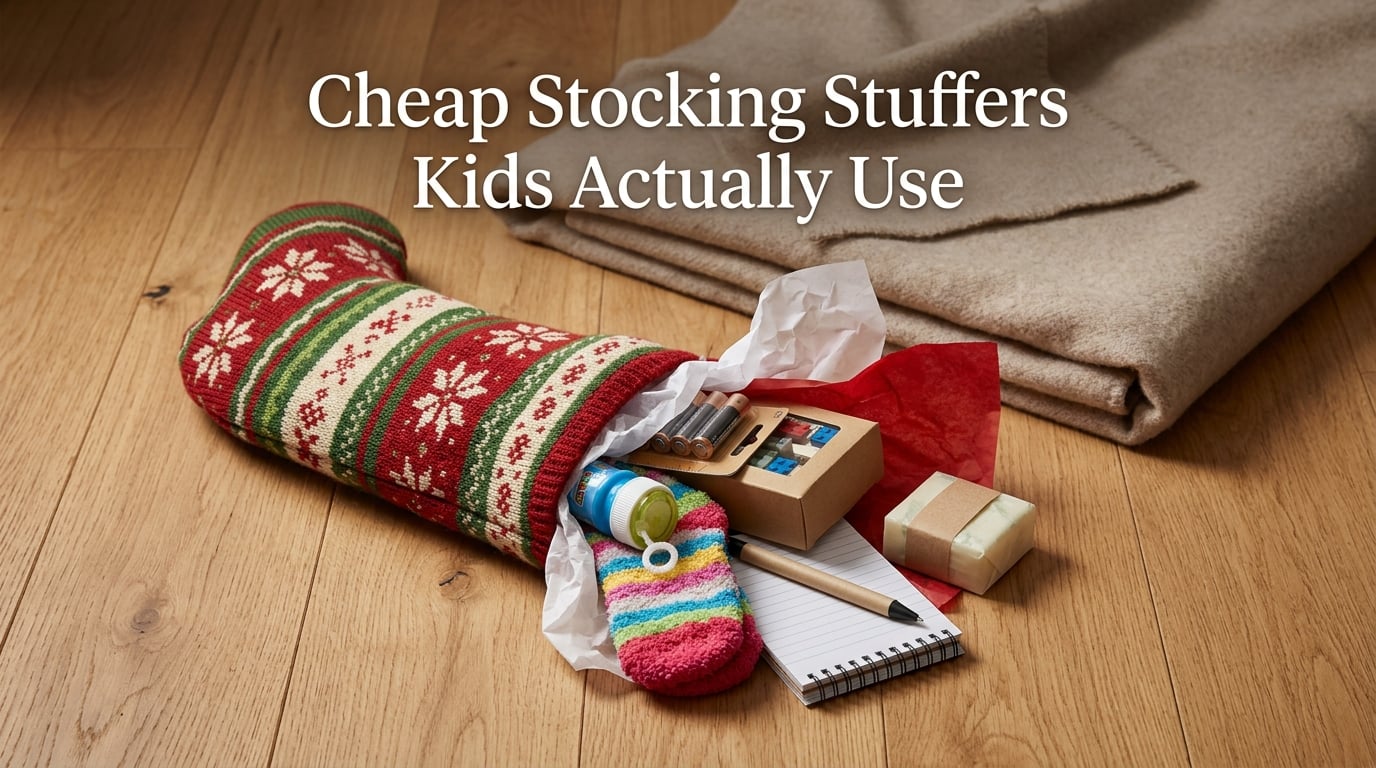
Cheap stocking stuffers for kids that they actually use are small, durable, screen-free items priced roughly between one dollar and ten dollars each — batteries, socks, bubbles, a toothbrush, a book of stickers, a LEGO minibuild, a tube of bath bubbles, or a colouring book that wipes clean. Skip the plastic trinkets that break by New Year’s and focus on fillers that get reached for again in February.
Last updated September 2026. Prices in Canadian dollars, and every retailer named here ships to Edmonton.
Here is the thing I have learned after a decade of filling four stockings every December: the budget rarely runs out because the gifts are too expensive. It runs out because the wrong things go in the bag. You buy a novelty plastic widget for four dollars a head, it survives until January 3rd, and then it lives in the bottom of the toy bin forever.
Parents in the r/Frugal and r/AskParents threads describe the same fatigue in the same words — tired of “cheap, useless junk” and tired of buying things the kids will not touch. Candy is the other half of the complaint. After Halloween, the school parade, and two weeks of trick-or-treating, most families I know would rather not add sugar to Christmas morning.
So this guide does something different. Every idea below runs through a four-point filter first, then gets sorted into a price tier, an age band, and a shortlist of things worth skipping entirely. No filler is on this list because it is trendy.
Table of Contents
- Quick Picks: Cheap Stocking Stuffers for Kids That Actually Get Used
- The Four-Item Test for a Stocking Stuffer They Will Actually Use
- Pocket-Change Picks: Stocking Stuffers Under One Dollar
- Great Value: Stocking Stuffers Under Five Dollars
- The One Splurge: Stocking Stuffers Under Ten Dollars
- Ideas by Age: Toddlers and Preschoolers (1 to 4)
- Ideas by Age: School-Age Kids (5 to 9)
- Ideas by Age: Tweens and Teens (10 and up)
- Non-Candy Stocking Stuffer Ideas
- Screen-Free and Reusable Favourites
- What to Skip (and Why)
- How to Fill Four or More Stockings on a Budget
- Where to Buy Cheap Stocking Stuffers in Canada
- Safety Notes by Age
- Last-Minute and No-Spend Filler Ideas
- Frequently Asked Questions
- What are some inexpensive stocking stuffer ideas?
- What are some affordable ideas for stocking fillers for kids?
- What are some good stocking stuffers under $10?
- What are some good stocking stuffers under $5?
- What are some good things to put in a stocking for a child?
- What are some unique stocking stuffer ideas for kids?
- What are some cool stocking fillers for kids?
- What to put in stockings instead of candy?
- What do well behaved kids get in their stockings?
- Conclusion
Quick Picks: Cheap Stocking Stuffers for Kids That Actually Get Used
If you want the short version before the details, these are the fillers that survive the longest in our house and come up again and again in parent discussions.
- A pack of batteries in the child’s own brand — pairs with the big gift under the tree, and it gets thanked on Christmas morning.
- A tube of bubbles — screen-free, keeps going for weeks, and works for every age from two to fifteen.
- A toothbrush — small, useful, and replaced on schedule anyway, so nothing is wasted.
- Fuzzy socks or a pair of mittens — the ones kids lose between January and March.
- A small LEGO minibuild — buildable in one sitting, and the box keeps the pieces together.
- A pocket notebook and a fine-tip marker — for lists, doodles, and secret notes to siblings.
- Lip balm — cheap, replaces constantly, and gets asked for all winter.
- A bath toy that squirts — the first thing out of the tub every single night.
- A board game in a pocket-sized box — a card game that fits in a stocking and travels in a car.
- A small pack of sidewalk chalk or glow sticks — outdoor energy in the short winter days.
| Age band | Fillers that land well | Why it keeps getting used |
|---|---|---|
| 1 to 4 years | Bubbles, bath squirters, stickers, chunky crayons, board books, wooden puzzles | They ask for them again the next day |
| 5 to 9 years | Small LEGO builds, card games, chapter books, spinning tops, jump ropes, science kits | Repeatable, screen-free play with no setup |
| 10 and up | Wireless earbuds, phone charging cable, mini LEGO, hobby stock, socks, grooming items | Replaces something they already use and lose |
The Four-Item Test for a Stocking Stuffer They Will Actually Use
This is the filter I run every candidate through before it goes in the bag. It takes about fifteen seconds and it removes most of the list.
One: would they still be using it a month from now
A month is the honest test. Candy fails it. So does most novelty plastic, seasonal decor, and anything shaped like a cartoon character that has a small part which snaps off. Batteries, socks, bubbles, a book, and a toothbrush sail through.
Two: does it work without a screen
Almost every filler that earns its keep is screen-free, and parents rank that above novelty. Screen-free fillers also survive being handed to a child in a car seat, a waiting room, or a grandparent’s house.
Three: is it reusable, or at least not disposable clutter
Reusable means it comes back out. A craft kit, a puzzle, a jump rope, and a flashlight all get pulled out repeatedly. Consumable is acceptable when the item gets used up and then replaced — batteries, lip balm, hand soap, toothpaste. What fails is stuff that is neither: a single-use plastic item that cannot be recycled and will not be reused.
Four: does it duplicate something already in the house
Check the toy bin before you buy. Another identical thing in the same colour is a guaranteed bin-filler. Rotate instead: a different board game, a different puzzle theme, a second water bottle in a new colour for the kid who lost the first.
The quick rule: if an item would still make sense in April, it passes. If it only makes sense on December 25th, it fails.
Pocket-Change Picks: Stocking Stuffers Under One Dollar
These are the fillers that let you build a full stocking almost out of change. They are also the tier where the junk-to-useful ratio is worst, so the four-item test matters most here.
- Sticker sheets — a book format means they do not scatter across the car in week one.
- Bubble wands and small bubble solution — the single most-repeated favourite across parent threads I read while putting this together.
- Sidewalk chalk — melts in the spring, which solves storage entirely.
- Hair elastics and clips — for the school-age set, and they snap constantly.
- Novelty socks — fun enough to be a gift, useful enough to be worn weekly.
- Miniature colouring pages — the paper-and-crayon version for a quiet car ride.
- Safety scissors or a small pencil case — school supplies that get used, not opened once.
- Hot chocolate packets — a reader on one parenting forum confessed to forgetting these one year and heard about it for a week.
Great Value: Stocking Stuffers Under Five Dollars
Most families land in this band, and it is where the best value per dollar lives. This is the tier where a slightly higher price buys an item with a real lifespan.
- Wireless earbuds for a tween or teen — the most requested item on my own family’s list, and the one that survives the year.
- A USB-C charging cable — the second half of the battery idea, and the half people forget.
- Replacement toothbrush and toothpaste — one forum thread called a musical toothbrush “lame,” and it became a family tradition anyway.
- A card game or travel-size board game — fits a stocking, plays in fifteen minutes, and travels.
- A small water bottle or travel mug — the first one always ends up lost or forgotten at school.
- Hand cream or a tube of hand soap — winter hands get dry, and a fancy scent makes it feel like a gift.
- Warm socks or a neck warmer — functional, replaceable, and gender-neutral.
- A short chapter book or graphic novel — a comic book even got credited on a forum with getting a reluctant reader reading more. Vet it for content first.
- A jump rope or a small paddle ball set — burns energy indoors when Edmonton weather is firmly against going outside.
- A deck of playing cards or a puzzle in a tin — tin packaging means no lost pieces in the dark.
Worth adding to this tier if the recipient is five or older: a pack of washable markers, a small science or craft kit, or a glow-in-the-dark star set. All three hold up for months of indoor afternoons.
The One Splurge: Stocking Stuffers Under Ten Dollars
One hero item per stocking, not five. This is how you make a stocking feel generous without the total climbing. Spend the extra on the thing they will use most.
- A LEGO minibuild box — the box is packaging and storage at the same time, which solves the stepping-hazard problem.
- A beginner chemistry or astronomy kit — the kind with clear step-by-step instructions.
- A decent torch or rechargeable flashlight — a core winter-use item in Edmonton, and it gets carried outside all winter.
- A set of premium bath bombs or soap noodles — a good choice for a kid who is at the stage of being too old for plastic bath toys.
- A hobby starter pack — watercolour pencils, a model kit, or a small tackle box, matched to something they already mention in conversation.
- A digital gift card for a game or streaming service they already use — priced at whatever you choose, and it costs you nothing to research.
That is the whole budget structure: several cheap fillers for texture, one mid-range item for substance, one hero item for the reveal. Across three kids it stays manageable, and you can read our breakdown in the section on filling four or more stockings below.
Ideas by Age: Toddlers and Preschoolers (1 to 4)
For this age group, the honest truth is that the item matters less than the interaction. A toddler will be delighted by a box of blocks they already own, wrapped in tissue paper.
- Board books with chunky pages — they survive being chewed, which is a genuine testing criterion at this age.
- Bath squirters and floating bath toys — the first toy out of the tub, every night, indefinitely.
- Chunky crayons and dot stickers — the three-finger grip version, not the thin kind.
- Large-piece wooden or foam puzzles — twenty pieces or fewer.
- Musical instruments for babies and toddlers — shakers, a small drum, a xylophone.
- Nesting cups and stacking rings — reliable, quiet, and they pack flat in a stocking.
- A night-light or a small lamp — a genuine need at this age, not a novelty.
At this age, avoid anything with small detachable parts, and treat slime as a no-go under three. There is more on that in the safety section.
Ideas by Age: School-Age Kids (5 to 9)
This is the sweet spot for cheap and genuinely well-used. Kids this age are collecting and building, so give them something to collect, build, or do with a friend.
- Small LEGO builds or a themed minifigure set — buildable in one sitting, and the packaging keeps it together.
- Trading card packs and booster packs — a parent on a forum described the card trail from stocking to tree as a genuine hit.
- Spinner or a fidget-style toy — a non-sensory version works just as well for kids who dislike textures.
- A travel card game — Uno-style or a small matching set for a car or a sleepover.
- Washable markers, sticker books, or a craft kit — long quiet-time value.
- A magnetic tablet or a drawing board — screen-free and endlessly reusable.
- A small science kit — the kind that produces a visible result within ten minutes.
Ideas by Age: Tweens and Teens (10 and up)
This is the age band that most published lists get wrong. They skew pink, princess-coded, or babyish, and trust drops immediately. Interest-based and gender-neutral wins.
- Wireless earbuds or earbud cases — the highest-use item in this whole guide, in my experience.
- A charging cable and a small power bank — practical, unglamorous, and always needed.
- A LEGO minibuild or a small collectible set — choose it from the interest they already volunteer.
- Socks, a beanie, or a neck warmer — plain, warm, and not a gift that insults them.
- Grooming basics — deodorant, a good hair tie, a nice bar of soap, a skincare sample set.
- A keychain or a backpack charm — small, personal, and a forum favourite in the general discussion.
- A magazine, a graphic novel, or a poster — cheap, and it says you were paying attention.
Is it weird to put practical things like toothbrushes or deodorant in a teenager’s stocking? Parents asked this directly in forum threads, and the answer from most was no — particularly if you keep the tone light and let the hero item carry the excitement.
Non-Candy Stocking Stuffer Ideas
If your family is done with sugar after Halloween and the parade, this section is the one to work from. Everything here is filler without a gram of added sugar.
- Toiletries — toothbrush, toothpaste, floss, hand soap, hand cream, lip balm, and a nice bar of bath soap.
- Socks and mittens — the practical core of a Canadian stocking.
- Bubble solution and a wand — the most recommended non-candy filler in the threads I read.
- Stickers, activity books, and colouring books — quiet, calm, and they travel.
- Small wooden toys and miniatures — a mermaid tail, a tiny animal set, a play food kit.
- Craft supplies — a small pack of beads, pipe cleaners, or a decorate-your-own ornament kit.
- A keychain, a magnet, or a small poster — keepsake fillers that cost very little.
- A night-light or a pair of fuzzy socks — comfort items that read as treats, not staples.
The most-requested non-candy filler in one parenting forum thread was, without contest, the small consumables — puzzles, small games, keychains, magnets, posters, mini stuffed animals, and activity books all clustered at the top.
Screen-Free and Reusable Favourites
These are the fillers that come back out of the bin in March. If you want one section of this list to do the heavy lifting, use this one.
- A jump rope, a paddle ball, or a flying disc — gets used in the hallway, the yard, and the park.
- A deck of cards — timeless, free of batteries, and endlessly adaptable.
- A wooden puzzle or a tin puzzle — a tin solves the losing-pieces problem entirely.
- Reusable silicone straws or a travel water bottle — replaces the one that vanished.
- A bath toy set — becomes part of the nightly routine rather than a one-day event.
- A flashlight or a headlamp — screen-free entertainment in a dark living room and a genuine winter need.
- A sketchbook — alongside whatever pens and pencils came in earlier in the year.
A note on storage, because this is where reuse plans go to die: anything with loose parts needs a bin with a lid, or it needs to stay boxed. A small lidded container on the shelf costs almost nothing and prevents the midnight barefoot trip to the Lego brick.
What to Skip (and Why)
The negative list is arguably more useful than the positive one. These are the categories that generate the most wasted money, based on the complaints that repeat across parent threads.
- Novelty plastic trinkets — a plastic character that breaks, loses a hand, or sheds a small part within a fortnight. This is the most common complaint in every thread.
- Duplicates of what is already in the toy bin — check first. A second identical set is a bin-filler.
- Candy overload — if they already have a week of Halloween treats, a full stocking of sugar gets ignored.
- Overstuffed stockings — fifteen small items create clutter, storage problems, and choking hazards. Eight good fillers beat fifteen random ones.
- Anything gendered past its welcome — a tween who is done with a princess-coded gift will not use it out of politeness forever.
- Screen-subscription or app-locked items — anything that needs a recurring payment or an account setup is a poor filler.
- Fragile glass ornaments or thin-walled novelty cups — not worth a broken piece in a Christmas morning.
How to Fill Four or More Stockings on a Budget
Multi-kid stocking filling is a logistics problem before it is a shopping problem. Work out the item count first, then shop once.
My working rule is eight items per child, built from three price tiers. Three or four fillers from the under-a-dollar tier for texture, three or four from the under-five-dollars tier for substance, and exactly one hero item under ten dollars. That is seven to nine items per stocking, and only one of them is a real purchase decision.
| Number of kids | Items per stocking | Total items to buy in advance |
|---|---|---|
| 1 child | 8 | 8 |
| 2 kids | 8 | 16 |
| 3 kids | 8 | 24 |
| 4 kids | 8 | 32 |
| 5 kids | 8 | 40 |
To keep it cheap, buy the low tier in bulk and in a single trip. A forty-piece pack of stickers or bubbles costs less per unit than four separate ones. Then buy the hero items in one order so you are not paying for four separate trips to four different stores in December.
Two further tricks. Buy the hero items in early November, when selection is wide and nobody else is shopping for them yet. And keep a running “stocking shelf” through the year — a box where the under-a-dollar fillers accumulate as you see them on clearance, so December is a two-hour job rather than a two-week scramble.
Where to Buy Cheap Stocking Stuffers in Canada
This is where most online roundups go wrong for a Canadian household: they list US retailers, US pricing, and shipping that erases any saving. Here is where Edmonton families actually shop.
- Winners — the strongest single source for bath, beauty, and grooming fillers, plus socks and lounge basics. Best for the under-five tier and for a teen’s stocking.
- Dollarama — the under-a-dollar tier lives here. Bubbles, chalk, stickers, hair accessories, and notebooks. Go early in December; the good seasonal stock is gone by mid-month.
- Toys R Us Canada — still the best single destination for minibuild toys, craft kits, and card games when you want everything in one place.
- Indigo — the strong option for books, activity books, and anything you want a proper return window on.
- Toys R Us and Indigo online — for the hero item, price-check before you commit. Delivery windows over the holidays are the real cost.
- Canadian Tire — batteries, flashlights, hand warmers, and small outdoor items, plus a reliable in-store pickup option.
- Amazon.ca — the easiest way to buy identical matching sets for siblings, provided you order early enough.
- TK Maxx — the surprising one. Seasonal stock arrives in November and the pricing is often the best in the city, but the selection moves fast.
Whatever you buy, check the return policy before December. A filler that gets a sticker residue on it in January is not really cheap.
Safety Notes by Age
This is the section I would not skip, and it appears on almost none of the lists I read while researching this one.
- Under three: no slime, no water beads, no small parts. Slime and water products are for older children, and water beads are a genuine choking and internal-burn risk for toddlers.
- Button batteries: treat every small battery as a swallow risk. If a child swallows one, go to an emergency department immediately rather than watching for symptoms.
- Magnets and magnetic sets — high-powered small magnets can pass through the bowel wall if swallowed in pairs. Choose sealed sets and check the age rating.
- Coloured pencils, markers, and small art tools — check for non-toxic certification and keep caps off the end for younger children.
- Coins and small hardware — never use them as stocking filler, and keep loose change out of reach.
- Corded toys, necklaces, and long lanyards — a loop hazard for a three-year-old and a distraction for a child in a car seat.
- Age ratings are not marketing — the small-print warning is the part that matters when the whole toy is going into a stocking a baby will dig through.
One more storage check — a stocking full of small items hangs low and gets grabbed by a toddler sibling. If you have a baby and a school-age child sharing a playroom, keep the fine-motor stuff on a high shelf after opening.
Last-Minute and No-Spend Filler Ideas
It happens every year, usually on the 23rd. These need no shopping trip.
- Hot chocolate packets from the pantry — the single most-regretted omission, according to one parent forum.
- A printed colouring sheet or a hand-drawn puzzle — a page of mazes or a dot-to-dot on card stock.
- A handwritten coupon — one outing, one movie night, one “choose dinner”. Redeemable and it feels personal.
- A promise note — a small card listing three specific things you will do together this winter.
- Refilling a low drawer — a new toothbrush, a fresh pair of socks, a hair tie pack.
- An experience instead of an object — a “stocking of outings”: three small planned trips written on cards and scheduled for January and February.
The experience version is worth considering if your family is tired of the object treadmill. A photo scavenger hunt, a special pancake morning, and a late-evening fort build fill three stockings at effectively no cost, and they are the three things my kids mention years later.
Frequently Asked Questions
What are some inexpensive stocking stuffer ideas?
The best inexpensive fillers are bubbles and bubble wands, sticker books, sidewalk chalk, novelty socks, hair accessories, small colouring pages, safety scissors, and hot chocolate packets. Each is under a dollar, most survive a full winter, and none of them leave a plastic mess in the toy bin. Buy the bubble and chalk items in multi-packs to cut the per-unit cost further.
What are some affordable ideas for stocking fillers for kids?
Build the stocking in three tiers: three or four fillers priced under a dollar for texture, three or four priced under five dollars for substance, and exactly one hero item under ten dollars. That gives seven to nine items per stocking without the total climbing. Batteries, socks, a toothbrush, a card game, and wireless earbuds are the items that keep getting used.
What are some good stocking stuffers under $10?
Strong under-ten-dollar picks are wireless earbuds for a tween, a USB-C charging cable, a LEGO minibuild box, a beginner science or astronomy kit, a rechargeable flashlight, a hobby starter pack such as watercolour pencils or a model kit, and a digital gift card for a game the child already plays. Buy one hero item per stocking rather than several mid-priced ones.
What are some good stocking stuffers under $5?
Good under-five-dollar fillers include wireless earbuds, a charging cable, a replacement toothbrush and toothpaste, a pocket card game, a travel water bottle, hand cream, warm socks, a short graphic novel, a jump rope, and a tin puzzle. Each one is used up, lost, or worn out on a regular cycle, so buying it again is not wasted spending.
What are some good things to put in a stocking for a child?
For a school-age child, small LEGO builds, trading card packs, spinner or fidget toys, a travel card game, washable markers, a magnetic drawing board, and a small science kit all work well because they invite repeat screen-free play. Add the consumables they always need — lip balm, batteries, and a new toothbrush — and the stocking fills without filler junk.
What are some unique stocking stuffer ideas for kids?
Unique but genuinely used ideas include a hand-written promise note redeemable as a family outing, a printed maze or dot-to-dot card, a decorate-your-own ornament kit, a themed LEGO minibuild, a novelty keychain or backpack charm, a jar of bath soap noodles, and a matching set of something small for siblings. Handmade items cost nothing and are never duplicated.
What are some cool stocking fillers for kids?
Cool fillers that get real use are a rechargeable flashlight for long winter evenings, a tin puzzle that does not lose pieces, a deck of cards, a pocket water bottle, glow sticks, a jump rope, a wooden play food set, a mini microscope, and a small pottery or paint-your-own kit. Choose the activity one matching something the child already talks about rather than the trendiest option on the shelf.
What to put in stockings instead of candy?
Replace candy with toothbrushes, toothpaste, floss, hand soap, hand cream, lip balm, fuzzy socks, mittens, bubble solution and a wand, sticker books, activity books, small wooden toys, a keychain or magnet, a mini poster, craft supplies, and a night-light. These are all non-candy, most are cheaper per unit, and they do not add to the post-Halloween sugar load.
What do well behaved kids get in their stockings?
For many families, well-behaved kids get the hero item: the LEGO minibuild, the science kit, the wireless earbuds, or the hobby starter pack. Other households run a small reward jar and let the child choose a pick from a short list of approved fillers. What works best is a clear rule everyone knows in advance, rather than a surprise that feels arbitrary.
Conclusion
Cheap stocking stuffers for kids that they actually use are rarely the cheapest thing in the aisle — they are the item that passes all four checks: still wanted in April, no screen required, reusable or genuinely consumed, and not already in the toy bin. Fill eight per stocking across three price tiers, add one hero item, and skip the plastic trinkets entirely.
If you try the four-item test on everything you are considering, you will probably end up with a smaller, cheaper stocking that gets played with in February. That is the trade I would make every year.
What is the one filler your kids actually still use a month later? I would love to hear it in the comments.