
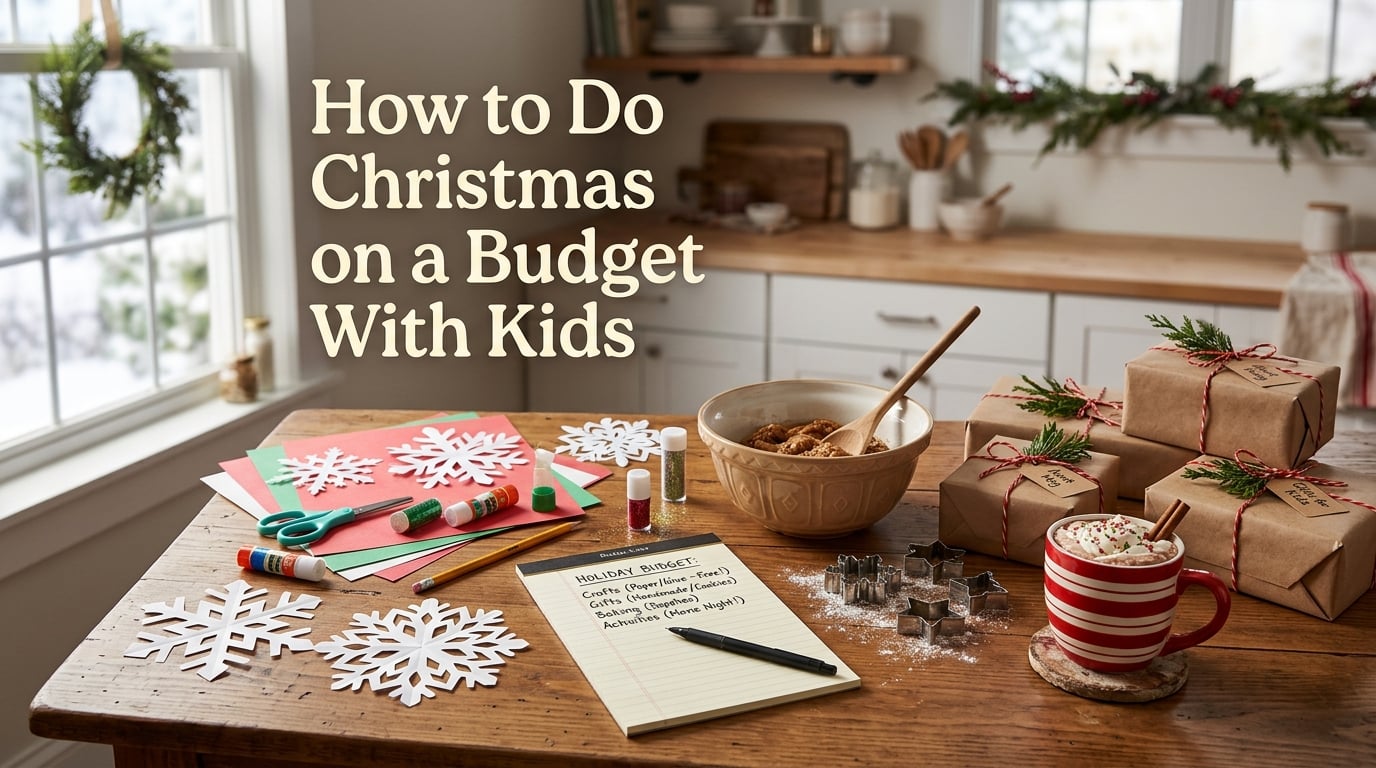
Every December, the same five bills arrive at once: the tree, the food, the decorations, the gifts, and whatever travel or outings the family has agreed to. On top of that sits the quiet pressure that everyone else will be doing more, which is the real reason most families overspend. Learning how to do Christmas on a budget with kids is not about spoiling the holiday. It is about deciding, in advance and on paper, exactly what the holiday costs, then building a full and warm December around that number.
Families who do this well are not the ones who buy less at random. They set one total, convert it into a per-child cap, apply a gift-count rule so the money spreads over a known number of items, and fill the remaining weeks with free traditions that carry no cost at all. That is the whole method, and it takes about an hour to set up. Here is how to do Christmas on a budget with kids, step by step, with the gift rules, the shopping places, the traditions and the Edmonton-area free stuff included.
Updated for 2026 — this guide is written for Canadian families, with Edmonton and Alberta specifics in the traditions and events sections.
Table of Contents
- What Is a Reasonable Christmas Budget for Kids?
- How to Build Your Christmas Budget in Four Steps
- Gift-Count Rules That Make Budgeting Easy
- Where Edmonton Families Buy Cheap
- Free Christmas Traditions and Activities for Kids
- Christmas Gifts by Age: Toddler to Teen
- How to Set Limits With Extended Family
- Cutting Christmas Food and Christmas Morning Costs
- Free Christmas Events in Edmonton and Alberta
- Your December Order-of-Operations Plan
- Frequently Asked Questions
- What is a reasonable Christmas budget for kids?
- What is the 7 Christmas rule?
- What is the 5 gift rule for Christmas kids?
- How to have a cheap Christmas with kids?
- How much does the average parent spend on their kids for Christmas?
- Is a few hundred dollars per kid a lot for Christmas?
- What is a good budget for Christmas gifts for kids?
- What are some ideas for a frugal Christmas?
- Conclusion
What Is a Reasonable Christmas Budget for Kids?
A reasonable Christmas budget for kids is one number, set before December starts, that you divide by the number of people on your list. There is no magic figure, because your income, your family size and your December commitments all differ, but there is a structure. Most families who succeed set a total, subtract the fixed commitments, and give what remains a per-child cap that they do not talk themselves out of.
Here is how to allocate a typical family Christmas total across the five categories that quietly eat the money:
- Gifts for kids: 40 to 50 percent of the total. This is the only category most families control easily, so it absorbs the savings.
- Gifts for adults, extended family and friends: 10 to 15 percent. Secret Santa and Yankee Swap cut this fastest.
- Food and groceries: 20 to 25 percent, including the Christmas morning meal.
- Decorations, tree and cards: 5 to 10 percent. Reusing what you already own usually makes this near zero.
- Activities, outings and travel: 5 to 10 percent. Free local events do most of the work here.
Work the percentage backwards from what you can genuinely pay without touching credit. If your total comes out lower than these percentages suggest, protect the food and the free traditions and trim the gift categories hardest, because the traditions are what your children actually remember. I have run this same split for our own family in 2026 and the version that worked was a gift cap, a drawn-names adult exchange, and a food total written on the fridge before the grocery run.
If you have never set a number at all, a first-year benchmark many families land on is roughly the amount of one month of take-home pay for the whole holiday, gifts for everyone included. Treat that as a starting point for conversation with yourself, not a rule, and adjust it for your own debt, your savings and the size of your list.
How to Build Your Christmas Budget in Four Steps
Do this before you buy a single decoration, ideally in late November, so the plan exists before the spending does.
Step 1: Set the total, in writing
Write one number on a sheet of paper. Not a range, not an estimate, one number. Put it somewhere you will see it daily. The reason most budgets fail is that the total lives in your head, where it flexes every time a nice thing appears.
Step 2: Subtract everything already committed
Before you can divide anything, remove the money that is spoken for: school fees, December bills, the tree, a hosting commitment, a trip already booked, or a credit card payment you are behind on. Whatever survives that subtraction is your true Christmas number. This is also the step where a family that was over-gifted last year quietly resets, because the previous leftovers still show up in that subtraction.
Step 3: Divide by the number of people on your list
Count every child, adult, teacher, neighbour and exchange partner. Divide the remainder by that count and you have a per-person cap that is real. Write the cap on the back of the sheet and tape it inside a kitchen cupboard door. When you shop, take the cap with you physically or leave it in your phone notes, because a cap you carry is a cap you keep.
Step 4: Apply a gift-count rule
A cap with no limit on quantity is meaningless, because the number of small items floats up to fill it. Pair your per-person cap with a fixed number of gifts and the shopping becomes predictable. A family of four with a modest total can plan four gifts per child, and a family with a very tight total can plan one big gift, and both plans finish in the same week with money unspent.
Do the whole plan in one sitting, then put the sheet away. Revisiting the budget every few days is how the number quietly grows.
Gift-Count Rules That Make Budgeting Easy
These rules exist so that adults get the decision made for them. Once the count is agreed, the arguing stops, because the number is a rule rather than a preference.
The four gifts rule
One want, one need, one item of clothing, one book. Four items per child, every year, no exceptions for the youngest. It is the simplest rule to enforce and the easiest to explain to a child who is used to a pile.
The five gift rule
Four categories plus one wild card, which can be anything the child picks. The wild card is what makes this rule work with kids who reject category-based shopping, because it gives them genuine control over one item.
The seven Christmas rule
Seven gifts total per person, which may include small filler items but not seven large ones. It is looser than the four or five gift rules, so it suits school-age kids and teenagers who would find four gifts insulting. Set it as a hard ceiling across all gifts, not seven gifts per category.
One big gift instead of many small ones
A single item that keeps going after December is the strongest budget move available. The best versions are not toys: a membership, a bike, a season pass, art supplies that refill, or a set of tools. Just verify the thing is a size or interest the child actually has, because a big miss costs more than a pile of small hits.
Secret Santa with a cap
Draw names among adults only. Agree on a fixed amount in advance and treat it as a ceiling, not a target. Adults who would spend far more will buy for themselves all year instead, which is the pressure valve that makes this rule work.
White Elephant and Yankee Swap
Everyone brings one item with a value cap, and the rules are usually silly on purpose, which is part of the fun. The advantage for your budget is that you buy one item instead of twelve, and a genuinely good swap can end up being something your own household needed anyway.
A buy-nothing exchange
For families already stretched, the exchange can be homemade consumables only: a cookie and candy-making kit with the recipe and ingredients, a craft or sewing kit, a bath salt set, or a small jar of homemade hot cocoa mix. Parent forum threads on doing Christmas when the kids already have too much settled on exactly this idea, and the comments leaned hard toward kits, ingredients and experiences over objects.
Where Edmonton Families Buy Cheap
Ordering matters more than most people expect. The same item costs very different amounts depending on when and where you buy it, and stacking two frugal habits is where the real savings show up.
Year-end clearance, first
Anything you can buy after December 20 is cheaper than the same thing bought in early November. Decorations, wrapping, cards, ornaments and even some toys drop hard once the holiday retail peak passes. If your family celebrates on the 25th, the shopping-after strategy requires storing items somewhere dry until then, which is worth it for the discount depth.
Dollar stores for the small stuff
Dollarama, Dollar Tree and Five Below cover the small-filler layer, the wrapping supplies, the stocking equivalents, the craft bases and the baking ingredients. Buy the filler here and save your real money for the one meaningful gift per child.
Thrift and consignment stores
Secondhand is the right place for the durable, non-size-specific items: board games, building sets, outdoor toys, craft supplies and books that do not wear out. Christmas decorations, ornaments and wrapping paper are also widely available secondhand. For anything that must fit, check the sizing carefully, because a coat that does not fit is not a saving.
Kijiji and Facebook Marketplace
Both are strong for single-use or big-ticket items, and even stronger for nothing at all if you are willing to post an ISO-style request. Bicycles, riding gear, camping equipment, hockey gear and tools are all common finds. Set up alerts so you see a listing before the good ones go, and remember that meeting at a public place is the safer option for you and your children.
Buy-nothing groups and freecycle
Local Buy Nothing groups post wanted posts, and many people will reply with a free item that has simply outgrown their house. This is a legitimate way to fill a stocking or complete a small need, and it costs nothing but a message.
Your library card
This is the most under-used free resource in any Canadian family Christmas. A library card gives children access to free streaming services, e-books, audiobooks, large-print titles and free passes to museums and partner attractions. Several Alberta library systems run free December craft programs and children story times, which are free, warm and a good way to spend an afternoon.
A note on secondhand toy hygiene
For anything that goes in a mouth, that touches a child who is teething, or that arrives without its original packaging, wipe it down with a dilute vinegar solution or soapy water before it is used, and skip the item entirely if the packaging was missing and the surface is cracked or stained. Car seats and cribs are the two categories we would never buy secondhand.
Free Christmas Traditions and Activities for Kids
Each of these has a cost label so you can plan honestly. Free really is free, and the pennies items use what you already own.
- Christmas lights tour. Cost: free, aside from gas. Load the kids into the car after dark, pick one route, and let them call out the best window. This is the single most requested tradition in every family Christmas round-up we have read.
- Advent calendar made from craft supplies. Cost: pennies, using leftover paper scraps. Number twenty-four small envelopes or cards, hide a free activity in each, and let the family open them together.
- Cookie decorating night. Cost: one grocery trip. Make the dough together, then let the kids do the decorating and eat the evidence. Freeze half the dough so a December baking emergency is already solved.
- Homemade hot cocoa bar. Cost: pennies from the pantry. Put cocoa, cinnamon, and candy in small jars on a counter and let everyone build their own mug.
- Popcorn garland. Cost: pennies. Old-fashioned, edible, and it doubles as a tree decoration that gets eaten.
- Breakfast in bed. Cost: whatever breakfast already costs. It replaces the expensive Santa photo outing with something the kids remember longer.
- Gingerbread house from a kit. Cost: modest, or free if you use the graham cracker version with icing as mortar. Large cardboard boxes make excellent indoor play forts for the same week.
- Family Christmas movie marathon. Cost: free if you use your library’s streaming access, or a bring-one-movie-each round if friends are involved.
- Read a stack of Christmas books by candlelight. Cost: free from the library. The quietest tradition on this list and often the one children rank highest when they are older.
- Handmade ornaments from household materials. Cost: free. Paper snowflakes, painted cardstock, cinnamon-stick stars and pinecone shapes made from what the yard or a walk gives you.
- Santa parade on the sidewalk. Cost: free. Kids in pyjamas, a torch or string lights, and a neighbour to walk with. It is the same feeling as a mall visit at a fraction of it.
- Christmas mystery box. Cost: pennies. Fill a shoebox with cheap sensory-bin items and let them unpack it on Christmas morning.
- Community caroling. Cost: free. Ask a street or a walking group whether they want a caroling round, and sing at a few doors. Adults get the benefit too.
- Family Christmas pickle. Cost: free. A pickle hidden somewhere on Christmas morning, found before the presents are opened. Absurd, cheap, and reliably remembered years later.
The pattern across all fourteen is that the value comes from participation, not purchase. That is also what the Reddit family conversations in this space keep circling back to: parents say the traditions their kids remember were the ones that cost nothing at all.
Christmas Gifts by Age: Toddler to Teen
Age matters more than price, because the same budget buys very different things. A toddler is not short-changed by a small toy and a full day; a teenager reads a gift list as a judgement.
- Toddlers and preschoolers: open-ended play things, bubbles, a blanket, dress-up clothes, wooden items, and a membership. Skip battery-heavy sets and skip anything with dozens of small parts, which get outgrown in weeks.
- School-age kids: board games, a craft or science kit, a bike or riding gear, books, and consumables like a cocoa or cookie kit. These age well and cost less than the toy versions of the same idea.
- Tweens and teens: experiences over objects. A movie night pass, a coffee shop gift card they can take a friend to, a hobby refill, a small piece of gear, or cash toward something they have named themselves.
If a child already has too much, the guidance that comes up again and again in parent forums is to shift the entire gift list toward consumables, experiences and memberships for the year. That keeps the holiday feeling generous while adding nothing to the toy volume.
How to Set Limits With Extended Family
This is usually the hardest part of a frugal Christmas, and it is a social problem, not a money problem. The approach that works is to set the limit before the conversation, keep it short, and frame it as a family-wide change rather than a personal shortage.
The script for switching to drawn names: “We are doing drawn names for the adults this year, and we are putting a fixed amount in. Nothing about you or your gift changes, we just stopped buying for fifteen people.” Short, factual, no apology. You do not have to explain your finances to anyone.
The script for a buy-nothing year: “We are trying a homemade-only exchange this year. I will make something for everyone, and I would love to receive something from you, but there is no expectation to buy.” Homemade consumables shift the pressure without anyone losing face.
The script for cash gifts from grandparents: ask them directly, early, to redirect money toward an experience or a membership instead of more objects. Grandparents are often relieved to be given a specific instruction, and it solves the toy-volume problem in one move.
Two rules make this hold. First, tell everyone the same thing, because a rule that only some relatives hear becomes a comparison. Second, lead with the reason rather than the refusal, and let the tone be permission-giving. A smaller Christmas that is described as a choice reads as generous. The same Christmas described as a limitation reads as an apology, and nobody needs another apology in December.
Cutting Christmas Food and Christmas Morning Costs
Food is the second-largest category and the easiest to control without anyone noticing, because nobody compares your groceries to anyone else’s.
- Plan the menu and the list together. Write the full menu first, then the list, then shop once. Most December overspending on food is unplanned trips, not bad choices.
- Move the expensive meal to a different day. Serving a full roast on Christmas Day is a choice, not a rule. A smaller dinner with the big meal hosted on New Year’s evening spreads both the cost and the work.
- Make it a potluck. One host provides the main and everyone else brings a side. The guest list does the price reduction for you.
- Bake from scratch and trade. Baking four dozen cookies with your kids costs a fraction of buying four dozen trays, and it is a tradition rather than a purchase.
- Keep Christmas morning cheap on purpose. A new toy for each child before breakfast feels like a reset, not a saving. Breakfast in bed plus a small surprise in a reused container keeps the morning warm without a second spending event.
Free Christmas Events in Edmonton and Alberta
Edmonton has an unusually large amount of free December programming, and most families never use it. The pattern that works is to check once, then commit the dates to the calendar before the good ones fill.
- Public library December programs. Edmonton Public Library and neighbouring systems run free children craft sessions, story times and family movie afternoons through December. These are usually drop-in or preregistration, and preregistration is the part that fills up first.
- Outdoor rinks and toboggan hills. City and neighbourhood rinks are free, and several Edmonton hills and parks are lit for the season.
- Community and recreation-centre tree lightings. Most Edmonton-area recreation centres hold free holiday events with crafts, a short performance and a visit from something in costume.
- Downtown and neighbourhood light displays. IceUA, the downtown light installations and the residential routes families line up for are all free to view and are the closest thing to a destination without a ticket.
- Window caroling and charity drives. A number of local groups coordinate holiday window performances and toy drives, which give families a free outing that also does something useful.
- Alberta-wide giveaways and passes. Alberta Health and local library partnerships periodically offer free passes and activity kits over the holidays. These are worth watching for in December and they are genuinely free.
Check specific dates with the venue before you plan around them, since holiday programming is set closer to the date than most events. If you are outside Edmonton, your municipal recreation department and your library run the equivalent programs, and the city-decorated streets in your own community work the same way.
Your December Order-of-Operations Plan
Spreading the spending is what makes the budget survivable, and the sequence matters more than the amount.
- Late November: set the total, subtract commitments, divide per person, and agree on the gift-count rule. No shopping yet.
- First week of December: buy consumables and baking ingredients, and check library programming so the free dates get in the calendar.
- Second week: buy the one meaningful gift per child while selection is still good, plus the tree if you need one.
- Third week: wrapping, cards, and a mid-month budget check to confirm you are still inside the cap.
- After the 20th: everything seasonal, including decorations, ornaments, wrapping paper and anything you decided to buy later, drops in price.
If you are ahead of plan in the second week, stop. The most common failure mode in a frugal Christmas is not overspending at the end, it is spending early because the sales felt like a deal.
Frequently Asked Questions
What is a reasonable Christmas budget for kids?
A reasonable budget is one fixed number for the whole holiday, divided by the number of people on your gift list. Many families start by setting a total, subtracting December commitments that are already spoken for, then giving what remains a per-child cap. As a first-year benchmark, roughly one month of take-home pay for the entire holiday, gifts for everyone included, is a common starting point to adjust for your own situation.
What is the 7 Christmas rule?
The seven Christmas rule is a cap of seven gifts per person for the whole holiday, not seven per category. Small filler items count toward the seven. It is looser than the four or five gift rules, so it suits school-age kids and teenagers, and it works best when the family agrees to the number before the shopping starts.
What is the 5 gift rule for Christmas kids?
The five gift rule is four categories plus one wild card: something they want, something they need, something to wear, something to read, and one item they choose themselves. The wild card is what makes the rule workable with children who dislike category shopping, because they still control one item outright.
How to have a cheap Christmas with kids?
Set one total, divide it into per-child caps, apply a gift-count rule, buy secondhand and after the seasonal peak, and fill December with free traditions. The free traditions are what make the holiday feel full rather than reduced, and they are the part children tend to remember as adults.
How much does the average parent spend on their kids for Christmas?
There is no single number, because the honest answer depends on income, family size and December commitments. The useful version is a percentage split of whatever total you can pay: roughly 40 to 50 percent for kids gifts, 10 to 15 percent for adult and extended family gifts, 20 to 25 percent for food, 5 to 10 percent for decorations, and 5 to 10 percent for activities and travel.
Is a few hundred dollars per kid a lot for Christmas?
For many families, yes, especially in a year already carrying debt or a large list. The number that matters is not the amount itself but whether the per-kid figure is the part you chose rather than the part that grew on its own. If your per-kid cap came from a percentage of a total you set deliberately, it is a plan rather than a strain.
What is a good budget for Christmas gifts for kids?
A good budget is a per-child cap paired with a fixed gift count, so the money spreads over a known number of items. For a tighter year, use one big gift that keeps going, such as a membership or hobby gear. For a roomier year, the four, five or seven gift rules keep the shopping predictable and stop the number of small items from filling the cap.
What are some ideas for a frugal Christmas?
Free traditions such as a Christmas lights tour, cookie decorating, breakfast in bed, a homemade hot cocoa bar, a sidewalk Santa parade, library story times and a caroling round cost nothing. On the spending side, drawn names for adults, a cap on the exchange, a buy-nothing homemade exchange, and buying seasonal items after December 20 are the highest-return moves.
Conclusion
To do Christmas on a budget with kids, you need four decisions and nothing else: one total number, a per-child cap derived from it, a gift-count rule that keeps the cap honest, and a December full of free traditions. Set them in late November, buy the meaningful gifts in the first half of the month, buy the seasonal items after the peak, and tell your relatives the new rules before anyone assumes the old ones still apply.
The families who manage this well are not being clever with coupons. They decided in advance what the holiday costs and let the traditions do the emotional work. If you have a number that worked for your family this year, I would genuinely like to read it in the comments, because the honest figures from real households help far more than any general advice.