
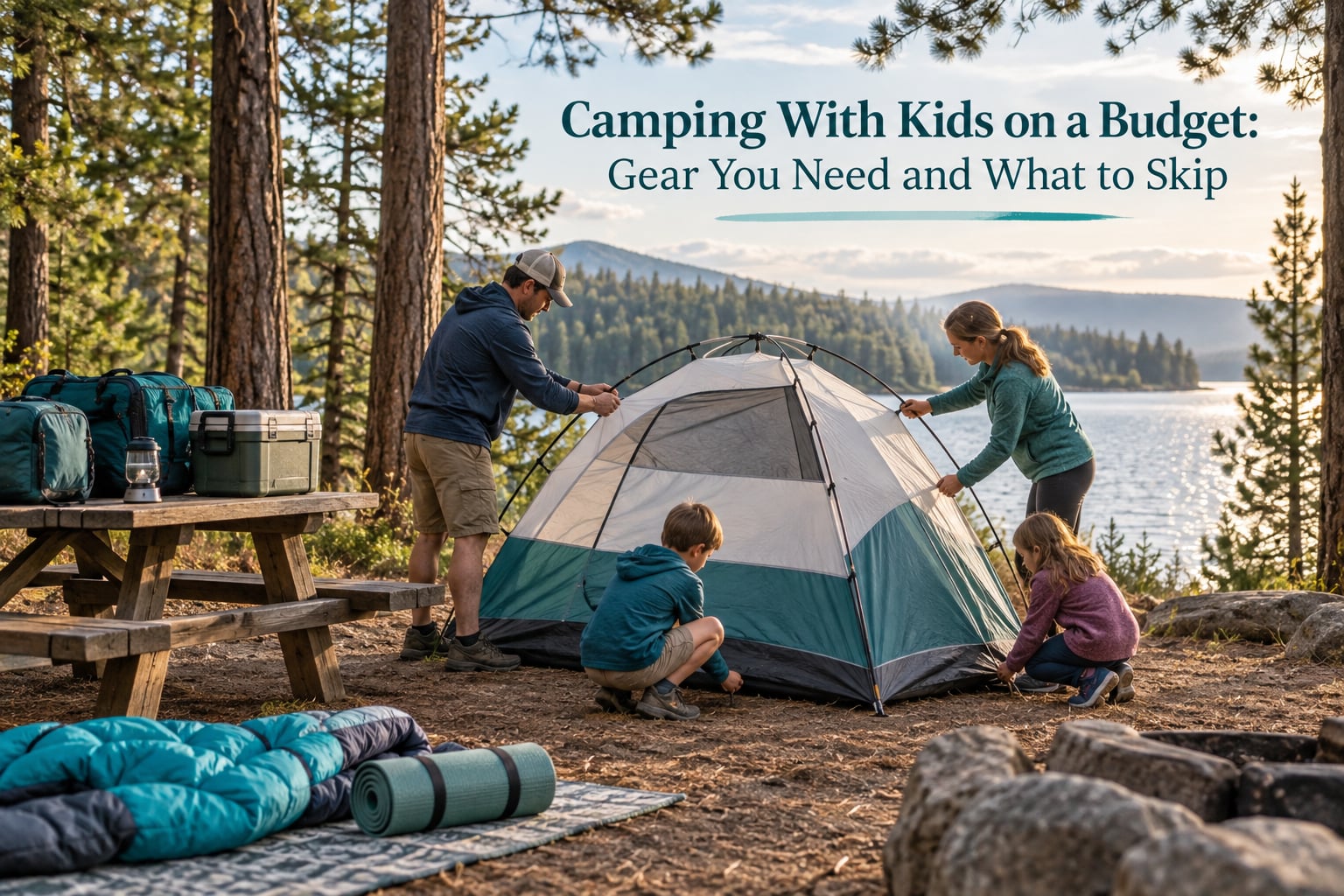
Camping with kids on a budget works in reverse from how most gear lists are written. Instead of starting with a shopping cart, you start with a short list of things that decide whether the trip succeeds, and you actively delete everything else. Families who do this end up with less equipment, a garage that is not overflowing, and money left over for the campsite fee and the groceries that actually make the trip bearable.
The gear that is genuinely non-negotiable for a family is small: shelter you can pitch fast, a real sleeping surface, a kid-appropriate sleeping bag, a way to cook and keep food cold, water, light after dark, and a safety kit. That is the whole list. Everything else is a preference, and preferences are where first-time families lose their budget.
I have watched families spend three times what they needed to on a single trip and then use maybe a third of it for the next three years. In this guide I break the gear into three buckets — spend, save, and skip — with a verdict for every category, a cost breakdown for a first trip, and an age-by-age look at what actually changes for a newborn, a toddler, a school-age kid, and a teen.
The short version: spend on the tent, the kid’s sleeping bag, a real sleeping pad, a stove, and safety gear. Save on pots, coolers, chairs, cots, and lanterns by buying them used or borrowing them. Skip footprints, camping pillows, cast iron, hiking boots, and the urge to buy a tent twice the size you need.
Table of Contents
- Camping With Kids on a Budget: The 10 Non-Negotiables
- Camping Gear to Skip (and What to Use Instead)
- Spend, Save, or Skip: The Verdict for Every Gear Category
- What a First Family Camping Trip Actually Costs
- Kids’ Camping Gear by Age Band
- Sleeping Setup: Why the Pad Matters More Than the Tent
- Cooking on a Budget: One-Pot Meals and Camp Kitchen Basics
- Safety Gear You Should Never Cheap Out On
- Buy Used, Borrow, or Rent?
- Free Things to Do at a Campsite With Kids
- First Night Out: A 30-Minute Setup Routine
- Frequently Asked Questions
- What are the essential camping gear items for a family with kids?
- What are the 7 C’s of camping?
- What is the 200 rule for camping?
- What camping gear is appropriate for a toddler?
- Is it okay to take a 2 year old camping?
- Can you rent camping gear instead of buying it?
- Is buying used camping gear safe?
- What should a toddler wear camping?
- Camping on a Budget Is a Plan, Not a Shopping List
Camping With Kids on a Budget: The 10 Non-Negotiables
These ten items answer the question that parents ask most often, which is what camping gear a family with kids actually needs. If you own all ten, you can camp. If you own four of them, borrow or rent the rest.
- A tent that pitches in under five minutes. Instant or near-instant designs exist because a tent you cannot pitch after dark with a tired toddler is a tent you will dread. Buy the one that goes up fastest, not the one with the most features.
- A tent sized one person larger than your family. Most tents labelled for four people are genuinely comfortable for two adults and a child. Wet gear, wet towels, and a wet car seat take up real floor space.
- A sleeping bag your child can actually get warm in. Kids run colder at night and sleep warmer in a bag than an adult because they are smaller. Buy by comfort rating, not by the cheapest number on the tag.
- A sleeping surface for every person. This is the single most-skipped item and the single biggest cause of ruined trips. A foam pad is fine. A thin inflatable pad is fine. Sleeping directly on the tent floor is not.
- A camp stove with fuel. Cold food and hungry children end trips. A single-burner stove is genuinely enough; two burners are a luxury, not a requirement.
- A cooler and enough food. Budget for the food before you budget the gear. A good day of camping is a feeding operation.
- One headlamp per child plus two spares. Kids wander in the dark and a headlamp is the difference between a child walking back to the tent and a panicked search. Each person gets their own, and the batteries live with the lamp.
- A stocked first aid kit. Blister plasters, antihistamine, any prescription medications, tweezers for ticks, antiseptic, gauze, tape, and painkillers. You can assemble this at home for almost nothing.
- Bug protection that is safe for their age. Different repellents have different minimum ages, and the label is not negotiable. Check it before the trip, not at the trailhead.
- Rain gear for everyone, including the adults. A soaking adult turns into a freezing child within an hour. Cheap rain jackets do this job better than expensive ones.
That is the list. Everything in the rest of this guide is either a way to spend less on these ten, a way to get one of them cheaper, or confirmation that you never needed it at all.
Camping Gear to Skip (and What to Use Instead)
This is the section that saves the most money, because skipped gear is money you never spend. For each item below there is a free or near-free substitute that works just as well for a family trip.
Skip: The tent footprint or ground tarp
For a family car-camping on a normal site, a footprint is not needed. A cut-down cheap shower curtain or a piece of heavy tarp from a hardware store protects a cheap tent floor. If the site is rocky or the ground is wet, put a tarp under the tent, not under the footprint.
Skip: Camping pillows
Every adult should bring the pillow they already own. It weighs nothing in a car, costs nothing extra, and your neck already knows the shape of it. A child who has their own pillow from home will sleep better than a child with a novelty camp pillow.
Skip: Hiking boots
On a drive-up campsite your family is walking at most from the car to the pitch. Sneakers are the right answer. A first camping trip is not a hiking trip, and boots that nobody has broken in are how you end a weekend with a blister on a child.
Skip: Cast iron and camp cookware sets
Cast iron is heavy, takes a long time to heat, and needs care after every use. One pot and one lid from home does the same job. Family camping meals are one-pot meals, so the cookware you already own in your kitchen cabinet is the correct cookware.
Skip: An oversized cooler
More empty volume is just weight you have to lift. Buy a cooler sized to two days of food for your family and nothing larger. If the food does not fit, the answer is eating simpler meals, not buying a bigger box.
Skip: A second tent, a screen room, and every tent accessory
Families upsizing because the label says four is where a lot of budget goes. Pitch the tent you have, count the bodies, and add a cheap square of tarp hung on the picnic table if the kids need shade. Nobody notices a tarp at a provincial park site.
Skip: A tent lantern
A hanging lantern is lovely and unnecessary. A headlamp per person gives you light while walking, working, and using the washroom. One small lantern for the table is a nice-to-have, and it is the last thing to buy.
Skip: The camp chair upgrade
One chair per adult is plenty. Kids are happy on a blanket, on a log, or in a borrowed lawn chair. Every extra camp chair is volume in a vehicle that is already full of wet gear.
Skip: Single-purpose gadgets
Camp shower tents, collapsible basins, propane fire pits, can openers for cans you can open with a pull tab, and hanging organizers all fall in this bucket. Each one is inexpensive, and each one is one more thing to lose.
A note on what not to bring at all: valuables, glass containers, home firewood in areas where it is not permitted, and enough clothing to change outfits for every day. Bring one extra outfit per child and accept that laundry exists.
Spend, Save, or Skip: The Verdict for Every Gear Category
This table is the whole guide compressed into one screen. Spend means buy new and buy well. Save means buy used, borrow, or rent. Skip means you do not need it for a family camping trip at all.
| Gear category | Verdict | Why | Spend level |
|---|---|---|---|
| Tent | Save | Buy a fast-pitch used model rather than a new one you barely use | Medium |
| Sleeping bag for kids | Spend | Buy new, by comfort rating, sized a year or two ahead | High |
| Sleeping pad | Spend | The ground is what ends the trip, not the tent | Medium |
| Camp stove | Spend | Buy new if you can, used if the fuel lines look sound | Medium |
| Cookware | Skip | Use the pot and pan already in your kitchen | None |
| Cooler | Save | Durable, easy to clean, widely available secondhand | Low |
| Headlamp per child | Spend | Non-negotiable, and cheap when bought off-season | Low |
| First aid kit | Spend | Assemble your own and refill it every trip | Low |
| Rain gear | Spend | Cheap gear works; do not skip it | Low |
| Bug repellent | Spend | Age-appropriate products, checked against the label | Low |
| Camp chairs | Save | Borrow or buy used; adults only | Low |
| Camping pillows | Skip | Use the pillows from your own beds | None |
| Tent footprint | Skip | Hardware-store tarp does the same job | None |
| Cast iron | Skip | Heavy, slow, high maintenance | None |
| Hiking boots | Skip | Drive-up sites are not trails | None |
| Car seat | Spend | Never borrow one, never buy past the expiry date | High |
| Entertainment | Skip | Free activities beat anything you buy | None |
What a First Family Camping Trip Actually Costs
The surprise for most families is not the gear. It is that gear is a one-time cost and campsite fees, park passes, and food are recurring costs that arrive every single trip. Families who budget only for the tent end up overspending on the weekend.
Break it into two buckets. The gear bucket is spent once and covers your first three years of trips. The trip bucket repeats every time you go.
Trip bucket: every weekend
- Provincial park pass, if your trip uses one
- Campsite fee for each night, which varies by season, by midweek versus weekend, and by whether you book ahead
- Firewood, where buying it on site is required
- Groceries and ice
- Fuel to drive there and back
Gear bucket: one time only
Most families who follow the spend-save-skip table above can assemble a working kit for a family of four in the low-cost tier, then top up to the comfortable tier over two or three more trips rather than all at once. The spread between those tiers is the honest number: the bare-bones version gets you through one weekend, the comfortable version gets you through a decade.
Two habits cut the recurring bucket fastest. Book midweek nights when you can, which most campgrounds price lower than a Friday or Saturday. And buy your park pass and firewood at the start of the season rather than paying the on-site premium each visit.
One more money decision applies to every trip: a lost or broken item on trip three hurts far more than on trip one. Once you have gear, replace it used where you can and only spend new on the things that failed under load — a kid’s sleeping bag and a sleeping pad are the usual two.
Kids’ Camping Gear by Age Band
Camping with kids on a budget is not one trip, it is four different trips that happen to share a family. What you need changes completely between a newborn and a thirteen-year-old, and the age band is the most useful filter when you are deciding what to buy or borrow.
| Age band | What actually changes | Buy or borrow | What to skip for now |
|---|---|---|---|
| Newborn to 12 months | A safe sleep surface, a way to keep them warm without overheating, a car seat, and a spot for feeding and changing | Car seat (buy new), a bassinet or safe travel cot, a changing pad, a warm sleep sack | Toddler sleeping bags, a high chair for the trail, a wagon you cannot fold |
| 1 to 3 years | The sleep problem becomes the trip. They need their own bed, their own bag, and a comfort object from home | Toddler sleeping bag with a comfort rating, a toddler pad, a headlamp, a white noise machine if they already use one | Anything requiring them to walk far, a hiking carrier, a full camp kitchen |
| 4 to 8 years | They can cook, dress themselves, and entertain themselves for long stretches. Safety kit and clothing matter more than comfort gadgets | Kid sleeping bag, a headlamp of their own, a small hand trowel, a walking stick if they want one | Child-specific furniture, a second cooler, a bike trailer for this trip |
| 9 to 13 years | They can carry their own gear, cook a meal, and camp with friends. They also need a bigger bag and real clothing layers | A sleeping bag sized for a few more years, a real sleeping pad, a proper rain shell, a headlamp | Child-specific anything. An adult item in their size works fine |
The takeaway for a budget is simple. Buy the next band early, because sleeping bags and rain shells are the two items a child genuinely outgrows, and buying them a year or two ahead prevents a second purchase. Everything else in each band can be borrowed for the season and returned.
Sleeping Setup: Why the Pad Matters More Than the Tent
Ask any parent who bailed out of a camping trip early what happened and you will usually hear the same thing: nobody slept. Cold ground pulls heat out of a body all night, and a wet sleeping bag has no recovery. Parents on camping forums consistently say the mattress, not the tent, decided whether the trip was good.
Two numbers matter here, and you need to know both before you buy anything.
Temperature rating. Sleeping bags are labelled with a rating, and the useful one is the comfort rating — the temperature a person can comfortably sleep in, not the survival extreme. For a child, buy the comfort rating and go one tier lower than you think you need. Kids cool down faster than adults in a bag they are swimming in, and a bag that is slightly too warm is a much smaller problem than one that is slightly too cold.
R-value. This measures a sleeping pad’s resistance to heat flowing up from the ground, and it is the number that tells you about cold ground. The higher the R-value, the warmer you stay on a cold surface. A cheap closed-cell foam pad has a low R-value, which is fine in summer and marginal in early spring or late summer nights. That is the trade-off: foam is cheap and indestructible, inflatable is warmer and lighter but can puncture.
For most families the setup that works is one inflatable pad per adult and foam pads for the kids, plus a blanket under a child on a cool night. The blanket under the body is an old trick and it works, because it stops the ground from stealing warmth in the first place.
The last piece is emotional rather than thermal. Put a familiar comfort item into the sleeping bag with your child: the same stuffed animal, the same small blanket, the same pyjamas. Families on forums credit this more than any piece of equipment. An unfamiliar bed in an unfamiliar place is the actual problem, and familiarity solves most of it.
Cooking on a Budget: One-Pot Meals and Camp Kitchen Basics
The cheapest camping food is the food you already eat. Pasta, rice, canned soup, hot dogs, sandwiches, and breakfast items that need a pan and a flame will feed a family for far less than any dedicated camp meal kit, and children eat them because they are not a novelty.
A one-pot meal is the pattern. Chop, toss, boil, eat from the same pot, wash it once. Breakfast can be almost free, which is what makes it the right meal to buy.
- Breakfast: oatmeal, bagels, bananas, nut butter, coffee from a single-burner stove. No cooking beyond boiling water.
- Lunch: sandwiches built at the car, or the leftovers from last night’s one-pot. Eating from the car is not cheating.
- Dinner: one pot, one heat, everything in it. Pasta with jar sauce, rice with canned vegetables, soup from a can plus a can of chickpeas.
Your cooler discipline matters more than your cooler. Pre-chill everything, keep raw food sealed and low, keep anything perishable in the top compartment, and open the cooler as rarely as possible. A full cooler stays cold. A frequently opened one does not.
The one kitchen splurge worth considering is a second burner, and only if you have two adults who both want to cook. Otherwise a single burner and one pot will handle every meal of the trip.
Plan for one more thing than you think you need, which is why the shopping list gets a backup meal. Something in the cooler that requires no flame, no pot, and no energy from anyone. It is the difference between a good evening and a bad one when the stove refuses to light.
Safety Gear You Should Never Cheap Out On
Some gear is not a place to economise, because the failure mode is a child who is cold, lost, sick, or hurt. These are the items where a cheap version is the wrong version.
- A car seat for every child who needs one. Never buy past the expiry date stamped on the seat, never borrow one without knowing the crash history, and never buy a used seat from a stranger. This is the one place in this entire guide where the used market is closed to you.
- One headlamp per child, worn at dusk. Not shared. A child who cannot see at night will move toward whatever light source exists, which is a fire pit, a road, or water.
- A tick tool and a routine. Check every child twice a day, at the neck, behind the ears, waistline, and behind the knees. Ticks attach in tall grass and at the campsite edge, not out on the trail.
- A first aid kit that is refilled before every trip. It is not a purchase, it is a restocking job, and it costs almost nothing.
- Proper footwear and rain layers. Hypothermia in a child starts with wet shoes, not with a dramatic event.
- A whistle per child, and a plan for meeting up. Pick one meeting point at the campsite and say it out loud to every child, every night.
Two rules are worth learning by heart. The 200 rule means storing your food, toiletries, and garbage at least 200 feet from your tent, because food smells carry and bears are better at camping than you are. And on any site where food storage is required, the locker, canister, or hanger is not optional, no matter how peaceful the weekend looked.
Fire rules work the same way. Read the fire ban sign at the site entrance rather than assuming. Many campgrounds switch to a full fire ban mid-stay, and the penalty for ignoring one is losing your site for the rest of the season.
Buy Used, Borrow, or Rent?
Used and borrowed gear is where a first-trip budget gets its breathing room. The catch is that some categories are safe to buy pre-owned and a few are genuinely not, and the difference matters more than the money you save.
Safe to buy used
- Coolers — check the seal and the lid, then disinfect. This is the easiest bargain in the whole category.
- Camp chairs and tables — fabric and aluminium age slowly. Check for bent frames and stripped hinges.
- Cots — simple frames with little to fail.
- Tents — the top of the used market for a reason. Open one in daylight, pitch it in your yard or driveway, and leave it up in rain before you trust it. Smell is your first warning about mould that never fully came out.
- Pots, pans, and camp kitchens — buy the simple stainless ones, not the folding aluminium or non-stick.
Never buy used
- Car seats — history unknown, expiry date unknown, and a failure here is not recoverable.
- Sleeping bags — bed bugs are the reason, and they are famously hard to be certain you have eliminated. If you find one free or nearly free, freeze it before the first use rather than trusting it.
- Stoves with old fuel lines — the lines harden with age. A replacement line is inexpensive and a fuel leak next to a tent is not a thing to gamble on.
- Life jackets — fit and certification cannot be verified from a photograph.
- Water filters and purifiers — the element inside is the product and it degrades whether you can see it or not.
When renting and borrowing make more sense
If you are going on one or two trips and then reassessing, renting is often the right call. The categories people rent most are the ones with the highest sticker price and the lowest resale value: the tent, a large cot, a bear canister if your site requires one, and a full stove-and-cookware kit.
Borrowing wins in a different set of categories, the ones that sit in a cupboard between uses. Ask around for a tent, a cooler, a stove, chairs, and a first aid kit. Most families with school-age children have a garage of exactly this and would rather see it used than resell it for a fraction of what they paid.
For gear you buy new, timing beats hunting. Off-season and end-of-season clears are when tents, pads, and sleeping bags hit their lowest prices of the year, and gear bought in that window is the cheapest gear you will ever buy.
Free Things to Do at a Campsite With Kids
Entertainment is where parents quietly spend money they did not plan to spend, buying things to keep children busy. Almost none of that is necessary, because the campsite itself is the activity and it is free.
- Scavenger hunt by list. Write ten things to find — a feather, a pinecone, a beetle, a specific rock, a Y-shaped stick. Children who are hunting do not complain about boredom.
- Night sky identification. Lie on a blanket and find the Big Dipper. A free app does the work of a telescope for the first few years.
- Water play. The creek, the shore, or a bucket of water with cups and a funnel turns an hour into an afternoon.
- A nature table. Clear a picnic table, set out whatever they collected, and let them sort it. Then talk about what each one is.
- Camp cooking with a role per child. Shelling peas, stirring, counting pieces into the pot. Children eat what they assembled.
- Storytime and a games bag. Cards, a deck of Uno, a notebook, colouring, and a small craft box from home covers the rained-out afternoon.
- Free local knowledge. Rangers run evening programs and fire talks at many sites. It is free, and kids remember it.
The one thing worth doing is reading the site’s rules with your children before you arrive. What they are allowed to ride, how close they can stand to the fire, and where the water ends are the rules that matter, and kids follow rules better when they helped make them.
First Night Out: A 30-Minute Setup Routine
The first hour at a site sets the tone for the whole trip. Families who have a short routine report calmer first nights and fewer midnight wake-ups, because nothing gets discovered for the first time at 2 a.m.
- Pitch in daylight, not after dinner. If the site is booked for a full day, use that daylight. Struggling with poles in the dark is the single most common first-night disaster.
- Test the stove before anyone is hungry. Light it, adjust it, and boil water. Then do it again tomorrow morning without thinking about it.
- Get every child into their own bag dry and comfortable. Fit them to the bag now, in daylight, at the table. Do not save this for bedtime.
- Put the comfort object in the bag before they are asleep. Familiarity, not temperature, is usually what ends a first night.
- Walk the site boundary in daylight. Show them the washroom, the water, the road, and the gathering point they should use if you are separated.
- Do a tick check and set out tomorrow’s clothing before you sit down. Doing it at bedtime is a chore; doing it while you are already standing up is not.
Frequently Asked Questions
What are the essential camping gear items for a family with kids?
Ten items cover almost every family trip: a fast-pitch tent, a sleeping bag per child sized by comfort rating, a sleeping pad for every person, a camp stove with fuel, a cooler and food, a headlamp per child plus spares, a stocked first aid kit, age-appropriate bug repellent, rain gear for everyone, and water. Parents who own these ten can camp comfortably. Anything beyond that list is a preference, not a requirement, and skipping those preferences is where the budget savings come from.
What are the 7 C’s of camping?
The 7 C’s of camping are a memory device for the core principles of responsible outdoor travel: Care for the environment, be Careful with your actions, be Considerate of other visitors, be Clean, be Courteous to the people you meet, minimise your Camping footprint, and follow the Code and Leave No Trace principles set out for the area you are in. It is a framework for behaviour rather than a gear list, and it applies to the campsite exactly as it applies to a trail.
What is the 200 rule for camping?
The 200 rule is a food storage rule: store your food, drinks, toiletries, and any garbage at least 200 feet away from your tent, and never in the same tent. Human and scented food smells travel much further than people expect, and a tent that carries food scent attracts bears, raccoons, and other wildlife. Where a campsite provides a food locker, bear canister, or bear hanger, use it instead, because local rules always override the 200 rule.
What camping gear is appropriate for a toddler?
A toddler needs a sleeping bag with a comfort rating a tier lower than you would guess, a pad they cannot roll off, a headlamp of their own, and a comfort object from home inside the bag. Beyond sleep, they need layers that keep them dry, bug repellent approved for their age, and shoes they can walk in themselves. Skip anything that requires long carries or a walk away from the site. A stroller that folds flat and a carrier for naps are usually more useful than any dedicated camping gadget.
Is it okay to take a 2 year old camping?
Yes, and most families find the first year easier than they expect, because a toddler sleeps well in a bag with a familiar object and has no expectations about the setting. The challenges are the ones that come with any small child: regular breaks for movement, food on demand, and a plan for the moment they refuse to get back into the sleeping bag. Choose a drive-up site so you can return to the car for a break, and keep the first night short and forgiving. Camping with toddlers is more routine management than adventure.
Can you rent camping gear instead of buying it?
Renting makes sense for a first trip or two when you are still deciding whether you will camp at all. The categories people rent most are the ones with the highest price and the lowest resale value: tents, cots, bear canisters where a site requires them, and full stove and cookware kits. Borrow for the items that live in cupboards between trips, like coolers, chairs, and a spare stove. Buy new only the things a child outgrows, such as a sleeping bag and a rain shell, and buy them off-season.
Is buying used camping gear safe?
It depends entirely on the category. Coolers, camp chairs, cots, stainless pots, and tents are commonly bought used if you inspect them, and tents should be pitched and left out in rain before you rely on them. Never buy used car seats, life jackets, water filters, or stoves with hardened fuel lines, and be cautious with sleeping bags because of bed bugs. A used sleeping bag can be frozen before first use as a precaution. When a category involves safety, the savings are not worth the uncertainty.
What should a toddler wear camping?
Layer it, and keep cotton out of the kit. Start with a moisture-wicking base layer, add a fleece or wool mid layer, and finish with a waterproof shell and waterproof footwear. Cotton stays wet, which is the main reason children get cold at a campsite. Bring one full extra outfit per child, choose clothes they can put on themselves, and add a warm hat and gloves even in summer, because campsite temperatures drop overnight. A sleep sack over their own pyjamas usually works better than a full change at bedtime.
Camping on a Budget Is a Plan, Not a Shopping List
Camping with kids on a budget comes down to two decisions. The first is which ten items you will not compromise on: the tent, the kid’s sleeping bag, a real sleeping surface, a stove, and the safety kit. The second is everything else, which you will buy used, borrow, rent, or simply not buy at all.
Start smaller than feels complete. Get the ten non-negotiables, run one trip, see what actually broke or got left behind, and fill only those gaps before the next one. That approach costs less, wastes nothing, and stops the cycle of buying gear for a version of camping you have not tried yet.
One last thing, since it is the piece most first-timers miss: this guide was written for the 2026 season, and rules at campgrounds change. Check the specific site’s fire bans, food storage requirements, and site fees before you leave, because they are the three things that cost you the most when you get them wrong.