
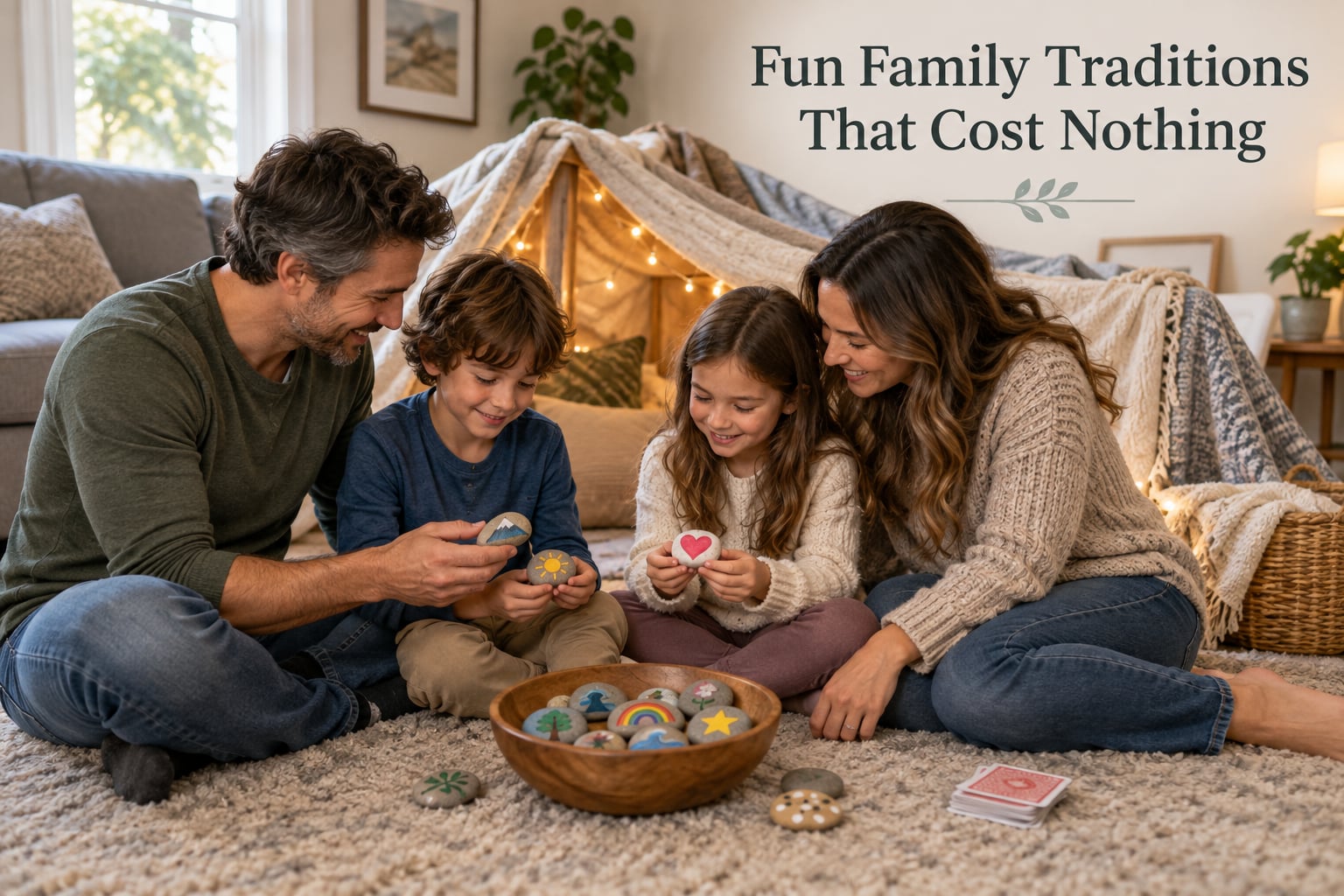
A family tradition is a small ritual you repeat on purpose, on a predictable day, until it becomes part of how your family sees itself. Fun family traditions that cost nothing are not the compromise version of the real thing. They are the real thing. Not one idea on this list needs a purchase, a reservation or a membership.
My own family runs on three of these. We eat breakfast for dinner on Sundays, rotated through French toast, egg pancakes and plain waffles. We do a check-in at the dinner table where each person shares one thing from their day and everyone else gets exactly one question. In February, we tape notes on the front door describing each family member, one word a day, until Valentine’s Day. None of them cost a cent. All three are the things my kids bring up years later.
Below are 30 of them, organized by season so you can find the one that fits the month you are actually in. If you only read one section, read the one for right now.
Five to start tonight: the dinner check-in, breakfast for dinner, a secret handshake, story stones picked out on a walk, and a weekly family meeting that takes fifteen minutes.
Table of Contents
- What “Costs Nothing” Actually Means Here
- How to Start a Family Tradition in 4 Steps
- Daily and Weekly Traditions That Cost Nothing
- Spring Traditions That Cost Nothing
- Summer Traditions That Cost Nothing
- Fall Traditions That Cost Nothing
- Winter and Holiday Traditions That Cost Nothing
- Tradition, Cost, Best Season and Best Age at a Glance
- Free Family Traditions in Edmonton and Alberta
- Quirky and Silly Family Traditions That Cost Nothing
- What Free Traditions Actually Teach Your Kids
- How to Adapt Traditions for Different Family Shapes
- What to Do When a Tradition Fizzles
- Frequently Asked Questions
- What are 5 examples of family traditions?
- What are some fun family traditions I can start tonight?
- What are some fun holiday traditions I can start with my family?
- What to do with family that doesn’t cost money?
- What are some quirky family traditions?
- What are some good family traditions to start with my kids?
- How do you keep a tradition going as kids get older?
- What are some fun activities for the whole family?
- Start Tonight With One Thing
What “Costs Nothing” Actually Means Here
Zero dollars means zero dollars. No craft supplies, no admission fees, no new ingredients you have to buy for a special occasion. Everything below runs on things you already own: your kitchen, your living room, your street, your neighbourhood, and the time you already spend together.
One thing worth naming: kitchen ingredients you normally buy count. If you would have made pancakes on a Tuesday anyway, making them on Sunday instead of buying a treat costs nothing. That is the honest test for every idea on this list.
A tradition is also not the same thing as a routine, though the two overlap. A routine is a habit, like brushing teeth before bed. A tradition carries a little meaning, and it usually marks something: a day of the week, a season, a person, a transition. Sunday dinner is a routine until the kids start helping set the table without being asked. Then it becomes a tradition.
How to Start a Family Tradition in 4 Steps
Step 1: Pick something that takes under 15 minutes. The most common reason traditions fizzle is that the first version is too big. Nobody survives a three-hour craft night in November. Start small enough that you would do it on your worst night of the month.
Step 2: Attach it to a fixed anchor. A day, a date, or a trigger. Second Sunday of the month. The first snowfall. The day before school starts. Anchors are what separate a tradition from a nice idea you had once.
Step 3: Tell the kids it is a thing now. Say the words out loud: “This is our Saturday morning thing.” Kids treat what is announced as custom far more seriously than what is quietly done for years.
Step 4: Run it three times, then decide. Three is long enough to know it works and short enough that you are not stuck. If it did not stick, you are not failing. You are editing.
Readers on What to Expect and Reddit’s r/family keep circling the same point in different words: traditions only survive if they are yours. A tradition copied perfectly from someone else’s family is a project. Adapt it.
Daily and Weekly Traditions That Cost Nothing
1. The Dinner Check-In
Every person, adults included, shares one thing from their day. Everyone else gets one question. No cross-examining, no advice, no lecturing. Cost: nothing. It takes about five minutes and it is the single most useful habit on this page, because it teaches kids that their day is interesting to other people.
2. Breakfast for Dinner
Sunday evening, pancakes, waffles or egg pancakes, at the table instead of the couch in front of a screen. Rotate who picks the meal so nobody is stuck with it forever. Cost: nothing, using what you would have bought anyway. The upside is that Saturday night’s screen pressure quietly disappears.
3. The Secret Handshake or Signature Move
Invent one ridiculous handshake, shoulder pat, or slow-motion high five. Practise it until it looks fake. Cost: nothing, it takes about thirty seconds. Small kids learn to read social cues from it, and older kids will absolutely use it against you in public, which is the point.
4. Show and Tell Night
Everyone brings one object to the table and tells the story of where it came from. A rock. A ticket stub. A tool. No explaining homework, just the object. Cost: nothing, because the objects are already in the house. This one quietly builds storytelling skills that transfer straight to writing assignments.
5. The Fort of the Month
One evening a month, the whole family builds a sleeping structure out of chairs, blankets and whatever else qualifies. Cost: nothing, you already own the blankets. What gets built matters far less than who built it, and a fort built once will be rebuilt unprompted for years.
6. Story Stones
Go for a walk, collect five interesting stones, paint a simple dot or stripe on each with a marker you own, toss them in a bowl. Draw one each week and tell a story about it together. Cost: nothing beyond paint. The rule that keeps it working: no one critiques anybody’s story, ever.
7. The Screen-Free Hour
One hour a week where every device is in a basket in another room. No substitution, no “just this one show.” Cost: nothing. It is the tradition parents notice most in retrospect, because the boredom that fills the first three weeks is exactly the creativity you were hoping to see.
8. Yes Day
One day a month the kids get a say in dinner, the evening plan and one rule of the house. Parents still hold safety lines, everything else is negotiable. Cost: nothing. It teaches decision-making by handing over real decisions instead of pretend ones.
9. The Fifteen-Minute Family Meeting
Same time, same spot, three items on a list: one thing going well, one thing that needs fixing, one thing everybody is looking forward to. Cost: nothing. Fifteen minutes is the ceiling. When families drift, this is the tradition that gets them back on track faster than anything else here.
Spring Traditions That Cost Nothing
10. The First Bloom Walk
The first warm weekend, walk the same route and look for the first flowers, buds or returning birds. Same route every year, so the changes are what you notice. Cost: nothing. After a few years this becomes a running record of your children’s ages without a single photo taken.
11. Spring Cleaning Relay
One Saturday in May, everyone gets a zone and a timer. Music on, ten minutes per zone, rotate. Cost: nothing, the supplies are already in the closet. The cleaning gets done, but the real result is that kids learn what a home is made of and how much work hides in it.
12. Sidewalk Chalk Survey
Each family member writes a question on the sidewalk, such as best hot dog in the city or worst chore. The next family answers it. Cost: nothing beyond a chalk stick you already bought. Photograph it before the rain. Over a few years you have an accidental record of how your kids’ answers change.
13. The Seed Swap
Everyone digs out last year’s seeds, divides them, and swaps with a neighbour, grandparent or cousin. Cost: nothing. Even kids who never touched soil become curious about where food comes from, and a packet of beans will grow on a windowsill for free.
14. Neighbourhood Nature Bingo
Make a quick grid on scrap paper: a bird, a spiderweb, a leaf bigger than your hand, a neighbour’s dog, something you have never noticed before. Walk the same blocks and fill squares. Cost: nothing. It turns an ordinary walk into a scavenger hunt without a single printed sheet.
Summer Traditions That Cost Nothing
15. The Longest Day Photo
Same spot, same camera position, every June. Everyone stands in the same spot. You will end up with a strip of images showing your children growing in one frame, and no studio, no props, no printing bill. Cost: nothing, unless you want to print them years later.
16. Sprinkler Evening
One hot evening a week, hoses out, sprinkler on, running in whatever you are wearing. Cost: nothing, the water is already there. The rule is no devices outside. It is the cheapest way I have found to exhaust children before bedtime.
17. Outdoor Cinema on a Sheet
Blanket, chairs from the garage, a projector you own or a laptop against a wall after dark. Popcorn made in a pot. Cost: nothing if you already own the gear. It is the tradition most often mistaken for expensive, and it works every single time.
18. Night Sky Week
One week each summer where the lights go off early and you look up. No app, no telescope, no audio tour. The Canadian northern sky gives you a lot for free. Cost: nothing, other than the electricity you were not using anyway.
19. The Letter to Your Summer Self
On the last weekend of summer, each person writes a note and seals it. Open it the following June. Cost: nothing, paper and pen. This one ages well, because kids get genuinely emotional reading a note from eleven-year-old self.
Fall Traditions That Cost Nothing
20. First Day of School Breakfast
Something better than the usual cereal, made by whoever is awake earliest, with the kids choosing the menu the night before. Cost: nothing, you are using the breakfast you would have bought. The predictability of this one matters more than the food, especially for kids who dread September.
21. The Gratitude Jar
A jar on the counter, slips of scrap paper folded in every night with one good thing from the day. Read them all out on the last Sunday of the month. Cost: nothing. If the jar is looking thin, the notes are too big. Make them smaller.
22. The Leaf Colour Hunt
Pick a Saturday in October, walk the same trail or park, and each person collects one fallen leaf. Press them in a heavy book, write the date and the place on the front. Cost: nothing. A few years of these become a real record of local seasons changing.
23. Anniversary Family Day
Whatever the date your family marks, kids and adults do something together that week. For us it is the same meal and a walk the kids plan entirely. Cost: nothing. Milestone markers are one of the traditions every scraped competitor listed, and one of the cheapest.
24. Light Parade Night
Every household in the street puts a light in the window or a paper lantern on the porch, then everyone walks the block. Cost: nothing, a candle or a window light covers it. It is the one tradition here that makes strangers in your neighbourhood into your family’s audience.
Winter and Holiday Traditions That Cost Nothing
25. The Secret Kindness Month
December, everyone is assigned one person they do something kind for without being seen. Anonymously written notes, a washed car, a quietly refilled snack drawer. Cost: nothing. It arrives on a Reddit r/family thread as an annual birthday tradition for a grandparent, and it works in any month of the year.
26. Door Notes for Valentine’s Day
From February first, one description per person taped to the front door. Warm and exacting in turn. A word a day means roughly 26 notes and a household that is significantly more visible to the neighbours than it was on February first. Cost: nothing, scrap paper and tape.
27. New Year Do-Over
Instead of resolutions nobody reads, the family picks three things in January and checks in in June. Three, not ten, because three is the number that survives a real February. Cost: nothing. The mid-year check-in is the part that makes it a tradition instead of a joke.
28. The Snow Day Rule
When school closes, there is a short list of daytime things that do not involve screens: fort building, baking, sorting, a long walk, reading aloud to each other. It is not a schedule, it is permission. Cost: nothing. Parents tell me the list is what makes the first morning of a snow day survivable.
29. The Family Recipe Hour
Once a month, a relative teaches one dish from memory, written down nowhere. Kids chop, adults narrate, everyone eats the slightly wrong version. Cost: nothing, ingredients you would cook anyway. Ask for the version with the handwriting mistakes in it, because that is the one that ends up in the box.
30. The Wrapping Paper Door Prank
Cover a bedroom door in wrapping paper so an unexpected guest appears to have broken in before breakfast. Cost: nothing if you saved the paper, near-nothing if you buy a roll. The knock and the reactions are the entire tradition, and the recycled paper year is funnier to everyone but the person holding the scissors.
Tradition, Cost, Best Season and Best Age at a Glance
Here is the short version. Every cost line says nothing, because that is the entire premise.
- Dinner check-in — Nothing. Any season. All ages.
- Breakfast for dinner — Nothing beyond kitchen staples. Winter. Ages 3 and up.
- Secret handshake — Nothing. Any season. Ages 3 to 10.
- Show and tell — Nothing, objects on hand. Any season. Ages 3 to 9.
- Fort of the month — Nothing beyond blankets you own. Rainy days. Ages 4 to 10.
- Story stones — Nothing beyond paint and a marker. Any season. Ages 4 to 10.
- Screen-free hour — Nothing. Any season. Ages 5 and up.
- First bloom walk — Nothing beyond shoes you own. Spring. All ages.
- Seed swap — Nothing beyond seeds you saved. Spring. Ages 4 and up.
- Longest day photo — Nothing beyond one fixed camera position. Summer. All ages.
- Sprinkler evening — Nothing beyond hose water. Summer. Ages 2 to 9.
- Gratitude jar — Nothing beyond a jar and scrap paper. Fall. Ages 5 and up.
- Secret kindness month — Nothing beyond notes and kindness. Winter. All ages.
- Door notes — Nothing beyond paper and tape. February. All ages.
- Family recipe hour — Nothing beyond food you would buy anyway. Any season. Ages 6 and up.
Free Family Traditions in Edmonton and Alberta
This is the section I get asked for most, and it is the one no competitor has. Edmonton and northern Alberta have an unusual amount of free family programming, and most of it is a tradition waiting to happen because it recurs.
The river valley is a free playground. The North Saskatchewan river valley, the ravines running south of the city, and the many miles of paved and gravel path are free year-round. Pick one loop and walk it monthly. Same loop means your kids notice the same things changing.
Outdoor rinks and tobogganing are free in winter. Community leagues operate outdoor ice rinks through the season, and hills around the city get used until the snow goes. Make the annual first-skate-of-the-year and the first-treat-of-the-year a fixed date.
Edmonton Public Library programs are free with a card. Story times, craft sessions and maker programming run all year, and the card itself is free for residents. This is the easiest recurring free tradition to set up: same branch, same day, same time.
Fort Edmonton Park and the museums run free or reduced days. Both have admission days and evenings where families walk in at no charge. Put the dates on a calendar at the start of the year so you can plan around the school year rather than around the weather.
Minus 20 is free and it is local. The tradition here is the trip, not the shopping. Ride the route, look at the ice sculptures, come home with hot chocolate you made yourself.
Playground circuits. Every neighbourhood has playgrounds most families walk past. Assign one per month, walk there, twenty minutes, home. It is a walkable version of story stones and it costs nothing beyond the walking.
Neighbourhood street parties. Edmonton has active community leagues with long-standing traditions of their own, including parade days and clean-up walks. These run on volunteer energy and are free to join. The kids learn what a neighbourhood is made of by participating in one.
Quirky and Silly Family Traditions That Cost Nothing
Mumsnet and Quora threads asking for quirky traditions all land in the same place: nobody wants elegant, they want the thing the neighbours will hear about.
Re-enact a family photo. Print nothing, look at an old picture, and recreate it exactly with the same faces. Cost: nothing.
Family theme nights. Each person picks a theme for one evening: pyjama night, cowboy night, backwards night where everyone speaks a word at a time until they get stuck. Cost: nothing but the clothes already in the closet.
Whisper challenge dinner. Communicate an entire dinner conversation in whispers only. It fails loudly and often, which is the entire joke. Cost: nothing.
The worst song on purpose. Everyone picks the song they like least and the family has to sing it all the way through together. Cost: nothing, and it becomes more irritating every year, which is the charm.
Remake a movie scene with whatever is in the room. Cost: nothing, kitchen utensils count as props.
The silent breakfast. No talking for the first fifteen minutes. Cost: nothing. It feels impossible for a week and then it becomes the calmest part of your morning.
Draw blind. Everyone draws the same object at the same time without looking at anyone else’s paper. Cost: nothing beyond paper you already have. Kids notice how differently four people picture the same snowflake.
What Free Traditions Actually Teach Your Kids
Parents ask me for the justification, and it is a fair question. A tradition is not entertainment, it is repetition, and repetition is what shapes a child.
Belonging. Rituals mark who is part of this family. Kids read repeated behaviour far more accurately than they read stated values, so a family that eats together on Sundays tells its children something true.
Emotional vocabulary. The dinner check-in works because each person has to find a word for an experience. Hard, proud, disappointed, surprised. That vocabulary shows up later in every form of self-expression.
Gratitude as a practice, not a lesson. A gratitude jar only works when the notes are small. When the good thing is something tiny, the habit of noticing becomes automatic, and nobody has to remind the kids.
Resilience and tolerance for disappointment. The family recipe that comes out slightly wrong every year, the show and tell nobody finds impressive, the snow day where the plan falls through. Kids learn traditions are not performances, and that is a genuinely useful thing to learn young.
Family history. The recipe hour, the anniversary day and the photo tradition each add one line to the story a family tells about itself. That story is the thing children carry into their own homes eventually.
Time perception. A child who measures their life in traditions can describe their childhood. A child whose childhood is a sequence of purchased outings cannot.
How to Adapt Traditions for Different Family Shapes
Blended and two-household families. Keep the ritual and change the location. If game night does not work in one house, hold the same game night in both on alternating weeks. Announce the same words in both houses. The announcement is what carries across.
Large families. Rotate a small job to each child so everyone gets a turn at the thing that matters, such as choosing breakfast. Add name-based rituals, one word for each person on the door, which scale easily and make each child visible.
Single-parent households. Lower the ceremony and keep the date. A tradition that survived a hard season is one that worked, not one that was too ambitious. Never let the size of the tradition measure the size of the family.
Teens. Hand over the planning. Let the teen choose the outing, the meal or the game for one occurrence a month. The tradition stays, the authority moves, and you get to find out what they would have chosen anyway.
Neurodivergent kids. Predictability is the whole benefit. Keep the anchor date fixed, announce changes early, and let a ritual be predictable rather than exciting. A routine that holds steady through a hard month is doing its job even when the mood around it is not.
Grieving families. Pick the tradition that keeps the person’s place at the table, such as setting a place, lighting a candle, or telling their one story on a specific day. Do not stop the ritual. Adjust the ritual. The quote I keep coming back to from the What to Expect community is that traditions are how you keep someone in the room.
Grandparents and extended family. Give them a defined role, not just an invitation. One telephone ritual, one monthly visit, one story that only they know. Adults get excluded from traditions the moment the kids get school-age, and it happens quietly.
What to Do When a Tradition Fizzles
Traditions fail constantly, and treating failure as a character flaw is the fastest way to end up with none.
Run it three times, then judge it honestly. Ask whether the failure is the idea or the week it landed in. A tradition that died because of a rough month is usually worth reviving.
Shrink it before you retire it. Most fizzled traditions were not bad ideas, they were bad sizes. A weekly family meeting that fails often becomes a monthly one that works for years.
Know when to let it go without guilt. If it has run three years and nobody is upset when you skip it, it has done its work. The goal was never a permanent record. The goal was the years you had it.
Start a new one the same day you stop the old one. A tradition swap is a good Sunday project, and you do not need a reason to start a new one.
Frequently Asked Questions
What are 5 examples of family traditions?
Five free family traditions you can start this week: the dinner check-in, where each person shares one thing from the day and everyone asks one question; breakfast for dinner on Sundays using kitchen staples; a secret handshake practised until it looks fake; show and tell with one object from the house; and story stones painted on a walk and used for a weekly drawing prompt. All five cost nothing.
What are some fun family traditions I can start tonight?
The ones that work on day one are the smallest: the dinner check-in takes five minutes, the secret handshake takes thirty seconds, and the story stones only need a walk to a park and a marker. None of them need preparation, ingredients or equipment you do not already own. Start one, run it three times, then add a second.
What are some fun holiday traditions I can start with my family?
Zero-cost holiday traditions include a December secret kindness month, wrapping paper covering a bedroom door for a surprise visitor, a nightly family recipe taught from memory instead of a cookbook, a new year do-over where the family picks three intentions and revisits them in June, and gratitude slips in a jar read aloud on the last Sunday of the month.
What to do with family that doesn’t cost money?
Use what you already have. Walk the river valley or your neighbourhood on a fixed date, borrow a projector for outdoor cinema, cook a meal that is already on your grocery list, build a fort out of chairs and blankets, or turn story stones into a weekly prompt. In Edmonton, outdoor rinks, public library programs and community league events add free recurring outings.
What are some quirky family traditions?
Quirky and free traditions include recreating an old family photo exactly, silent breakfasts, whisper-only dinners, a family theme night chosen from clothes already in the closet, drawing the same object blind so nobody copies, and picking the worst song anyone owns and singing it all the way through together.
What are some good family traditions to start with my kids?
Start with something that takes under fifteen minutes and attach it to a fixed date, because a tradition without an anchor is just a nice idea. Tell the kids it is a thing now so they treat it as custom, and run it three times before deciding. The dinner check-in and the secret handshake are the two that start the easiest.
How do you keep a tradition going as kids get older?
Change the authority, not the date. Keep the same anchor and hand the planning to the kids as they get older, letting a teenager choose the meal or the outing for one occurrence a month. Traditions that move from parent-led to child-led survive adolescence, because the kids inherited them rather than being assigned them.
What are some fun activities for the whole family?
Fun and free activities for the whole family include fort building, sprinkler evenings, a nature bingo walk made from scrap paper, a shared meal where everyone cooks one thing, a dance party in the living room, and a family meeting that ends with one thing everyone is looking forward to. Pick one and give it a fixed date.
Start Tonight With One Thing
Fun family traditions that cost nothing are not a budget substitute. They work because children remember the ritual and the attention, not the spending. Every idea above runs on your kitchen, your street and a date you chose out loud.
Do not start all of them. Pick the one your family would most likely still be doing in 2026 and start that one. If it survives three tries, you have a tradition, and you can add a second.
If your family already has a tradition, tell me about it in the comments. I read every one, and the best ones never made it onto a list like this.