
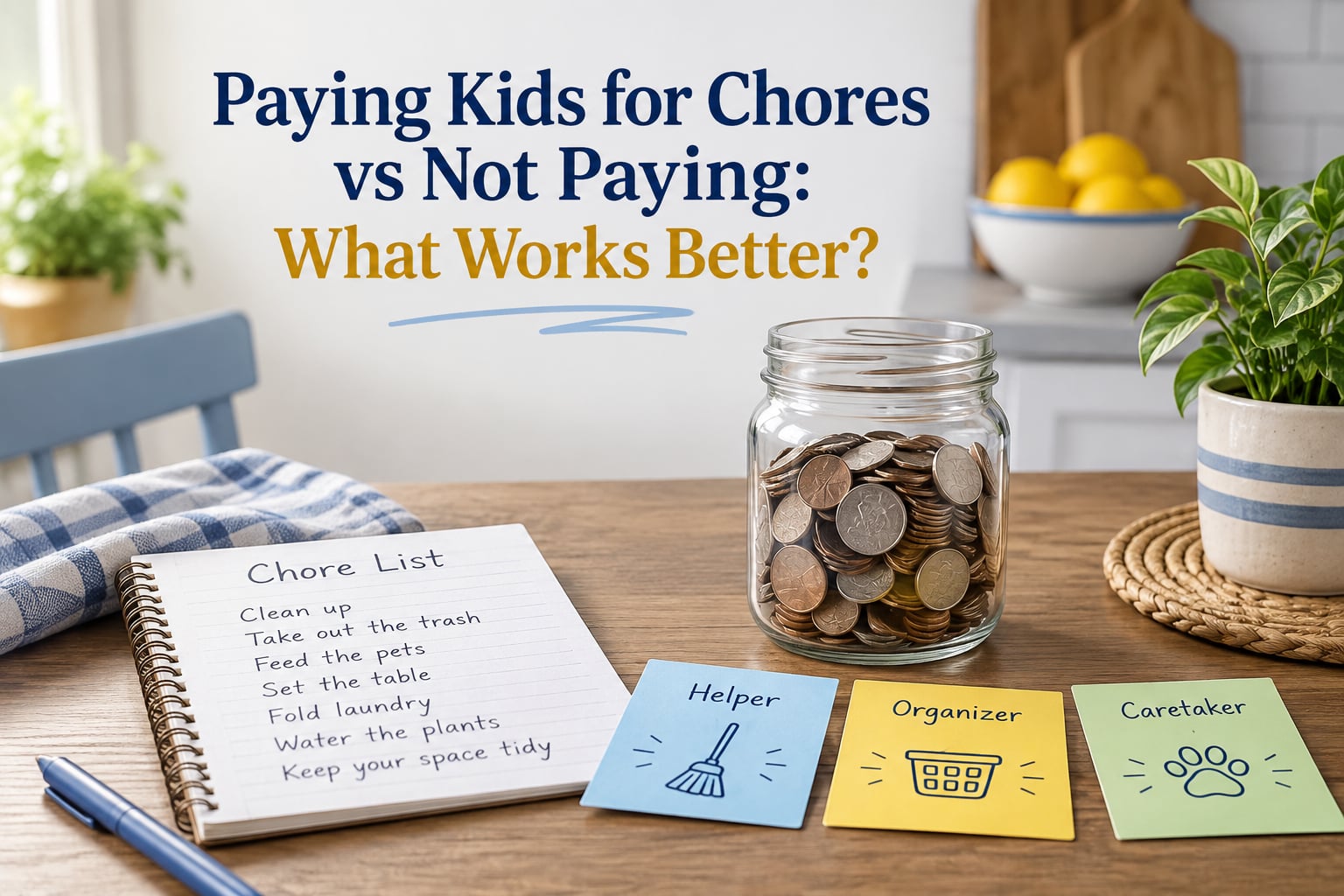
Every week in our house the same argument starts. Someone asks what each chore is worth, someone else asks why a child should be paid for putting their own laundry away, and the rest of us quietly hope the conversation ends before dinner. If you are searching for how to handle pay kids for chores allowance decisions, the honest answer is that most families are mixing two separate systems that were never meant to touch.
They are paying for the wrong things. Household duties that the child benefits from directly are getting a price tag, while real money lessons sit somewhere else entirely. Untangling that is not complicated, but it does take a few firm rules and a small amount of arithmetic nobody wants to sit down and do.
I have watched three families in our circle run this experiment for the past year, and the pattern was remarkably consistent. Families who separated duties from money had calmer homes. Families who tied every task to a payment had children who suddenly had opinions about rates.
Table of Contents
- Should You Pay Your Kids for Chores? The Short Answer
- The Two Systems Explained: Family Responsibility vs Paid Work
- Paid vs Not Paid: A Side-by-Side Comparison
- Why Paying for Basic Chores Backfires
- What Paying for Chores Actually Teaches
- The Middle Path Most Families Should Use
- How Much to Pay: Allowance and Per-Chore Amounts by Age
- When Paying for Chores Is the Right Call
- Free Rewards That Work When Money Does Not Fit
- What to Do When the System Stops Working
- How to Introduce or Change the System at Any Age
- The One-Month Test for Any Paid Chore System
- What This Costs a Family With Three or More Kids
- Frequently Asked Questions
- Should kids be paid an allowance for completing chores?
- Should parents give allowance for chores?
- How much should I pay my kids per chore?
- How much should I pay my daughter to clean my house?
- How much should an 11 year old get paid for doing chores?
- How much can my LLC pay my child?
- What does Dave Ramsey say about kids allowance?
- What is the 7-7-7 rule for parenting?
- At what age should kids start getting an allowance?
- How do I stop my kids from negotiating chore pay?
- Should chores be paid or unpaid for a 6 year old?
- What I Would Do Differently as a Parent
Should You Pay Your Kids for Chores? The Short Answer
Do not pay for your child’s baseline household duties. Those are unpaid because the child lives in the home and benefits from the home. Give a separate flat allowance on a fixed schedule to teach money handling, and pay real rates only for optional extra jobs beyond the required list.
That is the whole verdict. Four rules carry it:
- Baseline duties are unpaid. Their room, their laundry, their dishes, their share of the floors.
- Allowance is not payment for chores. It is a flat teaching amount, given whether or not the week went well.
- Extra jobs get extra money. Yard work, deep cleaning, a garage clear-out, a project with a finish line.
- Rates are set once and reviewed once a year. Never mid-argument.
If you only adopt one thing from this article, adopt rule three. It is where nearly every family who pays actually ends up, and the reasoning behind it is documented in developmental research rather than parenting folklore.
The Two Systems Explained: Family Responsibility vs Paid Work
Most of the confusion comes from using one word for two different ideas. Sorting the vocabulary clears up most household arguments in about five minutes.
Chore vs Job
A chore is a baseline family responsibility. It is non-negotiable, unpaid, and exists because the child is a member of the household. Not doing it brings a natural consequence, such as doing it later or losing a privilege. The test is simple: would you still expect this if the child had a million dollars? If yes, it is a chore.
A job is optional work beyond that list. It has a stated rate, a clear definition of done, and a deadline. The child can decline it without consequence. A well-known parenting post from 2015 recommends renaming chores as family contributions, which sounds fussy but works, because the word contribution carries the idea of belonging rather than billing.
Allowance vs Wage
An allowance is a fixed teaching amount handed over on a schedule, tied to nothing the child does. A wage is payment for a specific completed task. Mixing them is what turns a chore chart into a marketplace. Keep them on two separate lines in your budget and the arguments shrink dramatically.
Paid vs Not Paid: A Side-by-Side Comparison
Both systems have real failure modes, and parents on both sides tend to describe only the other one’s problems. Here is the honest comparison.
| Dimension | Paid-for-chores system | Family-responsibility system |
|---|---|---|
| Source of motivation | External, and the reward has to keep growing | Internal, belonging and contribution |
| What the child learns | That every task has a market price | That the household runs on mutual effort |
| Main failure mode | Negotiation spiral and resentment about rates | Chores get done only under threat of consequence |
| Weekly cost per child | Rises every year with cost of living | None, though it costs your patience |
| Scales to a third child | Poorly, the total becomes the constraint | Fine, the list just gets longer |
| Works best for | Teens, one-off projects, motivated older kids | Children under 10 and most families long term |
| Money skills taught | Direct, hands on, immediate | Indirect, through a separate allowance |
| Easy to reverse later | No, removing pay feels like a punishment | Yes, it is the default state |
Look at the reversibility row. A paid system builds an expectation, and pulling the money out later reads as a demotion. The unpaid system has nothing to unwind, which is why it survives a teenager.
Why Paying for Basic Chores Backfires
The strongest argument against paying for baseline duties is not about spoiled children. It is a well-documented psychological effect called the overjustification effect, described in plain language as follows: when you attach a reward to something a child already does willingly, the reward can replace the reason they were doing it.
Daniel Pink built an entire book, Drive, around this idea, and it is the most cited authority in the anti-pay camp. The practical version is simpler than the research. A child who cleans the kitchen because the family eats in the kitchen was already motivated. Hand over money and the message becomes transactional, and transactional motivation decays when the money stops.
Parents on r/Parenting describe the same thing almost word for word. Once the rate is on the board, the child treats the dishwashing table as a contract and starts asking for a raise, a shorter dishwasher, or a re-negotiated split with a sibling. One parent described paying a flat weekly amount that had nothing to do with task count, precisely to stop the itemization.
The failure mode is not laziness. It is that the child stops doing the task for free, which removes your ability to teach anything when they eventually have a real job. Nobody hires a nineteen year old and pays them a bonus for picking up their own laundry, as one widely shared parenting post put it.
What Paying for Chores Actually Teaches
I would be doing you a disservice if I only gave you the hard no. Paying does teach real things, and for some families those things matter more than a calm kitchen.
Money paid for work is the fastest route to a working understanding of delayed gratification. A child who saves for six weeks to buy something specific learns arithmetic, patience, and the real cost of a want in a way no budget conversation does. Parents who pay also report a steadier sense of fairness, since a visible rate feels more honest than an invisible expectation.
For teens especially, money attached to a completed task teaches negotiation, which is a genuine workplace skill. Some families also rely on external motivation because internal motivation is simply not wired into every child, and no amount of perfect framing fixes a brain that cannot generate its own reason to start.
That is the real case for paying. It is a good reason to pay for work. It is a weak reason to pay for membership in your household.
The Middle Path Most Families Should Use
Here is the system I would set up today, and the one the highest-signal parent forum advice converges on: a fixed list of mandatory unpaid duties, a gate, and then a job board of optional paid extras. The advice that gets the most agreement in those threads is a gate rather than a transaction. If and only if all mandatory chores are done can the child get paid to do more.
Setting up the paid job board in five steps
- Write the baseline list. Every recurring household task that is non-negotiable. Keep it short enough to fit on one page, usually eight to twelve items for an elementary-aged child.
- Set the gate rule. Every baseline task must be done before any paid job is eligible that week. Not partially. All of them.
- List the extra jobs. Only work with a clear finish line. Wash the car, clean the gutters, sort the storage bins, scrub the baseboards, prep a room for guests.
- Post a rate for each job and freeze it. Write the amount next to the job on the card. Do not reprice mid-week.
- Payout on one fixed day. Same day every week, whether the money came from allowance or from jobs. Predictability reduces the number of conversations.
The gate is the part families skip and then regret. Without it, paid jobs compete with required jobs, and a child will protect the paying task and abandon the rest.
Treating it as a real small business
For older kids, you can run the job board like a genuine micro-business and it changes the psychology. Set a rate card, let the child invoice you, pay into a bank account, and at tax time treat the earnings as income the child must declare. Parents who do this say the money stops feeling like a handout and starts feeling like a wage, and the lessons are real ones.
That framing is also why families sometimes register a small business entity for the arrangement. The legal details vary by province and by whether the arrangement is genuinely employment, so check with an accountant before you start calling it a business rather than a chore system.
How Much to Pay: Allowance and Per-Chore Amounts by Age
Nobody in the top search results actually gives numbers, which is why the same question gets asked over and over. These are starting points for Canadian households, not rules. Treat the allowance as a teaching amount you can afford, and set job rates so that a hard week of extra work is worth roughly the same as one week of allowance.
| Age | Weekly allowance | Per extra job | Notes |
|---|---|---|---|
| 4 to 6 | 2 to 4 dollars | Not recommended | Use privileges and outings, not cash |
| 7 to 9 | 5 to 8 dollars | 1 to 2 dollars | Fixed weekly amount, not per task |
| 10 to 12 | 10 to 15 dollars | 3 to 5 dollars | Start teaching a three-part split |
| 13 to 15 | 15 to 25 dollars | 5 to 10 dollars | Job board works well at this age |
| 16 and up | 20 to 40 dollars | 10 to 20 dollars | Lean toward outside work and shift ends |
For an eleven year old specifically, most families land between 10 and 15 dollars a week for allowance, plus a few dollars per extra job. If a seven or eight year old asks what a fair amount is, five to eight dollars a week covers it, and paying it flat rather than per chore avoids the itemization fight entirely.
One more rule that saves a lot of money and grief: set the raise schedule before you need it. The common trigger is a birthday or a new school year, reviewed once a year, in writing, at a time when nobody is tired.
When Paying for Chores Is the Right Call
There are situations where paying for the task itself is the correct decision, and forcing the unpaid model there causes real damage.
Neurodivergent children often cannot locate internal motivation for a task that does not interest them. External, concrete, immediate payment is not a character flaw here, it is the mechanism that gets the job done. Many families pay every task for these kids and lose nothing.
Teens respond to a job board far better than to being told to contribute. The rate can be realistic, the finish line clear, and the negotiation itself becomes practice for a first job.
Families with a genuine labour shortage, a new baby, an elderly parent, or a working parent travelling, may need paid help now rather than in eight years. In that case pay a market-adjacent rate and do not moralize about it.
As for paying a child to clean your whole house, that is a different arrangement and it deserves its own conversation about expectations, hours, and what happens when they lose interest in it.
Free Rewards That Work When Money Does Not Fit
Not every family has spare money in the budget, and a zero-cost system can work very well for young children who have no concept of earning anyway.
- Privilege such as later bedtimes or first pick of the game. Trains follow-through, costs nothing.
- Choice of family dinner for the week. Trains decision-making and negotiating.
- An outing credit redeemable later. Trains saving toward a specific target.
- Screen time tokens banked in a jar. Trains attention to a delayed reward.
- Family decision votes for weekend plans. Trains the idea that contribution earns influence.
Parents report that chores get easier to sell using privileges and outings than using cash once the transactional framing starts to sour. For younger children, that is most of the battle.
What to Do When the System Stops Working
Every system breaks somewhere. These are the four failures that come up most often, with the fix for each.
They ask for a raise
The answer is a calendar, not a conversation. Rates change on a set annual review date, or when responsibilities change materially. Saying that out loud once, calmly, ends the negotiation faster than any reasoning you could provide. Parents who pay report one hard requirement: do not advance, do not rescue, do not pay forward on next week’s job.
A scheduled job collides with sports or a sleepover
This is the most common scheduling problem and nobody addresses it well. Pick a rule in advance. My preference is a grace reschedule with a make-up date, because docking pay for a birthday party teaches that life is punished. Other families prorate, meaning a missed job simply pays less that week. Either works, as long as it is decided before the conflict rather than during it.
One sibling gets paid and another does not
Separate the systems, not the children. If one child is old enough for a job board and a younger one is not, that is an age difference, not a favouritism ruling. Say so explicitly: the younger child’s turn comes when they are older. Comparison between siblings is the fastest way to make money feel like a family ranking.
Chores become a marketplace
If a child is invoicing you for breathing and asking for a raise by Wednesday, the money has overtaken the household. Shrink the job board, move some items back to baseline, or pause paying entirely for a month and let the baseline list run. That month is a useful diagnostic, which brings us to the trial.
How to Introduce or Change the System at Any Age
Starting fresh is easy. Changing an existing arrangement is where parents get stuck, because removing money feels like a betrayal of the old deal.
Starting at four. No money. Two or three tasks and a sticker chart, plus privilege rewards.
Starting at eight. A flat weekly allowance plus a tiny job board of two paid extras.
Starting at thirteen. A full job board with written rates, a gate, and a fixed payout day.
Changing an existing paid system. Announce it as a move up, not a cut. Tell them the new list, explain the reason in one sentence, and let the current week’s rate be honoured in full so nothing already earned is taken away. Then start the new system the following week.
Phasing out. Two sensible off-ramps. The first is age, when the child can earn outside the home. The second is competence, when the baseline list runs without reminders. Pick one date in writing and hold to it, because an off-ramp is what makes a paid system feel like a job rather than a tax.
The One-Month Test for Any Paid Chore System
Before committing to a paid arrangement for a year, run it for four weeks and score it honestly.
- Week one. Baseline only, no money. Note which tasks actually happen without reminders.
- Week two. Add a flat allowance. Do not add job rates yet.
- Week three. Add the job board with frozen rates and the gate rule.
- Week four. Ask the child two questions: would you rather have the money or the job back, and how much did you actually want to work for it this month?
Keep the system if they chose the money and still did the baseline jobs without policing. Change it if you found yourself enforcing the baseline list more than they were maintaining it. That is the only honest measure, and it takes a month instead of a school year.
What This Costs a Family With Three or More Kids
Scale is where paid chore systems break, and it is worth planning for before the third child reaches the age where a job board makes sense. Parents in the forum threads describe the moment a 60 dollar weekly outlay becomes untenable, and that figure assumes modest rates.
Two habits keep it manageable. Cap the total family budget for chore money before you start, then allocate to age bands, so the newest allowance is a small one and the number is known in advance. And count big-ticket jobs separately, because a garage clear-out or a repainted fence is an occasional cost, not a weekly line.
Baselines cost nothing, which is another reason they carry the weight.
Frequently Asked Questions
Should kids be paid an allowance for completing chores?
No, not for baseline household duties. A child’s own room, laundry, dishes, and share of the floors are unpaid because they live in the home. Give a separate flat allowance on a fixed schedule to teach money handling, and pay real rates only for optional extra jobs beyond the required list.
Should parents give allowance for chores?
Yes, an allowance is worth giving, but keep it separate from chores. Allowance is a flat teaching amount given on a schedule whether or not the week went well. Chores are non-negotiable unpaid responsibilities. Chaining the two together is what turns a chore chart into a priced marketplace.
How much should I pay my kids per chore?
For ages 7 to 9, one to two dollars per extra job. For ages 10 to 12, three to five dollars. For teens, five to ten dollars. Set one fixed rate per job, write it on the card, and freeze it. Do not reprice mid-week or the conversation becomes the chore.
How much should I pay my daughter to clean my house?
For a one-off project like a deep clean, quote a flat total rather than an hourly rate, agree on what counts as done, and pay when it is finished. For ongoing weekly house cleaning, treat it as a real job: a set schedule, a stated rate, and honest expectations about how long it should take.
How much should an 11 year old get paid for doing chores?
Most families land between 10 and 15 dollars a week as a flat allowance, plus three to five dollars per extra job beyond the required list. At this age it is also a good time to introduce a three-part split of the money into spending, saving, and giving.
How much can my LLC pay my child?
If the arrangement is genuinely employment, there are payroll and tax obligations, minimum wage and record-keeping rules that apply, and in some provinces rules about family members. Do not assume a business entity makes informal household pay legal. Check with an accountant before you set anything up.
What does Dave Ramsey say about kids allowance?
His usual framework is a simple split rather than a payment-for-performance model. He recommends giving kids money in three parts, some to spend, some to save, and some to give to a charity or cause they choose. The point is teaching handling money, not buying compliance with a chore list.
What is the 7-7-7 rule for parenting?
It is a budgeting rule, not a parenting one. It splits a young person’s money into three parts: 70 percent to spend, 20 percent to save, and 10 percent to give. It is often suggested as a simple first money habit for children, though a 70-20-10 style split is more relevant to adults than to young kids.
At what age should kids start getting an allowance?
Around seven or eight, once a child can reliably complete a short list of baseline tasks. From four to six, skip cash entirely and use privileges, outings, and screen time. Many parents also start around thirteen, when a written job board with fixed rates starts to make sense.
How do I stop my kids from negotiating chore pay?
Set a raise schedule before you need one. Rates change once a year, on a birthday or the start of school, at a time when nobody is tired. Do not advance, do not pay forward, and do not rescue. A fixed calendar ends the negotiation faster than reasoning does.
Should chores be paid or unpaid for a 6 year old?
Unpaid. At six, a child has no working understanding of earning, and paying for baseline tasks risks teaching that contribution is a transaction. Use privileges, an outing credit, or a family dinner vote instead. Start real money closer to seven or eight.
What I Would Do Differently as a Parent
If I were starting over on how to pay kids for chores and allowance decisions, I would keep the baseline list unpaid from the beginning and never hand money to a child under seven. I would set the raise date before the first raise request, and I would run a one-month trial before committing to any paid arrangement for a school year.
Start with the list today. Write down what your child is already expected to do, and leave the money out of it. Everything beyond that list is where paying for chores works, and works well.