
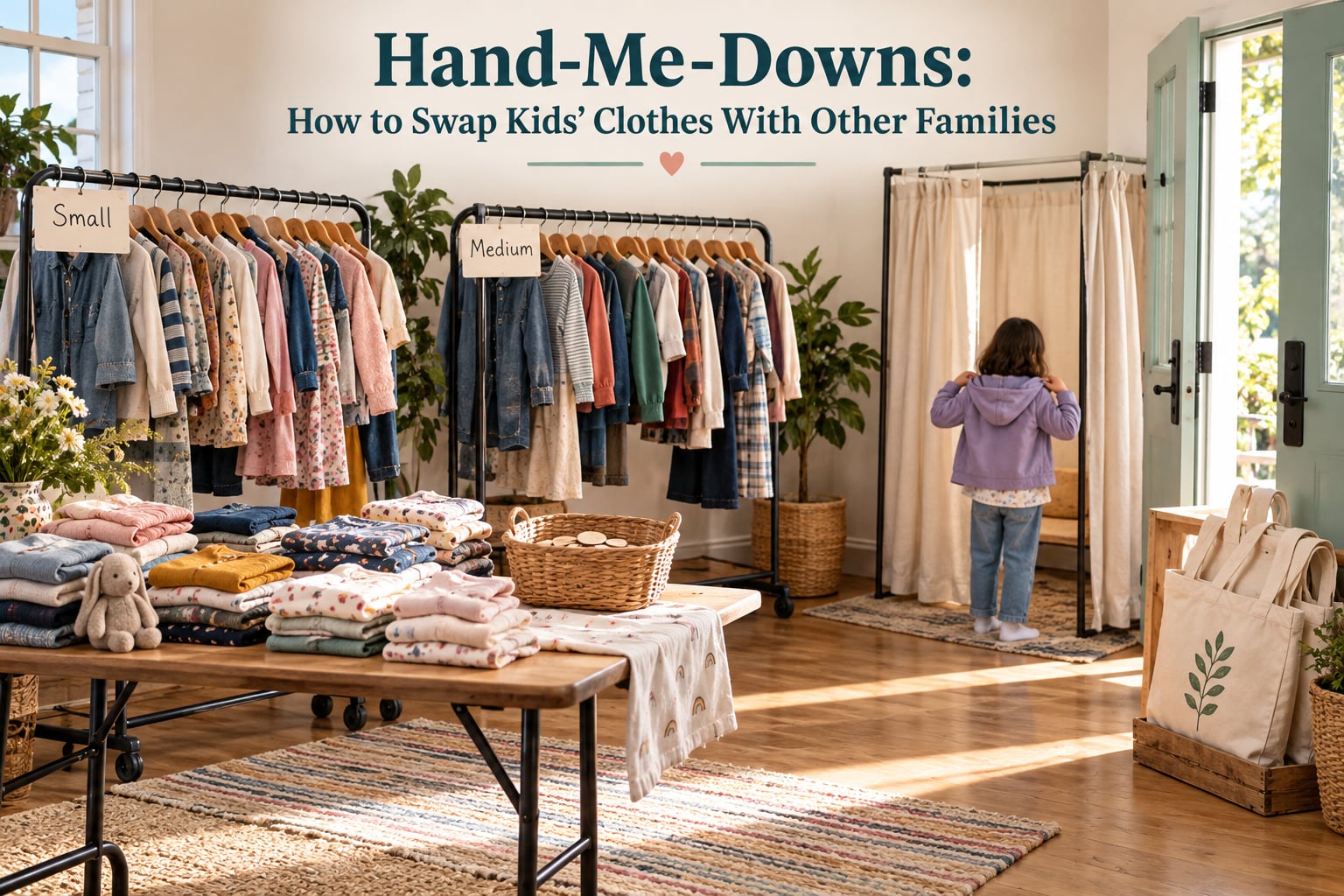
How does a kids’ clothing swap work? Families sort their children’s outgrown clothes, bring a set number of clean, good-condition items, and receive a token or credit for each one. Those tokens are then used to take home an equal value of items in the sizes and season they need. Whatever nobody claims gets donated, gifted or sent for textile recycling.
That is the whole mechanism. The parts that take real work are deciding which format to use, writing rules nobody can argue with, and sorting the bags that come home afterward. This guide covers all three, plus the Edmonton-specific ways to find families who are actually trading clothes rather than just hoarding them.
Table of Contents
- What Is a Kids’ Clothing Swap?
- Why Swapping Beats Buying
- How Does a Kids’ Clothes Swap Actually Work?
- Which Swap Format Fits Your Family?
- Three Ways to Swap: Host an Event, Join a Group, or Trade One-for-One
- How to Find Families to Swap With
- How Often Should You Swap by Age?
- The Rules That Make Swaps Fair
- What to Bring and What to Leave at Home
- Safety First: Recalls, Drawstrings and Sleepwear
- The 8-Week, 4-Week and Event-Week Timeline
- How to Organize Hand-Me-Downs Once They Arrive
- Helping Families Who Have Nothing to Bring
- How to Ask for a Swap or Say No Without Guilt
- Handling the Stigma Around Second-Hand Clothes
- What to Do With Leftover Clothes
- Edmonton and Alberta Swap and Donate Resources
- Your Swap Checklist and Token Tracker
- Frequently Asked Questions
- What are the rules of clothing swaps?
- How does a clothes swap work?
- What to do with your child’s old clothes?
- How do you organize a clothing swap?
- Are clothing swaps safe and sanitary?
- What size clothes should I bring to a swap?
- How many items should each family bring to a clothing swap?
- How to keep track of hand me downs
- What is the 3-3-3 rule for clothes?
- How do I find families to swap kids clothes with near me?
- Conclusion: Start Your First Swap This Season
What Is a Kids’ Clothing Swap?
A kids’ clothing swap is a structured way for families to trade outgrown-but-still-good children’s clothing instead of buying new. It happens at a hosted event, inside a neighbourhood or online group, or one-to-one between two families. Either way, everyone leaves with roughly as much as they brought.
The word that matters is structured. A swap is not the same as giving your neighbour a bag of two-year-old leggings and hoping something comes back. A real swap has a start time, a place, a written rule list, a way to count what you take, and a plan for the leftovers.
Swap vs consignment vs thrift store. At a swap you trade directly with other families and pay nothing. Consignment means you give your clothes to a store and get money when an item sells. A thrift store sells other people’s donated clothes at a fixed price. A swap is the only one of the three where your child’s outgrown leggings might come back to you three sizes up the following year.
Why Swapping Beats Buying
Kids grow out of clothing on a schedule that makes shopping new feel like a treadmill. Between newborn and age seven, most children change size every three to four months. That means a full closet of clothes with a short useful life, replaced again every season.
Researchers compiling secondhand-market data put annual household clothing spend for young children in the range of several hundred dollars, and frugal families routinely report saving four figures a year once swapping replaces retail shopping for the first three years. The number varies enormously by how many children you have and how long their clothes last, which is exactly why swapping lands harder for families with babies and toddlers.
The environmental case is equally well documented. The average person discards roughly 81 pounds of clothing a year, and the fashion industry accounts for a meaningful share of global carbon emissions. Extending the life of a garment by six months is the cheapest reduction available to a household: it requires no new production at all.
There is a fourth benefit that rarely makes the spreadsheets. Parents on r/minimalism describe purging monthly, before children get attached to specific items, and passing those pieces on to younger families rather than dropping them in a donation box. The clothing still goes somewhere it gets worn, which is the outcome they wanted.
How Does a Kids’ Clothes Swap Actually Work?
Here is the full process, from the first purge to the final donation run. Skip to the step that matches your situation: steps one to three matter whether you are hosting or simply participating.
- Purge your own closet first. Pull everything your child has outgrown in the last three months. Set aside anything you would not hand to a friend, because that same rule applies to what you accept.
- Inspect and wash every item. Check seams, zippers, buttons, elastic and stains. Anything failing a basic condition check stays home or goes to textile recycling.
- Count and cap your items. Decide your number before the day arrives. Most small groups use 10 to 20 items per family; a handful of families swapping privately can manage with 5 to 10.
- Sort by size, not by category. Colour-coded size tags on every hanger turn the rack into something a tired parent can read at a glance. Sort outfits together, not by tops and bottoms separately.
- Write the rules down and send them out early. Item caps, exchange ratio, what is not allowed, what happens to leftovers. Rules sent a week ahead prevent ninety percent of swap-day arguments.
- Set up a fitting area and a token table. Tokens, numbered slips or stickers for each item handed in, one exchange slip for each item taken.
- Run the exchange, then hold a short overflow window. Reserving the final fifteen to twenty minutes for people who were slow to browse prevents the frustration of a full rack emptying out early.
- Bag, label and route the leftovers. Anything unclaimed at the end goes to a named charity, a textile recycling point or a local free table. Name the destination in your event rules so nobody is left holding a mystery bin.
Which Swap Format Fits Your Family?
Five formats cover almost every situation. Most successful groups settle on one and stick with it, because switching systems mid-season confuses parents more than any other variable.
| Format | Best for | Pros | Cons |
|---|---|---|---|
| Straight one-for-one trade | Two or three families, one-to-one deals | No equipment, no crowd, no rules to enforce | Only works when sizes overlap |
| Token system | Groups of 10 to 30 families at an event | Fair, self-regulating, easy to explain | Needs tokens, a counting table and a rule cap |
| Curated swap | Groups with a narrow age band or a strong quality bar | Everything is inspected, so quality stays high | Time-consuming to sort beforehand |
| Free-for-all table | Helping families who have nothing to bring | Fast, generous, no tracking needed | Popular sizes vanish in minutes |
| Hybrid | Long-running neighbourhood groups | Tokens for the racks, free table for overflow | Two systems to explain to newcomers |
Groups that add a mending table usually see the most clothing leave the room. A needle, strong thread, spare buttons and a few minutes of volunteer time repairs more items than most hosts expect, and a repaired garment stays in a child’s closet rather than a donation bag.
Three Ways to Swap: Host an Event, Join a Group, or Trade One-for-One
Host an event
You control the rules, the item caps and the leftovers. The cost of failure is higher, because an empty rack reflects on you. Most first-time hosts succeed by inviting three times the number of families they hope will attend.
Join a group or event
The lowest-effort route by far. You bring a bagged, capped, size-sorted contribution and take home what fits. Read the rules before you pack, because some groups prohibit underwear, swimwear and any item missing safety labels.
Trade one-for-one with a single family
The most underrated option. Two families with kids at different stages can often trade perfectly: your 4T winter coat for their 24-month snowsuit. There is no venue, no signage and no leftover problem, because every item is taken.
Parents on r/AusFemaleFashion make a related point that applies to all three routes: make sure at least two people bring the largest size in the group. Nothing kills turnout faster than a parent arriving and finding nothing that fits.
How to Find Families to Swap With
Start where parents already gather. The fastest route to a reliable swap group is a place with a bulletin board and a reason for families to be there.
- School and childcare message boards. A note offering to organize a swap in exchange for a volunteer slot usually gets more replies than expected. Put a tear-off tab on the bottom of every sheet.
- Public library branches. Libraries in this region host craft, story and family programs, and several run seasonal clothing exchanges in meeting rooms. Ask the program coordinator directly.
- Buy Nothing and local gifting groups. These groups are built on the exact behaviour you want: giving away useful things to nearby families. Search for groups covering your neighbourhood and read the recent posts before posting.
- Neighbourhood social groups. Post a concrete offer rather than a general question: which sizes you have, which sizes you need, and what day works.
- Community centres, recreation centres and parent-and-baby groups. Facility rental is usually the only real expense of a hosted swap.
- Your own contacts. A single willing family in your child’s age bracket beats a large group with mismatched sizes.
When you find a partner, vet the clothing before the trade, not after. Ask whether they wash before passing on, whether they keep receipts or tags on anything safety-related, and whether they are willing to photograph recalled items out of the pile.
One warning from swap veterans: a family that brings fifteen items of 24-month clothing and takes fourteen items of 6-year clothing is not a partner. That imbalance is why a written cap and a token count exist.
How Often Should You Swap by Age?
Timing matters more than most hosts expect. Swap too often and you are sorting clothes your child has not outgrown yet. Too rarely and you are hauling a closet of dead weight to every event.
| Age range | Typical size label | How often to swap | Why |
|---|---|---|---|
| 0 to 12 months | Newborn to 12M | Every 6 to 8 weeks | Growth is fastest and least unpredictable in year one |
| 1 to 2 years | 12M to 24M | Every 2 to 3 months | Growth spurts hit without warning |
| 2 to 4 years | 2T to 4T | Every 3 to 4 months | Predictable pace, best time for a season swap |
| 4 to 7 years | 4 to 7 | Seasonally | Growth slows; school and activity gear matters more |
A practical rule: swap when your child can no longer wear the item comfortably for a full week, not when the tag says the wrong size. Brands size inconsistently, and a 4T from one label can fit where another 3T would not.
The Rules That Make Swaps Fair
Rules are the difference between a swap that feels generous and one that feels like a raid. Post them with the invite, not on the day.
Cap the contribution
Ten to twenty items per family for a large event, three to five for a small one. Caps are what keep the racks balanced so every family brings roughly the same amount of value.
Use a token system or a one-for-one rule
Under a one-for-one rule, one item in equals one item out. Under a token system, each item handed in earns a token, and each item taken costs a token. Both work. The token version is more forgiving when sizes are uneven, because a parent can bring twenty items and take twelve in the right size without feeling cheated.
Token math example: a family brings 15 items and receives 15 tokens. A winter coat counts as 3 tokens, a t-shirt counts as 1, so the family can take 15 small pieces or 5 winter coats. The multi-value weighting is optional, but it is what keeps a rack of coats from disappearing in the first ten minutes.
Offer a number-draw alternative
Instead of tokens, families draw a number between one and twenty and take that many items in order. Simpler, no supplies needed, and slightly less flexible when sizes are mismatched.
Ban hoarding explicitly
Write one line: no more than 20 items per family, no more than one pair of shoes, and no returning items to the rack after they are taken. A single family clearing a full rack is the reason small swaps dissolve the following season.
Decide the leftovers in advance
Name the charity, the recycling point or the free table in the rules. Unclaimed clothing that sits in a corner for six months ends up in a landfill bin, which defeats the purpose of the whole exercise.
What to Bring and What to Leave at Home
Parents on swap forums describe the same test again and again: if you would not hand it to your own child, do not bring it. That single rule removes most of the anxiety about condition standards.
Grade what you are bringing before you pack the bag. This table is the one I use.
| Condition | What it looks like | Swap-worthy? |
|---|---|---|
| Like new | Worn once or twice, tags on, no fading | Yes, premium rack |
| Excellent used | No stains, no holes, elastic still firm | Yes, standard rack |
| Good used | Faded or lightly pilled, fully wearable | Yes, discount rack |
| Fair | Visible wear, repaired, still functional | Only at a mending table |
| Damaged | Missing buttons, broken zipper, slack elastic, stains | No, donate or recycle |
Bring: clean clothing in good condition, sorted by size, hung or folded in a labelled bag, with a tag showing the size and any safety information intact.
Leave at home: underwear, swimwear and anything intimate; clothing with strong odours, smoke or pet smell; anything with a missing button or broken zip; single shoes without a pair; items carrying a recall notice; and anything a child has grown out of so fast you suspect it was never truly worn.
Adult clothing, shoes and hard gear are a different matter. Swap events that accept them often create disputes over fit and safety, so most groups exclude them by rule.
Safety First: Recalls, Drawstrings and Sleepwear
Second-hand clothing is not risky when a few specific rules are followed. Parents worry about this more than almost anything else about swapping, and answering it directly settles most of the hesitation.
- Check the federal recall database before the swap. Search the model or brand number for anything with a drawstring hood, cords, or a known issue. A piece that has been recalled stays out of circulation, donated or not.
- Remove or refuse drawstrings and long cords. Neck and waist drawstrings on children’s hoodies and jackets are a documented strangulation hazard. Cut them out or decline the item.
- Read the sleepwear label. Infant sleepwear must carry a flame-resistant label. Sleepwear made for older children is often tight-fitting cotton, and giving a parent a piece without its original label removes their ability to check it.
- Skip anything that swallowed a small part. Snaps, small buttons, bows and detachable decorations that have lost their backing are choking risks. Parents on r/parentsofmultiples describe checking every snap closure on outfits received from other families.
- Exclude car seats, cribs and carriers entirely. These have expiry dates and recall histories that a swap event cannot verify. Buy those new.
- Wash before use, always. Wash in hot water with detergent, dry fully, and never use a garment on a newborn before its first wash.
Sanity check. The worry is almost always about strangers. Swaps with a school, a library program, a family you already know or a neighbourhood group are a different risk profile from an open event in a public hall. Choose your people before you choose your date.
The 8-Week, 4-Week and Event-Week Timeline
Hosts who follow a timeline report calmer events and better turnout. The eight-week version suits a first attempt; the four-week version works once you have done it before.
Eight weeks out
- Decide the date, venue and format.
- Identify two volunteer helpers. Doing this alone is the most common reason swaps fail.
- Choose the age range. A narrow range gives better matches and less leftover clothing.
Four weeks out
- Write the rules, including the item cap, the exchange ratio, the no-hoarding line and the leftover destination.
- Confirm the venue, including tables, hangers, racks and a fitting area with a mirror and a surface for folding.
- Post the invite to school groups, library programs, community centre newsletters and neighbourhood groups.
Two weeks out
- Re-post the invite with the item cap as a specific number. Specific numbers get replies.
- Recruit at least two families with the largest sizes in the group.
- Assemble the token system: stickers or slips, a container per size range, and a written tally sheet.
Event week
- Collect drop-offs in the days before the event if your venue allows it. Pre-sorting is the difference between a smooth rack and a chaos pile.
- Pack the day-of kit: hangers, size labels, tape, markers, laundry bags, a needle and thread, spare buttons, scissors, sanitizing wipes, a sign sheet and a donation bin.
Day of
- Set up racks sorted by size, colour-coded if you can.
- Station one adult at the token table and one at the fitting area.
- Keep the last fifteen to twenty minutes as an open overflow window.
- Bag leftovers with the destination written on the bag before you leave.
How to Organize Hand-Me-Downs Once They Arrive
This is the half of the topic almost every swap guide skips: what happens at home after the bags come through the door. Three families’ worth of mixed-size clothing in one heap is how a swap turns into a second closet you never open.
The fix is a landing spot, one sorting pass, and a per-child bin. A parent in a Facebook decluttering group described one too-small bin per child as the single most useful hand-me-down system she used, and it is the core of this method.
- Give every bag one landing spot. A single laundry basket or a clear bin by the door, not a pile on the bed. Bags from different families go in one at a time.
- Do one pass, not five. Pull everything out and sort into four piles: fits now, fits at next growth spurt, outgrown but good, and damaged. Set a timer for twenty minutes and stop when it rings, even with items left over.
- Hang by outfit, not by item. Hang a shirt with the pants or leggings it is usually worn with. If the recipient returns it later, a parent can hand the whole set on one hanger.
- Fill a too-small bin per child. Label it with the child’s name, a size range and a date. When the next family needs 18-month clothes, the bin is already full and ready to go.
- Wash and put away before you swap the next round. Unwashed hand-me-downs sitting in a bin for six months get donated unwashed, which is how swap reputation suffers.
For tracking, one index card in each bin is enough. Write the source family, the date received, the number of items, and the sizes inside. Parents who receive hand-me-downs from three families report that a simple card per bag prevents the pile-up that comes from trying to remember who gave what.
One more trick: date the too-small bin. Clothes in it are not dead stock, they are inventory waiting for the right month. A dated bin also tells you when to stop and donate, because a bag nobody has claimed in a full year is not going to be claimed.
Helping Families Who Have Nothing to Bring
Some families show up with an empty bag. They have a growing child, no budget and no hand-me-downs to offer, which is exactly the family a swap should be helping.
A free-for-all table at the entrance handles this without complicating the main system. Put it near the door, cover it with a sign that says free, take it out of the token economy entirely, and let it run for the whole event.
Second, never make the contribution cap a test of need. A parent who brings five items instead of twenty has still helped. Third, if you know a family with nothing to bring, pair them with a family whose sizes match their child’s. A sizing buddy makes the whole exchange work when a general group would leave both families disappointed.
How to Ask for a Swap or Say No Without Guilt
Swap etiquette is mostly about making the ask concrete. Vague requests get ignored; specific ones get answered in a day.
Asking to receive: “We have a 20-month-old and our closet is empty for 12 to 24M. I would happily take any clean winter layers, and I have outgrown 4T snow pants and a few dresses to trade. No pressure if you have nothing suitable right now.”
Asking to join an event: “We would love to come to the swap on the 12th. We will bring 12 items, sizes 2T to 4T. Is there a cap we should know about?”
Offering your leftovers as a gift rather than a trade: “These are all clean and sorted by size. Take whatever fits, no need to send anything back.” Removing the obligation is what makes the offer hard to refuse.
Declining kindly: “We are set on clothing right now, but please keep us in mind for the next round, we will need 12M in the fall.” Nobody is offended by this, and the relationship survives, which matters because the next swap depends on it.
Handling the Stigma Around Second-Hand Clothes
Almost every parent who swaps clothes has had the same conversation with an older relative. The objection is rarely about hygiene and almost always about what handing down used clothing says about the family.
Three reframings work better than arguing. The first is the safety argument: swapped clothing has been inspected for drawstrings, recalls and loose parts by another set of parents, which is more checking than most new purchases receive at the till.
The second is quality. Parents on swapping forums note repeatedly that hand-me-down clothing is noticeably softer and better made than newly purchased kids’ clothes, because durable items survive long enough to be passed along and disposable ones do not.
The third is arithmetic. Showing a grandparent the actual cost of a year’s worth of new clothing for a toddler, alongside the size every three months, tends to end the discussion faster than any opinion about thrift.
Then give them a role. A grandparent who sorts and folds at the next swap is usually a convert within one event.
What to Do With Leftover Clothes
Leftovers are normal: expect between 10 and 30 percent of a swap to go unclaimed. Work through these in order.
- Hold it for the next round. Bag it, label the sizes, and store it. A winter swap naturally clears a summer rack and the other way around.
- Gift it directly. Post the bag with photos and sizes to a local giving group, or hand it to a family you know whose child is the right size. This is the option that produces the least landfill.
- Donate it. Only when it is clean, sorted and clearly labelled. Unsorted bags are frequently rejected, so sort before you go.
- Send it for textile recycling. Damaged, worn or unsuitable items belong here rather than in a donation bin. Check your municipality’s accepted-materials list first, because program names and accepted items change.
One rule worth adding to your event plan: never send a donated item to a charity without checking that the charity accepts it. Some refuse unbagged items, worn shoes or anything missing its safety labels, and the pile comes home with you.
Edmonton and Alberta Swap and Donate Resources
Local options change, so verify current schedules and locations before you commit to a date. These are the categories worth checking in this region.
- Buy Nothing groups. The national Buy Nothing network has active local chapters, including around Edmonton. These are the best single source of free clothing for a specific size, because members post items with exact sizes and hand them over within a day or two.
- Library and community centre programs. Branch libraries and recreation centres in the region run seasonal family clothing exchanges, often alongside story time or parent groups. Ask the program coordinator what season is coming up.
- School-based swaps. Several schools run end-of-term exchanges through their parent councils. These are the easiest events to join because the logistics are already handled.
- Donation centres. Large national charities operate drop-off sites in and around Edmonton. Check whether the location accepts clothing, and whether it requires sorted and bagged items.
- Local charities and shelters. Family-oriented charities in the region accept children’s clothing year round and are frequently short during winter. Calling ahead takes two minutes and avoids a wasted trip.
- Textile recycling. Your municipality runs textile recycling programs at designated drop-off points. These take damaged items that no charity will accept, which is where the pile from your damaged bin should go.
Your Swap Checklist and Token Tracker
Print this list before you pack.
- Items washed and dried, no stains or odours
- Sorted by size, tagged with the size written clearly
- Safety labels intact on sleepwear
- No drawstrings, no recalled items, no loose small parts
- Contribution count within the cap
- No underwear or swimwear
- Rules read, venue address and time noted
- Reusable bags for carrying home
- Tally sheet for tokens collected and spent
- Plan for leftovers confirmed before leaving
Worked token tracker: drop-off is 15 items, so 15 tokens go in the jar. Every time a parent takes a coat, subtract 3. Every t-shirt, subtract 1. The volunteer writing the tally keeps one page per size range, and a full page is your cue to start moving the leftovers rather than adding more to the rack.
Frequently Asked Questions
What are the rules of clothing swaps?
The standard rules are: bring a capped number of clean, good-condition items, sorted by size; take home an equal value, either one item for one item or one token per item in and one per item out; and cap how much one family can take so the racks stay balanced. Most groups also ban underwear and swimwear, exclude recalled items and anything missing a safety label, and name a charity or recycling point for leftovers before the event starts.
How does a clothes swap work?
You sort your child’s outgrown clothes, bring a set number of clean, good-condition items, and receive a token or credit for each one. Those tokens are then used to take home an equal value of items in the sizes and season you need. Whatever nobody claims gets donated, gifted to a specific family or sent for textile recycling.
What to do with your child’s old clothes?
Work through four options in order. Hold it for the next seasonal swap, bagged and labelled by size. Gift it directly to a family whose child matches the sizes, which produces the least waste. Donate it to a charity, but only sorted, clean and bagged. Finally, send damaged or unsuitable items for textile recycling, where they still get recovered even though no charity will take them.
How do you organize a clothing swap?
Decide the format first, then the date, venue and age range. Write the rules, including the item cap, exchange ratio, no-hoarding line and leftover destination, and send them out with the invite. Set up racks sorted by size, a token table and a fitting area. Recruit at least two volunteer adults, keep a final overflow window, and bag the leftovers with their destination written on the bag.
Are clothing swaps safe and sanitary?
Swaps are safe when a few specific checks are made. Wash every item in hot water before a child wears it, and keep safety labels on sleepwear so flame resistance can be confirmed. Remove or refuse drawstrings and long cords, check the federal recall database, and reject anything with loose snaps or buttons. Car seats, cribs and carriers should never be swapped, because their expiry and recall status cannot be verified at an event.
What size clothes should I bring to a swap?
Bring the sizes your child has just outgrown, plus one size up if you want the exchange to come back to you later. Babies and toddlers are the easiest to place, so new parents get first pick of the smallest sizes. Parents of school-age children should bring items in the range their child has finished wearing, because those sizes are usually the hardest to move and you would otherwise carry them home again.
How many items should each family bring to a clothing swap?
For a large hosted event, ten to twenty items per family keeps the racks balanced. For a small group of three or four families, five to ten per person is enough. Announce the number in the invite rather than leaving it to the day, because a stated cap is what stops one family from clearing a whole rack while others leave with nothing.
How to keep track of hand me downs
Give every incoming bag a single landing spot, then sort it in one pass into four piles: fits now, fits at the next growth spurt, outgrown but good, and damaged. Label one too-small bin per child with a name and size range, and keep a single index card in each bin recording the source family, the date received and the sizes inside. A dated bin turns a pile of unknown clothes into inventory.
What is the 3-3-3 rule for clothes?
The 3-3-3 rule is a decluttering prompt rather than a formal clothing standard. Keep three of the same item and give away or swap the third, in three categories, and act on it every three months. For children’s clothing it works well because sizes change on roughly that schedule anyway. Adjust the numbers to your household, but keep the review date fixed.
How do I find families to swap kids clothes with near me?
Start where parents already gather: school and childcare message boards, library branch programs, community centre parent groups and neighbourhood social groups. Buy Nothing and local gifting groups are the fastest option, since members post clothing with exact sizes and hand it over within days. Search for a group covering your area, read recent posts, then post which sizes you have and which you need.
Conclusion: Start Your First Swap This Season
Knowing how to swap kids clothes with other families comes down to three things: a written cap, a size-sorted rack, and a system at home for what comes back. None of them are complicated, and all three are what separate a swap that works from a pile of bags that never gets worn.
Start smaller than feels necessary. One family you already know, one bag each, and a straight one-for-one trade will teach you more than a large event you over-planned. Once that feels easy, invite three families with overlapping sizes and add a token count.
Updated for 2026. If you have questions about a specific step, the answer is usually hiding in the rules you wrote before the event, not in the event itself.