
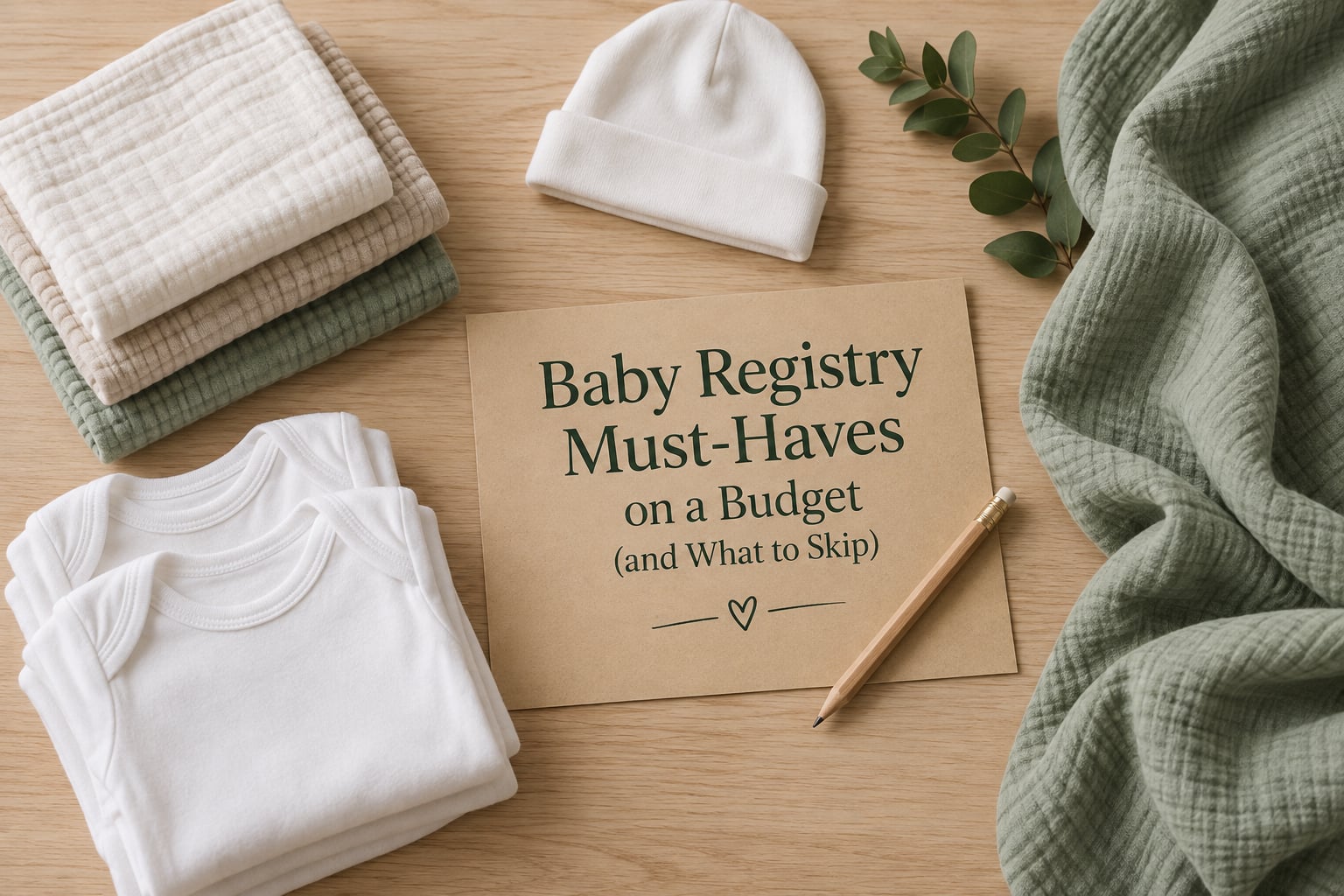
Most expectant parents build a baby registry by copying a wishlist, and then a third of it sits in a closet for three years. This guide breaks the whole list into what genuinely earns a place, what you can skip without feeling guilty, and how to keep the spend on a budget. The short version: the baby registry must-haves are a car seat, a safe sleep space, feeding supplies, a small clothing set, a way to carry your baby, and a handful of health items. Everything else is optional, and a surprising amount of it is a gadget you will use once.
The advice below leans on what new parents actually report back in r/NewParents, r/BabyBumps, r/moderatelygranolamoms, r/Parenting and r/daddit threads, plus long-running discussions on forums.thebump.com and forums.theknot.com where the same items keep landing in the not-needed column. I have read the guides, the price tags and the return windows line by line, and updated everything for 2026.
Two rules run through the whole article. First, the items that keep a baby safe and comfortable are not budget line items and we never cut them. Second, the single-use gadget is the enemy of a budget registry, and that is where the money leaks.
Table of Contents
- The 12 Baby Registry Must-Haves You Actually Need
- Quantities Cheat Sheet: How Many Onesies, Burp Cloths and Bottles
- What to Skip on Your Baby Registry (and Why)
- What New Parents Say They Regret Registering For
- What to Buy Yourself Instead of Registering For
- Second-Hand Baby Gear: What Is Safe and What Must Be New
- Budget Tiers: What a Lean, Mid-Range and Full Registry Looks Like
- Saving Money in Edmonton and Northern Alberta
- Second-Baby and Hand-Me-Down Strategy
- Safe Sleep and Car Seat Safety Items You Should Never Cut
- How to Keep a Full Registry on a Budget
- Baby Registry Timing and Etiquette
- Frequently Asked Questions
- What should I skip on my baby registry?
- What do I absolutely need on my baby registry?
- What items should I mark as most wanted on my baby registry?
- What is the etiquette for baby registries?
- Are there any baby gifts to avoid?
- Is a changing table necessary?
- Do I need a bottle warmer and sterilizer?
- What is the 5-3-3 rule for babies?
- Your Final Baby Registry Checklist
The 12 Baby Registry Must-Haves You Actually Need
A newborn needs twelve things to get through the first three months. Everything past that list is a preference, not a requirement.
- An infant car seat, rear-facing, bought new. It goes in the car before the baby does, and a crash-tested seat with a known history is the one piece of gear that is never a place to save.
- A safe sleep space. A crib or bassinet with a firm, flat, tight-fitting mattress and a fitted sheet. Skip the pillow, the bumper and the quilt.
- A waterproof mattress protector. It is the cheapest insurance on the registry and it protects the one purchase you cannot easily replace.
- Diapers, in a small starter quantity. Buy enough for roughly the first two weeks. Nobody finishes a diaper subscription on a registry.
- Wipes. A big tub, fragrance-free, the kind that do not tear during the first wipe of a newborn.
- Feeding supplies. Either bottles and nipples if you are bottle-feeding or combo-feeding, or nursing essentials if you are not. Register for a small mixed set, not a full set of one brand.
- Three to five bodysuits in newborn size, and three to five in 3-month. Skip everything else. Newborn sizing disappears fast.
- Four to six burp cloths. The workhorse item in the whole registry, and the one people most often undersupply.
- One sleep option. Either swaddles for the newborn stage or sleep sacks once you are past the roll. The 5-3-3 sleep guidance and safe sleep practices both push toward one fitted layer and nothing loose.
- A digital thermometer. Instant-read and easy to clean. Skip temporal forehead models, which parents on the forums report reading inconsistently.
- A nasal aspirator. The Frida Baby NoseFrida comes up again and again in r/NewParents as a genuine buy-it-again item, and it costs less than a single fancy feeding gadget.
- A diaper bag with a portable changing pad. Because you will change that baby on a floor, a picnic blanket and a car seat canopy at some point this year.
Note what is missing. There is no bottle warmer, no sterilizer, no changing table, no diaper pail, no bottle dryer and no baby bouncer, and each of those has a short section explaining why.
Quantities Cheat Sheet: How Many Onesies, Burp Cloths and Bottles
Under-ordering is the more common registry mistake than over-ordering, because you can always buy more at a discount later but you cannot buy back the outfits your baby outgrew unworn. These are the numbers experienced parents in r/BabyBumps threads converge on, not minimums from a retailer.
| Item | Quantity to register for | Why that number |
|---|---|---|
| Newborn bodysuits | 4 to 6 | Outgrown in two to six weeks, and they get gifted back to you |
| 3-month bodysuits | 4 to 6 | The size most babies actually wear the longest |
| 6-month and up outfits | 2 to 3 per size | Wash cycles and accidents happen; two is the floor |
| Burp cloths | 6 to 8 | One in use, one on the shoulder, three in the wash, one for the diaper bag |
| Washcloths | 6 to 8 | Doubles as a burp cloth, a placemat and a spill rag |
| Hooded towels | 1 to 2 | A regular bath towel folds into one that does the same job |
| Crib sheets | 3 to 4 | All crib sheets must be fitted and tight, so spares matter |
| Bottles and nipples | 4 to 6 total | Enough for one full sterilization cycle, across two brands at most |
| Swaddles or sleep sacks | 3 to 4 | They get soaked daily; a rotating set beats a bigger single set |
| Freezer or storage bags | 2 boxes | Storing pumped milk in reusable bags instead of disposable ones pays back in weeks |
| Pacifiers | 2 to 3 | Buy the small newborn size; babies reject a style, not a brand |
| Diaper rash cream | 2 tubes | One lives in the diaper bag permanently, one lives in the house |
One more habit from the forums that saves real money: wait until you have the baby and know the size before you commit to clothing. Register for a gift card toward clothes instead, and buy the clothes yourself once you can measure the baby.
What to Skip on Your Baby Registry (and Why)
These are the items that appear on most registry lists and get used once, never, or not until long after the newborn stage. This is the list the Bump and Knot threads are actually about.
- Bottle warmer. A mug of hot water does the same job for free, and it does not take a counter outlet.
- Wipe warmer. Babies do not notice. A closed container keeps wipes from drying out at room temperature.
- Diaper warmer. You change your baby somewhere else every single time anyway.
- Bottle sterilizer, when you have a dishwasher. A dishwasher basket on the sanitize cycle sterilizes bottles without a separate appliance. A stovetop pot of water works too.
- Diaper pail or diaper genie. A regular bin with a liner and a reusable odor eliminator costs a fraction and looks the same from the doorway.
- Bottle drying rack. A towel on a rack over the sink dries bottles fine. A plastic rack is a one-use-plastic purchase.
- Formula dispenser machines. Parents on the forums overwhelmingly mix formula by hand with a shaker bottle. The machine is a countertop appliance for something you can do accurately in ten seconds.
- Changing table with storage. Parents report buying one and then changing the baby on the floor, a bed, or a rug instead. Put a portable changing pad on a dresser you already own.
- Humidifier with a white noise function combined into a night light. A cool-mist humidifier and a separate sound machine do the same two jobs for less, and the sleep-sound machine is the part you actually keep for years.
- Infant tub with a bathing support insert and a new-born sling. A plastic basin or a wash tub works for the first six months, and most families move to the bathtub by then anyway.
- Plush, lovey, sleep positioner or anything loose in the crib. This is a safe sleep issue, not a budget issue. The crib is empty except for a fitted sheet.
- Newborn-specific bottles before you know the brand. Babies reject a bottle style, not a label. Register for a mixed set of two or three brands, and buy more of the winner later.
- A closet full of gender-specific colours. If there might be a second baby, neutral clothes and nursery pieces get used twice. The data on hand-me-downs value is covered later in this article.
Two more that get asked about constantly: baby shoes, which no newborn wears, and a mobile that would need to hang well out of reach anyway, which makes it a decoration rather than a development toy.
What New Parents Say They Regret Registering For
Across the forum threads, the same five regrets repeat. Parents list unopened bottles of a brand the baby refused, sizing mistakes on clothing, a bath tub used twice, a changing table that became a dresser, and a bottle warmer that lived in a cupboard next to a perfectly good mug.
The regret that comes up most is money spent on a brand before the baby had an opinion. Parents in r/BabyBumps threads describe buying a full set of one bottle brand, then the baby accepting only a different nipple shape from a different company.
The second most common regret is timing. Items bought after the registry was finalized cannot be compared, and the registry completion discount is a much larger discount than the welcome discount, so late additions cost more than the same item added on day one.
A third pattern is gender-specific and colour-matched gear that one family used for a single baby. When we asked ourselves what we would change in our own registries, the answer was simply to register for neutral things and buy the specific colours later.
What to Buy Yourself Instead of Registering For
Some items should not be on a registry at all, and this is the section no competitor writes. Register for what has many sizes, colours and brands, and buy yourself what depends on your body, your baby, or your exact living room.
- Postpartum and nursing items. Nursing bras, maxi pads, postpartum underwear, nipple gel pads and anything sized to you. These are personal, they are often returned, and nobody wants to receive them as a shower gift.
- Your breast pump. Pumps come in flange sizes, and the flange size that fits you is not knowable in advance. Buy it yourself, try it, and let a shower gift go toward something else.
- Clothing in sizes above newborn. Register for a gift card instead, then shop once the baby is here and you know the size and the season.
- Anything in a specific colourway that matches your walls or your existing furniture. Guests cannot know your decor, and neutral versions do not fight with anything.
- The high chair. Most families do not need it until solid food, and the models on the market change constantly. Buy it yourself around the four-to-six month mark.
Here is the mechanic that makes all of this work: keep every box, tag and receipt, and set a calendar reminder before the return window closes. A large number of parents on the forums said the most valuable registry item was the packaging itself, because it turned late purchases and duplicates into store credit rather than clutter.
Second-Hand Baby Gear: What Is Safe and What Must Be New
Second-hand gear is one of the biggest levers in a budget registry, but the safety carve-outs are hard lines. Here is where families consistently draw the line.
| Category | Second-hand? | Why |
|---|---|---|
| Infant car seat and base | Never | Crash history and expiry date are unknown, and both can invalidate the certification |
| Crib, bassinet, pack and play | Never | Safety standards changed after many older units were made; recalls also target specific models and dates |
| Mattress | Never | Must be firm, flat and free of damage, and you cannot verify either through a listing |
| Bottles, nipples, pacifiers, breast pump parts | Never | Hygiene and material integrity cannot be verified |
| Baby monitor, sound machine, humidifier | Only with the manual | Fine if you have the original power adapter and manual, since parts get discontinued |
| Books, board books, bath toys | Yes | Just check for loose buttons and clean them before first use |
| Clothing, burp cloths, blankets | Yes | Wipe clean or wash before use, and skip anything with a strong chemical smell |
| Stroller, carrier, high chair | Yes, with checks | Confirm the model has not been recalled, and check the harness, hinges and fabric for wear |
| Changing table, bouncer, swing | Yes, with checks | Check the recall list and the weight limit, and use the manufacturer manual for the product |
| Breast pump | Only closed system parts, or buy new | Open-system milk that sat in a used motor is a hygiene question, not a budget one |
Before buying anything used, run the model number through the Health Canada recalls database and the manufacturer site. A model name is not enough; recalls attach to specific model numbers and production dates.
Budget Tiers: What a Lean, Mid-Range and Full Registry Looks Like
Every registry should be built as three tiers, not one. This is how you keep a full list while spending less, because the tiering lets you mark the expensive things as most wanted and quietly drop the ones you would only buy anyway.
The lean tier is for a first baby, a tight budget, or a second baby with hand-me-downs. It covers the car seat, the safe sleep space and mattress protector, diapers and wipes for the first two weeks, a small mixed set of bottles, six to eight burp cloths, four to six newborn and 3-month bodysuits, a digital thermometer, a nasal aspirator, a diaper bag with a changing pad, and a carrier. Add diapers and wipes to this tier through a registry rather than as individual gifts, because most people would rather not shop for them.
The mid-range tier adds a sound machine, a proper swaddle and sleep sack set, a changing pad setup on existing furniture, a nursing or bottle-feeding kit with a pumping setup, and a higher-capacity diaper bag. This is the tier most first-time Edmonton families land on after hand-me-downs, and it is the one that still fits on a registry without anyone buying a single expensive gift alone.
The full tier adds a convertible car seat for later stages, a high chair, a baby monitor, a glider rocker or feeding chair, and a bath tub. Mark these as most wanted and most asked for, and let group gifting handle them. A convertible car seat in particular is a poor registry item for a single gift giver and a great group gift, so name it out loud at the shower.
Saving Money in Edmonton and Northern Alberta
Local sourcing is where a budget registry in this region beats a generic national guide. A few habits that work here specifically.
- Consignment shops for clothing and nursery decor. Baby clothing consignment is a strong Edmonton market because of the size churn, and the same store is often buying your outgrown clothes back a year later.
- Second-hand marketplaces for gear, with pickup. Filtering by pickup and current listings keeps you from buying gear that still has to ship, and lets you inspect a crib or stroller in person before you commit.
- Garage and yard sales in the spring. This is peak season for gear parents are still using, and you can inspect and clean on the spot.
- Library of things and equipment lending programs. Babymats, play yards and high chairs are the items most likely to be used for a single stage, which makes them ideal to borrow for a few months rather than buy.
- Buying bottles, wipes and diapers during larger-format sales events. The registry gift card is the better move for these, and the sale price is better for the restocking orders you place after the baby arrives.
One more local habit: join buy groups with other expecting parents. The feed, diaper and sleep items that expire or are outgrown at three months are the easiest things to move on locally, and it turns unused registry gifts into next year’s stuff.
Second-Baby and Hand-Me-Down Strategy
If this is not your first baby, the budget conversation changes completely, because most of your registry is a hand-me-down list. The second-baby version of this article is short: a new car seat if your first has expired or is in a growth stage, a new mattress and mattress protector, new bottles and pump parts, and new clothing in sizes you skipped last time.
Everything else is a resale or hand-me-down question, and we have a whole line on that above. Buy the neutral colourways now for that reason, and register for consumables, because that is the only category that genuinely runs out.
Do not, however, inherit a car seat or a crib just because a family member offers one. That is the one hand-me-down that experienced parents consistently refuse, and we agree with them.
Safe Sleep and Car Seat Safety Items You Should Never Cut
Safe sleep means a firm, flat surface with a tight-fitting fitted sheet and nothing else in the space. No pillows, no bumpers, no loose blankets, no lovey, no positioner, no weighted sleep product, and no inclined sleepers, for any stretch of the first year.
Rear-facing means the child stays facing backward until they reach the maximum height or weight for their particular seat, which is higher than most people expect and is the single most important car seat habit.
A convertible car seat is one that works rear-facing first and forward-facing with a harness later, which makes it the value choice for a second seat instead of buying an infant seat you will outgrow in months.
Check the expiry date printed on every car seat, and treat the manufacture date as the thing to look at, since many seats have a shelf life of roughly six to ten years depending on the model. Never buy a seat with a missing label, and never buy a seat involved in a recall.
The 5-3-3 rule is a widely cited sleep guide rather than a safety standard: it suggests roughly five hours of daytime sleep, spread across about three naps, with wake windows of about three hours once a baby reaches three months. Use it as a guide for pacing, and keep following safe sleep rules, which matter far more than any schedule.
How to Keep a Full Registry on a Budget
These are the free levers. None of them requires giving up a single item you actually need.
- Mark your genuinely expensive items as most wanted. Most asked for on registry platforms refers to what people commonly buy, which is rarely what you need most.
- Keep a short list of twenty items, not sixty. Every extra line is another chance for a duplicate.
- Do not add items after you share the registry. Anything added late is harder to compare, harder to group-fund and outside the completion window for the people who already shopped.
- Use group gifting on the big three. The car seat, the stroller and the monitor are the items that break individual gift budgets.
- Offer a gift card line for consumables. Diapers, wipes, cream and formula are the only category where a gift card is genuinely more useful to you than an object.
- Use the registry completion discount on the restock, not the registry. Plan a first shop a few weeks after the baby arrives, when you know what you are out of.
- Set a return-window reminder and keep every box. The packaging is what turns a mistake into store credit.
Do not strip the registry down to a bare list either. A twelve-item registry is harder to give into than a twenty-item one, because there is no cheap entry point for a guest who wants to spend a small amount on something useful.
Baby Registry Timing and Etiquette
Start your registry somewhere around twelve weeks into the pregnancy, which is early enough to be organized and late enough that you have finished the first round of research. Share the link about a month before your shower rather than in the invitation, and check your gift policy before you add anything you would not want.
A few etiquette rules that prevent most of the friction. Do not register for gift cards to a specific store you love, do not add items you will not use, and do not put anything on the list that is a personal or postpartum item for you.
Tell your guests about group gifting, and if you would rather not manage gifts at all, say so plainly in the invitation. Plenty of parents simply ask for no gifts and a meal instead, and nobody is offended when the request is clear and early.
Frequently Asked Questions
What should I skip on my baby registry?
Skip bottle warmers, wipe warmers, diaper warmers, diaper pails, formula dispensers, bottle drying racks, infant bath inserts, baby shoes, and anything loose in the crib like pillows, bumpers or positioners. A sterilizer, changing table, humidifier and bouncer are optional rather than useless, depending on your kitchen, furniture and stage.
What do I absolutely need on my baby registry?
Twelve items: a new rear-facing infant car seat, a safe sleep space with a firm mattress and fitted sheet, a waterproof mattress protector, a small starter set of diapers, wipes, feeding supplies in a mixed set of brands, three to five newborn and 3-month bodysuits, six to eight burp cloths, a swaddle or sleep sack set, a digital thermometer, a nasal aspirator, and a diaper bag with a portable changing pad.
What items should I mark as most wanted on my baby registry?
Mark the three items that are expensive enough to break an individual gift budget: the car seat, the stroller or travel system, and the baby monitor. Most asked for reflects what guests commonly buy rather than what you need most, so use most wanted for your true big-ticket items and reserve the rest for cheaper entry points like clothing, bath items and gift cards.
What is the etiquette for baby registries?
Start the registry around twelve weeks, share the link about a month before the shower, and keep the list short and genuinely needed. Do not register for gift cards to a store you prefer, avoid postpartum and nursing items on the list, tell guests about group gifting, and state clearly if you would prefer no gifts and a meal instead.
Are there any baby gifts to avoid?
Avoid anything used or opened, anything with missing parts or manuals, any car seat or crib with an unknown history or an unknown expiry date, and anything with a strong chemical smell. If a gift is not something you listed, most parents prefer a gift receipt to returning it, so make your policy clear in the invitation.
Is a changing table necessary?
No. Parents frequently buy one and never use it, because diapers get changed on the floor, a bed or a rug. A portable changing pad on a dresser you already own covers the same need for a fraction of the cost and takes up no floor space in a small room.
Do I need a bottle warmer and sterilizer?
Usually not. A mug of hot water warms a bottle as well as any appliance, and a dishwasher basket on the sanitize cycle or a pot of water on the stove sterilizes bottles. Buy a sterilizer only if you are washing bottles by hand and do not have a dishwasher.
What is the 5-3-3 rule for babies?
It is a widely cited sleep pacing guide, roughly five hours of daytime sleep across about three naps, with wake windows of about three hours once a baby reaches three months. It is not a safety standard, so keep following safe sleep practices, which matter much more than any schedule.
Your Final Baby Registry Checklist
Here is the whole thing in one line of reasoning. The baby registry must-haves are the car seat, the safe sleep space, the mattress protector, diapers and wipes, feeding supplies, a small set of clothing, burp cloths, a sleep option, a thermometer, a nasal aspirator and a diaper bag, and you buy the rest of what you need yourself with second-hand gear and the return windows on your side.
What to skip is a short list with one rule behind it: if the item performs a single task, a mug, a towel or a pot of water does the same job for nothing. What you must never skip is small: the car seat, the crib and the mattress are bought new, and the sleep space stays empty.
The next step is thirty minutes, not a weekend. Open your registry, delete every item you cannot justify in one sentence, add the twelve must-haves with the quantities from the cheat sheet, mark your three big-ticket pieces as most wanted, and share the link about a month before your shower. Then set the return-window reminder and keep every box.