
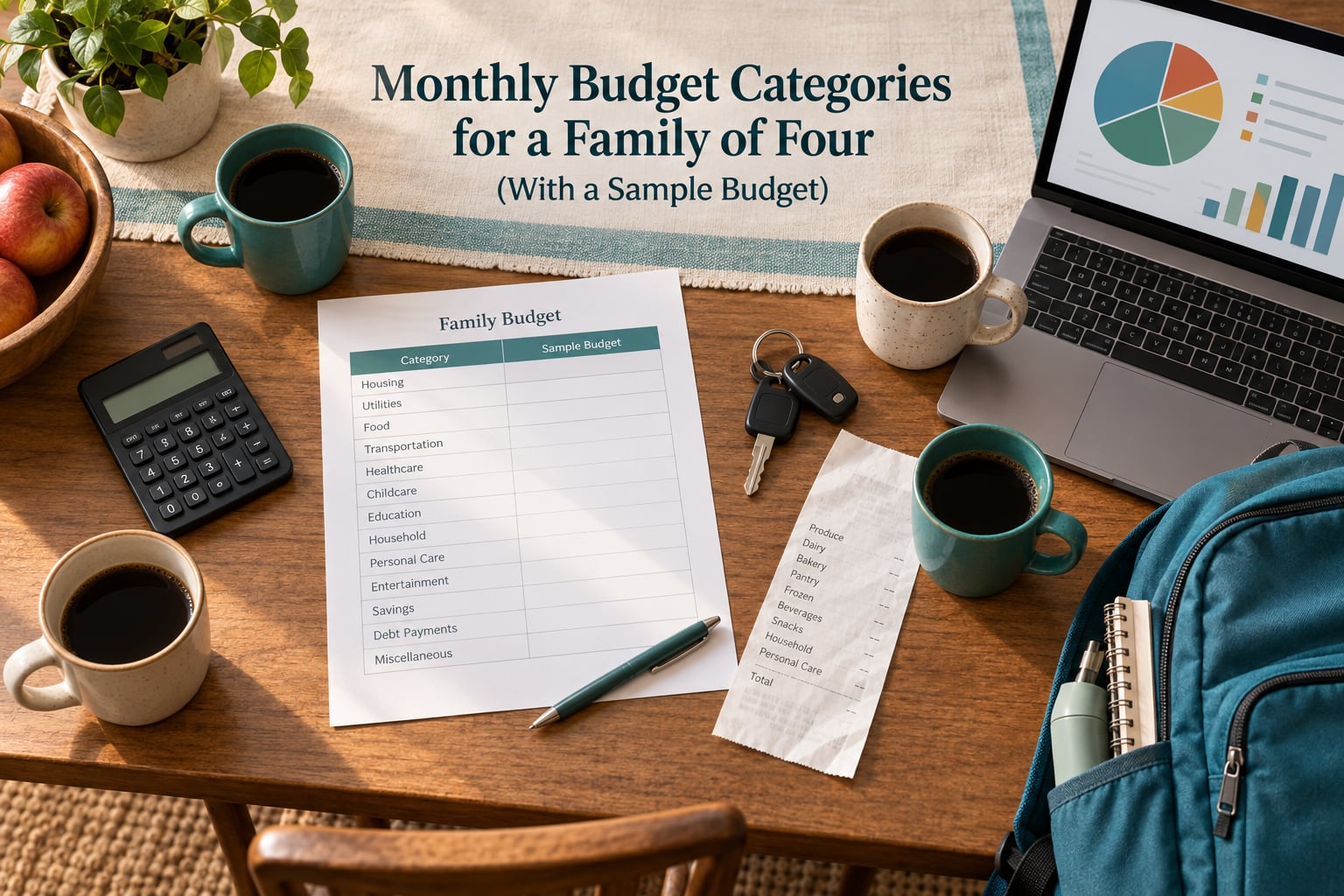
A monthly budget for a family of four only works when every dollar is assigned before the month starts, which is why the monthly budget categories matter more than the spreadsheet you use. Categories turn a take-home number into concrete decisions: this is the rent, this is food, this is what the car costs, and this is what happens to the rest.
Below you will find the seven categories we use, a fully totalled sample budget for a two-income family of four in Edmonton, and a simple percentage formula so the same plan works at a different income. All figures are in Canadian dollars and reflect what a household at that income level typically actually spends, not a rulebook average. Updated for October 2026.
Table of Contents
- The Sample Budget at a Glance
- The 7 Essential Budget Categories (With Sample Amounts)
- The Sample Monthly Budget for a Family of Four in Edmonton, Alberta
- Fixed vs Variable Expenses, and Why the Split Matters
- Using the 50/30/20 Rule With a Family of Four
- How to Adjust the Sample to Your Own Take-Home Pay
- The Irregular Costs Families Forget
- Where to Cut First When You Are Over Budget
- Frequently Asked Questions
- What is a realistic monthly budget for a family of four?
- What are the 7 categories of a budget?
- What is Dave Ramsey’s 50/30/20 rule?
- What is the average monthly grocery bill for a family of four in Canada?
- How much is normal for a family of four to spend on gas a month?
- Can a family of four comfortably live on 60,000 a year?
- How to Make This Budget Work for Your Family
The Sample Budget at a Glance
The sample below is built on a household take-home income of 6,000 a month, split across two incomes. That is roughly what a two-income Edmonton family earns after tax, CPP, and EI deductions, once each parent lands on a middle-income wage.
- Housing: 1,750 (29 percent)
- Utilities: 350 (6 percent)
- Food: 850 (14 percent)
- Transportation: 550 (9 percent)
- Childcare and education: 780 (13 percent)
- Insurance, healthcare and debt: 640 (11 percent)
- Savings and sinking funds: 720 (12 percent)
- Flexible spending and buffer: 360 (6 percent)
Read that as needs at 82 percent, goals at 12 percent, and everything discretionary at 6 percent. That ratio looks nothing like the popular 50/30/20 split, and that is the honest starting point for most families of four in a high-cost-of-living city.
The 7 Essential Budget Categories (With Sample Amounts)
The seven categories below cover 94 percent of the sample budget. The remaining 6 percent is a flexible layer for spending that changes week to week. Every line in the full table later in this article sits inside one of these seven buckets.
- Housing — 1,750 a month (29 percent). Rent or a mortgage payment, plus property tax or condo fees. Keep mortgage principal, interest, taxes, and insurance together in this single line so you always see the true cost of shelter.
- Utilities — 350 a month (6 percent). Power, gas, water, phone, and internet. In Edmonton, a family of four typically lands between 280 and 450 depending on the season and how the home is heated.
- Food — 850 a month (14 percent). Groceries plus the coffee and snacks that would otherwise be unbudgeted. Eating out sits in the flexible layer, not here.
- Transportation — 550 a month (9 percent). Car payment, fuel, transit passes, parking, registration, and maintenance folded into one number.
- Childcare and education — 780 a month (13 percent). Daycare fees, activity registrations, school fees, and supplies. This line shrinks dramatically once both kids are in school.
- Insurance, healthcare and debt — 640 a month (11 percent). Home, auto, and life insurance, extended health and dental share, plus minimum payments on any credit cards or lines of credit.
- Savings and sinking funds — 720 a month (12 percent). Emergency fund contributions, retirement savings, and the sinking funds that absorb annual bills so nothing shocks you in the month it lands.
The flexible layer — 360 in the sample — covers family activities, eating out, personal spending for each adult, gifts, and a small buffer. Give it a monthly ceiling and treat anything left over at month end as money that can go to savings.
The Sample Monthly Budget for a Family of Four in Edmonton, Alberta
Here is the full line-item breakdown behind the summary. The 11 lines sit inside the 7 categories above, and the total lands exactly on take-home income, which is what makes it usable rather than aspirational. All amounts are in Canadian dollars, and Alberta has no provincial sales tax, so every line is final cost to the household.
| Line item | Monthly (CAD) | Percent of take-home | Fixed or variable |
|---|---|---|---|
| Housing (rent or mortgage, property tax, fees) | 1,750 | 29 percent | Fixed |
| Utilities (power, gas, water, phone, internet) | 350 | 6 percent | Variable |
| Groceries and household food | 850 | 14 percent | Variable |
| Transportation (car payment, fuel, maintenance, transit) | 550 | 9 percent | Mixed |
| Childcare, activities, school costs | 780 | 13 percent | Fixed |
| Insurance and healthcare | 320 | 5 percent | Fixed |
| Debt repayment (minimums plus extra) | 320 | 5 percent | Fixed |
| Savings (emergency fund and retirement) | 540 | 9 percent | Goal |
| Family spending, eating out, personal | 250 | 4 percent | Variable |
| Sinking funds (annual and irregular bills) | 180 | 3 percent | Variable |
| Miscellaneous buffer | 110 | 2 percent | Buffer |
| Total monthly spend | 6,000 | 100 percent | — |
A few notes on the numbers. Housing at 1,750 reflects a three-bedroom rental in a decent Edmonton neighbourhood, or the housing half of a mortgage on a comparable home. Groceries at 850 sits inside the range families actually report; on r/MiddleClassFinance, a family of four in a high-cost-of-living area averages around 750 a month, and other households put the ceiling closer to 800 to 1,000. The 110 buffer is deliberate, not slack — it absorbs the surprise that would otherwise come out of savings.
Fixed vs Variable Expenses, and Why the Split Matters
Fixed expenses are the ones that do not change month to month: rent, childcare, insurance, minimum debt payments, and phone. Variable expenses flex with your choices: groceries, fuel, eating out, and personal spending. In the sample budget, fixed lines total 3,170, which is 53 percent of take-home.
That number is your real stress test. The consensus on r/personalfinance is to aim for fixed costs, groceries, and minimum debt payments to land at 50 to 60 percent of net income, which leaves room for savings. The sample lands at 4,020 including groceries, or 67 percent — above that range, because housing and childcare in a family of four consume more than the guideline assumes.
Why does the split matter? Fixed costs are a decision you make once and live with. Variable costs are the dial you turn when the month gets tight. When something breaks — a car repair, a dental bill — you adjust the variable lines first, and you know exactly which ones to touch.
Using the 50/30/20 Rule With a Family of Four
Dave Ramsey’s 50/30/20 rule divides take-home income into 50 percent needs, 30 percent wants, and 20 percent savings and debt. It is a popular starting point, but it was designed for a single earner with no dependents, and that is exactly where it struggles with a family of four.
Run the sample budget through it and you get 82 percent needs, 6 percent wants, 12 percent savings. The 50 percent needs target is not reachable when housing plus childcare already exceeds it. Forcing savings down to nothing to satisfy the rule leaves a family with no emergency fund, which is the opposite of what the rule is meant to protect.
The 70/10/10/10 variant, popular with some zero-based budgeters, is even looser: 70 percent needs, 10 percent wants, 10 percent savings, 10 percent debt. Some families use it well, but with a family of four, needs realistically land between 75 and 85 percent, so any framework with a lower needs cap will need adjusting on the savings side rather than the needs side.
Treat all three rules as a diagnostic, not a grade. Run your own numbers, see which bucket is under pressure, and adjust the goals you can actually control.
How to Adjust the Sample to Your Own Take-Home Pay
You do not need this exact income to use the framework. Take the percentage for each category, multiply it by your own monthly take-home pay, and that is your starting number. If your take-home is 4,800 instead of 6,000, housing at 29 percent becomes about 1,390, groceries at 14 percent becomes about 670, and savings at 9 percent becomes about 430.
Three adjustments matter more than the arithmetic. Renters can usually drop to 25 to 28 percent for housing, while owners should expect 28 to 32 percent once property tax, home insurance, and condo fees are included. Single-income households should cut the childcare line in half and assume the savings line grows, since there is no second paycheck to lose. And any household carrying credit card debt should move money from the flexible layer into debt repayment until the smallest balance is gone, then roll that payment into the next one.
After you scale, do a subtraction test: take-home minus all fixed lines and minimum debt payments is the amount you actually control each month. If that number cannot cover groceries, savings, and the flexible layer, the fix is a housing or childcare change, not a stricter grocery discipline.
The Irregular Costs Families Forget
The budget only holds if the annual bills are already paid. That is what a sinking fund is: a small account that you add to every month so a big annual cost never appears as a surprise. In the sample, 180 a month goes into these, and the 12 percent saved for goals would collapse if the car needed tires in the same month as school registration.
- Vehicle costs — 100 a month. Tires, brakes, batteries, and the deductible. One repair can absorb an entire flexible layer.
- School and activity costs — 40 a month. Supplies, field trips, sports registration, and equipment that grows with the kids.
- Seasonal and gift costs — 25 a month. Birthdays, holidays, and school celebrations spread across eleven months.
- Home maintenance — 15 a month. For owners, a rough guideline is 1 to 3 percent of the home value each year, which annualizes neatly into a small monthly transfer.
If you are starting from zero, open a single savings account with four sub-labels, or four separate accounts, and automate the transfers on payday. The account is not the point. The point is that no month ever contains a 900 surprise.
Where to Cut First When You Are Over Budget
Most advice tells you to cut subscriptions and takeout first. On a family-of-four budget, those are often the smallest lines. Cut in order of dollar impact instead, and only move down the list as far as you need to.
- Groceries: 100 to 150 a month. Meal planning, store-brand staples, and cutting household food waste. The largest variable line in most households.
- Childcare and activities: 80 to 200 a month. Drop one activity per child, or shift one child to a cheaper licensed option.
- Housing: 200 to 400 a month. The biggest line by far, and the only one where a change compounds. A roommate situation or a move further from the core is the only real lever.
- Vehicle: 80 to 150 a month. One vehicle instead of two, or refinancing a car loan at a lower rate.
- Utilities: 30 to 70 a month. A thermostat setting, a shower timer, and switching one provider to a cheaper plan.
- Subscriptions and takeout: 40 to 80 a month. Worth doing, but the smallest number on this list. Do it last.
If you are more than 400 a month over after all of that, the gap is structural. That is a conversation about income, housing, or childcare arrangements, not about discipline.
Frequently Asked Questions
What is a realistic monthly budget for a family of four?
A realistic monthly budget for a family of four assigns every dollar of take-home income before the month starts. The sample on this page budgets 6,000 a month across 7 categories: housing 1,750, utilities 350, food 850, transportation 550, childcare and education 780, insurance, healthcare and debt 640, savings and sinking funds 720, and a flexible layer of 360. Realistic means the numbers total your income exactly, with no imagined slack.
What are the 7 categories of a budget?
The 7 essential budget categories are housing, utilities, food, transportation, childcare and education, insurance and healthcare plus debt repayment, and savings with sinking funds. A flexible spending line for personal and family extras sits on top of those seven. Grouping them this way keeps a family budget to a manageable number of lines while still capturing every dollar of take-home pay.
What is Dave Ramsey’s 50/30/20 rule?
Dave Ramsey’s 50/30/20 rule divides take-home income into 50 percent for needs, 30 percent for wants, and 20 percent for savings and debt. It works well for a single earner with no dependents. For a family of four, housing and childcare alone often exceed the 50 percent needs target, so use the rule as a diagnostic rather than a target, and protect savings even if the needs bucket has to run high.
What is the average monthly grocery bill for a family of four in Canada?
Most Canadian families of four spend between 700 and 1,000 a month on groceries and household food, with about 850 a realistic planning figure. On r/MiddleClassFinance, a family of four in a high-cost-of-living area averages roughly 750 a month. One newcomer cost guide projects about 1,464 a month for a family of four on food prepared at home, which reflects a high-cost-of-living market. Cooking at home most nights is the single biggest lever on this line.
How much is normal for a family of four to spend on gas a month?
A family of four driving a combined 1,000 to 1,500 kilometres a week should budget roughly 150 to 250 litres of fuel a month. The 550 transportation line in the sample budget covers more than gas: it includes the car payment, fuel, registration, parking, and maintenance. If you rely on Edmonton Transit instead, the same line covers two adult passes and a student or youth pass, and the leftover can move to savings.
Can a family of four comfortably live on 60,000 a year?
A 60,000 annual income works for a family of four only in specific situations, and it is usually tight. After federal and provincial tax, CPP, and EI deductions, a two-income household at that wage level typically takes home between 4,300 and 4,700 a month in Alberta. The sample budget built here needs 6,000. Living on 60,000 generally requires renting a smaller home, relying on family for child care, or having no debt and no car payment.
How to Make This Budget Work for Your Family
Monthly budget categories for a family of four are a decision tool, not a test you pass or fail. Take the seven categories on this page, scale the percentages to your own take-home pay, and run the subtraction test to see what you actually control each month. The sample is a starting point built on real Edmonton numbers, and it only becomes yours once your own figures are in it.
Three things to do this week. First, open a single tracking sheet and record every dollar that leaves your household for one full month, with no categories, no judgement. Second, subtract your fixed costs from take-home to find your real baseline. Third, open the sinking fund account and set the first automatic transfer for the day after payday. That third step is the one that makes the next twelve months calmer than the last twelve.