
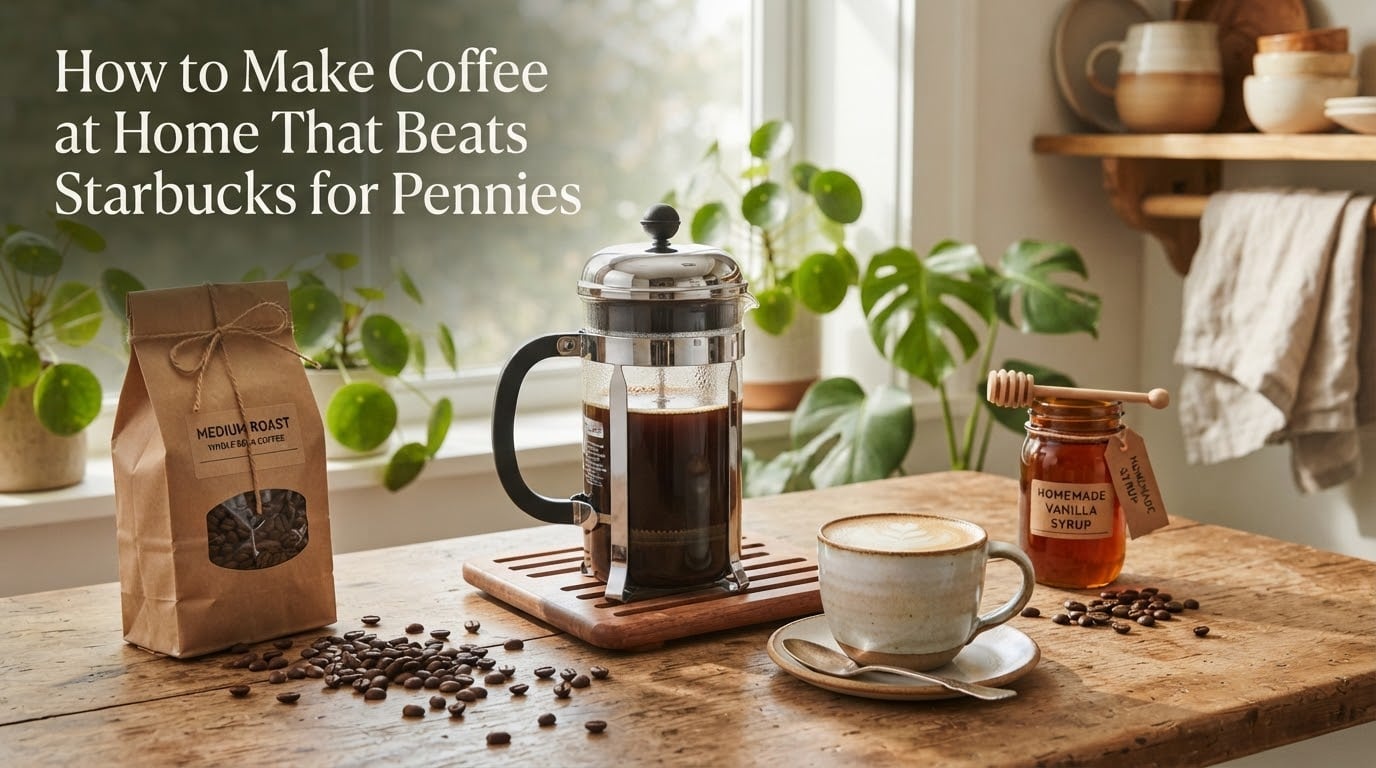
I used to stop at Starbucks three mornings a week. Then I did the math and nearly dropped my latte.
A grande caramel macchiato runs me around five dollars with tax. Multiply that by three trips a week for a year and I am spending close to eight hundred dollars on coffee I could make in my kitchen for roughly forty cents a cup. That gap is exactly why this guide exists. I want to show you how to make coffee at home that beats Starbucks for pennies, without buying a single fancy machine.
In the next ten minutes you will learn the cheapest equipment to buy, the beans and roasts to match each drink, and step-by-step recipes for the seven most-ordered Starbucks drinks. I have also included the real per-cup cost for every drink so you can see your weekly, monthly, and yearly savings the moment you start.
Table of Contents
- How to Make Coffee at Home That Beats Starbucks for Pennies
- What You Actually Need: Equipment Under $50
- Picking the Right Beans and Roast for Each Drink
- Brewing Methods That Actually Work at Home
- Starbucks Copycat Recipes You Can Make Right Now
- DIY Syrups and Flavorings That Save the Most Money
- How to Froth Milk Without an Expensive Machine
- The Real Cost Breakdown: Starbucks vs Home Per Cup
- Money-Saving Tips and Habit Breaking Tricks
- Beginner Mistakes to Avoid
- Frequently Asked Questions
- What is the cheapest way to make good coffee at home?
- How much does it cost to make a cup of coffee at home?
- Can I really make Starbucks coffee at home?
- What is the $3 Starbucks hack?
- How to make coffee as good as Starbucks?
- What is the easiest Starbucks drink to make at home?
- Is it really cheaper to make your own coffee at home?
- The Bottom Line
How to Make Coffee at Home That Beats Starbucks for Pennies
The short answer is yes, and the math is brutal for the drive-through. A cup of home-brewed coffee costs me about twenty cents for the beans and water. Add milk and a tablespoon of homemade syrup and the priciest homemade latte I make lands around sixty cents. The same drink at Starbucks is closer to five dollars.
Here is the one-glance cost table I keep on my fridge:
- Drip coffee: home around twenty cents, Starbucks around three dollars
- Iced coffee: home around thirty cents, Starbucks around four dollars
- Cold brew: home around forty cents, Starbucks around five dollars
- Cafe latte: home around fifty cents, Starbucks around five dollars
- Caramel macchiato: home around sixty cents, Starbucks around six dollars
Across a year those savings add up to between one and two thousand dollars for the average daily coffee buyer. That is a car payment, a vacation, or a whole pantry restock, all sitting in your coffee fund.
What You Actually Need: Equipment Under $50
You do not need an espresso machine to make great coffee at home. None of the recipes in this guide use one. The only tools I rely on are a kettle, a brewing vessel, a milk frother, and a kitchen scale. Here is how to spend depending on how serious you want to get.
The $10 Starter Kit
If you only have ten dollars, you can still skip Starbucks. Pick up a small French press and use hot water from any kettle you already own.
- Plastic or glass French press
- Kettle (you probably already have one)
- Reusable mug
This combo will make drip-style coffee and even a basic latte if you shake warm milk in a jar.
The $25 Starter Kit
Add a handheld milk frother to the $10 kit and you unlock lattes, cappuccinos, and macchiatos for under thirty dollars total.
- French press
- Handheld battery frother
- Kettle
- Basic kitchen scale
This is the kit I recommend for most people. It costs less than a single week of Starbucks runs and lasts for years.
The $50 Starter Kit
Spend fifty dollars and you have a real home barista setup with a Moka pot or AeroPress plus a pour-over dripper.
- Moka pot or AeroPress
- Pour-over dripper with paper filters
- Handheld frother
- Small burr grinder
- Kitchen scale with timer
This setup gets you closer to espresso-style drinks without the thousand-dollar machine.
What You Can Skip
You do not need an espresso machine, a built-in grinder, a smart scale, or any of the gadgets advertised on Instagram. A French press plus a $10 frother will out-pull a $300 machine for any drink Starbucks actually puts on its menu, because Starbucks drinks are mostly milk and syrup, not espresso.
Grinder Notes: Blade vs Burr
A blade grinder is fine for French press and cold brew. A burr grinder is worth it only when you start brewing pour over or Moka pot, where grind size changes the taste noticeably. If your budget is tight, skip the grinder for now and ask the coffee shop to grind your beans for the method you use most.
Picking the Right Beans and Roast for Each Drink
The single biggest mistake I see new home brewers make is buying the wrong roast. Light, medium, and dark roasts taste completely different in the cup, and the right one for a latte is not the right one for an Americano.
Roast to Drink Matching
- Light roast: pour over, drip coffee where you want bright fruit notes
- Medium roast: drip coffee, French press, cold brew, the everyday workhorse
- Dark roast: lattes, cappuccinos, macchiatos, anything with lots of milk
- Espresso roast: technically a bean blend labeled for espresso, used in Moka pots and lattes
Dark espresso roast is the one I keep on hand for milk drinks because the bold flavor survives being diluted. For black coffee I switch to medium roast so I can actually taste the bean.
Whole Bean vs Pre-Ground
Whole beans stay fresh for about a month once opened. Pre-ground coffee starts losing flavor within days. If you only buy one thing new, make it whole beans. You can grind them in a blade grinder in fifteen seconds.
Where to Buy Affordable Fresh Beans
I get the best value from grocery store bulk bins, local roasters with subscription discounts, and warehouse clubs. The cheapest route that still tastes great is a two-pound bag of medium roast from a trusted brand, divided into weekly portions and frozen until use.
Bean Freshness Timeline
Roasted beans are best within seven to twenty-one days of the roast date. After about a month the flavor flattens. Freezing in small weekly bags locks in freshness for up to three months.
Brewing Methods That Actually Work at Home
These five methods cover every drink Starbucks sells. Pick one or two to start. You do not need all of them.
French Press
The French press is the cheapest path to a full-bodied cup.
- Boil water and let it cool for thirty seconds
- Add one ounce of coarse-ground coffee per eight ounces of water to the press
- Pour water, stir once, put the lid on without pressing
- Wait four minutes
- Press the plunger slowly and pour
Pour Over
Pour over gives a cleaner, brighter cup than French press.
- Place a paper filter in the dripper and rinse with hot water
- Add one ounce of medium-ground coffee
- Pour just enough water to wet the grounds and wait thirty seconds to bloom
- Slowly pour the rest of the water in circles
- Total brew time should be three to four minutes
Moka Pot
A Moka pot brews strong stovetop coffee that stands in for espresso.
- Fill the bottom chamber with water up to the valve
- Fill the basket with finely ground dark roast, level but do not tamp
- Assemble and place on medium heat with the lid open
- Remove from heat when the sputter turns from coffee to steam
- Cool the bottom on a wet towel to stop the brew
AeroPress
AeroPress is fast, forgiving, and travel-friendly.
- Place a paper filter in the cap and rinse
- Add one scoop of medium-fine ground coffee
- Add eight ounces of water just off the boil and stir
- Insert the plunger and press gently for thirty seconds
Cold Brew Concentrate
Cold brew takes planning but pays off all week.
- Combine one cup of coarse-ground coffee with four cups of cold water in a jar
- Stir, cover, and refrigerate for twelve to eighteen hours
- Strain through a paper filter or fine mesh
- Dilute one part concentrate with one part water or milk before serving over ice
Starbucks Copycat Recipes You Can Make Right Now
Each recipe below makes one serving. Multiply as needed.
Iced Coffee (5-Minute Version)
- Brew eight ounces of strong coffee and let it cool slightly
- Fill a tall glass with ice
- Pour coffee over the ice
- Add two tablespoons of milk and one tablespoon of simple syrup
- Stir and serve
Per-cup cost: about thirty cents. Starbucks grande iced coffee runs around four dollars.
Cold Brew
- Fill a tall glass with ice
- Pour in six ounces of cold brew concentrate
- Add two ounces of cold water or milk
- Sweeten with simple syrup if desired
Per-cup cost: about forty cents. A grande cold brew at Starbucks runs around five dollars.
Caffè Americano
- Brew one shot of Moka pot or AeroPress coffee
- Pour into a mug with six ounces of hot water
- Stir and serve black or with milk
Per-cup cost: about twenty-five cents. A grande Americano at Starbucks runs around four dollars.
Cafe Latte
- Brew one shot of strong Moka pot coffee into a mug
- Froth six ounces of warm milk with a handheld frother
- Pour the frothed milk over the coffee
- Sweeten with vanilla syrup if desired
Per-cup cost: about fifty cents. A grande latte at Starbucks runs around five dollars.
Caramel Macchiato
- Add one tablespoon of vanilla syrup to the bottom of a mug
- Pour in eight ounces of frothed milk
- Slowly pour one shot of Moka pot coffee over the back of a spoon to keep the layers
- Drizzle homemade caramel sauce over the top
Per-cup cost: about sixty cents. A grande caramel macchiato at Starbucks runs around six dollars.
Pumpkin Spice Latte (Seasonal)
- Brew one shot of strong Moka pot coffee
- Stir in two tablespoons of pumpkin spice syrup (recipe below)
- Top with six ounces of frothed milk
- Sprinkle cinnamon on top
Per-cup cost: about sixty-five cents. A grande PSL at Starbucks runs around six dollars.
Cappuccino
- Brew one shot of Moka pot coffee
- Froth four ounces of milk until it doubles in volume
- Pour coffee into a mug, then top with the frothed milk
- Dust with cocoa powder or cinnamon
Per-cup cost: about fifty cents. A grande cappuccino at Starbucks runs around five dollars.
DIY Syrups and Flavorings That Save the Most Money
Bottled syrups are one of the biggest hidden costs of home coffee. A bottle of coffee syrup at the store costs about the same as ten homemade batches. These recipes make about a cup of syrup each, enough for roughly eight drinks.
Classic Simple Syrup
- Combine one cup of water and one cup of sugar in a saucepan
- Heat until the sugar fully dissolves
- Cool and store in a jar in the fridge for up to a month
Vanilla Syrup
- Make a batch of simple syrup and let it cool
- Stir in two teaspoons of vanilla extract
- Store in the fridge
Caramel Syrup
- Combine one cup of sugar with a quarter cup of water in a saucepan
- Cook over medium heat without stirring until amber
- Remove from heat and slowly whisk in a quarter cup of heavy cream and a tablespoon of butter
- Cool and store in a jar
Pumpkin Spice Blend
- Mix two tablespoons of pumpkin puree with one cup of simple syrup
- Stir in one teaspoon of cinnamon, half a teaspoon of nutmeg, and a quarter teaspoon of cloves
- Strain and store in the fridge
Sugar-Free Vanilla Syrup
- Combine one cup of water with two-thirds cup of a granular sweetener like erythritol
- Heat until dissolved, then stir in two teaspoons of vanilla extract
- Cool and store in the fridge
How to Froth Milk Without an Expensive Machine
Frothed milk is what makes a homemade latte feel like a real latte. None of these methods require an espresso machine.
Handheld Frother (Best Option)
A ten-dollar battery frother makes café-quality foam in about twenty seconds. Submerge the whisk just below the surface of warm milk and turn it on. Move up and down slightly until the milk doubles in volume.
French Press as a Frother
Pour warm milk into a French press and pump the plunger up and down quickly for thirty seconds. This creates a thick, stable foam that holds up beautifully in lattes.
Mason Jar Shake Method
Fill a jar halfway with warm milk, screw the lid on tight, and shake hard for forty-five seconds. Remove the lid and microwave for thirty seconds to set the foam.
Stovetop Steam Trick
Heat milk in a small saucepan over medium heat. Whisk vigorously by hand with a wire whisk just before it steams. It is harder than the other methods but it works in a pinch.
The Real Cost Breakdown: Starbucks vs Home Per Cup
Here is the breakdown I built after tracking every penny of my own coffee spending for six months. The numbers are averages across all the recipes above using mid-range grocery store beans and store-brand milk.
- Drip coffee: home twenty cents, Starbucks around three dollars, savings about two dollars and eighty cents per cup
- Iced coffee: home thirty cents, Starbucks around four dollars, savings about three dollars and seventy cents per cup
- Cold brew: home forty cents, Starbucks around five dollars, savings about four dollars and sixty cents per cup
- Cafe latte: home fifty cents, Starbucks around five dollars, savings about four dollars and fifty cents per cup
- Caramel macchiato: home sixty cents, Starbucks around six dollars, savings about five dollars and forty cents per cup
- Pumpkin spice latte: home sixty-five cents, Starbucks around six dollars, savings about five dollars and thirty-five cents per cup
- Cappuccino: home fifty cents, Starbucks around five dollars, savings about four dollars and fifty cents per cup
Weekly, Monthly, and Yearly Savings
One daily grande latte at home instead of Starbucks saves about four dollars and fifty cents per day, about thirty-two dollars per week, about one hundred and thirty-five dollars per month, and roughly sixteen hundred dollars per year.
Equipment Payback Period
The twenty-five-dollar starter kit pays for itself in less than a week. The fifty-dollar kit pays for itself in just under two weeks. After that, every cup is pure savings.
Hidden Starbucks Costs
Beyond the drink price, there is gas, tip jars, time in the drive-through line, and impulse bakery items. Most Starbucks regulars I have talked to admit the real per-trip cost is closer to eight dollars once those are added in.
Money-Saving Tips and Habit Breaking Tricks
Switching from Starbucks to home coffee is more about habits than recipes. These tips helped me go from three trips a week to zero, and they will help you too.
The $3 Starbucks Hack
Order the smallest size, ask for an extra shot, and add your own milk and syrup at home. You get a stronger drink with the same caffeine, pay less, and finish customizing it in your kitchen.
Buying Beans in Bulk
A two-pound bag of coffee from a warehouse club costs less per ounce than the smallest bag at a grocery store. Split it into one-week portions and freeze. The per-cup cost drops by another ten to fifteen cents.
Reusing Grounds
Used coffee grounds are great for garden compost, exfoliating scrubs, and odor absorption in the fridge. Nothing in your coffee routine has to go to waste.
When It Is OK to Still Go to Starbucks
I still go to a coffee shop on Saturday mornings with my kids. The trick is making it a deliberate treat instead of a daily habit. When you remove the everyday trips, the occasional one feels special again.
Building a Morning Routine That Sticks
Set out your French press and grounds the night before. Set the kettle to auto-start. Brew while the coffee is still steeping, then pour milk and head out the door. The whole routine takes about five minutes once you have done it five times.
Beginner Mistakes to Avoid
I made every mistake below in my first month of home brewing. Avoiding them will save you a lot of bad cups.
- Water that is too hot: boiling water scorches the grounds and tastes bitter. Always let the kettle sit for thirty seconds before pouring.
- Stale beans: if your beans have been sitting in the pantry for months, toss them. Coffee is one of the few foods where freshness truly matters.
- Wrong grind size: coarse for French press and cold brew, medium for pour over, fine for Moka pot and AeroPress.
- Skipping the scale: eyeballing leads to weak or bitter coffee. A cheap kitchen scale keeps every cup consistent.
- Expecting perfection on day one: my first homemade latte was awful. Cup ten was great. Give yourself a learning curve.
Frequently Asked Questions
What is the cheapest way to make good coffee at home?
The cheapest way to make good coffee at home is a French press plus a kettle and a bag of medium-roast whole beans. Per cup, beans and water run about twenty cents, and the equipment pays for itself in a week of saved Starbucks runs.
How much does it cost to make a cup of coffee at home?
A basic cup of drip coffee at home costs around twenty cents for the beans and water. A homemade latte with milk and syrup costs about fifty cents. A homemade caramel macchiato runs around sixty cents per cup, compared with five to six dollars at Starbucks.
Can I really make Starbucks coffee at home?
Yes. Every drink on the Starbucks menu can be made at home with a French press, Moka pot, or AeroPress plus a handheld milk frother. The recipes for lattes, cappuccinos, Americanos, cold brew, and caramel macchiatos are all covered above and use no espresso machine.
What is the $3 Starbucks hack?
The three-dollar Starbucks hack is ordering the smallest size, asking for an extra shot of espresso, skipping the flavored syrup, and adding your own milk and homemade syrup at home. You get the same caffeine and flavor for less, with full control over sweetness.
How to make coffee as good as Starbucks?
To make coffee as good as Starbucks at home, start with fresh whole-bean coffee, match the roast to the drink, brew with a French press or Moka pot, and finish with frothed milk and homemade syrup. Fresh beans matter more than expensive equipment.
What is the easiest Starbucks drink to make at home?
The easiest Starbucks drink to make at home is iced coffee. Brew strong coffee, pour it over ice, add milk and simple syrup, and stir. It takes about five minutes and costs around thirty cents per cup.
Is it really cheaper to make your own coffee at home?
Yes. A homemade cup of coffee costs twenty to sixty cents depending on the drink, while the same drink at Starbucks costs three to six dollars. Across a year of daily drinks, that is roughly one thousand to sixteen hundred dollars in savings.
The Bottom Line
Learning how to make coffee at home that beats Starbucks for pennies is less about technique and more about ditching the daily habit. Start with a French press and a $10 frother. Buy a bag of medium roast. Make iced coffee on Monday and a latte on Tuesday.
By Friday you will have spent less on coffee than one Starbucks trip. By the end of the year you will have saved sixteen hundred dollars, and your kitchen will smell better than any drive-through. Pick one recipe from this guide and brew it tomorrow morning. The first cup is the only hard one.