
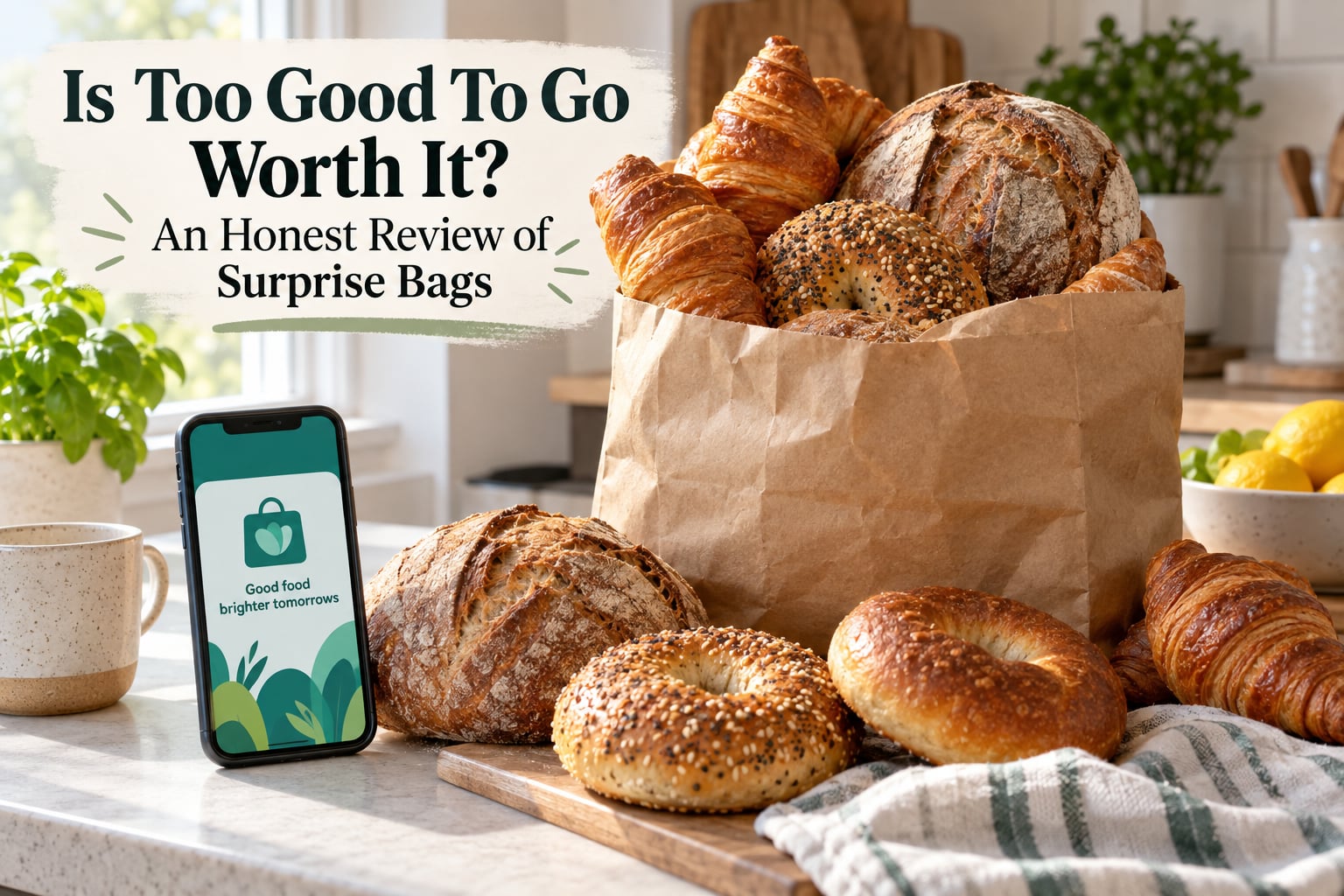
I have been asked more times than I can count whether Too Good To Go is worth it, and the honest answer is not a simple yes or no. After months of using the surprise bags app on and off in Edmonton and watching thousands of Reddit users debate the same question, I can tell you this: when you can actually grab a bag, the savings are real. The catch is the getting.
This honest review of surprise bags walks through exactly how Too Good To Go works, what you actually receive in the bag, where the savings math holds up, and where the app frustrates even its biggest fans. By the end, you will know whether the food waste app belongs on your phone or whether you should skip it.
Table of Contents
- What Is Too Good To Go and Why Does It Matter?
- How Too Good To Go Works: A Step-by-Step Walkthrough
- What You Actually Get in Surprise Bags by Store Type
- The Real Savings: When Too Good To Go Is Worth It
- Honest Downsides and Frustrations
- Tips for Getting the Best Too Good To Go Bags
- Who Should Use It and Who Should Skip It
- Frequently Asked Questions
- Final Verdict: Is Too Good To Go Worth It?
What Is Too Good To Go and Why Does It Matter?
Too Good To Go is a mobile app that connects users with local restaurants, bakeries, cafes, and grocery stores that have surplus unsold food at the end of the day. Instead of tossing that food, the business lists it as a “surprise bag” at roughly one-third of the original retail value, and nearby users claim it through the app. The premise is simple: less food waste, more money saved.
The platform now operates in 19 countries with more than 100 million users and over 170,000 partner stores, according to data shared across Reddit threads and Trustpilot reviews. That scale matters because it tells you this is not a fringe discount app. It is a major food rescue platform with real infrastructure.
The reason it matters to me, and to most frugal families I talk to, is the dual win. You get genuinely discounted groceries and restaurant food, and you keep edible food out of the landfill. For a household trying to trim a grocery bill without resorting to ultra-processed deals, that combination is hard to beat.
Defining the Surprise Bag
A surprise bag is exactly what it sounds like: a bag of items the business has chosen, not you. You know the store category (bakery, sushi spot, organic grocer) and a rough value range, but the contents stay a mystery until pickup. That surprise element is the heart of the experience, and it is also the source of most complaints.
How Too Good To Go Works: A Step-by-Step Walkthrough
The learning curve on Too Good To Go is small. Here is the exact flow from download to walking out with a bag of surplus food.
- Download the app and set your location. The app uses your area to show nearby stores with surprise bags available that day.
- Browse available bags. Each listing shows the store name, bag price, claimed retail value, pickup window, and how many bags are left.
- Reserve and pay in the app. Payment happens at reservation. There is no cash option and no changing your mind after checkout.
- Show up during the pickup window. Windows are typically 30 to 60 minutes long, set by the store, and missing the window forfeits the bag.
- Collect your surprise bag. Hand over your QR code, grab your bag, and you are done. No substitutions, no swapping.
The pickup window is the part most first-time users underestimate. A 5:30 to 6:15 window means arriving any time in that range. Showing up at 6:20 often means watching the staff hand your bag to the latecomer who arrived at 6:14.
Understanding the Rating System
Each store carries a star rating from previous customers. I treat anything under 4.3 as a warning sign. Ratings reflect both food quality and pickup experience, so a 3.8 bakery is telling you something. Long-time users on Reddit consistently point to the rating as the single best filter for a great surprise bag.
What You Actually Get in Surprise Bags by Store Type
This is where honesty matters most. Bag contents vary wildly by store category, and knowing what each tends to deliver makes the difference between loving the app and deleting it after two bad tries.
Bakery and Bagel Shop Bags
Bakeries are the gold standard. Users across Reddit and Trustpilot report getting $15 to $25 worth of bread, pastries, and bagels for $4 to $7. Day-old sourdough, croissants, and bagels are common. These bags are the closest thing to a guaranteed win, and they are what I recommend new users try first.
Grocery Store Bags
Grocery surprise bags are the most inconsistent. Some days you get a beautiful haul of organic produce and deli items worth triple the price. Other days you get a sad bag of wilted greens and three yogurt cups. The retail value claim on grocery bags is also the most generous interpretation of value. Treat them as a lottery, not a staple.
Restaurant and Sushi Spot Bags
Restaurant bags often contain fully prepared meals from that day’s menu. Quality is usually high because the food was ready to serve that day. The downside is portion variability: one user might get two full entrees, another gets one half-eaten tray of pasta. Reviews consistently flag sushi spots as a high-value option when you can find them.
Cafe and Coffee Shop Bags
Cafe bags typically contain baked goods, sandwiches that did not sell before lunch cutoff, and occasionally bottled drinks. Value is solid but rarely spectacular. A $5 cafe bag reliably nets $10 to $15 in items, which is decent but not the eye-popping win of a bakery haul.
The Real Savings: When Too Good To Go Is Worth It
The savings math on Too Good To Go works out roughly like this. Most surprise bags list at $4 to $7 and deliver $12 to $25 in claimed retail value. Even with the most skeptical haircut, you are getting two to three times your money back.
For a family of four, grabbing two bakery bags per week at an average cost of $6 each means $48 a month to feed breakfast or lunch sides that would otherwise cost $120 or more. For a single user or student, even one bakery bag a week turns into $25 to $40 in monthly savings without changing grocery habits.
When the Math Breaks Down
The math only works when you can actually claim a bag. In dense urban areas like NYC and London, users report bags selling out within seconds. If you spend 20 minutes a day refreshing the app and never win a reservation, the savings number is zero. The honest review takeaway: the value is real, but only if you can get past the sell-out wall.
Honest Downsides and Frustrations
No honest Too Good To Go review would be complete without the cons. I have hit every one of these personally or watched friends run into them within their first month.
- Bags sell out instantly in popular areas, which is the single biggest reason people quit the app within two weeks.
- No refunds on bad bags. You can leave a rating and a comment, but the money is gone whether the food was great or inedible.
- Pickup windows are inconvenient. Many run during the work-from-office crunch, and a missed window means losing both the bag and the money.
- Dietary restrictions are tough. If you are gluten-free, vegan, or have serious allergies, the surprise element is genuinely risky.
- Quality is inconsistent. Some bags feel generous, others feel like the store cleared the back shelf.
- Store availability shifts without warning. A favorite bakery can disappear from the app overnight.
The surprise element is also a hidden frustration. The first few bags feel fun. After six months of mystery produce you cannot use, the surprise starts to feel like a gamble rather than a perk.
Tips for Getting the Best Too Good To Go Bags
After enough months of trial and error, our team has settled on a few habits that consistently improve the experience. These are the tips I wish someone had told me on day one.
Turn On Notifications and Move Fast
Bags often drop at specific times based on when stores finish their main service period. Set alerts for your favorite stores and check the app right at the top of each hour. Speed matters more than strategy.
Start With High-Rated Bakeries
For your first three bags, filter for 4.5-star rated bakeries and bagel shops. They are the most forgiving category and almost always deliver real value. Build your confidence before branching out.
Read Recent Reviews Carefully
A 4.7 rating with five recent reviews telling you portions have shrunk is more useful than a 4.5 rating with 800 reviews from three years ago. Recency beats volume.
Pair the App With Meal Planning
Plan one or two flexible meals a week around whatever might arrive. Soups, frittatas, stir-fries, and sandwiches all absorb mystery vegetables and bakery goods beautifully. This is the habit that turned the app from a fun side project into a real budget tool for us.
Track Your Actual Wins
Keep a simple note of what you paid and what you received for the first month. After 10 bags, you will know exactly which stores and categories are worth your time. Your personal data beats any aggregate review.
Who Should Use It and Who Should Skip It
Too Good To Go is genuinely worth it for flexible urban dwellers who enjoy culinary surprises, students on a tight budget, families looking to extend the grocery budget without sacrificing quality, and anyone passionate about reducing food waste.
It is probably not worth it for people with strict dietary restrictions, anyone with a rigid 9-to-5 schedule that clashes with typical pickup windows, shoppers in rural areas with very few partner stores, and folks who dislike the surprise element entirely.
Frequently Asked Questions
How do Too Good To Go surprise bags work?
Local businesses list unsold surplus food as surprise bags in the app at about one-third of the retail value. You reserve and pay in the app, then pick up the bag during a specific 30 to 60 minute window chosen by the store. The contents stay a surprise until you arrive.
What are the downsides of Too Good To Go?
The biggest downsides are bags selling out within seconds, no refunds on bad bags, inconvenient pickup windows during work hours, inconsistent quality across stores, and the surprise element being risky for anyone with dietary restrictions or allergies.
Are Too Good To Go bags real?
Yes, the bags are real. Users across Reddit, TikTok, and Trustpilot regularly post photos of bakery hauls, grocery pickups, and restaurant leftovers worth several times the price they paid. Trustpilot holds over 100,000 user reviews for the platform.
What is the best Too Good To Go bag?
Bakery and bagel shop bags are consistently rated as the best value. Reviewers report getting $15 to $25 of bread, pastries, and bagels for $4 to $7. Restaurant and sushi spot bags also deliver strong value when available.
Can you choose items on Too Good To Go?
No. The contents are chosen by the store, not the customer. You know the store category, the claimed retail value, and the pickup window, but the specific items stay a surprise until pickup.
Is Too Good To Go available everywhere?
The app operates in 19 countries with over 170,000 partner stores, but coverage is much stronger in dense urban areas like major cities in the US, Canada, the UK, and Europe. Rural availability is limited and varies widely by region.
Final Verdict: Is Too Good To Go Worth It?
So, is Too Good To Go worth it in 2026? After months of testing and watching thousands of user experiences play out online, my honest verdict is yes, with one big asterisk. When you can claim a bag, the value is undeniable and the food waste reduction mission is genuinely meaningful. When you cannot get past the sell-out wall, the app becomes a frustrating time sink.
If you live in or near a city, have a flexible schedule, and enjoy the occasional surprise, download the app tonight, enable notifications, and start with a 4.5-star bakery. You will likely walk away impressed. If rigid schedules, strict diets, or rural geography describe you, the app probably is not worth your time. For everyone else, Too Good To Go remains one of the smartest food rescue tools on your phone.