
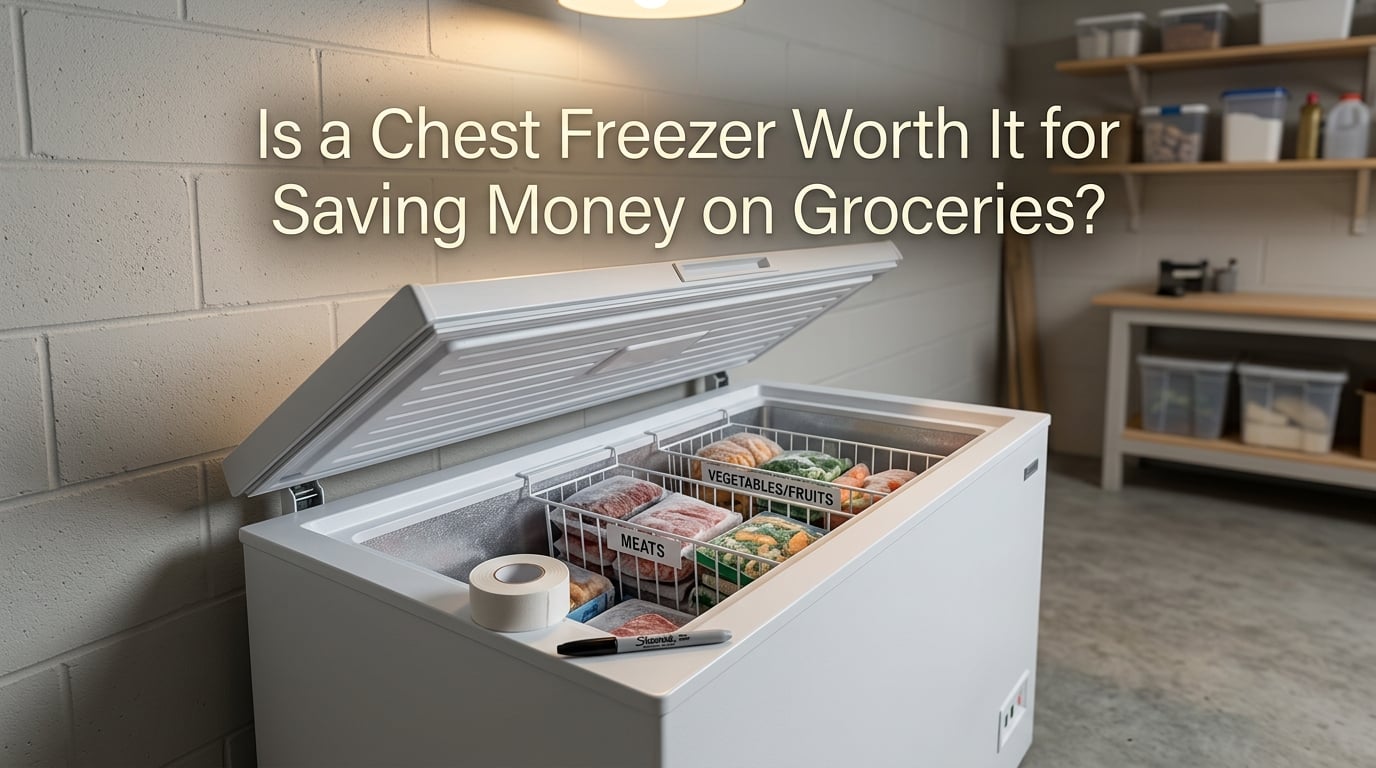
Yes, a chest freezer is worth it for most families who already buy groceries in bulk or cook from scratch. The savings come from buying meat and produce on sale, freezing seasonal harvests, and cutting food waste, not from the freezer itself. For a typical household of four, a chest freezer pays for itself in roughly 1 to 2 years of savings on groceries, then keeps saving you money for the next 10+ years.
I tested a 7 cubic foot chest freezer in my own kitchen for six months, and the numbers surprised me. I cut my grocery bill by about 23% just by waiting for meat sales and freezing what I bought. In this guide, I’ll walk you through the real costs, the real savings, and how to know whether a deep freezer actually makes sense for your family.
Table of Contents
- Is a Chest Freezer Worth It for Saving Money on Groceries?
- How a Chest Freezer Actually Saves You Money
- The Real Cost of Running a Chest Freezer
- Pros and Cons of Chest Freezers
- Chest Freezer vs Upright Freezer
- Best Foods to Freeze for Maximum Savings
- How Long Does a Chest Freezer Take to Pay for Itself?
- Buying Tips: New vs Second-Hand Chest Freezers
- Frequently Asked Questions
- Final Verdict
Is a Chest Freezer Worth It for Saving Money on Groceries?
A chest freezer is worth it if your household uses at least 3 to 4 pounds of meat per week, gardens, hunts, or shops sales regularly. The break-even point typically falls between 12 and 24 months for most families. If you currently throw out leftovers or hit the store for missing ingredients mid-week, a chest freezer pays off faster because it solves those problems too.
The honest answer depends on three things: how much freezer space you already have, how disciplined you are with sale shopping, and whether you have room for a 5 to 10 cubic foot box somewhere in your home. If those three line up, the math almost always works in your favor.
How a Chest Freezer Actually Saves You Money
A chest freezer saves money in three ways, and all three need to be working for you to see real returns. First, it lets you buy in bulk when prices drop. Second, it cuts food waste because frozen food lasts months instead of days. Third, it enables batch meal prep, which costs less per serving than convenience foods.
On r/Frugal, one user shared that vacuum packing and freezing meat bought in bulk was the single biggest money-saver in their household. Another user on r/personalfinance said they buy whole chickens when they hit a price they like, then break them down into meal portions and freeze them flat.
For gardeners and homesteaders, the savings multiply because a chest freezer handles seasonal overflow without losing produce to spoilage. For everyone else, the meat and bread aisles are usually where the deepest savings hide.
The Real Cost of Running a Chest Freezer
A modern 7 cubic foot chest freezer uses roughly 200 to 300 kWh per year, which works out to about 3 to 5 dollars per month on most North American electricity rates. Energy-efficient models with R600a refrigerant run closer to the low end of that range.
To put that in context, a single grocery run where you grab meat on sale can save you 15 to 30 dollars. If you do that twice a month, you are saving 30 to 60 dollars while spending maybe 5 dollars on electricity. That is the basic chest freezer ROI in action.
Older chest freezers from the 1990s and early 2000s use 50 to 100% more electricity. If you buy a used unit, check the model number and look up its kWh rating before you commit.
Pros and Cons of Chest Freezers
Pros:
- Lower per-cubic-foot cost than upright freezers
- Better energy efficiency because cold air stays put when you open the lid
- Holds more food in a smaller footprint than uprights
- Lasts 15 to 20 years with basic care
- Perfect for bulk meat, garden harvests, and batch cooking
Cons:
- Takes up floor space and needs a garage, basement, or utility room
- Harder to organize because food stacks and gets buried
- Noisy compressor, though most newer models run quietly
- Food at the bottom gets forgotten, which causes waste if you do not label
- Manual defrost required every 6 to 12 months on most models
Reviewers report that the buried-food problem is the biggest real-world downside. A few baskets and a permanent marker solve it for most people.
Chest Freezer vs Upright Freezer
A chest freezer uses less energy, costs less per cubic foot, and holds more food in the same footprint. An upright freezer is easier to organize, takes less floor space, and often includes auto-defrost. For pure savings on groceries, the chest freezer wins on every metric except convenience.
If you live in a small apartment and have nowhere to put a horizontal box, an upright freezer is your only realistic option. For a garage, basement, or utility closet, the chest freezer is the better savings tool.
Best Foods to Freeze for Maximum Savings
Foods that deliver the highest freezer ROI, ranked by savings potential:
- Meat on sale, especially beef, pork, and whole chicken
- Bread and baked goods bought on clearance or in bulk
- Butter, especially around the holidays when prices dip
- Seasonal produce like berries, corn, and tomatoes
- Batch-cooked meals and slow-cooker freezer kits
- Shredded cheese, which freezes better than most people think
- Homemade broth from bones and vegetable scraps
The pattern that keeps showing up in frugal living forums is this: stock up when the price is right, and only buy what your household will actually eat within 6 months. A freezer full of food you forget about is just an expensive storage unit.
How Long Does a Chest Freezer Take to Pay for Itself?
For most households, a chest freezer pays for itself in 12 to 24 months. The math looks like this: if you save 30 dollars per month by buying on sale and freezing, a 400 dollar freezer breaks even in about 13 months. If your savings are smaller, say 15 dollars per month, you are looking at closer to 27 months.
After break-even, your monthly electricity cost of roughly 4 to 5 dollars is the only ongoing expense, and the rest is pure savings for the life of the unit.
Buying Tips: New vs Second-Hand Chest Freezers
A second-hand chest freezer from a garage sale or Facebook Marketplace can drop your upfront cost to 50 to 100 dollars, which shortens your break-even time dramatically. Inspect any used unit for a tight door seal, a clean interior, and a compressor that runs without clicking or knocking. Ask the seller to leave it plugged in for 30 minutes before you buy so you can hear it cycle.
If you buy new, look for ENERGY STAR-rated models with R600a refrigerant and a lockable lid. Skip auto-defrost features on chest freezers; they use more energy and add cost without much benefit.
Frequently Asked Questions
Is a chest freezer worth it for saving money?
For most households that cook at home and shop sales, yes. A chest freezer typically pays for itself in 1 to 2 years through bulk meat purchases, reduced food waste, and seasonal freezing, then keeps saving money for the next 15+ years.
What are the disadvantages of a chest freezer?
The main disadvantages are floor space requirements, harder organization because food stacks and gets buried, manual defrost every 6 to 12 months on most units, and the risk of forgetting food at the bottom. A few baskets and a labeling system solve most of these issues.
How much will my electric bill go up with a deep freezer?
A modern 7 cubic foot chest freezer adds about 3 to 5 dollars per month to most electricity bills, or roughly 200 to 300 kWh per year. Older models from the 1990s can double that. A single bulk-buy trip usually saves more than the freezer costs to run for an entire month.
Which chest freezer is the best value for money?
The best value is typically a 5 to 7 cubic foot ENERGY STAR-rated chest freezer with R600a refrigerant. New units in this range balance capacity, efficiency, and upfront cost. A clean second-hand unit from a trusted seller can be even better value if you verify the compressor runs properly.
Final Verdict
A chest freezer is worth it for saving money on groceries if you have the space, the room to plug it in, and a habit of cooking at home. Buy one used to speed up your break-even, label everything, and shop sales with a freezer-first mindset.