
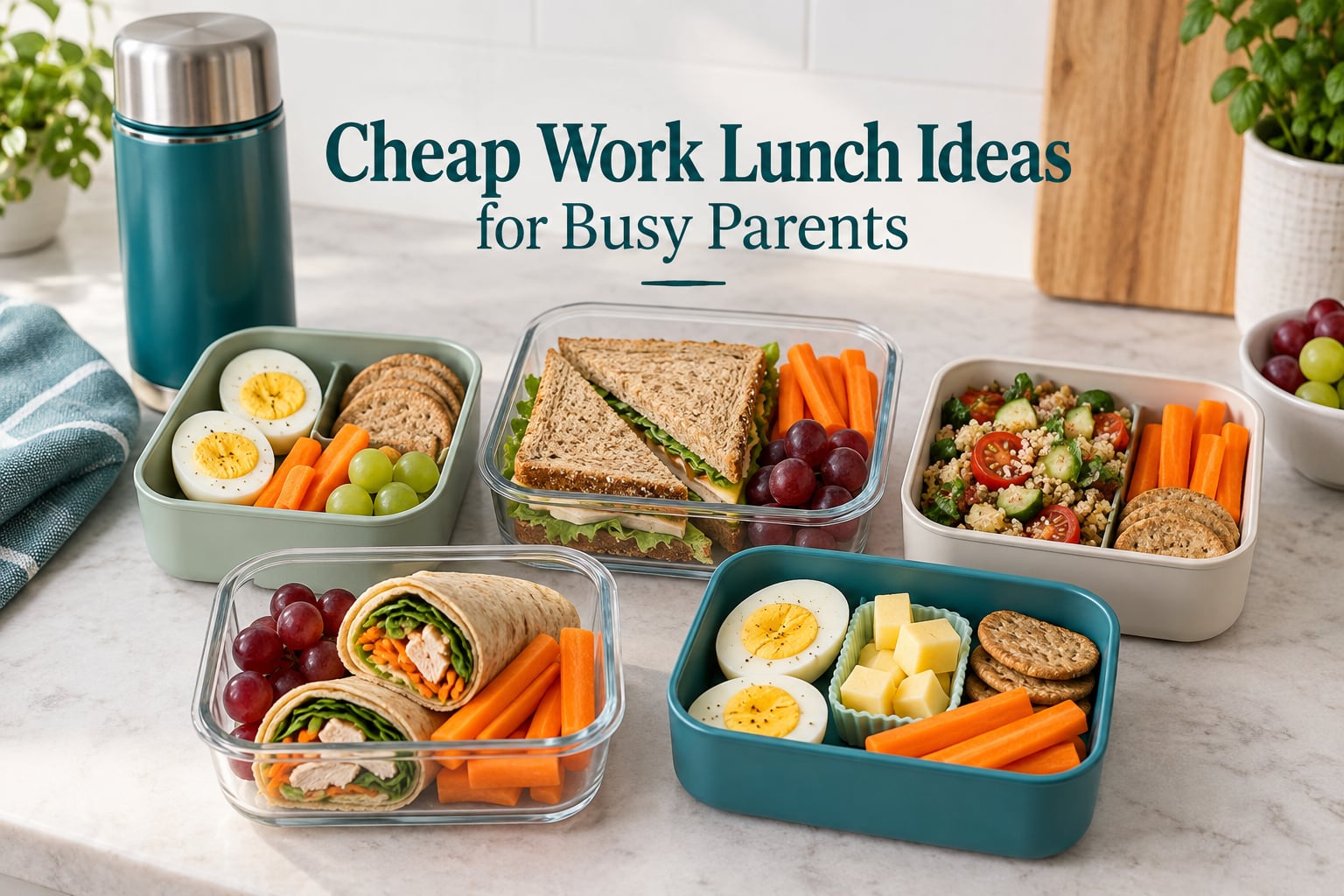
The cheapest lunch to take to work is a peanut butter sandwich, a hard-boiled egg with crackers, or a portion of the previous night’s dinner packed in a container. Each one costs roughly one to three dollars a serving, needs no microwave, and survives a commute intact. A takeout lunch bought five days a week runs about 60 dollars a person per week, so packing one meal is the fastest budget win on this whole list.
That math is why cheap work lunch ideas for busy parents are not about eating less interesting food. They are about cooking once instead of buying five times, and about packing food that still works when the office has no microwave, no fridge, and a 7 a.m. start time. I have tried most of these with two kids in the house, and the winners are the ones that survive a real week rather than a good first day.
Below you will find twelve lunches sorted by prep time, what each one costs per serving, a no-microwave section, an allergy-aware section, and the food-safety rules that actually matter in an Edmonton winter. Costs are estimates in Canadian dollars per serving, and they assume grocery-store pricing rather than a specialty diet aisle. Updated for 2026.
Table of Contents
- What is the cheapest lunch to take to work?
- Cheap work lunch ideas for busy parents, sorted by prep time
- What each lunch costs per serving
- What to pack when work has no microwave and no fridge
- One batch that feeds the adult and the kids
- Nut-free and school-safe packed lunches
- Food safety: how long a packed lunch can sit out
- Pantry and freezer staples worth buying
- Frequently Asked Questions
- What’s the cheapest lunch to take to work?
- What are some good lunch ideas for a busy mom?
- What are some budget-friendly lunch ideas for work?
- What are some cheap and easy lunch ideas I can pack for work?
- What are some good meal prep ideas for working moms?
- How long can a packed lunch sit without a fridge?
- Can I meal prep on Sunday for the whole week?
- Conclusion: your one-week starter rotation
What is the cheapest lunch to take to work?
Here are the lowest-cost options first, with a rough per-serving number on each line:
- Peanut butter sandwich — about 1.50 dollars, 3 minutes, no cooking, keeps 2 days in the fridge
- Portion of the previous night’s dinner — about 2 dollars, 0 extra minutes, keeps 3 to 4 days chilled
- Two hard-boiled eggs and a handful of crackers — about 1.75 dollars, 0 minutes at lunch
- Tuna and crackers with a small tin of peaches — about 2.50 dollars, 4 minutes, no fridge needed
- Home charcuterie box — cheese cubes, crackers, grapes, carrots and hummus, about 2.50 dollars, 5 minutes to pack
- Overnight oats with yogurt and berries — about 2 dollars, 2 minutes in the morning
- Freezer-staged sandwich and a thermos of soup — about 3 dollars, thawed in the fridge overnight
Every option on that list is under four dollars and none of them need heat. If your kitchen is tight on time, start with the first three and add the rest once the habit sticks.
Cheap work lunch ideas for busy parents, sorted by prep time
Five-minute assembly lunches for rushed mornings
Peanut butter and apple sandwich. Two slices of wholemeal bread, peanut butter, thin apple slices so nothing leaks. Add a handful of baby carrots and you have a lunch that is roughly 2 dollars. The spread stiffens in the fridge overnight, so pack it in a container rather than a paper bag.
Tuna melt-style crackers. Drain one can of tuna, mix it with a spoon of mayonnaise, a squeeze of lemon and diced celery. Spoon it onto whole-grain crackers in a divided container. It travels without a napkin explosion and costs about 2.50 dollars a serving.
Cottage cheese or yogurt box with fruit. A single-serve tub, a handful of grapes, two crackers. Under 2 dollars, no prep at all beyond grabbing the tub from the shelf, and it is a genuinely filling option on a ten-hour shift.
Cheese and cracker bento. Cube a block of cheddar, add whole-grain crackers, dried apricots, snap peas and two tablespoons of hummus in a small pot. Parents in a working-mom community forum described this exact board as the default zero-cook lunch, and it holds together far better than a sandwich on a long day.
Sunday batch lunches for the whole week
Next-day soup or curry from the dinner pot. This is the single biggest saver in the list. When you make lentil soup, chicken curry, or chili on Sunday dinner, you portion four extra servings into containers before the family eats. At about 2 dollars a serving, one pot replaces five lunches with no additional cooking at all.
Cooked pasta salad. One pot of pasta, one can of chickpeas, chopped cucumber, peppers, a handful of olives and a simple oil and vinegar dressing. It costs about 2 dollars a serving, lasts three days in the fridge, and reheats poorly, which makes it a natural no-microwave lunch.
Hard-boiled eggs for the week. A dozen eggs boiled on Sunday give you four or five grab-and-go breakfasts and lunches. Boiled eggs are the most-repeated protein anchor in budget meal forums, and they cost about 60 cents each.
Overnight oats jars. Five jars, half rolled oats each, milk or water, a spoonful of peanut butter and berries. Refrigerate overnight, grab and go. About 2 dollars a serving, and they can sit frozen and thaw in the fridge overnight when your week gets away from you.
Cook-ahead lunches that reheat in a minute
Microwave rice bowls. Batch cooked rice with frozen mixed vegetables, a can of corn and a scrambled egg. Portion into containers, keep the egg separate until morning so it does not turn rubbery. About 2.50 dollars a serving, reheat in 90 seconds.
Flask soup. A wide-mouth thermos filled with soup heated at home in the morning stays hot until lunch. This is the answer for a day when the only hot option should be hot. Budget about 2.50 dollars a serving on a can-based lentil or chicken soup.
Reheatable rice cakes and soup. Same soup, different vehicle, for a day you want a hot main and a crisp side. Rice cakes cost pennies and take up almost no room in a bag.
What each lunch costs per serving
This table is the fastest way to compare the ideas above. All figures are estimates in Canadian dollars for one adult serving, and the kid-friendly column marks lunches a school-age child will usually accept from the same batch.
| Lunch | Cost per serving | Prep time | Keeps for | Needs microwave | Kid-friendly |
|---|---|---|---|---|---|
| Peanut butter and apple sandwich | 1.50 | 3 min | 2 days | No | Yes |
| Previous night’s dinner portion | 2.00 | 0 min | 3 to 4 days | Yes | Mostly |
| Boiled eggs and crackers | 1.75 | 0 min | 5 days in shell | No | Yes |
| Tuna and crackers with peaches | 2.50 | 4 min | 3 days chilled | No | Mostly |
| Cheese and cracker bento | 2.50 | 5 min | 4 days | No | Yes |
| Overnight oats jar | 2.00 | 2 min | 4 days | No | Yes |
| Cottage cheese or yogurt box | 1.75 | 0 min | Perishable | No | Yes |
| Cooked pasta salad with chickpeas | 2.00 | 15 min Sunday | 3 days | No | Yes |
| Rice and vegetable bowl with egg | 2.50 | 25 min Sunday | 3 days | Yes | Mostly |
| Thermos lentil or chicken soup | 2.50 | 10 min morning | Keeps hot all day | No | Yes |
| Freezer-staged sandwich with soup | 3.00 | 10 min Sunday | 1 month frozen | No | Yes |
Multiply the per-serving figure by 5 for a week, then by roughly 48 working weeks in a year. At two dollars a serving, that is about 480 dollars a year per working parent, against roughly 2,900 dollars for takeout at twelve dollars a day. The gap is the entire reason this list exists.
What to pack when work has no microwave and no fridge
A microwave-free lunch has one job: it must be edible cold, hold its texture for six hours, and not leak. That rules out anything that needs reheating, anything with a wet condiment, and anything that turns to paste by 2 p.m.
- Cold sandwiches on wholemeal bread with mustard, mayo thinned with a drop of water, or cream cheese instead of butter
- Crackers and dips in separate compartments so nothing goes soft
- Salad in a jar with dressing on the bottom and sturdy vegetables on top, added in the order dressing, wetter vegetables, leaves
- Pasta salad, bean salad and grain bowls served at room temperature
- Dried fruit, nuts, popcorn or pretzels for the 3 p.m. slump
- Whole fruit that does not bruise in a bag, so apples and oranges over bananas
For hot lunches without a microwave, a wide-mouth thermos is the only reliable method. Heat the soup or stew at home in the morning, seal it, and do not open it. Parents on a working-parent forum noted that a flask genuinely beats a communal microwave on days when the office kitchen smells like someone else’s fish.
In Edmonton weather, an insulated bag with a frozen gel pack is not optional in January. It also solves the shared-fridge problem, because a packed cold bag does not need shelf space next to somebody else’s leftovers.
One batch that feeds the adult and the kids
The cheapest family lunch strategy is not two systems. It is one dinner, portioned twice.
- Cook one pot of soup, chili, curry, or a pasta bake on a Sunday or a weeknight.
- Portion four adult servings into containers for Monday through Thursday.
- Set aside two smaller servings for the school-age kids, before anyone seasons theirs heavily.
- Flatten everything into shallow containers so it chills fast and reheats evenly in a school microwave.
- Hide the veg in with a mild base and keep strong flavours in a small side pot the kids can skip.
A can of chickpeas, a bag of frozen vegetables and a box of pasta turns into four or five lunches for about 12 dollars total, which works out near 2 dollars a serving. Parents on a parents’ forum described the same pot-for-the-family pattern as the reason their grocery bill stopped moving in the middle of the month.
Nut-free and school-safe packed lunches
If your child has a classroom allergy policy, the same batch usually works once you change three things: swap peanut butter for sunflower seed butter, use seed or pumpkin toppings instead of nuts, and check labels on crackers, wraps and deli meat every week, because manufacturers change them.
School-safe also means nothing that has been sitting out warm, nothing broken into loose crumbs that get shared through the whole class, and nothing perishable without a pack. Hard-boiled eggs, yogurt, cheese cubes, grapes cut lengthwise, cucumber, whole-grain crackers, fruit leather and a small thermos of soup are the usual safe core. A stick of a nut-free granola bar or a few whole strawberries make the box look less like a rejected trade and get eaten instead of coming home.
Food safety: how long a packed lunch can sit out
These are the rules I would follow with a lunch that has been commuting since 7 a.m.
- Use the two-hour rule for perishable food sitting at room temperature in a warm room, and the four-hour rule when the weather is cool or the food sits in a car.
- Follow the four-day rule for cooked meat. Cooked chicken, beef and pork in a salad or grain bowl stay safe about four days in the fridge. Vegetarian versions without meat usually last longer.
- Pack cold items with a gel pack and keep the thermos hot; you want the lunch at under 4 degrees or above 60.
- Do not re-freeze a container you thawed overnight in the fridge for a second week.
- When in doubt, replace it. A 2 dollar lunch is cheaper than a clinic visit, and cheaper than sending your kid home.
The one rule people skip is the first one. A lunchbox left on a car seat in direct summer sun is not a 2-hour situation, and cold-chain discipline is the single most useful habit on this whole page.
Pantry and freezer staples worth buying
Shop for these once a month and the lunches above become nearly free to assemble. Big-size cans of tuna, chickpeas and black beans, wholemeal bread you can buy half loaves of, block cheddar, tortillas, whole-grain crackers, rolled oats, large yogurt tubs, eggs, a bag of frozen mixed vegetables, and nut-free spreads if you need them. Store brands of canned goods and frozen vegetables are worth it here because every can gets used inside a week.
Two freezer tricks pay for themselves within a month. First, freeze individual bread slices so a stale loaf never blocks sandwich making. Second, stage finished sandwiches and single cookie scoops on a tray, freeze them flat, then bag them; they thaw in the fridge overnight and go straight into a lunch bag.
Frequently Asked Questions
What’s the cheapest lunch to take to work?
A peanut butter sandwich is usually the cheapest, at roughly 1.50 dollars a serving. Two hard-boiled eggs and crackers, or a portion of the previous night’s dinner, run about 2 dollars. All three need no cooking, no microwave and no fridge. Buy bread in the half loaf, use block cheese ends, and treat single-serve yogurt as a lunch rather than a snack.
What are some good lunch ideas for a busy mom?
The most-repeated answer in parenting forums is a home charcuterie box: cheese cubes, crackers, grapes, carrots and hummus packed the night before, about 2.50 dollars a serving. Close behind are overnight oats, tuna and crackers, boiled eggs, and a portion of whatever you cooked for dinner. Pick two or three and repeat them, because variety is what makes packed lunches fail.
What are some budget-friendly lunch ideas for work?
Cheap work lunches come from three places: the previous night’s dinner portioned into a container, a Sunday batch of soup, curry, pasta salad or rice bowls, and no-cook assembly options like sandwiches and snack bento boxes. At about 2 dollars a serving, packing five lunches a week costs roughly 10 dollars, against about 60 dollars for bought lunches.
What are some cheap and easy lunch ideas I can pack for work?
Peanut butter and apple sandwiches, cottage cheese or yogurt boxes with fruit, boiled eggs with crackers, tuna on crackers, and overnight oats jars all assemble in under five minutes and cost under 2.50 dollars a serving. Each travels without a microwave, which matters when the office kitchen is shared, far away or closed. Keep the components in separate compartments so nothing arrives soggy.
What are some good meal prep ideas for working moms?
Batch one pot on Sunday and eat from it all week: lentil soup, chicken curry, chili or a pasta bake. Portion four adult servings and two smaller child servings before anyone seasons theirs. Add hard-boiled eggs, an overnight oats jar and one pasta salad, and the week is covered with about 30 minutes of cooking. Freeze the extras you will not eat within four days.
How long can a packed lunch sit without a fridge?
Perishable food should stay below 4 degrees or above 60 degrees. In practice, keep cold items in an insulated bag with a frozen gel pack, and use a thermos for hot food. The two-hour rule applies in a warm room and the four-hour rule in a cool one. Cooked meat in salads and grain bowls keeps about four days refrigerated, and perishable items sitting in a hot car should be thrown out.
Can I meal prep on Sunday for the whole week?
Yes, with two limits. Cooked meat dishes keep about four days in the fridge, so anything for Thursday and Friday should be frozen on Sunday and moved to the fridge overnight before it is eaten. Keep dressings, mayo and wet ingredients in separate containers, and add leafy greens and bananas last. Most forum regulars prep two to three dishes, not ten, because a small rotation is what people actually eat.
Conclusion: your one-week starter rotation
Start with this week and nothing more: Monday is a portion of Sunday dinner, Tuesday is a peanut butter and apple sandwich, Wednesday is two boiled eggs and crackers, Thursday is a cheese and cracker bento with hummus, and Friday is an overnight oats jar or a thermos of soup. That is roughly 10 dollars of lunches for the week instead of about 60, and every one of them travels without a microwave.
Once the routine feels automatic, add one Sunday batch pot and swap your sandwiches for a salad in a jar. From there, these cheap work lunch ideas for busy parents keep working because they are built on the dinner you already cooked and the staples already in the cupboard.