
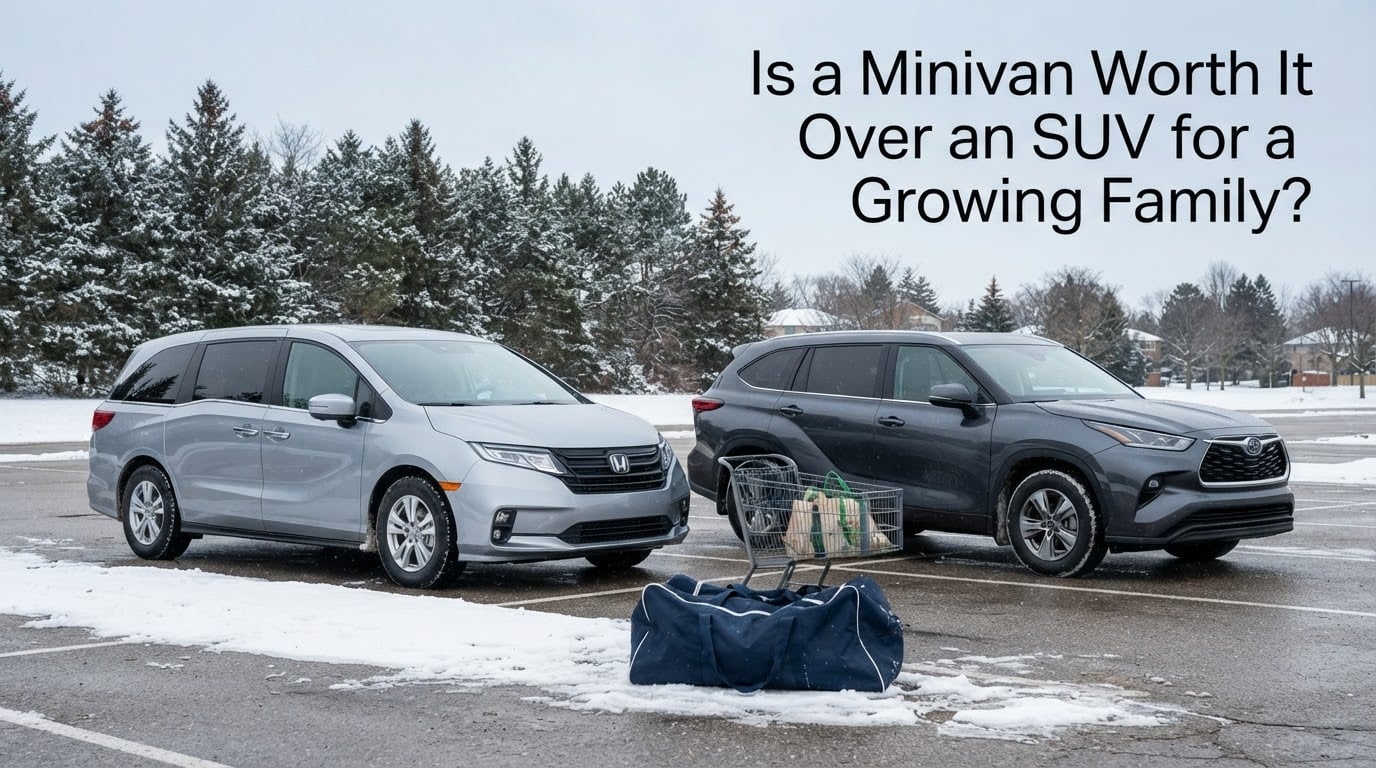
If you are weighing a minivan vs SUV for a growing family, you are probably past the specs stage and stuck on the real question: which one will make the next five years easier, and which one will not. This guide is a decision framework, not a sales pitch. We walk through the sliding door argument nobody else bothers to quantify, the third-row reality, the cargo math behind Costco runs, what an Edmonton winter actually demands from a family vehicle, and the running costs that nobody publishes.
My own family drove a crossover first, then borrowed a friend’s minivan for a week, then bought a different crossover. The week with the minivan was what settled it, and not because of anything I could have written down in a spec sheet. It was the door, the floor, and the third row.
Short version: for most families with two or more children in car seats, a minivan is the more practical vehicle. An SUV earns its place only when you genuinely need ground clearance, all-wheel drive on unplowed roads, or towing capacity well past five thousand pounds. Everything in between is usually a preference argument, and preference is a fine reason to buy a car.
What follows is the framework I wish I had before our test drives, updated with 2026 model-year information and current crash testing and fuel economy data. Last updated for October 2026.
Table of Contents
- Is a Minivan Worth It Over an SUV for a Growing Family?
- What a Minivan and a Three-Row SUV Actually Are
- Where the Minivan Wins
- Where the SUV Wins
- Edmonton Winter Driving: Winter Tires Beat All-Wheel Drive
- The Real Cost Difference Between the Two
- Used vs New: Where the Family Budget Breaks
- The Crossover Is the Honest Third Option
- Are Minivans Safe Enough for a Family?
- How to Decide: A Family-Size Rule
- Frequently Asked Questions
- What is the best vehicle for a growing family?
- Which is better for me, a 3-row SUV or a minivan?
- Why do people buy minivans instead of SUVs?
- Which is better for a family road trip, a full-size SUV or a minivan?
- Are minivans or SUVs better for families?
- Which 3rd row SUV has the least problems?
- What are the 5 worst SUVs to avoid?
- The Verdict
Is a Minivan Worth It Over an SUV for a Growing Family?
Usually yes, for most growing families. A minivan is worth it over an SUV when your daily life is car seats, a third child, big-grocery runs and long commutes on pavement, because it gives you sliding doors, more third-row legroom, more cargo behind the third row, and lower running costs. An SUV is the better choice when unplowed winter roads, heavy towing, or three teen passengers are part of the picture.
Everything below the answer comes down to three factors, and you can score yourself on each one in about two minutes:
- Do you have two or more children in car seats right now, or within the next two years? If yes, the sliding door and the third row matter more than almost anything else on the sheet.
- Do you drive unplowed rural roads, tow a camper or boat, or regularly leave the pavement? If yes, the SUV platform is doing something the minivan physically cannot.
- Will you need the third row for more than three years? If no, a two-row crossover is probably the honest answer and saves you both money and parking frustration.
Score yourself two out of three for a minivan, one out of three for a crossover, and all three for an SUV. Here is the head-to-head that no page-one competitor bothered to publish:
| Criterion | Minivan | Mid-size 3-row SUV | Full-size 3-row SUV |
|---|---|---|---|
| Rear door type | Power sliding, both sides | Hinged, narrower opening | Hinged, wide opening |
| Third-row legroom | Adult-usable, roughly 5 inches more than a mid-size 3-row SUV | Tight, best for smaller children | Usable, limited by cargo |
| Cargo behind row three | Best in class, often 140+ cubic feet with rows folded | Noticeably less behind an upright third row | More with row three folded flat |
| EPA combined fuel economy | Roughly 20 to 23 mpg, higher with a hybrid | Roughly 18 to 21 mpg | Roughly 16 mpg or lower on gas |
| Ground clearance | Low, roughly 6 inches | Mid, roughly 8 inches | High, roughly 9 inches or more |
| All-wheel drive | Toyota Sienna only | Common | Common |
| Towing capacity | Modest, family-holiday-trailer friendly | Around 5,000 lb class | Well past 7,000 lb |
| Total interior space advantage | About 15 inches more than a mid-size 3-row SUV | Baseline | Large, but cargo-heavy |
| Best for | Car seat logistics, third row daily, big-box runs | Mixed, moderate towing, some winter road | Rural winter, heavy towing, many passengers |
One note on those numbers. The EPA combined figure flatters front-wheel-drive vehicles and punishes all-wheel-drive ones, so a crossover rated lower on paper can beat a minivan in real life if most of your driving is highway. Our own highway commute on a winter road trip is where the gap closes noticeably.
What a Minivan and a Three-Row SUV Actually Are
A minivan is a car-based people carrier built on a unibody platform, with front-wheel drive or all-wheel drive, sliding rear doors on both sides, and three rows that are meant to be used every day. A three-row SUV is a taller, heavier vehicle built on a crossover or truck platform, with hinged rear doors, higher ground clearance, and available all-wheel or four-wheel drive.
That platform difference explains almost every other difference on this page. Minivans use car platforms and unibody construction, which is cheaper to engineer, lighter to build, more efficient to run, and better behaved in a side impact. SUVs use truck-based or crossover platforms, which buy ground clearance, payload and towing, and cost more of everything.
A word of caution about the word SUV. Sellers use it for everything from a small crossover to a full-size Expedition, so when you see a comparison, check which one is being compared. A two-row crossover and a full-size three-row SUV are different purchases, and the crossover is the one most families are actually shopping for.
Where the Minivan Wins
Sliding doors and one-hand child entry. This is the single most-cited real-world advantage in every family forum thread on this topic, and it is not a minor convenience. Getting a strapped-in toddler into a car seat in a parking lot, in the wind, while holding a squirming four-year-old’s hand, is a daily physical task. A sliding door opens in one motion and leaves a wide gap you can brace a shoulder against.
One parent on Reddit r/minivan described the moment that convinced her, after moving from a Nissan Pathfinder, that her two five-year-olds could open the sliding door themselves with a single button press. Child self-sufficiency is a real benefit, and no spec sheet credits it.
Third-row space that is genuinely usable. Mid-size three-row SUV third rows are regularly described by owners as a joke rather than a seat. A minivan third row fits a six-year-old with room to move. If your youngest is past car-seat age within the next couple of years, this is the difference between a family car and a shuttle that children resent.
Cargo behind the third row. The Costco and big-box run is where a minivan quietly wins. Behind an upright third row, minivans hold more usable rectangular volume than mid-size three-row SUVs, and the flat floor means a loaded box of paper towels does not slide into a well. It is the unglamorous reason parents end up choosing one.
Kid-focused features. Built-in vacuums, rear-seat screens, tri-zone climate control, stroller storage wells, hands-free liftgates, lounge seats with ottomans. Parents in forums also use the flat carpeted floor for wet-swim changing and picnicking when the weather turns, which is a hack, not a feature, but it works.
Ride and efficiency. A car-based platform is quieter over Edmonton roads and cheaper per kilometre. Hybrid minivans like the Kia Carnival and the Toyota Sienna hybrid add meaningful fuel savings on a mixed city and highway commute.
Where the SUV Wins
All-wheel drive on roads that are not cleared. This is the honest case, and it is a real one. If your commute crosses a rural stretch or a subdivision road that stays unplowed for weeks, all-wheel drive is worth having. So is the higher ride height and the ability to cross a snow bank without a tow.
Towing. Full-size three-row SUVs tow well past seven thousand pounds. Mid-size crossovers sit around the five-thousand-pound class. A minivan can pull a small holiday trailer, but if your trailer is heavy or your hitch needs real capacity, the SUV is the only real answer.
Visibility and seating height. You sit up higher, you see over traffic, and entry is easier for an adult with a knee issue. On a full-size SUV, the rear doors also open wide enough for bulky gear and a child seat at the same time.
Payload and platform durability. Truck-based platforms are built to carry weight over rough surfaces, which matters if the vehicle doubles as a work or recreational vehicle on weekends.
Here is the other side of that list honestly: most families use none of these capabilities. Paying SUV money for all-wheel drive you never use on a cleared suburban road is a real and common mistake, and it is worth asking yourself honestly before you sign.
Edmonton Winter Driving: Winter Tires Beat All-Wheel Drive
Every Edmontonian asking this question eventually gets to the same fear: what if I need all-wheel drive for the winter? Here is the part that matters more than the drivetrain. A minivan on proper winter tires will outperform an all-wheel-drive crossover on all-season tires in nearly every real winter condition, because the tire is the only contact point with the road and traction starts there.
Most Edmonton families keep one set of winter tires and one set of all-seasons on rims, and most of the year that all-wheel-drive system sits idle. Spend the same money on winter tires you would have spent on a drivetrain upgrade and you get more grip in January, March, and every freezing-rain day in between.
Ground clearance is the second winter factor, and it is the one where the minivan genuinely loses. Over deep unplowed drifts, a low step-in height can be a problem. If your route includes a named road that drifts, a road that is never plowed, a gravel lane, or a rural acreage property, clearance matters. Otherwise, on cleared city and highway routes, the minivan is fine.
Winter tires are also a genuine cost line item that this decision guide should not hide. A set of four winter tires mounted on your own rims is a real, recurring family expense, and the same line applies to both vehicles, so it does not tip the decision. It does tip the tires you buy, because a minivan on cheap tires is a poor winter car.
So for the majority of Edmontonian families, the honest answer to the all-wheel-drive question is: buy the minivan, and buy the winter tires. If you are rural, the SUV and its clearance earn their place.
The Real Cost Difference Between the Two
Purchase price is where this debate usually starts and where it usually stops. The wider cost picture matters more over five years, and it runs consistently in one direction: the minivan is cheaper to buy, to fuel, to insure, to tire, and generally to maintain.
Purchase. The average transaction price for a minivan sat meaningfully below the full-size SUV average in recent 2026 tracking, and below the mid-size SUV average too. The gap is not marginal, and it is one of the clearest reasons a family on a budget lands on a minivan.
Fuel. A typical minivan runs roughly 20 to 23 mpg combined, while large gas-powered three-row SUVs run roughly 16 mpg or lower. A hybrid minivan moves the number substantially in your favour, and a hybrid SUV narrows but does not close the gap. On a 48 km daily commute, the difference is real money every single week.
Insurance. Front-wheel-drive minivans generally cost less to insure than all-wheel-drive and four-wheel-drive SUVs of the same size. A family with several drivers and a tight budget feels this line in every renewal.
Tires. Three-row SUV tires are physically larger and cost more to replace, four per corner sets included. This is a small line item that repeats for as long as you own the vehicle.
Maintenance. Unibody, car-based platforms have simpler suspension, no transfer case, no low-range gearing, and no frame to inspect. The complexity you buy with all-wheel drive is complexity you pay to service.
Depreciation and resale. Here the trend has genuinely shifted. Minivans are not the automatic money-loser they were a decade ago. Minivan sales grew about 21 percent year over year to nearly 400,000 units according to Edmunds, and Toyota Sienna sales rose roughly 35 percent, as reported by CNN in July 2026. Demand has returned, which supports resale. A minivan bought new and sold in five years typically loses less ground than a large SUV bought new, which buyers now discount heavily.
For a family, that is a consistent direction of travel across five separate cost lines, not a single line. On a site called Frugal Edmonton Mama, this section is the whole argument.
Used vs New: Where the Family Budget Breaks
Used versus new is the most common question in the family-car forums, and the answer is less obvious than it looks. Three-year-old low-mileage three-row vehicles often barely discount off new, which leaves buyers feeling trapped. Meanwhile a five-year-old Honda Odyssey or Chrysler Pacifica has already taken its biggest depreciation hit and is a known quantity.
The tradeoff is warranty against discount. A new vehicle comes with a warranty that covers the expensive, infrequent failures, which is real protection for a family that cannot absorb a transmission or engine repair. A used vehicle buys that same protection in the form of a much larger price gap, and lets you step up to a higher trim level than you could afford new.
Reliability anxiety is the other half of the used conversation. Odyssey and Pacifica history makes some buyers nervous, and transmission complaints on certain model years are worth researching before you commit. The counterweight is worth hearing too: long-term owners on the Pacifica forums and Bogleheads threads report decades of trouble-free ownership. Own the model year you research properly and a used minivan is one of the safest bets in the segment.
My rule for families: if a five-year-old minivan with documented service history fits the budget with a repair cushion left over, it beats a new crossover. If the numbers only work by assuming everything goes wrong, buy new and get the warranty.
The Crossover Is the Honest Third Option
Most comparisons refuse to mention the third option, which is often the right one. If your children are spread out enough that the third row stays up permanently, a two-row crossover gives you the same driving footprint, the same ground clearance options, the same all-wheel drive availability, and better fuel economy and insurance than a three-row SUV. You lose the sliding door and the third row, but you were not using the third row anyway.
There is a boomerang pattern in the forums worth knowing about. Families move from a crossover to a minivan, back to a crossover when the kids get older, then back to a minivan again when the next child arrives. That is not indecision; it is the vehicle matching the family size at that moment.
Buy the body style that matches the next three years of your family, not the next ten. A family of four with one child in car seats is a crossover family right now, even if a minivan is on the horizon.
Are Minivans Safe Enough for a Family?
Yes. Current-generation minivans carry strong Insurance Institute for Highway Safety crash test results, and several models have earned Top Safety Pick+ status in recent testing. Check the current IIHS ratings for the specific model year you are shopping rather than relying on reputation.
Two structural points matter for parents. A minivan is smaller and lighter than a full-size SUV, which in a frontal offset crash is usually an advantage rather than a disadvantage. And a minivan’s low step-in height means children enter and exit at their own level, which reduces the risk of a fall during the most rushed, unsupervised moment of a parent’s day.
The honest caveat: a minivan is a tall vehicle with a high centre of gravity, so drive it with normal respect for that and keep the load inside the vehicle, not on a roof rack. Every other safety consideration, from rear automatic braking to 360-degree cameras to rear-seat screens for keeping children occupied, is available in the current crop at both body styles.
How to Decide: A Family-Size Rule
Before you test drive anything, answer three questions out loud. One: how many children, and for how long will the third row be in daily use. Two: what does your worst winter route actually look like, cleared or not. Three: what is your real budget once fuel, insurance and winter tires are counted, not just the payment.
With those answered, use these rules:
Choose a minivan if:
- You have two or more children in car seats, or another child arriving within two years
- You will use the third row more than three years running
- You do big-box, Costco, or gear-heavy grocery runs weekly
- Your winter driving stays on plowed city and highway routes
- You want the lowest running cost of the three options
- Sliding-door convenience solves a daily stress point for you
Choose an SUV if:
- You drive regularly on unplowed, drifted, or gravel roads
- You tow a camper, boat, or trailer above roughly five thousand pounds
- You routinely carry three or more teen passengers
- One vehicle has to work as a weekend recreational or work vehicle
- Ground clearance is a genuine requirement, not a feeling
Choose a crossover if:
- The third row would be up permanently anyway
- You are at the front edge of needing three rows, uncertain about the timing
- Fuel economy and insurance matter more than third-row access
- Parking in city garages or narrow streets is part of your week
| Your family situation | Duration | Recommended body style |
|---|---|---|
| One child, no car seats in the next year | Any | Crossover |
| One child in car seats, possible second within two years | 2 to 4 years | Crossover now, minivan when the second arrives |
| Two or more children in car seats | 4+ years | Minivan |
| Three children, mixed ages, third row used daily | Any | Minivan |
| Three or more teen passengers, or heavy towing | Any | Full-size SUV |
| Rural or unplowed winter route plus car seats | Any | Mid-size or full-size SUV with winter tires |
Whichever way you land, do one test drive properly. Bring the car seat. Bring a second adult. Try a parking-lot car seat install and a wet-floor child climb-in before you fall in love with the dashboard. Ten minutes of that beats an afternoon of spec sheets.
Frequently Asked Questions
What is the best vehicle for a growing family?
For most families it is a minivan, because it handles car seats, a third row used daily, and large shopping runs better than any other body style. Choose an SUV instead if you drive unplowed rural roads, tow heavy trailers, or carry three or more teen passengers. Choose a two-row crossover if the third row would stay up permanently anyway.
Which is better for me, a 3-row SUV or a minivan?
Count your car seats, your winter routes, and your towing needs. Two or more children in car seats plus cleared winter roads plus light towing means a minivan. Unplowed roads, a camper above roughly five thousand pounds, or three teen passengers means a 3-row SUV. If the third row would be up permanently, save the money and buy a crossover.
Why do people buy minivans instead of SUVs?
Families buy minivans for sliding rear doors, more third-row legroom, more cargo behind the third row, lower fuel and insurance costs, and features built for children such as built-in vacuums and rear screens. A minivan is also a car-based unibody, which makes it cheaper to buy and cheaper to run than a truck-based SUV of similar size.
Which is better for a family road trip, a full-size SUV or a minivan?
A minivan usually wins a family road trip on third-row comfort, low step-in height for children, interior width, and fuel cost per kilometre. A full-size SUV wins on ground clearance, all-wheel drive availability, and cargo once a row is folded flat. If your trip involves mountain passes, forest service roads, or a boat, take the SUV.
Are minivans or SUVs better for families?
Minivans are better for the physical logistics of small children, and SUVs are better for mixed winter and recreational use. Crash test results from the Insurance Institute for Highway Safety are strong for current-generation minivans, several of which have earned Top Safety Pick status, so the safety argument no longer favours the larger vehicle.
Which 3rd row SUV has the least problems?
Within a single brand, the same platform and powertrain usually matters more than the badge, so compare maintenance history and owner reports for the specific model year before you decide. If you want a shortlist rather than a model ranking, start with the Toyota Highlander, Kia Telluride, Honda Pilot, and Nissan Pathfinder, then check IIHS crash results and recall history for each.
What are the 5 worst SUVs to avoid?
That is a different question from this one, and building such a list would pull you away from the decision you actually need to make. Instead, watch for three-row SUVs with a cramped third row, low ground clearance marketed as off-road capability, and a powertrain with a weak reliability record for the model year. Test drive the third row yourself before ruling anything in.
The Verdict
Is a minivan worth it over an SUV for a growing family? For the majority of families reading this, yes. The sliding doors, the usable third row, the cargo behind it, and the lower running costs add up to a vehicle that is easier to live with every single day, and the stigma that once made the minivan feel like a demotion has largely disappeared. Minivan sales grew about 21 percent year over year and the segment is no longer the joke it was.
Buy the SUV instead when the reason is real: unplowed winter roads, ground clearance you will use, or towing well past five thousand pounds. Otherwise you are paying more for capability you will never touch.
Whatever you choose, test drive it with the car seats installed, in a parking lot, in the cold. That ten minutes will tell you more than every number in this article, including mine.