
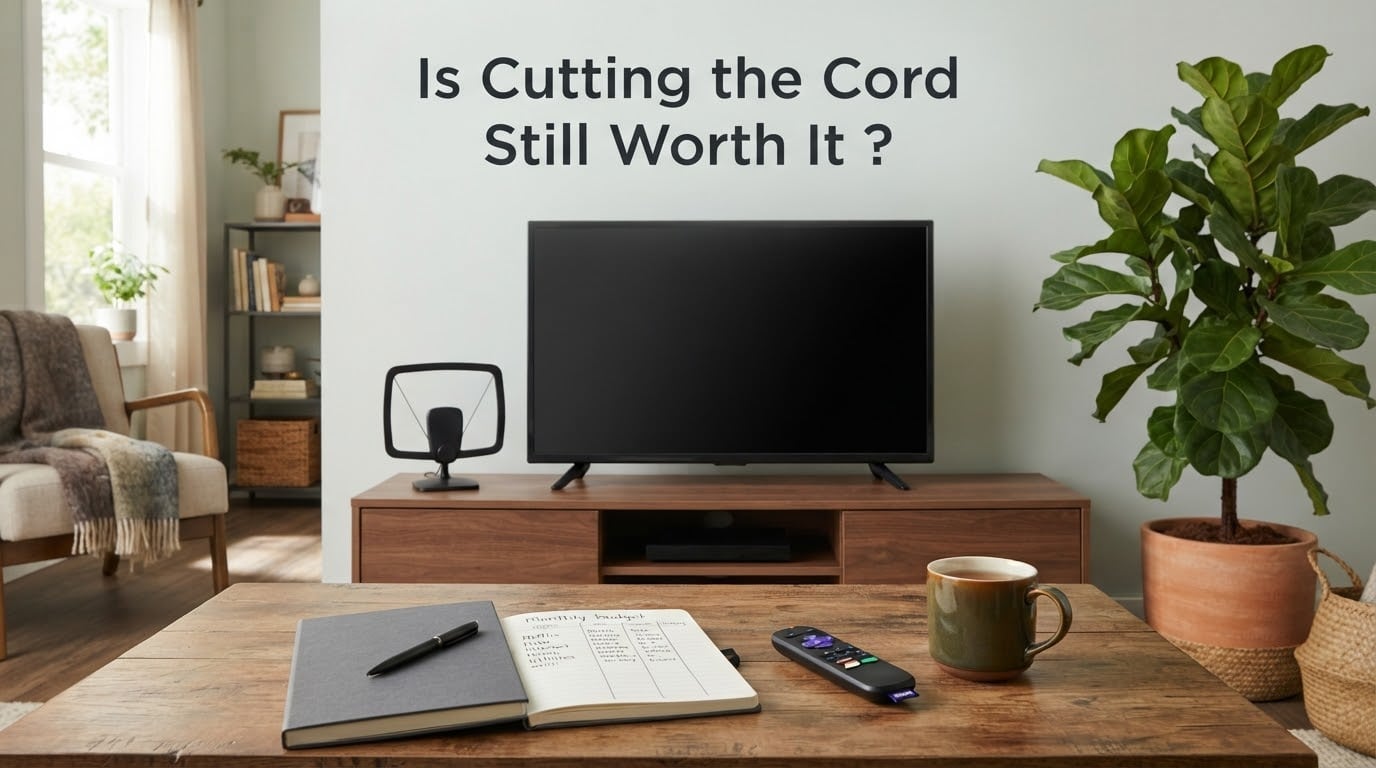
Short answer: yes, cutting the cord is still worth it in 2026 for most Canadian households, but the savings are smaller than they were five years ago and they disappear entirely for a few specific kinds of families. If your TV package is your biggest line item after rent and you watch mostly on-demand shows, you should do the arithmetic this month. If you need a regional sports network or a DVR, the honest answer is that you probably should not.
I have been the person in our house who tracks the subscriptions, and the question I get asked most often from friends is not really about antennas or streaming boxes. It is whether the swap is worth the effort and whether we will still be ahead in two years. So I built the framework I actually use, including the case where the answer is no.
Table of Contents
- Is Cutting the Cord Still Worth It? Yes for Most Homes, No for Some
- Cable vs. Streaming: What the Numbers Look Like in 2026
- The Break-Even Calculation: When Cord Cutting Pays for Itself
- What You Actually Lose When You Cut the Cord
- Do You Need an OTA Antenna? The Honest Reality Check
- Who Should Not Cut the Cord in 2026
- Why Families Are Leaving Cable Anyway
- How to Cut the Cable Cord Without a Termination Fee
- Ask for a Retention Discount Before You Cancel
- Build a Streaming Stack Without Subscription Creep
- Cutting the Cord for Parents and Seniors
- Cutting the Cord in Canada and Alberta
- Frequently Asked Questions
- Does cutting the cord really save money?
- How much can I save by cutting the cord?
- What percentage of households have cut the cord?
- Can I still watch local news without cable?
- Do I need an antenna if I cut the cord?
- How do I cancel cable and keep my internet?
- Is cord cutting legal?
- Why is my streaming bill higher than cable was?
- The Bottom Line on Cutting the Cord in 2026
Is Cutting the Cord Still Worth It? Yes for Most Homes, No for Some
Cutting the cord means cancelling your cable or satellite TV subscription and replacing it with a mix of over-the-air broadcast TV received through an antenna, free ad-supported streaming apps, and one or two paid streaming services. In 2026 that trade still comes out ahead for most homes, mostly because cable prices keep climbing while streaming prices have mostly flattened.
Here is the short version, so you can stop reading if it does not apply to you.
Cutting the cord is worth it if:
- Your cable or satellite TV costs more per month than you would spend on one streaming service plus a few free apps
- You watch most things on demand rather than live, and you can catch a big live event somewhere else
- You can receive your local broadcast stations with an antenna or a live TV streaming service
- Nobody in the house needs the cable DVR to record a weekly show
- You are disciplined enough to audit your subscriptions instead of collecting them
Cutting the cord is not worth it if:
- A regional sports network is non-negotiable in your household and you are done watching at a bar
- Your only local news source is a cable channel you would genuinely miss
- You live somewhere with weak indoor broadcast reception and the antenna hunt would eat your whole weekend
- You are cancelling on behalf of a parent who will struggle with a remote control
- Your current package includes several TV boxes, each billed separately, and those per-box charges are the real cost
Everything below breaks down how I get to that verdict, including a break-even calculation you can run with your own bill in five minutes.
Cable vs. Streaming: What the Numbers Look Like in 2026
Here is the comparison expressed as a share of your current basic cable TV package, so it holds whether you are on a modest plan or a premium one. I have avoided exact dollar figures here because both cable and streaming prices move constantly and any number in a blog post is stale within a month. The ratios do not change nearly as fast.
- Cable TV only, one box: 100% (the baseline). Nothing, this is the thing you are leaving.
- Live TV streaming service alone: roughly 50-80%. You give up most cable-only channels and some regional sports.
- Two on-demand services plus free tiers: roughly 40-70%. You give up all live TV and all local broadcast channels.
- Free tiers only (Tubi, Pluto, library Kanopy): close to 0%. You give up new releases, live sports, and most current movies.
- Antenna plus one on-demand service: roughly 20-40%. You give up subtle cable channels and some regional sports.
- Every major streaming platform: 100% or more. Nothing. You rebuilt the cable bill.
That last entry is the one that makes people angry, and it deserves an honest defence of cable. A commenter on thehackersparadise.com put it plainly: if you go into cord cutting thinking you need to duplicate your existing cable package, you will definitely not save money. A video on the wider cord-cutting discussion made the same point with a title I could not improve on: remember when we cut the cord to save money, and many of us are now paying more for streaming than we ever did for cable.
That is not a myth. Streaming services have raised prices, added ad-supported tiers, and split plans so that a household of four can quietly spend cable money on five subscriptions. If your plan is to cancel cable and then subscribe to Netflix, Amazon Prime Video, Disney+, Max, Peacock, and Paramount+, you have not saved anything.
The savings come from one specific discipline: cancel the TV, add at most one paid service, and treat everything else as free. Long-time cord-cutters on Reddit describe exactly this pattern, with one user saying he has not paid for TV in a decade and now runs on free tiers plus the streaming service already bundled with a package he was buying anyway.
The Break-Even Calculation: When Cord Cutting Pays for Itself
Here is the formula worth memorising, because it is the number that actually decides the question:
Break-even point (in months) = total upfront equipment cost divided by your monthly savings.
Measure both sides in months of savings rather than dollars and the arithmetic becomes trivial. If your antenna and streaming device together cost about what six months of savings add up to, you are at your break-even point in six months. If the same gear costs as much as two years of savings, you are waiting 24 months to come out ahead, which is a long time to be annoyed.
A worked example in relative terms: if your TV portion of the bill is roughly double what a single streaming service costs, your monthly saving equals the cost of your basic streaming service. A modest antenna and a streaming stick together usually run close to two streaming services in cost, which puts a careful household at roughly a two-month break-even point.
Now add the hidden replacement costs that are easy to forget, because this is where most failed calculations go wrong:
- Antenna and amplifier if your indoor reception is marginal
- A streaming stick, unless you already own a smart TV with the apps you need
- An HDMI cable, if the one you have is not in the same room as the device
- Movie rentals or purchases you used to get through your cable package
- The sports bar or arena tickets that replace a weekend game
- Any extra simultaneous-stream fees if your household watches at the same time
One personal-finance blog ran these numbers with a very small monthly saving and landed on a payback period of about 22 months. That is not a sign the method is wrong. It is a sign that a household already spending very little on TV has almost nothing to gain, and the effort is better spent elsewhere.
What You Actually Lose When You Cut the Cord
Every cord-cutting article leads with savings. Very few lead with the losses, which is why so many people try it and quietly go back. Here is the honest list.
Live sports, especially regional networks. This is the single biggest reason people cancel and then cancel the cancellation. Regional sports networks have been dropping off live TV streaming services one by one, and several leagues have moved their games behind paywalls that streaming simply does not carry. A user whose family went back to cable because sports-bar costs exceeded the savings is not unusual.
Local news and weather. You can keep most of it, but not automatically. Local broadcast affiliates are free over the air, which means an antenna gets you the big network feeds but often not the local channel you actually watch. Some local stations have streaming apps of their own. Others have simply gone dark on streaming and exist only as a broadcast signal.
The DVR. This one hurts more than people expect. Recording and time-shifting is the feature families miss most, and replacing it means either a paid cloud DVR with a storage limit, a broadcast-network DVR tuner, or a digital video recorder that you configure yourself.
Live cable-only channels. News channels, lifestyle channels, and a long tail of channels nobody misses until they are gone.
The set of working remotes and a single menu. I do not consider this a joke. The number of remotes on my coffee table dropped from four to two, and my household stopped losing the clicker.
Being able to add a channel in thirty seconds. Search burden is a real cost. Figuring out which service carries which channel is tedious, and it is the task that most often defeats a new cord-cutter in the first month.
Do You Need an OTA Antenna? The Honest Reality Check
An over-the-air antenna is how you keep free local broadcast channels after cutting the cord, and it is where most first attempts fail. What you get for free is what your local broadcast tower transmits: your affiliate network feeds, plus a handful of independent and digital-only subchannels.
The reality check is that reception is a location problem, not a product problem. Users on cord-cutting forums describe the same pattern: an indoor antenna works in one room, fails in another, and must be physically repositioned when a big event comes on. One writer whose first antenna could not reach a major championship network improvised by balancing it on a lamp.
Before you spend anything, check what you already have. Many smart TVs from the last several years include a digital tuner, which means you only need the antenna. In apartment buildings, check your lease and your rooftop access first, because balcony and rooftop placement changes reception more than any antenna on the market.
Two situations where an antenna will not save you: if you are deep inside a concrete building with no balcony or rooftop access, or if the transmitters you need are blocked by terrain. In both cases a live TV streaming service is the cheaper path than a weekend of testing.
Who Should Not Cut the Cord in 2026
This is the section I wish more cord-cutting guides would write, because the question is genuinely a yes-or-no question and most answers only cover the yes. If any of these describe your household, keep your cable and spend your energy negotiating instead.
Households that watch regional sports. If the games are the reason the television exists in your house, the replacement costs decide it, not the headline savings. A live TV streaming service that does not carry your network plus a season of sports-bar tabs is usually worse than what you had.
Households with several TV boxes. Cable providers bill each additional box monthly, and that per-box charge is often the single largest line on the bill. If you have three boxes, your real cable problem is the boxes, not the channels, and the fix is to call and consolidate rather than to cancel.
Households where someone records the news or a weekly show. Rebuilding a reliable recording habit from scratch takes an afternoon and a device, and it does not work well for everyone. If nobody in the house is willing to own that project, the money you save is not worth the daily friction.
Households helping a parent who lives alone. Technical support is a real cost even when it is free. A user who helped his octogenarian parents switch to a live TV streaming service described it as several in-person setup visits, and that labour has to be counted.
Households already paying very little for TV. Break-even math is unkind to small numbers. If your TV is a minor expense, the equipment and the setup weekend cost more in time than the subscription costs in years.
Why Families Are Leaving Cable Anyway
The shift is real and measurable, which matters because it tells you whether cable has any long-term pricing power left to bargain with. Reporting on the cord-cutting market, citing MoffettNathanson, put US cord-cut households above 80 million and pay-TV subscribers down by about 6 million in 2025, which was described as the largest single-year decline on record. Households with any kind of pay-TV subscription were reported at roughly a third of all households by late 2025.
Three forces are doing the work, and none of them is nostalgia:
- Cable prices have climbed for years while streaming plans have stayed comparatively flat, widening the gap every January
- Ad-supported free tiers now carry enough programming to satisfy a casual viewer at no cost
- One streaming service bundled with something you already pay for, like a retail membership or a mobile plan, is often the only paid service a household actually needs
About a third of households also still pay for both cable and streaming, which is worth keeping in mind. Cable is not dying out. It is becoming a premium niche product for households that need specific live content, and pricing follows that reality.
How to Cut the Cable Cord Without a Termination Fee
Work through these in order. Rushing this is how people end up paying equipment charges they did not have to.
Step 1: Audit what you actually watch for one week. Every title on a list, not a feeling. This takes ten minutes and it is the step that prevents the whole project from failing.
Step 2: Get your real current number. Pull up the itemized bill and find the TV portion, the equipment charges, and any bundle discount that is attached to having television with them. This last part is the one people miss.
Step 3: Negotiate before you cancel. See the next section. A retention offer is faster than a new setup and it is free to ask for.
Step 4: Cancel television only, and say so explicitly. Tell the representative you are keeping internet and removing television, and ask them to confirm that in writing. If you simply stop paying, providers assume you want everything.
Step 5: Return every box, and photograph the return. Unreturned equipment is the most common avoidable charge. Get a drop-off receipt for each box, and photograph the serial number as you pack it.
Step 6: Watch the next bill in full. Confirm the TV portion is gone, the equipment charges stopped, and the internet price did not jump. Some providers raise the internet rate when television is removed from a bundle, and it shows up on the following invoice rather than the cancellation call.
Ask about notice periods when you call. Many providers require notice before the change takes effect rather than cancelling on the spot, so plan the equipment return for the right week rather than guessing.
Ask for a Retention Discount Before You Cancel
Retention teams are authorized to discount, and the offer costs them far less than the churn costs the provider. A customer who stays at a reduced rate is a win for them, which means you are not asking for a favour.
Call, be polite, and be specific. Something close to this worked for me:
“I have been a customer for a number of years. I am looking at removing the television portion, but before I do I would like to see what you can do on the bill. If we cannot get the monthly cost down, I will cancel the television this month and keep the internet.”
Three rules for the call. Do not threaten to cancel before you have heard the offer, because the first offer is rarely the last one. Do not accept anything verbally. And do not accept a discount that requires signing a new long-term term, because that trades a monthly saving for a new lock-in.
If they will not move on price, ask about equipment consolidation, removing an unused box, or a channel-level trim. Those changes are smaller but they are immediate and they do not require new hardware.
Build a Streaming Stack Without Subscription Creep
Subscription creep is the number one complaint in every cord-cutting forum I read. People rebuild their cable bill one app at a time and then act surprised. The defense is a stack you decide on once, in advance, by household type.
Budget-first household. Free tiers plus a library card for Kanopy, which offers a large film and documentary catalogue at no cost through most public libraries. Add one paid service only if the household genuinely watches it every week.
Binge-watching household. One on-demand service is almost always enough, because the back catalogue is where the value is. Add a second one only after a full month, and only if you can name what you will watch on it.
Sports household. A live TV streaming service that carries your network, plus an antenna for local games. One forum user picked up a free month of a service solely to catch a single event and cancelled immediately afterward, which is a perfectly valid strategy for a championship.
Local news household. An antenna for broadcast affiliates, then check whether your local station has its own app. This is the stack most likely to disappoint, so test it before cancelling anything.
Then set the quarterly audit. Once every three months, open the subscriptions list on whatever account you manage the family through, cancel anything unused in the last 90 days, and check the total against your budget. Set a repeating calendar reminder, because the failure mode is not a bad decision, it is a decision you never revisit.
One habit worth naming: cancel the same day you need something. Buying a single event month and letting it auto-renew is how households end up paying for six services they watch for six hours each.
Cutting the Cord for Parents and Seniors
Helping a parent cut the cord is a different project from doing it yourself, and the money is rarely the hard part. The hard part is that you are not the user, you are the unpaid support desk.
Before you start, watch what they watch for a full week and write it down. An adult child who assumes their parent wants streaming is frequently wrong, because the habit is the point rather than the content.
Then pick the simplest stack that covers it. A smart TV with one streaming app, an antenna, and nothing else will serve more people than a five-service lineup with a new remote every month. Several cord-cutters described the transition as taking multiple visits, so plan for more than one.
Set expectations out loud: what it costs, what it does not include, and who to call when the remote stops working. Write the provider’s phone number on a card by the television, because the first time something breaks is not the time to search for a support number.
And keep the old remote until the new one is understood. I have seen more households abandoned a perfectly good setup over a clicker than over anything in the programming.
Cutting the Cord in Canada and Alberta
Canadian pricing changes the arithmetic in a way US-focused cord-cutting guides miss. Many smaller Canadian markets, including parts of Alberta, carry higher cable pricing than the large US metropolitan averages those guides are built on. The same streaming plan buys you more in most of the US than it does here, so the gap that made cord cutting obvious five years ago is narrower.
Two local specifics are worth knowing before you call. First, check whether your television is holding a bundle discount on your internet. Providers in this market commonly discount internet when television is attached, so removing television can raise the internet side more than you expect. Ask for the internet price with and without television before you decide.
Second, ask about the notification period in your province. Cancellation notice and equipment return rules are not identical everywhere, and the return window is the thing that generates the fees people complain about online.
One more money detail that gets overlooked: taxes are charged on streaming subscriptions the same way they are charged on cable. When you run your comparison, apply your provincial tax rate to the streaming side too, and it closes some of the gap that made the headline savings look bigger.
Frequently Asked Questions
Does cutting the cord really save money?
It saves money when your television is your largest recurring household expense and you replace it with one paid streaming service plus free tiers. It does not save money if you subscribe to every major platform, because several services together cost at least as much as the cable package you left. It also does not save money if you need a regional sports network and you pay to watch games elsewhere.
How much can I save by cutting the cord?
Most households land somewhere between 30 and 60 percent of their former television cost, depending entirely on how many paid streaming services they actually keep. A free-tier-only household saves nearly all of it, and a household keeping one live TV streaming service plus extras saves considerably less. Run your own numbers by dividing your itemized television charge by the number of paid services you would realistically keep.
What percentage of households have cut the cord?
Reporting that cites MoffettNathanson put the number of US households that have cancelled traditional pay television above 80 million, and described a pay-TV subscriber decline of about 6 million in 2025 as the largest single-year drop on record. By late 2025 roughly a third of US households still held any pay-TV subscription. Figures in this space are estimates and definitions differ, so treat them as direction, not precision.
Can I still watch local news without cable?
Usually yes, but not always in the form you want. An over-the-air antenna receives local broadcast affiliates free, which covers the major network feeds. It frequently will not include the specific local channel you watch, and some local stations have stopped streaming online entirely. Before cancelling, check whether your local station offers its own app, because that gap is the one that makes people regret the switch.
Do I need an antenna if I cut the cord?
You only need one if you want to keep local broadcast channels for free, and only if you can get a usable signal. Many recent smart TVs include a digital tuner, so you may need the antenna and nothing else. Reception is a building problem more than an antenna problem: concrete, floor position, and distance to the transmitter matter more than price. If you cannot get a stable indoor signal, a live TV streaming service is the better path.
How do I cancel cable and keep my internet?
Call your provider, state clearly that you are removing television and keeping internet, and ask for written confirmation of exactly what is being removed. Watch the next full itemized bill, because some providers raise the internet rate when television comes out of a bundle. Return every set-top box with a receipt and photograph the serial numbers, since unreturned equipment is the most common avoidable charge.
Is cord cutting legal?
Yes. Cancelling a subscription and receiving broadcast television over the air are both entirely lawful, and there is no legal requirement to hold a pay-TV licence. The only contractual points are your notice period and any early termination terms in your agreement, which you should read before you cancel rather than after.
Why is my streaming bill higher than cable was?
The usual cause is that you subscribed to every platform instead of one or two, which is the fastest way to rebuild a cable bill without meaning to. The second cause is lifestyle creep, where a family adds a service per member. The third is that a sports or news dependency pushed you toward an expensive live TV service, which is the one category that genuinely costs cable-like money. Audit the subscriptions first, because in most cases the fix is cancelling, not switching.
The Bottom Line on Cutting the Cord in 2026
Cutting the cord is still worth it in 2026, but it is now a decision about habits rather than about price. The savings are real when you replace a cable package with one streaming service and free tiers. They vanish the moment you start collecting subscriptions, and they never exist for households that genuinely need regional sports or a working DVR.
So do the part that takes ten minutes: pull out the itemized bill, write down the television charge, write down what you actually watch, and ask your provider what they can do before you cancel. If the number they come back with makes you shrug, the arithmetic will make you shrug too. That is the whole test.