
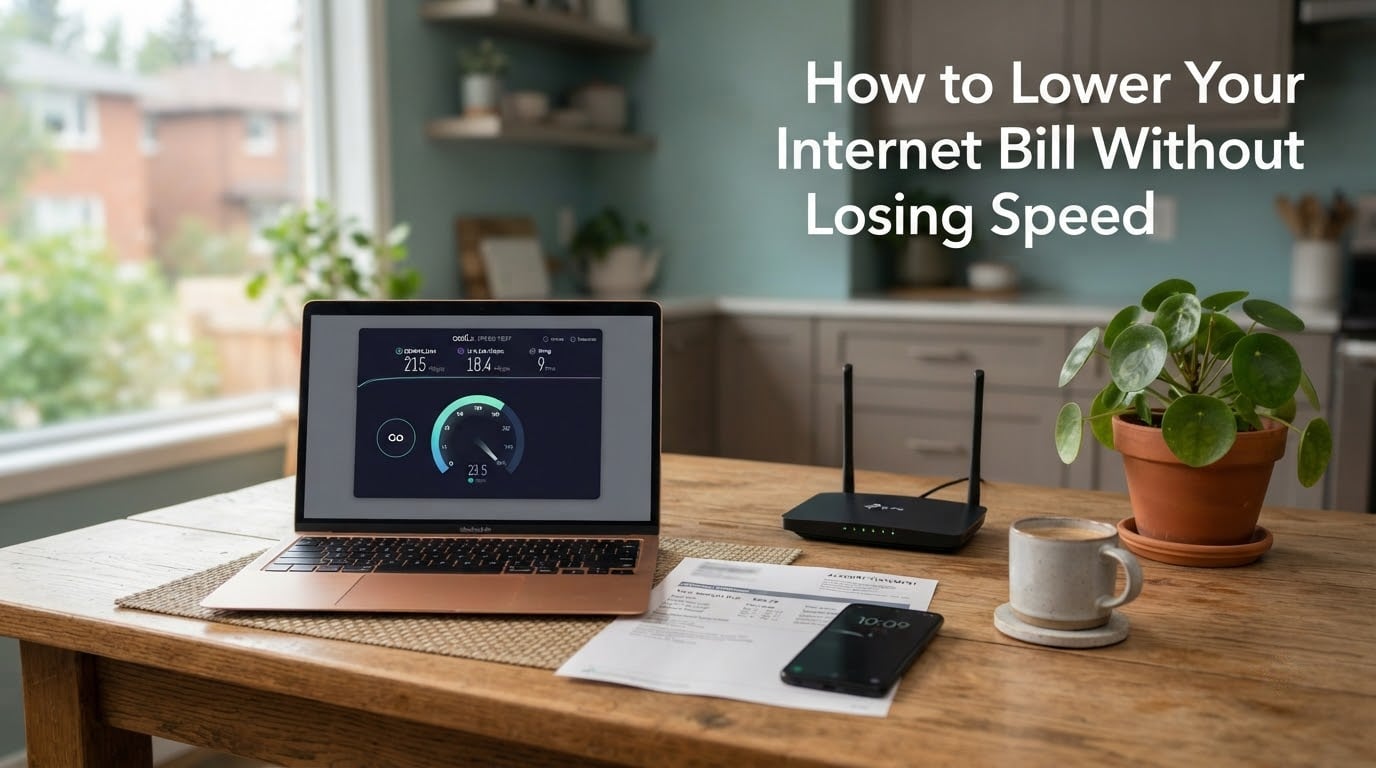
If your internet bill climbed after a promotional rate ended, the fastest way to cut it back is to match your plan to what you actually use and to remove the line items you never touch. In my experience helping Edmonton households audit their bills, the money is almost always hiding in three places: a speed tier you stopped needing, equipment rental fees, and a bundle you stopped watching years ago.
That is the honest version of how to lower your internet bill without losing speed. The phrase matters, because most advice in this space tells you to downgrade to the cheapest plan and hope. Downgrading blind is how people end up with buffering video calls in a house that pays for gigabit service and uses about a fifth of it.
Below is the method our team uses: audit the line items, measure what your household really pulls, right-size the tier, then call the retention department with a script. We have also flagged which US-only discount programs do not apply in Canada, because a lot of that advice circulates here and quietly does not apply.
Table of Contents
- How to lower your internet bill without losing speed: a 7-step checklist
- How much internet speed you actually need (and how to check)
- Why your internet bill went up: the hidden line items
- Buy your own modem and router – run the compatibility check first
- When your promotional rate expires
- The call script: exactly what to say, and what not to say
- What each money-saving move is actually worth
- Free and low-cost internet options in Canada
- Switching providers without losing service
- Frequently Asked Questions
- How do I get my internet bill lowered?
- Can I negotiate a lower internet bill?
- What should I say to lower internet bill?
- What makes your wifi bill go up?
- Is one hundred dollars a month too much for internet?
- What takes up most internet usage?
- Why did my internet bill increase so much?
- How can I get internet for very little each month?
- The bottom line
How to lower your internet bill without losing speed: a 7-step checklist
Here is the whole method in order. Each step is independent, so you can stop whenever you have taken out everything you are comfortable with.
- Audit every line item on the bill, not just the base internet rate. Look for equipment rental, broadcast or HD TV fees, a home phone line, extra set-top boxes, and installation charges.
- Run a speed test on wired Ethernet, ideally at three different times of day, and write down the result next to the speed tier you are paying for.
- Match the tier to household use using the table below. Most Canadian homes do not need gigabit internet.
- Buy your own modem and router if you are on cable or DSL, and only after confirming your provider’s approved-modem list.
- Call the retention department, not the general billing line, and use the script further down this page.
- Ask for a price lock on whatever rate you agree to, so the same increase does not repeat next year.
- Set a calendar reminder for one month before any promotional term or contract ends, and repeat the whole process.
Do the first two steps before you call. A household that knows its own usage gets treated differently than one that simply complains.
How much internet speed you actually need (and how to check)
Most people overpay for speed because they read the largest number a provider advertises. The honest answer is that download speed needs scale with the number of people online at once, not with the size of the household’s TV.
| Household profile | Devices active at peak | Comfortable download speed |
|---|---|---|
| One person, light use | 1 to 3 | 100 Mbps |
| One or two people, streaming in HD | 4 to 6 | 300 Mbps |
| Family of three or four, 4K on one screen | 7 to 10 | 500 Mbps |
| Four or more people, work from home plus 4K | 11 to 15 | 600 to 1000 Mbps |
| Gamers, large downloads, shared fibre | 10+ | 1000 Mbps |
To check what you actually pull, run a speed test three times: once mid-morning, once around seven in the evening, and once after dinner. Run it with a laptop plugged into the router by Ethernet cable, not over Wi-Fi, because a wireless test measures your router and your walls as much as your connection.
Then take the lowest of the three results. If your lowest result is well under the tier you pay for, you are overpaying for speed you never use. If it sits right at your tier’s ceiling during evening hours, your plan is correctly sized and you should look at the line items and the promotional rate instead of the speed.
Two more things distort the test. Public or building Wi-Fi gives you the building’s speed, not yours. And upload speed is a separate number that matters enormously for video calls and cloud backups, so note it separately rather than assuming it matches download.
Why your internet bill went up: the hidden line items
Bills rarely jump because one number changed. They jump because a promo ended and a fee you forgot about quietly continued. Go through this list line by line.
- Modem or gateway rental, commonly ten to fifteen dollars a month for hardware you never think about.
- Broadcast or HD TV fee and per-box charges if you kept a set-top box in a closet.
- Home phone line billed as a bundle component you stopped using but never removed.
- A second gateway or extender charged monthly rather than bought once.
- Promotional pricing that expired and reverted to the regular rate, often the largest single jump.
- Late fees and installation charges from a past move or activation.
- A tier bump from an “upgrade” you agreed to on a retention call two years ago and forgot about.
The bundle trap deserves its own warning. On several plans, dropping television triggers a price increase on the internet side, so removing TV can raise your total. Ask for the new internet-only total before you agree to anything, and only accept if it is genuinely lower than the bundled total.
Buy your own modem and router – run the compatibility check first
Buying your own equipment removes a monthly rental fee permanently, and over two to three years the arithmetic is easy. Rental pays for itself against a purchased unit quickly, because the rental never ends.
The catch is compatibility, and skipping this step is the most common expensive mistake in the whole process. Before you buy anything, find your provider’s approved-modem list and check the exact model number. An unapproved modem can mean an unactivated line, a technician visit, or a technician visit at your expense.
Also check the technology. If you are on cable or DSL, a DOCSIS modem or DSL modem is the right purchase. If your new fibre service uses an optical network terminal that your provider installs and owns, buying a modem does not remove that fee, because you are not permitted to attach your own unit to a fibre line. Ask the provider who owns the terminal on your specific building before you assume this applies to you.
A router is different. If you have a separate router and the provider’s modem is in bridge or passthrough mode, a good Wi-Fi router of your own often improves coverage in a larger Edmonton home as much as any plan upgrade would.
When your promotional rate expires
Yes, the jump after a promo ends is normal, and it is the single most common reason a household bill doubles after two years. Providers price aggressively for the first term because acquisition costs more than keeping you, then reset you to the regular rate.
Call thirty days before the promotional term or contract ends, not after. The retention team has authority to offer something better when it is cheaper for the provider to keep you than to lose the account. Call after the expiry and you are simply asking them to undo a decision they already made.
Ask three questions on that call: what the regular rate will be when the promo ends, whether a price lock is available, and what the early termination fee is if you decide to switch instead.
The call script: exactly what to say, and what not to say
Call centres usually have no authority to change your rate. The retention department does. Ask for it in your first sentence rather than after twenty minutes of small talk, and have your bill, your speed test numbers, and one competing provider’s plan price in front of you.
Say this:
- “I have been a customer for a number of years and I am looking at my bill with you, not cancelling yet. I would like to see what retention can do on my rate.”
- “I ran a speed test and my household uses about a third of this tier. Can we move me to a lower speed tier on the same network and keep unlimited data?”
- “My equipment rental is a monthly line item I want removed. What is the cost of a modem I own instead, and is it on your approved list?”
- “I want to cancel at the end of this billing cycle unless I can get the rate down. What can you offer?”
- “If I stay at this price, can you lock it for 24 months so it does not increase?”
Do not say this:
- “Cancel my service right now.” before you have an offer in hand. Announcing cancellation before they have made a counter-offer removes your leverage.
- “I demand a supervisor.” Escalating to a supervisor first usually gets you a callback to the same desk in a week.
- “I will post about this everywhere.” Threatening a review is an ending, not a tactic, and it ends the call.
- Any specific number you have not verified. Bluffing with a fake competitor offer is a bad idea; the number is easy to look up.
Forum threads are consistent on why this works. On r/personalfinance, a widely upvoted post described a bill cut from sixty-five dollars to forty-one dollars after the poster stated plainly that they intended to cancel. On r/Frugal, users report that calling specifically to cancel is what unlocks a real discount, while a general service call typically produces only a small credit. On r/Comcast_Xfinity, repeated posts describe promotional terms ending and bills jumping sharply, which is exactly why the timing above matters.
Be honest about the failure case. If retention has nothing to offer after two attempts, negotiation has done its job and switching providers is the remaining answer. Walking away is a legitimate outcome, not a defeat.
What each money-saving move is actually worth
Order your attempts by effect and effort. Several of these take one phone call and pay for a year.
| Move | Typical effect | Time to apply | Risk |
|---|---|---|---|
| Move to a lower speed tier after a speed test | Large monthly change | One call | Low, if measured first |
| Remove equipment rental, buy approved unit | Ten to fifteen dollars monthly | Same day | Medium, check approved list |
| Drop unused TV, phone or extra boxes | Several dollars to twenty monthly | One call | Medium, internet rate may rise |
| Retention or loyalty offer on the same plan | Varies widely | One call | Low |
| Ask for a 24-month price lock | Zero now, prevents a future jump | One call | Low |
| Switch to a competing provider | Largest possible change | Weeks | High, install delays and term fees |
Add up the first four rows before you research competitors. Plenty of households land a meaningful monthly reduction without moving a single connection, and switching introduces install delays and contract risk that the savings sometimes do not justify.
Free and low-cost internet options in Canada
Some of the largest reductions available come from programs rather than negotiation, and Edmonton has several worth checking.
- Library hot spots are borrowable portable modems from Edmonton Public Library, with a data cap rather than a monthly bill. Good for a few weeks of travel or a temporary gap.
- Community and public wifi covers libraries, community centres, and many municipal buildings, free for short sessions.
- Senior discounts are offered by several Canadian providers, usually requiring proof of age, and are far more widely available here than in the United States.
- Student discounts exist at most major providers if you are currently enrolled and can verify through your institution.
- Low-income connectivity programs run through provincial and federal programs in Canada, and eligibility varies.
One important flag: the Affordable Connectivity Program, which subsidizes service in the United States, does not exist in Canada. The same applies to several senior discount programmes found on US sites. If a page assumes a US address, the advice will not transfer.
For Edmonton specifically, TELUS PureFibre, Rogers Ignite, and Shaw all compete in the city, alongside some regional fibre providers in outlying neighbourhoods. Because cable, fibre, and fixed wireless behave differently at your address, check what technology actually reaches your door before comparing headline speeds.
Switching providers without losing service
Switching gives you the biggest possible saving but carries the most risk, because your problems become installation and contract problems instead of billing problems.
- Check your contract term first. Leaving early can trigger an early termination fee large enough to erase a year of savings.
- Ask for the new install date in writing and confirm it is before your current service end date, not after.
- Book the new service to activate after the old one ends to avoid paying two providers in the same month, or overlap by a few days if you cannot get a same-day cutover.
- Keep the old modem working until the new one is confirmed live, then return rental equipment promptly to avoid another month of fees.
- Test on the new connection before cancelling anything. A technician visit or a firmware issue is far easier to fix while your old service is still active.
- Keep the router you own. If it is compatible with both providers, a switch costs you nothing in hardware.
On r/Spectrum, users describe a workaround that circulates widely: cancel at the very end of the billing cycle, wait a day, then reconnect as a brand-new customer to pick up current promotional pricing. It can work, and it carries real risk, including losing promotional pricing for a length of time, having to reinstall equipment, and landing on a rate the provider treats as a special exception. Use it only after you have confirmed your terms and never mid-contract.
Frequently Asked Questions
How do I get my internet bill lowered?
Audit the bill line by line first, then move to a speed tier that matches a wired speed test, remove equipment rental by buying an approved modem, and call the retention department rather than general billing. Retention staff are the only team with authority to change a rate. Ask for a 24-month price lock on any new rate so the increase does not repeat next year.
Can I negotiate a lower internet bill?
Yes, and most households never try. Providers price new customers aggressively because acquisition costs more than keeping an existing one, which means retention has room to discount. Call, state your intent to cancel at the end of the billing cycle, and ask what they can do. If the first offer is small, politely ask to be transferred to retention.
What should I say to lower internet bill?
Say that you have been a customer for years, that your rate is higher than a competitor’s for a similar tier, and that you intend to cancel at the end of this billing cycle unless something changes. Do not threaten reviews or demand a supervisor first, and do not announce cancellation before you have an offer in hand. Have your bill and a competing plan’s price ready.
What makes your wifi bill go up?
Most often an expired promotional rate reverting to the regular price. Other common causes are equipment rental charges, a broadcast or HD TV fee, a home phone line added to a bundle, extra set-top boxes, a second gateway, and installation or late fees. Read the full bill rather than the summary box, because these items are itemized below the headline rate.
Is one hundred dollars a month too much for internet?
For a single Canadian household with unlimited data, it is high, especially on cable where comparable tiers cost substantially less. Providers commonly quote four figures annually for gigabit service in an introductory promotion, so a large bill often reflects a promotional rate that has not expired yet. Check whether you are still on a promo and what the regular rate will become.
What takes up most internet usage?
High-definition and 4K streaming, video calls, online gaming, and large game or file downloads dominate a normal household’s usage. Background activity such as cloud backups, video calls with cameras off, smart home cameras, and streaming to unused televisions consumes far more than most people expect. Use your router’s traffic report to find out which devices are responsible.
Why did my internet bill increase so much?
Because promotional pricing almost always expires, typically after 12 or 24 months, and the plan reverts to its regular rate. On r/Comcast_Xfinity, users repeatedly describe large jumps at exactly that point. A second cause is bundle add-ons you stopped using. If the increase is not explained by a promo expiry, call billing and ask them to identify the specific line item that changed.
How can I get internet for very little each month?
In Canada, look at library hot spots, community and public wifi, senior and student discounts from providers, and provincial low-income connectivity programs. In the United States, the Affordable Connectivity Program subsidizes service, but it does not exist in Canada and does not apply to Canadian households. Many low bills in Canada come from internet-only pricing on cable rather than fibre.
The bottom line
To lower your internet bill without losing speed, work in this order: audit the line items, measure real usage on wired Ethernet, right-size the tier, remove equipment rental, then call retention with a script and ask for a price lock. Each step is reversible, and the first four usually cost nothing but an afternoon.
Before any promotional term ends, put a reminder in your calendar for thirty days before the date. That single habit does more for most households than hours of research, and it is the difference between catching a rate change and reacting to one.