
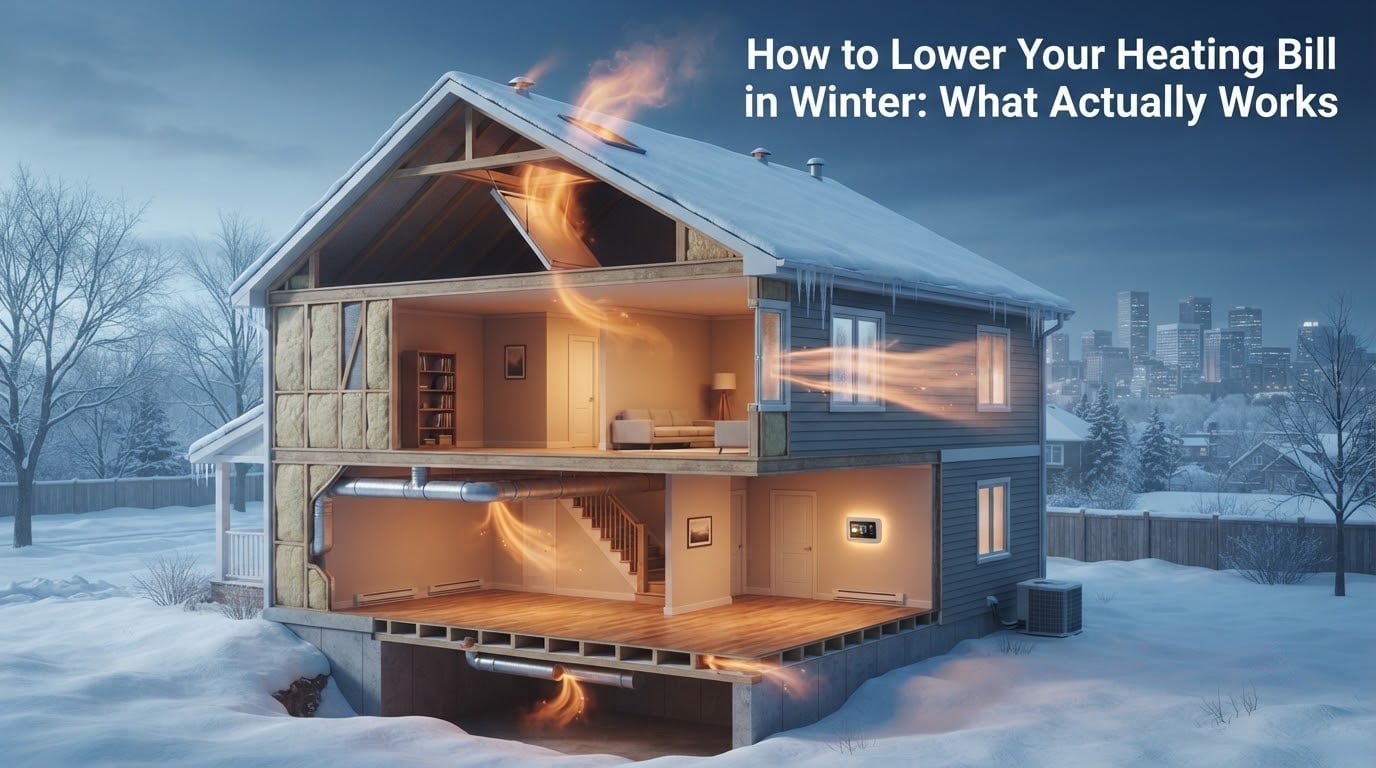
Every January, the same thing happens in this city. The gas bill lands, it is much bigger than the one before it, and somebody starts wondering whether the furnace is broken. It usually is not. Your bill went up because the weather turned and because heat is escaping through the same doors, windows, attic hatch and duct seams it escaped through last year.
This guide covers how to lower your heating bill in winter, ranked by how much each step actually moves the number, with the effort and payback for each one. It is written for Edmonton and Alberta homes, but the physics hold anywhere with a cold winter. I have paid these bills, made these mistakes, and chased the savings line items on statements until I could explain them. Last reviewed for 2026.
Before the list, the honest version: the biggest wins come from three places, and only one of them is behaviour. You are asking the furnace for a lower temperature, you are slowing down how fast heat leaves, or you are making the equipment and ducts deliver more of what they burn. Everything below attacks one of those three terms.
And a warning before we start. A few popular ideas, including the ones that show up at the top of most lists online, do not work and can cost you more. Those get their own section further down.
Table of Contents
- What Actually Lowers a Heating Bill in Winter, Ranked by Real Impact
- The Thermostat Rules That Matter in a Cold Climate
- Stop Heat From Escaping: Doors, Windows, Vents and Ducts
- Furnace Efficiency: Filters, Tune-Ups and Duct Sealing
- Insulation and the Envelope: Attic First, Always
- Heating the Person, Not the Space
- What Does Not Work (and Costs More Than It Saves)
- Edmonton and Alberta Specifics: What Your Bill Is Actually Made Of
- The Renter and Condo Version
- What Edmonton Homeowners Say Actually Works
- The First Week of Winter Checklist
- Heat Pumps and Furnace Upgrades: Worth It in a Minus 30 Winter?
- Frequently Asked Questions
- What is the average heating bill in winter?
- What is the average monthly heating bill in Edmonton?
- What runs up your electric bill the most?
- What is the simple trick to cut your electric bill?
- Is it cheaper to run AC all day or turn it off?
- What is the 30 minute heating rule?
- How much does a smart thermostat save?
- What temperature should I set my thermostat to in winter?
- Does turning the heat down really save money?
- Why is my gas bill so high this winter even though nothing changed?
- Should I leave my furnace on when I am away?
- How to Lower Your Heating Bill in Winter: The Short Version
What Actually Lowers a Heating Bill in Winter, Ranked by Real Impact
Here is the short answer: seal the air leaks first, then set your thermostat back properly, then keep the furnace and its ducts in good shape, then top up insulation in the attic, and only then consider new equipment. Those five steps account for most of the savings available to a typical household. The order matters, because spending on equipment before sealing the envelope is the single most common expensive mistake.
- Stop the drafts at doors and windows. Caulk, weatherstrip and add door sweeps and threshold seals. Air infiltration, not conduction through walls, is the biggest heat loss in most Alberta homes, and the materials are cheap.
- Set the thermostat back and schedule it properly. Every degree of setback for a period of hours cuts heating energy by roughly 1% to 3%.
- Top up attic insulation. Heat rises. Attic insulation is the fastest payback project on this list for older homes, and permies commenters consistently name it as the best return per dollar spent.
- Change the furnace filter monthly in winter. A clogged filter forces the fan to work harder and can quietly push the furnace toward its high-limit shutdown.
- Book the annual furnace service. Equipment that goes a year without service loses efficiency steadily, and many manufacturers tie warranty terms to it.
- Test and seal the ducts. In a forced-air home, a meaningful share of the heat your furnace produces never reaches a room.
- Use window coverings as free insulation. Open them to the sun during the day, close them at night. Quilted or lined curtains outperform thin ones by a wide margin.
- Reverse your ceiling fans in winter. A ceiling fan on low, running clockwise, pushes warm air back down along the ceiling instead of along the ceiling to the walls.
- Heat the person instead of the space. A heated blanket for two people costs a fraction of what it takes to raise a room temperature three degrees.
- Cut the electricity side. Water heating, laundry and standby power are the biggest electricity items in a typical home, and they ride the same statement as your gas.
- Block off rooms you never use. Close the vents, shut the doors, and put a cap or inflatable plug in an unused fireplace.
- Only then, evaluate new equipment. A heat pump or high-efficiency furnace only pays back if the envelope is already sealed.
Here is the same list, sorted by effort and return so you can pick one thing this weekend instead of twelve things this month.
Free, start today: setback schedule on the thermostat, ceiling fan reversed, window coverings, shorter showers, cold-water laundry, full laundry and dishwasher loads, switching off unused electronics.
A small outlay, one afternoon: door sweeps and weatherstripping kits, caulk for exterior gaps, a furnace filter, a smart thermostat, a lined curtain set, a small infrared thermometer for finding leaks.
A weekend project, or a contractor visit: attic insulation top-up, door threshold sealing, crawlspace or basement rim insulation, window film on the worst single-pane windows, duct sealing and testing.
A major project, only after the above: window replacement, wall insulation, furnace replacement, heat pump conversion. Each of these has a payback measured in years, so it belongs at the end of the list, not the start.
The Thermostat Rules That Matter in a Cold Climate
A thermostat setback, meaning lowering the set temperature for a defined period, is the cheapest real saving on this list. Every degree you turn the dial back for a few hours cuts your heating energy by roughly 1% to 3%, and the effect compounds over a whole winter of nightly setbacks.
The reason is simple physics. Your furnace burns fuel to offset heat loss, and heat loss is driven by the gap between inside and outside. The colder it is outside, the steeper that curve, which is exactly why a small setback in an Edmonton January is worth more than the same setback in October.
Three rules make the difference between a setback that works and one that does not.
Rule one: keep the swing under about 10 degrees. Turning the heat off in the evening and cranking it in the morning forces your furnace to run flat out to recover a deep temperature difference, and that recovery run is expensive. A gentler setback avoids the worst of it.
Rule two: set back overnight and during the workday, not around the clock. Lowering it eight hours while you sleep, and another eight while the house is empty, is where nearly all the savings live. Constantly living at a reduced temperature saves money too, but the first few weeks of feeling it usually ends the experiment.
Rule three: go overnight, not below freezing, and aim for around 18C. A home that sits near 18C overnight, then warms to 21C for the hours people are awake, is comfortable and cheap. Dropping a room to the low teens for days is where savings turn into mould and frozen-pipe problems, which we cover below.
A programmable thermostat automates this so you are not making decisions at 6am. A smart thermostat adds app control and can learn your schedule, which matters if your day changes. One Alberta energy retailer quotes savings in the 10% to 23% range from smart thermostat use, and the wide spread tells you something: the saving depends almost entirely on how the schedule is set, not on the device.
Many households leave the furnace running while everyone is away for the week. That is the worst of both options, because an empty house set to 21C is pure loss. Set it back hard or shut it off and drain the lines properly, rather than holding a comfortable temperature in an empty building.
Stop Heat From Escaping: Doors, Windows, Vents and Ducts
Air leaks, not thin walls, are the main reason an older Alberta house burns so much gas. Warm indoor air is lighter than cold outdoor air, so it escapes upward and outward through gaps that are invisible to the eye. Sealing those gaps is the highest-return weekend project in this guide.
Start at the top and work down, because that is the direction the air moves.
Door sweeps and thresholds. A sweep seals the gap under the door. If light is visible under the door on a bright day, that is a size of gap you are paying to heat. Check the sliding door tracks too, which leak along the whole length.
Weatherstripping. Door and window frames in homes built before the 1990s often have no seal at all. Adhesive weatherstripping is the fastest fix; caulk is better on flat surfaces and around wiring and pipe penetrations.
Window coverings. A lined or quilted curtain does more than a decorative one, because the air gap trapped between the curtain and the glass is the insulating layer. Cover the glass at night and open it during sun. If you have one terrible window, window film is a cheap targeted fix that blocks a draft without blocking light.
Bathroom and kitchen exhaust fans. Running an exhaust fan while showering pumps a surprising amount of heated air out of the house. Use it for the length of a long shower, and let it run a few minutes afterward to clear humidity. There is an old rule of thumb that leaving it on all day in winter costs more than the moisture it removes, though clearing humidity after a shower is worth it.
Unused fireplaces. An open chimney is a large vertical hole to the outdoors. A balloon or inflatable plug in the flue, or simply keeping the damper shut, removes a big leak for very little.
Vents and attic hatches. Ceiling return vents pull air up into the attic plenum, so anything leaking there is leaking into your attic space. R-6 to R-8 foam gaskets on the return registers and a gasketed attic hatch cover are cheap and effective.
Hunting the leaks. A small infrared thermometer makes this easy and is the most useful ten-dollar tool in this whole guide. Hold it near suspected gaps on a cold night and look for the ones that read far from their neighbours. That is what permies commenters mean when they say a cheap laser thermometer finds exactly where heat escapes.
Furnace Efficiency: Filters, Tune-Ups and Duct Sealing
A furnace that runs constantly in winter is usually not a heating problem, it is an efficiency or air-delivery problem. Three causes cover most cases: a dirty filter, leaks in the return ductwork, or a system that is simply oversized for the house and short-cycling.
Check the filter monthly in winter. A restricted filter makes the fan work harder for the same airflow, which means more electricity and a hotter furnace. It is also a safety issue: a dirty filter restricts airflow, the furnace runs hotter, and it can eventually trip a high-limit switch and stop entirely. A twenty-dollar filter checked on the first of each month costs nothing and takes two minutes.
Get the annual service. One competitor of ours cites about a 5% efficiency loss per year for an unserviced furnace, and the number is a fair ballpark rather than a promise. Combustion efficiency drifts as burners, flame sensors and heat exchangers age. Service also converts an emergency call into a scheduled one, which matters during a cold snap.
Test and seal the ducts. In a typical forced-air home, a measurable share of the hot air produced never reaches a room. A duct professional can find disconnected runs in a basement or crawlspace, seal them, and check the balancing. The savings land hardest in homes where the furnace runs continuously trying to warm rooms that stay cold.
Check the size. A furnace much larger than the house cycles on and off constantly. Short cycling wastes energy because the fan and burner start and stop rather than running steadily. If your furnace starts and stops several times an hour on a mild day, that is a sizing problem worth a conversation before you consider replacement.
Insulation and the Envelope: Attic First, Always
R-value measures how well something resists heat flow, and a higher number means better resistance. A well-insulated wall in a newer Alberta home can be around R-20 or better, while an old single-pane window is closer to R-1, which is why cold spots cluster around glass. The comparison matters because it tells you where the money goes.
Start at the attic. Heat rises, so the ceiling is the largest exposed surface in a typical two-storey home, and it is the cheapest place to add a lot of R-value quickly. Blown-in cellulose is the usual material, and topping up an under-insulated attic is the fastest payback project on this list.
Basement and crawlspace rim joists come next. They sit at the foundation perimeter, often uninsulated, and cold incoming air drives conductive loss straight up into the floor above. Sealing and insulating that band is inexpensive compared with any interior wall work.
Wall insulation and window replacement are the last insulation projects to consider. Both are real projects with real savings, but the payback is measured in years and both are largely wasted if air is still leaking through the attic hatch and door sweeps. Do the cheap air sealing first, then measure, then decide.
One caution for old character homes: the air sealing work matters more than the insulation work. An old house with modest insulation but tight windows and a well-sealed attic will usually out-perform a poorly sealed one.
Heating the Person, Not the Space
The most underused strategy in cold-climate heating is not about the furnace at all. It is about the fact that you feel cold at your skin, and skin responds to local warmth far more readily than it responds to air temperature. A heated blanket warms a sleeping person without raising a single air degree in the room.
A fan space heater is the least efficient option per dollar of comfort. It heats a small volume of air directly, and because the thermostat is at the far wall of that room it will run continuously, and it runs on electricity at roughly full element output. An oil-filled radiator heats a larger volume more slowly and evenly, and permies commenters consistently recommend it as safer and more efficient than a fan unit.
A heated blanket or heated mattress pad is the strongest of the three for the same reason, because the warmth is applied directly to the person using it.
Two other free moves belong here. Reverse your ceiling fans to low speed in winter, running clockwise, which pulls warm air that has pooled at the ceiling back down into the living space. And if you can concentrate activity in one part of the home, close the doors of unused rooms and shut their vents, which reduces the volume you are heating.
That last one has a limit, covered in the next section, because freezing an unused room has real costs.
What Does Not Work (and Costs More Than It Saves)
Several popular ideas fail in a cold climate, and two of them can damage your home. This is the part of the topic that matters most and that almost every competitor leaves out.
An electric space heater against a working gas furnace. Heating one room with electricity is more expensive per hour of delivered heat than letting the furnace run. r/centuryhomes users do report a limited version of this working well, though: running a heater briefly to preheat the coldest room before bed, then switching it off. That is warming a person for a short window, not running a heater all night.
Closing vents in a hydronic system. Shutting radiators or forcing-air registers reduces the flow your system was designed for and can introduce cold spots, noise and pressure problems. On a forced-air furnace, closing supply vents in a room with a thermostat can strand the furnace on high limit. In a hydronic home, the rule is different from forced air, so ask before you start turning things off.
Turning rooms down into the low teens. permies commenters raise rooms staying below roughly 14C for days, and the reason is mould. Air that cold holds far less moisture, and once surfaces get below the dew point, condensation forms on them, which is exactly the condition mould needs. The same move raises the odds of a pipe freeze in an exterior wall or a crawlspace.
Dropping the thermostat below freezing in a cold snap. You will save a modest amount, and you will risk a frozen pipe or a failed furnace. In Edmonton temperatures the risk calculus is different from a mild climate, and no setback saving is worth a flood.
Buying equipment first. A new furnace in a leaky house heats a bigger area of outdoors. The envelope has to be handled before the equipment decision makes sense, and this is the single most expensive ordering mistake we see.
Cutting wood use to save money. Users on r/woodstoving who ran the numbers report that burning less wood to cut the bill was not worth the comfort loss. A wood stove is not a general bill-reduction strategy; it is a backup and a hobby heat source.
Edmonton and Alberta Specifics: What Your Bill Is Actually Made Of
A typical Edmonton household on natural gas heating sees its winter consumption concentrated into five or six months, and the monthly total usually lands in the low hundreds of dollars, higher in a colder-than-normal year and higher still in a home with poor insulation. The single biggest source of confusion is that this figure is not comparable across households, because your home’s consumption depends on its size, its insulation and how cold the year was, not on the rate alone.
It helps to know what the three main line items on an Alberta natural gas statement are. Delivery is the fixed local distribution charge that gets your gas to the meter. Commodity is the per-unit price of the gas itself. And there is a fixed customer or admin charge on the account. When you compare two plans, you are usually comparing the commodity component only, because delivery and the fixed charge are the same either way.
That distinction explains the most common question in local heating threads, which is why a bill changed when nothing in the home changed. In many cases the usage component moved with the weather, not the rate. In others the rate itself moved, which is what a fixed-rate plan is designed to prevent. Switching to a fixed-rate plan before winter is the standard local advice for cost certainty, and the tradeoff is that you accept whatever rate the market settles at, which may be higher than the regulated rate.
On gas versus electricity, the local economics are clearer than most marketing suggests. Natural gas heating is roughly a third of the cost of electric resistance heating for the same heat output, which is the main reason Alberta homes heat with gas and why an electric space heater is a comfort tool rather than a heating strategy. A heat pump changes that arithmetic because it moves several times the heat per unit of electricity, and its weakness here is cold-weather capacity, which we cover near the end.
One more local reality: if you bought a home in the last couple of years, your first full winter bill is not a sign of anything being wrong. It is the baseline you will compare every future year against. Note the number now, because the r/Edmonton heating threads are full of people alarmed by that first bill and then guessing what went wrong months later.
The Renter and Condo Version
If you rent, most of the envelope work is off the table, but a meaningful share of the savings is not. Here is what a tenant can do without a landlord’s permission.
Set the thermostat. Ask what the setting is and what the building rule is, then use the schedule if the unit has one. Lowering it three degrees while you are out or asleep costs the landlord nothing and is the single biggest tenant lever.
Manage water heating habits. Shorter showers, cold-water laundry, full dishwasher loads, and skipping the heat-dry cycle are all yours to control and they are the largest electricity items in most homes.
Block drafts you are allowed to block. A door sweep and weatherstripping on your own door is usually acceptable, and removable caulking or sealant that does not damage paint is a reasonable ask. Ask before you do anything to a window, an outlet or a vent, because some buildings manage exterior penetrations as part of the envelope.
Use a portable heater carefully. It is the least efficient heating per hour, so treat it as a short-term fix for one room, keep it clear of anything flammable, and never run it unattended overnight.
Condo owners have a slightly different position. The building envelope and central heating are typically the corporation’s responsibility, which is often the biggest cost advantage of condo living in a cold climate. Individual unit improvements, window treatments and thermostat settings remain yours, and running a second portable heater against central heat is usually discouraged by the corporation for good reason.
Write down what you tried before you ask the landlord for a repair. A list of drafts, a thermometer reading and a month of bills is a far more effective request than a general complaint, and it protects you if costs go up later.
What Edmonton Homeowners Say Actually Works
Local threads run long, which tells you the demand is real. Here is what homeowners in these discussions report, paraphrased and anonymised.
A “help lowering gas bills” thread in r/Edmonton drew more than a hundred comments, and the most common early realization is that nobody had a baseline from the previous year, so nobody could tell whether the current bill was normal. Several people said the practical first step was simply reading the statement and separating the fixed charge from the usage line.
On r/Adulting, the consistent advice is to seal drafty doors, add insulation where it is safe to do so, and accept that not every room needs to be equally warm. Concentrating heat in the rooms people use comes up far more than any equipment purchase.
On r/centuryhomes, owners of older stock describe preheating the coldest room, often a child’s, before bed and then turning the heater off for the night, rather than heating it all evening.
On r/personalfinance, threads about very large heating bills tend to be households in large, poorly insulated homes, and the advice that follows is almost always to attack insulation rather than to change thermostats.
On r/hvacadvice, the recurring warning is that heat pumps are not the reason a winter bill spikes. The spike comes from the heat pump dropping into auxiliary or emergency electric heat in deep cold, which has a very different cost per unit of heat. If you own a heat pump, this is the first thing to read in your manual.
On r/woodstoving, the honesty signal is useful: people who tried to save money by burning less wood generally concluded it was not worth the loss of comfort.
On the permies comment thread, the highest-value additions are practical. Attic insulation is repeatedly named as the fastest return. A laser thermometer finds the leaks. An Arctic entry or vestibule beats a drafty entryway. Heat tape on pipes beats heating the space. And rooms kept below roughly 14C for days will grow mould.
The First Week of Winter Checklist
Run through this once at the start of the season, in order. It takes about an hour and covers most of the available low-cost savings.
- Read your last three gas statements and write down the usage volume, not just the dollar total, so you have a real baseline.
- Set up a thermostat schedule: a setback overnight and another during the workday, with a total swing of about 10 degrees or less.
- Replace the furnace filter, and set a recurring reminder to check it monthly.
- Book the annual furnace service if it has not been done in the last 12 months.
- Walk the exterior doors with a sheet of paper to find gaps, then add door sweeps and weatherstripping.
- Check the attic hatch, the chimney damper and the bathroom exhaust fan.
- Run a cold night hunt with an infrared thermometer to find the worst leaks.
- Swap to lined or quilted curtains, and open them to the sun during daylight hours.
- Switch ceiling fans to reverse for the season and confirm the thermostat schedule survived the change.
Heat Pumps and Furnace Upgrades: Worth It in a Minus 30 Winter?
Equipment upgrades can pay off, but only after the envelope and ducts are handled, and only if you understand the cold-weather catch. That is why this section is last.
AFUE, annual fuel utilization efficiency, is the number that describes how much of the fuel a furnace converts into usable heat over a year. Higher is better. When you shop, look at AFUE, not at the sticker price, and treat anything that does not state it as a warning.
The heat pump problem in a cold climate is capacity, not principle. A heat pump moves several times more heat per unit of electricity than electric resistance heating, which makes it dramatically cheaper to run in normal conditions. In deep cold its capacity drops, and below its operating threshold it calls the auxiliary or emergency electric heat. Auxiliary resistance heat costs several times more per unit of heat, so a bill that spikes is usually the resistance strips, not the heat pump, exactly as users on r/hvacadvice describe.
Ask two questions before you install: what is the auxiliary heat capacity in BTU per hour relative to the building load, and what is the balance point temperature at which the system switches over. A system whose auxiliary capacity is much larger than your home needs is a sign it was oversized, and an oversized auxiliary is where the bill shock comes from.
For furnace replacement alone, if your current unit is very old and inefficient and the envelope is sound, the payback is real but slow. For a heat pump conversion, the calculation depends on your electricity rate, your gas rate, your insulation and your tolerance for a cold snap when the system needs help.
Use an hour-by-hour comparison of the energy cost to heat one room using electricity versus a gas furnace. If the numbers do not favour the change at your current rates, the project will not pay back on utility bills alone, no matter how good the equipment is.
Frequently Asked Questions
What is the average heating bill in winter?
A typical gas-heated household in Edmonton usually sees winter monthly totals in the low hundreds of dollars, with the coldest months at the top of that range. The figure varies widely with home size, insulation and how cold the year was, so compare your own usage volume year over year rather than against anyone else number.
What is the average monthly heating bill in Edmonton?
Most Edmonton homes on natural gas land somewhere in the low hundreds of dollars per month across the five or six heating months. A colder-than-normal year, a large home or a leaky envelope pushes that higher, which is why a first winter after buying a home often feels like a shock.
What runs up your electric bill the most?
Water heating, laundry and drying, and standby power from electronics are usually the biggest electricity items in a typical home, with space heaters a close fourth when they are used. Lighting is far down the list in a home that has already moved to efficient bulbs.
What is the simple trick to cut your electric bill?
The simplest trick is running full loads instead of partial ones for the washer, dryer and dishwasher, and washing laundry in cold water. A full cold cycle uses a fraction of the energy of a small hot cycle, and the habit costs nothing.
Is it cheaper to run AC all day or turn it off?
Turning it off is cheaper. Air conditioners, like furnaces, burn energy continuously to hold a temperature, so the same reasoning that makes a thermostat setback work in winter makes switching off the cooling in summer. Use a schedule or a smart thermostat rather than deciding by memory.
What is the 30 minute heating rule?
The rule is a habit guideline rather than an appliance setting: avoid heating a space you will not use for more than about half an hour. Preheating a room and then abandoning it wastes the whole warm-up, which is the same logic behind heating only the rooms you occupy and switching the system down when everyone leaves.
How much does a smart thermostat save?
Alberta energy retailers quote savings in the 10% to 23% range, and the spread is the point: the saving comes from the schedule you set, not from the device. A smart thermostat helps because it can lower the temperature automatically while you are out and restore it before you arrive.
What temperature should I set my thermostat to in winter?
Around 21C while people are awake and roughly 18C overnight is a good target in a cold climate. Keep the total swing under about 10 degrees, and do not let unused rooms sit near the low teens, where condensation and mould become a risk.
Does turning the heat down really save money?
Yes. Every degree of setback for a period of hours cuts heating energy by roughly 1% to 3%, because it reduces the inside-to-outside difference your furnace has to fight. The saving only disappears if you crank the heat back hard enough to demand a long recovery run.
Why is my gas bill so high this winter even though nothing changed?
The most common cause is simply a colder-than-normal stretch, which shows up in the usage volume on your statement rather than in the rate. The second cause is a rate or plan change, which is why it helps to separate the commodity line from the delivery and fixed charges before deciding what happened.
Should I leave my furnace on when I am away?
An empty house held at a comfortable temperature is pure loss. Set it back well, or shut it off and take the proper precautions for freezing pipes, rather than trying to maintain indoor comfort in a building nobody is in.
How to Lower Your Heating Bill in Winter: The Short Version
To lower your heating bill in winter, you are doing one of three things: asking the furnace for less heat, slowing the rate at which heat escapes, or making the equipment deliver more of what it burns. Everything that works falls into one of those three.
Start where the money is easiest. Seal the drafts, set a real thermostat schedule, check the furnace filter every month and get the annual service. Those four cost little and apply to every home, owned or rented.
Then spend your effort in the order the returns actually come. Attic insulation next, then ducts, then the walls and windows, and equipment last. Almost every expensive mistake in this topic is really an ordering mistake, spending on the furnace while the attic hatch leaks.
Pick two items from the checklist, do them this week, and record your usage volume so you can compare it against next winter. That single habit is what turns advice into a measurement.