
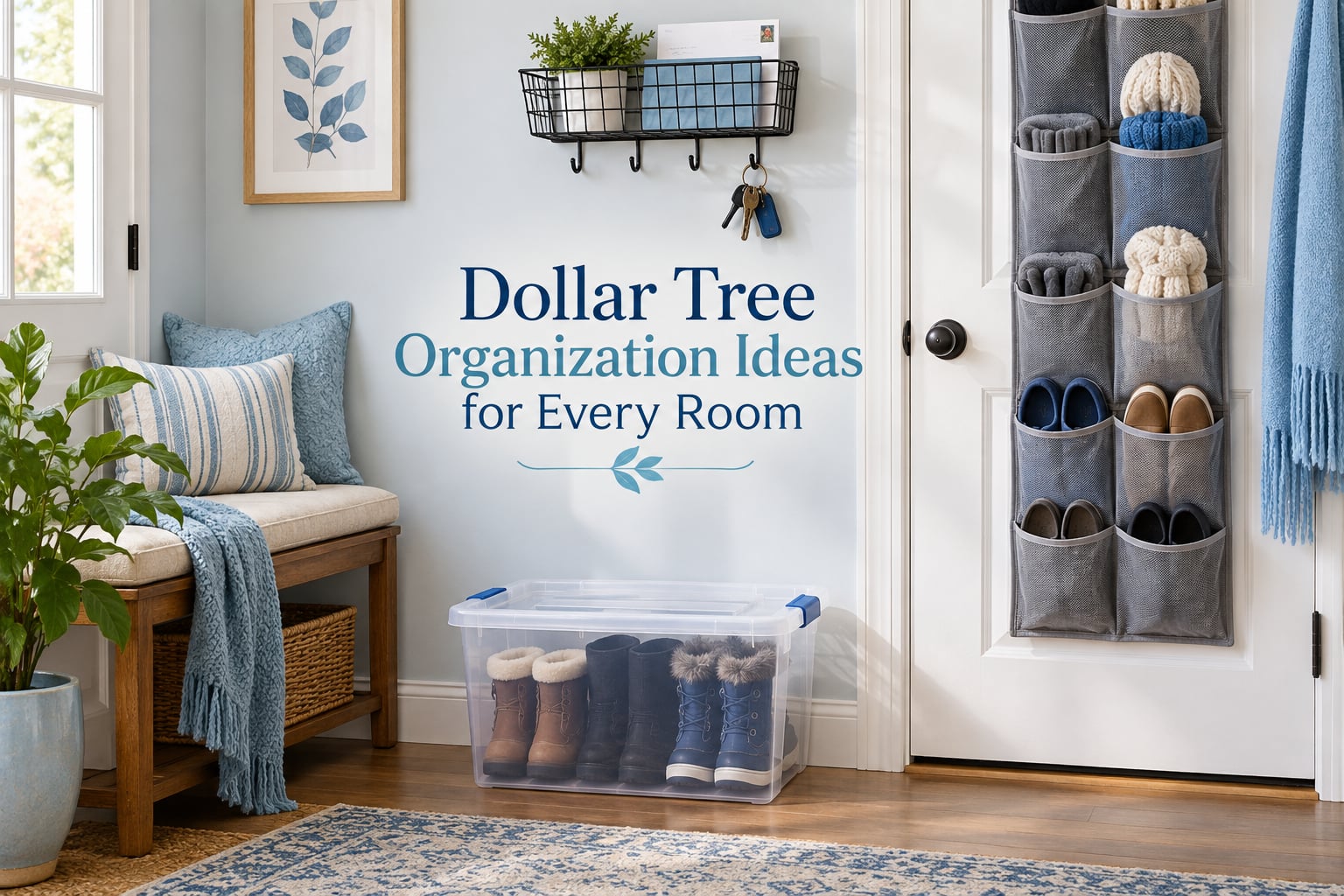
Dollar Tree organization ideas for every room are not about finding one magic product. They are about matching cheap, modular containers to the specific shape of the clutter you already own. A clear bin for the pantry, a narrow drawer divider for a bathroom cabinet, an adhesive hook for the blank wall above a door. The dollar store works as an organization supply store when you stop browsing and start shopping for a system.
I have been organizing homes on a tight budget for years, mostly in rentals where drilling was never an option, and the pattern holds every time. Almost every room gets fixed with the same short list of cheap items, and almost nothing needs a tool. Updated for 2026, this is the room-by-room sweep I wish someone had handed me before my first apartment, plus the things I now skip because they wasted my time.
The rooms below are in the order I would actually do them. Entryway first, because that is where the mess generates, and the kitchen last among the small rooms, because it needs a plan before it needs containers.
Table of Contents
- Quick Picks: The Dollar Tree Items That Work in Every Room
- Entryway and Mudroom: One Bin Per Person Beats One Big Pile
- Kitchen: Clear Bins and Turntables Do the Heavy Lifting
- Pantry: Group by Category, Not by Original Box
- Refrigerator: Bins Turn Fridgescaping Into a Five-Minute Job
- Bathroom: Drawer Dividers and Turntables Fix the Deep Cabinet
- Kids’ Room and Playroom: Picture Labels Do the Sorting
- Primary Bedroom: Clear Bins on Shelves Beat Matching Furniture
- Closet: Vertical Space Is the Cheapest Storage You Will Ever Add
- Laundry Room: Caddies and Hangers Turn One Wall Into a Sorter
- Home Office: Magazine Holders Are the Cheapest File Cabinet You Will Find
- Garage and Storage: Bins Only Work When You Label Them
- Renter Rules: No-Drill Setups That Hold Up in a Rental
- How to Organize a Room When You Have Too Much Stuff
- What Not to Buy at Dollar Tree
- Where Edmonton Shoppers Can Find These Items and When to Go
- Frequently Asked Questions
- What are some useful Dollar Tree organizing products?
- How to organize your room when you have a lot of stuff?
- What are some clever organization hacks for a closet?
- What are some ideas for organizing my room?
- What Dollar Tree items are going viral?
- What are some of the best DIY projects I can do at Dollar Tree?
- What is the best day of the week to go to Dollar Tree?
- Conclusion
Quick Picks: The Dollar Tree Items That Work in Every Room
Before the room-by-room sweep, these are the items that earn their space in my cart. Each one has survived at least a year of real use, not a fresh unboxing.
- Clear plastic bins with lids – the workhorse. Clear so you can see contents without lifting the lid, lidded so a stack stays stable.
- Collapsible fabric bins – the only dollar store bin I trust for closets and under-bed storage. They fold flat when empty, which matters more than you think.
- Adhesive hooks and strips – for the vertical gap nobody uses. Weight limits are real, so check the packaging before you hang anything.
- Two-drawer plastic organizers – small-parts drawers for craft, bathroom and office supplies. Two placed side by side make a custom-sized unit.
- Turntables (lazy susans) – two sizes cover spice jars, condiments and deep cabinets. They are the reason the back of my pantry is not a graveyard.
- Drawer dividers – adjustable, cut to width with scissors, and far more forgiving than buying a fixed organizer that does not match your cabinet.
- Chalkboard labels – the single upgrade that makes cheap bins look intentional instead of temporary.
- Wire baskets – a drop zone for keys and mail, and a wall organizer when you hang them with adhesive strips.
- Hanging closet organizers – shelf-less closet hangers. They add storage in a rental without a single screw.
- Picture labels for kid storage – a strip of printed photos on a labeled bin turns cleanup into matching, which a four-year-old can actually do.
Everything above is sold at both Dollar Tree and Dollarama in Canada, and most of the same pieces rotate through TJ Maxx, Marshalls and HomeSense when a store clears a line.
Entryway and Mudroom: One Bin Per Person Beats One Big Pile
The entryway fails for one reason: a single shared pile. A drop zone works when each person owns a container, because nobody has to sort anyone else’s things on the way out the door.
Give each person one clear bin and line it up on the floor against a wall, lowest-value spot first. Put loose winter gear in the bin on a hanger loop so coats do not crush. A shallow wire basket mounted on the wall with adhesive strips holds keys, mail and dog leads in one place, and it keeps the counter clear.
For shoes, a hanging over-the-door organizer turns a door into a rack, which is the fastest way to add storage in a rental. Stack one flat bin per person underneath for slippers and boots, and put a tray on top of the warmer ones so mud stays contained.
What changed this room most for me was adding a small bench with lift-up storage. Anything that sits down gets picked up off the floor, and a family of four going from a permanent shoe pile to four labelled bins is a ten-minute job. Do the floor first, because a cleared floor is what makes the rest look intentional.
Kitchen: Clear Bins and Turntables Do the Heavy Lifting
Kitchen organization fails when the back of a cabinet becomes a graveyard. The fix is small-group containers plus a turntable for anything you reach for weekly.
Group by task, not by original box. A bin for baking, a bin for wraps and bags, a bin for taco night supplies. Each gets a chalkboard label and lives on the shelf it belongs to. Plastic wrap and baggies roll better in a tall narrow bin than a wide shallow one, so match the bin to the shape of the item and you stop repacking constantly.
A turntable on the second shelf solves the reach-in problem. Put your most-used condiments on a medium one, and spices on a small one above. If the shelf is deep and the jars are round, the turntable alone will fix a cabinet you have been ignoring for years.
For cabinets above the fridge, use a shallow bin that slides forward rather than a deep one you have to lift down. Overhead storage is the most wasted space in most kitchens, and one shallow bin per week of cooking is a realistic ceiling.
The lazy part that pays off is keeping one bin per category and refusing to start a second. A second baking bin is where the duplication starts, and duplication is what makes a cheap system look cluttered.
Pantry: Group by Category, Not by Original Box
Pantry organization takes the longest because the real work is deciding what you own, not where it sits. Do the sorting in a weekend, not during a weekday, and give yourself three categories: use it, relocate it, or let it go.
Once it is sorted, use tall clear bins for dry goods so you can see the level of each bag without pulling it out. Small packets and seasoning go in drawer dividers or shallow bins you can lift with one hand. Stack the deep containers for water bottles and large bags on the floor of the pantry, where weight is not a problem.
A turntable at eye level for canned goods is the single most useful dollar store purchase in this room. Angled bins work too, but they only suit a straight shelf, and most pantries have a mix. I keep a lazy susan for cans and reserve angled bins for the one flat shelf I have.
Label the front of every bin with what goes in it, not what it used to hold. A bin labelled COOKIES attracts crackers, and a bin labelled SNACKS keeps people from opening a new bag in the wrong place. If you want the look to read as expensive rather than cheap, matching bin sizes do more work than any decoration.
Refrigerator: Bins Turn Fridgescaping Into a Five-Minute Job
Refrigerator organization is the easiest room to fix and the easiest to undo. Clear bins, one shelf each, is the whole system.
Use a shallow bin for lunch items, another for snacks, and a tall narrow one for drink pouches and yogurt tubes so they do not roll around. Small bins fit the back of the shelf and slide forward without you having to reach into a cold corner. A turntable on a middle shelf puts the condiments and jars you use daily within one rotation.
Do not go overboard. A fridge organized into twelve bins is a fridge that takes twelve minutes to load, and you will stop doing it. Three to four bins plus one turntable is the sweet spot for most households, and it holds up for a family or a single person.
Fridgescaping, if you have heard the term, simply means making the contents visible and tidy enough to look at when you open the door. Clear bins do most of that work on their own because you can see the level of everything at a glance.
Bathroom: Drawer Dividers and Turntables Fix the Deep Cabinet
Most bathroom cabinets are deep and awkward, which is why things get shoved to the back and lost. Drawer dividers and turntables are the cheapest fix for both problems.
Start with the deep cabinet under the sink. Wrap-around or U-shaped organizers fit around the plumbing and turn one tangled mess into two labelled zones. A two-drawer unit inside the cabinet holds cleaning supplies and refills, and slides out so you do not have to fish for the bottle at the back.
For the vanity drawer, cut adjustable dividers to width with scissors and sort by frequency: daily items in the first section, backups in the second, and everything else out of the drawer. A turntable on the vanity top keeps cotton rounds and daily skincare visible, and the shallow spacing means nothing hides behind it.
Vertical wall space in a bathroom is usually a rod tensioned with shower curtain rings. Thread small bins or caddies onto the rings to hold back-up soap, washcloths and toys without a single screw. In a rental this is often the difference between a workable bathroom and an overcrowded one.
Skip the tiny acrylic shelf units for heavy items. They work, but the same space is better used for a wall-mounted bin that keeps weight off the shelf entirely.
Kids’ Room and Playroom: Picture Labels Do the Sorting
Kids’ rooms are not a storage problem, they are a sorting problem. The child needs to recognize where a toy goes without reading a word, and picture labels solve that instantly.
Print or cut small photos of the actual toys, tape one to the front of each shallow clear bin, and put the bins at child height. A four-year-old can match a picture to a bin. A four-year-old cannot read LABELLED BOOKS, which is why the photos matter more than the words.
Use a hanging closet organizer in a kid’s closet for dress-up clothes, art smocks and backpacks, so the floor stays clear. For toys that get played with daily, a low open bin is better than a lid, because a closed lid ends the play session. For toys that appear once a month, a lidded bin on a high shelf is fine.
Two details do most of the work here. Keep the number of categories low, ideally under six, and put the things you swap out often at the front. A four-bin system that children maintain beats a twelve-bin system that gets ignored by week two.
Bookmark small baskets by book size rather than theme, and a shallow bin on the floor for the current pile of papers and drawings. If you do one thing before back-to-school season, labelling the school-supply bin with photos saves you the nightly hunt for a pencil case.
Primary Bedroom: Clear Bins on Shelves Beat Matching Furniture
Bedroom organization gets expensive when you chase matching storage. Clear bins on any existing shelf deliver the same tidy look for a fraction of the cost.
Use clear lidded bins for the categories that only get touched during a seasonal change: linens, winter clothing, holiday decorations. Put them on the highest shelf you have, because low bin storage is where daily items belong. A two-drawer unit under the bed or on a nightstand handles the small stuff that would otherwise live in a loose pile.
A hanging closet organizer adds a full shelf where there was only a rod, and it is removable the day you move out. Dresser drawer dividers sort socks, underwear and accessories so the top drawer closes instead of springing open every morning.
For a nightstand, one shallow bin with a chalkboard label for the things you actually reach for at night is plenty. Bedside clutter is usually a signal that the item has no home, not that the table is too small.
The bedroom trick I recommend most often is the seasonal rotation box. Keep one large bin per season, swap the contents twice a year, and you never have to store the winter coat next to the summer dress.
Closet: Vertical Space Is the Cheapest Storage You Will Ever Add
A closet rarely needs more furniture. It needs the empty vertical gap between the top of your clothes and the shelf above, and it needs matching containers for what is already hanging.
Hanging closet organizers are the big win. They hook over the rod and add two to three tiers without a screw, which makes them the default answer in a rental. Add a second unit lower on the rod for folded items or shoes and you have doubled your usable space for very little.
For the slim side wall, hang wire baskets with adhesive strips rated well above the weight of the contents. People, mail, scarves and accessories suit this format because everything stays visible. A hanging shoe organizer on the back of the closet door keeps pairs paired and off the floor.
Narrow bins and magazine holders turn dead corners into working storage. A magazine holder on a shelf is a set of upright dividers for rolled jeans, scarves or belts, and it costs less than a purpose-built organizer.
The rule that makes a cheap closet look curated: matching bin sizes and matching labels. A closet with four clear bins of the same shape reads as designed. A closet with four mismatched bins, even if the contents are better sorted, reads as a storage problem that is still in progress.
Laundry Room: Caddies and Hangers Turn One Wall Into a Sorter
Laundry organization is mostly a handoff problem. The fold, the sort, the carry. Caddies and wall hooks fix the handoff faster than any shelf will.
Wall-mount a three-tier wire shelf above the washer if you own the wall, and hang a caddy from it for the things that travel between rooms, like dryer sheets, a lint brush and a mesh bag. If you rent, a tensioned over-the-door rack and adhesive hooks give you the same zones with no holes.
Use one caddy for clean laundry going somewhere and one for dirty laundry coming back, so the two never mix. Hanging a slim bin on the wall for detergent refills keeps the floor clear and means you can see when a box is nearly gone.
A wall-mounted ironing board or a hanger hooked behind the door takes another daily object off the floor. Hanging clothes, ironing board, hamper lid, shoes all fit on one wall in most rooms, which is the entire point.
Wire baskets mounted in rows make a visual grid that reads as a proper laundry room, and they work in a condo laundry room where you do not own the space at all. Tension poles that press into the ceiling hold baskets without touching the wall, which is the safest option in a shared space.
Home Office: Magazine Holders Are the Cheapest File Cabinet You Will Find
A home office needs two things: somewhere to put paper, and somewhere to put the supplies. Both have cheap answers that take under fifteen minutes to set up.
Magazine holders, set upright side by side on a shelf, are vertical file folders. Sort by category rather than year, with labels facing out so you can read them without pulling anything. For paper that must stay flat, a magazine holder laid on its side works as a riser that lets you stack a few folders in the depth of one.
A three-drawer plastic organizer on the desk holds pens, sticky notes, scissors and tape within reach. Drawer dividers inside the desk drawer sort cables, chargers and small tools so you are not untangling a knot every time you need a USB cord. A small wall bin above the desk, held up with adhesive strips, keeps stationery out of the way but visible.
Wire baskets stacked in a cube shape on a shelf make a tidy paper inbox. Stackable drawer organizers placed beside each other can be configured into a custom-sized unit that fits a narrow desk drawer or an awkward gap, which is why I buy two at a time and use whichever pair fits.
Cookie sheets make excellent small dividers, so if you have seen them repurposed elsewhere, here is the office version: bend the edges to create compartments for pens and markers standing upright in a bin.
Garage and Storage: Bins Only Work When You Label Them
Garage storage has one rule that overrides everything else: if it is not labelled, it is not stored, it is buried. A clear bin in a dark garage is a bin you will not open until you need something you cannot find.
Use large clear bins with lids, stack them by category, and label the front and one side so you can read them from a stack. Heavy items go on the floor, lighter bins above. A turntable is not useful here, but a two-drawer organizer is, for the small hardware and fittings that otherwise disappear in a corner.
Vertical space in a garage is free. Wall-mounted wire baskets hold sponges, brushes, extension cords and seasonal car supplies, and adhesive strips are fine as long as the basket hangs something light. Anything heavy goes on a real shelf you have anchored properly.
Seasonal gear is the easiest garage win. One bin for winter tires tools, one for garden hose and summer equipment, one for holiday decorations, and you rotate three boxes instead of digging through six piles. Keeping Christmas in its own labelled bin is the difference between a two-minute setup and a two-hour search.
A two-drawer organizer also makes a good tool caddy. Carry one to the front of the garage, put the tools back in it, and you have built yourself a mobile workshop out of a plastic drawer and a set of casters from another cheap find.
Renter Rules: No-Drill Setups That Hold Up in a Rental
If you rent, a few rules keep an organization system from turning into a deposit problem. These are the ones I follow in every apartment I have lived in.
- Read the weight rating, not the packaging colour. Adhesive hooks come in different grades and the small ones are frequently rated for only a few pounds. Check the back of the card every time.
- Test on an inconspicuous spot first. Painted and textured walls hold adhesive far worse than smooth drywall. Pull a hook off, wait a few hours, then push it back and see if it still sticks.
- Wait before you load it. Give adhesive strips a full night before hanging anything heavy. Pressing firmly at the mount point helps, but time does more work than pressure.
- Favour over-the-door and tension solutions. Over-the-door organizers, tension poles and hanging closet organizers need no wall contact at all.
- Avoid anything that needs a stud or an anchor. If the fix requires drilling, choose a different storage solution rather than a temporary rental workaround.
The forum consensus matches this approach. People organizing in rentals report the simple Command-hook installs as the ones that get the most positive reaction, because they can be reversed in a minute and they actually hold.
How to Organize a Room When You Have Too Much Stuff
When a room feels unmanageable, the problem is almost never the amount of stuff. It is that no single item has an assigned home, so the sorting has to happen every time someone puts something down.
This five-step sequence is the one I use, and it works in about fifteen minutes per room.
- Pick one surface, not one room. One drawer, one shelf, one corner. A full room is the reason most attempts fail within ten minutes.
- Remove everything from that surface. Sort into three piles: stays, moves elsewhere, and goes. Be honest about the third pile.
- Buy three or four matching containers, not one. A single new bin in a mixed system is the most common reason a reset does not hold. Matching sizes are what make the result look finished.
- Label each container before you fill it. Writing the label with the bin empty takes ten seconds. Relabelling a full bin takes ten minutes.
- Fill only one container at a time and stop. You can come back tomorrow with the next container. Partial resets that get repeated beat complete resets that never happen.
The step people skip is number three. Decluttering without matching containers produces a tidier surface today and the same pile back in a week, because there is still nowhere for the loose items to go.
What Not to Buy at Dollar Tree
Cheap organization fails when you buy the wrong cheap object. These are the ones I stopped buying, and in most cases the savings were false.
- Non-stackable bins with tapered or flared sides. If the bottom is narrower than the top, they do not stack, which defeats the main reason to buy a container. Flip one over and check the footprint matches the rim.
- Thin single-wall bins for anything heavy. Books, canned goods and tools will bow the sides or crack the base. Look for a thicker ribbed base or a two-wall build.
- Oversized baskets. A basket that is too big for the shelf is decoration. Measure the shelf depth before you buy, not after.
- Heavy-duty claims on small adhesive hooks. The word appears on the front of the card and the rating is on the back. Small hooks are for keys and light cloth, not for a caddy of cleaning bottles.
- Furniture-sized storage on a whim. A cheap cabinet or desk that does not fit the space will not get assembled or will fight the room forever. Renters should skip these entirely.
- Single-purpose novelty items. A contraption for one specific job usually does that job worse than a simple bin and hook, and you will not know until it is assembled.
What the community repeatedly reports as better than expected is worth knowing too. Planner stickers and washi tape from the craft section get called out on r/planners as unexpectedly good quality, and repurposing cheap straw organizers as skincare dividers is a long-running favourite in r/dollartreebeauty. A dollar store pill organizer, used as a mixing palette with the lid as a tray, is the most shared hack I have seen in r/Watercolor, and it costs almost nothing.
Where Edmonton Shoppers Can Find These Items and When to Go
Almost everything in this article is available in Canada, but the Canadian dollar stores are not identical to the US ones and the regular selection rotates constantly.
Dollarama is the broadest source for the containers in this list, with wider selection on plastic bins, drawer units and caddies. Dollar Tree Canada carries more of the décor-leaning items, including wire baskets, wall baskets and chalkboard labels. HomeSense and Marshalls are where you find the same clear bins when a store has cleared a home line, often in sizes that never appeared at the dollar store. Value Village is the place to go when you need a full matching set and a single purchase will not cover it.
On timing, the honest answer is that fresh deliveries arrive through the week, so weekday mornings give you the best chance of finding a full aisle rather than a picked-over endcap. Early in the month is calmer than the week before a holiday, when seasonal items arrive in waves and the popular bins go first. The r/DollarTree community treats aisle location as shared intelligence, and the practical version of that is simply: check the seasonal and home sections before you assume a bin is gone.
One Canadian note that is easy to miss. The higher-priced Plus line inside Dollar Tree exists alongside the regular tier, so a single purchase there breaks the single-tier assumption that makes this whole approach work. I treat Plus as a place to look for one or two statement pieces, not as the source for the matching bins that make a room look organized.
Frequently Asked Questions
What are some useful Dollar Tree organizing products?
The items that work in almost every home: clear plastic bins with lids for categories, collapsible fabric bins for closets and under-bed storage, two-drawer units for small parts, adjustable drawer dividers, turntables for deep cabinets, adhesive hooks for vertical space, hanging closet organizers, and chalkboard labels to make cheap bins look intentional.
How to organize your room when you have a lot of stuff?
Pick one surface rather than one room. Empty it completely and sort into stays, moves elsewhere and goes. Then buy three or four matching containers, label each one before filling it, and fill only the first container before stopping. Repeat tomorrow, because a partial reset you repeat beats a complete reset you never finish.
What are some clever organization hacks for a closet?
Add a hanging closet organizer to create shelves from the empty vertical gap under the rod, and hang wire baskets on the side wall with adhesive strips rated above the load. Narrow bins and magazine holders fill dead corners, an over-the-door organizer takes shoes off the floor, and matching bin sizes plus matching labels are what make the result look designed rather than temporary.
What are some ideas for organizing my room?
Use shallow clear bins with picture labels of the actual items so sorting is visual, keep daily toys in open bins at child height, and move occasional toys to lidded bins on a high shelf. In an adult bedroom, group seasonal items into large lidded bins on the top shelf, use a two-drawer unit for the small stuff, and add drawer dividers to the nightstand and dresser.
What Dollar Tree items are going viral?
Repurposing cheap objects is what travels fastest: the dollar store pill organizer used as a mixing palette with the lid as a tray, clear straw organizers turned into skincare dividers, cookie sheets used as risers and pen compartments, and shower curtain rings threaded onto a tension rod to hold small bins. Cheap chest units made into dressers and room storage boxes also circulate widely.
What are some of the best DIY projects I can do at Dollar Tree?
Under-sink organizers wrapped or fitted around plumbing turn one tangled cupboard into two labelled zones. A tension rod threaded with shower curtain rings becomes a bathroom wall organizer. Cookie sheets make risers and small dividers, a paper towel holder becomes a freestanding bin, and hanging closet organizers plus adhesive-strip wire baskets create storage without any drilling at all.
What is the best day of the week to go to Dollar Tree?
Weekday mornings tend to be the most reliable window for finding full aisles, since new deliveries land through the week and endcaps get picked over first. Early in the month is calmer than the week before a holiday, when seasonal items arrive in waves and the popular clear bins go quickly. If you need one specific bin, go early in the week and check the home and seasonal aisles first.
Conclusion
What makes these dollar store organization ideas for every room work is not a clever product. It is the same sequence repeated: one container per category, matching sizes within a room, a label on the front, and vertical space used before you buy anything new. Every room in this sweep came together with the same short list of cheap items and under half an hour of actual work.
So pick one room and do it this week. Start with the entryway if the problem is shoes and coats, the pantry if you are cooking more and finding less, or the closet if you are hanging things on the floor. Do one surface, buy three matching containers, label them before you fill them, and stop when the first container is full. Then pick the next surface tomorrow.