
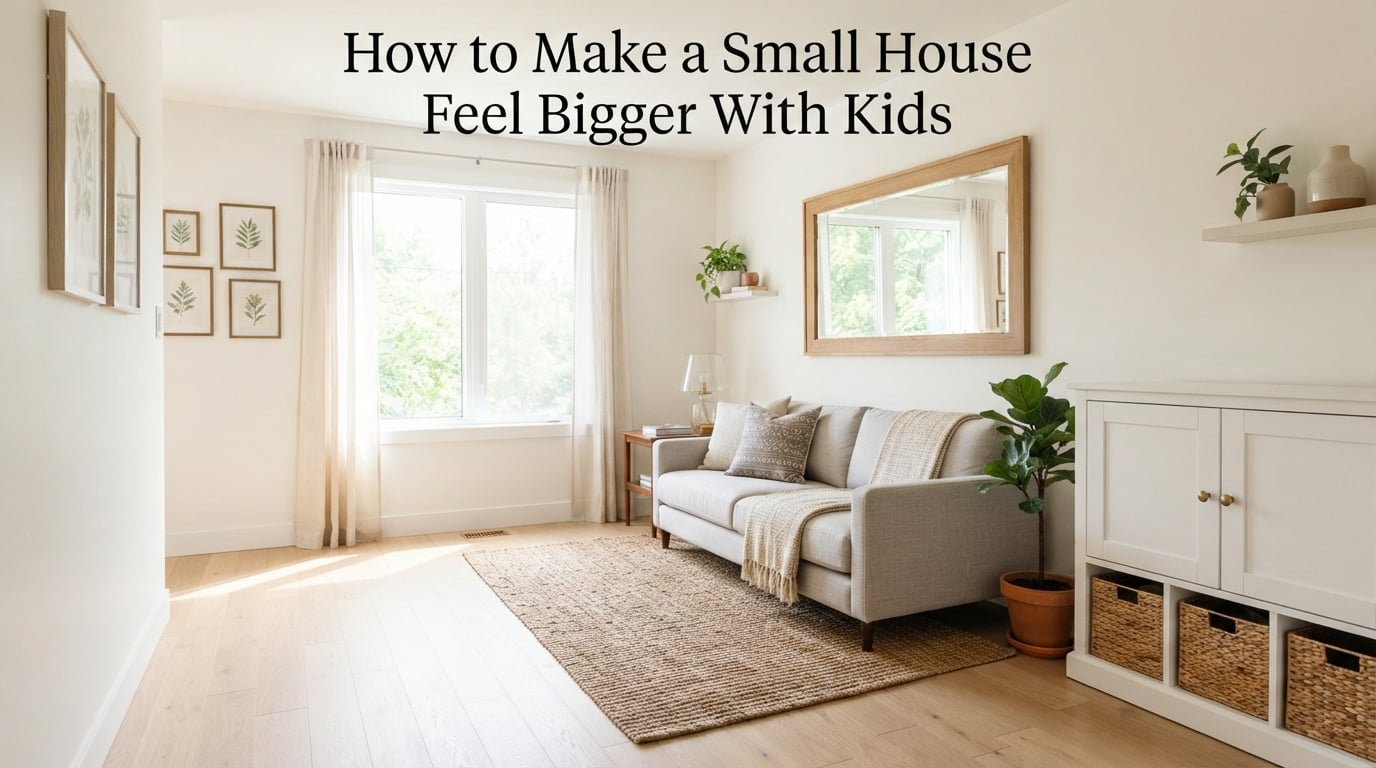
To make a small house feel bigger with kids, cut the number of things you can see, move storage off the floor and onto the walls, and only buy furniture that does at least two jobs. A room feels small when the eye stops travelling. Toys, laundry, shoes and craft supplies break the sightline into pieces, and every piece reads as a wall. Fix the sightline and the same square footage feels twice the size.
I live in a small house in Edmonton with kids, and the thing I got wrong for years was treating this as a storage problem. It is a visibility problem. Buying more bins made things worse, because I was hiding clutter in the open rather than removing it.
Below I break it into ten tactics, then go deeper on the parts that took me the longest to figure out: how to make a room look larger without renovating, how to work when you rent, what the reset actually costs, and what a small house with kids really looks like day to day.
Three words show up constantly below. Perceived square footage means how big a room feels, which is not the same as how big it measures. Visual weight is everything competing for your attention in a single sightline. Sliver spaces are the gaps under furniture, behind doors and above doorframes. Once you can name them, you can see them in your own house.
Table of Contents
- How to Make a Small House Feel Bigger With Kids: 10 Tactics
- Make a Small House Feel Visually Bigger, Not Just Tidier
- Closed Storage or Open Shelving: The Rule That Ends the Debate
- Declutter Before You Organize
- Use the Vertical Space Above Eye Level
- The Sliver-Space Audit: Where to Put Toys When You Have No Closet
- Toy Storage Systems That Actually Work in a Small House
- Storage Types Compared for Small Houses With Kids
- Buy Multi-Use Furniture and Count the Jobs, Not the Pieces
- Room Zoning: Keeping the Living Room Looking Like a Living Room
- Build an Entryway Drop Zone Before It Builds Itself
- Renting? Everything Above Works Without Drilling
- The 15-Minute, One-Hour, and Weekend Reset Plan
- Safety in a Small House With Toddlers
- What a Small House Reset Costs: Free First, Then Layers
- Three Small Houses With Kids, With Real Square Footage
- What Nobody Tells You About Living Small With Kids
- Frequently Asked Questions
- How do you make a small house feel bigger?
- How do you make a small house feel less cluttered?
- What are some cheap ways to make a small room feel bigger?
- How do you store kids toys in a small space?
- How do you keep toys out of the living room?
- What are the best storage options for a small child’s room?
- What are some creative vertical storage ideas for small spaces?
- What is the 20 toy rule for kids?
- Is it possible to raise kids in a tiny home?
- What are the disadvantages of living in a small house with kids?
- Making a Small House Feel Bigger: Where to Start Tomorrow
How to Make a Small House Feel Bigger With Kids: 10 Tactics
These are in priority order. If you only do the first three, you will notice a difference this weekend.
- Clear the floor. The single biggest visual gain in any small room comes from seeing floor you did not know you had. Push furniture to the walls, keep the walking route open, and stop using the middle of the room for anything. One clear path from door to sofa is worth more than any mirror.
- Go vertical. Anything stored on the floor is floor you cannot use. Move it to shelves above shoulder height, wall rails, pegboards, or tall narrow units. You are not adding storage, you are changing the plane it occupies.
- Close most of it. Every open object is a thing your eyes have to process. One closed cabinet in a busy family room does more for perceived size than a whole wall of tidy open shelving.
- Put the mirror opposite the window. Light that hits a mirror bounces into the dark half of the room. A large mirror on the wall facing your brightest window is the cheapest square footage you will ever gain.
- Keep furniture low. A low sofa, a low coffee table and low shelving let you see across the room. A tall back-heavy unit against the same wall chops it in half visually.
- Declutter before you contain. Buying storage for clutter you refuse to remove means you now have clutter in nicer bins. Reduce first, then contain what is remaining.
- Rotate toys on a schedule. Toys that are out are toys you see. Rotate roughly half of them into a bin outside the main living space every few weeks and swap them back when the novelty wears off.
- Use the same surface for everything. A closed basket, a chest, an ottoman. One container per type of item beats three containers shared across three categories.
- Light the room properly. One overhead ceiling light makes a room feel flat. A floor lamp in a dark corner, a warm table lamp, and sheer curtains that do not block the window change the shape of a space at no structural cost.
- Keep one zone pristinely clear. A sofa corner, a reading spot, a table. One area that is never a toy landing pad gives the whole room a resting point, and your eye returns to it.
Make a Small House Feel Visually Bigger, Not Just Tidier
Most advice on this topic stops at the storage half. Almost none of it touches the half your brain actually reacts to, which is how much you can see at once. This is the section I would read first if you are renting and cannot paint or drill.
Light is doing most of the work
Perceived square footage tracks available light closely. A room lit evenly from front to back reads as deep. A room with a bright window and a dark far corner reads as a small room with a dark end.
The fix is rarely more windows. It is distributing what light you already have. Put a mirror perpendicular or opposite the window rather than beside it, so it catches daylight and throws it toward the shadowed wall. Use a floor lamp in whichever corner stays dimmest after sunset. Keep curtains and blinds up and sheer during the day.
Wall colour changes the boundary you can see
The same four walls can feel like four walls or like a continuous space. A single consistent colour across walls, trim and doors removes the corners your eye uses to measure the room. Painting a small bedroom one colour, ceiling included, makes the ceiling feel higher because the wall stops before your eye expects it to.
If you rent, this is where adhesive-backed vinyl roll or peel-and-stick panels come in. Not a perfect result, but they do remove the picture rail and trim lines that chop a wall into segments.
Furniture scale is doing more work than you think
Scale follows a rule most people learn the expensive way: a small room needs lower and lighter furniture, not a full set of matching adult pieces. Bulky high-backed seating, deep armchairs and large solid tables all block the sightline across the room.
Swap one heavy piece for a lower, narrower version and the room reads as deeper immediately. Legs that leave space beneath a piece also make the floor look continuous underneath it, which reads as more floor.
Sightlines are the real currency
Stand in the doorway of each room and count how many separate objects you can see at once. In a small house with kids, that count is the reason it feels cramped. It is not the number of items you own, it is the number your eye lands on from one spot.
Three changes reduce that count fast: clear the top of every tall surface, put one matching closed container in any open basket you cannot close, and move the single most visual item to a less central room. A small house has one or two true focal points. Everything else competes with them.
Keep a washable rug and let mess read as contained
One more low-cost tactic that helps more than it sounds: define the play area with a washable area rug. Mess in a defined area reads as a rug that needs shaking out. Mess with no boundary reads as the room itself being chaotic. Same toys, different feeling.
Closed Storage or Open Shelving: The Rule That Ends the Debate
One r/minimalism commenter described a living room that was driving them crazy and the diagnosis was precise: literally all the storage was open storage, and the answer was a sideboard, a tall closet, or a media unit with doors. That debate runs through every parent forum on small spaces, so here is the rule instead of another opinion.
Use open shelving for things that are visually quiet, rarely needed, and pleasant to look at. Books with spines facing out, a few baskets, plants. Everything else goes behind a door.
Use closed storage for anything small, colourful, numerous or busy. Small plastic toys are the worst offenders, because a scattered handful reads as noise from across the room while the same toys in a closed cabinet register as nothing at all. In a family room, closed storage wins by default.
The practical compromise is a mix, and it is a good one: closed storage low and central where the mess accumulates, open shelving high and peripheral where the eye can rest. A high shelf of baskets is hidden from the main sightline. A low open bin in the middle of a playroom is chaos in a box.
Declutter Before You Organize
Organizing clutter is just arranging furniture around a problem. The order that works is reduce, then contain, then maintain. Skipping straight to bins is why most small-house resets stall in month two.
Give the kids a box, not a rule
The single most reusable parent-generated hack in the research came out of a comment thread: give a child a physical box and tell them to choose only the toys that fit inside it. The child decorates the box themselves.
This works because a limit you can see and own feels different from a limit imposed on you. A visible empty box also doubles as your acceptance bin. When the box is full, the child decides what goes.
The 20 toy rule is a starting point, not a law
Popular advice suggests capping a small child’s toy count somewhere around 20, adjusted for age. The number matters far less than having any number at all. What matters is that the child participates in setting it and can see the limit.
Run the sort into keep, donate and undecided. Do not decide for them what is sentimental, and give yourself a deadline on the undecided pile. An undecided pile that survives three months is a donate pile with better branding.
Control what comes in
One in, one out is the mechanism that stops the work from reversing. It works best when it applies to the child as a visible trade rather than a punishment: one new toy arrives, one goes to a sibling or a neighbour.
Second filter, applied at purchase time: skip anything noisy, light-up or battery-driven. Those toys do the playing for your child, and they are also the hardest to store because the parts do not nest. Open-ended toys, blocks, cars, pretend food, dress-up, puzzles and sensory materials stack, combine and pack small. In a small house that is a real advantage, not a philosophy.
Let the children be part of the sort
Sorting with kids is slower at the start and dramatically faster forever after. Give each child one category. Adults handle sentimental items and anything with a real history.
One real family example
A parent in a Reddit decluttering thread with a multi-kid household started with the youngest child’s room because outgrown or broken items are the easiest to release. Once one room was honest, the rest of the house followed. That is the same order I used: start where the decision is already made for you.
Use the Vertical Space Above Eye Level
Walls are the only free surface in a small house, and most families use the bottom third of them. Shelf space above shoulder height is where the return on space is highest, because almost nothing up there is at risk of being grabbed, climbed on or dragged out.
Options that work in real family rooms: narrow wall shelves, pegboard panels, slatwall rails with hooks, wall-mounted cube units, over-door racks, and tall thin shelving placed where furniture would otherwise sit. IKEA gets named repeatedly and unprompted in parent communities for this, with TROFAST-style stacking units and repurposed narrow racks among the recurring suggestions.
Three rules keep high storage from becoming a junk shelf. Assign one category per shelf, so the shelf has a job you could name out loud. Use closed bins or baskets on the highest shelves, because open bins up high are where forgotten clutter goes to live. Keep one shelf completely empty as a landing spot, because that single empty surface prevents everything from being dumped on the floor.
Safety belongs here too. A shelf at toddler head height is a climbing risk, and anything holding glass, small parts or heavy items needs to be well above reach. More on that shortly.
The Sliver-Space Audit: Where to Put Toys When You Have No Closet
Plenty of small homes have no closet, no basement and no storage walls. When that is your situation, stop looking for floor space and go through the house measuring the gaps. This takes one evening and it is the most reliable capacity gain available to a renter.
Under the bed
Raise any bed frame that will allow it, or slide low rolling totes underneath. This is the single largest hidden volume in a small child’s room. Bedding, outgrown clothes, winter gear, craft overflow and a whole rotation bin of toys all fit under a standard bed.
One parent in a What to Expect thread on a small family home recommended tall bed frames specifically so totes could be stored underneath. Parents in that same thread also recommended bunk beds for shared rooms, which doubles sleeping capacity while freeing the floor beneath.
Use lidded containers here. Under-bed space is a graveyard for anything that can fall through a handle, and dust is a real issue.
Behind the sofa and under the low table
Leave a gap of eight inches or so behind the sofa and you have created a narrow slot that a parent can slide a basket into. It is invisible from the main seat, and it is the reason many family sofas in small houses come with a gap behind them.
Play baskets go under a low coffee table. A small table with open space underneath doubles as a surface and as storage, which is exactly the dual-purpose principle discussed later.
Under the stairs
Under-stairs is a large, awkward, rarely-used volume. In one What to Expect thread, the most-replied advice was to designate a bin of outdoor toys and move it outside or into the garage. The same logic applies indoors: whatever can live in the least convenient corner of the house should go there.
Above the door
The gap over a standard doorframe holds flat or light items, holiday storage, spare bedding or a bin of seasonal shoes. Check the door swing before committing a tall item, and keep it out of a toddler’s climbing reach.
Under window sills and inside unused cabinets
Low closed cupboards under sinks or in kitchens get filled with a pull-out riser before they get used properly. Bathroom cabinets above the toilet and deep under-sink cabinets are usually half empty because nobody can see the back of them. Bins that fit the interior depth solve this without buying anything.
Toy Storage Systems That Actually Work in a Small House
Storage is a container decision, and most families get it wrong by sorting by sub-category. Small categories mean many small containers, which means every container takes up a full footprint while holding a handful of items. Fewer, broader containers hold the same volume in less space.
Sort into broad categories, not sub-categories
Five or six categories maximum, chosen by what your child actually plays with: building, vehicles, pretend play, puzzles and games, art, soft toys. The failure mode is over-granularity. A parent of four writing about her own toy list described play food that only made sense in its original container and dinosaurs that had to go in the truck. Sub-categories multiply, and each one demands its own bin.
Where sub-categories genuinely matter, solve them with a divider inside one bin instead of a second bin. One clear container per child, per broad category, is the arrangement that holds up.
Label with pictures for pre-readers
If your child cannot yet read, a written label is meaningless. Stick a picture of the contents on the front of every bin. Chalk-style picture labels and photo labels cost almost nothing and let a three-year-old return a toy to the right place independently.
Keep kid storage at kid height and adult storage above it
Children can only maintain what they can reach. Put the bins they use every day on the lowest shelf, and put adult-managed items higher. This also solves the tidying problem, because a child who can reach the bin can put things away without asking you.
Toy rotation is the mechanism that makes small space work
Rotation is what turns a storage problem into a solvable one. Put roughly half the toys into labelled bins and move them out of the main living space. Bring them back after two to four weeks, swapping what comes out.
The out-of-home half can be a garage shelf, a closet, a rented storage unit, a neighbour’s garage or the trunk of a car. The location matters far less than the fact that it is somewhere the family does not look at it every day.
Give stuffed animals a dedicated answer
Stuffed animals are the hardest category in every parent forum, because kids name them, they have personalities, and donation centres often refuse them. Four options that work: a net hammock on a wall corner keeps a large volume visible but contained; a bean bag cover that unzips stores overflow out of sight while keeping it reachable; a lidded clear bin in the closet keeps the current set; and a rotating handful on the floor with the rest in a bin means only the favourites are ever in circulation.
Pick one and be consistent. A small rotating set feels normal to a child in a way a huge permanent pile does not.
Contain craft and homeschool supplies properly
Art and school supplies are the quietest way a small house becomes unusable. A parent of four described having more arts and crafts supplies than a big-box craft chain, distributed across several multi-drawer units in different rooms rather than concentrated in one playroom.
Distributing supplies is right when you have no dedicated craft area. Use one multi-drawer unit per zone so each child has a short walk. Portable caddies work even better: everything lives in a caddy, the caddy moves to the table when it is time to create, and it disappears when it is not.
Storage Types Compared for Small Houses With Kids
No single container wins. The table below compares the options that come up most in parent communities across the five things that actually matter in a small house: how much they hold, what they cost relative to each other, whether a child can use them independently, and whether they work without drilling.
| Storage type | Best for | Capacity | Cost tier | Kid-accessible | Renter-friendly |
|---|---|---|---|---|---|
| Under-bed totes | Bedding, outgrown clothes, seasonal gear, rotation bins | Very high | Low | Partly | Yes |
| Tall cube or stacking unit | Broad toy categories, books | High | Mid | Yes | Yes |
| Wall-mounted shelves | Quiet items, books, closed bins above head height | High | Low to mid | No | Often, with adhesive mounts |
| Storage ottoman or bench | Living room toys, blankets, shoes | Medium | Mid | Yes | Yes |
| Multi-drawer cabinet | Craft, homeschool, small-parts supplies | High | Mid | Yes | Yes |
| Closed sideboard or media unit | Killing visual noise in a family room | Medium | Mid to high | Partly | Yes |
| Over-door rack | Coats, bags, everyday gear | Medium | Low | Partly | Yes |
| Tension rod and hooks | Kitchen rails, hanging baskets | Low to medium | Low | Partly | Yes |
| Stuffed animal net | Soft toy overflow | Medium | Low | Yes | Yes |
| Rolling cart | Craft caddies, cleaning, anything mobile | Medium | Low to mid | Yes | Yes |
Two patterns fall out of that. The high-capacity options are almost all rental-friendly, which is good news if you are not allowed to drill. And the option that does the most for how a room looks, closed cabinetry, is the one that tends to cost the most, so it is worth buying used.
Buy Multi-Use Furniture and Count the Jobs, Not the Pieces
In a small house, every piece of furniture is competing with another piece for the same square footage. The way out is to stop counting pieces and start counting jobs. A bench that is seating, shoe storage and toy storage is one item doing three jobs, and a chair that only sits is one job.
Before buying anything, write the two or three jobs it will do. If you cannot name a second job, it is hard furniture for a small house. Then measure it against your clear sightline rule: low beats tall, narrow beats deep, open-legged beats solid-fronted, legs beat a solid base.
Buying secondhand is an advantage here, not a compromise. Small families need a wide variety of specific things, and a narrow local market is easier to satisfy when you are not shopping for one perfect matching set. Buy the big low pieces used, where furniture is most available and most depreciated, and buy the small plastic things new, where used means unknown.
Before bringing anything in, ask where it will live. If the honest answer is the middle of the floor, it does not come in yet.
Room Zoning: Keeping the Living Room Looking Like a Living Room
A multi-use room is the hardest kind of small space, because adults and children need the same floor and the room has to look intentional to both. Zoning is the answer, and it is mostly about boundaries rather than furniture.
Define a kid zone with a rug
An area rug is a visual boundary that costs nothing structurally. Toys inside the rug are playing. Toys outside it are clutter. Defining the play area this way gives you a rule you can point at instead of a conversation.
Keep the adult zone genuinely adult
One seating area that is not a toy landing pad gives the room a resting point. Keep a small table with a lamp there, keep it visually distinct, and say out loud that this corner is not a storage spot. In our house that single rule did more than any bin I have ever bought.
Use a divider when the room really is doing two jobs
A curtain on a tension rod, a narrow open shelving unit, or a half-height shelf all create a soft boundary without closing the room off. A full wall of closed cabinetry does the same job harder and uses more visual weight, which is the opposite of what you want in a small room. Pick the lightest divider that actually works.
Stop the migration
Toys leave the play zone and end up everywhere else, which defeats zoning entirely. Two habits stop it. First, make the return easy: bins close to the play area, at child height, with picture labels. Second, make it slightly inconvenient: a closed basket you have to open rather than an open pile.
Toys migrate because they are too good to stop
Some will end up in the bedroom or the kitchen regardless. Rotate a small basket of quiet toys for the bedroom, and accept a small basket of sensory materials for the kitchen table. Fighting the migration entirely is a losing battle; absorbing a controlled amount of it is how a shared room stays livable.
Build an Entryway Drop Zone Before It Builds Itself
The entryway is the most reliably forgotten small-space problem. Shoes, coats, hats, backpacks, library books and wet winter gear all arrive at one door every day, and in a small house that pile blocks the door, the wall and often the walking route.
Build a drop zone before you need one, and keep it near the door where the habit already exists.
- An over-door rack for coats and daily bags, sized so the door still closes.
- A shallow bench or narrow shoe cabinet that holds shoes without taking a full wall.
- A wall-mounted hook row at child height so coats and hats are the child’s job.
- One lidded basket labelled for the things that leave the house again, so library returns and sports gear have a home.
Do this in September, not in January. The volume of gear that arrives at a door in a Canadian winter is a different category from the rest of the year, and it needs somewhere to go that is not a chair in the living room.
Renting? Everything Above Works Without Drilling
Many small-house families rent, and a large share of the advice online assumes you own. Almost none of it does. Here is the same system, stripped of anything that needs a drill or a paint can.
- Vertical storage: adhesive-mounted shelves, tension rods, over-door racks, and freestanding tall shelving instead of wall units.
- Closed storage: wardrobes, sideboards and trunk-style chests instead of built-in cabinetry.
- Wall colour: peel-and-stick panels or a single removable vinyl roll on the worst wall, and matching curtains to the existing trim colour to soften the boundary.
- Toy reduction: the entire declutter and rotation system is free and drilling-free, which means the highest-return tactics have no rental problem at all.
- Sliver spaces: under-bed totes, behind-sofa gaps and under-stairs bins are all landlord-approval-free.
Use removable adhesive strips rather than permanent fixtures, and remove them at move-out. Renting should constrain what you mount, not what you own.
The 15-Minute, One-Hour, and Weekend Reset Plan
The most common reason a reset stalls is that the starting task is too large to begin. Here is the same plan at three sizes, so you can start at whatever scale you actually have.
Fifteen minutes: clear sightlines only
Do not organize anything. Clear every flat surface, put one thing away in each room, and push seating back to the walls. Stand in the doorway of each room and look. This costs nothing and it is the change people notice most.
One hour: one room, start with the floor
Pick the room you walk through most. Work floor to ceiling, always in that order. Floor-level items into bins, surfaces cleared, then high storage assigned one category per shelf. Stop when the timer goes. Doing this one room only, repeatedly, beats a whole-house day that never happens.
The weekend: reduce, then contain, then maintain
- Friday, one room. Everything into keep, donate and undecided. Give each child a box to fill with the toys they are done with. Set a deadline for the undecided pile.
- Saturday morning, storage. List every container the family needs. Go buy only what is still missing. Label everything with pictures. Assign every container one home.
- Saturday afternoon, sliver-space audit. Measure under the bed, behind the sofa, under the stairs, above the door, inside the deep cabinets.
- Sunday, rotation day. Half the toys into labelled bins, out of the main living space. Note the date you will bring them back.
- Sunday evening, the routine. Agree on the daily reset with your kids and write down the kid version and the adult version.
That is the whole method. Everything else in this article is detail on one of those five moves.
Safety in a Small House With Toddlers
There is a real tension in all of this advice. Using every vertical inch, every sliver space and every wall plane is exactly the right instinct, and it is also how small homes get dangerous for toddlers. Resolving the tension is straightforward if you split the surfaces by height.
- Anchor everything tall. Every shelving unit over about four feet, every dresser, every bookcase and any wardrobe in a child’s reach should be strapped to a stud. This is the single highest-value safety task in a small house.
- Keep the bottom 36 inches child-safe. That band holds the toys they use, the bins they reach and the cords they pull. Heavy, breakable, small-part and chemical items go above it.
- No climbable furniture near a window. Dressers, chairs and low shelving under a window are a fall risk.
- Outlet covers and cord management. In a small house, the electrical load and the number of extension leads both go up once you add bins and lamps.
- Gates, but plan where they go before you install one. Know which openings need a gate in your layout, and avoid arrangements that require a gate across the main path.
- Check the weight of anything on a wall shelf. Books, storage totes and craft supplies add up faster than they look.
Do the anchoring first, before the pretty work. It is also the cheapest item on the whole list, and it is not optional in a home with a toddler.
What a Small House Reset Costs: Free First, Then Layers
Small-space advice usually implies a spending spree, and the parents in the research repeatedly postponed doing anything because replacing the right furniture was too expensive. Here is the order that works, cheapest layer first.
Do these first, for free
- Declutter with the kids and set a visible box limit per child.
- Start toy rotation using bins you already own or that you borrow.
- Set a rule for the entryway drop zone using a hook and a basket you already have.
- Move furniture to the walls and clear every surface.
- Pull one existing mirror to the wall facing your window.
- Assign a category to every shelf and put the mismatched things in one closed bin.
The cheap layer
Under-bed totes, picture labels, a wall rack for the entryway, a set of matching closed baskets, one tall narrow storage unit and a tension rod are all low-cost and cover most of the capacity problem. A single tall unit plus under-bed space often replaces a wall of expensive cabinetry.
The mid-range layer
One piece of multi-use furniture, a storage ottoman, a washable area rug to define the play zone, and a better mirror are the purchases that change how a room looks rather than how much it holds. Buy the rug and the mirror before you buy the cabinet, because those two do more for the way a small house feels.
Buy used, buy one thing at a time, and let each piece earn its place for a season before the next one arrives. A slow reset that stays done beats a fast one that gets undone.
Three Small Houses With Kids, With Real Square Footage
General advice is cheap and often useless. What actually helps is knowing how this works in a real house with a real number of kids, which is why the details below come from parent community threads rather than from us.
The 900 square foot three-bedroom
A parent on What to Expect posted from a 900 square foot, three-bed, two-bath home with a five-year-old, a three-year-old and twins on the way, unable to move. The honest conclusion in that thread was that the space was not going to work long-term. The advice that came back was practical rather than optimistic: bunk beds, tall bed frames with totes stored underneath, ruthless decluttering, and staying outside as much as possible.
The most-replied suggestion was to designate a bin of backyard toys and store it outside or in the garage, so the indoor footprint shrank immediately. That is the rotation principle, and it came from a family living it rather than from a blog.
The 1,140 square foot home where a whole floor sat unused
Another family in the same community, in 1,140 square feet, said they barely used the upstairs at all. The breakthrough was not a new storage product. It was realising they were storing things in the rooms they never walked through, and that unused square footage on a whole floor is a bigger gain than any container.
Before buying storage, walk your house and count the rooms you do not use daily. In a small house that number is usually higher than it looks.
The off-grid 27 foot toy hauler
A family living in an off-grid 27-foot toy hauler made a bunk bed that lifts to reveal toy storage underneath, plus a pack-n-play that doubles as a guest bed, with a couch that converts to a bed. Their framing of it is worth borrowing: the kids have somewhere to sleep, there is a roof, there is food, and there is love.
That is not a house, and the comparison is not meant to be a fair one. It is useful because it shows the underlying principle. When space is genuinely scarce, the test for a piece of furniture is not how much it stores, it is how many of your family’s basic needs one item covers at once.
What Nobody Tells You About Living Small With Kids
Small houses with kids are genuinely harder, and any article that says otherwise is selling something. Here are the honest disadvantages, all of which come up repeatedly in parent communities.
It gets dirty faster. The same room generates the same volume of mess whether it is four hundred square feet or fifteen hundred, so a small house is on a permanent shorter cleaning cycle. Plan for a ten-minute daily reset rather than a weekly deep clean, because a weekly clean in a small house is a losing proposition.
You will buy things you did not want. Gifts, hand-me-downs and well-meaning visitors arrive at a small house with nowhere to go. Having one designated overflow bin makes the arrival a five-second decision instead of an argument.
Storage capacity becomes a permanent constraint. In a bigger house, decluttering once is enough. In a small house you are running intake and rotation for years, and that is real ongoing work.
You will share more rooms. A bedroom doubles as a play area, a living room doubles as a playroom, a table doubles as a desk. That is the part of the honest trade nobody pictures.
You need an out-of-home option. A rotation half that lives in a garage, a closet or a neighbour’s shed is what makes a small house workable. Families without that option have less room to maneuver than the rest of the advice assumes.
None of that means it does not work. It means the work is a standing system rather than a one-time project, and it means anyone handing you an expensive clever solution is selling you half of it.
Frequently Asked Questions
How do you make a small house feel bigger?
Clear the floor first, then move storage off it and onto the walls. Keep the walking route open, use low furniture so you can see across the room, close most of what is visible, and put a large mirror on the wall facing your brightest window. Perceived square footage depends on sightlines, light and visible floor area, not on how many items you own.
How do you make a small house feel less cluttered?
Reduce before you contain. Sort everything into keep, donate and undecided, set a visible box limit for each child, then buy storage for what is remaining. Rotate roughly half the toys out of the main living space on a few-week cycle. Use closed storage for small, colourful, numerous items, because those read as noise from across the room.
What are some cheap ways to make a small room feel bigger?
Clear every flat surface, push furniture to the walls and keep one continuous walking route. Move one mirror to the wall facing your window so daylight reaches the dark half of the room. Add one warm lamp in a dim corner, switch to sheer curtains, use a floor lamp instead of a single ceiling light, and define the play area with a washable rug. Most of this costs nothing.
How do you store kids toys in a small space?
Sort into five or six broad categories rather than many small ones, use one clear bin per category, and label each with a picture so a pre-reader can put things away. Keep everyday bins at child height and adult-managed storage above that. Use under-bed totes, behind-sofa gaps, over-door racks and above-doorframe space for the overflow your main rooms cannot hold.
How do you keep toys out of the living room?
Make returning them easier than leaving them. Keep closed bins near the play area, at child height, with picture labels, and define the play zone with an area rug so there is a visible boundary. Keep one adult seating corner that is never a toy landing pad, and let a small rotating basket of quiet toys live in the bedroom so you are absorbing a controlled amount of migration instead of fighting it.
What are the best storage options for a small child’s room?
Under-bed totes for bedding, outgrown clothes and a rotation bin give the most capacity for the least footprint. A tall narrow cube or stacking unit handles broad toy categories, and a wall-mounted shelf keeps quiet items above shoulder height. For the living room, a closed sideboard or media unit removes more visual noise than any amount of open shelving. Rolling carts work well for craft and homeschool supplies.
What are some creative vertical storage ideas for small spaces?
Wall shelves and pegboards above eye level, slatwall rails with hooks, narrow wall-mounted cube units, over-door racks, and tall thin shelving placed where furniture would otherwise sit. Assign one category per shelf, use closed bins on the highest shelves, and keep one shelf completely empty as a landing surface. Anchor anything above toddler head height, and avoid heavy or breakable items low down.
What is the 20 toy rule for kids?
The 20 toy rule is a guideline suggesting a small child keep a capped number of toys, adjusted for age and room size. The specific number matters less than having a visible limit the child helped choose. Give each child a physical box to fill, let them decorate it, and let them decide what goes. Apply one in, one out so the count stays where it is.
Is it possible to raise kids in a tiny home?
It is possible, and families do it, but it is a standing system rather than a one-time project. The essentials are the same as in any small house: reduce before you contain, use vertical space, keep sightlines clear, run toy rotation with an out-of-home half, and anchor tall furniture. Be honest that it gets dirty faster and that intake control never stops mattering.
What are the disadvantages of living in a small house with kids?
The same volume of mess arrives in a smaller space, so the cleaning cycle is permanently shorter and a weekly deep clean will not keep up. Storage capacity is an ongoing constraint rather than a project you can finish. Rooms double as play areas and workspaces, and you will buy things you did not plan on. Families without an out-of-home storage option have less room to maneuver.
Making a Small House Feel Bigger: Where to Start Tomorrow
Start with the floor. Clear one room’s surfaces, push the furniture to the walls, and take a photo before and after. That is fifteen minutes and it is the change that makes people stop calling their house small.
From there, the order holds: reduce before you contain, store the remainder off the floor and up the walls, close what is visually noisy, rotate toys so half of them are always out of the room, and give the entryway somewhere to be a drop zone rather than a pile.
None of that makes your house larger. It makes your house behave like a house that fits your family, and that is the version of this problem worth solving.