
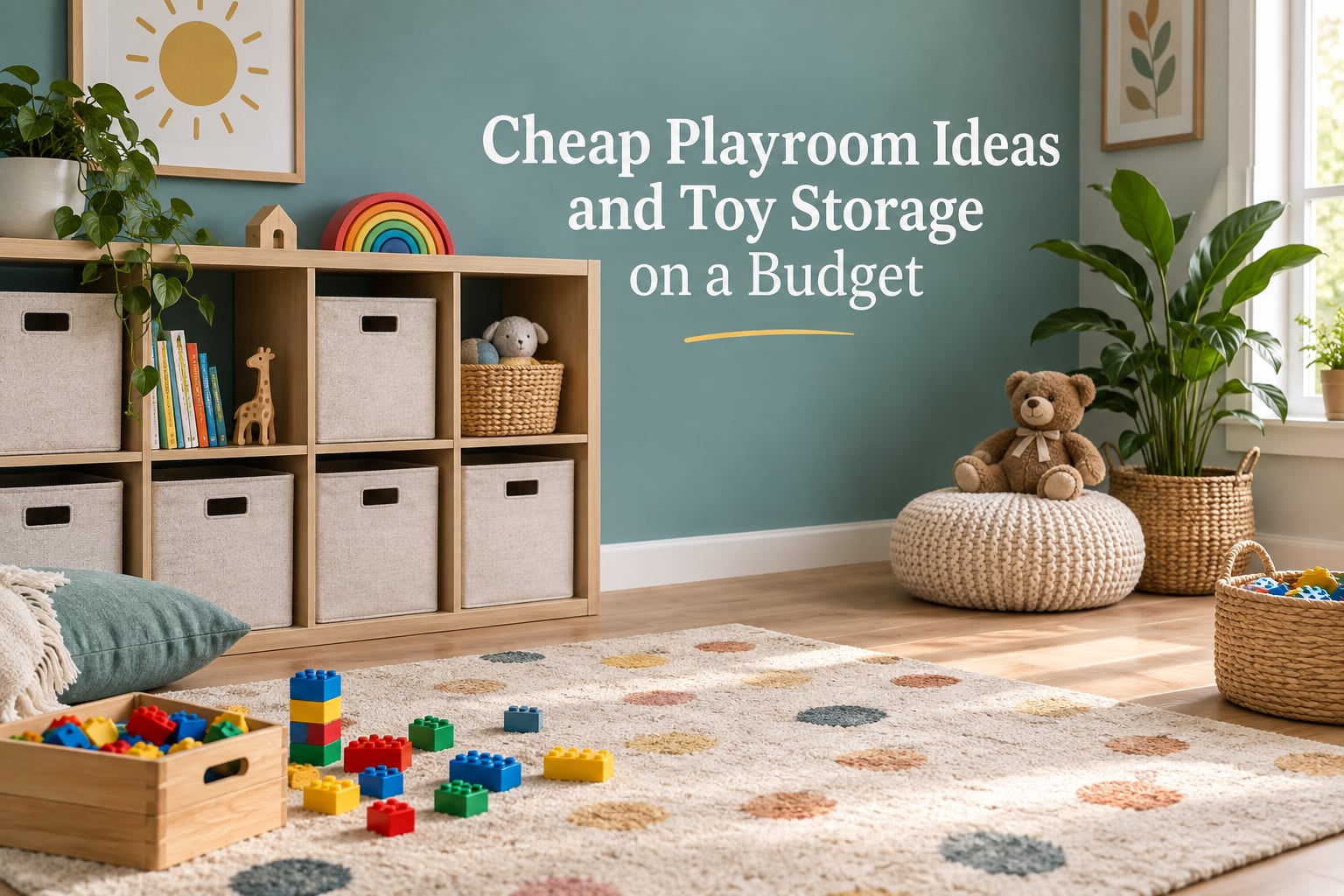
A playroom does not get messy because you are disorganized. It gets messy because toy volume grows faster than the space you have, and every new toy arrives with a home that lasts about a week before it joins the pile on the floor.
That is the real problem behind cheap playroom ideas and toy storage on a budget searches: you do not need more storage capacity, you need fewer toys in circulation at once and a place for everything that is not in circulation. I have run playrooms for three kids across a small rental house and a suburban family home, and the same three things solved it both times: a rotation rule, containers that match the toy type, and heights a child can actually reach.
This guide covers all of it. You will get a rotation schedule, a set of zero-cost storage builds from things you already own, a framework for deciding what to make and what to buy, storage matched to specific toy categories, and separate plans for small rooms, rentals, and shared living spaces.
Every idea here works without custom built-ins or a single drilled hole unless you want one. If your budget is tight, start with the free sections first and only buy something after you have run the free version for a month.
Table of Contents
- Every budget playroom needs six basics, and five of them cost nothing
- Toy rotation is the cheapest way to fix an overflowing playroom
- DIY toy storage built from what you already own costs nothing
- These budget-friendly storage buys earn their space
- Make it or buy it: a simple framework for every storage decision
- Match storage to toy type, from LEGO bricks to ride-on trucks
- Small rooms, rentals, and shared spaces each need a different setup
- Storage strategy should change as kids grow from toddler to tween
- Keeping kids involved is what stops a tidy playroom from collapsing
- Frequently Asked Questions
- What are some budget-friendly ideas for toy storage?
- What are some budget-friendly options for toy storage?
- How do you implement toy rotation without kids noticing?
- How do I store large toys in a playroom?
- What is the 20 toy rule for kids?
- Where is the cheapest place to get storage bins?
- At what age do kids outgrow a playroom?
- What should every playroom have?
- What are some ideas for a small playroom?
- Do clear bins or fabric bins work better for kids?
- Your budget playroom action plan starts with what you already own
Every budget playroom needs six basics, and five of them cost nothing
A playroom works when the room has a floor, a bin, a surface, a seat, a display, and a cleanup rule. That is the whole list. Parents searching for what should every playroom have usually picture rugs and themed walls, but those change nothing about whether a room stays tidy.
Here are the six basics, in the order I would set them up:
- A rug that defines the zone. One area rug is the single cheapest way to make a corner feel intentional. It tells your child where play happens, and it protects the floor underneath.
- Open floor space in the middle. If the centre of the room is full, the room feels full. Push storage to the walls and keep the middle empty for building.
- One container per toy category. Not one giant bin. Category containers are what make cleanup possible for a young child.
- A low shelf within child reach. Anything a child cannot reach on their own is a toy they stop playing with.
- A display surface for art and books. A low bookshelf turned sideways, or a rail clipped to a shelf, turns stored things into visible things.
- One cleanup rule the child owns. One rule, said the same way every time, is worth more than any container you buy.
Five of those six are free or already paid for. The one you may need to purchase is a low shelf or a set of matching bins, and even those can come from a secondhand marketplace or a garage sale.
Before you spend anything at all, walk the room and count what is actually on the floor versus what is in a container. In every room I have measured, the floor count was triple the container count. That gap, not the lack of furniture, is what makes a playroom feel chaotic.
Toy rotation is the cheapest way to fix an overflowing playroom
Toy rotation means keeping only a portion of your toys accessible and moving the rest somewhere out of sight, then swapping them back later. It is the highest-impact budget playroom organization move because it reduces clutter without buying a single bin.
The 20 toy rule is the simplest version: roughly 20 toys per child in rotation at a time, in a mix of categories rather than 20 of the same thing. Some families run 15, some run 30. What matters is that the number is small enough that the floor stays clear and the toys on the shelf rotate through, so boredom never sets in.
Here is how I set one up from scratch:
- Bin everything first. Put every single toy into a container, even if the container is a laundry basket. Do not skip the ones that seem obvious.
- Sort into categories. Bricks and building, vehicles, stuffed animals, pretend play, puzzles and games, art supplies, dress-up, books, outdoor. Nine categories is usually enough to be useful without being fussy.
- Sort each category into keep, rotate, and pass on. Keep means daily use. Rotate means it comes out later. Pass on means it goes to another child, and that pile is usually the biggest surprise of the project.
- Choose what goes out, and put the rest away. Aim for enough that the shelf is comfortable and the floor is empty, not a specific number.
- Set a swap day and write it down. Same day each week or every two weeks. A recurring appointment on a calendar survives better than good intentions.
- Do the swap without an audience. Swap while the kids are asleep or at school. Children rarely object to a rotation they do not watch happen.
- Keep one open overflow basket. Anything that does not fit the schedule goes in a lidded basket you can pull out on a hard day.
Weekly works better than monthly. When I tested both, the weekly swap kept the shelf interesting and the monthly swap meant a big reshuffle that nobody wanted to do, so it kept not happening.
Where does the off-duty stuff go? That depends on your housing, and it is the question parents ask most often. Under a bed works well for large flat items. A high closet shelf works for anything that does not need to be reachable. A bin in a garage, a basement, or the back of a storage locker works for everything else, provided the containers are labelled so you know what is in them without opening them.
If you have no off-site space at all, a rotating scheme still works using vertical space. Cube units let you stack six containers in the footprint of one chair, so you can hold a full year of toys in a corner without adding a second room.
DIY toy storage built from what you already own costs nothing
Zero-cost storage is the most underrated part of budget playroom organization. Almost every household owns containers, surfaces, and boxes that are currently doing nothing, and repurposing them is faster than shopping.
Clear shoe organizers on the back of a door. This is the most commonly recommended hack in parent forums, and it works because it uses vertical space nobody owns. Fill each pocket with a category: one for paint, one for small cars, one for blocks, one for costume accessories. Hang the organizer on a door with a hook and remove the door if you need the wall back.
Fabric bins matched across the room. Uniform containers are what make a room look organized even when it is not perfectly tidy. Matching does not mean expensive, it means the same. Save up for a set and use it for everything.
Drawstring bags or totes for bulk items. Balloons, blocks, magnetic tiles, dress-up fabric. A bag takes a third of the shelf space a rigid bin needs and disappears when it is tucked under a bed.
Cardboard boxes turned into cube storage. Cut a wine-box-sized opening in the front of a sturdy box, wrap it in contact paper or fabric, and add a label. It looks like a cubby and costs nothing. Cardboard is weaker than plastic, so keep these for light toys and fill them by weight rather than by volume.
Drawers and dressers repurposed. If a piece of furniture has smooth drawer fronts, you can often mount a label holder or rail on the front with removable adhesive strips. No drilling, and the drawers become the label.
A shelf edge for books. Two short lengths of tension rod and a bracket, or a simple L-shaped lip, keeps picture books upright with their covers showing. This is the cheapest possible kids art display and book display idea combined.
A rail or rope for stuffed animals. A stuffed animal hammock or a rope strung between two wall anchors corrals the soft toys that otherwise occupy every chair. Keep the anchor points high enough that nobody pulls on it, or use removable strips on the wall.
Under-bed and under-table space. Rolling bins under a bed are a game changer for bulky flat toys. Under an activity table they double the table surface area and hide the whole storage system at the same time.
A guest bed or folding table as storage cover. A fitted sheet or a draped throw over a bin stack makes an improvised container look deliberate. It costs a few dollars at a thrift store and hides mismatched bins completely.
Add pictures to the front of every container rather than words. Labels with images of the contents are readable by a child who cannot read yet, which is the whole point of a kid-accessible system.
Renter-friendly note. Everything in this section uses removable adhesive hooks, tension rods, or freestanding frames. If a storage idea requires a hole in a wall, ask whether a tension-mounted or adhesive-mounted version exists before you commit.
These budget-friendly storage buys earn their space
When free storage is not enough, buy fewer and buy once. Budget-friendly toy storage options that work fall into a short list of categories, and each one has a job it does better than the others.
- Matching fabric bins with handles. The workhorse. Choose handles so a child can carry one bin at a time, and choose a size that stacks cleanly on the shelf you already own.
- Clear plastic bins with latching lids. Best for art supplies, LEGO pieces, and anything that benefits from being visible. Lids matter more than colour because a child who can see into a box will use what is in it.
- A cube or cubby unit. One unit gives you several storage spots at once and defines a zone. Check the shelf depth against the depth of the bins you already have before buying anything else.
- A storage bench with a hinged seat. Double-duty furniture: seating plus concealed storage, which is the best solution for a room where toys must disappear fast.
- An activity table with storage underneath. Children play at it and clean up into it, so the storage and the behaviour are in the same place.
- Rolling bins. Casters on a large bin mean you can drag it out to clean and push it back. This is the difference between a storage system that lasts a year and one that lasts a month.
- Picture-label sheets or cardstock tags. The cheapest item on the list and the one that makes the whole system usable by a child.
Where is the cheapest place to get storage bins? For bulk quantities, discount chains and dollar stores usually win on price, and secondhand marketplaces win when you need a matching set. The trade-off is durability, so check seams and handles before you commit to a large order, and buy the first two bins to test them before ordering a whole shelf’s worth.
Two buying mistakes I would avoid. First, buying bins before measuring the shelf, which guarantees a stack that leans. Second, buying open-topped bins for small toys, because small toys are the single biggest cause of a floor that is never fully clear.
Make it or buy it: a simple framework for every storage decision
Ask three questions in order. Ask whether the toy is already contained, whether the container is reachable, and only then whether it works. Buying before those three answers is how a playroom ends up with beautiful empty bins and a full floor.
Use this decision framework for every category of toy you are trying to house:
- Does the toy leak, spill, or lose pieces? Then it needs a lidded container. LEGO, art supplies, and puzzles fall here.
- Is the toy soft, bulky, or awkward to stack? Then it needs a bag, hammock, or oversized bin. Stuffed animals fall here.
- Is the toy large but not in daily use? Then it needs floor space, not shelf space. Ride-ons and play kitchens fall here.
- Is the toy better displayed than stored? Then it needs a shelf edge, a rail, or a wall hook. Books, art, and minifigure collections fall here.
- Is the toy light, loud, or messy to hand over? Then it needs a lidded container on wheels so cleanup is one motion.
Make it when the item is bulky, the shape is odd, or the toy group is temporary. Buy it when it holds weight, holds small pieces, or has to survive a child pulling on it. If you are unsure, a bin is cheaper than a trip to a doctor for a swallowed building piece.
Run the framework on five categories only for the first month. Trying to solve the whole room at once is the reason most projects stall on a weekend afternoon.
Match storage to toy type, from LEGO bricks to ride-on trucks
Specific toy categories need specific solutions, and this is where most generic lists fall short. Here is the map, starting with the ones that cause the most trouble.
LEGO bricks and building pieces. Sorting by brick size in small lidded bins beats sorting by colour, because a child can find the size they want without hunting. For loose pieces on the floor, a soft-sided drawstring bag under the table is faster to tidy than any rigid bin. If pieces are constantly on the floor, cap the daily amount deliberately: one bin out, one bin away. The same approach works for magnetic tiles and construction sets.
Toy cars and trucks. A parking garage built from stacked boxes or a sheet of shelf liner on a low shelf lets cars be lined up rather than dumped. For a large collection, a wide shallow bin keeps them in one layer so they stay visible.
Stuffed animals. A hammock, a corner net, or a rope line corrals them off the floor and off the seating. The key detail is to make sure the child can reach the hammock, otherwise the soft toys end up back on the floor within a day. A large ventilated basket in the corner works if wall space is not available.
Art supplies and craft materials. Clear lidded bins sorted by medium: paint, paper, glue and glitter, scissors, beads. Anything with a cap or a lid belongs in a container with a lid, because a tipped box of glitter is a cleanup event rather than a storage problem. A low caddy near the table keeps the active project within reach.
Puzzles and board games. Slide the box into a clear bin with the box facing forward so a child can match the picture, or file them upright in magazine holders. Lost pieces go in a small labelled bag taped inside the lid of the box.
Books. A front-facing display shelf with a lip keeps covers visible and makes choosing a book a decision rather than a dig. Store the overflow flat and horizontal rather than upright, because upright books on a short shelf lean and fall.
Dress-up clothes and props. A door hanging on an over-door hook, a dresser with child-height drawers, or a rack on a wall all keep hangers off the floor. Sizing matters here: if a costume is too long, it goes on the floor within a week.
Large toys, ride-ons, play kitchens, and climbing items. These need floor space, not containers, and they need a plan for when the season or the age changes. Under-bed rolling bins handle bulky flat pieces. For ride-ons, the cheapest solution is a defined parking spot marked on the floor, so the rule exists even when the storage is the rug.
Small rooms, rentals, and shared spaces each need a different setup
For a small playroom, the answer is vertical space and closed storage, in that order. Cube units, door-mounted organizers, hanging solutions, and under-bed bins each add capacity without adding floor footprint. Keep the centre of the room clear, and accept that some toys will be in rotation rather than out at once.
Small room checklist:
- Swap flat storage for vertical storage before buying anything new.
- Hang what can hang: soft toys, dress-up items, art.
- Use door space that is currently a blank door.
- Keep a rotating overflow basket inside a lidded container that closes out of sight.
- Choose furniture that closes over the mess, such as a storage bench or a trunk.
For rentals, the rule is simple: assume you will move eventually, and avoid anything that needs a hole. Removable adhesive strips, tension rods, over-door hooks, freestanding cube units, and bins that sit on existing shelves all move with you. Where you must hang something heavy, use a strip rated well above the actual weight and check it periodically, because loaded storage bins are much heavier than empty ones.
One renter-friendly warning: a tall unfilled shelf unit is a tipping risk in a house full of children. If you go tall, anchor the unit or keep it low and wide.
For a shared living room play area, the goal is a fast reset rather than perfect storage. Choose containers that can be closed in one motion, keep the setup in one corner rather than spread around the room, and use a lidded basket as a parking spot for everything that is not actively in use. A rug plus one container plus a rule is often all a shared space needs.
Because a shared room has to look like a living room, closed storage beats open shelves there. Clear lids solve the visibility problem, and a fabric cover over the stack solves the matching problem.
Storage strategy should change as kids grow from toddler to tween
Most playroom organization advice is written for one age and then copied everywhere. The storage that works for a toddler stops working around age seven, and what a tween needs is different again. At what age do kids outgrow a playroom? The room usually goes first when the child starts wanting quiet, focused activities, or when the toys become too big for the storage that was chosen for babies.
Toddler, roughly one to three. Storage should be low, open, and shallow. A toddler can only pull things out, not put them back in high places, so the most accessible bin is the one that is always half empty. Use a few large, open containers and accept that everything lives in them. Avoid small pieces entirely during this stage.
Preschool and early school age, roughly three to seven. This is when labels, categories, and rotation take over. The child can now sort, so build the system around sorting: one category per bin, a picture label on the front, and a fixed home for each category. Height planning matters most here, because the child starts reaching independently.
School age, roughly seven to ten. Storage moves from open to closed. Collections, builds, and craft projects get a home each, and lidded bins become more important than open baskets. Add a project bin for things that are in progress, because that is what fills a floor at this age.
Tween, roughly ten and up. The dominant need is display. Open shelving, a pin board, and a hook wall let a tween own their space without a parent reorganizing it weekly. Rotation becomes less necessary as the child begins choosing their own activities, but it still works if the choice is framed as a swap rather than a removal.
The lesson across all four stages: change the system when the child’s capability changes, not when the mess looks bad. Most long-term failures come from keeping toddler storage after the child is nine.
Keeping kids involved is what stops a tidy playroom from collapsing
Every organized playroom I have seen that stayed organized had one thing in common: the child was allowed to make the changes. A room set up by an adult and then enforced by an adult collapses the first time the adult gets tired.
Use picture labels. Pre-readers cannot match a word to a bin. A picture of blocks on the blocks bin is the whole system working, and it takes one sheet of cardstock and a printer to make a full set.
Put the most-used toys in the most accessible places. Reach should follow frequency: daily toys at toddler height for a young child, weekly toys on a middle shelf, and rotation toys wherever you have space.
Let them own one container completely. One bin the child fills, empties, and manages without help teaches the idea better than any adult demonstration.
Set a cleanup rule in one sentence. Something like every toy goes back in its labelled home before dinner. One rule, same words, every time, and no negotiation about how many items are in the room beforehand.
Do the maintenance yourself, weekly. The weekly swap, a quick shelf wipe, and a check that labels still match what is inside take a few minutes and are what separate a system that works from a system that looks good in a photo.
Re-declutter seasonally. Twice a year, pass on what has not been touched. Toys your child has ignored for months are not being enjoyed, they are being stored, and someone else’s child would use them.
Frequently Asked Questions
What are some budget-friendly ideas for toy storage?
The strongest budget-friendly toy storage ideas are a door-mounted clear shoe organizer for small items, matching fabric bins for shelf storage, lidded clear bins for anything that spills, drawstring bags for bulky loose pieces, and a hanging hammock or corner net for stuffed animals. Under-bed and under-table bins handle the biggest toys, and repurposed cardboard boxes make instant cubbies. Start with the containers you already own and add to the set only after a month of rotation.
What are some budget-friendly options for toy storage?
Budget-friendly options fall into five useful categories: fabric bins with child-sized handles for general shelf storage, clear plastic bins with latching lids for small pieces and art supplies, a cube or cubby unit that multiplies your storage spots, a storage bench with a hinged seat for rooms where toys must disappear fast, and rolling bins so cleanup is one motion. Buying fewer, matching containers beat buying a wide assortment of mismatched ones.
How do you implement toy rotation without kids noticing?
Do the swap while the children are asleep or at school, and keep the routine identical each time so it becomes predictable rather than surprising. Put the incoming toys into the same bins in the same positions, and announce nothing. Keep one lidded overflow basket out for anything the child asks about during the swap so you can return it on the spot. Weekly swaps work better than monthly ones because a small change is easy to repeat.
How do I store large toys in a playroom?
Give large toys floor space rather than shelf space, and mark a parking spot for ride-ons so the rule exists even when the container is a rug. Store bulky flat pieces in rolling bins under the bed or under an activity table. Break down play kitchens and climbing items when they are not in use, and use the ceiling and wall space with hanging solutions and over-door hooks. A storage bench or trunk is the most effective container for anything larger than a cube.
What is the 20 toy rule for kids?
The 20 toy rule means roughly 20 toys per child are in rotation at a time, spread across categories rather than 20 of the same kind. The goal is a clear floor, a shelf that still looks interesting, and enough novelty that boredom never sets in. Families run anywhere from 15 to 30. The number matters far less than keeping it small, consistent, and swapped on a fixed schedule.
Where is the cheapest place to get storage bins?
For bulk quantities, discount chains and dollar stores usually win on price, while secondhand marketplaces and garage sales win when you need a matching set. The trade-off is durability, so check seams and handles before a large order. Buy one or two bins first and let them survive a month of real use before committing to a full shelf. Buying more than you need is the most common way a budget storage plan costs more than it should.
At what age do kids outgrow a playroom?
Most children outgrow a playroom as a dedicated room somewhere between ages seven and ten, when they want quieter focused activities, collections, and projects instead of floor-based play. Storage needs change too: toddler storage should be low, open, and shallow, while school-age and tween storage shifts toward closed bins for small pieces and open shelving for display. Changing the system when capability changes, rather than when the mess looks bad, keeps it working.
What should every playroom have?
Every playroom needs six things: a rug that defines the zone, clear open floor space in the middle, one container per toy category, a low shelf within child reach, a display surface for art and books, and one cleanup rule the child owns. Five of the six are free or already paid for. Parents usually picture rugs and themed walls, but those change nothing about whether a room stays tidy.
What are some ideas for a small playroom?
In a small playroom, add capacity vertically before adding anything new. Use a cube unit, a door-mounted organizer, a hanging stuffed-animal hammock, over-door hooks, and under-bed or under-table bins, and keep the centre of the room clear. Closed containers that look tidy matter more in a small space, so choose lidded bins or a trunk. Rotation also does more here than anywhere else, since the limit is the room itself.
Do clear bins or fabric bins work better for kids?
Clear bins win for anything that spills or loses small pieces, because a child can see the contents and pick up a specific item, and the lid keeps the mess contained. Fabric bins win for general shelf storage because they match visually, stack neatly, and are lighter for a child to carry. The most workable setup uses both: clear lidded bins at child height for active toys, matching fabric bins for the rest of the shelf.
Your budget playroom action plan starts with what you already own
Cheap playroom ideas and toy storage on a budget comes down to three moves, in order. First, reduce what is out at once with a weekly toy rotation. Second, match the container to the toy type using what is already in your closet and behind the door. Third, only then buy matching bins and one piece of double-duty furniture.
Start this weekend by binning everything, sorting it into categories, and putting half of it away. The room will look better in an afternoon than it has in months, and the part that makes it stick is a picture label and one cleanup rule your child can own.