
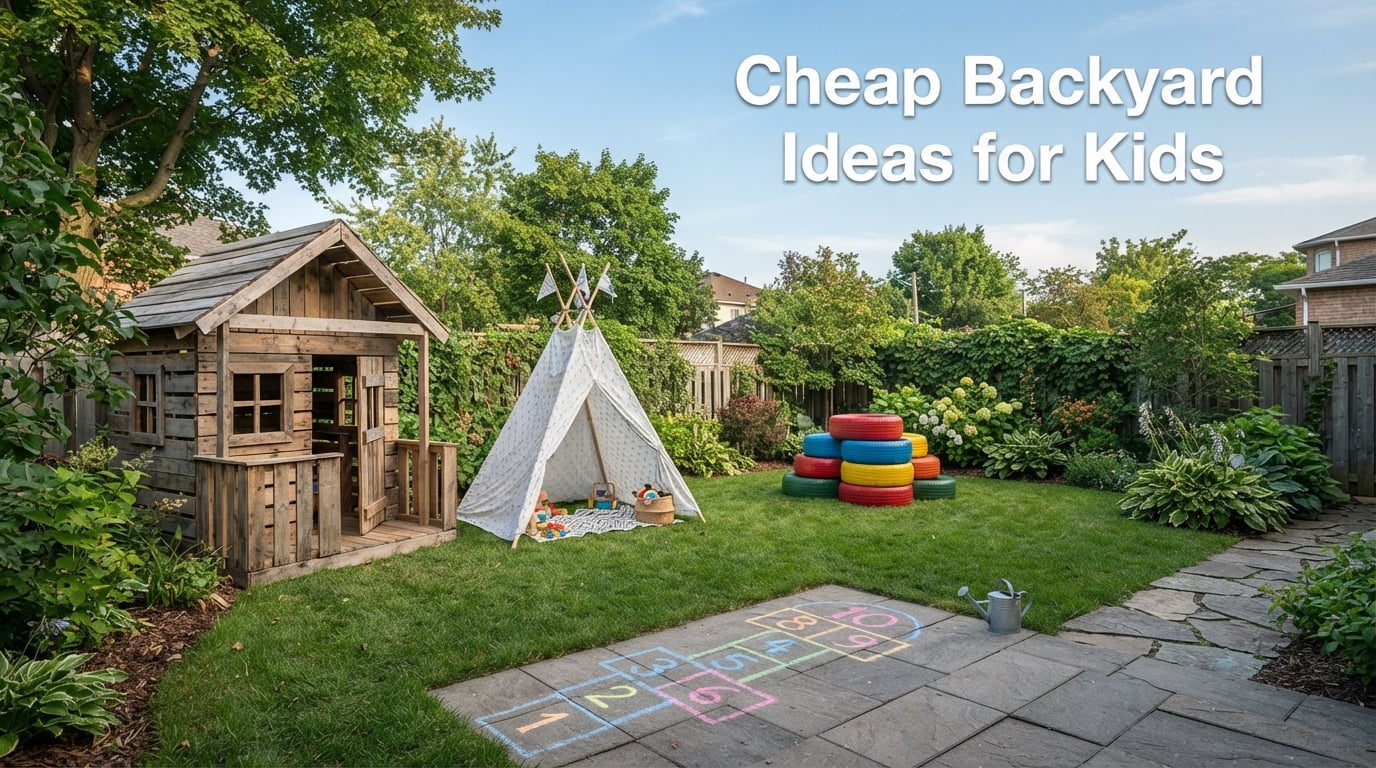
Cheap backyard ideas for kids are low-cost or free ways to turn an ordinary yard into a real play space, built mostly from things you already own: pallets, old tires, cardboard boxes, scrap lumber, pool noodles, a discarded nightstand. Skip the store-bought plastic playset and most of what a toddler actually plays with costs nothing at all.
My own yard is a narrow Edmonton lot with a lot of clay and not much room. We have built, rebuilt, and given up on more backyard projects than I can count, and the pattern is consistent: the projects that survived two summers are the ones built from scrap, and the ones that failed were the ones that needed perfect weather and constant upkeep.
This guide is organised by cost, because “cheap” means something different to every family. Some weeks the whole budget is a garage shelf and a few lengths of rope. Other weeks you have enough for a weekend of hardware and lumber. Every idea below states what it costs in materials, how long the build takes, and how long it survives an Edmonton winter.
I updated this list for October 2026, and every cost here is materials only. Your time is the real budget, and I say so honestly throughout.
Table of Contents
- 10 Cheap Backyard Ideas to Try This Weekend
- 15 Cheap Backyard Ideas for Kids, Ranked by Cost
- 1. Chalk games on the driveway or patio (free)
- 2. Nature scavenger hunt (free)
- 3. Homemade bubbles (free)
- 4. Giant water-bottle bowling (free)
- 5. Leaf printing and rock painting (free)
- 6. DIY mud kitchen (almost free)
- 7. No-sew teepee (almost free)
- 8. Tire climbing stack (free to low cost)
- 9. Pallet playhouse or fort (low cost)
- 10. Sensory walking path (low cost)
- 11. Outdoor chalkboard on the fence or gate (low cost)
- 12. Sidewalk obstacle or agility course (free to low cost)
- 13. Kids’ garden in raised planters (low to moderate cost)
- 14. Fairy garden or bug hunt corner (free to low cost)
- 15. DIY water wall (low to moderate cost)
- What Each Idea Costs, How Long It Takes, and Who It Fits
- Free Backyard Ideas for Kids: 10 Ways to Spend Nothing
- How to Make Your Backyard Safe for Kids Without Spending Much
- Cheap Backyard Ideas for Small Spaces and Renters
- DIY vs. Buying: What Each Budget Tier Actually Buys You
- Which Ideas Work in Edmonton’s Climate, and When
- Where to Find Free and Cheap Materials in Edmonton
- Cheap Backyard Ideas by Age: Toddlers, Preschoolers and School-Age Kids
- 5 Ideas to Skip and Why
- Frequently Asked Questions
- Conclusion
10 Cheap Backyard Ideas to Try This Weekend
If you want the short version first, these are the ten that get the most use per dollar and per hour. Jump to the full list below for the build details.
- Free — sidewalk chalk maze and hopscotch course
- Free — nature scavenger hunt with a printable list
- Free — bubbles with homemade wands from pipe cleaners and a dish tub
- Free — giant water-bottle bowling
- Free — leaf printing and rock painting art station
- Almost free — mud kitchen built from a kitchen sink or bucket and a shelf
- Almost free — teepee from three poles and a sheet, no sewing
- Almost free — tire climbing stack painted a bright colour
- Low cost — pallet playhouse or fort, no-saw build
- Low cost — sensory walking path of stones, wood slices and pinecones
15 Cheap Backyard Ideas for Kids, Ranked by Cost
Each idea below lists the materials, the rough cost tier, and the honest drawback. Nobody builds a cheap backyard perfectly, and the ones that work are the ones where you accept a little roughness.
1. Chalk games on the driveway or patio (free)
A chalk maze, a hopscotch grid, and a four-square court take about ten minutes and no supplies beyond the chalk in the bucket. Parents report this one outliving every toy because it costs nothing, resets itself, and works for kids who cannot yet climb.
Keep a bucket of chalk indoors in October so it survives wet weeks. Rain washes the pattern away, which is exactly what you want.
2. Nature scavenger hunt (free)
Print or hand-write a list: something rough, something smooth, a feather, a Y-shaped twig, a leaf bigger than your palm. Ten items, ten minutes of walking, and it works in a fenced city lot as well as a suburban acreage yard.
The one thing that makes it stick is a cheap field guide or a simple colour-sorting book. A parent on a forum mentioned organising a bird book by colour and it turned bird-watching into a real hobby for a four-year-old.
3. Homemade bubbles (free)
Bend pipe cleaners, coat hangers or sticks into wands, add a shallow tub of water with dish soap, and you have fifty minutes of running for about the cost of a box of spaghetti. Bigger wands make bigger bubbles, and that is the entire trick.
Wash the wand residue off the grass with the hose afterwards, or bubble solution leaves a film that attracts flies on hot days.
4. Giant water-bottle bowling (free)
Line up empty two-litre bottles, use a rolled-up rug or a soft ball, and knock them down. Add a painted scoreboard on the fence and it becomes a game with a season.
This is one of the rare free ideas that works well for a mixed age group, since a four-year-old can roll the ball and a nine-year-old can keep score properly.
5. Leaf printing and rock painting (free)
Crayons on collected leaves make excellent cards and bookmarks. Wash some rocks, let the kids draw on them, and park them along a path. It costs nothing and it occupies a whole afternoon.
Collect the leaves now and save them for a rainy day in October; the printing is just as good indoors on a table.
6. DIY mud kitchen (almost free)
A mud kitchen is a shelf or a plank across two boxes, a pan or a shallow tub of dirt, and a handful of real kitchen tools. Add a tap made from a spigot screwed into a post and a water bucket, and it becomes a full pretend kitchen.
This is the single most requested idea in parent forums, and also the biggest cleanup complaint. Set it on grass or pavers near a hose, not on a deck, and put a lid or a tarp over the dirt tub in the rain. Mud season here turns an uncovered mud kitchen into a swamp by the second week of April.
7. No-sew teepee (almost free)
Three long poles, one sheet or an old blanket, and rope at the top. It takes about an hour with no sewing and no cutting. Beanpole style works too: lash five or six saplings trimmed to roughly equal height and lay the fabric over the tops.
Weight the bases with rocks or a sandbag and check the guy lines before every wind. Kids love the build as much as the fort, so invite them to help tie it and treat the construction as the play.
8. Tire climbing stack (free to low cost)
Three or four vehicle tires, stacked and bolted or weighted, become a climbing tower. Spray paint a bright colour and it looks intentional rather than discarded.
Rubber tires left in sun can get hot enough to burn bare skin, which matters on a July afternoon here. Keep the stack in shade or fill them with soil to take the heat out. Check the bolts every month, because a climbing toy that shifts is a hazard.
9. Pallet playhouse or fort (low cost)
Two or three pallets screwed or wedged together make a deck; a sheet over a hoop makes a roof. It is the classic cheap answer to “where do they play when it rains” and it can be moved in winter.
Pallets are free in most industrial yards, but check that they have no chemical treatment and no damaged stringers. A four-year-old needs a floor under a loft, and a ladder or step instead of a rope.
10. Sensory walking path (low cost)
Flat stones, cross-sections of log, pinecones, smooth pebbles and a few cedar chips set flush into a metre-wide strip become a barefoot path. It is quiet, it is small, and it fits a narrow side yard.
Rinse off after sandstorms and sweep the pinecones, or the path becomes a trip hazard. It also works as a winter feature if you clear snow off it, since it is the one play idea that stays interesting when there is no grass.
11. Outdoor chalkboard on the fence or gate (low cost)
A sheet of plywood or a reclaimed door, a frame of furring strips, and weather-resistant blackboard paint gives you a surface that rain wipes clean. Weather-resistant paint is the whole project; cheap acrylic chalkboard paint peels off the fence within a season.
Attach it with hooks or straps rather than screws if you rent. It also doubles as a scoreboard for bowling, hopscotch, and any giant yard game the kids invent.
12. Sidewalk obstacle or agility course (free to low cost)
Cones, chalk lines, a rope, a hose laid in a loop, and a few paver stones make a course the kids can redesign themselves. It burns a remarkable amount of energy for a total spend close to nothing.
No-course-required version: a chalk hopscotch, a balance line, and a sprint to the fence. Put a water break station at the end, and in October move the whole thing indoors as a living-room obstacle route.
13. Kids’ garden in raised planters (low to moderate cost)
Two or three planters of sunflowers, beans and herbs give children a reason to be outside daily. Sunflowers are the reliable choice because the height is dramatic and the seeds are edible if you use untreated varieties.
Choose kid-height planters so a three-year-old can reach the soil without help. Skip the painted border boxes; a plain box and a marker-written label is the same idea at a fraction of the price.
14. Fairy garden or bug hunt corner (free to low cost)
Fill a shallow tub or a cracked pot with soil, add moss, small stones, a few fairy figures, and whatever the kids find. The ongoing play is spotting insects, not the garden itself.
A butterfly feeder made from a plate and sugar water, or a simple pinecone dipped in seed and peanut butter hung near a window, keeps the interest going at almost no cost.
15. DIY water wall (low to moderate cost)
Clamp or tie short lengths of PVC or garden hose to a fence or board at different heights so water runs down them. Add a bucket underneath and the kids work the plungers for a long time.
This is the one idea on the list that is genuinely unhappy in a cold climate, so give it a season. Drain the hoses completely, store them indoors, and the fittings will not split in freezing weather.
What Each Idea Costs, How Long It Takes, and Who It Fits
This table is the fastest way to match an idea to your weekend and your child. Cost tiers are materials only, and assume you already have basic tools.
| Idea | Cost tier | Build time | Ages | Skill level |
|---|---|---|---|---|
| Chalk games | Free | 10 minutes | 2-10 | None |
| Nature scavenger hunt | Free | 20 minutes to prepare | 3-10 | None |
| Homemade bubbles | Free | 15 minutes | 1-10 | None |
| Water-bottle bowling | Free | 30 minutes | 3-10 | None |
| Leaf printing and rock painting | Free | 10 minutes | 2-8 | None |
| Mud kitchen | Almost free | 2 hours | 2-8 | Beginner |
| No-sew teepee | Almost free | 1 hour | 2-9 | Beginner |
| Tire climbing stack | Almost free | 1 hour | 3-10 | Beginner |
| Pallet playhouse | Low cost | Weekend | 3-10 | Intermediate |
| Sensory walking path | Low cost | Half day | 1-8 | Beginner |
| Fence chalkboard | Low cost | Half day plus drying | 2-10 | Intermediate |
| Obstacle or agility course | Almost free | 30 minutes | 3-10 | None |
| Kids’ garden planters | Low to moderate | Weekend | 2-10 | Beginner |
| Fairy garden or bug corner | Almost free | 1 hour | 2-8 | None |
| Water wall | Low to moderate | Half day | 1-8 | Intermediate |
Free Backyard Ideas for Kids: 10 Ways to Spend Nothing
Parents searching for cheap backyard ideas split into two groups: those who want something built, and those who need this afternoon sorted. This section is the second group.
- Scavenger hunt — ten-item list, ten-minute walk
- Sidewalk chalk — maze, hopscotch, four-square, chalk outline art
- Bubbles — pipe cleaner wands and a dish tub
- Bottle bowling — empty containers and a rolled rug
- Hide-and-seek variations — reverse countdown, or hiding objects and leaving clues
- Leaf printing and rock painting — crayons and yard finds
- Nature detective hour — find five different textures and name them
- Backyard camping — a sheet tent, a flashlight, and stars counted from the step
- Outdoor story time — a blanket, a book, and a tree to lean against
- Shadow drawing — trace each other at midday and again in the evening
None of these need a purchase, and all of them survive a wet day because you can run them on a balcony or a covered porch.
How to Make Your Backyard Safe for Kids Without Spending Much
Safety is the section that most backyard idea lists skip, and it is the part a grandparent or a visiting parent will actually check. Work through this before the first play session, not after.
1. Check the ground under anything climbable. A fall zone should be clear of rocks, exposed roots, and hard edges for a good distance on all sides. Wood chips, bark mulch, pea gravel, or sand work. Concrete and asphalt do not, and neither does bare packed clay, which turns to concrete in an Edmonton winter.
2. Look for pinch points. Anything that opens, closes, or rotates can trap fingers: swing seats, seesaw pivots, folding chairs, and the gap where a pallet deck meets its frame. Fill gaps, cover hardware, and never leave a folding chair in the play area.
3. Give swings real clearance. Leave space in front of and behind the seat for the full arc of travel, not just the seat itself. An under-five needs a bucket seat and an adult nearby; strap toddlers into it rather than letting them climb.
4. Check your fence line. Fences with horizontal rails invite climbing, and a climbable fence beside a street or a parking area is a genuine risk. Before spending on anything else, secure the boundary.
5. Handle water deliberately. Empty every bucket, tub, and small water feature overnight. Standing water is a drowning risk with toddlers and it also breeds mosquitoes in a warm week.
6. Plan for shade. A canopy sail, an umbrella, or a sheet on a frame costs little and does more good than any toy. Check the temperature of rubber, metal, and dark decks before sitting a child on them on a hot afternoon.
7. Sun protection. Sunscreen, hats, and water breaks matter more in a place with this much spring and summer sun than most lists admit. Set a water break schedule rather than waiting for a child to ask.
8. Keep the sightline. Whatever you build, you should be able to see the whole play area from a kitchen window or the back step. That single factor does more for peace of mind than any product.
9. Inspect monthly. Bolts loosen, rope frays, and paint peels. Five minutes at the start of each month catches the problem before a fall does.
Cheap Backyard Ideas for Small Spaces and Renters
Small yards get the best of these ideas, because everything here scales down. A teepee, a chalkboard, a tire stack, and a scavenger hunt all work in a six-metre side yard. A playset does not.
For narrow lots, think vertical and mobile. Hang a tire from a tree branch with a rope. Stack crates as stepping blocks. Use the fence as the play surface, which is why the chalkboard and the water wall both attach to fence boards.
If you rent, or your lease says no drilling, work around it. Hook-mounted chalkboards instead of screwed-in ones, rope lashings instead of bolts for a teepee, weighted planters instead of posts in the ground, and fabric screens instead of fixed structures. Check your lease anyway; many allow detachable accessories and only prohibit permanent attachment.
Balconies and shared courtyards also work if you keep it activity-based rather than structure-based: bubbles, chalk, a scavenger hunt, and a scavenger-hunt card on the railing. On shared ground, choose ideas that take up no floor space at all.
DIY vs. Buying: What Each Budget Tier Actually Buys You
The honest question is not what things cost, it is what your time costs. Parents on forums describe a DIY jungle gym as more affordable but a lot of hard work, and they are right: the material bill is rarely the biggest part of a cheap backyard project.
Here is what each tier realistically delivers.
- Nothing to spend — activities, games, art, scavenger hunts, bubbles, bowling. No structure, but a full summer of screen-free afternoons.
- A shelf of materials — mud kitchen, teepee, tire stack, fairy garden. Permanent, and all ages can use them.
- A weekend of hardware and lumber — pallet playhouse, chalkboard, sensory path, water wall. These are the projects that look finished.
- A store-bought playset budget — you can skip it. Parents frequently report that children outgrew a bought playset in under two years, while a chalkboard or a garden keeps changing with their interests.
Two moments when spending money is the cheaper choice. First, if your child needs a swing for sensory or physical reasons, buy a well-built one with a bucket seat and proper clearance. Second, if the ground under a climbing structure cannot be surfaced safely with wood chips, mulch, or sand, a surfacing job is worth it before any new play equipment goes up.
Everything else on this list is a bad investment. Inflatable water slides, novelty light-up toys, and plastic pop-up pools get one afternoon of use and then live in a shed.
Which Ideas Work in Edmonton’s Climate, and When
This is where a list written for a warm climate falls apart, so here is the local calendar.
March to May. Wait for the ground to stop being soup before walking on it, and expect mud season to destroy an uncovered sandbox. Build indoor-friendly ideas now: chalkboard, teepee, tire stack, planters. Sand play needs a secure cover between uses or it fills with rainwater and freezes into a block.
June to August. This is the season for water play, bubbles, the obstacle course, and the scavenger hunt. Run water features in the morning rather than the afternoon. Watch tire and metal temperatures, and keep shade over the sandbox.
September to November. Great weather for the builds you skipped: the pallet fort, the sensory path, the kids’ garden harvest. Fall is when you drain hoses, empty sand tubs, wash chalkboard paint off, and store anything you do not want frozen.
December to February. Most backyard ideas stop working, and pretending otherwise wastes your energy. The exceptions are the sensory path, a snow-obstacle course built from the same cones and rope, and a bird feeder, which is genuinely more interesting in deep winter when the birds are still coming.
The rule I use: if an idea needs standing water or mud to function, it gets one warm season. If it is built from wood, rope, and paint, it can stay out all year.
Where to Find Free and Cheap Materials in Edmonton
Most of the materials on this list are already in your neighbourhood, if you know where to look.
- Free curb pickups — leave a note and you will often collect pallets, a door, or an old window the same week.
- Kijiji and Buy Nothing Edmonton — search for pallets, lumber offcuts, tires, playhouses, and sandboxes. People list these free because they cannot move them.
- Salvage and reuse yards — ask for the pallet rack lumber and the odd door. This is where chalkboard builds come from.
- Dollar stores — the pool noodles, rope, paint, planters, and chalk that show up in half these projects. Buy the same rope and you can restock for a few dollars a season.
- Your own recycling bin — cardboard boxes become a fort wall or a balance obstacle. It is the cheapest building material in the yard.
- Tool library and neighbours — a jigsaw or a drill is a one-time cost most families should not pay for twice.
Skip the hardware store until the free sources are empty. That order matters more than any coupon.
Cheap Backyard Ideas by Age: Toddlers, Preschoolers and School-Age Kids
Most wasted spending comes from buying for a stage your child is about to leave.
Toddlers, one to three. Bubbles, a water table, a sensory walking path, chalk, a tire stack to crawl over, and a covered sandbox. Keep everything low, soft, and away from steps. No open water overnight, no climbing towers.
Preschoolers, three to five. The mud kitchen, a no-sew teepee, a fairy garden, water-bottle bowling, and a fence chalkboard. This is the sweet spot for cheap projects because imaginative play peaks here.
School-age, six to ten. Obstacle courses, scavenger hunts with harder lists, a kids’ garden they are responsible for, a fort with rules, and a build they do themselves. A four-year-old’s teepee is a toy; a nine-year-old will turn the same poles into a clubhouse with a door.
The pattern to watch for: a beanpole teepee works beautifully at four and is ignored at nine. Check what your child is asking for before you build, and a direct question about what they want to play costs nothing.
5 Ideas to Skip and Why
Honest curation is more useful than a longer list, so here is what I would not spend money on.
- A store-bought plastic playset. The cheapest-looking option in a shopping search is the most expensive way to play. Parents routinely report toys outgrown in under two years, and a plastic fort occupies the whole yard while being used by one child at a time.
- Inflatable water slides. Fun for one afternoon, stored in a shed for the rest of the summer, and a slip hazard on grass.
- An unanchored tire swing from a tree branch. A free branch is not a structure. If you want a tire swing, use a proper swing frame or a play set rated for it.
- A trampoline. It needs clearance on all sides, regular net replacement, and it displaces every other idea on this list. If you buy one, buy a springless model and check your insurance.
- A full astroturf or hardscape play area. It solves low maintenance, and it also solves your budget entirely. Wood chips under a climbing area give you most of the safety benefit for a fraction of the cost.
If you want one thing that lasts, build a surface for free play and let the games stay temporary. That is the opposite of how most backyard spending goes.
Frequently Asked Questions
What is the cheapest way to make a backyard fun for kids?
The cheapest approach is activity-based, not structure-based. Chalk games, nature scavenger hunts, homemade bubbles, water-bottle bowling and leaf printing cost nothing beyond what you already own. If you want something built instead, a mud kitchen or a no-sew teepee made from poles and a sheet costs only materials, and both last years.
What are some small backyard ideas for kids?
Small yards suit vertical and mobile ideas. Hang a tire from a rope, stack crates as stepping blocks, attach a chalkboard to the fence, and use chalk on the patio. Teepees, sensory paths and scavenger hunts all fit into a narrow side yard. Anything requiring a large fall zone, like a playset or a trampoline, does not.
What are inexpensive ideas for a backyard playground?
A pallet playhouse, a tire climbing stack, and a fence-mounted chalkboard cover most of what a small playground offers for a fraction of the cost. A DIY swing from a pallet is possible but only if you follow swing clearance rules and use rated hardware. Surfacing with wood chips or mulch matters more than the equipment itself.
What are the must-haves for a backyard for kids?
A safe ground surface under anything climbable, a clear fall zone free of rocks and roots, no pinch points in moving parts, shade, and a sightline from a window. Beyond safety, a mix of one physical activity, one imaginative play spot, and one nature activity keeps children busy far longer than any single piece of equipment.
What are easy DIY playground ideas on a budget?
Three of the simplest are a tire climbing stack, a pallet fort, and a chalk-drawn obstacle or agility course with cones and rope. Each takes an hour or less, needs only basic tools, and is easy for children to help with. Involving kids in the build is often what makes the finished project interesting to them.
What DIY ideas work for a kids’ garden play area?
A raised planter with sunflowers, beans and herbs gives children a daily reason to be outside, and kid-height boxes mean a three-year-old can reach the soil. Add a sunflower house or a beanpole teepee at the end of the path. Choose untreated seed varieties if the plan is to eat what grows.
Conclusion
Cheap backyard ideas for kids are less about clever building and more about what you already own. Fifteen ideas on this list cost nothing or close to it, and the five we would skip would have emptied a savings account.
Start with one free activity this week, build one project this weekend from pallets or poles, and get the safety checks done before anyone climbs. Check the free and cheap material sources before you spend a dollar, and store the water stuff before the first freeze.