
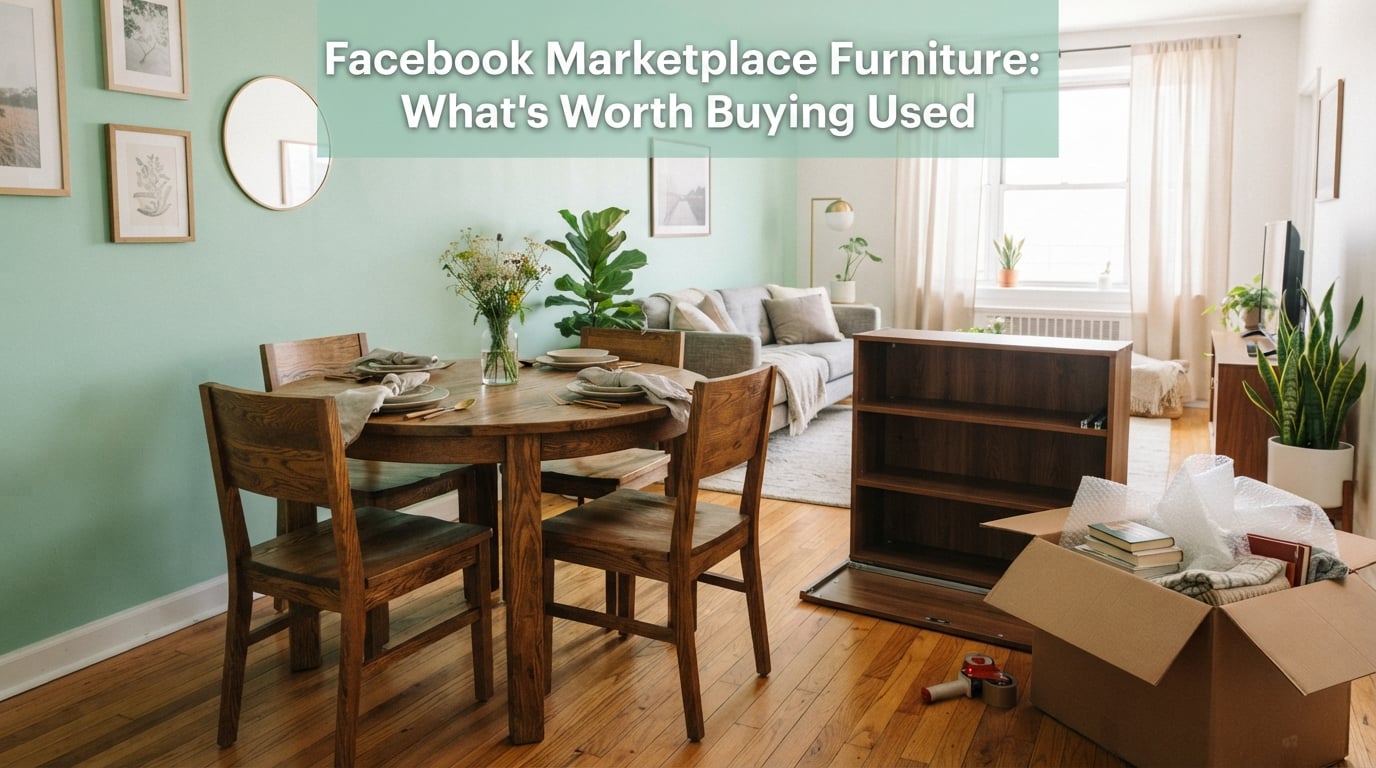
Yes, most Facebook Marketplace furniture is worth buying used, and quality solid-wood pieces often cost a fraction of their new price. But three categories are never worth it at any price: mattresses and pillows, children’s safety items, and flat-pack particle board pretending to be solid wood.
That direct answer matters because Facebook Marketplace furniture has no checkout, no payment processing, no buyer protection, and no return window. Sellers post photos and a number, buyers message through Messenger, and the deal is done face to face in a driveway or a living room. The entire purchase rests on a twenty-minute inspection you do yourself.
Used furniture typically trades at roughly 40 to 60 percent of its retail equivalent, and the gap is driven by materials, brand, and condition rather than by age. A twelve-year-old teak dining table can be worth more to you than a two-year-old flat-pack one, because the frame underneath is still solid and the finish can be renewed. That is the whole reframe this article is built on.
I have furnished Edmonton rentals, student housing, and my own place this way over the past several years, and the strategy that keeps working is the one that shows up again and again on r/FirstTimeHomeBuyer: buy used now, upgrade later, once you have survived the move-in costs. The mistake people make is treating used furniture as a downgrade instead of a different category of object. Some used pieces are the best value in the room. A few are dead money no matter how little the asking number is.
Edmonton buyers have a specific advantage here. Local listings skew toward the solid wood, mid-century, and natural-material pieces that are close to impossible to find at a big-box retail store in Canada, and you can inspect them the same afternoon. This guide is organized the way I actually shop: a verdict for every category first, then how to run the inspection, then how to get the piece home without the transport cost eating the savings.
Last reviewed and updated for 2026.
Table of Contents
- The Verdict: What Furniture Is Worth Buying Used on Facebook Marketplace
- What to Buy: Categories That Hold Their Value
- What to Skip: Categories Not Worth Buying Used
- How to Tell Solid Wood From Veneer, MDF, and Particle Board
- The 60-Second Structural Test You Can Run in the Seller’s Living Room
- Bed Bugs, Termites, and Odour: What to Look For
- How to Determine the Value of Used Furniture
- Facebook Marketplace Safety: Scams, No-Shows, and Payments
- How to Negotiate on Facebook Marketplace Without Losing the Piece
- Getting the Furniture Home: Transport and Logistics
- Reupholstery Break-Even: When Fixing Beats Replacing
- Where Edmonton Buyers Find the Best Used Furniture
- How to Get Rid of Furniture You Regret Buying in Edmonton
- Frequently Asked Questions
- Is it worth buying furniture on Facebook Marketplace?
- What furniture is worth buying used?
- What furniture should I avoid buying used?
- What to look out for when buying a used couch?
- How do I tell if furniture is solid wood?
- How much does used furniture cost compared to new?
- Do Facebook Marketplace purchases have buyer protection?
- Is Facebook Marketplace available in Canada?
- Where is the best place to look for second hand furniture in Edmonton?
- How do I get rid of furniture I regret buying in Edmonton?
- Conclusion
The Verdict: What Furniture Is Worth Buying Used on Facebook Marketplace
The table below is the short answer. Buy, buy with caution, or skip, with the reason and the specific thing to check. If you only read one section of this guide, read this one.
| Furniture category | Verdict | Why | What to check before you commit |
|---|---|---|---|
| Solid wood dining tables and chairs | Buy | Hardwood frames last generations and can be sanded and refinished | Joint tightness, leg attachment, leaf hardware, water rings |
| Dressers, chests of drawers, armoires | Buy | Drawers and dovetail joinery survive moves that break flat-pack joints | Drawer slides, drawer bottoms, back panel, mirror condition |
| Bookshelves and shelving units | Buy | Cheap to fix, easy to reinforce, always in demand | Flatness, sagging shelves, wall anchor hardware included |
| Desks | Buy | Solid wood and vintage steel-frame desks hold value well | Wobble, cable routing, drawer action, finish wear |
| Bed frames and headboards (no mattress) | Buy | The frame is the part that matters and the part that gets thrown out new | Slat spacing, centre support leg, wobble at the joints |
| Nightstands and side tables | Buy | Small footprint, easy to test, easy to move alone | Wobble, drawer alignment, veneer lifting at the edges |
| Coffee tables | Buy with caution | Cheap glass tops and particle board tops are common failure points | Flip it over, look at the underside, check the glass for chips |
| Mid-century and vintage pieces | Buy | Natural materials, honest joinery, and designs that are not dated | Water damage, veneer delamination, missing hardware, originality |
| Rattan and cane pieces | Buy | Unique material that holds interest and cannot be mass produced cheaply | Weaving breaks, frame creak, mould spots in humid storage |
| Sofas and sectionals | Buy with caution | Great frame, tired cushions. The frame is worth buying, the foam may not be | Sit test, frame creak, cushion foam, sagging, pests, odour |
| Reupholstered or dated-colour sofas | Buy with caution | Cost is recoverable only if the frame is solid and the shape is current | Frame material, seam condition, whether the piece is already recovered |
| Patio furniture | Buy with caution | Aluminium and resin frames are fine, wood and wicker fail in Edmonton winters | UV fading, rust at the joints, fabric rot, drain holes |
| Mattresses, box springs, pillows | Skip | Body imprint, hidden pests, and unknown history outweigh any saving | Not worth inspecting. This is a firm no. |
| Cribs, car seats, strollers | Skip | History is invisible and safety recalls are permanent | Not worth inspecting. This is a firm no. |
| Flat-pack particle board sold as solid wood | Skip | Cam bolts and particle board fail, and it rarely survives a move | Cam bolt holes, raw particle board edge, hollow core |
| Furniture with built-in speakers or lighting | Skip | Proprietary electronics are obsolete within a few years | Ask whether the electronics still work. Assume not. |
| Trendy-colour fast furniture | Skip | Hard to live with, hard to give away, hard to resell later | If you love it, buy it, but expect to move it on yourself |
The pattern is clear. Buy anything where the material and the joinery are the point. Be careful where the frame is good but the soft parts or the finish are the weak link. Skip anything where your safety or your sanity depends on a history you cannot see.
What to Buy: Categories That Hold Their Value
Sofas and sectionals: buy the frame, judge the foam
A used sofa is worth buying when the frame underneath is solid and the cushions are the only tired part. Cushion foam compresses and fails, and cushion foam is the cheapest thing on any sofa to replace. That makes a good-frame, tired-cushion sofa the single best value category on Marketplace.
What you cannot fix is structure. A frame made of particle board or of thin metal will not survive a decade, and no amount of new foam changes that. Press down on the arm, sit hard in the middle, and listen. Creaking under load is normal for older springs. A hollow or plastic-sounding collapse is not.
Buyers on r/ApartmentHacks point out that a genuinely good-quality sofa at anywhere near its new cost is close to impossible to find new in the price range most people are working with. That is the whole second-hand argument in one sentence.
Dining tables and chairs: the highest-value category on the platform
A solid wood dining set is the thing I would tell a first-time buyer to hunt for first. Hardwood frames are mechanically simple, repairable, and refinishable, and chairs are the easiest test in the store: sit, rock the back legs, and check whether the joints are tight.
Watch for water rings, splitting along a grain line, and leaves that have been glued rather than pinned. A leaf glued back into place is a sign the table has been stressed. It is not automatically a deal breaker, but it should lower your offer.
Dressers, chests of drawers, and armoires
Drawers are the best structural test in all of used furniture because they show wear in a way nothing else does. Slide every drawer all the way out. If it binds halfway, the runners have swollen or the box has warped. If the bottom is thin, flexing, or stapled rather than screwed, the piece is not worth much to you.
Armoires and wardrobes are the most interesting buy and the most painful to move. Back off unless you have help, a vehicle with a real cargo opening, and a plan for the doors.
Bookshelves, coffee tables, and side tables
Shelving is the easiest place to start if you are new to this. Look for a piece that stands flat on the floor when you rock it, and reinforce any unit taller than about two metres before it goes into a home with kids or pets.
Coffee tables need the flip test. Turn it over and look at the underside, because that is where particle board, hollow-core panels, and cheap hardware show themselves. Glass tops chip at the edges long before the centre cracks, so run a finger along the rim.
Desks, bed frames, and nightstands
A used bed frame is an underrated buy. The mattress gets replaced constantly, so a good frame is thrown out with a sagging mattress on top of it, and a solid wood or heavy metal frame is a genuinely long-lived object. Check slat spacing and make sure a centre support leg is present on anything wider than a twin.
Desks split into two groups worth buying: solid wood writing desks, and vintage steel-frame desks that came out of professional offices. Both survive. Modern particle board desks with cable management cut into the top usually do not.
Mid-century, vintage, and rattan pieces
These hold interest for a reason nobody can manufacture at scale. Teak, walnut, and cane have a texture and warmth that flat-pack veneer and moulded plastic cannot copy, which is why the r/Decor and r/Frugal conversation keeps returning to the idea that older, well-made furniture uses real wood and lasts.
Buyers on r/ZeroWaste make a related point: hard wood furniture can be had second-hand for a fraction of what artisan or factory-direct pricing asks. The catch is real age, so check veneer edges, drawer runners, and any water exposure, and expect to do finish work.
What to Skip: Categories Not Worth Buying Used
Mattresses, box springs, and pillows
This is the firmest consensus position in the whole second-hand furniture world, and the r/Frugal threads are unusually consistent about it. Do not buy a used mattress. Not because saving the money is bad, but because the cost is invisible: a mattress carries years of body imprint, moisture, and pest risk that no inspection can rule out.
Pillows fall in the same category for the same reason. A mattress cover is a new product. Spend your budget on the frame instead.
Cribs, car seats, and strollers
Skip all of it. Cribs and car seats have published recall histories that you can look up by model, and a recall does not expire because a seat has been through two owners. Strollers have the same problem in reverse: no history of a minor injury, ever reported anywhere.
If you need these items, buy them new, and check the model against the recall database before you buy them.
Flat-pack and particle board sold as solid wood
This is the false economy that frustrates buyers most. Particle board and hollow-core panels are held together with cam bolts, and cam bolts fail in cycles as the material swells and dries. A cheap flat-pack wardrobe will often not survive its own move, let alone a decade of use.
The tell is the price claim. If a listing describes a large wardrobe in oak as a bargain, and the edge of any panel shows raw brown particles, the wood is a thin printed veneer over engineered board. Walk away, or ask for a photo of the underside where there is no finish to hide behind.
Furniture with built-in speakers or lighting
A bed frame with integrated speakers and a charging station looked clever for about eighteen months. The proprietary parts will not be sold in five years, the wiring is glued inside the frame, and the whole thing becomes a heavy box with dead electronics. Plain LED strips and USB ports are the harmless exceptions, because those are standard parts anyone can replace.
Trendy-colour fast furniture
Some pieces are worth buying in a colour you dislike, because neutral tones travel and bold ones do not. A forest green or mustard piece in good condition will be sitting on your curb or your Marketplace listing within a year. If you genuinely love it, buy it, and know you are the one who moves it next.
How to Tell Solid Wood From Veneer, MDF, and Particle Board
Material identification is the single most useful thing a buyer can learn, because it predicts everything else: durability, repairability, and resale value. Here is the decoder.
| Material | What it actually is | Used-buying verdict | How to spot it |
|---|---|---|---|
| Solid wood | The whole board, or a thick layer of it | Buy. Sandable, refinishable, repairable | End grain shows a continuous grain pattern; varied colour and knots; no repeating pattern |
| Wood veneer | A thin layer of real wood glued to a cheaper core | Buy with caution. Fine if the edges are intact | Look at the underside, the edge, and the inside of any drawer. Chipped edges reveal the core |
| MDF | Wood fibre pressed into a smooth dense panel | Buy with caution on small parts, skip on large | Very smooth, uniform, no grain. Heavy for its size. Edges show a fine fibrous texture |
| Particle board | Wood chips pressed together, usually chipboard | Skip | Raw brown chips visible on any cut edge, or a hollow-sounding knock |
| Engineered wood | A broad family including veneer-on-core and laminated board | Judge by the core, not the surface | Any board that is smooth, light, uniform, and cheap is engineered until proven otherwise |
Here is the plain-English version. Solid wood is the whole thing, so it is the thing you want. Veneer is a thin real-wood skin over something cheaper, which is not a scam, but it fails at the edges and the edges are where it always fails. MDF is smooth and heavy and works okay for a small drawer front. Particle board is a chip puzzle held together with a spanner, and it does not deserve a second life.
Three quick physical tests work in a doorway. First, look at the underside and the inside of every drawer, because finish stops at those surfaces. Second, check the end grain: real solid wood has growth rings running through it, while a laminated board has a visible seam. Third, tap it. Hollow means chipboard; dense and dull means solid wood or MDF.
The 60-Second Structural Test You Can Run in the Seller’s Living Room
You do not need tools and you do not need expertise. You need sixty seconds and a willingness to be slightly rude to a piece of furniture. Run these in order.
1. Lift one end. A solid wood piece is noticeably heavier than its size suggests. If it feels hollow, put it down and reconsider.
2. Rock it diagonally. Push the top corner and release. Any movement at the base means a joint has already failed.
3. Sit hard. For a sofa, a chair, or a stool, sit and shift your weight side to side. Squeaks from springs are fine. A creak that comes from the frame is fine. A hollow thud is not.
4. Open everything. Every drawer, every door, every cushion cover, every storage compartment. Wear is always most visible inside.
5. Flip it over. Put your phone light on the underside. This is where particle board, missing back panels, water staining, and mould all hide.
6. Check the fasteners. Look for rust bleeding around screws, brackets, and cam locks. Rust at a joint means water has been sitting there.
7. Tap the joints. Knock along a rail or a leg. A dull solid knock is wood. A hollow knock is a cavity. A rattle is loose hardware.
One more trick I use constantly: before you agree on anything, tape the footprint of the piece on the floor of the room it is going into and walk around it for a full minute. More used furniture is returned to being unwanted at that point than at any other.
Bed Bugs, Termites, and Odour: What to Look For
Second-hand upholstery carries the one risk that genuinely ends the transaction. Bed bugs are the reason many buyers refuse used sofas outright, and they are not something you can negotiate your way past.
Look for rusty or dark speckling along seams, piping, and cushion undersides. Check the underside of every cushion and the gap between cushion and frame, where the fabric tag often sits. Bring a flashlight and use it. If you see shed skins, droppings, or the shells you get when you crush one, walk out.
For wood, termites show up as fine brown droppings on a horizontal surface and small translucent shed wings near a window or a baseboard. Both mean the piece has been infested and probably treated, and you cannot verify it.
Odour is the most underrated deal breaker. Smoke, pet, and chemical smells wick deep into wood and foam and can be effectively permanent. A piece that smells of cigarettes in the sun is a piece you will still smell in two years. Apply a pressure differential rule: never buy a heavily upholstered piece that smells.
How to Determine the Value of Used Furniture
Value is not age. It is material, brand, construction, and condition, in that order. A fifteen-year-old solid wood dresser in good condition is worth more than a four-year-old particle board desk in the same room.
The working anchor is 40 to 60 percent of retail for a typical used piece, adjusted by the variables above. Solid wood and quality construction push toward the top of that band. Particle board, flat-pack construction, and integrated electronics push toward the bottom or below it, sometimes to zero.
Grade condition before you price. Excellent means near-retail with no visible defect. Good means minor cosmetic marks and working everything. Fair means a real defect or two that affect use. Poor means structural. Each step down removes a meaningful slice of value, and a poor-condition piece of a category that is not worth buying used is worth nothing at all.
To find a fair number, do the work the listing did not do. Search the same category within your pickup radius and look at what comparable pieces are listed at, not at what the one in front of you is asking. Then check whether the price reflects a rushed sale. Sellers moving, downsizing, or clearing a storage unit are all priced differently from sellers who listed something they love.
Facebook Marketplace Safety: Scams, No-Shows, and Payments
Facebook Marketplace has no buyer protection, no return window, and no dispute process. There is no checkout, so there is no card charge to reverse. Every protection is one you build yourself, and a no-show seller is one of the most common complaints from local second-hand buyers.
Never send money before you have seen the item. That is the single rule. A deposit to hold a piece is the oldest marketplace scam there is, and there is no mechanism on the platform to get it back.
Never pay a deposit to hold a piece. Pay only at pickup, in person, after the inspection. For local furniture, use an instant bank transfer or e-transfer at the moment of exchange, and check the name on the account matches the person you are dealing with. For a large piece, carrying cash is fine, count it in front of them, and get a text message confirming the handover and the amount.
Meet in daylight if you can, and meet in a public place for a first contact with a seller you do not know. Bring someone with you. Tell another person the address you are going to and the time you expect to leave.
Red flags in the listing itself:
- Stock photos, or photos clearly taken from a retailer’s website
- An account created in the last few days with no other activity
- A price that is far below the category’s normal band, with no explanation
- Urgent language: must sell today, moving tomorrow, one item only
- A seller who refuses a video call or an extra photo of the underside
- A large sofa or wardrobe offered as shipping only when no shipping method exists
- Soliciting payment through a link, an email address, or a “friends and family” request
- Any request to move the conversation off-platform before the sale
One more warning: a piece that appears in a listing you find elsewhere under a different city, with the same photos, is being used to build a fake inventory. If the seller cannot answer a single specific question about the piece, there is no piece.
How to Negotiate on Facebook Marketplace Without Losing the Piece
The mistake is lowballing arbitrarily. Sellers on Marketplace describe the experience as a stream of lowball offers, and they respond by simply not replying. Lowball based on evidence instead.
Name the defect you found. That is not an insult, it is information, and it is the one kind of lowball that works: “the veneer is lifting on the right drawer front, so I am offering less than the asking.” Offer roughly ten to twenty percent below asking when there is a real, visible reason, and a token amount when there is not, because sellers read a token offer as an insult rather than a negotiation.
Use your own searches as your comps. If the same set is listed at four nearby addresses, say so. Bundle cash and pickup into the conversation. Most importantly, know your walk-away before you message, because the piece you talked yourself into paying too much for is the one you cannot return.
Getting the Furniture Home: Transport and Logistics
Transport is the hidden cost that turns a good used deal into a bad one. Sellers almost never deliver, and a solid-wood wardrobe or a wide sectional is a two-person job with a real risk of injury and a real risk of damaging the piece on the way down the stairs.
Before you agree, measure three things: the piece, the vehicle cargo opening, and the tightest turn between the front door and where it will live. If it does not disassemble, you need a pickup or a van and at least one other adult, plus straps and moving blankets.
Most dining tables, bookshelves, and bed frames come apart, and disassembly is cheap if you have the tools. An armoire with a mirrored door is a different conversation entirely, and a sectional that will not fit through your stairwell should not have been offered to you in the first place.
Then do the math honestly. Rentals, helpers, and straps are a real expense, and a piece that needs two of them can be a bad buy at any asking number. This is the single most common reason people end up regretting a Marketplace purchase, and it is entirely avoidable by measuring first.
Reupholstery Break-Even: When Fixing Beats Replacing
Reupholstery is worth it when the frame is solid and the shape is current, because you are buying a new skin for an object that is already half-paid for. It is not worth it when the frame is particle board, when the piece is already in an awkward shape you dislike, or when the quote approaches the cost of a good used replacement.
Before you get a quote, confirm the prerequisites. A solid frame and intact springs are the two things that make recovery viable. A sagging webbing base means the whole seat is being rebuilt, and a particle board frame means you are gluing a new skin to a structure that will fail anyway.
The simplest break-even test I use: get the recovery quote, add the cost of your time and transport, and compare that total against the best used piece in the same category you could buy tomorrow. If the recovered piece costs meaningfully more than a good used alternative, recover the alternative instead. Nobody ever regrets skipping a reupholstery project that was going to cost more than the sofa was worth.
Where Edmonton Buyers Find the Best Used Furniture
Yes, Facebook Marketplace operates in Canada, and the Edmonton marketplace pages are active, with listings posted in Canadian dollars within a set distance of the city. The local signal is real, and so is the local pricing.
Facebook Marketplace versus Kijiji. Kijiji tends to run heavier on professional dealers and commercial lots, which means more selection in bulk categories and more sellers who expect haggling. Facebook Marketplace runs heavier on private, one-off household pieces, which is where mid-century and solid wood finds come from. r/Edmonton describes Marketplace as decent and points to Habitat for Humanity on 99 Street as a reliable used furniture source, and both are worth using side by side.
Habitat ReStore on 99 Street. Donation-run, sorted, and priced to move. Good for a first apartment, good for patio and storage pieces, and a good backup when a Marketplace listing falls through.
Marketplace mechanics. Set your search radius wide and filter by distance later. Use saved searches and turn on notifications, because good local furniture often disappears within hours. Message sellers the same day a listing appears, ask for the full photo set including the underside, and always check the seller’s other listings, which tells you whether you are dealing with a household clearing out or a flapper.
Curbside and free finds. Free items left at the curb are a real and time-limited Edmonton strategy, particularly in summer moving season. Check your route, be respectful of the property, and confirm it is genuinely free before you move it.
How to Get Rid of Furniture You Regret Buying in Edmonton
It happens, and it is not a failure. Donate usable pieces to Habitat ReStore or a local charity, take them to a consignment shop if they are in good shape, or list them back on Marketplace at a low number with clear photos so they sell quickly rather than sitting. For the rest, check Edmonton’s bulky-goods curbside pickup rules, which generally allow a limited number of large items per curbside cycle and prohibit dumping.
The lesson for next time is simple: measure your space and your transport before the inspection, not after.
Frequently Asked Questions
Is it worth buying furniture on Facebook Marketplace?
Yes, for most categories. Solid wood dining sets, dressers, bookshelves, desks, bed frames, nightstands, and mid-century pieces routinely trade at a fraction of retail and are built from materials that survive decades of use. What makes Marketplace different from other second-hand platforms is that it has no buyer protection and no return window, so a bad purchase is final.
What furniture is worth buying used?
Buy anything where the material and joinery are the point: solid wood dining tables and chairs, dressers and armoires, bookshelves, desks, bed frames, nightstands, side tables, mid-century pieces, and rattan or cane. Judge coffee tables and sofas on their frames, since cushions and glass tops are the parts most likely to need replacing.
What furniture should I avoid buying used?
Skip mattresses, box springs, and pillows, because body imprint, moisture, and hidden pests are invisible and cannot be inspected. Skip cribs, car seats, and strollers, because their recall and damage history is permanently unrecorded. Skip flat-pack particle board, and skip anything with built-in speakers or proprietary lighting.
What to look out for when buying a used couch?
Check six things: sit hard and listen for a hollow collapse rather than spring creak, check the frame material, examine cushion foam for sagging, inspect seams and cushion undersides for bed bug speckling, look for shed skins in crevices, and smell the piece in sunlight. Smoke and pet odour wick into foam and can be permanent.
How do I tell if furniture is solid wood?
Look at the underside, the edges, and the inside of any drawer, since finish stops at those surfaces. Solid wood shows continuous grain on the end edge and varied colour with knots. Veneer and MDF hide their core until an edge chips. Particle board shows raw brown chips on any cut edge, and a hollow knock under a knuckle confirms a cavity.
How much does used furniture cost compared to new?
Used furniture typically trades at roughly 40 to 60 percent of the retail equivalent for the same piece. The gap is driven by materials, brand, and condition rather than age, so a fifteen-year-old solid wood dresser can be worth more than a four-year-old particle board desk. Judge value by construction, not by how many years something has been in a house.
Do Facebook Marketplace purchases have buyer protection?
No. There is no checkout, no payment processing, no return window, and no dispute process, so there is no card charge to reverse. Never send money before seeing the item, never pay a deposit to hold a piece, pay only at pickup after your own inspection, and use an instant bank transfer or e-transfer with the account name matching the seller.
Is Facebook Marketplace available in Canada?
Yes. Facebook Marketplace operates across Canada, and the Edmonton browse pages are active with local listings posted within a set distance of the city. Edmonton shoppers also see the same categories of solid wood and mid-century finds that are hard to find at Canadian big-box retail stores.
Where is the best place to look for second hand furniture in Edmonton?
Use Facebook Marketplace for private one-off household pieces, especially mid-century and solid wood finds, and Kijiji for heavier dealer stock and bulk categories. Habitat ReStore on 99 Street is a reliable donation-run source for a first apartment. Curbside and free finds are worth checking during summer moving season, within Edmonton’s bulky-goods rules.
How do I get rid of furniture I regret buying in Edmonton?
Donate usable pieces to Habitat ReStore or a local charity, consign them if they are in good condition, or relist them on Marketplace with clear photos and a low number so they sell quickly. For the rest, follow Edmonton’s bulky-goods curbside pickup rules, which generally allow a limited number of large items per cycle and prohibit dumping.
Conclusion
Facebook Marketplace furniture is worth buying used for anything built from solid wood, real cane, or good hardware, and it is worth skipping for anything where your safety depends on a history you cannot see. The verdict table at the top is the whole decision in one screen; the sixty-second structural test is what protects you when a listing looks perfect and is not.
Buy used now, upgrade later. That is the strategy that has worked for every first apartment and first house I have watched get furnished, and it works here too, as long as you measure the piece, the vehicle, and the stairwell before you say yes.