
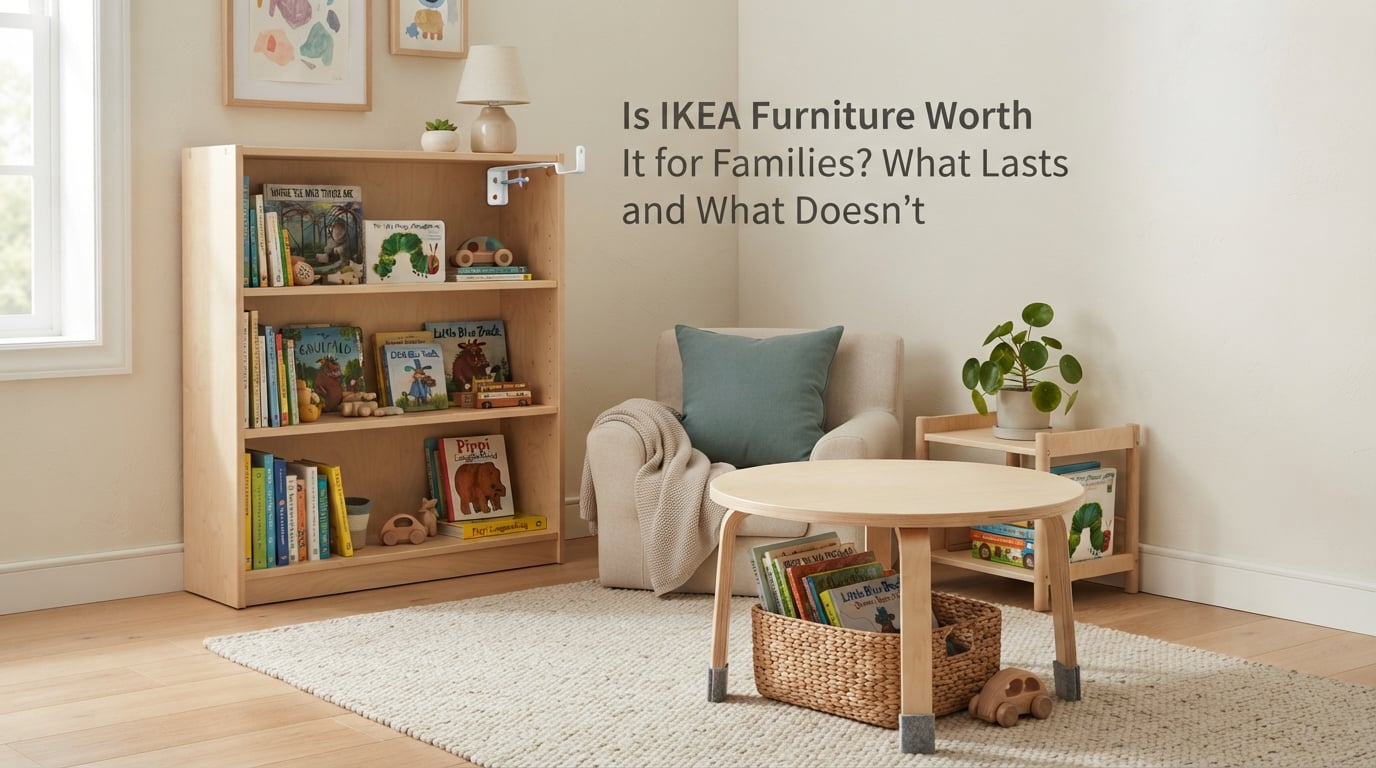
Is IKEA furniture worth it for families? For most of us, yes — but only for the right pieces, and the right pieces are decided by material and by room rather than by brand. Solid wood, steel and properly anchored storage earn their place. Particleboard in a spot where a toddler can climb, chew or spill does not, no matter how good it looked in the showroom.
We have furnished three homes with flat-pack pieces over the past decade, watched the same bookcase get rebuilt after two moves, and watched a different one sit untouched for a decade in a room nobody climbs into. The brand is not the variable. The material, the anchoring, the moisture exposure and the number of moves are the variables.
So this guide does what the sales pages will not: it splits the answer by material, gives you a room-by-room verdict, does the cost-per-year math honestly, and spends real time on the single issue that matters most in a family home, which is a tall piece of storage falling onto a small child. Everything here is updated for 2026, and every number is a range rather than a promise, because your kids, your pets and your basement humidity will all have opinions.
Table of Contents
- Is IKEA Furniture Worth It for Families? The Verdict Up Front
- What Worth It Actually Means for a Family
- What Lasts and What Doesn’t in IKEA Furniture: By Material
- The Room-by-Room Verdict for a Family Home
- IKEA Pieces That Reliably Hold Up
- IKEA Pieces to Skip or Buy Second-Hand
- Child Safety Is the Non-Negotiable
- What IKEA’s 10-Year Warranty Actually Covers
- The Moving Problem: Why Flat-Pack Fails at Moving
- How to Make IKEA Furniture Last Longer
- How to Inspect a Piece in the Store Before You Commit
- The As-Is Section and the Resale Reality
- The Assembly-Time Reality for Parents With Young Kids
- When to Skip IKEA Entirely and What to Buy Instead
- Frequently Asked Questions
- The Bottom Line for Families
Is IKEA Furniture Worth It for Families? The Verdict Up Front
It is worth it for the pieces that live in low-stress spots: bookcases that hold books, storage cubes, shelving in a finished basement, a desk, a dining table used twice a week, upholstered sofas and armchairs. It is not worth it for the pieces that take abuse: an unanchored dresser within a toddler’s reach, particleboard shelving in a laundry room or beside a diaper pail, or a low-tolerance coffee table in a playroom.
The durability of IKEA furniture sits in an unusually wide range, and where a piece falls in that range is decided by four things:
- Material. Particleboard, MDF, plywood, veneer and solid wood behave nothing alike around water, weight and impact.
- Anchoring. A tall piece bolted to a stud behaves completely differently from the same piece free-standing.
- Moisture and heat exposure. Particleboard swells and delaminates at edges. Radiators, kettles and window sills are where flat-pack dies quietly.
- How many times it gets moved. A piece that survives daily use can still be destroyed by a single move.
The most common family regret we hear is not about broken furniture. It is about furniture that technically still stands but has racking back panels, swollen edges near a sink, and loose cam-lock fasteners that wobble every time a drawer closes.
The second most common regret runs the opposite direction: overpaying for a solid-wood dining table that gets ring-burned, dog-chewed and crayon-scored in a house with toddlers, when a veneered table with a replaceable top would have absorbed the same punishment and cost less to live with.
Judge by material and by room. That single habit answers nearly every question families ask about IKEA.
What Worth It Actually Means for a Family
Worth it is not a sticker-price question. A sticker price tells you what you pay on day one. What a family actually needs to know is what the piece costs per year of use, which means dividing everything — what you paid, plus what you will pay to replace it, plus a share of your own assembly time — by the number of years it stays in service.
Here is the same math using relative cost units instead of currency, so it holds up whatever you paid. Call a small side table one unit.
| Piece | Rough cost | Years in service | Total units spent | Cost per year of use |
|---|---|---|---|---|
| Small side table, engineered wood | 1 unit | Replaced twice across 8 years | 3 units | 0.38 units per year |
| Solid-wood bookcase kept | 4 units | 20 years | 4 units | 0.20 units per year |
| Modular storage unit, engineered wood, kept | 2.5 units | 10 years | 2.5 units | 0.25 units per year |
| Unfinished dining table, one water ring | 2 units | 2 years, then a tablecloth forever | 2 units | 1.00 unit per year |
Read that last row again. A table that gets one ring on an unfinished surface and then permanently hidden under a cloth costs you twice as much per year as a solid-wood bookcase that survives two decades. Price tells you almost nothing. Behaviour under your family’s actual habits tells you everything.
Two decision rules from the research make this concrete. A Renotalk furniture forum thread that surfaced in our research summed up the pragmatic case in one line: if you do not intend to use the furniture for more than five years, IKEA in general is okay. Five years is a reasonable floor for a rental, a first condo, a student apartment or a five-year plan before a move to a bigger house.
The second rule is the Comfort Principle, borrowed from a Lifehacker piece on cheap furniture: spend your money where your family actually spends its time. Nobody relaxes on the entryway bench. Everybody sits on the sofa every single evening. Put your budget into the sofa and the dining chairs, and put the savings into storage nobody touches.
One more honest cost nobody lists: your time. A two-hour build in a living room with a toddler awake is a real cost, and it comes out of the same budget as the furniture. We do the math on that in the assembly section below.
What Lasts and What Doesn’t in IKEA Furniture: By Material
Before the lifespan ranges, one plain-language box, because the particleboard-versus-MDF-versus-solid-wood question is the single most common thing families get wrong.
Particleboard is wood chips pressed and glued into a dense panel. It is uniform, cheap, heavy for its price, and it hates water — the glue line fails and the panel swells. MDF is wood fibre moulded into a smooth panel with an excellent painted or veneered surface; it is heavier still and even more moisture-sensitive. Plywood is real veneers of wood glued in layers, and it handles screws, moisture and load far better than either. Veneer is a thin layer of real wood glued onto an engineered core — it looks like solid wood, moves a little differently as temperature changes, and cannot be sanded back. Solid wood is the whole piece, and it is the only one that can be repaired from a scratch or a chipped edge.
The myth worth killing: IKEA furniture is all particleboard is false. IKEA sells solid pine, birch, oak, beech, ash, acacia, teak, steel, aluminium, plastic and glass, plus a great deal of engineered wood. Knowing which one you are holding in the store is the whole game.
| Material | Typical years of use | Holds up well for | Watch out for |
|---|---|---|---|
| Solid wood | 20+ years | Dining tables, bed frames, bookcases, anything repairable | Seasonal movement; check for solid wood on the hidden underside, not just the top |
| Steel and metal frames | 20+ years | Bed frames, desk frames, shelving uprights, crib frames | Coating chips at joints; rust in a damp basement |
| Plywood | 10 to 20 years | Shelving, kids’ desks, storage that takes real weight | Delamination if it stays wet |
| Bending veneer and bentwood | 10 to 15 years | Curved frames, POÄNG-style armchairs, layered-frame sofa beds | Creaks at the curve; not repairable if the veneer splits |
| Veneer over engineered core | 10 to 15 years | Tabletops, sideboards, cabinet fronts | Cannot be sanded; edge chipping is permanent |
| MDF | 7 to 10 years | Painted cabinets, drawer boxes, moulded parts | Heaviest for the money; worst moisture behaviour; screws strip in it easily |
| Particleboard and melamine | 3 to 7 years | Shelving, storage cubes, wardrobe carcasses, flat panels in dry rooms | Swelling at edges, delamination, sagging under load, ruined by cam-lock re-tightening |
| Plastic and polypropylene | 5 to 10 years | Kids’ storage, bins, step stools | Creaks, yellows, hinges snap, no repair |
So if you want one number for the average lifespan of IKEA furniture, the honest answer is a range: particleboard and melamine pieces run roughly three to seven years of real family use, MDF and veneer pieces run seven to fifteen, and solid wood and steel pieces routinely clear twenty. Anyone who tells you IKEA furniture lasts a set number of years is describing one material and ignoring the rest.
One material note specific to Alberta winters. Indoor humidity in a heated Edmonton home in January can sit low enough that particleboard edges dry and crack, then swell again when you run the dishwasher. Keep flat-pack panels away from exterior walls, off the floor, and away from any radiator or heat register.
The Room-by-Room Verdict for a Family Home
Buy and skip decisions reverse completely between a nursery and a dining room, so any advice that treats IKEA as one category is worthless. Here is the same brand, room by room.
| Room | Verdict | What to buy and why | What to avoid |
|---|---|---|---|
| Nursery | Buy carefully | Cribs, changing tables and low storage with solid frames; anchor anything tall | Particleboard dressers at toddler standing height, unanchored |
| Young child’s bedroom | Buy | Low shelving, modular storage, plywood or solid-wood bed frames, curtains with breakaway | Tall wardrobes within climbing reach; glass-front cabinets |
| Teen bedroom | Buy | Storage systems, desks, loft and bed-frame storage — built for a decade of abuse | Anything the teen must not be able to climb on |
| Dining room | Buy with a caveat | Extendable tables with a stored leaf; veneer is fine if you accept surface marks | Unfinished or untreated tops if children will eat at that table |
| Living room | Buy | Upholstered sofas, armchairs, coffee tables with replaceable tops | Glass tabletops in a toddler’s path |
| Entryway | Buy | Benches, shoe storage, wall-mounted hooks, anything you can wipe clean | Nothing tall and narrow that needs anchoring and will not be anchored |
| Home office | Buy | Desks, shelving, cable management, drawer storage in a dry room | Flat-pack drawer units if you will overfill them with files |
| Playroom | Buy selectively | Soft-sided storage, low units, rugs, plastic storage | Glass, sharp-cornered and unanchored tall storage in a running-and-jumping room |
| Garage | Buy | Shelving, plastic storage, workbenches — the pieces nobody emotionally invests in | Anything moisture-exposed, or MDF in an unheated space in winter |
| Basement and cold storage | Buy with care | Ventilated plastic bins, steel shelving, clearly labelled contents | Unsealed particleboard, and paper in cardboard boxes in a damp corner |
Two patterns jump out. Storage and kids’ rooms are where flat-pack wins hardest, because that is where the durability problem is solvable with felt pads and anchors. Dining tables and adult bedrooms are where the weaknesses show, because that is where water rings, heat and daily heavy use accumulate.
The one exception worth knowing: upholstered pieces outperform almost everything else. A ChronofHorse forum poster reported a ten-year-old futon and a ten-year-old sofa from IKEA, both bought for their daughter’s college days, both still going strong. Soft frames and loose covers forgive impact in a way a cam-lock joint does not.
IKEA Pieces That Reliably Hold Up
These are the series we tell parents to buy without hesitation, and the reason each one survives.
IVAR is the closest thing IKEA makes to a forever shelf. Solid wood or steel, no engineered panel doing structural work, and a design that was extended for decades. If a bookcase has to survive a move, a resale and a child, this is the one.
BILLY in solid wood or glass-door variants has held up for families far longer than the particleboard version. Check the underside of the top panel and the shelf edges for a continuous grain rather than a chip pattern; that one check is the whole quality conversation.
KALLAX and PAX work because failure is contained. A damaged cube is a cube you replace, not a wardrobe you discard. Modularity is a durability feature, not just a storage feature.
MALM and the PAX wardrobe range use steel frames and run heavy doors on rails, which is why a ten-year-old unit still closes smoothly while a cam-lock wardrobe has gone cross-threaded.
POÄNG, the HEMNES range and EKENÄSET bedding are solid-wood and bending-veneer constructions that can be repaired, re-waxed and re-finished rather than thrown out.
BEDDINGE LÖVÅS and similar layered-frame sofa beds are worth it for a specific reason: when the mattress goes, the frame usually does not. Upholstery can be re-covered. A sagged particleboard base cannot be fixed.
LACK in the right room is fine. A small side table in a bedroom or entryway takes almost no load, no water and no climbing, which puts it firmly in the acceptable band.
The common thread is worth saying plainly: every item on this list either avoids engineered panel board in its structural parts, or is designed so that when one part fails, you can replace that part cheaply.
IKEA Pieces to Skip or Buy Second-Hand
Now the honest list, with the specific failure mode named for each.
Particleboard LACK-style dining and coffee tables, untreated. Failure mode: water rings and marker bleed that do not come out, on a surface with no finish to sand. If children will eat at that table, buy one with a treated or lacquered top, or use a placemat culture from day one.
Engineered-wood shelving you plan to load with real weight. Failure mode: sagging. Particleboard shelves bow in the middle once loaded with hardbacks, bins of toys or canned goods in a basement, and the bow is permanent. Fix it by adding a centre support or a thicker shelf, or buy the same shelf in plywood.
Tall wardrobes and dressers in a toddler’s reach, unanchored. Failure mode: tip-over, which is a safety failure and not a durability one. This is covered in full below.
Anything you will move more than once. Failure mode: cam-lock fastener stripping and crumbling particleboard edges on the second disassembly. A piece that has already been moved once has a shortened remaining life; buy it used and expect that, or buy solid wood instead.
Flat-pack beds for adult daily use in a room you heat in winter. Failure mode: the headboard and side rails take kicks and daily movement, and a particleboard rail or a loose cam joint fails in a way that wakes you up. A steel-frame adult bed solves it for a modest premium.
Anything in the As-is section that is damaged in a way you cannot see. Failure mode: dented back panels, chipped laminated edges, stripped hardware holes, water marks on the underside. Buy As-is only when the damage is cosmetic and you can disassemble it for parts or for a kid’s room.
MDF drawer boxes in a move. Failure mode: screws strip out of MDF easily, and a stripped screw hole cannot be repaired without a wood plug and filler. If a piece is MDF-heavy and you will move it, expect a rebuild.
Child Safety Is the Non-Negotiable
Of everything in this guide, this is the section we would put at the top if we could. A tipping dresser is the kind of family risk that has nothing to do with whether the furniture was good value, and the fact that most flat-pack pieces ship with an anti-tip bracket makes the excuse hard to give.
Parents’ biggest stated fear in the forum discussions we reviewed was exactly this: flat-pack wardrobes and dressers becoming unsafe the moment a toddler starts climbing. It is a reasonable fear, because a top-heavy piece with a few kilograms of clothing in the top drawer has the leverage to fall quickly.
How to anchor an IKEA dresser or storage unit properly
Take these five steps in order, and budget twenty minutes the same evening you build the piece, not a month later.
- Find a stud. Use a stud finder or knock on the wall and listen for solid. A drywall anchor alone is not enough for a piece that tips with a child’s weight on it.
- Use the supplied anti-tip bracket and strap. The hardware in the box is sized for the panel thickness. Do not substitute a picture hook.
- Position the bracket high on the wall side of the piece, into the frame or a solid rail rather than into a hollow section, and into a stud wherever the geometry allows.
- Anchor at the top, not part-way up. A bracket halfway up leaves the top of the piece free to rotate and tip.
- Re-check it every few months, especially once your child starts pulling to stand. Screws into a hollow panel can back out with repeated load.
Then walk the room for the other hazards that no box tells you about.
- Glass doors and glass tabletops. Tempered glass breaks into small cubes rather than shards, but it still breaks. A glass-front cabinet in a toddler’s room is a choice you should be making on purpose.
- Pinch and shear points at hinges. Check the door swing of wardrobes, and keep fingers out of the gap between an open drawer and the carcass. Many families set a rule about which doors get opened and by whom.
- Choking-size hardware and dowels. Small dowels, screw caps and decorative plugs on a piece within a crawling child’s reach are worth removing, securing or just accepting as a supervised-age piece.
- Entrapment gaps. A gap between mattress and side rail, or between a table and a wall, is a climbing hazard. Bunk-bed guardrails and loft-bed safety poles exist for this reason.
- Cords and blind cords near the bed. A standard family check, worth adding to your list since you are already walking the room.
- Climbing on the wrong piece. Most nursery climbing injuries happen on the furniture that was never meant to be climbed. Store the step stool somewhere real children cannot reach.
One more thing families miss: the anchoring step is the one everybody skips, so the safety benefit is lost by default. A bracket in the box is a safety feature that does not exist until it is screwed to a stud.
What IKEA’s 10-Year Warranty Actually Covers
Many families assume the answer to “is my IKEA furniture covered” is “no, because it is cheap.” That is not right. IKEA’s standard warranty runs ten years on most furniture, which is a genuinely meaningful term compared with most furniture retailers.
Here is what the term actually means in practice.
- The ten years run from the purchase date, and the general rule is that a fault in the material or construction is covered. That is the normal expectation: a joint that never tightened properly, a panel that was defective, hardware that fails under normal use.
- Normal wear is not covered, and for flat-pack that means surface scratches, chips, and damage from loads, moisture, or moving that the piece was not designed for.
- Damage to parts listed as consumable — think cushion foam, fabric and certain finishes — is treated differently and often more narrowly than the structural parts.
- Self-assembly is part of the contract. If the fault traces back to assembly, IKEA’s position is that the piece was not installed as intended, and coverage can be affected. This is the single biggest reason the anchoring and careful-build advice earlier in this guide matters.
- Commercial and non-household use falls outside a household warranty, so a home office desk used by customers or a daycare room is a different conversation.
Practical advice: keep the receipt, keep the assembly instructions, and photograph the finished piece when it is new. A warranty claim ten months from now is much easier with a dated photo showing the joint was tight on day one.
And be realistic about the process. A claim usually means a decision about replacement or repair after inspection, and for particleboard pieces the outcome often depends on whether the failure is structural or cosmetic. The ten-year term is a real protection, but it is not a guarantee that a worn shelf will be replaced out of goodwill.
The Moving Problem: Why Flat-Pack Fails at Moving
If you only take one failure mode seriously, take this one. Furniture is destroyed by moves, not by daily use. The clearest account we found was a Quora answer from a parent whose son’s college dorm piece “did not last all four years by any stretch” — moving it from a dorm room to an apartment did most of the damage, and the writer blamed the particleboard panels.
That is the pattern. r/AskReddit’s consensus was blunt about the general expectation: good temporary stuff at a price you can accept. But the more useful point from the same discussion is the reversal of a durability complaint into value: when you assemble a table or shelf yourself, you remember building it. The memory is part of what the flat-pack model sells.
The technical reason moves are so destructive: cam-lock fasteners are designed to be tightened once. Every disassembly cycle strips the small pre-drilled hole in the particleboard edge a little more, and the joint gets slacker each time. Particleboard edges crumble under the pressure of an inserted cam. Plywood and solid wood joints tolerate the same cycle many more times.
So if you will move, follow this method.
- Photograph the piece fully assembled from at least four angles, including close-ups of every joint. This is your assembly diagram and it is worth more than the paper instructions.
- Label every panel with masking tape and a marker as you take it apart, marking both faces of each joint.
- Bag and label the hardware by room, not by type. A bag marked “nursery” beats a bag of forty mixed screws.
- Back out cam fasteners properly, by inserting the cam key and turning the bolt, rather than levering the joint apart.
- Wrap panels individually in blankets or cardboard, and carry them upright rather than flat so a bending panel does not set permanently.
- On reassembly, glue particleboard joints with a thin bead of wood glue in addition to the cam. The glue is what survives the next move.
- Re-tighten every fastener by hand in month three, before the first seasonal swing loosens everything at once.
And if you know a piece will move more than twice, buy it in solid wood or steel in the first place. That one decision is worth more than any assembly tip here.
How to Make IKEA Furniture Last Longer
Most premature IKEA failures are not manufacturing defects. They are ordinary household habits that a family never changed. Here is the list we actually use.
- Anchor tall pieces at assembly day. Covered above, and it is the single highest-value habit on this list.
- Re-tighten the hardware in month three. Particleboard shifts slightly with humidity and the fasteners back out. Ten minutes with the Allen key you saved in the box prevents a wobbly wardrobe.
- Use felt pads on every leg, on every hard floor, under every piece. This is what protects the leg joint, not just the floor. Particleboard leg ends absorb impacts and crack internally over time.
- Keep flat-pack panels away from water sources. A diaper pail, a laundry basket or a sink edge near an unpanelled cabinet side is how you get swelling and delamination that no warranty covers.
- Give particleboard shelving a load limit it will never see. Books are heavy. Spread hardbacks across two shelves rather than cramming one, and reinforce long spans with a centre upright or a thicker shelf.
- Keep panels off the basement floor and away from exterior foundation walls, where seasonal damp works at the edges.
- Keep heat sources away from engineered wood. Radiators, kettles, a toaster oven and a hair dryer appliance parked on a dresser will dry and crack a top panel over a season or two.
- Add a real wood top to a light table if you must keep the base. A beech or birch slab screwed to an engineered top converts a disposable piece into a repairable one, and you can sand the top whenever the finish wears.
- Replace damaged panels rather than the piece. A storage cube, a shelf or a drawer front is a small replacement; keeping the rest of the carcass is the difference between a ten-year and a two-year life.
Two more worth naming because they are free. Store the spare hardware and the second set of cam keys in a labelled envelope with the manual; the single most common repair failure is a stripped fastener with no replacement on hand. And photograph your fully assembled pieces before you paint or move out — that is the whole disassembly guide in one image set.
How to Inspect a Piece in the Store Before You Commit
You have about ninety seconds in a showroom. Spend them like this.
- Look at the grain on the top and on the shelf edges. Continuous wood grain means veneer or solid wood. A fine, even chip pattern on the edge means particleboard, and it will tell you that faster than any label.
- Check the underside of the top panel and the back panel. A back panel that is thin, stapled rather than screwed, or visibly flexes is the first sign of racking once the piece is loaded.
- Flex the shelf gently while pressing down on both ends. Any visible bow means the span is too long for that panel thickness and will sag under real load.
- Rack the piece side to side by the top corners. If the carcass moves independently of the top, the joint is loose. This is the single best predictor of a wobbly piece.
- Look at the edge sealing on any piece that will see water, especially a cabinet side or a base panel. Unsealed particleboard edges are where swelling starts.
- Check that dowels and cams are both present and sized correctly, and count the cam keys against the number of cam bolts listed in the instructions.
- Read the material line on the label, not the marketing name. Product names are reassuring and material names are informative.
If the display model is assembled, check the pieces you will not see in a box: the underside of the assembled carcass, the interior shelf edges and the joint where the frame meets the top. Scratches and dents on a showroom model tell you exactly how the piece will look after a year of real use.
The As-Is Section and the Resale Reality
The As-is and B-stock area is the most useful part of a flat-pack store for a family on a budget, and the least understood.
As-is stock is unsellable for one specific reason. Usually it is cosmetic — a scratch, a dent, a chipped laminate corner, a hole in the packaging, a discontinued colour. Sometimes it is functional, such as a missing hardware bag. Read the tag to find out which, because the two are worth very different amounts to you.
Cosmetic damage on an otherwise sound piece is a strong buy. Check for a dented or cracked back panel, stripped cam-lock holes, or a chipped edge that goes through the veneer. Those three are structural signals, and a piece with them is a parts donor rather than furniture.
Resale reality is the other half of this. A scratched five-year-old BILLY or IVAR is a bargain, because the finish is already broken and you were not going to protect it anyway. A scratched new one is just a discount on damage you could have avoided.
Where flat-pack loses resale value is the opposite of where people expect. Pieces with solid wood, steel frames and removable parts move well at resale, because a buyer can see the material. Particleboard carcass pieces lose value fast once a load-bearing shelf bows, and cam-jointed assemblies are worth very little to the next buyer because they know what moving it will cost them.
For an Edmonton household specifically, the practical note is the same one that applies to any large flat-pack purchase: the cost of getting it home, whether that is a delivery to your door or a short trip to the warehouse with a borrowed van, is part of the cost-per-year math. Factor it in before you decide a piece is a bargain, because the cheapest piece in the showroom is rarely the cheapest piece in the house.
The Assembly-Time Reality for Parents With Young Kids
Assembly time in IKEA’s instructions assumes two people, a clear floor, no interruptions and a powered driver. The instructions rarely say so clearly, and families discover this at nine o’clock on a Saturday evening.
Rules that make it survivable, based on doing this too many times.
- Check for a second person in the box. Nearly every flat-pack wardrobe, bed frame and large bookcase lists two people in the instructions. If you are one adult, either recruit help or choose a piece designed as a solo build.
- Build during the nap, not the evening. You will stop mid-cam-lock three times during a Saturday build and lose your place each time.
- Sort the hardware into bowls per step rather than pouring the whole bag out. The single biggest assembly time sink is a cam key found after the piece is already together.
- Keep the Allen keys. Every key in the box is a repair tool you will need later, and IKEA sells replacements only as a whole kit.
- Avoid the built-in driver bit if you have a real one. The supplied bit rounds out, and then the piece ends up half-built.
- Leave the instructions out for the second build. If you will move, the person who helps you move should have seen the build, or should have the photos.
One last framing, because it is genuinely true and worth hearing from a parent rather than a store: the hour spent building a piece is part of what you are paying for. A friend whose children still remember assembling their own bookshelves described it as the thing that makes the criticism of durability land differently. The memory survives the furniture.
When to Skip IKEA Entirely and What to Buy Instead
Some situations are not about price at all, and in those cases flat-pack is the wrong tool. Skip it when the piece will be handed down, when it takes structural load every single day, or when a failure would be dangerous rather than annoying.
- An heirloom dining table you expect to keep twenty-five years. Buy solid wood from a local maker, or buy a flat-pack base with a replaceable top and accept that the top is consumable.
- An adult bed frame in a heated room, used nightly. Buy steel. A steel frame outlasts a cam-joined frame by a decade and shrugs off being moved.
- A dresser that must live within a toddler’s reach. Buy a solid-wood, tip-resistant, factory-anchored unit, or keep a flat-pack dresser only if it is properly anchored to a stud and mounted high.
- Anything you will move three or more times. Buy solid wood, plywood or steel with screws and traditional joinery rather than cams.
- A seat where an adult spends hours daily. Apply the Comfort Principle honestly and buy the chair you sit in, and save on everything nobody sits in.
On the direct comparison that comes up constantly, IKEA versus a conventional furniture retailer such as Ashley, the answer is by room rather than by brand. IKEA generally wins on modularity, design currency, storage density and price per year of use. A traditional retailer generally wins on solid-wood construction, heavier joinery and heavier hardware, which is exactly what you want for adult-use furniture that will not be moved. Buy modular storage from one and the solid-wood pieces from the other, and your house ends up consistent without the budget suffering.
Frequently Asked Questions
What is the average lifespan of IKEA furniture?
It depends almost entirely on material. Particleboard and melamine pieces typically last three to seven years of real family use, MDF and veneer pieces run seven to fifteen, and solid wood and steel pieces routinely exceed twenty. A single average number is misleading, because the range inside the brand is wider than the range between brands.
Is IKEA furniture worth buying?
Yes for storage, kids’ rooms, entryways, playrooms, home offices and light-use living areas, and for upholstered pieces that get re-covered. No for particleboard in wet rooms, for heavy-load shelving in damp spaces, for unanchored tall storage within a toddler’s reach, or for anything you expect to move more than twice. Judge by material and room, not by brand.
How durable are IKEA furniture?
Durability varies enormously within the range and hinges on four things rather than the brand: the material, whether the piece is anchored to a stud, its exposure to moisture and heat, and how many moves it survives. Anchor tall pieces, keep engineered panels away from water, and expect solid wood and steel to outlast cam-joined particleboard by many years.
Is Ashley furniture better than IKEA?
Neither is better overall, and the answer is by room. Ashley-style retailers generally win on solid-wood construction and heavier joinery, which suits adult dining tables, adult bed frames and anything inherited. IKEA generally wins on modularity, design currency, storage density and price per year of use, which suits kids’ rooms, storage and entryways. Many families mix both without noticing.
Is IKEA furniture safe for a child’s room?
It is, once you finish the job IKEA leaves to you. Anchor every tall dresser, wardrobe and storage unit to a stud with the supplied anti-tip bracket, mounted high on the wall side of the piece. Avoid glass doors and glass tabletops within a toddler’s reach, check door swing and drawer pinch points, and remove small dowels and screw caps from anything a crawling child can reach.
Can you move IKEA furniture without it falling apart?
Usually yes, if you disassemble it properly rather than prying it. Photograph the finished piece, label panels on both faces, bag hardware by room, back out cam bolts with the cam key instead of levering joints, and wrap panels individually. On reassembly, add a thin bead of wood glue to particleboard joints. A piece that survives two moves this way can survive a third.
The Bottom Line for Families
So, is IKEA furniture worth it for families? Yes, for storage, kids’ rooms, entryways, playrooms, home offices and light-use living areas, and for anything built from solid wood, plywood or steel. No for particleboard in wet rooms, for heavy-load shelving in damp spaces, and for tall unanchored storage anywhere a child can reach it.
Three rules carry almost all the weight. Buy by material and by room, not by brand. Anchor every tall piece to a stud the day you build it. And calculate cost per year of use, because the cheapest sticker price in the showroom is rarely the cheapest piece in the house ten years later.
Start with one room and one walk-through. Walk the room with the material table in front of you, decide which pieces earn a place, and put the anchoring step on the calendar before the boxes are opened.