
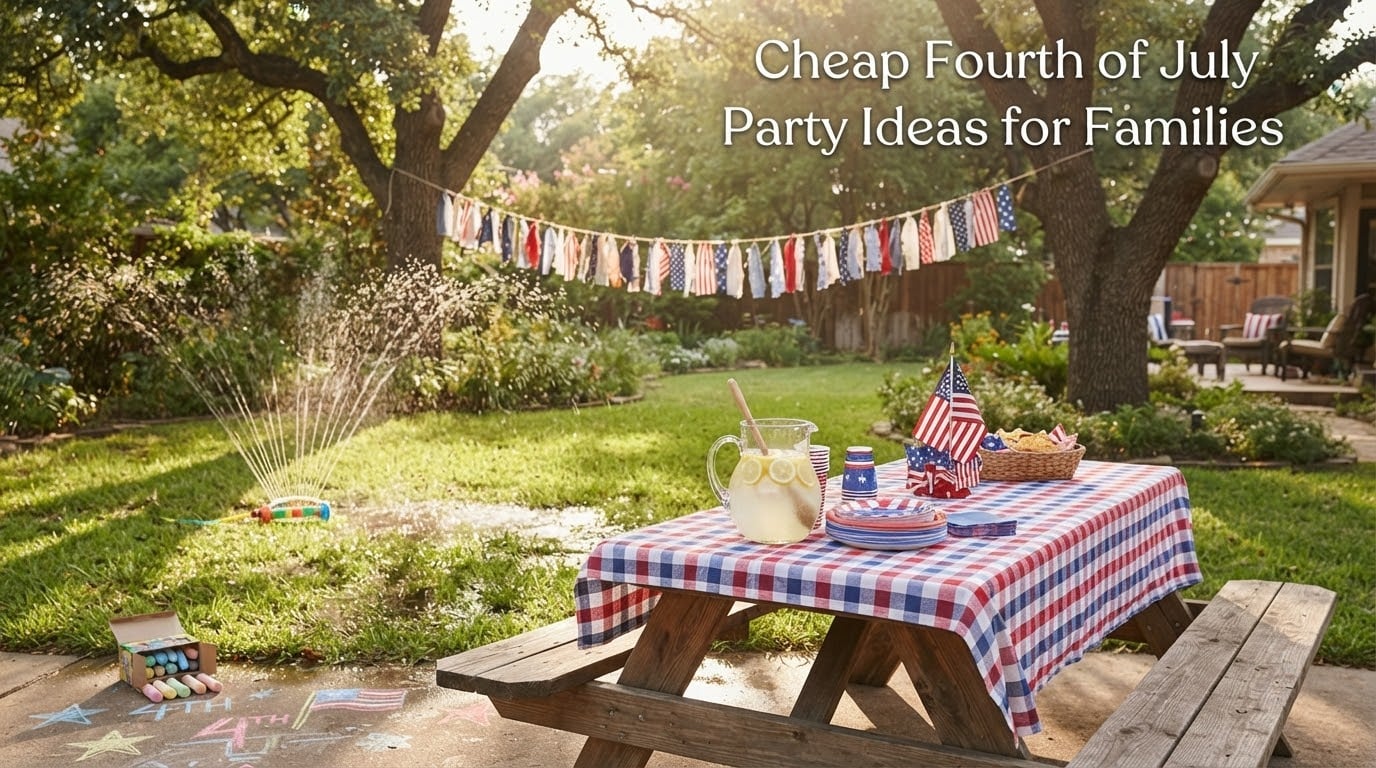
A family Fourth of July party does not need a catering invoice to feel like a real celebration. The families who nail this holiday every year share one habit: they decide in advance where the money goes, and they spend almost none of it on things nobody remembers on Monday.
That is the whole idea behind cheap fourth of July party ideas for families. Guests remember the food, the music, the string lights coming on at dusk, and something fun for the kids to do. They do not remember whether the paper plates matched the banner. Spend your budget on the first four items and the party works, even when the total is small.
Most family hosts go wrong in the same way. They overspend on decorations because that is the part that looks like a project, then they arrive on party day with a beautiful yard and a grocery bill they were not expecting. Reversing that order fixes the problem before it starts.
What follows is the framework I use when friends ask me to help them plan: what a budget party really costs, eight ideas to start from, a menu that scales, games that work for mixed ages, and a two-week timeline so nothing gets forgotten on the Thursday before. All figures are in Canadian dollars, and Edmonton-area sourcing is called out throughout because that is where our readers are.
Most of what I have learned here came from watching friends over years of July weekends, and the pattern is consistent: the parties people still talk about were never the ones with the biggest spending. They were the ones where someone decided early what mattered, and let everything else be simple.
Table of Contents
- What Does a Cheap Family Fourth of July Party Actually Cost?
- 8 Cheap Fourth of July Party Ideas to Start With
- Cheap Fourth of July Decorations That Look Expensive
- A Budget Menu That Feeds 10, 20, or 30
- Free and Low-Cost Fourth of July Games by Age
- Your Two-Week Party Timeline
- Edmonton and Alberta Notes: Canada Day, Sourcing, and Fireworks Rules
- Fireworks Safety, Food Safety, and a Rain-Date Backup
- Where to Spend and Where to Save
- Frequently Asked Questions
- How to throw a party on a small budget?
- What are some ideas for a 4th of July party?
- What are some fun games to play at a 4th of July party?
- What’s a good budget for a party?
- How much does a 4th of July party cost?
- Is it cheaper to host a potluck or a full party?
- How do I keep kids busy before fireworks?
- How do I keep pets calm during fireworks?
- Your Next Steps
What Does a Cheap Family Fourth of July Party Actually Cost?
Plan roughly half your total on food and drinks, about a quarter on atmosphere, a tenth on supplies and paper goods, and keep the remainder as a buffer for the one thing you always forget. Guests notice food first, then lighting and music, then having something to do. Nobody notices the price of the tablecloth.
Here is the split I recommend for a family party of any size:
- Food: 50 percent. This is the meal, the drinks, and the one dessert. If you have only one place to cut, cut decor, not food.
- Atmosphere: 25 percent. String lights, a playlist, a few flags, something on the table that looks deliberate.
- Supplies: 10 percent. Plates, cups, napkins, ice, garbage bags, and one thing for the kids’ table.
- Buffer: 15 percent. Do not spend this in advance. This is the portion that covers the extra guests, the ice you underestimated, and the last-minute run to the store.
The single most useful number in your head is the per-head share. Divide your total by your guest count before you buy anything, then think of every item as a fraction of that share. When you are standing in a discount aisle debating a patriotic tablecloth, you are not spending a few dollars, you are spending a slice of a specific guest’s meal. That framing ends the debate quickly.
A small get-together of six needs a very different structure than a neighbourhood block party of thirty. Scale the same four buckets, but remember that setup time and cleanup do not scale down nearly as fast as guest count does. A six-person party still needs a table, a cooler, and somewhere for kids to burn energy.
Two habits keep a small total from feeling like a small party. Put a real effort into one hero dish rather than a dozen mediocre ones, and make the space work harder with lighting and music, which cost almost nothing compared with another dish. Those two things carry the evening.
8 Cheap Fourth of July Party Ideas to Start With
Not sure where to begin? Start with one of these. Each one is deliberately simple, and each can be expanded or scaled down depending on how many people you are feeding.
- The neighbourhood potluck. Everyone brings one dish, you handle drinks, paper goods and atmosphere. Lowest cost per guest of anything on this list, and the cleanup is shared. Assign dishes by text so you do not get six potato salads.
- The afternoon barbecue and evening fireworks. Food in the afternoon, games in the gap, then walk to a public display or set off sparklers as the light goes. This is the classic long-weekend shape and it fills the day without stretching one meal across eight hours.
- The two-family combined celebration. Two households, one yard, one cooking effort instead of two. Splitting the cost halves everything and often doubles the guest list.
- The picnic in the park. Blankets, a cooler, a portable speaker, and a trash bag per family. No cooking required, no cleanup beyond what you carried in, and the kids have a whole field to run across.
- The cookout with a craft table. Set up a small table with paper, glue, and a printout of a star or a flag, and let the kids make decorations while you cook. It occupies them and it doubles as your decor.
- The themed dessert table. Skip the complicated main and make the dessert the event. A sheet cake with a berry pattern on top, or a tray of ice cubes frozen with berries inside, does the visual work that decor usually does.
- The games-only afternoon. A badminton net, a ball, chalk, and a sprinkler. No cooking, no decorations, and it works as well in a small yard as a large one.
- The quiet family dinner. Just your household plus grandparents, a real meal, and the fireworks after. A legitimate Fourth of July party for anyone hosting a small or low-key celebration, and often the best option if someone in the house is noise-sensitive.
Cheap Fourth of July Decorations That Look Expensive
The trick to patriotic decor is repetition and height, not spending. Pick three colours, repeat each one at least three times, and put something at three different heights on any table you set. That is the entire formula, and every project below costs about what a takeout dinner costs.
The masons, banners, and jars
Mason jars you already have in the cupboard become table centrepieces with a strip of red, white and blue ribbon tied around the neck and a short piece of greenery or a single stem in the top. Group three jars, not one, and set them on a tray or a stack of books to vary the height. A cluster looks designed; a lone jar on a table looks like a jar.
A flag bunting is the highest-impact item you can make yourself. Two lengths of kitchen twine, wooden clothespins, and squares of red, white and blue cardstock give you a garland for the price of the cardstock. Add a second swag at a different height and the plain fence behind it stops being plain.
The pizza box star garland
Flatten clean pizza boxes, cut stars from the cardboard, and fold each one over a length of twine so it hangs in three dimensions. A dozen stars fill a fence line. It is free if you are already ordering pizza, and it reads as deliberate craft rather than a shortcut.
The crepe paper cascade
Twist strips of crepe paper in three colours and drape them from a single hook or a length of tape along an eave or a porch ceiling. This is the one decoration that changes the look of a space because it lives overhead, where guests rarely look. Keep it to a corner or a pergola rather than the whole ceiling, and outdoors use a waterproof tape rated for the surface.
The layered paper lantern
For an after-dark look, hang a few paper lanterns you already own at staggered heights and put a warm light in one of them. Evening parties read very differently from afternoon ones, and lighting is the cheapest way to change that.
What to buy and what to skip
At a dollar store, buy the things that are used in volume and nobody inspects closely: plates, cups, napkins, straws, cellophane, and a tablecloth if you need one. Skip the pre-printed patriotic centrepieces, the metallic garland, and anything with a visible seam of glue on the front. Those read as cheap at exactly the moment you are trying to look thoughtful.
Check the bargain bin and the end-of-season table in early July. Patriotic paper goods are heavily discounted in the days after the holiday, which makes them an excellent buy for Canada Day or a Labour Day long weekend if you are planning ahead or hosting a belated gathering.
Local sourcing matters here. Dollarama and Tiger are your volume sources for paper goods and ribbon, Canadian Tire has patio and cooler items, and a thrift store is where jars, crates, and mismatched lanterns come from. A little thrifting is not a compromise here; most of the best-looking tables in this party plan are built from things that were already in the house.
A Budget Menu That Feeds 10, 20, or 30
The menu that works at every size is boring on purpose. Hot dogs and burgers handle any crowd, one make-ahead side feeds everyone, watermelon costs almost nothing per serving, and a layered punch stretches further than bottled pop. Concentration is what makes a small budget feed a large crowd.
The core menu
- Protein: hot dogs for kids and one burger option for adults. Buying buns in two varieties feels generous and complicates your grill.
- One substantial side: potato salad, baked beans, or a pasta salad made the day before. Pick one, not three, and make enough that it is a real meal rather than a garnish.
- Something raw: a whole watermelon, sliced, plus a bag of carrots and cucumber. Low cost, no cooking, and it gives you a break from the grill.
- One cheap luxury: a bag of frozen fries in the oven, or corn on the cob. Skipping this is what makes a budget barbecue feel like a budget barbecue.
- One dessert: a sheet cake from a grocery bakery, or a tray of ice cubes frozen with berries. No need for a tiered anything.
How the menu scales
The same grocery list stretches across guest counts if you buy in the right shape. Here is how the quantities change without the shopping list changing completely. I use these three columns as a starting point and then adjust for how many kids are coming, because children between two and six eat about half of what a teenager does.
- 10 guests: Roughly two packages of hot dogs, one of burgers, a small side dish, one watermelon, and a half-size cake. You will have some spare, which is useful.
- 20 guests: Double the meat, double the side dish, two watermelons, a full-size cake, and buy your buns a day ahead. This is the point where a big-box run starts to save real money.
- 30 guests: Triple the meat, a larger tray of each side dish, three watermelons, and consider splitting into two mains, one hot and one cold. At this size, one person cooking alone will be overwhelmed, so recruit a neighbour or two in advance.
Drinks scale the same way. A jug of homemade lemonade with sliced fruit and ice in it looks festive and costs a fraction of bottled options. For a layered red, white and blue punch, do not layer by sugar, because the drinks mix and the colours turn muddy within minutes. Use a clear base, a red fruit punch, and a white ingredient such as coconut water or pineapple juice, and add them in layers in the glass right before serving.
Make-ahead, freezer, and second-day plan
Potato salad, pasta salad, baked beans, and coleslaw all make better the next day, so make them the day before and serve them cold. Cooler-friendly foods are a gift on a long afternoon because they need no reheating and no attention.
Freeze the things that freeze well: unbaked cookie dough, a brie or cheddar for the grill, and half of a dessert you know you will not finish. Thaw in the fridge, not on the counter.
Plan the second day deliberately rather than eating random containers for a week. Cut excess watermelon into cubes and freeze it for smoothies. Turn a watermelon rind into quick pickles by trimming the green, salting the pieces, and covering them in vinegar and sugar overnight in the fridge. Good luck with the burgers, but the people who brought sides will walk home with full containers in their arms. Send them off with lidded containers so the extra food becomes their next few lunches instead of another week of fridge triage for you.
Free and Low-Cost Fourth of July Games by Age
Entertainment should cost almost nothing. All of the games below are free or near-free, need little space, and work without an adult refereeing every dispute. The age split matters more than the price, because a game that suits a four-year-old will bore a twelve-year-old in about ten minutes.
Toddlers, ages 2 to 4
- Silly safari scavenger hunt: hand a picture list of safe yard objects and send them wandering. Free, quiet, and keeps them away from the grill.
- Sponge water wall: sponges, a bucket, and a low fence or the side of the house. The single most reliable toddler activity of any party.
- Bubble station: a large container of water, a few bottles, and whatever surface you can hang them from.
School age, ages 5 to 9
- Sidewalk chalk course: draw a hopscotch that spells a name, a set of targets, and a set of obstacle squares. Free chalk and two hours of quiet.
- Sack race with pillowcases: pillowcases instead of burlap sacks. Setup time is under two minutes.
- Three-legged race pairs: one bandana and two kids. No purchase needed, endlessly funny.
- Water balloon or sponge relay: cheap cups, a bucket, and a towel. Have a dry change of clothes ready, this is the one where clothing gets ruined.
Mixed ages, teens, and adults
- Cornhole or bocce: yard games, essentially free, and they give adults something to do.
- Frisbee or badminton: the classic reliable two-person yard game.
- Patriotic trivia: a phone, a playlist of general knowledge questions, and small stakes like picking the next song.
One glow item per child is the only thing worth buying for the games section, and even that is optional. Have the adults run the sprinkler and the badminton long enough that nobody notices you skipped the favour table.
If you are expecting a lot of small children, buy a couple of extras. A wet toddler who is having fun is the picture you want, and having dry clothes ready for three of them decides whether the afternoon is fun for you too.
The gap between the party and the fireworks
The hours between an afternoon barbecue and evening fireworks are where parties lose their shape. Kids get restless, adults drift inside, and someone checks the time every ten minutes. Plan that window on purpose: a second game round, a craft table, a sprinkler, or an early bath-and-pajamas option for the youngest ones. If you are heading to a public display, the walk over is entertainment enough.
Your Two-Week Party Timeline
This is the section that saves money, because most overspending happens when things are bought on the day before at full price. Work through it backwards from your party date.
- Day 14 — Set the total and the guest count. Decide your number, then write the per-head share on a sticky note. Invite now, because an accurate headcount drives every later decision.
- Day 12 — Make the potluck list and assign dishes. If it is a potluck, assign specific dishes to specific people. An unassigned potluck produces the same three dishes and no vegetables.
- Day 10 — Make anything that freezes. Cookie dough, a cheese for grilling, dessert portions. This is also when you borrow jars, crates, and anything else you need rather than buy.
- Day 7 — Shop paper goods and ribbon. Bulk items are cheapest in the middle of the week, and this is your last clean shot at getting the volume you need before the holiday weekend rush.
- Day 5 — Buy the make-ahead food. Potato salad, pasta salad, baked beans, and your drinks. The grocery stores get noticeably busier closer to the date.
- Day 3 — Do the DIY projects. Bunting, star garland, mason jar centrepieces, the crepe cascade. Cardstock and ribbon are still available and you have the time to fix mistakes.
- Day 2 — Thaw and prep. Move frozen items to the fridge. Portion the watermelon. Set up the cooler area and figure out where the food and drinks will live.
- Day 1 — Final run and setup. Meat, buns, ice, the one thing you forgot, and the kids’ table supplies. Do not skip this run; it exists precisely because everyone forgets something.
- Party morning — Set up early. Bunting, tables, cooler, trash and recycling bins, music speaker charged. Most of the stress of a party day is a setup that started too late.
- After — Send people home with food. Grab the containers you borrowed so they come back. Note what you would do differently, because the same weekend next 2026 is now half planned.
Edmonton and Alberta Notes: Canada Day, Sourcing, and Fireworks Rules
Our long weekend is unusual compared with most of North America, and it works in your favour. Canada Day on July 1 falls midweek in most years, so many families host one celebration across the July 1 long weekend and let it cover both holidays. That halves your effort and your budget for the same result.
The advantage of combining is timing. An afternoon get-together on Canada Day weekend, with your own fireworks or a walk to a public display on the evening of the 4th, spreads the fun over the whole break and gives you two celebration moments out of one preparation.
On sourcing, our local prices generally work in your favour too. Paper plates, cups, ribbon, and seasonal decor are all available at Dollarama and Tiger in volume, patio and grilling basics are at Canadian Tire, and a local grocery run is the cheapest place to buy the food. If you want the party to look designed rather than assembled, spend an hour at a thrift store first; jars, crates, lanterns, and glassware are the backbone of most of the projects above and they cost a fraction of new.
On fireworks, check your municipality’s current bylaw before you plan anything, because rules on permitted dates, times, and discharge distances are set locally and they change. Public displays run on their own schedule and are free to watch. If you are setting off anything on private property, that is where a designated adult, a clear perimeter, and a water source stop being optional. More on safety below.
Fireworks Safety, Food Safety, and a Rain-Date Backup
Fireworks and pets
Fireworks frighten a large share of young children and most dogs, and that fear is the part of the holiday families remember badly. Keep children well back from any discharge, and never let them hold anything until after the show. Put the dog in a quiet interior room with the radio on and a blanket before dark, well before the noise starts, because a pet left outside until the first bang cannot be moved calmly. If your household has a noise-sensitive child, plan the party earlier in the day and view fireworks from indoors.
Food safety for a long afternoon party
A party that runs four hours is a food safety problem, not just a menu problem. Keep cold food under about 4 degrees Celsius, which in practice means a cooler with plenty of ice, smaller batches taken out as people eat, and perishables that sat out for more than two hours thrown away. Put hot food on a preheated grill or in a low oven, not on a buffet pan going lukewarm. The mayonnaise myth is largely false; the temperature myth is not, and hot weather makes it worse. Set up a hand-washing station with soap and running water, and use a separate cooler for drinks so the opening one stays cold for the whole afternoon.
Rain date and small-space backup
Rain does not have to cancel a family party. Decide your backup before party day, not during it: a covered porch, a garage with the door down, a community centre hall, or simply moving the whole thing inside. If you are in an apartment or a small yard, the same plan works by default with a different layout. Push the food table to one wall, use a rug as a picnic blanket, and move games to the hallway.
For a larger group, a municipal park with a gazebo or a community centre room is usually the cheapest venue by a wide margin and it removes every cleanup problem. Check the booking rules and whether a permit or a firework restriction applies to that space before you commit.
Where to Spend and Where to Save
The order below is the whole guide. Work through it top to bottom and the budget takes care of itself.
- Spend on food. This is what people talk about, and the difference between a good hot dog and a great one is the thing guests actually notice. Do not economise here to buy decorations.
- Spend on atmosphere. String lights, a speaker, and a playlist. This is the cheapest way to make a modest space look like an occasion.
- Spend on one kid activity. A sprinkler, a chalk set, or glow items. One good activity beats a table of small favours.
- Save on decor by making it. Bunting, star garlands, and mason jar centrepieces from materials you already own. A project you finish in an hour beats a purchased version on every count.
- Save on entertainment. Yard games, a scavenger hunt, and a phone playlist. Nothing here requires a purchase.
- Save by borrowing. Coolers, folding tables, shade canopies, a large pot, extra chairs, and serving dishes. Ask a week ahead, offer to return them washed, and expect to be on the hook next time.
- Save by potluck-ing the sides. Assign dishes so you get variety. Your cooking effort drops and everyone still eats well.
- Skip entirely: printed invites, custom signage, hired entertainment, a rental tent, and anything that says the host spent money on the party rather than the people at it.
If guests are more than a dozen, a sign-up list for dishes saves more than any other single habit. It removes duplicate dishes, it tells you what you still need to buy, and it turns your cooking from a large job into a small one.
Ask yourself the useful question before any purchase: will the guests remember this in a year? If the answer is no, it goes in the borrow or skip column. That one filter, applied consistently, is what makes these cheap fourth of July party ideas for families a real plan rather than just a cheaper version of an expensive one.
One last habit pays for itself every time. When the party is over, write down what ran out, what nobody touched, and what you wished you had made more. That three-line note is the entire reason your next party is cheaper than your last one, and it takes less time than searching your phone for a photo of the guest list.
Frequently Asked Questions
How to throw a party on a small budget?
Set a total before you buy anything, then divide it by your guest count. Borrow first, buy paper goods at a dollar store second, make your decorations yourself third, and potluck the side dishes. Put the remaining money into food and atmosphere, which are the two things guests actually remember. Keep a share of the budget unspent for the extra guests, the ice, and the one last-minute run.
What are some ideas for a 4th of July party?
Try a neighbourhood potluck, an afternoon barbecue followed by an evening fireworks walk, a two-family combined celebration, a picnic in the park, a cookout with a kids’ craft table, a dessert-focused table, a games-only afternoon with a sprinkler and chalk, or a quiet family dinner for a small group. Each scales up or down and each can be done with DIY decorations and borrowed equipment.
What are some fun games to play at a 4th of July party?
For ages two to four, a silly safari scavenger hunt, a sponge water wall, and a bubble station. For ages five to nine, a sidewalk chalk course, a pillowcase sack race, three-legged races, and a water balloon relay. For mixed ages and adults, cornhole or bocce, frisbee or badminton, and patriotic trivia on a phone. All of these are free or near-free and need only a few minutes of setup.
What’s a good budget for a party?
Work in shares of your total rather than fixed amounts: about half on food and drinks, a quarter on atmosphere such as string lights and music, a tenth on paper goods and supplies, and the remaining fifteen percent as an unspent buffer. Calculate a per-head share at the start and treat every purchase as a fraction of it, so a decorative impulse is always measured against a real meal.
How much does a 4th of July party cost?
The total depends on guest count and how much you borrow, make, or potluck. The structure stays the same at any size: food takes about half, atmosphere about a quarter, supplies about a tenth, and you keep a fifteen percent buffer untouched. A six-person get-together and a thirty-person block party follow the same ratios, and the thirty-person version mainly needs more people cooking.
Is it cheaper to host a potluck or a full party?
A potluck is cheaper per guest because your guests supply the side dishes. The key is coordination: assign specific dishes to specific people by text, otherwise several people bring the same thing and you still end up short on food. A potluck also shares the cleanup, which is a hidden cost that does not appear in the shopping list.
How do I keep kids busy before fireworks?
Plan the hours between the afternoon meal and the evening display instead of leaving them empty. A second round of games, a craft table, a sprinkler or a chalk course, and an early bath-and-pajamas option for the youngest children all work. If you are walking to a public display, the walk itself keeps them occupied until the sky darkens.
How do I keep pets calm during fireworks?
Move the dog indoors before dark, well before the first discharge, into a quiet room with a blanket and a radio playing. Keep children well back from any fireworks and never let them hold anything until after the show. If a child in the house is sensitive to noise, hold the party earlier and view any display from indoors.
Your Next Steps
Pick your guest count tonight and write your total on a sticky note. Divide it by the number of people, set aside the buffer, and you now have cheap fourth of July party ideas for families that fit the budget you actually have rather than the one you wish you had.
Tomorrow, text your guests and assign the potluck dishes. That single message does more for your budget than any shopping trip, and it gives you the two weeks you need to do the rest slowly.