
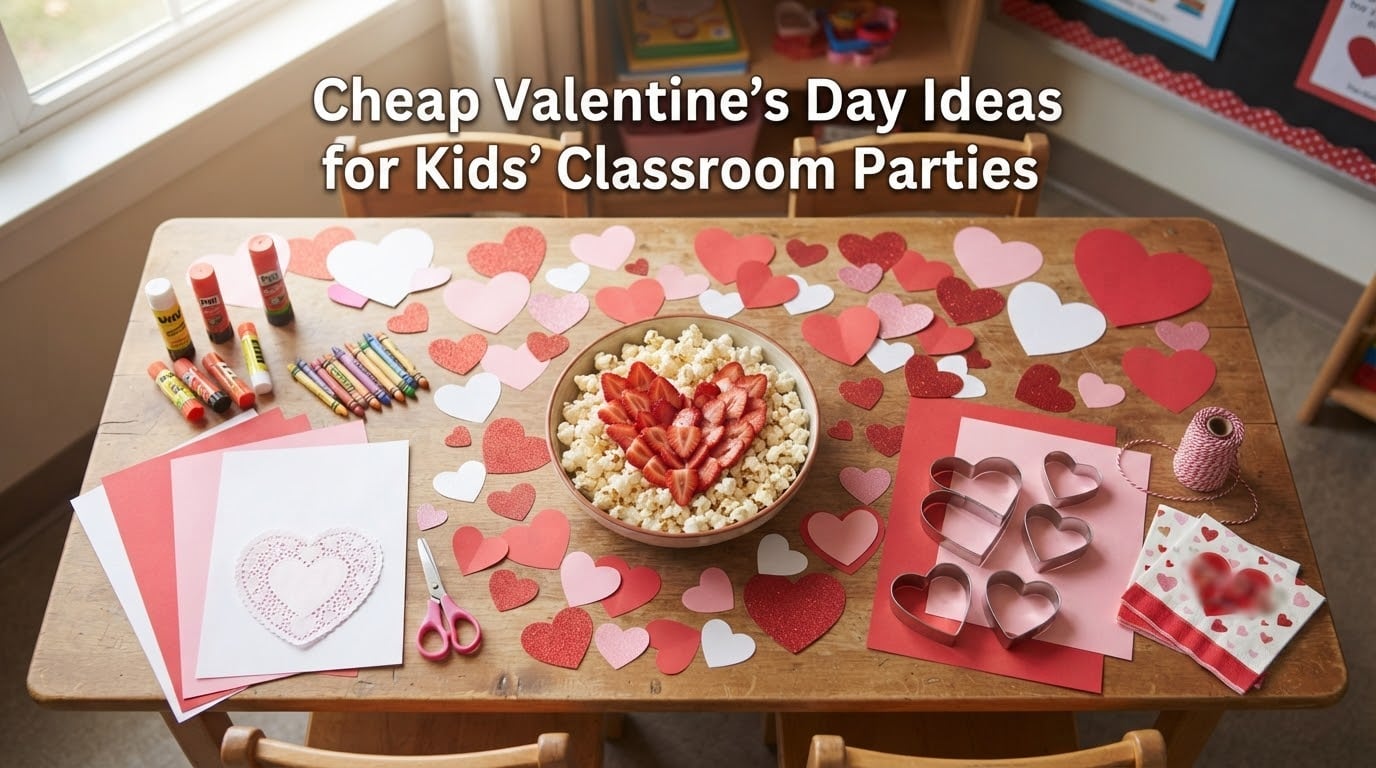
Every February, the same message lands in my inbox: I love Valentine’s Day, but I have no budget and no time. Teachers and room parents describe a familiar squeeze, since the school calendar has barely room for the regular lessons and the treat policy usually limits sweets to a couple of celebrations a year. So this guide covers cheap Valentine’s Day ideas for kids’ classroom parties, built from what teachers and parents actually report needing: activities that cost next to nothing, take ten minutes of setup, and clean up before the custodians arrive.
Nothing here costs more than a trip to a dollar store and a trip to the pantry, and every activity below gets a cost level, a prep time and a cleanup rating so you can pick the ones that fit your actual day. Cost levels use four labels: Free means you already own everything, Almost free means a scavenged supply, Low means a small shop run, and Low-moderate means you are buying in slightly larger quantities or one specialty item.
I have organized this so you can skim. Start with the quick picks if your party is tomorrow. Jump to the games, crafts or snacks if you already know what your class needs. Read the planning timeline if you have two weeks and a committee who wants direction.
Table of Contents
- Quick Picks: 10 Cheap Valentine’s Day Ideas for Kids’ Classroom Parties
- How to Plan a Classroom Valentine’s Party on a Budget
- Active Valentine’s Day Games That Cost Almost Nothing
- Cheap Valentine’s Day Games That Build Literacy and Math Skills
- Cheap Valentine’s Day Crafts for the Classroom
- Budget-Friendly Valentine’s Day Snacks and Non-Candy Treats
- Dollar Store Shopping List for a Classroom Valentine Party
- How to Adapt Valentine’s Ideas by Age
- Allergy-Friendly and School-Policy-Friendly Valentine’s Ideas
- How to Organize Parent Volunteers and Contributions
- Frequently Asked Questions
- What are some fun activities for Valentine’s Day in the classroom?
- What are some unique classroom Valentine ideas?
- What are some creative Valentine’s Day party ideas?
- How do you plan a Valentine’s Day classroom party on a budget?
- What are non-candy Valentine’s Day ideas for a school exchange?
- What are cheap Valentine’s Day snacks for a classroom?
- Where do I buy cheap Valentine’s party supplies?
- What Valentine’s Day activities work for middle school?
- How do you handle food allergies at a classroom Valentine party?
- Wrapping Up Your Budget Valentine’s Day Plan
Quick Picks: 10 Cheap Valentine’s Day Ideas for Kids’ Classroom Parties
The ten ideas below are the ones that come up most often when teachers compare notes, and each one is cheap, classroom-tested and quick to reset. Cost level, prep time, age range and cleanup difficulty are listed so you can match an idea to your actual schedule before you commit.
| Idea | Cost level | Prep time | Age range | Cleanup (1-5) | Allergy-friendly |
|---|---|---|---|---|---|
| Heart musical chairs | Free | 5 minutes | 4-10 | 1 | Yes, non-food |
| Conversation heart math | Low | 5 minutes | 5-9 | 2 | Nut-free version available |
| Syllable clap freeze dance | Free | 0 minutes | 4-12 | 1 | Yes, non-food |
| Tissue paper heart collages | Almost free | 3 minutes | 4-8 | 2 | Yes, check paste |
| Fruit salad hearts | Low | 10 minutes | All ages | 2 | Yes with swap |
| Cardboard heart collage wall | Free | 10 minutes | All ages | 2 | Yes, non-food |
| Graham cracker love notes | Low | 15 minutes | 4-8 | 3 | Gluten-free swap |
| Glow stick heart scavenger hunt | Low | 10 minutes | 7-14 | 1 | Yes, non-food |
| Valentine mystery bag guessing game | Free | 5 minutes | 6-12 | 2 | Yes if filled with craft items |
| Heart-shaped snack board | Low | 10 minutes | All ages | 2 | Yes with labels |
Here is the same list in a form you can hand to a volunteer. Each item is deliberately short, because a room parent working from a printed sheet is far more likely to finish the setup than one reading a paragraph.
- Heart musical chairs — cut large hearts from scrap cardboard, set them chair to chair, and play until the beats stop. Free, and cleanup is just stacking the chairs.
- Conversation heart math — use candy hearts as counters for addition, skip counting and patterning. The sugar version is optional, since plastic counting hearts work just as well.
- Syllable clap freeze dance — clap the beats in a Valentine’s word, then freeze. This one needs no materials at all.
- Tissue paper heart collages — torn tissue squares glued onto a paper heart. Great for fine motor skills and nearly impossible to mess up.
- Fruit salad hearts — sliced strawberries, bananas and melon arranged in a heart on a platter, with a yogurt dip on the side.
- Cardboard heart collage wall — one large paper heart, a bin of craft scraps, glue sticks, and the kids fill it. It becomes the bulletin board display.
- Graham cracker love notes — spread cream cheese, add alphabet cereal letters, and eat. The message is written in cereal.
- Glow stick heart scavenger hunt — hide small heart-shaped notes around the room and let kids hunt, then open the notes together as a class.
- Valentine mystery bag guessing game — a bag holds four small items; kids reach in without looking and guess the heart-themed surprise.
- Heart-shaped snack board — arrange pretzels, fruit, popcorn and crackers in a heart with compartments so allergies never cross.
If you only do three, do the freeze dance, the collage wall and the fruit hearts. Those three hit gross motor, fine motor and social-emotional learning without needing a permission slip or a special snack policy.
How to Plan a Classroom Valentine’s Party on a Budget
A budget classroom party succeeds when the planning happens on a schedule, not on the day. Teachers say the hardest part is not the money, it is that the instructional calendar has almost no slack, so the party has to fit into an existing block instead of creating a new one.
Two weeks before: decide the shape of the party
Write down three things and nothing else: the length, the number of helpers and the treat situation. Sixty to ninety minutes with three rotating stations is the most common shape. Ask the office about the treat policy in writing, because policies that limit sweets usually specify a number of celebrations per year and teachers routinely misremember which ones have already used it.
One week before: assign and pre-cut
Put the jobs in writing and give each helper a single deliverable, not a job title. One person brings the snack, one person pre-cuts the paper hearts, one person runs the game, one person handles cleanup. Pre-cutting the hearts at home is the single biggest time saver, since it turns fifteen minutes of scissoring into a five-minute setup.
Two days before: gather from the dollar store and the pantry
Work the shopping list at the end of this guide category by category. Check the pantry first, because dry cereal, crackers, canned fruit and vanilla wafer crumbs cover most of the snack ideas below. Reuse classroom supplies whenever you can, and reserve new purchases for the one or two things that make the day feel special.
Day before: set stations, not rows
Push tables to the perimeter and put four activity spots in the corners. A floor spot for the active game, a table for crafts, a table for the exchange, a table for snacks. This layout lets you rotate thirty kids without a seating change, and it keeps the snacks out of the craft glue zone.
Day of: keep the schedule visible
Post the rotation on the board and tell students the ending time before it starts, because the anticipation of a longer party is what triggers most mid-party meltdowns. If you are the room parent rather than the teacher, ask the teacher for the hard stop and build backward from it.
Group size scaling
Every activity here scales, but the way you scale depends on the activity. Movement games scale by adding a line or shortening the music. Craft activities scale by dividing the class into two groups of twelve or thirteen so the craft table never becomes a crowd. Board games and card exchanges scale by adding a second table. Quiet sensory stations scale by adding bins rather than adding children, since a bin with three children is already at capacity.
Active Valentine’s Day Games That Cost Almost Nothing
Movement games work because they cost nothing, reset in seconds and burn off the energy that builds up in late February. None of these need a music system, a projector or a special purchase, and all of them run at cleanup difficulty one or two.
1. Heart musical chairs
Cost level: Free. Prep: 5 minutes. Cleanup: 1 of 5. Best for: Ages 4-10.
How to run it:
- Cut one heart per chair from scrap cardboard or the back of a reused poster.
- Set the hearts on chairs in a loose circle, well away from desks.
- Play a familiar walking song and walk when the music plays, freeze when it stops.
- Shrink the circle each round by removing one heart at a time.
- Award a team rather than a child so nobody is left standing alone.
What it builds: gross motor skills, turn-taking and spatial reasoning as children judge how much space is left on each shrinking chair. Teachers who run this every year report it works best if you cut the hearts a day ahead.
2. Syllable clap freeze dance
Cost level: Free. Prep: 0 minutes. Cleanup: 1 of 5. Best for: Ages 4-12.
How to run it:
- Call out a Valentine’s word, such as valentine, and clap its beats together as a class.
- Immediately switch to a movement word, such as jump, and the class switches to that motion.
- Go back and forth, speeding up each round.
- Finish with a slow round so the class ends calm rather than wired.
What it builds: phonemic awareness and syllable segmentation in a form that works better than a worksheet. A four-year-old claps the three beats in valentine without reading a single word.
3. Heart bean bag toss into a bucket
Cost level: Almost free. Prep: 5 minutes. Cleanup: 1 of 5. Best for: Ages 5-12.
How to run it:
- Tape a large heart outline on the floor as the target zone.
- Fill a sock or small bag with dried beans, or use rolled paper.
- Set a line three feet back and let each child take three throws.
- Award a heart sticker, a high five or a point on a team board.
- Add a distance round for older students who need a challenge.
What it builds: hand-eye coordination, gross motor control and counting accuracy. Because the beans never leave the sock, this stays a low-mess activity even with thirty children.
4. Glow stick heart scavenger hunt
Cost level: Low. Prep: 10 minutes. Cleanup: 1 of 5. Best for: Ages 7-14.
How to run it:
- Hide small folded notes around the room, roughly one per pair of desks.
- Open the room a note at a time by reading a clue aloud.
- Have each pair find the note with a heart drawn on it.
- Collect all notes and read them together as a class message.
What it builds: spatial reasoning, reading comprehension and collaborative problem solving. It also works well for middle school groups, who tend to find it too juvenile unless the notes hold a puzzle rather than a joke.
5. Heart pass the beanbag
Cost level: Free. Prep: 0 minutes. Cleanup: 1 of 5. Best for: Ages 6-14.
How to run it:
- Sit the class in a circle and pass a soft heart-shaped beanbag or folded sock.
- Count the passes aloud and write the class record on the board.
- Add a rule, such as pass it under your leg or behind your back, on round two.
- Beat the record on round three.
What it builds: concentration, sequencing and calm group attention, which is a rare gift in a classroom with five-year-olds. Upper elementary and middle school students stay engaged when the record is visible and beatable.
Cheap Valentine’s Day Games That Build Literacy and Math Skills
The strongest budget move is to use Valentine’s materials you already have for review. Teachers report doing this all year: conversation hearts become math counters, and words written on the board become a phonics game that costs nothing.
1. Conversation heart math stations
Cost level: Low. Prep: 5 minutes. Cleanup: 2 of 5. Best for: Ages 5-9.
Set out three small piles of hearts: one pile for pattern building, one for addition problems written on index cards, and one for skip counting by twos. Students rotate through the piles. Run it with plastic counting hearts rather than candy if your school restricts sweets, and the activity still teaches one-to-one correspondence.
2. Sight word hearts on the door
Cost level: Free. Prep: 10 minutes. Cleanup: 2 of 5. Best for: Ages 4-7.
Write each sight word on a paper heart and tape them around the door. A student enters, reads a heart aloud, and the class responds. Send the child to hunt the next one rather than calling on cold, which keeps every child moving. This doubles as a display that stays up for the rest of February.
3. CVC word hunt with heart cards
Cost level: Almost free. Prep: 5 minutes. Cleanup: 1 of 5. Best for: Ages 5-8.
Write consonant-vowel-consonant words on heart-shaped cards, such as cat, dog, hug, sun, and tape them face down on a table. Children draw one, blend the sounds aloud, and add it to a matching pile. Keep a small running list on the board and the blending becomes visible progress instead of a worksheet.
4. Heart symmetry and heart graphing
Cost level: Free. Prep: 5 minutes. Cleanup: 1 of 5. Best for: Ages 6-12.
Fold a paper heart down the center, add one mark on one side, and let children predict the mirrored mark before they open it. Then move to graphing by folding hearts into eighths and drawing on the crease lines only, so the finished shape lands in one quadrant. It quietly teaches symmetry, spatial reasoning and following multi-step directions, and it is a natural fit for the last ten minutes of a literacy block.
5. Valentine’s codebreaker for middle school
Cost level: Free. Prep: 15 minutes. Cleanup: 1 of 5. Best for: Ages 10-14.
Give each pair a grid where hearts represent letters. Write a Valentine’s phrase as a coded grid, hand out clues, and let pairs decode it. Then ask them to write their own coded message and swap with another pair. Middle schoolers usually need a puzzle with actual rules, and this one has clean rules, zero materials and a natural reason to talk to a classmate.
Middle school is the most ignored corner of Valentine’s classroom planning. Most lists stop at elementary, and the few that reach older students lean on crafts that read as babyish. Logic puzzles, codebreakers, word sorts, inference puzzles and a low-pressure writing prompt will hold sixth through eighth graders without a single decoration.
Cheap Valentine’s Day Crafts for the Classroom
Crafts eat the most budget, so these are built from paper scraps, pantry staples and classroom supplies you already own. Every one has a cleanup rating, and the last two work as calm-down stations for early finishers.
1. Tissue paper heart collages
Cost level: Almost free. Prep: 3 minutes. Cleanup: 2 of 5. Best for: Ages 4-8.
Give each child a paper heart and a cup of tissue squares. Children tear, not cut, which is easier on small hands. The result looks textured and finished, and the tearing is a deliberate fine motor exercise. Put the glue sticks on the table rather than the floor so nobody loses one, and let finished hearts go straight onto the classroom wall.
2. Heart mosaic collages
Cost level: Almost free. Prep: 5 minutes. Cleanup: 2 of 5. Best for: Ages 5-10.
Draw a heart lightly in pencil, divide it with a few straight lines, and let children fill each section with one color of tissue paper. Younger children get three sections, older children get a dozen. When they are done, tear the paper along the pencil lines to expose the mosaic lines underneath, which is the moment that gets a reaction from the room.
3. Q-tip painted hearts
Cost level: Almost free. Prep: 3 minutes. Cleanup: 2 of 5. Best for: Ages 3-6.
Use cotton swabs, washable paint and paper hearts, one heart per child. Q-tips give a preschooler real control and a full heart shape that a brush rarely does. This is the go-to activity for the youngest classroom, and the drying hearts double as a display.
4. Salt dough heart ornaments
Cost level: Low-moderate. Prep: 15 minutes. Cleanup: 3 of 5. Best for: Ages 4-12.
Mix two cups flour with one cup salt, add water, and knead in a few drops of pink food colouring. Children roll small hearts, cut them with a cookie cutter and poke a hole at the top with a straw. The pieces dry in about two days, which is why this needs a start three days ahead. It is the only activity here that requires a real ingredient purchase, so treat it as the one special item and cut it back to one heart per child.
5. Scented play dough hearts for early finishers
Cost level: Almost free. Prep: 10 minutes. Cleanup: 3 of 5. Best for: Ages 3-8.
Scoop two tubs of play dough onto trays, sprinkle cinnamon on one side and keep the other plain, and hand out heart-shaped cookie cutters. Children shape and cut, then tell you whether their heart is the cinnamon heart or the plain heart, which turns sensory play into a sorting activity. Set the trays on a tray table so cleanup is one trip, and skip the perfumed hearts if any child in the room reacts to strong smells.
One warning on all crafts: check the paste, glue sticks and glitter for peanut oil ingredients before they go on a table. Most nut reactions at school come from craft materials rather than lunch boxes, and this is a five-second check on a label.
Budget-Friendly Valentine’s Day Snacks and Non-Candy Treats
Snacks are where the budget usually slips, so the ideas below lean on grocery-store pantry items and fruit rather than packaged Valentine’s treats. Cost level here is per class of about 24 children, and the allergy column tells you what to swap before the day, not during it.
| Snack | Cost level | Prep time | Allergy notes | Kid appeal |
|---|---|---|---|---|
| Fruit salad with yogurt dip | Low | 10 minutes | Nut-free if you use yogurt, not nut dip | High |
| Heart-shaped graham crackers with cream cheese | Low | 15 minutes | Gluten-free crackers available | High |
| Popcorn hearts in cups | Free | 5 minutes | Check popcorn for butter and dairy | High |
| Pretzel hearts with yogurt coating | Low | 10 minutes | Check the coating for nuts | Medium |
| Watermelon hearts on sticks | Low | 10 minutes | None | High |
| Heart-shaped sandwiches or mini pizzas | Low-moderate | 25 minutes | Watch bread and cheese labels | High |
| Heart-shaped jell-o cups | Low | 5 minutes plus setting time | Can use a dairy-free option | High |
| Heart-shaped fruit and pretzel board | Low | 10 minutes | Label each compartment | Medium |
The fruit salad is the most reliable crowd-pleaser, and parents on a sign-up sheet happily take it because it is one specific job rather than a vague request. Guests report that the trick is a shallow serving tray so every child can reach without scooping with fingers, and a separate dish of dip so nobody has to dig.
For a heart theme, cut watermelon with a cookie cutter five minutes before serving and slide the pieces onto popsicle sticks. It is the fastest decoration in the whole plan and the one kids notice most.
Heart-shaped sandwiches or mini pizzas take more time than they save, so only do these if a parent volunteer is handling them and the cooking happens at home. The naive version, where each child builds their own, adds twenty minutes of oven traffic to your day and creates a cleanup nobody wants.
The most reliable no-cook option is a snack board: pretzels, fruit, popcorn and crackers arranged in a heart on a platter with small cups. Label it clearly and keep each item in its own cup, because cross-contact is what turns a snack into a safety incident.
And keep a non-food option in the mix. Stickers, pencils, erasers and small heart-shaped tokens cost about what a single treat costs and they last, which parents on a tight budget frequently mention as a relief when the treat policy pushes back.
Dollar Store Shopping List for a Classroom Valentine Party
This list covers a class of about 24 children across every activity above, and it is built for a single dollar store trip plus whatever you already have. Quantities assume one item or portion per child unless noted.
| Category | Item | Quantity for 24 kids | Notes |
|---|---|---|---|
| Paper | Construction paper | 3 sheets of 20 | White and pink cover collages, hearts and card stock |
| Paper | Poster board | 1 sheet | Cut the big heart for the collage wall |
| Paper | Card stock | 40 sheets | Index-card substitute for all game prompts |
| Paper | Paper plates | 1 pack | Snack stations, cookie cutters for cutting dough |
| Adhesives | Glue sticks | 1 pack of 24 | One per child removes the sharing queue |
| Adhesives | Washable glue | 2 bottles | For the mosaic and collage wall |
| Art | Tissue paper | 2 packs | Torn, not cut, by the children |
| Art | Washable paint | 2 bottles pink | Q-tip hearts for the youngest group |
| Art | Cotton swabs | 2 packs | One pack per group of four |
| Snacks | Graham crackers | 2 boxes | Cut with a cookie cutter the night before |
| Snacks | Fresh strawberries | 4 pounds | Sliced thin for the salad |
| Snacks | Bananas | 6 | Bananas are the cheapest filler in the salad |
| Snacks | Pretzels | 2 large bags | Snack board and dipping |
| Snacks | Microwave popcorn | 3 bags | Air popped into paper cups |
| Snacks | Yogurt | 1 large tub | Fruit dip; choose plain so you control the sugar |
| Dexterity | Heart cookie cutters | 4 sets | Sandwiches, watermelon, jell-o and dough |
| Extras | Heart stickers or pencils | 24 or 30 | Non-food option and small prizes |
Check the pantry before you buy any of it. Dry cereal, vanilla wafer crumbs, canned mandarin oranges, crackers and a bag of frozen fruit can replace several rows on this list, and teachers consistently say the pantry walk saves more than the shopping trip costs.
One habit pays off every year: keep a small “February bin” in a closet and drop spare supplies into it as the holiday passes. Craft scissors, glue sticks, cookie cutters, heart cutters, card stock and unused decorations make next year’s list shorter.
How to Adapt Valentine’s Ideas by Age
The same activity usually needs three different versions to work from preschool to middle school, and most frustration with party plans comes from picking one version. Use this table to shorten an activity rather than abandon it.
| Activity | Preschool (3-5) | Early elementary (6-8) | Upper elementary (9-11) | Middle school (12-14) |
|---|---|---|---|---|
| Freeze dance | Two-beat words, no counting | Clap syllables in the words | Add a speed round | Switch to a code or clue round |
| Collage | Torn tissue, glue only | Mosaic sections | Symmetry and graphing | Drop the craft, keep the design task |
| Conversation heart math | Skip it, use counters | Addition and patterns | Two-digit addition | Probability with a real jar |
| Snack | Finger foods only | Cut fruit salad | Build your own snack board | Label and rank a blind taste test |
| Card exchange | Valentines to teacher only | Match to a friend | Kind message exchange | Anonymous appreciation notes |
| Quiet option | Play dough hearts | Scented dough sorting | Word sort with heart cards | Logic puzzle with coded messages |
For middle school, the single change that matters is dropping the craft. Preteens will do a puzzle, a write activity or a game, but a tissue collage earns eye rolls and leaves glue on your desks. For preschool, the single change that matters is removing anything requiring a written name before a helper has labelled it.
One more split worth planning: if your class spans a wide age range, run a parallel lane. A three-year-old and a nine-year-old cannot both do the same station without someone losing. Assign an adult helper to the preschool table rather than trying to make one activity work for both.
Allergy-Friendly and School-Policy-Friendly Valentine’s Ideas
Most schools handle this well if you do the homework before the day. The three things to confirm in writing are the treat policy, the number of celebrations that count against it, and the classroom’s specific allergen list. Teachers report that the policy is usually a limit on how often sweets are served, not a total ban, and that the phrase “sweets twice a year” gets remembered very differently by different staff.
Build your plan around four labels so you can answer any question in two seconds.
- Nut-free — no peanuts, tree nuts or nut-derived ingredients, including in craft glue and play dough.
- Gluten-free — rice crackers, fruit, popcorn, yogurt and cheese instead of wheat crackers and bread.
- Dye-free — skip conversation hearts and red-dyed snacks. White frosting, white yogurt and fruit work.
- Non-food — stickers, pencils, tokens, a heart bookmark or a turn at an extra game.
The easiest safety system is a labelled snack board with each item in its own cup and a small card naming it. Parents scanning the table can see what is safe in three seconds, and a teacher handing out cups can hand out the right one without asking questions.
For a food-free option that still feels like a party, run the exchange as sticker or pencil valentines. Fifth graders, in particular, treat an ice cream party or a Valentine box competition as a major event, so if your school allows it, ask about the box competition and its rules early, because those rules usually arrive the week before.
Finally, keep one shelf of non-food items and let children choose freely. It removes the pressure to have the most impressive treat, and it lets the child with the hardest allergy participate exactly like everyone else.
How to Organize Parent Volunteers and Contributions
Good parent coordination is the difference between a teacher running a party alone at 7:45 in the morning and a party that runs itself. The formula that works is one named person per job, and no more than four jobs total.
Put the sign-up sheet up two weeks ahead with four rows, not a full list of tasks:
- Snack helper — brings one specified item, already portioned, plus the serving spoons and cups.
- Prep helper — arrives thirty minutes early to cut hearts, set stations and fill the bins.
- Game leader — runs the one active game for the class. This is the single most valuable volunteer on the sheet.
- Cleanup helper — stays fifteen minutes past the end and handles trash, tables and floor.
Keep what the teacher must do personally to two things: the treat policy check and the room layout. Everything else can be handed over, and the four-line sheet above is the whole ask.
Give helpers a two-sentence brief the morning of the day, including the hard stop time and the allergy list. Volunteers want to be useful, and almost every coordination problem we hear about comes from a helper who did not know the ending time or which snack was the safe one.
Frequently Asked Questions
What are some fun activities for Valentine’s Day in the classroom?
The best low-cost classroom activities are a freeze dance with syllable claps, a paper heart collage wall, conversation heart math stations, a sight word heart hunt on the door, and a Valentine card exchange. The first four need only construction paper, glue sticks, candy hearts and index cards, and each one runs in under ten minutes of setup.
What are some unique classroom Valentine ideas?
Unusual options that stay inside a tight budget include a glow stick heart scavenger hunt, a mystery bag guessing game filled with craft items, a codebreaker puzzle where hearts stand for letters, and a heart snack board where children arrange their own portions. These work for middle school students who find typical crafts too young.
What are some creative Valentine’s Day party ideas?
Creative ideas on a budget include tissue paper heart collages, heart mosaic collages with torn paper, Q-tip painted hearts for preschoolers, salt dough heart ornaments, and scented play dough hearts for early finishers. Add a heart snack board and a short exchange game, and the whole party runs in about ninety minutes.
How do you plan a Valentine’s Day classroom party on a budget?
Work backward from a sixty to ninety minute block, choose four rotating stations, and confirm the treat policy in writing two weeks ahead. Assign one parent volunteer per job, pre-cut all paper hearts at home, and gather supplies from a dollar store list plus your pantry. Nothing needs to be purchased fresh except one or two items.
What are non-candy Valentine’s Day ideas for a school exchange?
Non-candy valentines include heart-shaped stickers, mini pencils, erasers, bookmarks, tokens for a class game or a coupon for extra recess. Teachers report that older students often prefer a small pencil or a puzzle card over a treat, and these options also keep the party clear of school treat policies entirely.
What are cheap Valentine’s Day snacks for a classroom?
The cheapest classroom snacks are popcorn in paper cups, sliced watermelon hearts on sticks, fruit salad with yogurt dip, pretzels with fruit on a snack board, and graham crackers cut into hearts with cream cheese. Each one uses grocery pantry items, scales easily to a class of 24, and needs no cooking.
Where do I buy cheap Valentine’s party supplies?
Buy supplies at a dollar store in one categorized trip: construction paper, card stock, glue sticks, tissue paper, washable paint, cotton swabs, cookie cutters and small non-food prizes. Check your school or home pantry first, because cereal, crackers, canned fruit and vanilla wafer crumbs cover most snack ideas at no cost.
What Valentine’s Day activities work for middle school?
Middle schoolers respond to puzzles and writing rather than crafts. Try a heart codebreaker, logic and inference puzzles, a word sort, a low-pressure writing prompt or a blind taste test with ranked results. A glow stick scavenger hunt also works if the hidden notes hold a puzzle instead of a joke.
How do you handle food allergies at a classroom Valentine party?
Confirm the classroom allergen list and the school treat policy in writing, then label every snack item on its own card. Keep nut-free, gluten-free, dye-free and non-food options available, put craft glue and play dough through the same label check, and let children pick from a non-food shelf so no one is singled out.
Wrapping Up Your Budget Valentine’s Day Plan
A memorable classroom Valentine party does not need a large budget, it needs a plan and a small supply list. Everything in this guide runs on construction paper, glue sticks, pantry snacks and a four-row volunteer sheet, and every idea scales to your class size.
Pick three things from the quick picks and stop there. If you have two weeks, post the volunteer sign-up now and confirm the treat policy in writing so the whole thing runs on the day without a scramble.
If you are teaching, save this list for 2026. If you are a room parent, hand the timeline and the shopping list to whoever is helping, and the party takes care of itself.