
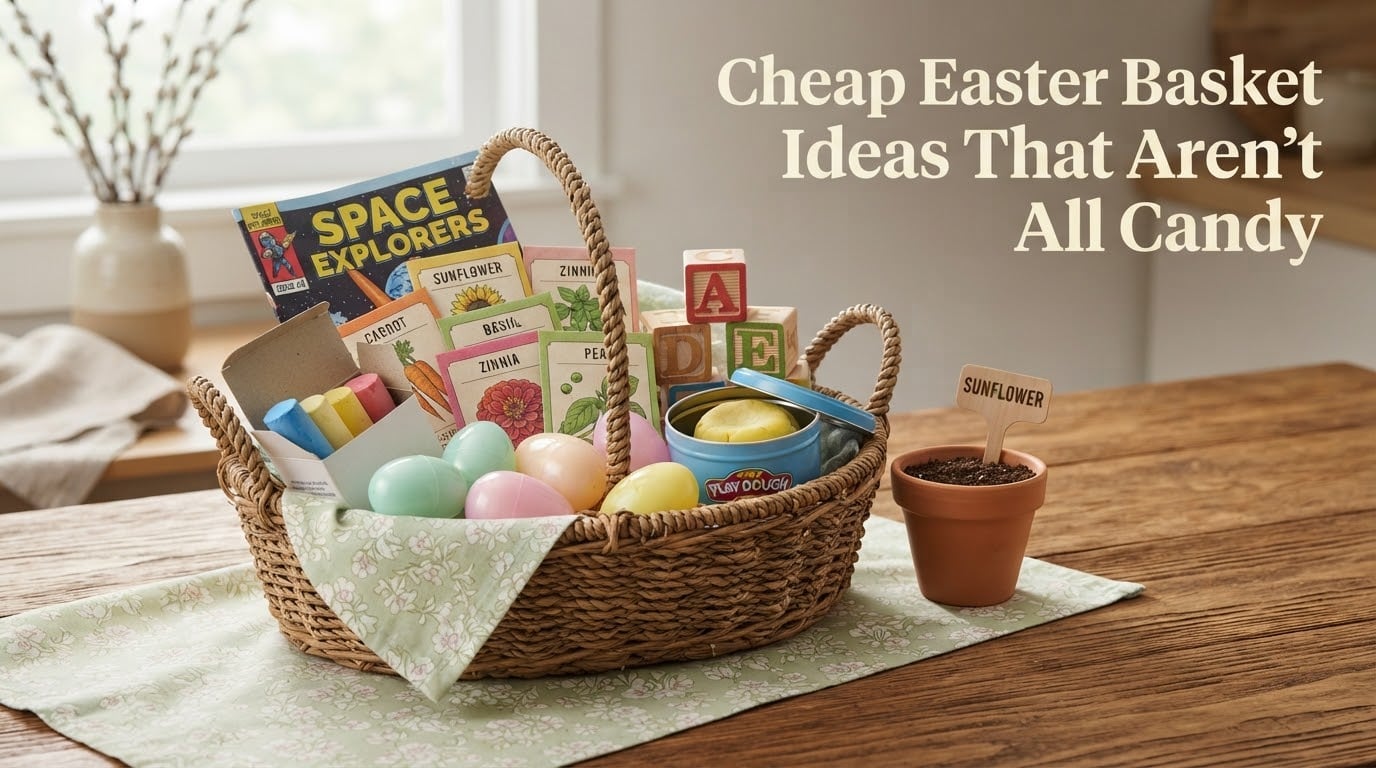
If you want cheap Easter basket ideas that aren’t all candy, start with the boring stuff: sidewalk chalk, a sticker sheet, a seed packet, a comic, a puzzle, and one small toy your kid will actually use. Five or six items per child, a reusable basket, and a scrap of fabric as the liner adds up fast and leaves you with a basket that gets used for months instead of binned by the following weekend. We ran these combos on our own three kids and on a few very opinionated friend households, and this is the list that survived.
The default Easter basket is cheap plastic novelty junk plus a stomach full of sugar, and most of it is in the trash within a week. Swapping in durable, open-ended, low-cost fillers cuts the waste and the sugar, and it very often costs less than the candy version did.
This guide is written for Edmonton and the surrounding area, so the sourcing notes point at Dollarama, Walmart, Indigo, and the local library of used toys rather than shipping estimates. It is updated for 2026 and works every year, because the best fillers are the ones you can buy once and rotate.
Table of Contents
- What Counts as an Easter Basket Filler?
- Quick Picks: 12 Cheap Fillers, Cost Tier and Best Age
- Free or Nearly Free Fillers You Already Own
- The 6-Item Basket Formula That Ends the Overthinking
- Arts and Crafts Fillers
- Building, STEM and Open-Ended Play Fillers
- Books, Comics and Reading Fillers
- Outdoor, Sensory and Spring Fillers
- Wearables and Everyday-Use Fillers
- Filling Plastic Easter Eggs Without Candy
- Easter Basket Ideas by Age
- Experiences and Gift Cards for Older Kids and Adults
- How to Build a Whole Basket on a Budget
- What to Skip: Plastic Novelty Junk and Choking Hazards
- Where Edmonton Families Buy Fillers Cheap
- Reuse the Basket Every Year Instead of Buying New
- Grab-and-Go Shopping Checklist
- Frequently Asked Questions
- What do you fill an Easter basket with?
- What are good basket fillers?
- What to put in an Easter basket that’s not junk?
- What can I use as filler in a gift basket?
- What to fill Easter baskets with?
- What to use instead of baskets for Easter?
- What are some unique Easter basket ideas for adults?
- What can I put in plastic Easter eggs instead of candy?
- How do I keep Easter basket stuff from becoming junk?
- Your Turn: Cheap Easter Basket Ideas That Aren’t All Candy
What Counts as an Easter Basket Filler?
The words get mixed up, so here is the plain version. A basket filler is any item that goes inside the basket itself. A basket stuffing is the material that fills the gaps so the items do not rattle around. An Easter egg filler is small enough to fit inside a closed plastic egg, which is a much shorter list than most people expect.
“Junk-free” does not mean plastic-free. It means the item is durable, open-ended, and still interesting in month three, rather than a novelty shape that breaks or a wrapper that is thrown out before Easter Monday is over. That distinction is the whole reason this list looks the way it does.
Most families land on five to eight fillers per child. Fewer than that and the basket looks empty once the eggs are added. More than eight and you are back to the bin.
Quick Picks: 12 Cheap Fillers, Cost Tier and Best Age
These twelve cover most baskets. Cost tier is relative, not a set price: Free means you already own it, Very low means pocket change at a dollar store, Low means a small spend, and Medium is where a bigger or longer-lasting item lands.
- Sidewalk chalk bundle — very low cost, age 3 and up. Outdoors, washes off, no cleanup argument.
- Sticker sheet or temporary tattoos — very low cost, age 2 and up. Small enough for plastic eggs too.
- Pocket-sized colouring book — low cost, age 3 and up. Fits the car, the table, the waiting room.
- Comic or graphic novel — low cost, age 7 and up. Library sale shelves and swap groups are full of them.
- Wooden building blocks — medium cost, age 2 and up. Lasts years, packs small in a bucket.
- Packet of flower or herb seeds — very low cost, age 4 and up. Free from a plant-packet swap, or dirt-free indoors.
- Play dough tub — low cost, age 2 and up. Open-ended, reusable; buy non-toxic tubs only.
- Reusable water bottle — medium cost, age 5 and up. The only thing in there they use daily.
- Novelty pen or scratch-art pad — very low cost, age 5 and up. Screen-free, quiet, car-friendly.
- Flashlight or glow sticks — very low cost, age 5 and up. Turns an egg hunt into a real event.
- Puzzle with a great photo — low cost, age 5 and up. Better than a novelty toy in every way.
- Gift card or experience voucher — medium cost, age 10 and up. No storage, no clutter, no trash.
If you only do one thing, do the chalk and the stickers. They are the two items our kids pulled out first every single year.
Free or Nearly Free Fillers You Already Own
This is the section nobody else writes, and it is the one that saves the most. Every household has more Easter filler sitting in drawers and cupboards than they realise.
- Dollar-drawer rescues. That novelty pen, the deck of cards with the bent corner, the travel-size anything. Clear out two handfuls and you have a preschooler’s basket handled for nothing.
- Pantry finds. A small box of crackers, a packet of dried fruit, a fun-shaped pasta, a single-serve granola bar. This is the one place a food item makes sense, because a basket with zero food in it sometimes reads as a mistake to the people receiving it.
- Recycling bin treasures. Clean caps, a flattened cereal box cut into puzzle pieces, a washed yogurt container for a tiny plant, bottle caps for a mosaic.
- Home-printed colouring sheets. Print three seasonal pages, roll them, tie with twine. Free, and you can personalise with the kid’s name.
- Scavenger-hunt clue slips. Five slips of paper, each pointing to a different hiding spot. Costs nothing and turns the morning into a game.
- Seed packets you saved. If you buy one packet of anything, save the empties. Next year’s basket is already half built.
- Fabric scraps. An old necktie, a bandana, a piece of a tablecloth. This is your liner, and it is free.
- Library card stickers and bookmarks. Ask at the desk. They hand these out free and kids treat them like a treasure.
The 6-Item Basket Formula That Ends the Overthinking
Our household stopped making decisions in March. We run the same six slots every year and just age them up. It is the single most useful thing on this page.
- Something to make with. Chalk, play dough, or a craft kit.
- Something to read. A comic, a puzzle book, or a library haul.
- Something to build or pretend with. Blocks, figures, a magnetic set.
- Something to wear or carry. Socks, a bandana, a water bottle, a hat.
- Something for outside. A flashlight, bubbles, chalk if you skipped slot one.
- Something to experience. A class pass, a movie ticket, a small gift card, or an IOU for a trip.
Same six categories, six dollars’ worth of nothing, zero decision fatigue. If your kids are the same age year to year, buy deeper baskets and buy less junk.
Arts and Crafts Fillers
Craft supplies are the strongest non-candy category because they are cheap, they last, and the mess happens on your table instead of in your kid’s mouth.
- Watercolour paint set or washable markers.
- Chunky crayons, which are easier for small hands than thin ones and do not break in a pocket.
- Sidewalk chalk, always the single most used item in our baskets.
- Scratch-art pad, quiet and self-contained.
- Sticker book or sheet of temporary tattoos.
- Pipe cleaners, wooden craft sticks, or a roll of low-tack tape.
- Air-dry clay or a tin of play dough.
- A printed activity sheet set, free, made by you.
Two craft items in one basket is the sweet spot. Five feels like an arts supply store threw up in there.
Building, STEM and Open-Ended Play Fillers
Open-ended toys are the opposite of novelty junk. The child decides what to do with them, which is exactly why they are still interesting weeks later.
- Wooden blocks, magnetic tiles, or a small construction set.
- A magnifying glass, which pairs perfectly with the outdoors half of an egg hunt.
- Measuring tape or a small ruler, funnier than it sounds for anyone learning about size.
- A jump rope, skipping rope, or a resistance band for older kids.
- Play dough, kitchen utensils, and a rolling pin as a pretend bakery kit.
- A toy animal set, plastic and light, easy to rinse and hand down.
- A card or board game small enough to fit a shoebox.
The one-item test: if your child would still be playing with it in August, it belongs in the basket. If you cannot picture that, skip it.
Books, Comics and Reading Fillers
A book is the easiest filler to source for almost nothing. Edmonton has an excellent used-toy and book ecosystem, and it is largely free if you are willing to hunt.
- A comic or graphic novel, the sweet spot for seven to twelve year olds.
- A pocket puzzle book or a new colouring book.
- A library haul, especially seasonal or animal books.
- A joke book, a magic trick manual, or a “how to draw dinosaurs” type book.
- A book light or clip reading light for the tween who reads in bed.
- Fresh book day stickers and bookmarks from the library.
Swap groups, school book sales, and the free shelf outside many branches give you a book for nothing. That is the difference between a basket that reads as thoughtful and one that reads as store-bought.
Outdoor, Sensory and Spring Fillers
Edmonton in April is not exactly a beach holiday, which is a good argument for putting the weather in the basket. Give them a reason to go outside and be outside.
- Bubbles or a small bubble wand, the single most popular item across all our households.
- A flashlight, which makes an egg hunt genuinely exciting after dark.
- Glow sticks if you are hunting at dusk.
- A pack of flower, herb, or grass seeds to plant after the long winter.
- Small garden gloves, which make a child feel like the planting is theirs.
- A tiny pot or teacup to plant the seed in and a marker to label it.
- A scavenger-hunt clue set, printed at home.
- Kiddie pool repair patches or a floating sandcastle kit, stored flat all year.
The seed-and-pot combo is our family’s tradition. It costs next to nothing, it is edible-fun-adjacent without being candy, and the kid remembers it every spring.
Wearables and Everyday-Use Fillers
These get used daily, which is the real test for a non-junk filler. Nothing here is a toy that expires.
- A pair of fun socks, which is where most families started.
- A bandana or neckerchief.
- A hair scrunchie or clip set.
- A small travel-size anything: hand cream, lip balm, a tidy brush.
- A reusable water bottle or insulated tumbler, which is the item our teens actually wanted.
- A matching hair tie set for siblings so the basket photographs well.
- A novelty adult-size item for grown-ups in the household, an easy way to make a family basket feel fair.
Filling Plastic Easter Eggs Without Candy
Small plastic eggs are the hard part. Anything that fits in a closed egg is also, statistically, a choking risk for under-threes, so this list stays short and boring on purpose.
- Stickers, small sheets or individual.
- Temporary tattoos.
- Small wooden beads or flat craft pieces, for over-threes only.
- Plasticine or play-dough, in a twist-wrapped piece.
- A rolled-up colouring sheet or a bookmark.
- Small coins, a Canadian quarter each if you are doing a hunt-style egg.
- Foam shapes or paper confetti shapes, for gluing later.
- Nothing at all: an empty egg with a handwritten name and a clue inside is a completely valid egg filler.
For under-threes, an empty or sticker-only egg is the correct answer. Everything else in the basket should be bigger than a toilet paper roll.
Easter Basket Ideas by Age
Same budget, very different basket. This is the part most lists skip, and it is the part that keeps you from buying a five-year-old’s gift for a thirteen-year-old.
Toddlers and under-threes
Bubbles, a soft ball, board books from the library, a container of play dough, and a sticker sheet. Nothing small enough to swallow, nothing with a battery, and nothing that requires you to supervise assembly.
Preschool, ages three to five
Sticker books, chunky crayons, sidewalk chalk, wooden blocks, a puzzle under twenty-four pieces, a dress-up accessory, and a seed packet. This is the age that responds best to movement, so bubbles and chalk go near the top.
School age, ages six to nine
A comic, a magnifying glass, a small craft kit, a bouncy ball, a flashlight, a colouring or activity book, and something to build. At this age a small tool or a kit they assemble themselves beats a toy hands-on.
Tweens, ages ten to twelve
A graphic novel, a kit to build, a puzzle with a good photo, a jump rope, a book light, stickers or washi tape, and a small gift card. Avoid anything that reads as babyish; tweens are the most fussy basket recipients in the house.
Teens
A gift card, a class pass, a movie ticket, a decent pair of earbuds, a book, a coffee or tea card, or a small kit for a hobby they already have. A handwritten list of “things I would actually use” from the teen themselves beats any guess you make.
Adults and grandparents
Coffee or tea, a good candle, a book, a self-care item, a plant or seed kit, a piece of chocolate you chose carefully on purpose, and an experience. Adults get a candy basket so rarely that a genuinely useful item lands surprisingly well.
Experiences and Gift Cards for Older Kids and Adults
This is the answer to the question we get most: what do you put in a basket that is not stuff? Experiences have no storage cost, no clutter, and no trash.
- A movie ticket or a small gift card for a specific store they actually use.
- A class pass, a single session, a climbing gym day pass.
- A zoo, science centre, or attraction ticket.
- A bookshop gift card, which is hard to waste.
- A “coupon book” you write yourself, redeeming for a driveway evening, a pancake morning, or a chore-free afternoon.
- A promise: “one sleepover pick, your choice, this spring.”
- A donation in their name to something they care about.
Ask before you buy, though. An experience the recipient does not want is worse than chocolate, because chocolate at least gets eaten.
How to Build a Whole Basket on a Budget
Here is the four-step process we use, whether it is one child or five.
- Buy the basket once and reuse it. A dollar-store basket, a pail, or a planter works. If you buy one, you never buy again, which is the entire point.
- Skip the shredded paper. A square of fabric, an old towel, or a bandana does the same job, does not blow around the living room, and survives the clean-up. Shredded paper is single-use landfill filler.
- Fill the empty space with free volume. Rolled socks, a rolled towel, a tea towel, a clean piece of newspaper, or grass from the yard add bulk and cost nothing.
- Fill with five to eight durable items per child. Use the six-item formula, then swap one slot for something age-appropriate from the brackets above.
Run the arithmetic for a family. One basket: a basket, a fabric liner, and six low-cost fillers stays comfortably in low single digits per child. Three children reusing the same liners with three free filler sets each comes in cheaper still. Five or more children, and the free list plus the swap groups and the library carry the whole thing, because the per-child cost collapses once nothing is disposable.
The real saving is year two. Baskets, liners, and the chalk and play dough you did not eat all come back out of storage, so the second Easter is close to free.
What to Skip: Plastic Novelty Junk and Choking Hazards
To deliberately avoid junk, you have to know what you are avoiding. The top-ranking community thread on this topic is essentially one long complaint about cheap plastic toys used once and binned, and the poster had already landed on socks and homemade cookies as her non-candy fillers before she asked for more.
- Anything that is only a container, like a novelty egg filled with more sugar.
- Miniature plastic animals in mixed sets, unless the child is under three and you are specifically looking for chew-safe pieces.
- Anything with a name printed on the packaging in a five-letter brand name you have never heard of.
- Eggs, plastic eggs, and filler sold as a sealed set, when you can buy the parts separately and reuse them.
- Items with loose small parts for any child under three. This is a hard line, not a soft one.
Also check for allergens if anyone in the family has them, and read labels on anything edible you put in a school or classroom basket. Many schools now ask families to send non-food items for allergy reasons, which makes a sticker-and-colouring egg the safest classroom filler there is.
Where Edmonton Families Buy Fillers Cheap
Dollarama is the backbone of any local budget basket, and the seasonal aisle is where the liners, baskets, and craft items turn over. Walmart and Canadian Tire carry the practical stuff, especially outdoor and garden items in spring. Indigo and the local library of used toys cover books, and swap groups on social platforms are the single best source of building sets, puzzles, and toy lots that are clean and complete but outgrown.
For timing, shop the days right after Easter. Seasonal displays get rotated out then, which is when baskets, ribbons, and craft kits are easiest to pick up cheaply for next year. Store them, label the box, and forget about it until March.
Reuse the Basket Every Year Instead of Buying New
Reusing the same small baskets year over year is already a common habit among the readers who care about this topic, and it is the cheapest fix available. Nothing about an Easter basket requires it to be new.
Beyond that, a few swaps reduce the footprint without spending anything. Fabric instead of shredded paper. A refillable bubble bottle instead of a novelty can. Seeds instead of plastic grass. A marker instead of a novelty plastic egg, or a decorated boiled egg instead of a plastic shell, which is a whole activity in itself and involves no purchase at all.
Over five years, a family that reuses baskets and liners spends a fraction of what they would buying fresh each spring, and the basket stops being an obligation and starts being a container.
Grab-and-Go Shopping Checklist
Print this or keep it in your phone notes. Tick as you go and you can assemble four baskets in one trip.
- Basket or pail per child, only if you do not own one
- Two fabric squares or old towels for liners
- Chalk bundle
- Sticker sheet or temporary tattoos
- Play dough or air-dry clay
- Comic or puzzle book from the swap shelf
- Seed packet and a small pot
- Bubbles or a bubble wand
- Flashlight or glow sticks for a dusk hunt
- Socks or a bandana
- One build-or-create item
- One experience or gift card
Frequently Asked Questions
What do you fill an Easter basket with?
Fill it with durable, open-ended items rather than candy: sidewalk chalk, a sticker sheet, a puzzle book, a comic, play dough, wooden blocks, a seed packet, bubbles, a flashlight, a pair of fun socks, and one experience or small gift card. Five to eight items per child is the sweet spot, set in a reusable basket with a fabric liner instead of shredded paper.
What are good basket fillers?
Good basket fillers are things a child chooses how to use: building sets, play dough, chalk, craft supplies, books, puzzles, magnifying glasses, jump ropes, and water bottles. The three questions to ask are whether it is open-ended, whether it is still interesting in a few months, and whether it is age-appropriate for the smallest child in the house.
What to put in an Easter basket that’s not junk?
Skip anything that has one correct use and a short life. Choose items that are reusable, breakable-free, and open-ended: a real puzzle with a good photo, a craft kit they assemble, a comic, a set of blocks, or a voucher for an activity. If your child would still be playing with it in August, it is not junk.
What can I use as filler in a gift basket?
For basket stuffing on a budget, use a square of fabric, an old tea towel, a bandana, or a clean sheet of newspaper folded around the contents. Free volume fillers like rolled socks, a rolled towel, or grass from the yard fill gaps without buying shredded paper that ends up in the trash.
What to fill Easter baskets with?
Use the six-item formula: something to make with, something to read, something to build or pretend with, something to wear or carry, something for outside, and something to experience. Repeat that structure for every child and adjust each slot for their age, and filling a basket stops being a decision problem.
What to use instead of baskets for Easter?
A bucket, a metal pail, a large reusable tote, a pillowcase, a storage bin, or even a garden planter all work as an Easter basket. Each one is already in the house or easily repurposed, and it survives far better in storage than a seasonal basket sold for one morning of use.
What are some unique Easter basket ideas for adults?
Adult baskets work best with things that get used: coffee or tea, a good candle, a book, hand cream or a brush, a plant or seed kit, a small gift card, or a voucher for a class, a meal, or a day out. Adults rarely get a candy basket, so a genuinely useful item lands better than you would expect.
What can I put in plastic Easter eggs instead of candy?
Stickers, temporary tattoos, a rolled colouring sheet, a bookmark, play-dough pieces, a bouncy ball, or a small coin work inside a closed egg. For children under three, stickers or a handwritten clue are the safest options, because anything small enough to fit in an egg is also a choking risk.
How do I keep Easter basket stuff from becoming junk?
Buy fewer things and buy them better, then store everything in one labelled box so it comes back out next year. Reuse the basket, use a fabric liner instead of shredded paper, and choose items that are open-ended rather than novelty-shaped. Most of the waste comes from buying new each spring, not from the basket itself.
Your Turn: Cheap Easter Basket Ideas That Aren’t All Candy
Cheap Easter basket ideas that aren’t all candy come down to three habits: start from what you already own, spend only on the one item per child that gets used every single day, and reuse the basket. Five to eight durable fillers, a fabric liner, and a clear-out of the dollar drawer gets you a basket that costs less than the candy version and survives the year.
Pick your six slots, write the ages of everyone in the house against them, and go. If you want more, start with the free fillers list and the age brackets, then shop the days after Easter for next year’s box.