
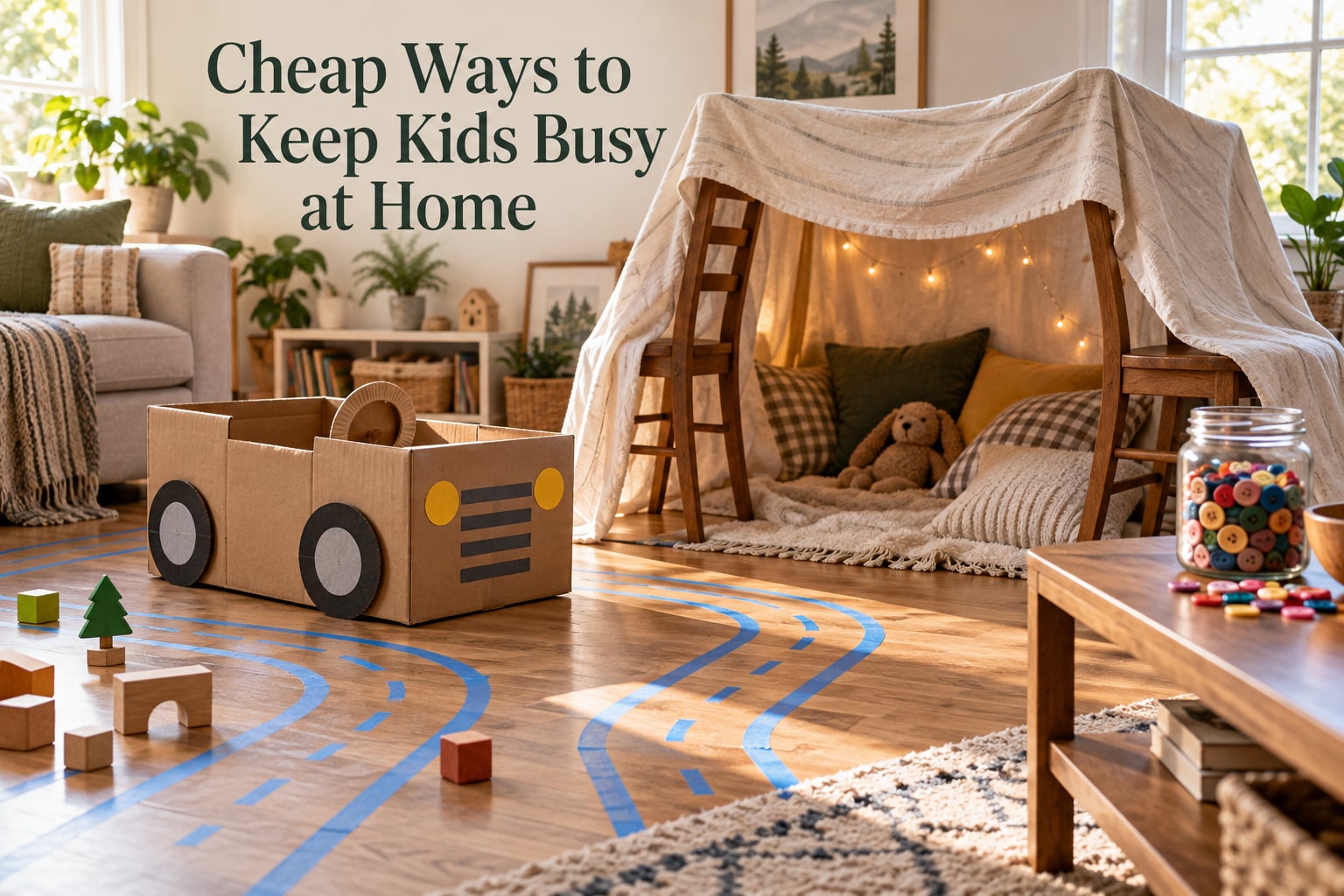
Somewhere around 4:15 on a snowy Saturday in Edmonton, the third request for “I’m bored” arrives and you have exactly enough energy left to open a tablet and call it done. That is the version of this problem almost every searcher is actually trying to solve. The question is not really how to entertain a child. It is how to buy yourself forty quiet minutes without spending money you do not have, without handing over a screen you feel guilty about, and without a twenty-minute craft setup that leaves you tidier than the living room but no less tired.
Here is the direct answer, so you can stop reading and start doing. Cheap ways to keep kids busy at home are free or near-free activities built from things you already own — cardboard boxes, junk mail, socks, buttons, pots, blankets, a jar of buttons — matched to the type of restless your child is. A physical child gets a movement challenge, a hands-busy child gets a sorting and building task, and a child who needs imagination gets a pretend-play setup. Because the materials are already in the house, the cost is nothing and the prep is minutes rather than hours.
Throughout this guide I have labelled every idea with four things no competitor bothered with: what it costs, what age it lands for, how long adult prep takes, and how much mess it makes. The cost definition is simple. Free means nothing to buy. Near-free means a small top-up of something already in the house, like one more box of cereal or a bag of ice. Anything beyond that is not on this list.
This page was updated in October 2026. Parents in Edmonton tell me the version of this question that lands hardest is always the same one: what do I do with a child who is restless, in a house with nothing spare, on a day when going outside is not an option. That is the version I have written for.
One more thing before the list. Boredom is not an emergency, and a kid who says “I’m bored” is not broken. A short stretch of it teaches a child that they can start their own fun, which is a skill worth more than any single craft. I will cover when to step in and when to wait, further down.
Table of Contents
- The 8 Ideas That Buy You the Most Time
- All 30 Activities at a Glance
- Free Crafts and Art With What You Already Own
- Indoor Games That Work for Any Number of Kids
- Kitchen and Science Experiments
- Energy Burners for Bad Weather Days
- Quiet and Calming Activities
- Forts, Hideouts and Big Builds
- Zero-Dollar Ideas by Household Room
- The Free Stash Worth Keeping Ready
- Low-Energy and Sick-Day Ideas
- Boredom Is Normal, and Sometimes Useful
- How to Never Run Out of Ideas Again
- How to Keep Kids Busy at Home With Different Ages
- Free Things to Do With Kids in Edmonton
- Where Screen Time Fits
- Frequently Asked Questions
- How do I keep my kids busy at home without spending money?
- How to keep kids occupied without screens?
- How to keep ADHD kids busy at home?
- How to keep a toddler occupied with nothing but household items?
- What can kids do at home when bored?
- Is boredom actually harmful for kids?
- What is the 7 7 7 rule for kids?
- What are the 3-3-3 rule, 10-10-10 rule and 3 6 9 12 rule for kids?
- Cheap Ways to Keep Kids Busy at Home: The Takeaway
The 8 Ideas That Buy You the Most Time
These are the ones that hold a child past the twenty-minute mark, cost nothing, and need you in the room for under five minutes of setup. If you only try eight things from this page, try these.
- Painter’s tape roads. Cost: free. Age: 3 to 8. Prep: 5 minutes. Mess: none. Tape lanes, parking spots and a garage onto the floor, then hand over the cars.
- The mystery bag. Cost: free. Age: 3 to 9. Prep: 3 minutes. Mess: none. Fill a grocery bag with a spoon, a shoe lace, a key, a rock. They pull items out and name them or invent a story about them.
- Cardboard box car. Cost: free. Age: 3 to 10. Prep: 10 minutes. Mess: low. One box, some tape, and a hole cut for a windshield. It occupies a child for an hour.
- Sort the buttons. Cost: free. Age: 2 to 6. Prep: 2 minutes. Mess: none. A muffin tin, a jar of buttons, and a sorting rule they invent. Fine motor work disguised as tidying.
- Blanket fort with a job list. Cost: free. Age: 4 to 10. Prep: 15 minutes. Mess: none. The fort is the project; the job list taped to the wall is what keeps them in it.
- Bubble snake. Cost: free. Age: 2 to 8. Prep: 2 minutes. Mess: low. A bottle, a sock, a little dish soap and water. Outdoors, or in the bathtub.
- Scavenger hunt with a twist. Cost: free. Age: 4 to 10. Prep: 10 minutes. Mess: none. Instead of finding objects, they find things that are blue, then things that are soft, then things bigger than a shoe.
- Audio book plus a drawing station. Cost: free. Age: 4 to 10. Prep: 2 minutes. Mess: low. The one activity on this list that uses a screen on purpose, used as a background track rather than a pacifier.
All 30 Activities at a Glance
This is the scannable version. Cost, age, prep, mess and setting for every idea in the article, so you can pick one that fits the afternoon you are actually having.
| Activity | Cost | Age | Prep | Mess | Setting |
|---|---|---|---|---|---|
| Painter’s tape roads and parking | Free | 3-8 | 5 min | None | Indoor |
| Mystery bag guessing | Free | 3-9 | 3 min | None | Indoor |
| Cardboard box car | Free | 3-10 | 10 min | Low | Indoor |
| Button sorting in a muffin tin | Free | 2-6 | 2 min | None | Indoor |
| Egg carton creature puppets | Free | 3-8 | 10 min | Low | Indoor |
| Sock puppet theatre | Free | 2-6 | 5 min | Low | Indoor |
| Shoe box marble run | Free | 5-10 | 10 min | None | Indoor |
| Crayon rubbings of the house | Free | 3-7 | 2 min | None | Indoor |
| Scavenger hunt by category | Free | 4-10 | 10 min | None | Indoor |
| Floor is lava | Free | 4-10 | 0 min | None | Indoor |
| Hot and cold with a hiding object | Free | 3-8 | 2 min | None | Indoor |
| Balloon volleyball with a robe on the door | Free | 4-10 | 3 min | None | Indoor |
| Memory match with a photo of the food cupboard | Free | 3-8 | 10 min | None | Indoor |
| Sink or tub float and fill | Free | 1-4 | 5 min | Low | Indoor |
| Volcano with vinegar and baking soda | Free | 4-10 | 5 min | Low | Indoor |
| Ice cube rescue mission | Free | 2-6 | 5 min | Low | Indoor |
| Walking on painter’s tape rivers | Free | 2-6 | 5 min | None | Indoor |
| Balloon stomp or balloon pass | Free | 2-8 | 2 min | None | Indoor |
| Toddler proofing the living room obstacle course | Free | 2-6 | 10 min | None | Indoor |
| Musical statues with a spoon on a pot lid | Free | 2-8 | 1 min | None | Indoor |
| Legos or blocks on the floor with a blanket city | Free | 3-8 | 5 min | None | Indoor |
| Tape hopscotch down the hall | Free | 2-6 | 5 min | None | Indoor |
| Origami from scrap paper | Free | 5-12 | 0 min | None | Indoor |
| Story stones or a shadow puppet show | Free | 3-8 | 10 min | None | Indoor |
| Audio books, puzzles and sticker books | Free | 3-10 | 2 min | None | Quiet |
| Blanket fort with a taped job list | Free | 4-10 | 15 min | None | Indoor |
| Sofa cushion fort and reading nook | Free | 3-8 | 10 min | None | Indoor |
| Cardboard castle with a working drawbridge | Free | 5-10 | 20 min | Low | Indoor |
| Sheet tent with a reading flag | Free | 3-7 | 10 min | None | Backyard |
| Chalk obstacle course on the sidewalk | Free | 3-9 | 10 min | None | Outdoor |
Free Crafts and Art With What You Already Own
These are the ideas that cost nothing, need a surface you can wipe down, and leave behind something a child made rather than something you cleaned.
1. Crayon rubbings of everything in the house
Cost: free. Age: 3 to 7. Prep: 2 minutes. Mess: none.
Put a sheet of paper over a doorknob, a stair tread, a textured placemat, a coin or a leaf, and have them rub a crayon sideways over it. The rubbings become a gallery on the fridge and the child gets a new reason to look closely at the house.
2. Egg carton creature puppets
Cost: free. Age: 3 to 8. Prep: 10 minutes. Mess: low.
An egg carton, some yarn scraps and a marker make a family of animals. Stick a popsicle stick under each and they have a whole cast. A drop cloth under the table keeps the marker bleed off the floor.
3. Sock puppet theatre from a laundry basket
Cost: free. Age: 2 to 6. Prep: 5 minutes. Mess: low.
Old socks, a laundry basket laid on its side, and a torch in the middle makes a stage. The plot is whatever the puppets decide it is, which is the entire appeal.
4. Shoe box marble run
Cost: free. Age: 5 to 10. Prep: 10 minutes. Mess: none.
Cut a hole in each end of a shoe box, run a pipe cleaner or a length of yarn through, and let the sides fall to make steps. Tape two boxes together and you have a longer run. The designing is the activity; the marble is the excuse.
5. Paper snowflakes, no folding required
Cost: free. Age: 3 to 9. Prep: 0 minutes. Mess: none.
Fold paper, cut away, unfold. A five-year-old can do it in two minutes; a nine-year-old can invent symmetry rules and try to beat them. Tape the results to a window and the wall becomes a record of the afternoon.
Indoor Games That Work for Any Number of Kids
These are the ones that scale from one child to four, and the ones that need nothing taped to the floor or cut with scissors.
6. Floor is lava
Cost: free. Age: 4 to 10. Prep: 0 minutes. Mess: none.
You have played this one, and it works because the rules change every time. Parents on r/AskParents describe it as part of what they call creative time, and it needs nothing but floor space and a soundtrack.
7. Hot and cold with a hiding object
Cost: free. Age: 3 to 8. Prep: 2 minutes. Mess: none.
Hide something small while they count, then let them hunt while calling “hotter” and “colder.” The toddler version is the same game with you pointing at the cupboard. Extend it by hiding four things at once and matching them to a written clue.
8. Balloon volleyball with a robe on the door
Cost: free. Age: 4 to 10. Prep: 3 minutes. Mess: none.
A robe hung from a door frame is the net. It will not survive the first rally and that is fine, the point is the noise and the running. Balloon stomp works the same way with no net at all.
9. Memory match you make yourself
Cost: free. Age: 3 to 8. Prep: 10 minutes. Mess: none.
Photograph twelve items from your cupboard on your phone, print or draw them on cards, and the child cuts them out and pairs them. Suddenly the pantry is a matching game. This one grows into a real deck of homemade playing cards if you keep going.
10. Simon says with a twist
Cost: free. Age: 4 to 10. Prep: 0 minutes. Mess: none.
The regular version runs out after five minutes, so change the middle. Simon says touch something blue. Simon says cross the room quietly. The twist is that you are also playing, which keeps the attention off you as the director.
Kitchen and Science Experiments
These need adult involvement at the start and then get out of the way. They hold attention longer than most crafts because the result is genuinely uncertain.
11. Volcano with vinegar and baking soda
Cost: free. Age: 4 to 10. Prep: 5 minutes. Mess: low.
A cup, a spoon of baking soda, a splash of dish soap and vinegar. Tray under it. The mess rating is low because the foam stays in the tray, which is the only reason this is on the list at all.
12. Ice cube rescue mission
Cost: free. Age: 2 to 6. Prep: 5 minutes. Mess: low.
Freeze a small toy or a coin in an ice cube overnight. Today they fish it out with a spoon, a straw or a warm hand. Salt makes it faster. This one is quietly excellent for a slow morning when nobody is in a hurry.
13. Dancing pepper in water
Cost: free. Age: 4 to 10. Prep: 3 minutes. Mess: low.
A shallow plate of water, a pinch of pepper, a drop of dish soap on a cotton swab. The pepper shoots away from the soap. It takes ninety seconds and it is the fastest attention-grab on this whole page.
14. Baking soda volcano variations
Cost: free. Age: 4 to 10. Prep: 5 minutes. Mess: low.
Same materials, different container. A muffin tin, a foil tray, an empty yogurt cup, a balloon on a bottle. Once they have the basic reaction, they will spend an hour inventing new versions and that hour is the point.
15. Sink or tub float and fill
Cost: free. Age: 1 to 4. Prep: 5 minutes. Mess: low, and the tub is the reason.
Cups, bowls, bottles and a watering can on a bath mat in the tub or the sink. The toddler who is not yet walking will do this for half an hour. Everything is already in the house and everything gets washed at the end.
Energy Burners for Bad Weather Days
On a dark four-o’clock afternoon in the middle of winter, when going outside means ten minutes of shovelling and a child who is already cold, these are the ones that spend the energy instead of storing it.
16. Toddler-proof the living room as an obstacle course
Cost: free. Age: 2 to 6. Prep: 10 minutes. Mess: none.
Cushions to crawl over, a chair to squeeze between, a table to walk under, painter’s tape on the floor for a balance beam. Take fifteen minutes of things out of the way and you have a course, and the tidying afterwards is a bonus.
17. Walking on painter’s tape rivers
Cost: free. Age: 2 to 6. Prep: 5 minutes. Mess: none.
Two strips of tape on the floor is a river. One is a bridge. Add two more and it is an island. This costs almost nothing to set up and it will run for as long as the novelty lasts, which is usually long.
18. Ballet and statues with a pot lid and a spoon
Cost: free. Age: 2 to 8. Prep: 1 minute. Mess: none.
Music on, dance until the spoon taps the pot lid, then freeze. Younger children freeze on the spot, older ones try to hold a balance on one leg. Rule: the last person moving picks the next song.
19. Balloon pass, keep it up
Cost: free. Age: 2 to 8. Prep: 2 minutes. Mess: none.
No balloon if you are out. A rolled sock works. The rule is simple and the game lasts as long as everyone can cooperate, which is a useful lesson and a lot of running.
20. Tape hopscotch down the hall
Cost: free. Age: 2 to 6. Prep: 5 minutes. Mess: none.
Numbers or a hopscotch grid in tape down a hallway. Add a throwing sock at the end and it becomes two games. Tape lifts off cleanly, which is the only reason it is on the list.
Quiet and Calming Activities
These are for when someone is napping, someone has a headache, or you need to be on a call in twenty minutes. All of them are silent and all of them are free.
21. Origami from envelope paper
Cost: free. Age: 5 to 12. Prep: 0 minutes. Mess: none.
Junk mail envelopes and scrap paper folded flat. A five-year-old makes a boat in four folds. A ten-year-old will fold for an hour without being asked, because origami has a built-in ceiling that keeps being raised.
22. Sticker book, done properly
Cost: free. Age: 3 to 8. Prep: 2 minutes. Mess: none.
If you have a half-used sticker book, hand it over and walk away. Reddit parents in r/digitalminimalism point to this kind of quiet, phone-free filler alongside magazines, crosswords and stretching games as the stuff that survives a long afternoon.
23. Magazine collage
Cost: free. Age: 3 to 9. Prep: 2 minutes. Mess: low.
Old magazines, scissors, glue. Cut out every single word that means something to them and make a word picture. A r/pics poster described a similar low-tech bundle of magazines, stickers and a tea party that kept kids going for hours, and the collage is the same idea with less setup.
24. Shadow puppets against a lamp
Cost: free. Age: 3 to 8. Prep: 10 minutes. Mess: none.
A lamp, a sheet, and hands or a cardboard cutout between them. Then the child becomes the puppet and puts on a show for anyone who will sit down.
25. Audio book plus a drawing station
Cost: free. Age: 4 to 10. Prep: 2 minutes. Mess: low.
Your library card gets you audiobooks, and a stack of paper and pencils on the floor beside you keeps hands busy. r/digitalminimalism posters recommend this split specifically, and it holds because the screen is a soundtrack rather than the activity.
Forts, Hideouts and Big Builds
Builds are the highest-value category on this list. They take the longest to set up and the least supervision once they are finished, because the building itself is the entertainment.
26. Blanket fort with a taped job list
Cost: free. Age: 4 to 10. Prep: 15 minutes. Mess: none.
Chairs, blankets, and a sheet over the top. Then tape three jobs to the wall inside: build a guard post, make a flag, arrange the cushions. The job list is what turns a fort into an hour-long project instead of a twenty-minute one.
27. Sofa cushion fort and reading nook
Cost: free. Age: 3 to 8. Prep: 10 minutes. Mess: none.
Every spare cushion from the couch into a corner, a sheet over the top, a reading lamp if you have one. Do not rescue the cushions until the fort is declared finished. That rule matters more than it sounds.
28. Cardboard castle with a working drawbridge
Cost: free. Age: 5 to 10. Prep: 20 minutes. Mess: low.
Two boxes, a toilet roll tube as a drawbridge arm, pencil and paper for the flag. Older children will extend this into a whole compound with walls, which is the best problem you can hand them on a snow day.
29. Sheet tent in the backyard or the balcony
Cost: free. Age: 3 to 7. Prep: 10 minutes. Mess: none.
Two patio chairs, a sheet, and a bungee cord or a heavy box. Works on a balcony in Edmonton when the temperature cooperates. Add a flag and a book and it becomes a reading tent.
30. Chalk obstacle course on the sidewalk
Cost: free. Age: 3 to 9. Prep: 10 minutes. Mess: none.
Squiggly to walk, circles to hop, a long straight line to balance on. The r/AskParents threads describe an obstacle course as one of the reliable go-to answers, and chalk is what makes it repeatable in one session instead of once.
Zero-Dollar Ideas by Household Room
When the cupboard looks bare, stop looking in the cupboard. Here is what each room of the house can lend you.
- The kitchen. Paper plates, a muffin tin, wooden spoons, plastic cups, a colander, ice cube trays, a whisk, a jar of dried beans or a bag of frozen peas for a counting game.
- The recycling bin. Cardboard boxes, egg cartons, yogurt lids, cereal boxes, bottle caps, milk jugs, and the flat cardboard from any delivery that arrived this week.
- The junk drawer. Buttons, rubber bands, paper clips, keys, takeout menus, twist ties, batteries you will not use, string, clothespins, a lighter you keep away from them.
- The bathroom. A plastic tub, measuring cups, a small mirror, a comb, a hairbrush, bubbles left over from a bath, a waterproof pen if you want to write on the tub wall.
- The closet. Old shirts on hangers for dress-up, a sheet for a fort, hats, sunglasses, a bag of old shoes to sort by size or colour, a scarf for a magician trick that never works but never stops being funny.
- The backyard or balcony. Sidewalk chalk, a hose, buckets, a tarp, stones, pine cones, a stick, a magnifying glass, and whatever the season has left on the ground.
The delivery box is the single most underused free item in Edmonton households. Flatten it, cut it into a ramp, and the marble run from earlier in this article suddenly has somewhere to go.
The Free Stash Worth Keeping Ready
Idea bankruptcy usually means you ran out of ideas, not materials. If you keep these seven things somewhere, the rotation system further down runs itself.
- Painter’s tape, for floor markings that lift cleanly
- Sidewalk chalk in whatever weather you are in
- A jar of buttons, sorted loose, for threading and muffin-tin sorting
- Stacked egg cartons and a few yogurt lids
- Flat cardboard and a utility knife that only adults touch
- A box of old dress-up shirts on hangers
- A sticker book, half used, still good
Low-Energy and Sick-Day Ideas
When a child is ill, the useful filter is different. Low stimulation, no running around, nothing that needs you to be on the floor. These are the ones that still work on a sofa with a fever.
Sticker, puzzle and sorting
A jigsaw, a sticker book, a muffin tin and a jar of buttons. Sitting down, hands busy, no noise. An hour passes without either of you noticing.
Audio book marathon
Two or three chapters over a weekend from your library app. Low energy, low mess, and a reason to look forward to the next one.
Playdough clinic
A ball of dough and a rolling pin on a placemat. Add a toy hospital and a stethoscope made from a paper towel tube and the doctor game runs for an hour. The dough stays on the mat, which is the whole trick.
Draw a comic
Paper, a pencil, and a rule that every box has to be a different shape. Quiet, absorbing, and it produces something worth keeping.
Water play in the sink
Cups, a colander, a plastic bottle with holes in the cap. A child who is allowed to sit at the sink and make water go places is quietly occupied, and you are not supervising anything that can break.
Boredom Is Normal, and Sometimes Useful
I want to be straight with you about the uncomfortable part of this. Boredom itself is not a problem to solve. It is the empty space where children learn to start their own play, negotiate with a sibling, and invent something from nothing, which is a harder skill than any activity on this page teaches.
Here is how I decide. If a child is restless, wandering, poking at things they should not poke, or narrating how bored they are for more than about fifteen minutes, that is a signal. Offer two options rather than running the whole list. Pick the one that matches their energy, and if they refuse both, go with the refusal and see what they build instead.
If a child is genuinely absorbed in nothing, quietly, for half an hour, that is a good sign and not an emergency. Some of the best independent play I have seen in my own house started as a complaint I chose not to answer. You will not know whether your child can entertain themselves until you let a little quiet back in.
One more thing worth saying. If you find yourself out of ideas by day four of a school break, that is a planning problem, not a parenting problem. It is also the entire reason the next section exists.
How to Never Run Out of Ideas Again
A list of thirty ideas is worth almost nothing if you have already used them. A rotation system is worth a lot. This one costs nothing and takes about an hour to set up.
Step 1: Write down every idea you already know
On slips of paper or index cards, one idea each. Include the obvious ones you never bother doing because they feel too ordinary. Twenty cards is a solid start and takes fifteen minutes.
Step 2: Add the ones that come to you mid-week
The moment you think of something while driving, or reading this page, write it on a card and put it in a pocket. Unrecorded ideas are lost, and losing them is how you end up out of ideas on day four.
Step 3: Use a jar, a box or an envelope
Whatever container you have. The child can be the one who pulls the card, which turns the draw into a small ceremony rather than you being the one who decides again.
Step 4: Try to match the card to the child
Movement for an active afternoon, quiet for a nap in the next room, wet for a hot day, building for a child who has gone off crafts. You do not need labels on the cards. Just remember roughly what is in there.
Step 5: Retire the cards, and add yours back
When an idea has been used, toss the card. When the jar runs low, spend ten minutes adding five more from the free stash list above. The system stays alive as long as you keep feeding it, and it costs nothing to run.
If your children are old enough to read, make it a binder instead. Laminate nothing, just punch holes in the cards and put them in plastic pages. On a snow day, let the child pick the activity and set the timer.
How to Keep Kids Busy at Home With Different Ages
This is the problem that breaks most family activity lists. One idea for a three-year-old is not an idea for a nine-year-old, and no single activity holds both of them. Here is what actually works.
Give each child a job in the same project
Building a cardboard castle together solves the age gap without splitting the room. The three-year staples and tears the tape; the nine-year-old plans the walls. Neither is doing the other’s version, and both are in the same build.
Pair a busy activity with a quiet one on a timer
The energy burner on one side of the room, the puzzle or the drawing on the other, with a visible timer for both. Same room, different jobs, no one waiting for anyone.
Use the older child as the younger one’s teacher
Making the marble run, the sock puppets or the origami into something the older child has to teach rather than just help with keeps the older one occupied and the younger one absorbed.
Stagger the start
The nap child gets the low-prep quiet ideas first, then the older child starts the build while the little one is occupied. Fifteen minutes of timing buys an hour.
Accept that one idea will not serve both, and stop trying
The honest answer from parents in r/AskParents is that a creative time and an outdoor time split, run in sequence rather than together, is what manages a multi-age household. Trying to find one activity that satisfies a toddler and a nine-year-old at the same moment is the most common reason parents conclude they have no ideas left.
Free Things to Do With Kids in Edmonton
Edmonton parents have a specific set of free options that no national list mentions. Winter is the long stretch, but the city has free things running all year.
The library is the best value in the city
Edmonton Public Library branches run free storytime for the youngest ages, free drop-in crafts, and free summer and reading-club programs. A library card is free for residents, and everything above is included in it. If you take one thing from this section, take the card.
Free rec centre drop-ins
Edmonton has a large network of recreation centres where drop-in programming and open swims carry a low cost, and several family-oriented sessions run free. Check your local facility board, because the schedule rotates and the free sessions move between centres.
Playgrounds and the river valley
The river valley trail network and the playgrounds across the city are free year round. In winter, the ones with good drainage stay usable on a cold day, which matters more here than anywhere else in the country. Layer the kids up and give yourself an hour.
Splash pads and water play in warmer months
Public splash pads turn a hot Edmonton afternoon into free screen-free entertainment. They are seasonal, and the season is short, so treat them as a mid-summer priority rather than a backup plan.
Neighbourhood programs and parent-run groups
Community leagues, library parent-and-child groups, and church-run youth nights are free or near-free and run on a regular calendar. The calendar matters: a weekly slot removes the daily decision, which is the decision that actually exhausts you.
Winter versus spring thaw, which ideas to run
From roughly October through April, run the indoor builds, the science experiments, the blanket forts and the quiet activities. Freezing hands end a chalk course and a bubble snake by the first real freeze. From the first real thaw onward, switch the same list to the obstacle courses, the sidewalk chalk, the scavenger hunts, the tent and the long bug-hunt walk, and bring the indoor list back out on the next wet day.
Where Screen Time Fits
Almost every parent reading this is not against screens. You are against the screen being the default answer when you are tired. Those are different positions.
Major pediatric bodies generally recommend keeping recreational screen use for school-age children to about two hours a day or less, with less for younger children, and treating it as a tool rather than a treat. What that means in practice is that an audio book while a child draws is doing something different from handing over a tablet because you need ten minutes. The first is a use. The second is a handover.
If you want to cut back, do not go cold turkey. Pick the one thing that currently fills the gap, like a long-weekend afternoon, and replace it with something from this list for two weeks. That is what worked for the parents in r/Parenting threads who talked about moving away from YouTube without the meltdown, and it is a lot more achievable than an absolute ban.
Frequently Asked Questions
How do I keep my kids busy at home without spending money?
Build the activity from things you already own, and match it to the type of restless your child is. A physical child gets a movement challenge like a tape obstacle course, a hands-busy child gets a sorting and building task like a marble run, and a child who needs imagination gets a pretend-play setup like a sock puppet theatre. Because the materials are already in the house, the cost is nothing and the prep is minutes rather than hours.
How to keep kids occupied without screens?
Give them something with a job inside it. A taped obstacle course has a start and a finish, a marble run has a design problem to solve, a scavenger hunt has a list to complete, and a fort has a job list taped to the wall. Activities with a task embedded inside them hold attention far longer than open-ended suggestions, because a child always knows what happens next.
How to keep ADHD kids busy at home?
Movement-heavy, one-step, and short is the pattern that works. Movement burns the restlessness that drives most of the difficulty, and a single clear instruction avoids the working-memory load of a multi-step craft. Change activities every twenty minutes rather than pushing through one, put the timer where a child can see it, and let the drum or the music run underneath whatever comes next.
How to keep a toddler occupied with nothing but household items?
Cupboards, spoons, pots, a muffin tin and a tub. Fill a sink or a bath with warm water and give them cups, bowls and a colander to pour and strain. Tape a strip of floor for a balance beam. Sort buttons into a muffin tin by colour. Hide a small toy in an ice cube and let them rescue it with a spoon. The rule is simple: nothing small enough to swallow, and stay within arm’s reach.
What can kids do at home when bored?
Ask them to pick a category before you pick an idea. Movement, building, drawing, pretend play, or sorting are the five buckets, and almost every idea on this page fits one of them. When a child chooses the category, they usually choose the activity, and a chosen activity needs far less coaxing than a suggested one. If they refuse every option, let the boredom sit for a while before intervening.
Is boredom actually harmful for kids?
A short stretch of boredom is normal and useful, because it is where children learn to start their own play. It only becomes a problem when it stretches for a long time with nothing to work toward, or when it turns into a parent who is running on empty. Offer two options, and if both are refused, accept the refusal and see what gets built instead.
What is the 7 7 7 rule for kids?
The 7 7 7 rule is a budgeting habit rather than an activity rule: it is a way of splitting income, where roughly seventy percent covers needs, seven percent goes to goals, and the remainder is a spending cushion. Parents sometimes borrow the number for weekend planning, such as seven activities, seven screens, and seven dollars, but the original idea is about money, not entertainment.
What are the 3-3-3 rule, 10-10-10 rule and 3 6 9 12 rule for kids?
These are all personal finance or time management rules, not activity ideas. The 3-3-3 rule is a savings split of thirty percent now, thirty percent later, and thirty percent retirement, sometimes adjusted by age. The 10-10-10 rule refers to spending ten percent more than income, then saving ten percent, and repaying ten percent of debt. The 3 6 9 12 rule is a discipline ladder, one month, three months, six months, and a year, for building a habit.
Cheap Ways to Keep Kids Busy at Home: The Takeaway
The whole list rests on one rule: if the material is already in your house, the activity is free, and you should never feel you need to buy something to keep your child busy. Thirty ideas, every one of them built from cardboard, junk mail, buttons, blankets and the pots in the cupboard.
Two habits make it stick. Match the activity to the kind of restless your child is, not to the clock. And set up the jar or the binder, because the reason most parents run out on day four is that ideas live in their heads and get lost instead of written down.
Which of these worked in your house? Tell us in the comments and I will add the ones readers keep coming back to, and the list stays free.