
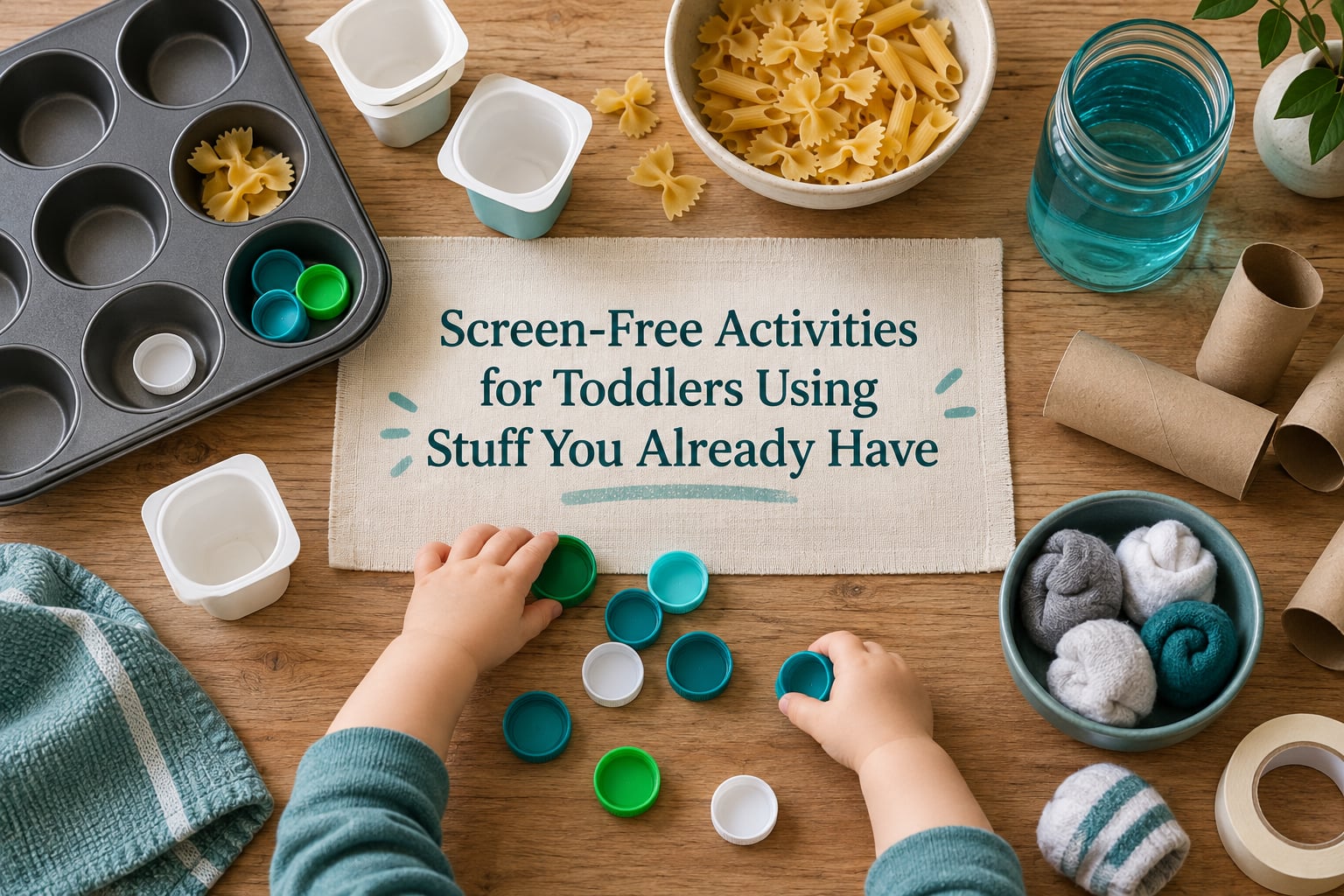
Every afternoon around 4 pm my toddler announces that she is bored, and every afternoon I open the same three apps to make it stop. Writing this list replaced that loop for our house, and for most of the parents I talk to in Edmonton who are stuck in the same spot. These are screen-free activities for toddlers using stuff you already have, which means the cereal box, the yogurt cups, the socks in the laundry basket, and the ice cube tray. No purchases, no subscription printables, no craft kits in a plastic bag.
What follows is a working list built around real household items, with honest prep times, honest mess levels, and the age each idea actually suits. Most of it works while you cook, many of it survives a small apartment, and all of it is free. Updated for 2026, because toddlers do not wait for a better season to get bored.
Table of Contents
- Screen-Free Activities for Toddlers Using Stuff You Already Have: 12 to Start With
- When They Say “I’m Bored”: Why That’s Normal and What to Do
- Quick Indoor Activities With No Prep (5 Minutes or Less)
- Sensory and Water Play With Kitchen Supplies
- Arts and Crafts From Recycling Bin Staples
- Gross Motor Energy-Burners for Small Spaces
- Imaginative and Pretend Play
- Outdoors in Edmonton: Winter and Year-Round
- Activities by Age: What Actually Works at 12-18, 18-24, and 2-3 Years
- Activity at a Glance: Prep Time, Mess, and Best Age
- Activities for Waiting Rooms, Restaurants, and Car Rides
- What to Have on Hand: The Free Pantry and Fridge List
- How to Set Up an Activity Basket for Independent Play
- Free Edmonton Places to Play
- Why Screen-Free Play Matters
- Frequently Asked Questions
- Conclusion
Screen-Free Activities for Toddlers Using Stuff You Already Have: 12 to Start With
These twelve are the ones I hand to friends first. Each one needs nothing you do not own, and each one can be set up while the kettle boils.
- Cereal box marble run cut from a shoebox lid
- Yogurt cup and bottle cap colour matching
- Sock sorting by size and colour
- Pasta threading on dry spaghetti
- Muffin tin sorting station with kitchen staples
- Oil and water lava bottle in a sealed jar
- Cardboard box car racetrack on the floor
- Sponge painting with washable tempera
- Ice cube tray frozen confetti for a winter patio
- Measuring cups, water, and a bathtub or bin
- Tape roads on the floor for a toddler driver
- Stuffed animal picnic with a blanket and the cat’s food bowls
A screen-free activity is any play with no TV, tablet, or phone involved: sensory, art, music, movement, and pretend games built from ordinary items already in your home. Nothing has to be bought, stored, plugged in, or assembled. The measure is simple. If your toddler is doing something with their hands that involves a household object, it counts.
Why does this work at all? Because toddlers learn through hands-on repetition. Filling, sorting, pouring, stacking, and tearing with safe household items gives them exactly the practice they are looking for, and it keeps going long after the novelty of an app wears off.
When They Say “I’m Bored”: Why That’s Normal and What to Do
Boredom is developmentally normal, not a problem to solve. A toddler has a short attention span, limited language for what they want, and no concept of entertaining themselves yet. Saying “I’m bored” is often the only sentence they have for “I have run out of ideas I can name.”
Parents in r/toddlers and r/workingmoms describe the same loop: the announcement, the negotiation, the tablet, and then the guilt. The fix is not a better activity. It is lowering the bar for starting. Offer two choices, both drawn from the list below, and let the choice itself be the involvement. My rule is that the activity has to be visible and available within ten seconds, which is why the activity basket later in this guide exists.
On r/lowscreenparenting, parents who kept their kids screen-free longer report focus and calm as the payoff rather than a meltdown at 4 pm. That tracks with what I see at home. Boredom is uncomfortable for about four minutes, then the child starts building something.
Quick Indoor Activities With No Prep (5 Minutes or Less)
These need no setup beyond grabbing a container, and they run on almost no cleanup. Prep: under 5 minutes. Mess: low.
1. Pasta threading
You need: dry spaghetti, a shoebox lid with holes, and a dry penne or rigatoni.
Break dry spaghetti into fist-length pieces, poke them through the holes, and you have a fine motor task that lasts surprisingly long. My two-year-old does this for twenty minutes without asking for me once. The pieces are large enough to be handled but too big to swallow whole. Prep: 3 minutes. Mess: none, it all goes back in the box.
2. Sock sorting
You need: the clean laundry pile, two laundry baskets, and a timer.
Sort by colour into one basket, size into the other, then put the pairs together. It is a real chore wearing a costume, and it gives a toddler a genuine sense of contribution. Prep: 0 minutes. Mess: none, the laundry was going in a basket anyway.
3. Bottle cap colour matching
You need: a muffin tin, a muffin cup, and bottle caps in a few colours.
Drop ten to fifteen caps into each well and let your toddler sort them by colour into the liners. Fine motor work, colour recognition, and a satisfying clatter. Use caps you have already rinsed, and check for any sharp edges or loose inserts. Prep: 2 minutes. Mess: low, caps scatter.
4. Drawer spice-cabinet raid
You need: a small muffin tin and whatever dry goods you are willing to donate to the cause.
Fill the wells with a dry grain, a pulse, a scoop of rice, and let your toddler line up the scoops. This is the classic sorting station and it works for a full decade of sensory play once set up. Prep: 5 minutes once, then refill as needed. Mess: low if you use a tray underneath.
5. Sticker dot peel and place
You need: old sheet music, a page from a magazine, or a grocery bag, plus round stickers.
Hand over a sheet and a jar of stickers. Peeling and placing is exactly the fine motor skill this age is building, and it is completely silent. Prep: 1 minute. Mess: none.
6. Dance party with a timer
You need: three songs you actually like and a clear floor.
Set a timer for the length of one song, dance it out, then discuss it like a performance. Parents on r/StayAtHomeDaddit call these their sanity-saving activities, and movement is the most reliable reset when the afternoon has gone sideways. Prep: 0 minutes. Mess: none.
7. Shadow puppets with a lamp
You need: a lamp, a plain wall, and your hands or a sock puppet.
Turn off the overhead light and make shapes on the wall. A bunny, a bird, a dog. Narrate the story as it goes. This is the one activity on the list that feels like a small production and costs nothing. Prep: 2 minutes. Mess: none.
8. Taping a road
You need: masking tape and a toy car or a toddler.
Tape lines down the hallway, add a garage square and a stop sign. Your toddler becomes the driver, and the construction alone buys you several minutes. Prep: 5 minutes. Mess: none, tape peels off cleanly.
Sensory and Water Play With Kitchen Supplies
Sensory play is any activity that lets your toddler explore touch, temperature, and weight with their hands. Kitchen items are ideal because they are already within reach and already varied. Prep: under 5 minutes for most. Supervise every water activity without exception, because water plus a toddler plus a staircase is the combination parents regret.
1. Oil and water lava bottle
You need: a clear jar with a tight lid, water, a third of a cup of oil, food colouring, and an effervescent tablet.
Fill two-thirds with water, add the oil and a few drops of colour, cap it, then drop in the tablet and stand back. The colour rises in blobs. My daughter asked for this one every day for a week. Prep: 3 minutes. Mess: none, which makes it the best sensory option in the kitchen.
2. Frozen confetti in the ice cube tray
You need: the ice cube tray, water, and small bits of paper, food, or flower petals.
Freeze it overnight, then set the tray on the tray table or the patio and let the colours melt out. Prep: 5 minutes the night before. Mess: low, everything stays on a tray. In Edmonton this is one of the highest-value activities from November through March.
3. Water table or tub with cups and funnels
You need: a plastic tub, measuring cups, silicone funnels, and a scoop.
Pouring water between containers until the clothes are soaked is the entire point. A muffin tin makes excellent tiny boats. Prep: 2 minutes. Mess: high, and worth it. Towels down, sleeves up.
4. Sink-side sinkers
You need: a bowl of water, a wooden spoon, and small safe items such as wooden blocks or clean plastic lids.
Drop each item in and watch whether it floats or sinks. This is a first science experiment, and a toddler who loves water will stay with it. Prep: 2 minutes. Mess: low, everything happens over the bowl.
5. Dry sensory bin with rice, pasta, or cornmeal
You need: a shallow tub, a base layer of dry rice or pasta, scoops, funnels, and small containers.
Give them cups and a scoop and let them dig, pour, and transfer. Cover the tub with a fitted sheet when you are not using it, and keep it on a tray you can slide outside to shake out. Prep: 5 minutes. Mess: low with the sheet on, high without it.
6. Ice bowl with toys and a spoon
You need: a bowl, ice cubes or a frozen block, small plastic toys, and a spoon.
Freeze some bath toys in a block overnight, then hand your toddler a spoon and a bowl. The rescue mission keeps them occupied for a surprising length of time. Prep: 5 minutes plus freezing. Mess: low, it all melts.
7. Flour, oil, and food colouring dough
You need: flour, water, a little oil, food colouring, and a bowl you do not love.
Mix it into a thick coloured dough and hand over a rolling pin. The colour change is the hook. Prep: 10 minutes. Mess: high, and the dough will dry out, so make small batches.
8. Playdough table with pressed-in textures
You need: the dough from above, plus keys, a fork, a cookie cutter, or a leaf from outside.
Press household objects into the dough and hand your toddler a magnifying glass. Fine motor work and observation in one. Prep: 5 minutes. Mess: medium, keep the dough on a board.
Arts and Crafts From Recycling Bin Staples
The recycling bin is the cheapest toy store in the house, and the items are already free. Prep is usually 5 to 10 minutes because of the cutting, so this section is the one to set up on a good-energy day rather than mid-crisis. Always have a marker and a pair of scissors ready and insist on the child using them with you nearby.
1. Shoebox lid marble run
You need: a shoebox lid, a few bottle caps or cardboard strips, glue, and marbles or wooden beads.
Glue a line of caps down the lid, tape cardboard ramps, and let your toddler release a marble. Repositioning the ramps is the game. Prep: 10 minutes with a glue dry. Mess: low, contained to the lid.
2. Toilet paper roll tube stamping
You need: three or four tubes, washable paint, and scrap paper.
Paint the rim of a tube and stamp circles, rows, and spirals across the page. If you use paper rolls rather than toilet paper rolls, cut a slit lengthwise first so it stamps as a shape instead of a circle. Prep: 5 minutes. Mess: medium, paint transfers to everything.
3. Cereal box marble maze
You need: one cereal box panel, straws cut into short pieces, and tape.
Tape the straws to the cardboard in a zigzag and let your toddler thread a ball or marble down. This is the same idea as the marble run with more control, and it works for a two-year-old. Prep: 10 minutes. Mess: low.
4. Tissue paper sun catchers
You need: a cereal box frame or a window hanger, contact paper or tape, and tissue paper squares.
Stick the tissue paper to the tape or contact paper and tape the whole thing to a window. The result looks like stained glass and gives your toddler something to point at. Prep: 10 minutes. Mess: low, no paint involved.
5. Cardboard box city
You need: a few small boxes, cut openings and windows, and cars or blocks.
Cut doors with a craft knife yourself, then hand over the blocks. A parking garage from a shoebox and a fire station from a shipping box gives a whole afternoon. Prep: 15 minutes. Mess: low, cardboard only.
6. Newspaper painting
You need: newspaper, washable tempera, and a wide brush.
Paint on the newspaper directly. Tear a sheet into confetti pieces afterwards and use them for a collage. Prep: 2 minutes. Mess: medium, ink transfers to hands and floor.
7. Paper plate animals
You need: paper plates, glue, and cut-out scraps from magazines or old envelopes.
Glue scraps on to make a face, then staple the two plates together as a puppet. Prep: 5 minutes. Mess: low, glue only.
8. Cardboard box car racetrack
You need: a large flattened box, painter’s tape, and a toy car.
Tape the box down as a garage floor, or stand it on its side as a wall to drive along. It converts a rainy afternoon into a car wash, a gas station, and a parking lot. Prep: 10 minutes. Mess: low.
Gross Motor Energy-Burners for Small Spaces
Toddlers are physical creatures, and indoor energy has to go somewhere. These burn it off in a hallway or living room, need no equipment, and take turns in about three minutes to set up. All of them work in winter, which is most of the year here.
1. Pillow obstacle course
You need: cushions, a blanket, and two chairs to mark the finish.
Crawl over, climb under, and jump across. Change the route every time it is completed too easily, which takes about forty seconds. Prep: 3 minutes. Mess: none, everything is soft.
2. Painter’s tape floor lines
You need: masking tape and about five minutes.
Make lines, circles, and a hopscotch on the floor. Jump the line, walk the line, walk backwards on the line. The same tape works for the tape road game in the no-prep section. Prep: 5 minutes. Mess: none.
3. Animal walks
You need: a clear stretch of floor.
Bear crawl, crab walk, frog jumps, and worm wriggle. Say each one and let your toddler lead the next. It burns more energy than it sounds like it will. Prep: 0 minutes. Mess: none.
4. Sock-ball basketball
You need: a laundry basket and rolled up socks.
Set the basket against a wall and let them shoot from wherever they like. No rules required, and the miss is part of the fun. Prep: 1 minute. Mess: none.
5. Staircase bowling
You need: empty plastic bottles and a soft ball.
Set the bottles on the bottom step, sit your toddler at the top, and roll. Works for a ball, a rolled sock, or a cereal box. Prep: 3 minutes. Mess: low, plastic bottles only, and hold the rail.
6. Dance with a stop-and-go rule
You need: music and an open room.
Dance until you clap to stop, then freeze. Freeze games teach body control and impulse waiting, which parents find transfers to calmer moments elsewhere. Prep: 0 minutes. Mess: none.
Imaginative and Pretend Play
Pretend play needs almost nothing except a prompt and a willing adult for the first minute. Nanny forums describe the pattern clearly: toddlers need to be told what to do and shown once, then they run with it for a surprising length of time. The adult sets the scene, then leaves the room.
1. Stuffed animal picnic
You need: a blanket, the stuffed animals, and the cat or dog bowls.
Lay out the blanket, hand your toddler the food, and walk away. Animals get served, animals get stories, animals go to bed. Prep: 3 minutes. Mess: low, crumbs if the dog is involved.
2. Cardboard box post office
You need: a shoebox, index cards or scrap paper, and stickers.
Slots in the box become sorting holes, and letters get stamped and delivered. Drawing the letters takes a toddler longer than delivering them, which is a good sign. Prep: 5 minutes. Mess: low.
3. Kitchen shop
You need: a muffin tin, play coins or poker chips, empty food packages, and a grocery bag.
Stock the tin, write prices on scraps, and set your toddler up behind the counter. The counting is real counting. Prep: 10 minutes. Mess: low, everything stays in the bag until the end.
4. Doctor or vet clinic
You need: a toy stethoscope, a cardboard box for the bed, and soft toys as patients.
The cardboard bed is the piece that sells it. Prep: 5 minutes. Mess: none.
5. Airplane with a broom handle
You need: a broom handle and an empty room.
You are the runway, the chair is the terminal, the toddler is the pilot. Prep: 0 minutes. Mess: none. Hold the broom flat and level, not upright.
6. Shadow puppet theatre
You need: the same lamp and wall from the no-prep section, plus a blanket over a chair.
Turn the chair into a booth, put your toddler behind it, and narrate. It takes about a minute to set up and then it belongs to them. Prep: 2 minutes. Mess: none.
Outdoors in Edmonton: Winter and Year-Round
Edmonton families get roughly five months of below-freezing weather, so the honest answer is that outdoor play needs a winter version. Most parents who posted in r/NewParents and local parent groups in winter settled on a two-layer plan: outside daily for twenty minutes, then a wet-weather list indoors for the rest of the day.
Winter: ice painting on the sidewalk
You need: coloured water in squeeze bottles or a cup and a stick, and a patch of snow.
Paint on packed snow where the sun has not reached it, and the drawing lasts days. Prep: 5 minutes. Mess: none, the snow takes it away.
Winter: salt and ice sensory
You need: a tub, ice cubes, a pinch of salt, and a small spoon.
Put the ice in the tub, add salt, and watch the melt rate jump. This is the winter equivalent of the lava bottle and works on a balcony or a deck under supervision. Prep: 5 minutes. Mess: low, keep it outside.
Winter: shovel and salt tray
You need: a tray of snow or ice, coarse salt, a small shovel, and a scoop.
Two materials, endless combinations. It is the same sensory-bin format as the dry bin above with a winter base layer, and it keeps the format consistent. Prep: 5 minutes. Mess: medium, outdoors or in the tub.
Any season: nature colour hunt
You need: a bag and ten minutes.
Find five things in five different colours and bring them home. No reading required, so a two-year-old can do it. Prep: 0 minutes. Mess: low, they bring it back.
Any season: sidewalk chalk circuit
You need: chalk.
Draw a loop around the block with arrows and a start line. A two-year-old can follow arrows. Prep: 5 minutes. Mess: none, rain handles it.
Any season: puddle jumping
You need: rubber boots and a coat.
Spring puddles are the best free entertainment in the city. Prep: 0 minutes. Mess: only on the boots.
Activities by Age: What Actually Works at 12-18, 18-24, and 2-3 Years
Most activity lists on the internet are written for four-year-olds and labelled toddler. The 18-24 month window is genuinely the hardest, because the American Academy of Pediatrics recommends no screen time other than video chat, and very few listed ideas suit that developmental stage. Here is the honest breakdown for the screen-free activities for toddlers on this page.
12-18 months: sensory, sound, and whatever can go in the mouth
Floor play works: blocks into a bowl, a soft toy onto a blanket, a muffin tin with one large item per well. Dancing, clapping, and copying sounds suit this age. Skip anything with small loose parts, skip the dry sensory bin, and skip crafts entirely, because the materials go in the mouth. A r/NewParents thread on floor play describes exactly this setup and it works.
18-24 months: matching, filling, and repetition
This is the window for bottle cap sorting, pasta threading, sock sorting, the lava bottle, and the muffin tin scoops. Your toddler can hold an intent for two to three minutes and wants to do the same thing repeatedly, so repetition is the feature rather than the flaw. Keep the pieces above two and a half centimetres across, and expect to do the same activity forty times.
2-3 years: building, pretend, and a real question
Cardboard box cities, the cereal box marble maze, pretend play, obstacle courses, and the tape road all come online here. Your toddler can hold a pretend storyline, combine two steps, and start asking why the marble stopped. That is where the sorting and sinking games start paying off in real problem-solving.
Safety note: the Canadian Paediatric Society and most paediatric guidance treat an object that fits through a toilet paper roll as a choking risk. Keep caps, beads, dry pasta, and small loose parts out of reach of anything under three, supervise water play continuously, and cut all cardboard edges yourself with a craft knife. The most common accident in this whole list is a paper cut, not a choking one.
Activity at a Glance: Prep Time, Mess, and Best Age
Use this list when you need an idea in under ten seconds, which is usually the situation. Prep time is the honest number, including the cutting, and mess level is from the parent’s point of view rather than the child’s.
- Pasta threading | shoebox lid, dry spaghetti, penne | 3 min | None | 18-24 months
- Sock sorting | laundry pile, two baskets | 0 min | None | 2-3 years
- Bottle cap sorting | muffin tin, liners, caps | 2 min | Low | 18-24 months
- Lava bottle | sealed jar, water, oil, tablet | 3 min | None | 18-24 months
- Frozen confetti | ice tray, paper scraps | 5 min + overnight | Low | 12-36 months
- Water pouring | tub, cups, funnels | 2 min | High | 12-30 months
- Dry sensory bin | tub, rice or pasta, scoops | 5 min | Low | 18-36 months
- Shoebox marble run | lid, caps, ramps, marble | 10 min | Low | 2-3 years
- Tube stamping | tubes, washable paint, paper | 5 min | Medium | 2-3 years
- Cardboard box city | small boxes, blocks, cars | 15 min | Low | 2-3 years
- Pillow obstacle course | cushions, blanket, chairs | 3 min | None | 12-36 months
- Sock-ball basketball | basket, rolled socks | 1 min | None | 12-36 months
- Stuffed animal picnic | blanket, toys, pet bowls | 3 min | Low | 18-30 months
- Ice painting | snow, coloured water, squeeze bottle | 5 min | None | 2-3 years
Activities for Waiting Rooms, Restaurants, and Car Rides
A ten-minute window needs a different kind of activity: quiet, no mess, and nothing that rolls. The hidden advantage of household items is that most of them fit in a single bag and cost nothing to replace.
- Draw on a paper napkin with a pen from the glove box. Prep: 0 minutes.
- Play with bottle caps and a muffin liner, sorting one colour at a time. Prep: 0 minutes.
- Stickers from a grocery bag onto the bag itself, turning it into a sticker book. Prep: 0 minutes.
- Sock matching from a spare pair in the car. Prep: 0 minutes.
- I spy in the waiting room, with the rule that you only look for red things or things with wheels. Prep: 0 minutes.
- Talk about the back seat as a car wash, garage, or spaceship. Prep: 0 minutes.
- Shape matching with the car vent dial or a seatbelt clip. Prep: 0 minutes.
- For a long drive, a shoebox lid marble run stays on the seat and occupies a good twenty minutes. Prep: 10 minutes at home.
Parent groups repeatedly recommend the local library as the first stop, and it doubles as a free waiting room option since most branches have a play area. Several community posts name the library and the park and rec centre as the top answers to the boredom question, which is the right answer more often than a screen is.
What to Have on Hand: The Free Pantry and Fridge List
This is the list of materials behind every activity above. Keeping them in one bin is what makes the ten-second start possible. Prep: 15 minutes, once.
- Empty yogurt cups and single-serve fruit cups
- A muffin tin and spare liners
- Clean bottle caps in a few colours
- A shoebox lid and two or three cereal box panels
- Cardboard tubes, paper towel rolls, toilet paper rolls
- Measuring cups, silicone funnels, and a plastic scoop
- Wooden spoons and a small plastic tub
- Ice cube tray
- Dry pasta, a bag of dried lentils, and a bag of rice
- A sponge and washable tempera paint
- Masking tape and painter’s tape
- Old socks in a laundry basket
- Contact paper or a roll of clear tape
- Scissors, a blunt craft knife, and a glue stick
- A jar with a tight lid for the lava bottle
- Newspaper, and a magnifying glass if you have one
Store it in a lidded bin, not a toy chest, so you can pull the whole thing onto the floor in one move. If the bin lives in a closet instead of a kitchen, the activities will not happen.
How to Set Up an Activity Basket for Independent Play
An activity basket is a one-time 15-minute setup that keeps paying off for months, and it is the single thing that changed independent play at our house. It is a container of loose parts plus a small tray, rotated weekly, that a toddler can go to without asking you.
Step one: pick one container. A laundry basket, a plastic tub, or a cardboard box works. Low walls matter more than size, because the contents need to be visible.
Step two: fill it with loose parts from the free pantry list, plus anything safe your toddler has outgrown. Wooden blocks, plastic lids, cups, measuring spoons, large buttons, empty containers, and rolled up magazines all belong here. The rule is everything must be too big to swallow and free of sharp edges.
Step three: add a tray or a small flat surface inside, so a toddler can build on something solid rather than on the basket floor.
Step four: put the basket somewhere the toddler can reach without you, and say once where it is. Do not re-explain it. On r/workingmoms, parents describe this as the difference between parallel play and independent play, and the single sentence that works is “the basket is there when you want it.”
Step five: rotate the contents once a week. Swap in one new item and take out one that has stopped interesting them. Boredom with the basket is expected. The rotation is what brings attention back.
Step six: expect mess to stay in the basket. Cut a plastic liner, or set the basket on a sheet you can shake out outdoors. A basket that leaves a mess on the floor will not survive the month.
Free Edmonton Places to Play
Home is not the only zero-cost option here, and parents who post in local groups name the library and the rec centre as the two that actually save them. Most of these are free or have free family time blocks.
- Edmonton Public Library branches run free toddler story time, and the children’s floors double as free indoor play space on cold days. Branch schedules change, so check the current listing before you drive over.
- City of Edmonton recreation centres run free family swims and open gym time on a rotating schedule. Registration for drop-in programs is often free with a family pass.
- Neighbourhood playgrounds and play structures in every quadrant, plus the river valley trail network, which is a free sensory environment of bark, gravel, and sticks.
- Outdoor splash pads and water play features that run through late summer, which are worth the trip while they are open.
- Free museum and gallery programming for families, including story time and craft sessions at the Art Gallery of Alberta and the Royal Alberta Museum.
- Public library story time registration, which fills up. If the branch session is full, another branch usually has space.
Check the current schedules and hours directly with each site before you rely on them, because program times and seasonal closures shift through the year.
Why Screen-Free Play Matters
The American Academy of Pediatrics recommends no screen time other than video chat for children under 18 to 24 months, and no more than one hour per day of high-quality co-viewed content for ages 3 to 5. Those two numbers are the reason the 18-24 month section above exists, and they are worth quoting rather than paraphrasing.
Hands-on play builds fine motor skills, hand-eye coordination, language, and early problem-solving, because the child has to plan, attempt, fail, and adjust rather than receive. Sorting bottle caps, threading pasta, and pouring water are small versions of exactly that loop. Parents on r/lowscreenparenting describe the visible result as focus and calm, which is why I think the list above pays off outside the activity itself.
Two rules come up constantly in parent groups and are worth defining, because neither is an official guideline. The 3-3-3 rule is a social media formula for budgeting time across a life, with no paediatric authority behind it. The 7-7-7 rule is a similar idea for parenting time. Both are popular, neither is research-backed, and both turn up constantly in toddler screen-time searches. Use them as personal reminders, not as medical advice.
One last thing, and it is the thing nobody tells you. On r/StayAtHomeDaddit, threads about sanity-saving activities share the same conclusion over and over: boredom is a normal state to pass through, not a problem with a solution. The activity list is not a way to make your toddler never bored. It is a way to make the boredom shorter.
Frequently Asked Questions
How do I keep my toddler busy without screens?
Keep a small bin of loose parts within reach and offer two choices from it rather than one. The most reliable no-screen activities use items you already own: sock sorting, bottle cap sorting in a muffin tin, pasta threading, pouring water between cups, taped roads on the floor, and cardboard box construction. Activities that need no setup start fastest, which matters when the boredom arrives without warning.
How do I deal with a bored toddler?
Boredom is developmentally normal at this age, because a toddler has a short attention span and few words for what they want. Rather than solving the feeling, lower the barrier to starting: name two options and let the child pick. Most toddlers are engaged within four minutes once their hands are busy.
How much screen time should a toddler have?
The American Academy of Pediatrics recommends no screen time other than video chat for children under 18 to 24 months, and under one hour per day of high-quality co-viewed content for ages 3 to 5. For toddlers under two, the recommendation is no screens at all aside from video chat with family.
What is the 3-3-3 rule and the 7-7-7 rule for toddlers?
Neither is an official guideline. The 3-3-3 rule is a time budgeting formula about dividing a week or lifetime into thirds, and the 7-7-7 rule is a similar personal time management idea for parenting. Neither comes from a paediatric body or from research, and both circulate widely in parent groups as gentle reminders rather than as rules.
What can a 2-year-old do on their own?
A 2-year-old can play independently with sorting, filling, matching, pouring, stacking, and simple building for two to three minutes at a stretch, and much longer if the task repeats. An activity basket of large loose parts, such as cups, lids, blocks, measuring spoons, and wooden spoons, gives them something to reach for without asking you. Pretend play at this age usually needs one adult minute to start.
What are fun screen-free activities for toddlers using household items?
Pasta threading through a holed shoebox lid, bottle cap colour sorting in a muffin tin, sock sorting from the laundry pile, a sealed oil and water lava bottle, sponge painting on newspaper, toilet roll stamping, a cereal box marble maze, cardboard box construction, taped floor roads, and water pouring between measuring cups are all made from items most homes already have.
Conclusion
You do not need a single new item to fix the 4 pm boredom, which is the whole point of screen-free activities for toddlers using stuff you already have. The fastest win is a bin of loose parts in the kitchen, the fastest activity is sock sorting, and the most useful habit is keeping the box in reach so starting takes ten seconds rather than ten minutes. Try three this week, keep the ones that work, and let the rest go. Then tell us which ones actually bought you twenty quiet minutes, because that is the only review that matters.