
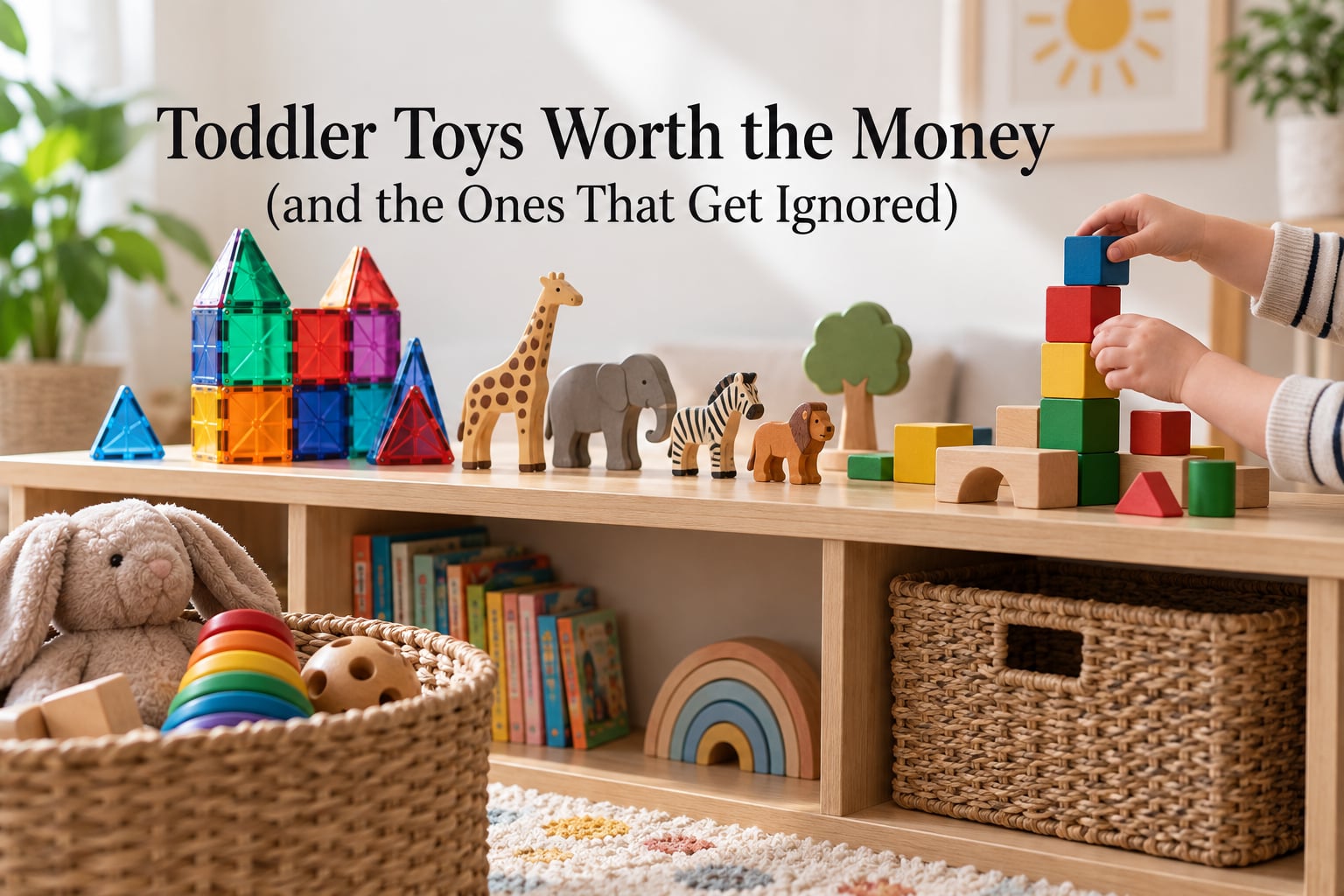
A toddler toy is worth the money when it is open-ended, can be used in more than one way, works without an adult standing over it, survives more than one child, and is still in play six months later. The toys that get ignored are almost always the opposite: closed-ended, single-skill, noisy, over-packaged, or duplicates of something already in the toy box.
That is the whole argument, and it is worth stating plainly because most toy advice skips it and hands you a list of forty names instead. A list tells you what other people’s children liked. A filter tells you whether a toy will survive your child.
We have spent years buying, passing down, rotating and eventually binning toys for children from one year old through four. What follows is the filter we actually use, the categories that have earned their shelf space, and the ones that reliably end up ignored.
Everything here covers roughly 12 months to 3 years, and all sourcing notes are Canadian with Edmonton in mind, because almost every roundup you will find for this query is priced in US dollars and shipped from somewhere else.
Last reviewed and updated for October 2026.
Table of Contents
- Quick Picks: Six Open-Ended Toys We Would Buy Again Tomorrow
- The 5-Question Test for a Toy Worth the Money
- Toddler Toys Worth the Money (Keep These)
- Toys That Get Ignored (and What to Buy Instead)
- Why Toys Get Ignored: Five Reasons and How to Fix Each
- Worth It by Age: What to Buy at Each Stage
- How to Spend Your Toddler Toy Budget Without Regret
- How to Bring an Ignored Toy Back Into Rotation
- Frequently Asked Questions
- What childhood toys are worth money?
- What is the 20 toy rule for kids?
- Why does my toddler ignore new toys?
- What to buy a 2 year old who has everything?
- What are some good open-ended toys for a 1-year-old?
- What are the most versatile open-ended toys?
- Are expensive toddler toys worth it?
- How do I know if a toy is developmentally appropriate?
- The Bottom Line on Spending Less on Toddler Toys
Quick Picks: Six Open-Ended Toys We Would Buy Again Tomorrow
These are the ones that survived every rotation we have tried, across multiple children. Each is a category rather than a brand, because the brand matters far less than the properties the category delivers.
- Wooden blocks and an arch stacker. The single most versatile open-ended toy category there is. They build spatial reasoning, sequencing and hand-eye coordination, and the same set works for stacking, building, knocking down and imaginary play at two and at four.
- Magnetic tiles. A build-and-take-apart format that converts a toddler’s short attention span into your problem rather than theirs. Parents on r/daddit ask specifically for take-apart construction toys, and magnetic tiles are the version that survives being taken apart every single time.
- A shape sorter. Closed-ish by design but invaluable, because the reward loop is immediate and repeatable, and it is one of the few toys that teaches shape, size and hand-eye coordination without a single word of instruction.
- A push ride-on or balance bike. The highest-value purchase across a whole toddler year on a cost-per-play basis. Gross motor skill, independence and it gets used outdoors, which means it does not compete with the indoor shelf.
- Play dough plus real kitchen tools. Not the dough alone. The rolling pin, the cookie cutters and the real mixing bowls are what turn a modelling compound into a pretend kitchen that runs for forty minutes.
- A set of animal figurines. Almost free, endlessly reconfigured, and the backbone of symbolic play. Parents name this in r/Montessori threads as a staple for a one-year-old, and it costs a fraction of any themed play set.
Everything on this list is quiet, washable, and free of batteries. That is not a coincidence, and the reasoning behind it runs through the rest of this article.
The 5-Question Test for a Toy Worth the Money
Before you buy any toddler toy, run it through five questions. If it fails two or more, it will probably be ignored, and you already know why.
- Can it be used in more than one way? A toy with two uses survives a bored afternoon. A toy with one use survives about four days. Ask what your child does with it after the original trick stops being new.
- Does it grow with them? At 12 months it is a thing to grasp and drop. At three it should still be a thing to build with. If the manufacturer lists an upper age of 18 months, you are buying an eighteen-month toy.
- Will it survive more than one child? This is the second-hand test. If it would not survive a toddler, do not plan on passing it on, because you will end up buying the same toy twice.
- Does it work without an adult? Anything requiring instructions, an app or a parent to operate it becomes a toy for the first four minutes and a cupboard item after that. The exception is a toy an adult is genuinely playing alongside, which is a different category.
- Will they still be playing with it in six months? Check what is already out of the cupboard. A brand-new toy competes with the one they already know, and familiarity is a serious advantage for a toddler.
Those five questions take about ninety seconds and they work on a four-dollar impulse item at a dollar store as honestly as they work on a premium subscription box. That is the point. The filter does not care what you spend, only what the toy does.
Open-Ended Versus Closed-Ended: The One Distinction That Matters Most
Open-ended toys have no single correct answer. A stack of blocks, a tub of play dough, a set of animals, a balance board, a set of pots and pans: the child decides what happens, and the same object can mean something different tomorrow.
Closed-ended toys have one built-in ending. Press the button, the light flashes, the sound plays, and then it is finished. That loop is genuinely useful for a very young child working on cause and effect, and it becomes a ceiling later. When you compare open-ended toys against closed-ended ones, you are really comparing a toy that keeps generating play against one that delivers a result.
Toddler Toys Worth the Money (Keep These)
These are the eight categories that have consistently justified what we spent on them, with the developmental work each one does and a rough price tier rather than a dollar figure. Price tiers are budget, mid and premium.
- Wooden blocks. Verdict: the most versatile open-ended toy you can buy a toddler. Builds spatial reasoning, sequencing, early STEM thinking and hand-eye coordination, and the same set works at 18 months and at four years. Budget to mid tier, and check for splinter-free corners and water-based finishes if you have a mouther.
- Magnetic tiles. Verdict: a build-and-take-apart set that converts a short attention span into your tidying problem rather than yours. Excellent for early STEM and spatial reasoning, and the take-apart tolerance matters more than most parents expect. Mid tier, and expect to hand one over a sibling.
- Wooden animal figurines and a small figure set. Verdict: the cheapest route into symbolic play and language development, and the set that gets reconfigured most often. Parents posting in r/Montessori name these as a one-year-old staple. Budget tier, and buy more than you think you need.
- Play dough with real kitchen tools. Verdict: sensory play that doubles as fine motor practice, but only if you add the rolling pin, the cutters and the real bowls. This is the most commonly under-bought item in toddler households. Budget tier for the dough, mid tier for a good tool set.
- A push ride-on or balance bike. Verdict: the best value across an entire toddler year on a cost-per-play basis, because it develops gross motor skills, balance and independence, and it gets used outdoors where nothing else competes with it. Mid tier for a balance bike, premium for a ride-on, and this is the one category where spending more buys a genuinely longer useful life.
- A shape sorter. Verdict: the fastest teachable cause-and-effect lesson in the house, and the toy most often handed down intact. Works from 12 months for about a year. Budget tier, and the classic shape-and-colour cube version outlasts the electronic ones.
- Board books with real photographs. Verdict: realistic board books are the ones parents name as getting re-read rather than abandoned, because the pictures match the real world. Budget tier, and a small basket on the floor beats a shelf.
- Pots, pans, wooden spoons and a set of nesting containers. Verdict: pretend play, sorting, stacking and cause-and-effect for the price of one cheap kitchen purchase, and the single best answer to a rainy Edmonton afternoon. Budget tier, and add a bowl of dry beans or pasta for the pouring games.
A pattern runs through that list. Every entry is quiet, has no small parts, needs no batteries, and can be cleaned with a damp cloth. That is not style preference; it is what makes a toy stay in rotation.
Toys That Get Ignored (and What to Buy Instead)
These are the eight categories we would skip at checkout, each with the specific reason it fails and what to do instead. Naming what not to buy is the most useful thing in this article.
- Battery-powered flashing light-and-sound toys. Why they fail: the result is identical every single time, so there is nothing to discover. They also die, and then they are e-waste. Instead: wooden cause-and-effect toys or a shape sorter, which teach the same concept with a part that cannot break.
- Duplicates of what they already own. Why they fail: three identical push cars mean one is played with and two are ignored, and the third is a gift you cannot return. Instead: ask the caregiver directly, or buy a category rather than an item. Parents posting in r/toddlers about dividing a toddler room from a separate playroom are describing the same pile problem from a different angle.
- Apps, tablets and screen-linked toys. Why they fail: the screen is the toy, and the screen is not a toy. They do not build the fine motor or symbolic play skills the rest of the list builds, and they replace rather than add. Instead: wooden blocks, and treat the tablet as a separate decision.
- Open-ended toy sets marketed to a narrow age. Why they fail: the box says three years plus, your child is eighteen months, and the piece meant for them is the smallest one. Instead: buy the open-ended category one stage below the label, which grows upward instead of being outgrown sideways.
- Talking dolls and plush characters with pre-recorded sound. Why they fail: they are closed-ended and they do the storytelling for the child. Language development needs a child supplying the words, not a toy supplying them. Instead: animal figurines, which invite your child to name them and invent the story.
- Complex construction sets with hundreds of pieces. Why they fail: too many pieces for a toddler’s fine motor control, and the small parts are a choking risk until much later. Instead: magnetic tiles or large wooden blocks, which give the same satisfaction at a scale the hands can manage.
- Clothes, costume sets and dress-up items as the main gift. Why they fail: worn once, photographed once, then ignored. Early childhood educators posting in r/ECEProfessionals ask parents for help identifying toys to avoid, and the pattern that comes back is the single-use category. Instead: costume pieces that combine with existing figurines and pots and pans rather than standing alone.
- Over-packaged novelty sets. Why they fail: the box is doing the marketing and the contents are one plastic part. If opening it produces four components with no instructions and no second purpose, walk away. Instead: single-material, many-purpose sets where the value is in what you can do, not what came in the box.
One more category deserves its own warning: anything with button batteries. The hazard is well documented, and there are documented cases of children opening battery compartments unsupervised. If a toy has a battery compartment it needs a tool to open, and if the batteries are coin cells, the risk is higher still.
Why Toys Get Ignored: Five Reasons and How to Fix Each
Five reasons explain nearly every ignored toy, and each one has a fix you can apply before the purchase rather than after.
1. It is closed-ended and the child has already solved it
A toddler learns the cause and effect of a toy in under a week. If the toy produces the same result every time, there is no reason to return to it. The fix is simple: buy things where the child, not the toy, supplies the variation.
2. It duplicates something they already own
Novelty is not the problem here, supply is. In r/toddlers threads, parents describe a one-year-old whose wheeled toys hold his attention while everything else gets ignored, and the honest conclusion is not that the child only likes cars; it is that the house had ten cars and four other things. The fix is to buy the category that is missing, not the category that is popular.
3. It needs an adult to be fun
Instructional toys, complicated app-linked kits and anything with a thirty-step setup get used once with help and then ignored. The fix is to test whether your child can start playing without you in the room.
4. It is the wrong developmental stage
A toy that is too advanced frustrates, and a toy that is too young bores. Frustration reads as rejection, which is why a sophisticated puzzle for a fourteen-month-old looks identical to a dud. The fix is to aim slightly below the label age, because toddlers climb developmental stages quickly.
5. There is simply too much stuff
This is the reason nobody expects, and it is the one the forums keep circling without a published answer. When a room holds more than about twenty toys, everything competes, and the newest item is not automatically the most appealing. Parents planning a room-versus-playroom split are solving this problem with furniture. The fix is to take things away, not add to them.
Worth It by Age: What to Buy at Each Stage
Open-ended toys are not age-neutral; the same block set is a different toy at each stage, and your spending should follow the stage. Here is the cheat sheet.
| Age stage | What to buy | Skill it builds | Share of budget |
|---|---|---|---|
| 12-18 months | Shape sorter, nesting cups, chunky blocks, board books, ball drop toys, large push toys | Pincer grasp, object permanence, hand-eye coordination, cause and effect | About a quarter |
| 18-24 months | Push ride-on, simple puzzles, stacking blocks, play dough, animal figurines | Gross motor skills, fine motor control, early problem-solving | About a third |
| 2-3 years | Magnetic tiles, wooden blocks, pretend kitchen, dress-up pieces, books they can finish themselves | Spatial reasoning, symbolic play, language development, self-regulation | About a quarter |
| 3-4 years | Balance bike, larger construction sets, board games, art supplies, more complex puzzles | Early STEM, sequencing, executive function, collaborative play | About a sixth |
For a one-year-old specifically, keep it heavy, chunky and obvious. A single large push toy, a shape sorter and a stack of board books will get more use in three months than a shelf of small plastic anything.
For a two-year-old who appears to have everything, change what you buy rather than how much. Experiences, consumables, art supplies, a bike seat, a membership, or a set of pots and pans for the kitchen all deliver something no existing toy can.
How to Spend Your Toddler Toy Budget Without Regret
Spending less on toddler toys is not about finding cheaper versions. It is about buying fewer things and keeping each one in rotation long enough to earn its cost.
What is the 20 toy rule?
The 20 toy rule is a guideline that a toddler should have roughly 20 toys available at any one time, kept in a rotating set rather than all on the floor at once. It works like this:
- Keep about 20 toys visible and put the rest away in a bin, a closet shelf or the car.
- Swap a few toys out every one to two weeks, returning ones that have faded rather than all of them at once.
- Put back only the toys you have not seen used in a while, not the ones that got ignored in the last three days.
- Donate or pass on anything that has not been touched in a full rotation before buying a replacement.
That last step is the money-saving part. Most toy budgets are not spent on bad toys; they are spent on duplicates bought to replace something that was sitting in a bin.
Measure toys by cost per hour of play
The simplest way to judge a purchase after the fact is cost per hour of play. Take what you paid, divide it by the rough number of hours the toy got used over a year, and compare that figure across your whole toy shelf.
A premium balance bike used daily outdoors produces a very low per-hour figure. A premium electronic toy used for four days in the first month produces an enormous one. Neither is a rule about how much to spend; it is a rule about noticing. Doing this once, on your current shelf, usually ends the buying pattern that caused the clutter.
Buy fewer, rotate more
The most common mistake is not overspending on quality, it is buying quantity. A single new open-ended toy added to a full room changes less than removing five toys the child has not touched in a month. Rotation also solves the ignored-toy problem before it starts, because a toy that has been away for three weeks comes back as a novelty.
Secondhand, hand-me-downs and toy libraries
Secondhand is the frugal answer to buying quality, and for most toddler toys it works well. Wooden blocks, board books, pots and pans, balance bikes, shape sorters and pretend kitchen sets all hold up well if you check them first.
Some things should never be bought used. Anything with a battery compartment you cannot fully inspect, anything with a cracked or stressed plastic shell, any outdoor swing or climbing frame with visible rust at the hardware, and anything that was recalled. A bike seat or car seat should be bought new, full stop.
A toy lending library is the cheapest way to test whether an expensive category is worth it before you commit. Borrow the balance bike for a month. If your child rides it daily, buy one used. If they ignore it, you have learned something for the price of a membership.
Safety checks before you buy
Three things to check on any new toy: the recommended age, whether small parts exist anywhere in the set, and whether it contains button or coin batteries. For Canadian recalls, check Health Canada’s product recalls database and the toy safety notices published by the industry before buying anything used or in a discount bin.
Where Edmonton parents actually buy
For durable wooden and plastic toys, dollar stores and Winners are where the open-ended categories actually live, because the classic shape sorter and the basic block set are not premium products. Consignment shops are strong for ride-ons and balance bikes, which outgrow children rather than break. Buy the outdoor and gross motor gear new or from a cycle shop, and buy the open-ended indoor categories used, because those are built to be knocked about.
How to Bring an Ignored Toy Back Into Rotation
If a toy has been ignored, do not throw it out and do not force it. There is a four-step reset that works far more often than a new purchase.
- Remove it completely for at least three weeks. A toy in the toy box is a toy they have already finished. Out of sight is what makes returning possible.
- Change the context, not the toy. Put the blocks somewhere new, bring the pots and pans to the sandbox, or leave the figurines on the tray at the table. Same object, new setting, new reason to use it.
- Reintroduce it alongside something they currently love. A new toy placed alone gets a polite look. A neglected toy placed next to the current favourite gets considered, and imitation is how toddlers learn new play.
- Watch what they do and match the next purchase to it. If they return to the figurine set and immediately start parking the cars in a garage, the next thing to buy is another category like that, not another figurine.
Parents on r/toddlers ask constantly how to swap out toys their child has lost interest in without buying new ones. This reset is the whole answer, and it costs nothing beyond a bin and three weeks of patience.
Frequently Asked Questions
What childhood toys are worth money?
Toys worth money are open-ended, multi-use, and grow with the child: wooden blocks, magnetic tiles, animal figurines, play dough with real tools, a shape sorter, a balance bike, pretend kitchen items and realistic board books. They work without an adult, survive more than one child, and are still in play after six months. A toy that fails two of those tests is usually the one that gets ignored.
What is the 20 toy rule for kids?
The 20 toy rule is a guideline that a toddler should have about 20 toys available at once, kept in a rotating set rather than all out at the same time. Put the rest in a bin, swap a few every one to two weeks, and return toys that have faded rather than recently ignored ones. It works because a toddler who already owns everything is choosing, not playing.
Why does my toddler ignore new toys?
Five reasons cover almost every case: the toy is closed-ended so the child has already solved it, it duplicates something already owned, it needs an adult to be fun, it is the wrong developmental stage, or there is simply too much stuff competing for attention. The last one is the most common and the least obvious. Remove toys for a few weeks and the interest often returns on its own.
What to buy a 2 year old who has everything?
Change the type of thing rather than the amount. Buy an experience, a consumable such as art supplies or dough, ride-on or outdoor gear, a membership, or pretend kitchen items like pots and pans. None of these duplicate an existing toy, and all of them add a new kind of play to a child who has already filled the shelf with objects.
What are some good open-ended toys for a 1-year-old?
For a one-year-old, keep it chunky, heavy and obvious: a shape sorter, nesting cups, a large push toy or ball-drop toy, a stack of realistic board books, and a few large wooden blocks with no small parts. These build pincer grasp, object permanence and hand-eye coordination, and each one can be used in several ways as your child grows.
What are the most versatile open-ended toys?
Wooden blocks, magnetic tiles, play dough with real kitchen tools, and a set of animal figurines are the most versatile, because the child decides what happens and can change the scenario tomorrow. Versatility is the one-line version of the five-question test: a toy with two uses survives a bored afternoon, and a toy with one use survives about four days.
Are expensive toddler toys worth it?
Only when the extra spend buys durability or a longer useful life, as with a balance bike compared with a push toy. On anything open-ended, the premium tier is usually paying for packaging and branding rather than play value. Judge any purchase by cost per hour of play: divide what you paid by the hours it actually got used over a year.
How do I know if a toy is developmentally appropriate?
Check three things: the recommended age on the box, whether any part is small enough to be a choking risk for your child’s stage, and whether the toy can be started without instructions or an adult. Aim slightly below the labelled age, because toddlers move up a stage quickly and a toy that is too advanced frustrates in a way that looks exactly like being ignored.
The Bottom Line on Spending Less on Toddler Toys
The toddler toys worth the money are the open-ended ones, and they are identifiable in under a minute: more than one use, grows with the child, survives another sibling, works without you, and is still in play in six months. Run the five questions before checkout and take the toys out of rotation for a few weeks after, and most of the ignored-toy frustration disappears on its own.
Then buy less of it, secondhand where you can, and keep one bin in the closet. That single habit will save you more each year than any single toy ever returned.