
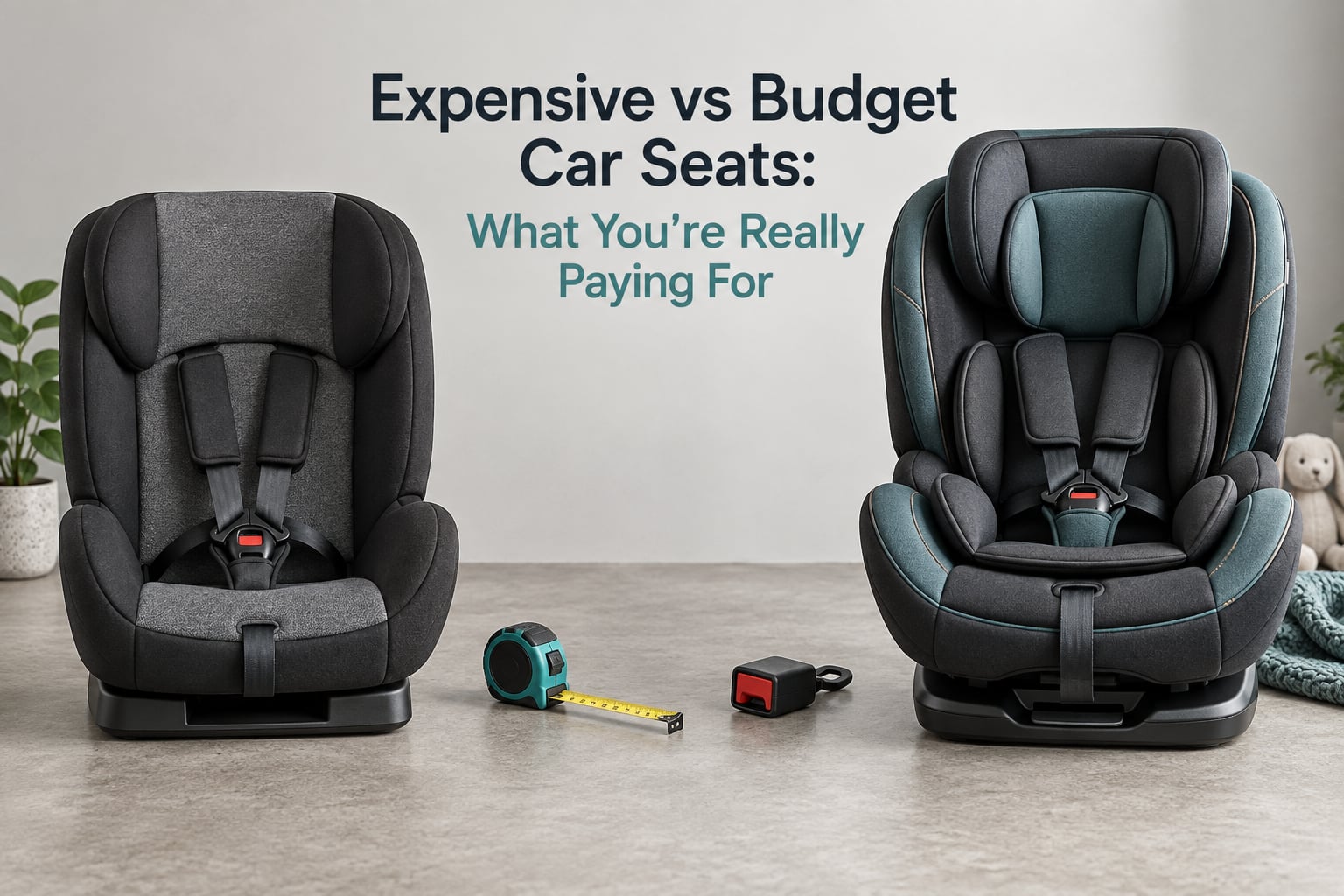
Every parent eventually asks the same question out loud, usually in a parking lot or a cramped nursery at 2 a.m.: if every car seat on the shelf passes the same federal crash test, what exactly am I paying for when the price tag jumps? I have asked it too, and the honest answer has three parts. Most of the difference between an expensive seat and a budget seat is engineering convenience, materials, and how long the seat stays useful. A smaller share is real crash performance margin. And a meaningful part of what feels like a safety upgrade is marketing language that describes comfort as though it were protection.
This guide breaks down expensive vs budget car seats feature by feature, tier by tier, without naming a single brand to push you toward a more expensive option. I want you to be able to walk into a store, hold two seats, and know which of the differences between them actually change your real-world outcome. The research here pulls from NHTSA, the American Academy of Pediatrics, Transport Canada, Health Canada, Safe Kids Canada, and CPST technicians, plus the parent forum conversations that show where the confusion keeps coming from.
One thing to say up front. Price is not a proxy for care, and a family on a tight budget is not choosing between good parenting and bad parenting. A correctly used budget seat protects a child. That is the whole argument of this article, and I will spend the next few thousand words making it concrete.
Table of Contents
- Are Expensive Car Seats Safer Than Budget Car Seats?
- The Bottom Line
- What Every Car Seat Must Pass Before It Reaches the Store
- What the Extra Money Actually Buys: A Price Tier Breakdown
- What Price Does Not Buy
- What Price Does Buy
- How to Read the NHTSA Ease-of-Use Ratings Correctly
- Installation Correctness Is the Stat That Reframes the Whole Argument
- The Three-Fit Framework for Buying Any Price of Seat
- New vs Used Car Seats: Where the Savings Are Real
- Total Cost of Ownership Across the Three Stages
- Canadian and Alberta Programs That Change the Real Cost
- When to Spend More and When to Spend Less
- What to Do If You Already Bought a Seat You Regret
- Frequently Asked Questions
- Are cheap car seats as safe as expensive ones?
- Is an expensive car seat worth it?
- What is the safest budget car seat?
- Do NHTSA stars mean a car seat is safer?
- Is one type of car seat safer than another?
- How much should I spend on a car seat?
- How do I know my car seat is installed correctly?
- Is it safe to buy a used car seat?
- Conclusion: What You’re Really Paying For
Are Expensive Car Seats Safer Than Budget Car Seats?
No. Every child restraint sold in the United States must meet the same federal crash standard, FMVSS 213, and Canada applies equivalent requirements through Transport Canada, so the cheapest legal seat and the most expensive legal seat clear the identical safety floor. The extra money buys features that make a seat easier to install correctly, more comfortable to sit in, and less likely to be outgrown early. Crash protection is standardised; correct use is not. That gap, not the price tag, is where your money and your attention belong.
The Bottom Line
- Price does not buy a higher safety floor. A budget seat and a premium seat both have to pass the same crash testing before either one reaches a store shelf.
- Price does buy ease of use. Better instructions, clearer labels, rigid LATCH hardware, and wider recline adjustment are the features most likely to stop a real installation mistake.
- Price does buy service life. A seat with a long rear-facing limit and a long forward-facing harness limit can span two or three stages, which changes the true cost across a child’s whole rear-seat career.
- Price buys comfort and materials. Softer fabric, deeper head support, and nicer finishes are real, and parents on parenting forums notice them immediately. They are not crash protection.
- Nearly half of car seats are installed incorrectly. That single statistic matters more than every feature difference on this page combined.
If you read nothing else, read that last line. A seat that is perfectly built and badly installed is the commonest failure mode in child passenger safety, and it is the one an upgrade can genuinely help with.
What Every Car Seat Must Pass Before It Reaches the Store
FMVSS 213 is the federal motor vehicle safety standard that governs child restraints in the United States. It is a pass or fail test, not a ranking. A seat either clears the standard or it does not, and it cannot legally be sold if it does not. There is no version of the standard that only premium manufacturers must meet.
The standard covers the seat’s structure, how it absorbs crash energy, how the harness restrains a child, and how the labels describe all of that. Canada works through Transport Canada, with the Canada car seat information book and Health Canada guidance layered on top for how children should actually be transported. Provincial public health teams in Alberta, and public health in every other province, train and support the technicians who do the hands-on work.
Here is the part that confuses people. Once a seat clears the standard, the manufacturer is free to make it nicer, tougher, longer-lived, or simpler to operate. None of that is regulated. That gap between the regulated floor and the unregulated ceiling is exactly where your extra money goes, and it is why two seats sitting next to each other in the same store can look wildly different in price while sitting at the same level of required protection.
There is a second ratings system that causes even more confusion, which we will get to shortly. NHTSA publishes star ratings for child restraints, and those stars measure ease of use. They are not a safety rating, and NHTSA says so plainly. Marketing departments do not always say so plainly.
What the Extra Money Actually Buys: A Price Tier Breakdown
Here is the breakdown nobody in this search space gives you with numbers attached. The tiers below describe what changes as you climb, and roughly how much of your total spend each tier represents. The dollar gap between the cheapest and the most expensive seat in a category is often a factor of four to six, which is a real budget decision, so it deserves a real answer.
| Tier | Share of a premium seat’s price | What the tier adds | What the tier does not add |
|---|---|---|---|
| Budget | Smallest share | Meets the full federal standard, basic harness, manual belt install, shorter rear-facing range, often a printed rather than moulded recline guide | No measurable crash advantage over the tier above |
| Mid-range | Middle | Better instructions and labels, no-rethread harness, more recline positions, stroller compatibility, sometimes a load leg | No measurable crash advantage over the tier above |
| Premium | Full price | Rigid LATCH, long rear-facing and forward-facing limits, flame-retardant-free fabrics, refined materials, extended service life, high side-wing geometry | Still no measured safety tier above mid-range |
Read that table a second time and one line stands out. Every row in the third column describes something about the seat. Every row in the fourth column says the same thing. That is the honest summary of expensive vs budget car seats, and it holds across every category we looked at.
Now let me assign rough proportions to where the money goes, based on what separates tiers in practice. Expect roughly a third of the gap to be materials and construction, a third to be safety-adjacent engineering such as energy-absorbing foam in the head area and side-impact geometry, and a third to be brand, packaging, warranty, and retail margin. The crash-test pass or fail outcome is identical across all three. None of that is a trick; it is just how pricing works when the regulatory floor is fixed and everything above it is open.
What Price Does Not Buy
Let me be blunt about the things a higher price tag will not get you, because these are the claims that generate the most guilt among budget-conscious parents.
A higher legal safety standard. There is no such thing. The bar is FMVSS 213, and it is the same bar at every price point.
A guarantee against injury in a serious crash. No seat sold at any price can promise that. Crash survivability depends on the collision, the seating position, the restraint fit, and factors nobody controls.
Better crash performance as a rated category. NHTSA does not publish a safety ranking of child restraints, and no accredited body sells one to consumers. If a page implies otherwise, read it closely.
Exemption from installation mistakes. A premium seat can be installed just as badly as a budget seat. Better design lowers the odds of an error; it does not cancel the possibility of one.
Immunity from recalls and expiry dates. Every seat has a manufacture date and a service life. Premium seats expire on the same kind of schedule.
Parents on WhatToExpect forums describe the cheapest seats as feeling rougher with minimal head support, and the pricier ones as noticeably softer. That perception is accurate and worth weighing for a long drive. It is a comfort difference, not a protection difference, and I would rather you know that going in than discover it later as a disappointment.
What Price Does Buy
So if the safety floor is identical, what is a premium seat actually for? Five things, in rough order of how often they change outcomes for a real family.
Ease of installation. This is the big one. Premium seats typically ship with clearer moulded labels, better-illustrated manuals, colour-coded belt paths, and hardware that does the fiddly parts for you. Every one of those features attacks the single biggest real-world risk, which is a seat that is not correctly fitted.
Rigid LATCH hardware. Rigid lower anchors do not have to be re-buckled and re-tightened to the same tension every time. On a seat that gets moved between two vehicles or used by a tired grandparent at 6 p.m., that difference is not marginal.
Longer rear-facing and forward-facing limits. Extending rear-facing to a higher weight and harness to a higher height means one seat can cover more stages. This is where price turns into genuine value, and we will quantify it further down.
A load leg. A load leg transfers crash forces into the vehicle floor. Independent testing has associated load legs with meaningfully reduced head excursion in rear-facing installations. This is a case where a premium feature has a defensible physical basis, and it is a feature you cannot add to a budget seat later.
Materials and side-impact geometry. Deeper side wings, energy-absorbing foam in the head area, and fabrics made without added flame retardants are real differences in how a seat feels and how it is built. They are not measured by any published safety rating, so treat them as quality-of-life and build-quality items rather than protection items.
How to Read the NHTSA Ease-of-Use Ratings Correctly
NHTSA rates child restraints on ease of use using stars, and parents routinely misread those stars as safety scores. They are not. Here is the complete list of what the rating actually covers, and nothing else is in it.
- Evaluation of Labels. Whether the labels on the seat clearly and correctly describe the parts and the setup.
- Evaluation of Instructions. Whether the manual is understandable, sequenced well, and readable by a tired parent.
- Securing the Child. Whether the harness and head support are easy to adjust correctly for a range of children.
- Vehicle Installation Features. Whether the seat is easy to install, and whether it fits a normal range of vehicles.
Four categories, all of them about the human being using the seat. None of them measure crash performance, because crash performance is already equalised by the federal standard.
Two practical notes. First, a seat is rated separately for each mode of use, so a convertible can earn different ratings for rear-facing and forward-facing. Match the category to the stage you are actually in. Second, technicians in the r/CPST community point out that third-party buying guides carry their own visibility limits, which is one more reason to have a human check the seat rather than a rating decide for you.
Installation Correctness Is the Stat That Reframes the Whole Argument
NHTSA reports that a large share of car seats are used or installed incorrectly. This is the number that matters, and it is the reason the ease-of-use question is not a comfort question.
By contrast, the payoff from correct use is large. The American Academy of Pediatrics has reported that a correctly used child restraint reduces the risk of fatal injury by about 71% for infants and about 54% for toddlers. Those figures are for proper use, which means fitted to the child, installed to the vehicle, and buckled in consistently on every trip.
Think about what that means for the price question. A premium seat that is meaningfully easier to install raises the chance you install it correctly the first time. That is a real mechanism by which spending more can change a real outcome, even though the two seats are equally strong in a lab.
Three errors account for most of the problem. The belt path is not tight enough, so more than an inch of movement shows at the belt path. The harness is too loose, so a pinch test at the collarbone shows slack. Or the seat is simply not buckled, which sounds absurd and happens constantly when caregivers rotate between two vehicles or two adults with different habits.
The one-inch rule and the pinch test take about twenty seconds. They are worth more to your child than any feature on any price tier.
The Three-Fit Framework for Buying Any Price of Seat
A CPST-authored framework that circulates widely puts the decision into three checks, and it works at any budget. Use it in this order.
Does it fit the child? Check the rear-facing weight and height limits, then the harness limits, then whether the child is still within the seat’s stated stage range when you expect to use it. Buy for the stage you are in, not the one you are hoping to skip.
Does it fit the vehicle? Not every seat fits every back seat. Measure the middle seat if that is where your child will ride, and be honest about the width available, especially if you need three across or a seat beside a second child.
Can it be used correctly every time? This is the third fit and the one most shopping conversations skip. Who installs this seat? How often? In how many vehicles? If a tired grandparent will do it at the end of a long day, choose the seat that is easiest to get right, not the one with the longest feature list.
If a seat fails any of the three, a higher price will not rescue it. A seat that passes all three at a budget price is an excellent purchase.
New vs Used Car Seats: Where the Savings Are Real
Hand-me-down seats are a reasonable option under narrow conditions, and the conditions are not negotiable. The seat must have no crash history, no expiry, no recall, and a complete set of parts with the original manual.
Where savings are real: a family with two children spaced far enough apart who passes a seat down within its service life, or a seat coming from a relative with a known, clean history and all original components. Alberta public health and Safe Kids Canada both treat known-history hand-me-downs as acceptable under those conditions.
Where savings are not real: a seat from an anonymous sale, a seat missing a recline foot or base clip, or anything involved in a collision. Insurance replacement programs and some provincial and community programs can supply a seat after a crash at no cost, so a crashed seat is rarely a budget problem worth solving. The honest financial answer is to ask whether the car or the seat is being covered before you buy anything.
Total Cost of Ownership Across the Three Stages
Here is where the price question gets interesting, because the cheapest seat at stage one is rarely the cheapest plan. A budget infant seat may be outgrown in under two years, which forces a second purchase. A longer-range seat can span infant, toddler, and part of the booster stage, which collapses two or three buys into one.
| Path | Stage one | Stage two | Stage three | Total purchases | How the cost spreads |
|---|---|---|---|---|---|
| Budget path | Short-range infant seat, low outlay | Convertible seat bought early | Booster bought later | Three | Cheapest at the start, most expensive overall |
| Long-life path | Convertible with a high rear-facing limit | Same seat, harness stage | Booster, sometimes a backless booster | Two, sometimes one more | Higher at the start, usually lower by the end |
The lesson is not that everyone should buy the most expensive convertible seat available. It is that the correct comparison is cost per year of useful stage coverage, not purchase price. A seat that covers more stages spreads its cost over more time and removes a purchase decision you would otherwise have to make under time pressure.
For many families the middle path works best: a solid mid-range convertible with a good rear-facing limit, plus a booster later when the child outgrows the harness. You capture most of the service-life benefit without paying the full premium tier price. That is the sweet spot for a lot of Edmonton households, and it is the answer I give when friends ask me directly.
Canadian and Alberta Programs That Change the Real Cost
Most of the search results for this question are American, which means they lean on FMVSS 213 and NHTSA ratings and rarely mention what is available to a family in this province. A few Canadian specifics are worth knowing before you spend anything.
Transport Canada sets the regulatory requirements and publishes the Canada car seat information book, which is the reference Canadian parents should be using rather than a translated version of a US guide. Health Canada publishes guidance on child passenger safety that sits alongside it.
In Alberta, public health units and community injury prevention programs run certified CPST events and inspection stations, frequently at no charge, and they are the fastest route to a verified install. If a hospital, community clinic, or family resource centre near you offers a seat program, the price question can shrink dramatically before you ever shop. Ask what your local public health unit offers before you buy.
For a full Canadian breakdown of stages, limits, and provincial resources, ask your local public health unit for the Canada car seat information book and their current CPST event schedule. Both are free and both are more useful than any buying guide, including this one.
When to Spend More and When to Spend Less
Spend more when any of these are true, because each one converts money into a concrete benefit rather than a marketing line.
- You intend to keep the child rear-facing to the seat’s maximum weight or height, and the budget seat tops out well before that.
- The seat moves between two vehicles, or between you and another caregiver who installs it regularly.
- Your back seat is tight and you need three across, so width and a low-profile install matter.
- You want a load leg and cannot add one later.
- You want one seat to cover rear-facing, harness, and booster, which removes a future purchase decision.
- You know the manual is your weak point and the budget seat’s instructions are thin.
Spend less, and do not feel guilty, when none of those apply.
- You have one vehicle, one caregiver, and a straightforward install.
- You are buying a stage-one seat for a child who will outgrow it quickly anyway.
- You can get the install checked for free by a technician, which removes the main argument for premium hardware.
- Your real constraint is buying the next stage, and preserving budget for it matters more.
And there is a stopping rule, which most guides never give you. If the seat fits the child, fits the vehicle, and gets used correctly by the people who will actually install it, you have bought enough. Extra money beyond that is spending, not protecting.
What to Do If You Already Bought a Seat You Regret
Plenty of parents read this after checkout. Here is what actually matters. First, check the manufacture date and the service life, and check for recalls. If the seat is within its life and has no history, you are fine on those grounds regardless of price.
Second, if the frustration is about difficulty of use, fix that rather than replacing the seat. A free CPST inspection can solve a tight install, an unclear belt path, or a recline problem in ten minutes. This is the fastest fix available and it costs nothing.
Third, if your child will outgrow the seat within months, do not replace it. Buy the next stage seat instead and pass the current one along. That is the cheapest path through a stage transition and it is exactly what a long-life seat would have saved you, so you are not as far behind as the sticker shock suggests.
Frequently Asked Questions
Are cheap car seats as safe as expensive ones?
Yes. Any car seat sold legally in North America has to meet the same federal crash standard, FMVSS 213 in the United States, with equivalent Transport Canada requirements in Canada. There is no separate, higher safety standard for premium seats, so a budget seat and a premium seat clear an identical safety floor.
Is an expensive car seat worth it?
Sometimes, and for specific reasons rather than general ones. A higher price is worth it when the seat is easier to install correctly, has a longer rear-facing and harness range so it covers more stages, includes rigid LATCH or a load leg, or will be moved between vehicles and caregivers. It is not worth it as a general safety upgrade, because the crash standard is identical.
What is the safest budget car seat?
There is no published ranking, so the safest budget seat is the one that fits your child within the stated limits, fits your vehicle, and gets installed correctly every time. Look for a mid-range or well-reviewed budget model with a no-rethread harness, clear instructions, and a rear-facing range that matches how long you plan to keep your child rear-facing.
Do NHTSA stars mean a car seat is safer?
No. NHTSA star ratings measure ease of use, not safety. The four categories rated are evaluation of labels, evaluation of instructions, securing the child, and vehicle installation features. Crash performance is already equalised across all legal seats by FMVSS 213, which is why NHTSA publishes no safety ranking of child restraints.
Is one type of car seat safer than another?
No. Infant, convertible, all-in-one, and booster seats are all subject to the same federal standard, so none is safer than another in the abstract. They are suited to different stages, and the correct question is which seat matches your child’s current size, development, and stage rather than which type has the best numbers.
How much should I spend on a car seat?
Enough to cover the stage you are in and the length of that stage. A solid mid-range convertible with a good rear-facing limit and a no-rethread harness covers most families for two or three stages and usually costs less over time than three cheaper sequential purchases. Above that, spend only for rigid LATCH, a load leg, a tighter fit in your back seat, or exceptional instructions.
How do I know my car seat is installed correctly?
Check four things. Push at the belt path and confirm there is no more than one inch of movement. Do a pinch test at the collarbone to confirm the harness is snug with no slack. Make sure the seat is at the correct recline angle for your child. And have a Child Passenger Safety Technician verify it in person, which is free or low cost through many public health programs.
Is it safe to buy a used car seat?
It can be, under strict conditions: no crash history, not expired, no recalls, complete with all original parts and the manual, and a history you can actually verify. Seats from garage sales and anonymous resale are not worth the risk. If a seat was in a crash, check whether insurance or a community program will replace it before you spend anything.
Conclusion: What You’re Really Paying For
Expensive vs budget car seats come down to one clean idea. Every legal seat clears the same crash standard, so the price gap buys ease of use, materials, and service life, not a higher level of protection. Spend more where a feature changes how correctly the seat will be used or how many stages it will cover, and spend less where it does not.
Then do the thing that matters more than any purchase decision in 2026: book a free Child Passenger Safety Technician inspection through your local Alberta public health unit, and have them check the seat in your actual car. It takes about twenty minutes, and it is the single highest-value thing you can do for your child’s safety.