
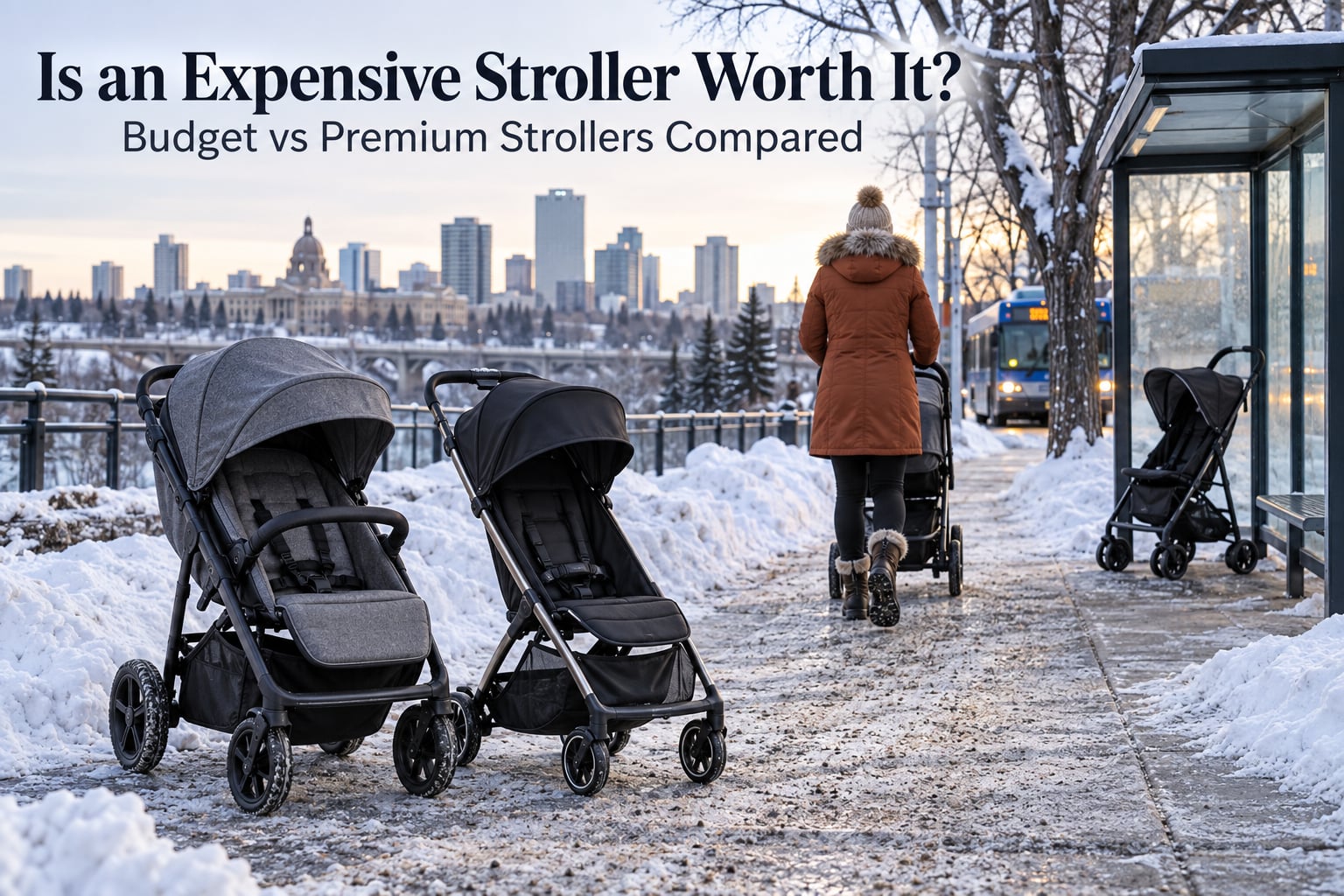
No, not for most families. A higher price tag does not automatically mean safer, easier to use, or more functional. Across a few hundred pushes of budget, mid-range and premium frames over the last few years, the honest finding is simple: the middle tier handles almost every real life, and the top tier only pays off when your day genuinely demands a lighter frame, a genuine one-hand fold, and a warranty long enough to matter.
This guide is a cost teardown rather than a roundup. We break down what the extra money actually buys in engineering terms, what it only buys in brand image, and how to work out your own break-even point. We also cover the Edmonton-specific math of snow, ice, gravel, transit and stairs, because a stroller that glides on a showroom floor can be useless on a cleared-but-gritty sidewalk in February.
No dollar figures appear anywhere in this article. Instead, everything is expressed in multiples of the entry price, where the entry tier is 1x, the mid-range tier is roughly 2x, and the premium tier runs 3x to 4x. This makes the reasoning hold regardless of what any of these brands charge this year, and it forces the question that actually matters: is the gap between tiers buying you something you will physically use?
We have pushed budget, mid-range and premium frames side by side on the same routes for years now, loaded them with roughly the weight of a toddler, and watched which ones ended up permanently in the garage. That garage test matters more than any spec sheet, because a stroller you leave behind has failed no matter what it cost.
Here is the short version of where each tier wins:
- Entry tier (1x):fine for flat neighbourhoods, short walks, paved paths, and a stroller that lives in the trunk of a car.
- Mid-range tier (about 2x):the sweet spot for the majority of families. Better wheels, a real suspension system, a fold you can do one-handed, and fabric that survives a full toddler life.
- Premium tier (3x to 4x):worth it when you carry a stroller up stairs, ride transit, fly often, push over broken pavement and snow, or plan to hand the frame down to a second child and then resell it.
We will break each of those down, but first, the definitions, because the word “premium” gets thrown around without any agreed meaning.
Table of Contents
- What makes a stroller budget, mid-range, or premium
- What the extra money actually buys in engineering
- What premium money does not buy
- Safety is not a luxury feature
- Where the retail dollar actually goes
- Budget vs premium strollers compared
- Winter, sidewalks and transit: the local modifier
- Seven questions that decide your tier
- Cost per year, and when the premium breaks even
- What premium buyers regret
- Resale value, hand-me-downs and buying secondhand
- When a budget stroller is genuinely the right call
- How to pick your tier in four steps
- Frequently Asked Questions
- Is it worth getting an expensive stroller?
- Are expensive strollers worth it?
- How much should you spend on a stroller?
- What is a good affordable stroller?
- What is the Rolls-Royce of strollers?
- Which stroller is considered the most luxurious?
- Why is everyone obsessed with Uppababy?
- What stroller did Kim Kardashian buy?
- Do expensive strollers last longer than cheap ones?
- Is a mid-range stroller good enough?
- The bottom line
What makes a stroller budget, mid-range, or premium
There is no regulatory line between these tiers. Nothing in the safety standard changes at a particular price, and no inspector shows up to check whether you spent enough. The tiers are a market convention built out of materials, components and warranty length, which is exactly why they drift upward every few years.
The most honest way to talk about them is in multiples of each other rather than in price, because the absolute numbers move but the ratios stay surprisingly stable.
Entry tier: 1x
This is the lightweight folding stroller that lives at the back of a closet. The frame is usually steel or a thin aluminium tube, the wheels are small moulded plastic or basic foam-rimmed rubber, and the fabric is a tightly woven polyester that wipes clean and eventually pilling-stains in a way you stop noticing.
What you reliably get: a fold that works, a five-point harness, a storage basket of some kind, a recline, and compliance with the same safety standard as everything else on this page. What you give up: suspension sophistication, wheel durability, frame longevity, a warranty that lasts, and resale value.
Mid-range tier: roughly 2x
This is the tier almost nobody names out loud, which is why it is the real sweet spot. You get an aluminium frame, better wheel bearings, a genuine suspension linkage, a reversible seat in some models, a one-hand fold, and usually a warranty measured in years rather than months.
The jump from 1x to 2x is the largest step in perceived quality anywhere in the category. It is where the wheels stop catching on every expansion joint and the fabric stops feeling thin under a winter cover. In our experience this is the tier that gets handed down, resold, and forgotten, which is exactly the outcome a parent wants.
Premium tier: 3x to 4x and up
Premium frames are typically lighter aluminium, sometimes carbon fibre, sometimes with better hardware throughout. They tend to fold smaller, ride smoother, recline flatter, and carry longer warranties. The most expensive tier also tends to include a bassinet or carrycot, a car seat adapter, and a full suite of accessories as standard.
Some of that is real. Some of it is a bundle strategy that moves cost out of the box price and into the accessories aisle. That distinction matters more than anything else in this guide, and we come back to it below.
What the extra money actually buys in engineering
Strip away the branding and there are seven places where money genuinely changes what you push. This is the honest core of the answer to “are expensive strollers worth it”: the answer is yes only along these specific axes, and no everywhere else.
Frame material and tube geometry
Steel frames are heavy and cheap. Aluminium frames cost more per kilo and weigh substantially less, and the savings in mass accumulate every single time you lift the stroller. Carbon fibre sits at the very top of the range and buys real weight savings, but the reduction from aluminium to carbon is a fraction of what you get going from steel to aluminium.
Frame weight is the single most underrated factor in whether a stroller gets used daily. A stroller you dread carrying is a stroller that stays in the garage, and a stroller in the garage is pure loss no matter what it cost. Tube thickness and weld quality matter too: thin tubes flex under a heavier child, and flex is what you feel two winters later.
Wheels and bearings
Small moulded wheels are the clearest visual tell of the entry tier. They work fine on smooth pavement and fall apart on expansion joints, gravel, grass, and packed snow. Larger wheels with sealed bearings roll over cracks instead of stopping dead at them, which is the difference between a smooth walk and a constant forward-leaning workout.
Air-filled tires on a jogging or all-terrain frame are a genuine premium feature, but one narrow use case. If you are not running with the stroller, foam-rimmed or solid polyurethane wheels on a good bearing are the workhorses you actually want.
Suspension
Entry-tier strollers generally give you nothing more than slightly flexible frame tubes. Mid-range adds a real rear suspension linkage. Premium frames add independent or adjustable suspension, often with a lockout for smooth pavement.
Suspension is not a comfort luxury. A stroller with real suspension protects a newborn’s head from the repeated small impacts of a bumpy sidewalk, and it saves your wrists over a long walk. It is one of the strongest genuine arguments for spending more.
The fold
A one-hand fold is the feature parents request most and regret least. It is what lets you collapse the stroller while holding a toddler in the other arm, fold it over the edge of a bus seat, or get it into a trunk before your arms are full. Many entry-tier folds require you to tip the frame, remove a seat, or fold in two separate stages.
Whether the stroller can stand upright when folded is a nice-to-have, and worth checking, because a folded stroller that lies flat in a hallway is a trip hazard with a sleeping child in it.
Fabric and seat construction
The difference shows up in frame feel and in how the fabric behaves after two years. Better grades are thicker, less porous, and easier to wipe. A removable, washable seat cover matters enormously in the first eighteen months, when everything spills.
Recline range and canopy coverage with a real UPF rating are worth paying for if you live somewhere with strong sun. In Edmonton the more relevant fabric spec is wind resistance, which is almost never listed and almost never adjustable.
Warranty length and support
Here is the quietest huge difference between tiers. Entry-tier frames often carry a warranty measured in a couple of years, or limited to specific parts. Premium frames commonly carry multi-year or lifetime warranties on the frame.
A long warranty is a direct financial instrument, because it converts a two-generation stroller into a one-generation stroller. When you buy a mid or premium frame at 2x or 4x, a lifetime frame warranty quietly halves the cost per child.
Repairability and parts
Some brands publish spare wheels, wheel bearings, canopies and harnesses. Some do not, which means a broken wheel ends the stroller’s life even if the frame itself is fine. Before you buy, check whether the replacement part you are most likely to need exists at all. This single check separates strollers that last from strollers that get binned.
What premium money does not buy
Now the part most brand-loyal readers skip. There is a long list of things people pay for at the top tier that have nothing to do with the child, the sidewalk, or the fold.
Brand tax. A well-known name commands a multiple, and part of that multiple is marketing, retail showroom cost, distribution and the simple fact that parents visibly recognise the logo. Two frames with near-identical suspension, wheels and harness can sit at 2x and 4x. The gap is not a specification you can point to.
The accessory bundle. Some of the price jump is simply a car seat, a bassinet and a set of adapters thrown in. That is a real saving versus buying them separately, but it is a bundle discount dressed up as a stroller upgrade. If you do not need the newborn stage, a convertible seat may be all the premium frame is actually for.
Weight that is not actually lower. The most repeated complaint from parents who spent more is that premium strollers are no lighter than the mid-range models they replaced, and sometimes heavier. Parents who regret premium purchases almost never say it broke. They say they do not use the features they paid for, and that the thing is still awkward to lift.
Status. This is the one nobody admits to. There is a specific social dynamic around a certain convertible frame that appears at a great many first birthdays. If that dynamic is part of what is pulling you upward, spend the money consciously and accept the trade-off, or skip the tier entirely and feel fine about it.
Features you will never touch. Cup holders, magnetic buckles, mesh ventilation panels, underseat compartments sized for nothing, and handlebar-mounted snack trays all appear with increasing frequency as the price rises. Every one of them is a design feature first and a convenience second.
Safety is not a luxury feature
This is the part we wish more parents knew, because it defuses a huge amount of overspending. There is no safety tier system. A compliant entry-tier stroller and a compliant premium stroller are held to the same standard, tested by the same rules, and approved by the same regulators.
- CPSC 16 CFR Part 1227 is the US consumer safety rule covering strollers and carriages sold in that market.
- ASTM F833 is the underlying US standard covering the performance of infant and toddler car seats, which travels with any travel system you buy.
- EN 1888 is the European standard covering pushchairs and prams.
- Health Canada oversees compliance for anything sold in Canada, and provincial requirements layer on top for things like rear-facing car seat seats.
What safety-critical components exist on any compliant stroller regardless of price: the five-point harness, the buckle, the parking brake, the folding hinge lock, and the frame geometry that stops tip-over. Those are not the first place a manufacturer cuts cost to hit a lower price point, and if a brand were cutting there it would be recalled rather than discounted.
Where budget frames genuinely compromise is weight, ride quality, and longevity. Nobody gets hurt much by a plastic wheel. They just have a worse winter.
One real warning applies across every tier: a stroller has a real service life, and car seats inside a travel system have a printed expiration date. An expired car seat is unsafe in a premium stroller exactly as it is in a budget one. Check the sticker on your car seat, not the frame.
Where the retail dollar actually goes
Understanding cost anatomy is the fastest way to see why two strollers that look identical on a store floor can sit three multiples apart. Component cost is a minority of what you pay.
- Frame and joints: tube material and gauge, welds, hinges, locking mechanisms. A real suspension linkage and sealed wheel bearings are the two line items that scale most with tier.
- Wheels: wheel size, bearing quality, foam rim versus solid versus air-filled. Larger wheels with sealed bearings cost more to make and more to ship, because they are simply bigger.
- Fabric: grade, coating, UPF treatment, and whether the cover is removable and washable.
- Safety parts and testing: the harness, buckle, brake, anti-tip hardware, plus the certification and lab testing to clear the standards listed above. These are close to fixed cost across tiers.
- Tooling and design: a custom frame, unique hardware and a developed mechanism cost real design and mould work. This is where customisation and a polished folding sequence quietly add up.
- Quality control and labour: a stroller that survives warranty claims for years carries inspection cost that a disposable one does not.
- Packaging and freight: bulky frames and folded dimensions drive shipping cost, and a bad fold in a big box costs a manufacturer more to remedy.
- Supplier margin, distributor and retail markup: usually the largest single block, and the reason a price gap can exist even when the bill of materials looks close.
Read that list and the pattern is clear. A tier gap is mostly frame, wheels, suspension, fabric, and marketing, plus whatever margin the brand chooses to take. Safety sits in the flat part of the list. That is the whole case against spending more in the hope of buying a safer stroller.
Budget vs premium strollers compared
One table, all three tiers, no product names. Every row is something you can verify in a store in about five minutes.
| Attribute | Entry tier (1x) | Mid-range tier (about 2x) | Premium tier (3x to 4x) |
|---|---|---|---|
| Frame material | Steel or thin aluminium | Aluminium, lighter gauge | Light aluminium or carbon fibre |
| Stroller weight | Heaviest relative to build | Noticeably lighter | Lightest, though not always by much |
| Wheels | Small moulded or basic rubber | Larger with sealed bearings | Largest, sometimes air-filled on sport frames |
| Suspension | Tube flex only | Rear suspension linkage | Adjustable or independent, with lockout |
| Fold | Two-handed, sometimes multi-step | One-hand, stand-up | One-hand, smallest folded package |
| Seat | Fixed forward, limited recline | Deep recline, sometimes reversible | Full flat recline or lie-flat, reversible |
| Fabric | Thin polyester, wipeable | Denser weave, removable cover | Premium weave, washable, higher UPF |
| Warranty | Short, often parts-limited | Multi-year | Multi-year or lifetime on the frame |
| Spare parts | Rarely published | Often available | Usually published |
| Resale demand | Low | Steady | Strong for recognised names |
| Best for | Short paved walks, trunk storage | Most families, most neighbourhoods | Stairs, transit, travel, rough terrain, hand-me-downs |
If you read that table and most of the entry column does not describe your life, you already have your answer. If the right column describes your Tuesday, the premium tier stops being an indulgence and becomes an operational tool.
Winter, sidewalks and transit: the local modifier
Edmonton changes this decision more than any other factor, and it is the one our local readers ask about most. A stroller that feels wonderful in a showroom in April is a different product in January.
Cleared sidewalks are not smooth sidewalks. City clearing leaves windrows, compacted snow ridges and grit along the curb line. A small-wheeled stroller stops dead at every ridge, and you end up carrying the child plus the frame. Larger wheels and real suspension are the two features that matter most in that environment, and both sit above the entry tier.
Freeze-thaw is harder on cheap frames than on expensive ones. Slush refreezes in the wheel housing, grit works into bearings, and salt eats into unprotected metal. A sealed-bearing wheel and a corrosion-resistant frame last noticeably longer here than a cheap equivalent. A mid-range frame that survives three Edmontons is genuinely cheaper over its life than an entry frame replaced twice.
Transit changes the weight question. If you ride the city bus or take a rideshare to grandparents, you are lifting the stroller on and off a curb, up steps, and into a trunk more than you are on a smooth sidewalk. Weight and one-hand fold stop being nice-to-haves. This is the strongest legitimate case for the top tier that I can think of, and it is a logistics argument rather than a luxury one.
Stairs still favour lightness. Walk-up apartments, storage lockers, and getting a stroller into a third-floor walkup with a toddler in your arms is a workout. Every kilogram saved is a kilogram you did not have to carry up a landing.
Transit is where the mid tier proves itself. Most of our readers who ride the bus report that a mid-range frame at 2x handles the commute fine, as long as it folds one-handed and is not the heaviest model in its class. Reserve the premium tier for frequent flights, stairs every single day, or genuinely rough terrain.
Seven questions that decide your tier
Answer these honestly and the tier picks itself. I have watched families agonise over strollers for weeks and then answer these in about ten minutes.
- How far is the walk, and on what surface? Under fifteen minutes on pavement is entry-tier territory. Regular walks over gravel, unplowed side streets, park paths or parkade floors are mid-range or better.
- Do you carry it more than you push it? Up stairs, on transit, across a parking lot to a rideshare, onto a bus, into a trunk. The more you lift, the more weight matters, and the higher your tier should be.
- Do you fly? A stroller that folds to fit an overhead bin without being checked is worth real money. Check the folded dimensions and the carrying weight, and confirm the airline treats it as a gate-check rather than a checked bag.
- How many children, and how far apart? If you will use one frame across two children, a 4x frame that lasts through both is closer to 2x per child. If twins are likely, a convertible double changes the maths entirely.
- Do you have a car, and what is the trunk like? Trunk space is the most common overlooked constraint. A beautiful fold that will not fit in your specific vehicle is not a fold.
- What is your real terrain? Snow and grit push you up a tier. Smooth indoor surfaces and a mall let you stay low.
- What is your real ceiling, including the accessories you will actually need? Work out whether you need a newborn stage, a car seat, a travel system, a second seat or adapters at all. Buying the top frame to avoid buying a separate newborn carrycot is often the most efficient premium spend available.
Notice that five of those seven questions are about logistics and only one is about money. That is the whole argument of this article compressed into a checklist.
Worth saying plainly: parents who skip these questions tend to buy on the basis of a five-minute in-store impression, and five minutes is exactly how long a heavy folded frame feels fine. The heaviest frames are surprisingly manageable when you are empty-handed and standing still in a shop, and surprisingly awful when you are lifting them into a trunk while holding a sleeping toddler. Give yourself a proper test, and do it on a bad surface rather than showroom carpet.
Cost per year, and when the premium breaks even
Strollers are used daily for roughly three to four years per child, and a quality frame can serve two children. That turns the purchase into a per-year decision rather than a sticker decision, and per-year framing is where the premium tier either justifies itself or quietly does not.
Using relative units where the entry tier is 1x and the mid tier is about 2x:
- Entry tier, one stroller used for the full window: about 1x divided by the years of use. The catch is that this often means replacing it mid-window because a wheel or a hinge goes.
- Entry tier, replaced twice in the same window: about 2x total, so roughly double the per-year cost of a single mid-range frame that never broke.
- Mid tier used for one child: about 2x over the window.
- Mid tier used across two children: about 1x per child, which lands it right next to a single entry-tier stroller.
- Premium tier at 4x used across two children and resold after: if it retains a meaningful share of its value and survives both children, the per-child cost can land at or below the mid tier.
That last line is the only scenario in which the top tier is financially defensible on pure arithmetic, and it depends on two things you cannot control: the frame actually lasting, and the resale market actually existing for your brand when you sell.
The break-even rule of thumb: the premium tier pays for itself when you would use at least two children, or when your week contains enough stairs, transit, air travel or rough ground that you know the entry frame will be replaced or abandoned. If you have one child, flat sidewalks, a garage, and no flights, the arithmetic will not save the top tier, and that is fine. Buy the middle and put the difference toward a car seat or a winter coat.
What premium buyers regret
Across the parent discussions we read before writing this, the same handful of regrets repeat, and none of them are about the stroller breaking.
They do not use the features they paid for. The bassinet, the second seat, the travel kit, the underseat compartment, the handlebar tray. These sit in a closet for three years. Before you buy, ask which specific accessory you have already decided you will use, and check whether the cheaper tier can take the same accessory later.
Weight was not lower than expected. The most cited single regret in parent threads is lifting a premium frame and finding it no lighter than the mid-range one it replaced. Check the stated carrying weight, and check it against what you can comfortably lift while holding a toddler.
Storage is smaller than the photograph suggests. Marketing photos stage a week of shopping in a bottom basket. Real baskets swallow a nappy bag and a coat. If you carry a heavy bag, test basket capacity in store with something bulky in it.
The fold is a two-step affair on a model that advertised a one-hand fold. Sometimes removing the seat is implied rather than stated. Test the full fold with one hand while holding something else.
Converting strollers get heavy and awkward. A frame designed for one child that converts into a double is a genuinely different product in the hand, and parents describe the transition as heavier, bulkier and harder to manoeuvre. If two children are the plan rather than the contingency, budget for a real double or two singles.
Travel strollers trade away everything else. Compact travel frames are the premium-adjacent category with the worst regret profile: the most-cited examples weigh around 16 pounds with no baby in them, carry almost no storage, and have small wheels that behave badly on anything but a smooth airport floor. They are a specialist tool for air travel, not a primary stroller.
Social pressure, quietly. Some parents describe regretting a tier partly because of what they assumed was expected of them. That is worth naming honestly before you buy, not after.
Resale value, hand-me-downs and buying secondhand
The strongest financial argument for a premium stroller is the one that never appears on the price tag: what it is worth when you are done with it. It deserves a fair hearing rather than a dismissal.
Resale value comes from three things: the frame surviving, the brand being instantly recognisable to a stranger, and the model still being in production or having a well-known successor. Recognisable premium names have real advantages here precisely because they are recognisable. A nobody-brand frame in good condition can be harder to sell than a named one in slightly worse condition, which is an uncomfortable but real effect.
Two things blunt that advantage. First, the market for used frames is local and small, so your money back depends on your city as much as your purchase. Second, on a used frame you inherit somebody else’s worn bearings, tired canopy elastic and a warranty you no longer hold.
Buying secondhand is a strong play in the mid and premium tiers for a reason: a two-year-old premium frame is a steep discount on the same hardware, and the suspension and frame are precisely the parts that were expensive in the first place. Check the wheel bearings, the brake, the harness straps for stretching, the fold mechanism, and the fabric for pilling. Skip any frame with a recalled or unknown safety history, and treat any frame with a bent rear leg as scrap.
Consignment, buy-sell-trade groups, and family hand-me-downs are the fastest way to own premium hardware without the premium tier’s entry cost. The trade is a little research and a little patience.
The even cheaper path: buy the middle tier new, keep it through two children, and sell it when your family is done. In most Edmonton families that route ends up costing less per year than buying one premium frame new and getting a fraction of the money back.
When a budget stroller is genuinely the right call
I do not want this guide to read as an argument for spending. For a large share of families, a budget stroller is not a compromise, it is the correct answer, and buying above your needs is a real waste even when you can afford it.
You are genuinely fine at the entry tier if most of these are true:
- Your walks are on pavement and mostly under fifteen minutes.
- The stroller mostly lives in a car trunk or a closet and is used seasonally.
- You have one child and a short usage window ahead of you.
- You fly rarely, and when you do, you accept checking the stroller in the hold.
- You have no stairs, no transit, and no rough terrain on your regular route.
- You want one simple, low-fuss object that does the job without a learning curve.
- Your real priority for that money is elsewhere, and the stroller is a means to an end.
Add a lightweight wrap or a properly rated infant carrier for the newborn stage and you have covered the only time a stroller is genuinely unsuitable. Plenty of families never needed anything more elaborate and still have perfectly happy toddlers.
The caution is only this: buy the entry tier and expect to replace it, or buy the middle tier and expect to keep it. The worst financial outcome in this category is not spending 1x, it is spending 1x twice, or 4x on a frame that sits in a garage because it was too heavy to lift.
How to pick your tier in four steps
Here is the process I would use, in order, and it takes about an afternoon including a store visit.
Step one: write your route.List the surfaces you actually cover, the stairs you actually climb, the transit you actually ride, and the trips you actually take. Be specific. Most premium purchases are defended with abstract worries rather than a real commute.
Step two: set the accessory list first.Decide whether you need a newborn carrycot, a car seat, a second seat, a travel system, or nothing beyond the frame. Then buy the cheapest frame that takes those accessories. This single step routinely saves an entire tier of spending, because parents pay a premium for a bundle they then replace with cheaper parts.
Step three: test the two shortlisted tiers side by side.Load both with a weight approximating your child, push both over the worst surface on your route, fold both one-handed, and lift both into your actual vehicle. Do not do this in a showroom on flat carpet. Watch how the front wheels behave when you pull rather than push, and listen for the rattle parents learn to ignore.
Step four: read the warranty and the spares.Check the frame warranty length, whether it transfers, and whether wheels, bearings, canopies and harnesses are sold separately. If no spare wheels exist, the stroller’s real life is probably shorter than the warranty suggests.
Two extras that change the arithmetic enough to mention. Travel system bundles are a genuine saving if you were going to buy a car seat and a stroller anyway, and a poor deal if you will not use the car seat or already own one. And for twins or a tight age gap, a convertible double or a tandem costs far more than two single frames while weighing dramatically more, so run the numbers before committing to the double tier.
Frequently Asked Questions
Is it worth getting an expensive stroller?
Usually not on price alone. A premium stroller earns its cost when you carry it up stairs, ride transit or flights, push over snow and broken pavement, use it across two children, or plan to resell it. For one child, flat sidewalks and a stroller that lives in a trunk, a mid-range frame at about twice the entry price is usually the best value, and the entry tier is often enough.
Are expensive strollers worth it?
Sometimes, but never for the reason most buyers assume. Higher price does not mean a safer stroller, because every compliant model meets the same safety standards, including CPSC 16 CFR Part 1227 and EN 1888. What money does buy is a lighter frame, better wheels and bearings, real suspension, a one-hand fold, a longer warranty and stronger resale demand.
How much should you spend on a stroller?
Think in multiples of the entry tier. One times the entry price is a folder for short paved walks. About two times is the sweet spot for most families. Three to four times is for stairs, transit, air travel, rough terrain, two children or resale. If you are choosing between the middle and top tier, the middle wins unless you can name the specific premium feature you will use weekly.
What is a good affordable stroller?
Look for an aluminium or steel frame, wheels with sealed bearings rather than small moulded plastic ones, a five-point harness, a functional parking brake, a storage basket that fits a real nappy bag, and a fold you can do one-handed. Add a mid-range frame and the main upgrades are better suspension, a deeper recline and a warranty measured in years instead of months.
What is the Rolls-Royce of strollers?
At the extreme top of the market you will find British luxury names such as Silver Cross, plus ultra-light and carbon-fibre frames from brands like Bugaboo, UPPAbaby, Nuna and Stokke, alongside a few bespoke and couture makers whose output is closer to furniture than to baby gear. There is no single agreed answer, which is itself a useful signal.
Which stroller is considered the most luxurious?
The usual candidates are British luxury frames in the Silver Cross range, ultra-light premium frames such as the Bugaboo Butterfly, and couture or bespoke builds. People rarely name a winner, and when pressed they usually describe the same things: fine materials, leather details, a heavy price and a large logo. Judge those frames on fold, weight and suspension like any other.
Why is everyone obsessed with Uppababy?
Because the Vista and its siblings became the default convertible frame in a huge number of registries and gift lists, so they have the strongest name recognition in the category. That is a social and gifting effect more than an engineering one. The frame is genuinely capable, but the obsession tells you far more about social pressure than about build quality.
What stroller did Kim Kardashian buy?
Celebrity stroller choices get photographed constantly, and the names that circulate most are Bugaboo and UPPAbaby frames, plus the compact Nuna and Doona travel models. Treat this as a curiosity rather than a buying signal. A celebrity holding a particular frame on a walk is not a test result, and it tells you nothing about how the frame handles your sidewalk.
Do expensive strollers last longer than cheap ones?
They can, but not automatically, and the deciding factor is the frame warranty plus the availability of spare wheels, bearings, canopies and harnesses. A mid-range frame with a multi-year warranty and published spares will often outlast an entry frame replaced twice, which is why the mid tier is the best value per year. A premium frame with no spare parts is a costly paperweight.
Is a mid-range stroller good enough?
For most families, yes. The step from the entry tier to the mid tier is the largest single jump in ride quality, durability and resale in the whole category, and it is where a two-times price turns into a stroller that lasts through two children. Move above mid range only when stairs, transit, flights or rough ground are a regular part of your week.
The bottom line
So: are expensive strollers worth it? Only in a narrow set of circumstances, and never because they are safer. A premium stroller is worth paying for when weight, fold size and suspension are daily problems, when the frame will serve two children, or when you will genuinely resell it. In every other case the mid tier at roughly twice the entry price is the better buy, and the entry tier is better still if your walking life is short and paved.
Start with your actual route, not a brand name. Write down where you push, what you carry, how far you go, and how often the frame gets lifted. That list will pick your tier more reliably than any product page ever could.
Our rule for 2026: if you cannot name the single premium feature you will use every week, buy the middle. The money you keep is worth more to your family than a logo on a frame you push in the dark.