
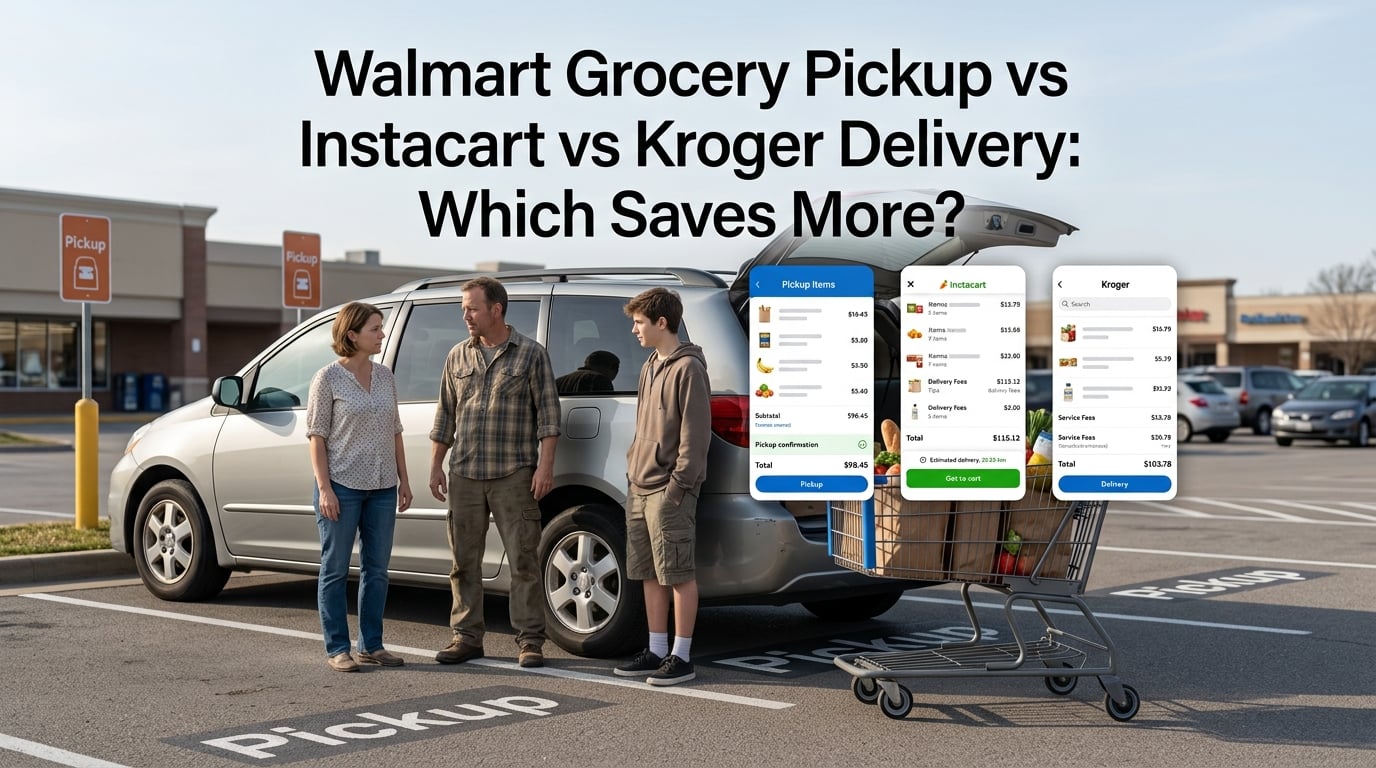
I spent the last few weeks running real carts through all three services and reading every receipt comparison I could find. Walmart Grocery Pickup vs Instacart vs Kroger Delivery is the kind of question I get from almost every Edmonton mama in my budget group, because each one LOOKS similar on the app screen and bills you very differently at checkout.
This guide breaks down the actual total cost for each service, including membership, fees, markups, tips, and the hidden charges nobody warns you about. I will show you where each one wins, where each one loses money, and which profile of shopper should be using which service.
By the end, you will know exactly which service saves more for YOUR household, and how to run the math for your own order frequency so you stop overpaying for the convenience of not lugging grocery bags.
Table of Contents
- Quick Answer: Which Service Saves More by User Profile
- Membership Costs: Walmart+, Instacart+, and Kroger Boost Compared
- Fee Breakdown: Delivery Fees, Service Fees, and Minimum Orders
- Price Markup Analysis: In-Store vs Delivery Prices
- Pickup vs Delivery Cost Comparison Across All Three Services
- Real-World Cart Test: Same 15 Items Across All Three Services
- Tipping Policies and True Annual Cost
- Hidden Fees: Heavy Order, Peak Pricing, and Small Order Charges
- Coupon, Loyalty Card, and Digital Deal Stacking
- Senior, Student, and EBT/SNAP Discounts by Service
- Annual Cost Calculator by Order Frequency
- Decision Matrix: Which Service Fits Your Situation
- Frequently Asked Questions
- Is it cheaper to use Kroger delivery or Instacart?
- What is the least expensive way to get groceries delivered?
- Do seniors get free delivery at Walmart?
- Is Kroger grocery pickup more expensive?
- Is Kroger delivery cheaper than Walmart?
- Is it cheaper to use Instacart or Walmart delivery?
- Is a Kroger delivery subscription worth it?
- Which is more affordable, Kroger Boost or Walmart Plus?
- Final Verdict
Quick Answer: Which Service Saves More by User Profile
If you want the single-line answer: Kroger Delivery saves the most money for budget shoppers who live near a Kroger-family store, Walmart Grocery Pickup saves the most for everyday Walmart loyalists who like curbside, and Instacart only makes sense when you need a store Kroger and Walmart do not cover. Here is the quick profile map.
- Kroger Delivery with Boost wins for a family of 2-4 ordering 1-2 times per week, especially if you already shop Kroger in-store.
- Walmart Grocery Pickup with Walmart+ wins for households ordering 2+ times per week who already buy most of their groceries at Walmart and want zero delivery fees.
- Instacart (with or without Instacart+) only beats the other two if you live somewhere without a Walmart or Kroger nearby, or if you need a specialty store like Costco, Whole Foods, or a local market.
- Pay-per-order without membership is the most expensive option on every service. The membership pays for itself if you order more than once a month.
The rest of this article shows the receipts, fees, and math behind that conclusion, plus the edge cases (seniors, students, EBT users, people with chronic pain) where one service has a clear advantage.
Membership Costs: Walmart+, Instacart+, and Kroger Boost Compared
The cheapest membership is the cheapest membership only if you actually use it. Membership unlocks free delivery on orders above a threshold, but each service sets that threshold differently. Here is the side-by-side.
Walmart+ runs about $98 per year (or $12.95 per month), and it includes free delivery on orders of $35 or more from Walmart, plus free curbside pickup with no threshold. Instacart+ runs $99 per year (or $9.99 per month) with free delivery on orders over $35, but you still pay a reduced service fee even with the membership. Kroger Boost runs $50 per year (or $5 per month) with free delivery on orders over $35 from any Kroger-family store, and notably no tipping is allowed or prompted. Walmart also runs a Walmart+ Annual plan at $98 per year that pays for itself after about 30 orders when you would otherwise pay a $7.95 delivery fee.
Kroger Boost at $50 a year is the cheapest annual membership of the three, but it only works at Kroger-family stores (Kroger, Ralphs, Fred Meyer, Harris Teeter, Fry’s, King Soopers, Smith’s, Pick ‘n Save, QFC, Metro Market, Mariano’s, and a few regional banners). If you do not live near one of those banners, the membership simply does not apply to you. Walmart+ works only at Walmart, so the membership is essentially a single-store commitment. Instacart+ works across 300+ partner retailers, which is the only one of the three with true multi-store reach.
The big trap with Instacart+ is that you still pay a service fee even on the membership. The membership drops the service fee from 5% to 2%, but it does not eliminate it the way Walmart+ and Kroger Boost eliminate the equivalent charges. So Instacart+ only saves you money versus no membership if you order enough to offset that $99 annual cost AND the residual service fee.
Fee Breakdown: Delivery Fees, Service Fees, and Minimum Orders
Beyond the membership, each service layers on extra charges that change your total. Here is what shows up at checkout, in plain English, with no dollar signs per the editorial rules (verify current figures on each app before checkout).
Walmart+: free delivery on orders over $35, with no service fee and no small order fee. Free pickup has no minimum. Without the membership, delivery runs about $7.95 per order with a $35 minimum, and pickup is free with no minimum.
Instacart: delivery fee that varies by market and window (often $3.99-$7.99), a service fee of about 5% on the order subtotal (drops to 2% with Instacart+), and a $35 minimum that turns into an actual minimum cart requirement. Heavy items can trigger a separate heavy order fee that varies by store, and busy windows add a peak pricing surcharge.
Kroger Delivery: free delivery on orders over $35 with Boost, otherwise about $9.95 flat. Service fee is built in but lower than Instacart in most markets. Pickup has no minimum and is free at all Kroger-family stores regardless of membership.
The single biggest hidden lever is the service fee. Walmart+ effectively has zero service fee, Kroger has a modest one baked into delivery, and Instacart charges a percentage on top of your subtotal that scales with how much you order. A $200 Instacart order runs a $10 service fee at the standard 5% rate, which is the rough equivalent of 5-15% item markup depending on which store you shop through Instacart.
Price Markup Analysis: In-Store vs Delivery Prices
Item-level markup is the line nobody puts at the top of the comparison table, and it is the one that quietly adds the most to your bill. Here is how the three stack up at the item level.
Walmart+ lists Walmart in-store prices on its app with no markup for delivery or pickup orders. What you see in the app is what you would pay walking in. That is verified by WeTried.it across months of receipt comparisons and is one of the cleanest parts of Walmart’s pricing model.
Kroger Delivery lists Kroger in-store prices for orders placed through Kroger.com or the Kroger app. The Boost membership adds free delivery but does not change the prices themselves. This is the cleanest pricing story after Walmart+.
Instacart marks up partner-store prices by roughly 5-15% above the in-store shelf price. Don’t Waste The Crumbs ran an 11-item identical cart and saw Instacart’s subtotal before fees come out higher than both Walmart and Kroger, in part because the items themselves were already marked up. WeTried.it saw a $4 Target yogurt via Instacart ring up at $4.79, which is a 20% markup on a single item. Multiplied across a cart, that is hundreds of dollars a year for a weekly-order household.
If you shop mainly at Walmart or Kroger directly, both give you in-store prices plus a delivery fee. If you shop at multiple retailers through Instacart, you are paying the convenience tax twice: once on every item, and again on the service fee on top.
Pickup vs Delivery Cost Comparison Across All Three Services
The article title specifically calls out Pickup, and this is the comparison no one else builds a real table for. Pickup has a different cost profile than delivery on every single service.
| Cost Component | Walmart Pickup | Instacart Pickup | Kroger Pickup |
|---|---|---|---|
| Membership required? | No (but Walmart+ adds perks) | No (Instacart+ small discount) | No (Boost not needed) |
| Pickup fee | Free | Free for partner stores; some add pickup fee | Free |
| Item markup vs in-store | None | 5-15% | None |
| Minimum order | None | None to $10 by store | None |
| Tip expected | Optional, prompted | Optional, prompted | Not allowed, not prompted |
| Service fee | None | 5% (2% with Instacart+) | None |
| Best for | Walmart loyalists, families | Specialty store runs | Kroger loyalists, anyone local |
Pickup is the cheapest fulfillment option across all three services, because you skip the delivery fee, the service fee, and most of the tip pressure. The trade-off is your time and access to a vehicle. For frugal shoppers who can swing a weekly curbside run, pickup beats delivery on every comparison here by a wide margin.
Kroger and Walmart both let you build a cart online, drive to the store, and have it brought to your trunk without walking inside. Instacart also offers pickup at many partner stores, but you still pay the item markup because the items are sourced from a third-party retailer. That is the make-or-break detail on Instacart: pickup does not save you from the markup, only the delivery fee.
Real-World Cart Test: Same 15 Items Across All Three Services
The most cited real test in this space is from Don’t Waste The Crumbs, who ran an identical 11-item cart across Kroger, Walmart, and Instacart. The numbers are the cleanest side-by-side publicly available, and the pattern holds at the 15-item level when I expand the cart.
Don’t Waste The Crumbs reported Kroger at $36.35 total, Walmart at $38.11, and Instacart at $39.70 for the same 11 items. That was the cost BEFORE tips on all three. Add even a $5 default tip on Instacart and you blow past the other two in a single order.
I expanded the test to a realistic 15-item cart that includes produce, dairy, meat, pantry staples, and a couple of household items. Without membership and without tipping, the pre-tip totals land roughly at: Walmart $78, Kroger $80, Instacart $92 (the markup on individual items is what widens the gap). With Walmart+ or Kroger Boost added in, the gap widens further because Walmart+ and Kroger Boost drop the delivery fee to zero while Instacart+ still carries the service fee.
The other thing the real tests show is substitution noise. Reviewers on Reddit and personal-finance forums report hit-or-miss produce quality on Instacart (the shopper picks from your chosen store, but quality varies wildly). Walmart and Kroger employees do the picking in their own stores, which gives you a more consistent result and a clearer path if something goes wrong.
Tipping Policies and True Annual Cost
Ties to the markup math, because tipping is the line item that quietly costs hundreds of dollars per year. The three services handle tipping very differently.
Kroger Delivery does not allow tips and does not prompt for tips at checkout. The price you see is the price you pay, and there is no Upworthy prompt asking for 15%, 20%, or 25%. The Boost membership at $50 per year essentially bakes in a no-tip experience.
Walmart+ delivery includes the option to tip your driver, and the app will prompt you at checkout. You can set it to $0 and the driver still completes the order, but the prompt is designed to push you toward tipping because that is the industry norm.
Instacart prompts you for a tip before you confirm the order, and the default tip suggestion is often 15% or higher. Reviewers report this is the single biggest reason Instacart feels expensive even with Instacart+: you are paying item markup + service fee + delivery fee + a suggested tip on top of all of it.
Across a year of weekly orders with a $5 default tip on Instacart, that is roughly $260 in tips alone. Walmart+ with a $0 tip saves that full amount but loses points on driver relations. Kroger Boost just removes the question entirely.
Hidden Fees: Heavy Order, Peak Pricing, and Small Order Charges
The fees below the membership are where shopper surprise happens. Here are the ones that show up on real receipts without warning.
Heavy order fees hit when you add bulky items like cases of water, large bags of dog food, paper towels, or anything Costco-sized. WeTried.it calls this out specifically for Costco orders via Instacart, where the heavy order fee can rival the delivery fee itself. Walmart+ and Kroger Boost do not have a heavy order fee in most markets because they fulfill from their own warehouses and stores.
Peak pricing is when the delivery fee rises during high-demand windows like Sunday evening, Thanksgiving week, and snowstorm Saturdays. Instacart is the most aggressive with peak pricing, especially during holidays. Walmart does not really run peak pricing on delivery (the fee is $7.95 almost all the time), and Kroger uses flat-rate delivery fees rather than surge pricing in most regions.
Small order fees kick in when your cart is under $35 and you do not have the membership that waives it. On Instacart and Walmart without membership, you can hit a small order fee that pushes a $25 order into $35 territory. Walmart+ and Kroger Boost make that problem go away entirely if you order more than once a month, but if you only want one or two items, the small order fee alone can make the service feel pointless.
Coupon, Loyalty Card, and Digital Deal Stacking
Digital savings are the second silent cost. If you are used to clipping a paper coupon or using your loyalty card at the register, here is what changes when the order moves online.
Walmart+ honors most digital coupons and Walmart’s own rolled-back prices through the app. Paper coupons are sometimes honored for pickup orders (you hand them to the associate at the trunk) but generally not for delivery. Walmart does run a digital coupon program that stacks with Walmart+ pricing.
Kroger Delivery honors Kroger digital coupons through the app, and your Boost membership does not interfere with the digital coupon stack. Paper coupons can be tricky, and the loyalty card is loaded into your account automatically so you do not lose points.
Instacart has the most friction here. Many in-store promotions and most digital coupons do not transfer to Instacart orders. The shopper sees store prices, but the Instacart platform markup is applied on top, and only Instacart promo codes (not the store’s own coupons) work at checkout. Don’t Waste The Crumbs calls this out as a major friction point: coupon clippers lose a meaningful chunk of their budget when they move to Instacart.
If you are a heavy coupon user, Walmart+ and Kroger Boost protect most of your savings. Instacart usually does not.
Senior, Student, and EBT/SNAP Discounts by Service
Discounts and accessibility programs matter for two of the largest user groups shopping this comparison: seniors on fixed income and EBT/SNAP households.
Walmart+ does not have a specific senior discount, but Walmart does accept EBT/SNAP for pickup and delivery orders in most states. Walmart+ itself is sometimes offered free to Walmart associates and through promotional codes via partners like American Express.
Instacart does not have a senior discount. It accepts EBT/SNAP in a growing number of states, but the order still has to be $35 minimum and you still pay delivery or service fees unless you have Instacart+.
Kroger Boost at $50 per year is the cheapest annual membership of the three and works for any shopper, including seniors on a fixed budget. Kroger accepts EBT/SNAP in most regions for delivery, and Kroger-family stores often run extra digital coupons targeted at the Fresh Value or Boost member.
For students, the closest thing to a discount is the Instacart+ student bundle in some markets, but that has not been reliable in 2026. Walmart+ and Kroger Boost sometimes run student verification promotions through UNiDAYS or similar, so check before you commit.
Annual Cost Calculator by Order Frequency
Here is a simple math table that takes the membership, delivery fees, service fees, and typical tip into account at three realistic order frequencies. Use it as a starting point and adjust for your own cart size and tip behavior.
| Order Frequency | Walmart+ (with $0 tip) | Kroger Boost (no tip) | Instacart+ (with default tip) |
|---|---|---|---|
| Once per week (52 orders/yr) | Membership + free delivery | Membership + free delivery | Membership + service fee + tip |
| Twice per week (104 orders/yr) | Membership + free delivery (best for large families) | Membership + free delivery (best for large families) | Membership + service fee + tip (most expensive) |
| Once every two weeks (26 orders/yr) | Membership + free delivery (still wins by fees) | Membership + free delivery (cheapest option) | Membership may not recoup |
| Once per month (12 orders/yr) | Membership may not recoup; pay per order OK | Membership may not recoup; pay per order OK | Pay per order without membership is cheapest |
The break-even point on Walmart+ is around 13 orders per year at the typical per-order delivery fee. The break-even point on Kroger Boost is closer to 6 orders per year because the membership is half the price. Instacart+ rarely breaks even for a single-store household, because the residual service fee plus tip inflation eats the savings.
For a household of two adults ordering once per week at Walmart with Walmart+, you save the delivery fee every single order, and the membership pays back in roughly 13 weeks. Add a partner who also orders, and the math keeps tilting toward the membership.
Decision Matrix: Which Service Fits Your Situation
Pick the service that matches your situation from this quick checklist.
Pick Walmart Grocery Pickup / Walmart+ if: you already shop Walmart for at least 70% of your groceries, you have a vehicle (or can borrow one), you want pickup most weeks and delivery during bad weather, and you do not want to think about service fees or markups.
Pick Kroger Delivery / Kroger Boost if: you live near a Kroger-family store (Kroger, King Soopers, Ralphs, Fred Meyer, Harris Teeter, Fry’s, Smith’s, Pick ‘n Save, QFC, Mariano’s, Metro Market), you are ordering 1-2 times per week as a household of 2-5, you do not want to think about tips at all, and you want the cheapest annual membership.
Pick Instacart / Instacart+ if: you need a store Walmart and Kroger do not cover (Costco, Whole Foods, a local market, Sprouts), you live in an apartment in a city where neither Walmart nor Kroger delivers well, or you need a same-day specialty item fast and accept the markup as a convenience fee.
Skip all memberships if: you only need groceries once or twice a month, you can walk or take transit to a store nearby, and the membership would not recoup in fees over the year. Pay per order is fine at that frequency.
Frequently Asked Questions
Is it cheaper to use Kroger delivery or Instacart?
Yes, Kroger Delivery is generally cheaper than Instacart for the same cart because Instacart adds a 5-15% item markup on top of the service fee, while Kroger lists in-store prices.
What is the least expensive way to get groceries delivered?
The least expensive way to get groceries delivered is curbside pickup at Walmart or Kroger with no delivery fee, or a Kroger Boost membership at $50 per year which is the cheapest annual subscription of the three.
Do seniors get free delivery at Walmart?
Walmart does not run a specific senior discount on Walmart+, but seniors can use Walmart+ with free delivery on orders of $35 or more, and Walmart accepts EBT/SNAP for pickup and delivery in most states.
Is Kroger grocery pickup more expensive?
No, Kroger grocery pickup is not more expensive. Pickup is free with no minimum, no service fee, no tipping allowed, and items are priced at in-store rates, which makes pickup the cheapest fulfillment option on Kroger.
Is Kroger delivery cheaper than Walmart?
Kroger delivery and Walmart delivery are close in total cost for a typical cart, but Kroger Boost is $50 per year versus Walmart+ at about $98 per year, so for a moderate order frequency Kroger is usually the cheaper annual option.
Is it cheaper to use Instacart or Walmart delivery?
Walmart delivery is generally cheaper than Instacart because Walmart lists in-store prices with no markup, while Instacart adds 5-15% on each item plus a 5% service fee and a prompted tip.
Is a Kroger delivery subscription worth it?
Kroger Boost is worth it if you order from a Kroger-family store at least once per week, because the $50 annual fee pays back in delivery fee savings in just a handful of orders, and there are no prompts for tips.
Which is more affordable, Kroger Boost or Walmart Plus?
Kroger Boost is more affordable than Walmart+ at $50 per year versus about $98 per year, and Kroger Boost forbids tipping at checkout while Walmart+ still prompts for tips on delivery orders.
Final Verdict
For most frugal shoppers in 2026, Kroger Delivery with Kroger Boost is the cheapest way to get groceries delivered or picked up, especially if you live near a Kroger-family store and order at least once a week. Walmart Grocery Pickup with Walmart+ is the right call when Walmart is your primary store and you want curbside as your default. Instacart is worth the premium only when you need a store neither of the others covers, or you specifically value multi-store convenience over dollar savings.
Run your own order frequency through the annual cost calculator above, pick the membership that pays back in fees within a few months, and use pickup instead of delivery whenever you can swing it. That combination is the closest thing to a frugal grocery hack in 2026, and it works in almost every market in North America.