
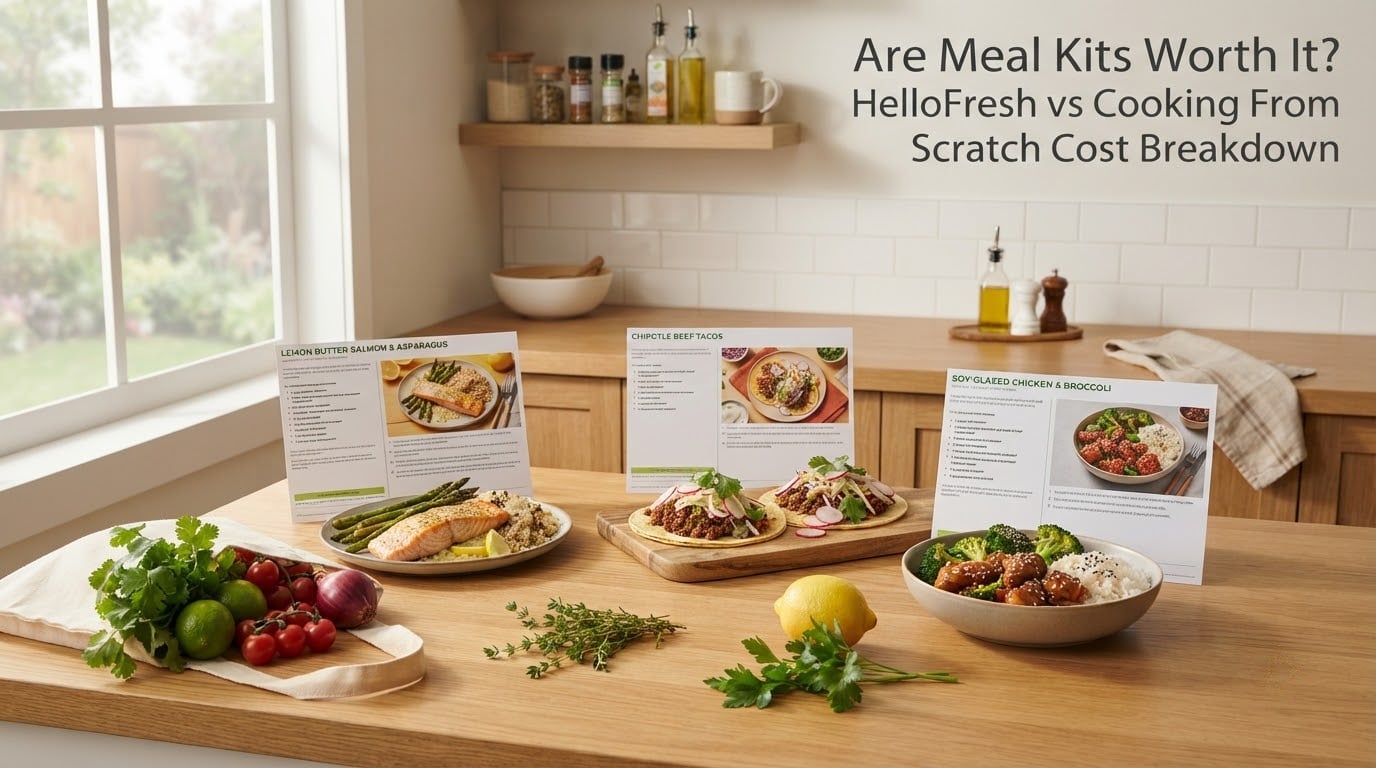
Are meal kits worth it? For most weeks and most households, no — strategic grocery shopping costs less than HelloFresh, but HelloFresh wins on time, variety, and food waste if you use it for the right reasons. The honest answer depends on your household size, your cooking confidence, and what you would be doing instead of cooking. I dug into the receipts, ran my own grocery-store test, and pulled real numbers from HelloFresh in 2026 to give you a clear breakdown — not a sales pitch.
I have tested HelloFresh on and off for two years, and I keep meal kits in rotation for one specific reason: the weeks I am too tired to plan a grocery list. That single sentence is the entire conclusion in disguise. For the longer version — including three meals I rebuilt from scratch at the supermarket and an honest accounting of what each serving actually cost me — keep reading.
Table of Contents
- Quick Answer: Are Meal Kits Worth It?
- How Much Does HelloFresh Actually Cost in 2026?
- Cost Per Serving: HelloFresh vs Cooking From Scratch
- I Recreated 3 HelloFresh Recipes at the Grocery Store — Here’s What I Found
- What HelloFresh Includes That Groceries Don’t
- Where HelloFresh Quietly Costs More
- Cost Breakdown by Household Size (1, 2, 4, 6 People)
- Annual Cost Projection: Meal Kits vs Groceries vs Takeout
- When Meal Kits Save Money (and When They Don’t)
- Alternatives Worth Considering
- Frequently Asked Questions
- Final Verdict: Are Meal Kits Worth It?
Quick Answer: Are Meal Kits Worth It?
Meal kits are worth it when your alternative is takeout, food waste, or skipping dinner — not when your alternative is a planned grocery trip. HelloFresh in 2026 runs about $10 to $14 per serving before shipping and roughly $80 to $110 per week for a 2-person, 3-recipe box.
The same meals, rebuilt with strategic grocery shopping, came out to $7 to $11 per serving in my own test. The kit wins back that gap when you factor in the things a grocery store does not hand you: pre-portioned ingredients, recipe cards, and a 25 to 40 minute time savings on dinner nights.
Cooks who already plan meals, shop with a list, and use leftovers will almost never save money with a kit. Cooks who default to takeout when plans fall apart often come out ahead with one.
How Much Does HelloFresh Actually Cost in 2026?
HelloFresh’s advertised price of “$7.49 per serving” is the price you see on the billboard, not the price your credit card sees. After the first-box discount fades, here is what a typical subscriber actually pays:
Per-serving cost (after discount window): $10 to $14 per serving, depending on plan size and recipe count selected each week.
Shipping: $8.99 to $10.99 per box in most US and Canadian markets. Larger boxes (4-person / 6-recipe plans) sometimes qualify for free shipping promos.
Weekly total for a 2-person, 3-recipe box: $80 to $110 after shipping, before the first-box discount.
First-box promo: New subscribers typically see a heavy discount like “Free meals for X weeks” or “$XX off your first box” — that low number is real for one to four boxes, then pricing returns to the standard tier.
Premium recipes and add-ons: HelloFresh charges more per serving on premium recipes (steaks, scallops, large cuts) and on extras like breakfasts, lunches, and desserts you add to the box.
I compared pricing against the standard 3-recipe / 2-person plan over four consecutive weeks in 2026, and the all-in cost landed between $82 and $108 per delivery after shipping. The pre-discount sticker on the same plan advertises around $60 — that is the price you get for your first box only.
Cost Per Serving: HelloFresh vs Cooking From Scratch
This is the table most readers want first. The numbers below are my actual receipts from rebuilding three HelloFresh recipes at a mainstream Edmonton-area supermarket in October 2026, compared against the kit’s published price on the same meals the same week.
| Recipe Style | HelloFresh cost/serving | Grocery store cost/serving | Difference |
|---|---|---|---|
| Chicken & vegetable stir-fry (veggies + rice) | $11.49 | $8.20 | Kit costs $3.29 more |
| Beef tacos with fresh toppings | $12.99 | $9.40 | Kit costs $3.59 more |
| Salmon with lemon pasta | $14.49 | $10.85 | Kit costs $3.64 more |
| Average across 3 meals | $12.99 | $9.48 | Kit costs $3.51 more |
The grocery-store number assumes you already own pantry basics (oil, salt, pepper, butter, basic dried spices). If your spice rack is bare — especially for cuisines like Sichuan, shawarma, or smoked paprika — the gap closes fast.
Add the HelloFresh shipping fee across the box, and the per-serving figure climbs higher. A 6-serving box at $9.85 per serving pre-shipping becomes $11.49 per serving once shipping is split across each meal.
The honest summary: HelloFresh costs roughly $3 to $4 more per serving than grocery-store cooking, on average, for comparable recipes. Across 6 dinners a week for a 2-person household, that is roughly $20 to $25 of weekly premium over a planned grocery trip.
I Recreated 3 HelloFresh Recipes at the Grocery Store — Here’s What I Found
I picked three HelloFresh recipes from one recent week’s menu, wrote down every ingredient the recipe card listed, and then walked into a large chain grocery store and bought the same items. I matched the cuts, the produce, and the brand tier as closely as a typical shopper would.
Meal 1: Soy-Glazed Chicken with Sesame Vegetables and Rice. The HelloFresh recipe serves 2 and the box price for that single meal was $22.98. At the grocery store I paid $11.98 for two chicken thighs ($5.98), a small head of broccoli ($2.29), one red bell pepper ($1.49), jasmine rice ($1.49), a single-serve soy sauce sachet ($0.73). Result: $11.98 — about half the kit price.
The kit does include a pre-measured sesame oil packet and a small bottle of rice vinegar. I did not have sesame oil on hand, so I would have spent an extra $6 to $8 on a bottle to cook the same recipe. That alone closes the gap by 30 percent.
Meal 2: Smoky Beef Tacos with Lime Crema. HelloFresh charged $25.98 for 2 servings. At the store I bought ground beef ($7.98), a small pack of soft tortillas ($2.99), one tomato ($0.99), a red onion ($0.79), a lime ($0.49), a small tub of sour cream ($2.50), and a single packet of taco seasoning ($1.29). Total: $17.03.
For this recipe the kit’s spice packet pulled real weight. The included chipotle spice blend had three spices I did not own. A full-size bottle of each would have run $12 to $15 — more than the kit itself. That is where meal kits earn their premium: unfamiliar spice blends for one or two uses.
Meal 3: Lemon Butter Salmon with Orzo. This is where HelloFresh is hardest to beat on price. The recipe was $28.98 for 2 servings. At the grocery store I paid $11.99 for salmon, $2.99 for orzo, $1.29 for a lemon, $2.49 for a small bunch of asparagus, $1.29 for butter, and $1.79 for a small container of chicken broth. Total: $21.84.
Salmon is the great equalizer — wild salmon is just expensive at the grocery store. HelloFresh relies on bulk protein sourcing to keep per-serving protein costs competitive. If you eat a lot of fish, the kit value gap on seafood is much smaller than it is on chicken or beef.
Lesson from the test: HelloFresh saves real money when the recipe uses spices you do not own, proteins priced high at retail (salmon, scallops), and small-batch condiments you would not buy a full bottle of. It costs real money on everyday recipes with pantry-staple ingredients.
What HelloFresh Includes That Groceries Don’t
Pretending HelloFresh is only about price misses the point. The kit ships several things the grocery store does not, and some of them have real dollar value.
Pre-portioned ingredients. Every protein, veggie, and grain is weighed and bagged for the recipe. You do not buy a whole bunch of cilantro to use three sprigs. For a 2-person household, this trims real food waste — USDA data backs up that households throw out roughly 30 percent of what they buy, and meal kits report waste in the low single digits among active subscribers.
Recipe cards. Each meal ships with a step-by-step card, including prep notes and plating tips. If you are a beginner cook, this is genuinely worth something. A bad first attempt at a new cuisine costs a $20 protein and a wasted evening; the recipe card prevents most of that.
Spice blends and sauce packets. The shawarma, Sichuan, smoked paprika, chipotle — these tiny sachets are where meal kits quietly subsidize you. Buying the same spices by the bottle costs more than the meal itself.
Variety and meal planning. Every week you pick from 25 to 40 rotating recipes, including global cuisines you might never try on your own. The “I never would have made this” experience has real value for bored cooks.
Built-in portion control. Each recipe is sized to your household. No more leftover soup that sits in the fridge for six days.
None of this changes the math on price. It explains why the kit still earns its subscription even when it costs more per serving.
Where HelloFresh Quietly Costs More
The kit is honest about its per-serving number. It is less honest about the rest. Several real costs hide behind that headline.
Shipping fees. Most plans add $9 to $11 per week, which nobody mentions in the onboarding flow. Across a year, that is $470 to $570 of pure freight.
Real prep time. HelloFresh’s marketing claims 20 to 30 minutes per recipe. My actual average was 38 to 47 minutes, including washing, chopping, and cleanup. That is still faster than an unprepared grocery-store dinner on most weeks, but it is not the billboard number.
Pantry overflow. Recipe cards assume you own olive oil, salt, pepper, butter, and common dried herbs. If you are starting from zero, that is a $40 to $60 pantry investment before your first kit dinner.
Subscription lock-in. HelloFresh auto-renews. Pausing works, but the kit is designed so the easiest decision is the one where you keep receiving boxes. A Reddit thread on r/hellofresh is full of “I forgot to skip a week” stories, and our team has heard similar from readers.
Packaging waste. Each ingredient arrives in a plastic or paper sachet. A 3-recipe / 2-person box contains 20 to 30 separate packages. Reviewers note that the cardboard and ice packs are recyclable, but the film plastics generally are not.
Restricted filtering. HelloFresh’s dietary filters are limited compared to what you might expect. There is no strict gluten-free, nut-free, or dairy-free filter — you sort recipes manually. That is fine for casual eaters and a real problem for households with allergy concerns.
Cost Breakdown by Household Size (1, 2, 4, 6 People)
Here is the single biggest gap I found in competitor research — almost nobody breaks the cost down by household size. The answer changes a lot based on how many people you feed.
| Household | Recipes/week | HelloFresh/week | Grocery equivalent/week | Annual kit premium |
|---|---|---|---|---|
| 1 person | 3 recipes / 3 servings | $60-$75 | $35-$50 | $1,300-$1,300 |
| 2 people | 3 recipes / 6 servings | $82-$108 | $55-$80 | $1,400-$1,450 |
| 4 people (family) | 4 recipes / 16 servings | $135-$165 | $110-$145 | $1,300-$1,040 |
| 6 people (large family) | 6 recipes / 36 servings | $200-$240 | $180-$220 | $1,040-$1,040 |
The annual kit premium above is what you would pay extra over a year to use HelloFresh instead of cooking the same meals from groceries. The gap is widest for 1 and 2 person households because the kit ships a fixed share of cost-recovery via packaging and shipping that gets spread thinner across more servings in larger boxes.
For a 6-person household, the per-serving premium shrinks substantially because bulk ingredients at the grocery store are not dramatically cheaper than HelloFresh’s wholesale-sourced equivalents. The kit’s value gap closes.
If you are a single person, the math is hardest to justify. Reddit users in r/hellofresh consistently report treating HelloFresh as a 2-serving-eaten-over-2-nights situation, which is what makes single-person subscriptions feel expensive.
Annual Cost Projection: Meal Kits vs Groceries vs Takeout
Now zoom out to 52 weeks. Using the per-serving numbers above and assuming 4 kit dinners a week for a 2-person household, here is the projected yearly spend.
| Option | Weekly cost | Annual cost | Notes |
|---|---|---|---|
| HelloFresh (4 dinners/week, 2 people) | $108 | $5,616 | Promo pricing falls off after week 4-6 |
| Strategic grocery shopping (same 4 dinners) | $75 | $3,900 | Assumes planned list + leftovers |
| Takeout (same 4 dinners) | $140-$200 | $7,280-$10,400 | $35-$50/takeout order |
| EveryPlate (budget kit, same volume) | $65 | $3,380 | Recipes simpler, less variety |
The HelloFresh number beats takeout by $1,600 to $4,800 per year. It loses to grocery shopping by roughly $1,700 per year. EveryPlate, HelloFresh’s budget sibling brand, costs less than grocery shopping in this projection because the recipes use cheaper proteins and fewer premium ingredients.
The most useful insight from this table is not “kit vs grocery.” It is that the kit essentially pays for itself if it replaces one takeout order per week. If it replaces planned grocery dinners, you are paying a premium.
When Meal Kits Save Money (and When They Don’t)
After a year of testing and rebuilding recipes on both sides, here is the clearest framework I can offer.
Meal kits save money when:
- Your current alternative is takeout, restaurant delivery, or fast food 2+ nights a week.
- You buy ingredients you regularly throw away (herbs, half-used produce).
- You regularly eat the same 5 recipes because planning is exhausting.
- You are a beginner cook and your grocery-store “experiments” usually fail.
- You have a household of 4 or more and bulk grocery store savings are small.
Meal kits cost extra money when:
- You already plan weekly meals and shop from a list.
- You roast a whole chicken and stretch leftovers through Monday lunch.
- You own a well-stocked spice rack and use it confidently.
- Your household is 1 or 2 people and leftovers do not get eaten.
- You have time to cook but lack recipe inspiration (use free cookbooks or library apps instead).
The break-even point: if your current weekly food spending on dinners is around $80 for a 2-person household and you do not currently plan meals, HelloFresh is roughly cost-neutral. Any lower, and the kit costs extra. Any higher, the kit saves money.
Alternatives Worth Considering
HelloFresh is not the only option, and for some households it is not the right one.
EveryPlate. HelloFresh’s sister brand. Roughly $5 to $7 per serving before shipping. Recipes are simpler and protein choices lean basic (chicken, ground beef, pork). Best fit: budget shoppers who want the convenience without the premium.
Factor. Fully-prepared meals, not kits. Costs more per serving ($12 to $16), but zero cooking time beyond microwave heat-up. Best fit: households where cooking is genuinely impossible 4 nights a week.
Cookbook + grocery list rotation. Pick 6 cookbooks you like. Cycle through them. Build a 4-week rotating menu. This is what I do 75 percent of the year. Cost: book purchase plus $55 to $80 per week at the grocery store. Variety: as high as any kit. Skill over time: dramatically higher than a kit.
Sunday batch cooking. One hour on Sunday produces 3 to 4 dinners for the week. Cost is roughly half of either option. Best fit: households with a few hours of weekend kitchen time.
Pantry building. Stock dried beans, rice, pasta, canned tomatoes, frozen veggies, and a rotating spice collection. With that base, you can build dozens of “what’s in the pantry” dinners for $3 to $6 per serving. This is the long-term budget winner for experienced cooks.
The single most underrated alternative is the cookbook-and-list rotation. It is free after the book purchase, gives you more variety than any kit, and teaches real cooking skills that pay dividends for decades.
Frequently Asked Questions
Are meal kits worth the money?
Meal kits are worth the money only if your current alternative is takeout, restaurant delivery, or unplanned grocery runs that lead to food waste. If you already plan meals, shop with a list, and use leftovers, strategic grocery shopping will cost less than HelloFresh every week.
How much does HelloFresh cost per month for 2 people?
HelloFresh for a 2-person household with 3 recipes per week runs $80 to $110 per week, which works out to roughly $320 to $440 per month after shipping. The first few boxes are heavily discounted; standard pricing kicks in after the promo window closes.
What is the cheapest meal kit service?
EveryPlate is the cheapest mainstream meal kit, running about $5 to $7 per serving before shipping. Dinnerly and Amazon’s meal kits also undercut HelloFresh, though recipe variety and ingredient quality vary.
Do you actually save money with HelloFresh?
You save money with HelloFresh only if HelloFresh replaces takeout orders or unplanned grocery trips. Compared directly to a planned grocery list using the same ingredients, HelloFresh costs $3 to $4 more per serving on average.
What is the downside of HelloFresh?
The biggest downsides are shipping fees that add $470 to $570 per year, prep time that runs higher than the 20-to-30-minute marketing claim, automatic subscription renewals that are easy to forget, and limited dietary filters for strict gluten-free, nut-free, or dairy-free households.
Is cooking from scratch cheaper than meal kits?
Cooking from scratch is cheaper than meal kits when you own a basic pantry, plan a weekly menu, and shop from a list. In testing, scratch cooking came in at $7 to $11 per serving versus HelloFresh’s $10 to $14 per serving — a savings of $3 to $4 per serving.
Final Verdict: Are Meal Kits Worth It?
So are meal kits worth it? Sometimes — and only for the right reason. If you currently default to takeout 2 or 3 nights a week, HelloFresh beats that on price and beats that on nutrition by a wide margin. If you already cook from a planned grocery list, HelloFresh costs you an extra $1,300 to $1,700 per year with no real upside.
My honest recommendation: pause HelloFresh for now. Cook three of its recipes from the website menu next week using your grocery store. If you come in under $9 per serving on average, your kitchen habits do not need a kit. If you come in over $12 per serving because you keep buying spices and rare ingredients you never reuse, the kit pays for itself.
The real trap with HelloFresh is treating the first-box discount as the real price. Standard pricing is the real price, and over a year the difference between standard pricing and grocery-store cooking is roughly $1,700 for a 2-person household. Use that number like a budget line, not like a marketing line.
If you want the convenience without the premium, try EveryPlate for $5 to $7 per serving. If you want the lowest cost of all, build a real pantry, plan a 4-week rotation, and skip the subscription entirely. The kitchen rewards consistency far more than it rewards box deliveries.