
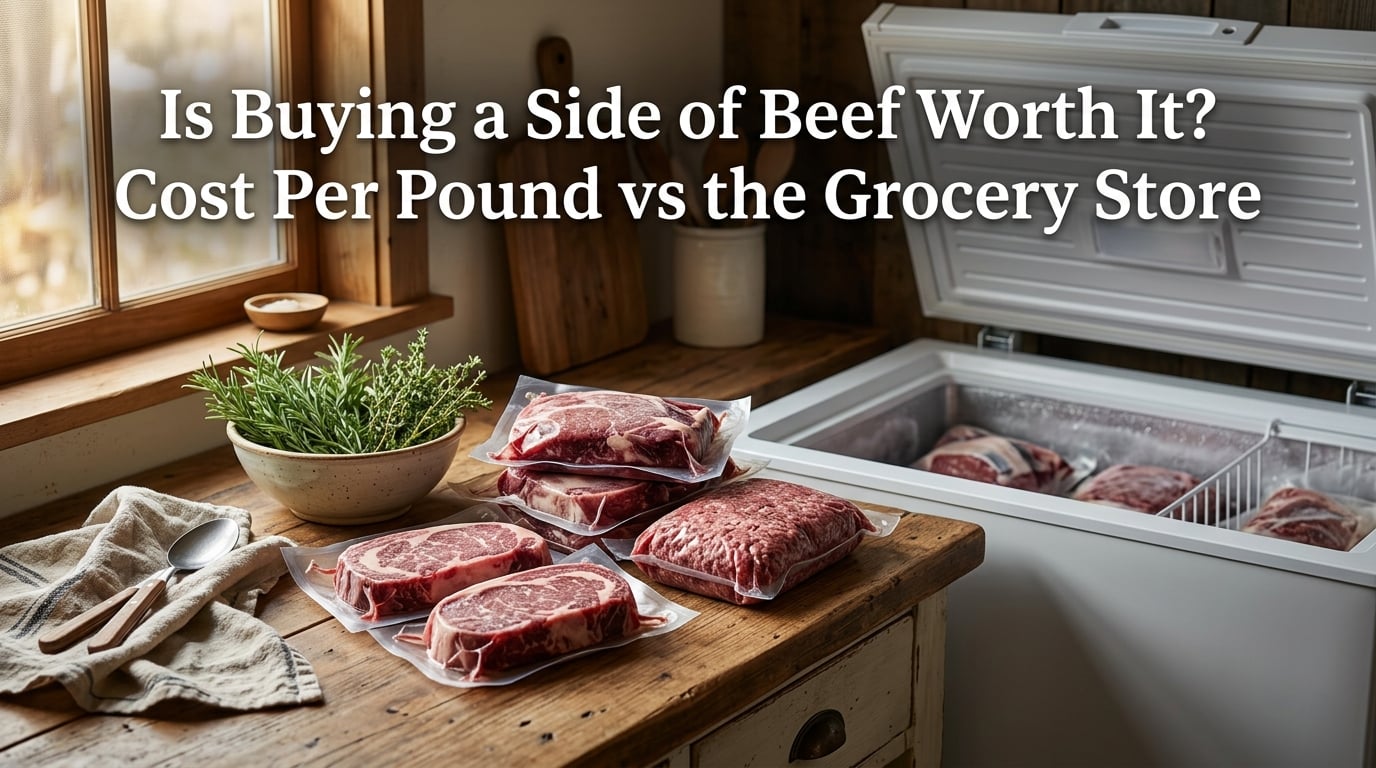
When our family first started talking about buying a side of beef, the math made my head spin. We were used to grabbing a tray of ground beef and a couple of steaks from the grocery store each week, never thinking about where the animal came from or what we were actually paying per pound for individual cuts. The more I researched, the more I realized the question “is buying a side of beef worth it?” has a clear answer for most families – but only once you understand the cost math, freezer logistics, and what cuts you’ll actually receive.
This guide walks through real numbers from farmers, processors, and grocery store price surveys across North America. You’ll see a cut-by-cut price comparison, an honest look at when a beef share makes sense (and when it doesn’t), plus freezer space requirements and a step-by-step buying process. Whether you’re a frugal family of four looking to stock the freezer or a household of two wondering if a quarter cow would work, you’ll have the data to make the call.
Table of Contents
- Quick Answer: Is Buying a Side of Beef Worth It?
- How Much Does a Side of Beef Cost in 2026?
- Cut-by-Cut Price Comparison: Bulk Beef vs Grocery Store
- What Cuts of Meat Do You Get With a Side of Beef?
- How Much Freezer Space Do You Need for a Half Cow?
- Grass-Fed vs Grain-Finished Beef: Is the Upgrade Worth It?
- How to Buy a Side of Beef Step by Step
- When Buying a Side of Beef Does NOT Make Sense
- Sharing a Side of Beef With Another Family
- How Long Does Bulk Beef Last in the Freezer?
- Frequently Asked Questions
- Is buying a side of beef worth it?
- How much does a side of beef cost?
- Is it cheaper to buy meat at a meat market or grocery store?
- How much freezer space do I need for a side of beef?
- What cuts do you get with a side of beef?
- How long does bulk beef last in the freezer?
- Can I split a side of beef with a friend?
- Is grass-fed beef worth the extra cost?
- Final Verdict: Is a Side of Beef Worth It for Your Family?
Quick Answer: Is Buying a Side of Beef Worth It?
Yes – for most families who eat beef 2-3 times per week, have 8+ cubic feet of freezer space, and can pay $1,500 to $3,000 upfront, buying a side of beef saves 30-50% per pound compared to grocery store prices on equivalent quality beef. A half cow yields 170 to 250 pounds of finished, vacuum-sealed cuts including steaks, roasts, ground beef, and ribs, averaging $7 to $13 per pound all-in.
That headline number holds up when you run the real math, but the savings shrink fast if you don’t have freezer space, can’t stomach the upfront cost, or only eat a few cuts of beef. Reviewers on r/Frugal and r/Butchery consistently report the same pattern: people who use the entire animal (ground beef, roasts, brisket, short ribs, soup bones) save the most; people who cherry-pick only ribeyes end up paying more than they would at the grocery store.
The deciding factors are surprisingly simple:
- Your household eats beef at least twice a week
- You have or can afford a chest freezer (8-14 cubic feet)
- You can pay the deposit ($500-$1,000) and final balance when the animal is processed
- You’re willing to use cuts beyond steaks – ground beef, roasts, stew meat, brisket, and bones
If all four boxes feel right, a beef share is one of the most reliable ways I know to slash a grocery bill and dramatically improve the quality of meat your family eats.
How Much Does a Side of Beef Cost in 2026?
A side of beef (half cow) in 2026 typically costs between $1,800 and $3,500 all-in, depending on your region, the farm, the animal’s weight, and the processing fees. The wide range comes from two separate charges: the price per pound paid to the farmer, and the butchering fees charged by the processor.
Here’s how the total bill breaks down:
| Cost Component | Typical Range | Notes |
|---|---|---|
| Price per hanging pound (paid to farmer) | $3.50 to $6.00 | Grass-fed and organic command the higher end |
| Kill fee / slaughter fee | $75 to $150 flat | Sometimes split between share buyers |
| Cut and wrap fee | $0.50 to $1.00 per pound | Based on hanging weight |
| Curing and smoking (optional) | $1.00 to $2.50 per pound | For bacon, ham, corned beef add-ons |
| Offal/organ meats (optional) | $0 to $50 | Liver, heart, tongue – usually requested separately |
The single biggest pricing variable is hanging weight versus take-home weight. Hanging weight is what the carcass weighs after slaughter and initial trimming but before aging and deboning; it’s the number the farmer usually quotes you. Take-home weight is the actual packaged beef in your freezer – typically 60-65% of hanging weight once bones, fat, and trimming are removed.
A realistic example for 2026: a half cow with 400 pounds of hanging weight at $5.00/lb plus $0.75/lb cut and wrap plus a $100 kill fee comes to $2,400 total. That yields about 240-260 pounds of packaged beef, putting your effective cost around $9.20 to $10.00 per pound for every cut combined. Compared to buying equivalent cuts at the grocery store, the per-pound savings show up most clearly on premium steaks and roasts.
Cut-by-Cut Price Comparison: Bulk Beef vs Grocery Store
This is where the bulk beef case gets airtight. When you compare the actual cuts you receive from a side of beef to what you’d pay at the grocery store for the same quality, the savings are dramatic – especially on premium cuts that the grocery store marks up heavily.
| Cut | Bulk Effective Price/lb (All-In) | Grocery Store Price/lb (Conventional) | Grocery Store Price/lb (Organic/Grass-Fed) | Approximate Savings |
|---|---|---|---|---|
| Ground Beef (80/20) | $7 to $9 | $5 to $7 | $8 to $12 | Break-even to 30% |
| Ribeye Steak | $12 to $18 | $18 to $25 | $28 to $40 | 30-50% |
| NY Strip Steak | $12 to $18 | $16 to $22 | $25 to $35 | 30-45% |
| Filet Mignon | $18 to $28 | $30 to $45 | $45 to $65 | 40-55% |
| Chuck Roast | $8 to $12 | $10 to $14 | $15 to $22 | 20-40% |
| Brisket | $9 to $14 | $12 to $18 | $20 to $30 | 25-50% |
| Short Ribs | $8 to $12 | $12 to $18 | $18 to $26 | 30-50% |
| Sirloin Steak | $10 to $14 | $12 to $17 | $18 to $26 | 20-40% |
| Stew Meat | $9 to $13 | $10 to $14 | $16 to $22 | 15-35% |
| Soup Bones | $3 to $5 | $4 to $7 | $6 to $10 | 30-50% |
Methodology note: Bulk effective prices reflect the all-in cost of a side of beef (purchase price + kill fee + cut and wrap) divided across every pound you receive, which is why ground beef shows a higher effective price than you’d pay for a single pound at the store. Grocery store prices reflect national averages from USDA data and major chain surveys in 2026, with conventional grocery store pricing on the low end and organic/grass-fed sections on the high end.
The pattern is clear: the more premium the cut, the larger the savings. If your family loves ribeye, brisket, and filet mignon, a side of beef pays for itself in savings alone. If your household mostly eats ground beef and the occasional roast, the math still works but the dollar savings are smaller.
What Cuts of Meat Do You Get With a Side of Beef?
A half cow yields roughly 170-250 pounds of finished, packaged beef – the exact number depends on the animal’s size and how you customize the cuts. The composition is fairly predictable across farms: roughly 40-50% ground beef and stew meat, 20-25% steaks, 15-20% roasts, and the rest bones, organ meats (if requested), and specialty cuts.
Here’s a typical breakdown of what you’ll find in those neatly labeled boxes at pickup:
| Category | Approximate Pounds | Common Cuts Included |
|---|---|---|
| Steaks | 35-55 lbs | Ribeye, NY Strip, Sirloin, Filet Mignon, Flank, Skirt |
| Roasts | 30-50 lbs | Chuck Roast, Rump Roast, Arm Roast, Sirloin Tip Roast |
| Ground Beef | 70-110 lbs | 1 lb packages of 80/20, some processors offer 85/15 or 90/10 |
| Stew Meat / Cubed | 5-15 lbs | Cut from chuck and round |
| Ribs and Specialty | 10-20 lbs | Short Ribs, Back Ribs, Brisket, Tri-Tip |
| Bones and Trim | 10-20 lbs | Soup bones, knuckle bones – great for stock |
| Organ Meats (optional) | 5-15 lbs | Liver, heart, tongue, oxtail – request specifically |
The ground beef tonnage catches first-time buyers off guard. Coming home with 80-100 pounds of ground beef feels like a lot, but it disappears surprisingly fast if your family uses it for tacos, burgers, chili, meatloaf, spaghetti sauce, and casseroles twice a week. Reviewers on r/Frugal often say the same thing: the families who use all their ground beef save the most and enjoy the experience; families who only want steaks end up giving ground beef away or letting it sit in the freezer past its prime.
Most processors let you customize at order time – thicker steaks (1.5 inch instead of the standard 1 inch), boneless vs bone-in roasts, ground beef fat ratio, and how many pounds per package. Get these choices in writing before the animal goes to the processor.
How Much Freezer Space Do You Need for a Half Cow?
You’ll need 8 to 14 cubic feet of freezer space for a half cow, depending on how it’s cut and packaged. A standard 7 cubic foot chest freezer holds about a quarter cow; a 14 cubic foot chest freezer comfortably fits a half cow plus other frozen goods.
The shape matters as much as the volume. Chest freezers hold more cubic feet per dollar than upright freezers, and the rectangular layout makes it easy to stack the flat boxes most processors use. Upright freezers waste shelf space on oddly shaped packages.
Plan for freezer space carefully. A 240 pound half cow in vacuum-sealed packages takes up noticeably more room than 240 pounds of loose meat would suggest. Add some buffer for the cuts you’ll pull out to thaw and refreeze, and you’ll want at least 10-12 cubic feet dedicated solely to the beef share.
If you don’t have a chest freezer, expect to add $200-$400 to your effective cost. A decent 7 cubic foot chest freezer runs around $250-$350, and a 10-14 cubic foot model runs $400-$600. That’s not nothing, but the freezer pays for itself within your first half cow in saved grocery trips.
Grass-Fed vs Grain-Finished Beef: Is the Upgrade Worth It?
Grass-fed beef typically costs $1 to $3 more per pound than grain-finished beef from the same farm, and the question of whether it’s worth it comes down to your priorities around flavor, nutrition, and animal welfare.
Grass-fed cattle eat only grass and forage for their entire lives. The meat tends to be leaner, with a more mineral, earthy flavor and slightly less marbling. Nutrition studies show grass-fed beef is higher in omega-3 fatty acids and conjugated linoleic acid (CLA), though the absolute differences are modest. Many reviewers on r/Frugal note that grass-fed ground beef can taste gamey to families accustomed to conventional beef, so plan a taste test with a small order before committing to a whole animal.
Grain-finished cattle start on grass but transition to grain (usually corn) for the final 4-6 months. The grain produces more marbling, richer flavor, and the buttery texture most people associate with a classic steak. This is the bulk of what you find at the grocery store, and it’s what most beef share farms raise unless you specifically request grass-fed.
From a pure cost perspective, the upgrade is worth it if you care about flavor variety, want to support pasture-based farming, or want the small nutritional bump. From a dollars-and-cents perspective, grain-finished is the better value and the path of least resistance for families new to bulk beef.
If you want grass-fed without the premium, look for farms that raise “grass-fed, grain-finished” cattle – the animal spends most of its life on pasture and finishes on grain for the last few months. You get many of the welfare benefits at a lower price point than 100% grass-fed.
How to Buy a Side of Beef Step by Step
Buying a side of beef for the first time feels intimidating, but the process is straightforward once you know the sequence. Here’s the workflow that works for most families.
Step 1: Find a local farm or ranch. Start with farmer’s markets, local food co-ops, social media groups in your region, and the Local Harvest directory. Ask friends and neighbors who have bought beef shares for referrals. Expect to wait 4-6 months from deposit to pickup depending on the farm’s schedule.
Step 2: Ask the right questions before you put down a deposit. Confirm the price per hanging pound, the kill fee, the cut and wrap fee, the estimated hanging weight, the pickup or delivery timeline, and whether the meat is USDA inspected. Ask what cuts are standard, what customization is available, and how the meat is packaged (vacuum-sealed vs paper wrap).
Step 3: Place a deposit and submit your cut sheet. Most farms take a 25-50% deposit when you commit. Submit your cut sheet at the same time – this is the document that tells the processor how thick to slice steaks, what fat ratio for ground beef, how many pounds per package, and whether you want organ meats or soup bones.
Step 4: Wait for processing. The processor dry-ages the carcass 7-14 days, then cuts and wraps to your specifications. Most farms will give you a 2-4 week heads-up before pickup so you can clear freezer space.
Step 5: Pick up, weigh, and pay the balance. The processor weighs the finished packaged beef and bills you for the final balance. Take a cooler for the trip home, and bring a notebook to log the actual cuts and weights – this becomes your personal reference for next time.
Step 6: Organize your freezer. Sort cuts by type – steaks together, roasts together, ground beef together – and label everything with the date. Place older cuts toward the top and newer cuts toward the bottom so you use them in the right order.
When Buying a Side of Beef Does NOT Make Sense
I’d rather lose readers than mislead them, so here’s the honest list of scenarios where a beef share is a bad fit. If any of these sound like your household, skip the half cow and stick with grocery store or butcher shop purchases.
The upfront cost is a stretch. If $1,800 to $3,500 would tap out your emergency fund or put you behind on other bills, the bulk beef math doesn’t work. The whole point is savings over time, but the savings only materialize if you can absorb the lump sum without stress.
You don’t have freezer space and won’t buy a chest freezer. Trying to cram 200+ pounds of beef into a regular kitchen freezer means it piles up next to the ice cream and gets lost behind frozen pizza. The beef will sit past its prime, you’ll cook less of it, and the effective savings shrink.
Your household doesn’t eat much ground beef. If your family mostly wants steaks and skips ground beef, you’ll end up with 80+ pounds of ground beef you don’t use. Either find a friend to take it, plan to grind it into burger patties for the freezer, or skip the share.
You’re picky about specific cuts. If you only want ribeye and filet and don’t want to deal with brisket, short ribs, and chuck roasts, the grocery store is a better fit. You can pick exactly what you want without committing to a full half animal.
You move frequently or have unstable housing. A 240 pound freezer full of beef is hard to move. Renters with short lease terms and people who relocate for work should think twice before filling a chest freezer they might have to leave behind.
The local farms in your area are unreliable or low quality. The math assumes the meat is good. If the nearest farm has poor reviews, inconsistent cuts, or vacuum sealing that fails within a few months, the savings disappear in wasted product. Travel to a better farm if your local options aren’t up to par.
Sharing a Side of Beef With Another Family
Splitting a half cow with another family is one of the smartest ways to make bulk beef work for smaller households. A quarter cow (split from a half) gives you 100-130 pounds of finished beef, fits in a smaller freezer, and cuts the upfront cost roughly in half.
Here’s how splitting typically works. Family A and Family B each take one half of the butchered animal. The processor divides the cuts as evenly as possible – one family gets the left side, the other gets the right. Each family pays for their share of the hanging weight, plus their share of the kill fee (often split evenly) and the full cut and wrap fee for their half.
Most processors and farms are comfortable with this arrangement – just specify at order time that you want a “split half” with two separate cut sheets. If you and your co-buyer want different cut preferences (one family wants thicker steaks, the other wants more ground beef), some processors will let each family submit a separate cut sheet for their half. Ask before you commit.
The cost per pound is the same as a full half cow, but each family’s total bill drops to roughly $1,000 to $1,800. That’s a much easier pill to swallow, and it opens bulk beef up to households that couldn’t justify the larger lump sum.
How Long Does Bulk Beef Last in the Freezer?
Vacuum-sealed beef keeps peak quality for 9-12 months in a chest freezer held at 0°F or below. After 12 months, the meat is still safe to eat but the flavor and texture start to drift. Steaks hold quality longer than roasts; ground beef is best used within 6-9 months for best flavor.
The packaging matters enormously. Vacuum-sealed cuts in heavy plastic with no air exposure will look and taste nearly identical at month 12 as they did at month 1. Paper-wrapped cuts from processors that don’t vacuum seal start developing freezer burn within 3-6 months. Before you commit to a farm or processor, ask specifically whether they vacuum seal, what kind of plastic they use, and how they handle the freezing process.
To stretch the quality window, organize your freezer so you use older cuts first. Keep a small notebook on the freezer with the date your beef came home, and plan to cook the oldest steaks and roasts before newer arrivals. If you buy a half cow in fall and a quarter cow in spring, you’ll naturally cycle through them before quality drifts.
Frequently Asked Questions
Is buying a side of beef worth it?
For most families who eat beef 2-3 times per week and have 8-14 cubic feet of freezer space, yes. A side of beef typically saves 30-50% per pound over grocery store prices on equivalent quality cuts, with the biggest savings on ribeye, brisket, short ribs, and filet.
How much does a side of beef cost?
A side of beef in 2026 typically costs $1,800 to $3,500 all-in, including the price paid to the farmer (usually $3.50-$6.00 per hanging pound), the kill fee ($75-$150), and the cut and wrap fee ($0.50-$1.00 per pound). The total depends on your region, the animal’s size, and whether you choose grass-fed or grain-finished.
Is it cheaper to buy meat at a meat market or grocery store?
A meat market (or butcher shop) often beats grocery store prices on individual cuts by 10-20%, but neither matches bulk beef savings. A side of beef averages $7-$13 per pound all-in across every cut you receive, which is 30-50% less than equivalent grocery store quality.
How much freezer space do I need for a side of beef?
Plan on 8-14 cubic feet of chest freezer space for a half cow. A 7 cubic foot chest freezer fits about a quarter cow (100-130 lbs of packaged beef), while a 14 cubic foot chest freezer comfortably holds a full half cow plus other frozen goods.
What cuts do you get with a side of beef?
A half cow yields about 170-250 pounds of packaged beef including steaks (ribeye, NY strip, sirloin, filet), roasts (chuck, rump, arm, sirloin tip), 70-110 pounds of ground beef, stew meat, brisket, short ribs, soup bones, and optionally organ meats like liver and heart.
How long does bulk beef last in the freezer?
Vacuum-sealed beef keeps peak quality for 9-12 months at 0°F or below. Steaks hold quality longer than ground beef; ground beef is best used within 6-9 months. Beyond 12 months, the beef is still safe to eat but flavor and texture start to drift.
Can I split a side of beef with a friend?
Yes – splitting a half cow with another family is common and easy to arrange. Each family gets one side of the butchered animal, pays for their share of the hanging weight and fees, and submits their own cut sheet. The result is roughly half the upfront cost and half the freezer space needed.
Is grass-fed beef worth the extra cost?
Grass-fed beef typically costs $1-$3 more per hanging pound than grain-finished, with leaner meat, more omega-3s, and a more mineral flavor. It’s worth it if you prioritize pasture-based farming and flavor variety, but grain-finished is the better value if you want classic steakhouse flavor at the lowest per-pound cost.
Final Verdict: Is a Side of Beef Worth It for Your Family?
For most families who eat beef twice a week or more, a side of beef is one of the highest-impact money moves on the grocery budget – 30-50% savings on cuts you already buy, plus access to grass-fed and pasture-raised quality the grocery store rarely stocks. The real deciding factors are freezer space and upfront cost; if you have 8-14 cubic feet of freezer room and can absorb a $1,800-$3,500 lump sum, the math almost always favors buying a side of beef.
Start by reaching out to one or two local farms, asking the questions in our step-by-step section, and requesting a quote based on your region’s hanging weight prices. If the numbers look right, place a small deposit on a quarter cow for your first try – it gives you the bulk-beef experience at lower risk, and you can size up to a half cow once you know what works for your family.
Is buying a side of beef worth it? For most families reading this, the answer is yes – and the sooner you commit, the sooner your freezer (and your grocery bill) starts to look very different.