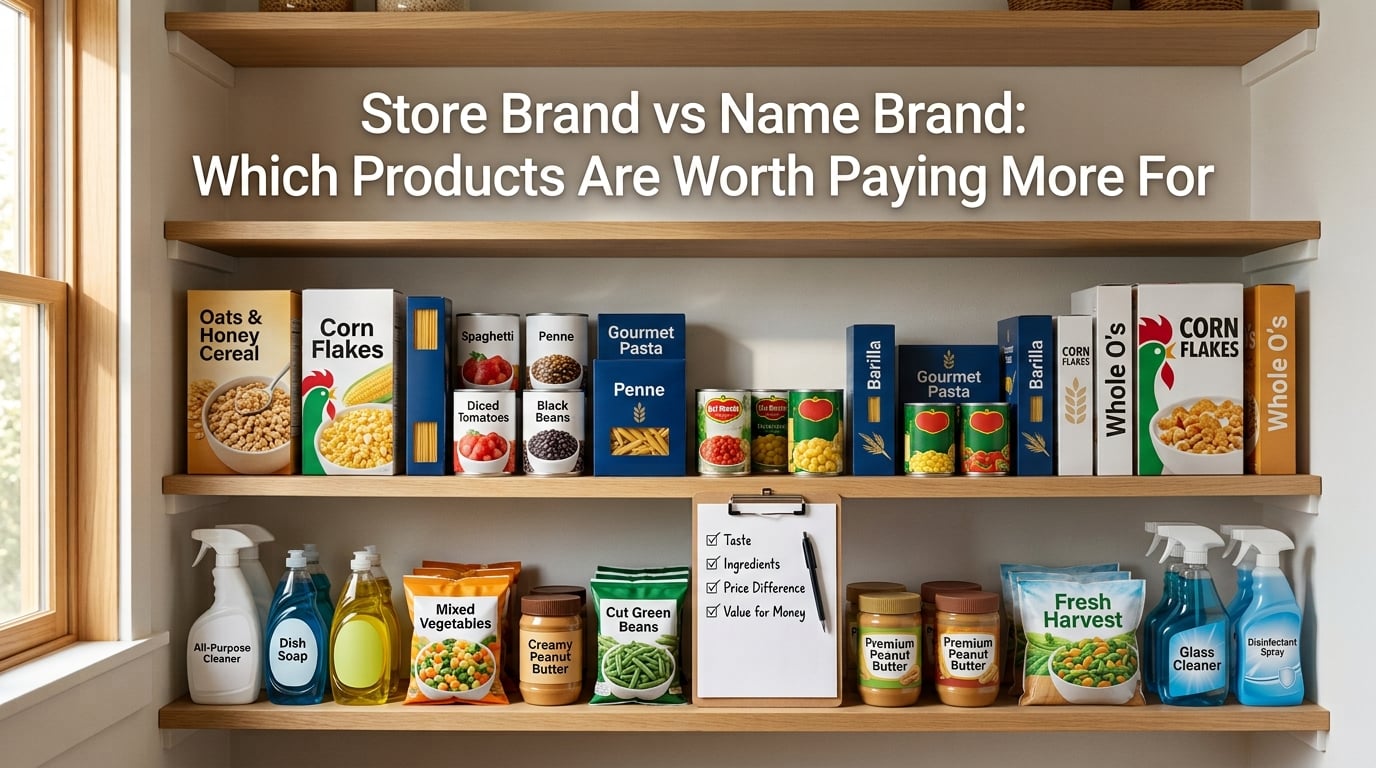
I walked out of Costco last Tuesday with a cart full of Kirkland Signature peanut butter, frozen wild blueberries, and a giant tub of Greek yogurt, then drove across town to grab a couple of name-brand items I still won’t compromise on. The total made me pause: my “savings cart” was nearly three times the size of my “premium cart,” and the quality difference between them was almost zero.
That cart is what this whole store brand vs name brand guide is about. We are not talking about being cheap or cutting corners. We are talking about recognizing that in 2026, store brands have quietly become some of the best products on the shelf, and that being intentional about which categories you save on (and which ones you don’t) is one of the most reliable ways to keep a family grocery budget under control.
After comparing products across categories for our family of four and digging into forum threads, blind taste tests, and Consumer Reports data, I put together a clear framework: an Easy Wins list, Smart Swaps, and a Pay More List. If you follow it, you can save real money every week without ever feeling like you settled.
Table of Contents
- How Store Brands Became Genuine Alternatives
- The Easy Wins: Where Store Brand Equals Name Brand Every Time
- Smart Swaps: Store Brands That Often Beat the Name Brand
- The Pay More List: Categories Where Name Brand Still Wins
- Personal Care and Household: The Surprising Middle Ground
- Retailer-by-Retailer Private Label Cheat Sheet
- Your Shopping Strategy: A 5-Step Decision Framework
- Frequently Asked Questions
- Are store brands better than name brands?
- Why are store brands cheaper than name brands?
- Which store brand is considered the best?
- What is the 3-3-3 rule for groceries?
- Which grocery store is the most trusted in the US?
- What is the most overpriced store?
- Is there a noticeable difference in quality of store brands?
- When should you buy name brand instead of generic?
- Final Verdict: Building Your Smart Savings List
How Store Brands Became Genuine Alternatives
If you grew up in the ’90s, you probably remember store brands as the sad, off-color knockoffs sitting on the bottom shelf. They had awkward names like “Purrfect Kitty” or “Cracklin’ Oat Something,” and most of us walked right past them. That version of private label is gone.
Walk into a Costco, Aldi, or Trader Joe’s today and the dynamic has completely flipped. Kirkland Signature is the single most purchased brand in many of those stores. Aldi’s private labels (Millville cereal, Friendly Farms cottage cheese, Mama Cozzi’s pizza, Baker’s Corner mixes) have cult followings. Trader Joe’s entire business model is built around store brands. According to Consumer Reports data cited by Lifehacker, several store brands now score higher in blind tests than the name brands they sit next to on the shelf.
Here’s the part most people don’t realize: a huge share of store brands are made in the same factories as the name brands. That box of “Premium Sea Salt Pita Chips” and the Great Value version may literally come off the same manufacturing line, just packaged under different labels and priced differently. The difference is the marketing budget, the slotting fees retailers pay to get national brands placed at eye level, and the brand premium shoppers are willing to pay for a familiar logo.
None of that means every store brand beats every name brand. The honest truth is that the gap has narrowed dramatically in some categories (medications, baking staples, frozen produce) while staying stubbornly wide in others (coffee, condiments, paper goods). Knowing which is which is the entire game.
The Easy Wins: Where Store Brand Equals Name Brand Every Time
These are the categories where you can switch to the store brand with confidence, save 20% to 40% on average, and never notice a difference at home. If you only ever change one section of your shopping habits, start here.
Over-the-Counter Medications
This is the single most reliable win in the entire store brand vs name brand conversation, and it’s not even close. The FDA requires generic and store-brand medications to contain the exact same active ingredient, in the exact same strength, and to deliver the same dose to your body as the name brand. The inactive ingredients can differ (fillers, dyes, flavor), but those rarely affect how well the medicine works.
Equate (Walmart), Up & Up (Target), Kirkland Signature (Costco), and Member’s Mark (Sam’s Club) all sell acetaminophen, ibuprofen, allergy tablets, and cold medicines that are pharmacologically identical to Tylenol, Advil, Claritin, and DayQuil. Forum threads on r/Frugal are filled with people confirming they’ve used generic versions for years without a single difference.
Baking Staples
Flour is flour. Sugar is sugar. Baking soda, salt, baking powder, and yeast are commodity ingredients with strict industry standards. The Kirkland all-purpose flour in your pantry performs identically to the King Arthur bag two shelves up, often at a fraction of the cost per pound. This is one of those areas where paying more is paying for marketing.
Pantry Basics
Plain pasta, white rice, dried beans, lentils, canned tomatoes, canned beans, and canned corn are nearly impossible to distinguish between name brand and store brand. Many of them come from the same handful of large manufacturers. Aldi’s Casa Mamita line, Great Value’s canned goods, and Kroger’s Simple Truth pantry basics have become defaults for many frugal shoppers precisely because nobody can taste the difference in a pot of chili or a plate of spaghetti.
Frozen Fruits and Vegetables
This one surprised me when I first learned it. Frozen produce is typically picked and flash-frozen at peak ripeness, often within hours of harvest. The “fresh” berries in the produce section may have spent a week on a truck. Frozen fruits and vegetables can actually retain more nutrients than their fresh counterparts that have been sitting around.
Great Value frozen broccoli, peas, corn, and mixed berries are a slam-dunk switch. Kirkland’s frozen wild blueberries are particularly beloved (and they’re often labeled as the same product as a more expensive brand at conventional grocery stores). r/Cooking users regularly recommend frozen over fresh for cooked applications.
Basic Household Cleaners
White vinegar, baking soda, dish soap, and all-purpose spray cleaners are largely commodity products. The Great Value or Member’s Mark version of a basic spray cleaner will clean your counter just as well as the name brand for substantially less. This is not the place to overthink.
Smart Swaps: Store Brands That Often Beat the Name Brand
These are the products where store brands don’t just match the name brand. In many cases, they actually outperform it. This is where the store brand vs name brand conversation gets really fun, because you start saving money while upgrading quality.
Costco Kirkland Signature Standouts
Costco’s private label is widely considered the gold standard. Kirkland Signature bacon consistently scores higher in blind tests than most national bacon brands. Kirkland Greek yogurt rivals Fage and Chobani at a fraction of the price. Kirkland vanilla ice cream, peanut butter (with simpler ingredients than many name brands), olive oil (often the same supplier as premium Italian brands), and coffee (which is frequently repackaged from Starbucks and other roasters) are all category leaders in their own right.
Aldi Private Label Hits
Aldi’s entire strategy is private label, and their quality control is exceptional. Millville cereals win taste tests against name-brand counterparts. Friendly Farms cottage cheese has surged in popularity precisely because it offers comparable protein to premium brands at a much lower cost. Mama Cozzi’s frozen pizza is one of the best-selling frozen pizzas in the country. Baker’s Corner baking mixes, Simply Nature organic products, and the Specially Selected premium line all punch well above their price point.
Walmart Great Value and Equate
Great Value frozen vegetables, canned tomatoes, pasta, peanut butter, and rice are reliable workhorses. Equate covers the personal care and over-the-counter side, often at half the price of the name-brand equivalent. The breadth of the Great Value line means you can replace most of your pantry for less without a single quality compromise on basics.
Target Good & Gather
Target invested heavily in their Good & Gather line as a premium-leaning private label, and it shows. The shredded cheese rivals Sargento and Cracker Barrel in taste tests. The snacks, coffee, and frozen meals are well above what you’d expect from a store brand, and the packaging actually looks nice on your shelf.
Trader Joe’s Specialty Dominance
Trader Joe’s is essentially a private-label store, and the brand shines brightest in a few specific categories. Their extra-virgin olive oil is sourced from premium producers at a fraction of what you’d pay for the same product under a different label. Their frozen appetizers (mozzarella sticks, spanakopita, spring rolls, tikka masala) routinely beat premium competitors. Their snacks, salsas, and seasonal items are category leaders.
Sam’s Club Member’s Mark
Member’s Mark cheese blocks, butter, paper products in bulk, and frozen proteins are well-priced for the quality. It’s not as celebrated as Kirkland, but for sheer bulk value on basics, it’s a serious contender.
The Pay More List: Categories Where Name Brand Still Wins
Honesty matters here. There are real categories where the name brand consistently outperforms the store brand, and trying to save money in these areas often backfires. Knowing when to pay more is just as important as knowing when to save.
Coffee
Coffee is one of the most personal purchases on this list, and also one where the gap between store brand and name brand can be substantial. Coffee freshness, roast profile, and bean origin matter enormously, and premium roasters (Stumptown, Intelligentsia, Counter Culture, Peet’s) put real money into sourcing and roasting. Kirkland Signature coffee is a fine mid-tier option, but if you have a specific taste (light roast single-origin, espresso blends, dark French roast), you’ll often notice a real difference between that and a name brand. Reddit’s r/coffee is full of “I tried the store brand and went back to my usual” stories.
Condiments: Ketchup, Mayo, and BBQ Sauce
Heinz ketchup is a textbook example of an emotional brand loyalty item, but the flavor difference between it and Great Value or Market Pantry ketchup is genuinely noticeable in blind tests. The same is true for Hellmann’s mayo versus store brands (the taste is tangier and richer). BBQ sauce varies wildly, and most frugal shoppers admit to keeping a name brand on hand. The Krazy Coupon Lady’s blind taste tests confirmed that condiments are one of the categories where name brands win more often than not.
Paper Products
This is where forum pain points really show up. Toilet paper, paper towels, and tissues are surprisingly technical products, and the quality variance between name brands (Charmin, Bounty, Puffs) and store brands is significant. Cheap paper towels shred and fall apart before they finish the job. Off-brand toilet paper leaves lint and doesn’t absorb well. The thread on r/Frugal asking what people will “only buy name brand of, never generic” almost always starts with paper products.
Trash Bags
This came up repeatedly in forum complaints. Generic trash bags, especially kitchen bags, frequently tear at the bottom when only two-thirds full. Glad and Hefty have invested in specific technologies (ForceFlex, RipPro) that genuinely make a difference. If you’ve ever had a bag split open in your kitchen trash can, you already know.
Baby Items
Formula, diapers, and wipes are deeply personal and very baby-specific. Infant formula is FDA-regulated and technically equivalent, but babies with sensitive stomachs may react differently to different brands. Diapers vary enormously by fit; the wrong brand leads to blowouts. Wipes are another category where reviewers report that generics don’t clean as effectively and may require a spray bottle backup. Pampers and Huggies maintain a strong reputation that store brands have not fully closed the gap on.
Personal Care: Shampoo and Conditioner
This is a more nuanced category. Some store brand shampoos (Trader Joe’s Tea Tree Tingle, Target’s Method line) are genuinely excellent. Others vary by hair type and concern (curly hair, color-treated hair, dandruff-prone scalps). If you have specific hair needs, name brands like SheaMoisture, Olaplex, and Head & Shoulders may be worth the premium.
Personal Care and Household: The Surprising Middle Ground
Beyond medications and paper goods, there are several personal care categories that fall into a genuine middle zone. Quality varies more by specific product than by category, so this is where your own taste test matters most.
Toothpaste and Mouthwash
Toothpaste is one of the more reliable personal care wins for store brands. Fluoride is the active ingredient, and FDA standards mean every fluoride toothpaste on the shelf provides the same cavity protection. Up & Up (Target) and Equate (Walmart) toothpastes are indistinguishable from Colgate and Crest in everyday use. Mouthwash falls in the same category.
Body Wash and Bar Soap
Body wash is largely a fragrance and surfactant product. Store brands from Aldi, Target, and Walmart clean just as effectively as Dove or Olay. The differences are mostly in scent, lather, and moisturizing additives. If you have sensitive skin, you may want to stick with a known gentle formula, but for most people the store brand is a reliable swap.
Razors
Razors are complicated because the handle and the cartridge are sold together, and name brands (Gillette, Schick) charge a premium for the cartridge system. Store brand razors work fine for the handle, but replacement cartridges are sometimes harder to find or lower quality. Many frugal shoppers keep a name brand handle and use store brand cartridges, or vice versa. This is one where you have to experiment.
Sunscreen
Sunscreen is a category where I personally don’t compromise. The active ingredients (zinc oxide, avobenzone, titanium dioxide) matter for UV protection, and the formulation affects how evenly and how long they stay on your skin. Trusted dermatologists consistently recommend name brands like Neutrogena, EltaMD, and Coppertone for reliable sun protection. This is one where I’d pay more.
Cleaning Supplies Beyond Basics
All-purpose cleaner is a commodity, but specialty cleaners (toilet bowl, glass, grout) vary more in performance. Method and Seventh Generation offer store-brand alternatives at competitive prices, and Aldi’s Magnum and Easy Home lines are well-reviewed. This is a “test for yourself” category.
Retailer-by-Retailer Private Label Cheat Sheet
Different retailers have built different private label reputations. Here’s the quick-reference breakdown we use when planning our shopping trips.
Costco: Kirkland Signature
Kirkland is widely considered the best overall private label in the country. The brand covers everything from olive oil to clothing to tires, and quality is consistently excellent. Best bets: Kirkland bacon, Greek yogurt, vanilla ice cream, olive oil, batteries, peanut butter, toilet paper (the Kirkland brand is actually preferred by many Costco shoppers over name brands), and coffee.
Aldi: Multiple Cult Favorite Labels
Aldi’s strategy is to run multiple specialized private labels rather than one umbrella brand. Millville (cereal), Friendly Farms (dairy), Mama Cozzi’s (frozen meals and pizza), Baker’s Corner (baking), Specially Selected (premium), Simply Nature (organic), and Clancy’s (snacks) are all category leaders. The Aldi Twice as Nice Guarantee means if you don’t like a product, they’ll replace it AND give you your money back, which makes the trial-and-error phase risk-free.
Walmart: Great Value and Equate
Great Value covers the entire grocery spectrum, and Equate handles health and personal care. Both are reliable workhorses, not premium, but excellent for the price. Best bets: Great Value frozen vegetables, canned goods, pasta, dairy basics, and Equate OTC medications and personal care items.
Target: Good & Gather and Favorite Day
Good & Gather is Target’s premium-leaning food line, and Favorite Day covers snacks and sweets. Up & Up handles household and personal care. The quality is consistently above average, and the packaging is nicer than most store brands. Best bets: Good & Gather cheese, snacks, and frozen meals, plus Up & Up medications and cleaning supplies.
Trader Joe’s: Specialty Private Label Powerhouse
Almost everything at Trader Joe’s is private label, and they have built strong reputations in olive oil, frozen appetizers, snacks, sauces, and seasonal items. The brand is built around discovery, so you have to be willing to try new things, but the rewards are real.
Sam’s Club: Member’s Mark
Member’s Mark is Sam’s Club’s answer to Kirkland, and it covers bulk basics, dairy, paper products, and household goods. Not as celebrated, but reliable and well-priced. Best bets: Member’s Mark cheese blocks, butter, paper products, and frozen proteins in bulk.
Kroger: Private Selection and Simple Truth
Private Selection is Kroger’s premium private label, with a particular reputation for ice cream, cheese, and specialty items. Simple Truth covers the organic and natural line. Both are competitive with national brands at lower prices.
Your Shopping Strategy: A 5-Step Decision Framework
Knowing the categories is half the battle. The other half is having a repeatable process you can apply to anything in the store. Here is the framework I use every shopping trip, and it has saved our family several hundred dollars a month without changing what we eat.
Step 1: Check the Unit Price
Every shelf tag in a U.S. grocery store has a unit price (price per ounce, per pound, per 100 sheets, per load). This is the single most reliable way to compare value across brands and package sizes. The unit price strips away the marketing of “bigger value pack” and shows you the raw cost. Often a smaller store brand container has a lower unit price than a giant name brand box. Make the unit price your default comparison.
Step 2: Compare Ingredient Lists
For food products especially, the ingredient list tells you almost everything you need to know. If the store brand ingredient list is shorter, simpler, and recognizable, it’s often a better product than the name brand with twenty additives. This is one area where Kirkland peanut butter actually beats Jif, because the ingredient list is just peanuts and salt.
Step 3: Run a Blind Taste Test at Home
The Krazy Coupon Lady famously organized a blind taste test with 30 family members and friends, and the results were surprising. Many “obvious” name brand preferences vanished when the labels came off. You can run your own version in your kitchen: pour the two products into identical unmarked cups, swap them between tasters, and see which one wins. If you can’t tell the difference blind, save your money.
Step 4: Use Satisfaction Guarantees
Aldi offers the Twice as Nice Guarantee: if you don’t like a product, they refund your money AND replace the product. Costco has one of the most generous return policies in retail, period. Trader Joe’s will refund any product for any reason. These guarantees make the trial phase completely risk-free, so use them. Buy the store brand, try it, and if you don’t like it, return it. There’s no reason to be loyal to a brand out of fear.
Step 5: Track What You Actually Prefer
After a few months of testing, you’ll have a clear list of the products where you genuinely prefer the name brand and the products where you can’t tell the difference. That personal list is worth more than any article, because it’s calibrated to your family’s taste buds. Review it every year because store brands improve, and your preferences might shift too.
What About the 3-3-3 Rule for Groceries?
The 3-3-3 method is a meal prep framework that’s been circulating online: 3 proteins, 3 vegetables, and 3 starches or grains to mix and match throughout the week. It is not a store brand vs name brand concept, but it pairs well with one. Once you have a 3-3-3 plan, you can shop the Easy Wins list with confidence for the basics, then put your savings toward higher-quality proteins or specialty ingredients where store brands are weaker.
Frequently Asked Questions
Are store brands better than name brands?
Store brands are not uniformly better, but they are now genuinely competitive in many categories. Over-the-counter medications, baking staples, pantry basics, frozen produce, and basic household cleaners are reliable store brand wins. Coffee, condiments, paper products, baby items, and personal care products with specific needs often favor the name brand. The answer depends entirely on the category and your own preferences.
Why are store brands cheaper than name brands?
Store brands cut out several layers of cost that national brands carry. Manufacturers spend heavily on national TV and digital advertising, pay slotting fees to retailers to get prime shelf placement, and pass along a brand premium shoppers are willing to pay for a familiar logo. Retailers can produce or source a comparable product, label it under their own name, and sell it at 20 to 40 percent less because they are not paying for any of that overhead.
Which store brand is considered the best?
Costco Kirkland Signature is widely considered the best overall store brand in the United States, with consistent quality across food, household, and personal care. Aldi’s family of private labels (Millville, Friendly Farms, Mama Cozzi’s, Baker’s Corner, Specially Selected) is the strongest in grocery specifically. Trader Joe’s dominates specialty categories like olive oil and frozen appetizers. Target’s Good u0026amp; Gather and Walmart’s Great Value cover the most ground across categories.
What is the 3-3-3 rule for groceries?
The 3-3-3 rule is a meal planning approach where you choose 3 proteins, 3 vegetables, and 3 starches or grains to mix and match across the week. It simplifies shopping, reduces food waste, and pairs well with a store brand strategy because you can confidently buy the basics in their generic form and put savings toward higher quality proteins or specialty items.
Which grocery store is the most trusted in the US?
Consumer trust in grocery stores varies by region and category, but Costco and Trader Joe’s consistently rank at the top of customer satisfaction and trust surveys. Aldi scores very high on value and satisfaction guarantees. Traditional chains like Kroger, Publix, and H-E-B rank highly in regional surveys. The best store for trust is often the one that combines a generous return policy, transparent sourcing, and consistent private label quality.
What is the most overpriced store?
Overpricing varies by category rather than store overall. Convenience stores and small-format urban grocers typically have the highest markups on staples. Premium organic chains like Whole Foods charge more across the board, though their 365 store brand offers meaningful savings. The smartest approach is to shop the Easy Wins categories at whichever retailer you trust, then comparison shop the categories where name brands matter.
Is there a noticeable difference in quality of store brands?
Yes, but mostly in specific categories. The most consistent quality gaps where store brands fall short are coffee, condiments, paper products, trash bags, and baby items. The categories where store brands match or beat name brands include medications, baking staples, pantry basics, frozen produce, dairy basics, and cleaning supplies. Run your own blind taste test in any contested category to know for sure.
When should you buy name brand instead of generic?
Buy name brand for products tied to specific outcomes (sunscreen, baby formula for sensitive babies, allergy medication with a proven track record), products where texture and flavor matter to you (coffee, condiments, ice cream), products with specific technologies (trash bags with reinforced bottoms, razors with multi-blade cartridges), and paper products where shredding would be a real problem. Buy store brand for everything else until you find a reason not to.
Final Verdict: Building Your Smart Savings List
The store brand vs name brand question is not really a question anymore. In 2026, store brands have become genuinely competitive in most categories, and they are the smart default unless you have a specific reason to pay more.
Start with the Easy Wins: switch your over-the-counter medications, baking staples, pantry basics, frozen produce, and household cleaners. Use the Smart Swaps to upgrade your cart with Kirkland, Millville, Good & Gather, and Trader Joe’s products that actually beat the name brand. Save the Pay More list for coffee, condiments, paper products, baby items, and personal care where the brand genuinely matters.
Run the 5-step framework on anything you are unsure about, lean on retailer satisfaction guarantees, and remember that a complete shorter strategy always beats a partial expensive one. Your grocery bill is one of the few expenses you control every single week, and this is the easiest place to start saving without changing what your family eats.