
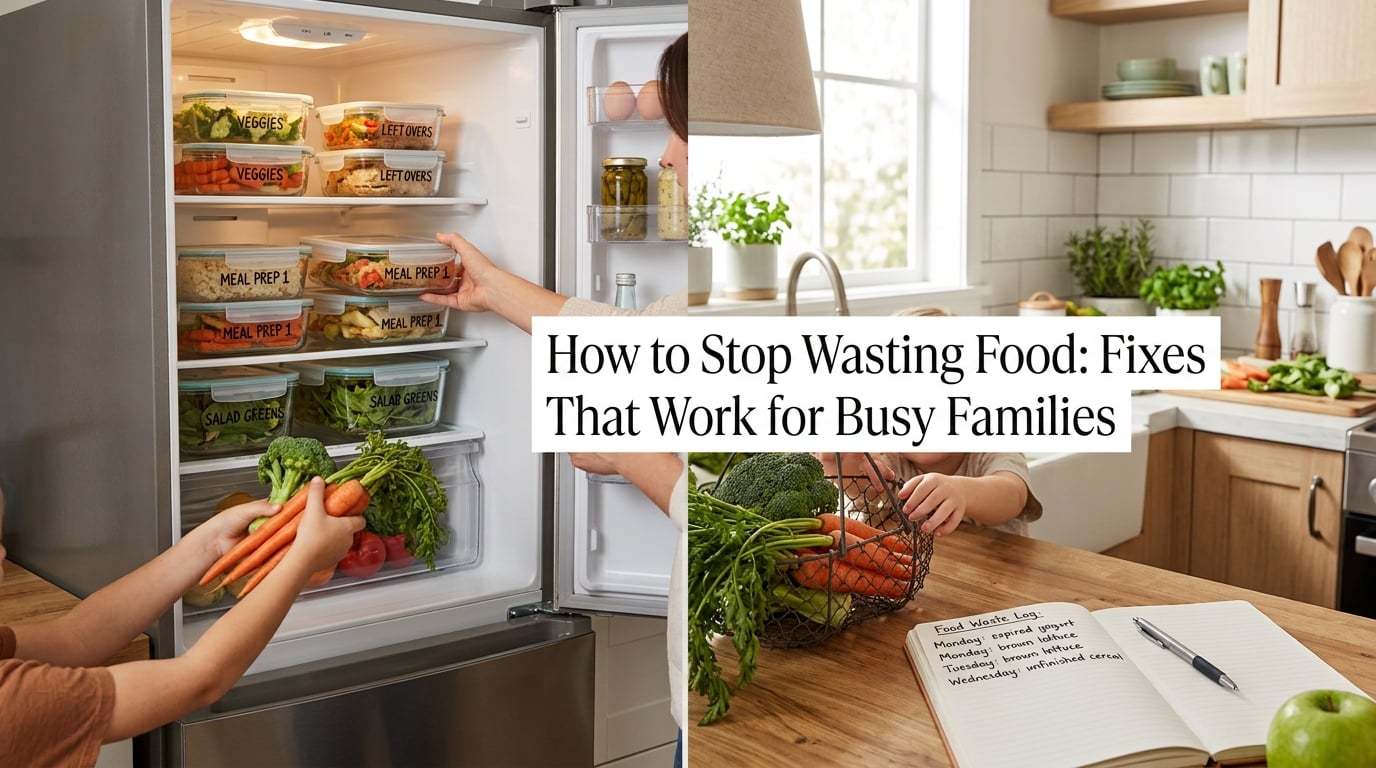
Picture Tuesday night: you open the fridge, stare at half a bag of wilting spinach, three random carrots, and last night’s uneaten chicken. Sound familiar? You are not lazy, and you are not a bad cook. You are a busy family member running on fumes, and the system you inherited was built for someone with more time, more energy, and a quieter household. We have helped families across Edmonton and beyond rebuild that system, and we wrote this guide to share what actually works.
Learning how to stop wasting food is not about becoming a meal-planning perfectionist or composting every carrot top. It is about replacing ten small chaotic decisions with one calm weekly routine. In this guide we will walk you through a one-week audit, realistic meal planning that survives soccer practice, smart shopping habits, storage systems that don’t require a label maker, and freezer strategies that turn one dinner into three. By the end you will have a complete action plan you can start using this week.
Table of Contents
- The 5 Quick Wins: How to Stop Wasting Food This Week
- Why Busy Families Waste More Food Than They Realize
- Start With a 1-Week Family Food Waste Audit
- How to Stop Wasting Food With Realistic Meal Planning
- Smart Shopping: Inventory First, List Second
- Storage Hacks That Actually Work in a Busy Household
- Leftovers and Freezer Meals: Turn One Dinner Into Three
- When Plans Fall Apart: Backup Meal Strategies
- The Last 5%: Composting, Donating, and Closing the Loop
- Quick-Reference Action Plan: Your First 7 Days
- Frequently Asked Questions
- What are 5 ways to reduce food waste?
- What are 10 ways to reduce food waste at home?
- What are some ways households can reduce food waste?
- What is the 2-2-2 food rule?
- What are 5 waste management strategies for the kitchen?
- How can a busy household reduce food waste with no time?
- What should I do with food about to expire?
- The Bottom Line on How to Stop Wasting Food
The 5 Quick Wins: How to Stop Wasting Food This Week
If you only have five minutes, start here. These are the five changes that deliver the biggest drop in household food waste fastest, based on the families we have worked with.
- Shop your fridge first. Before you write a list, eat down what you already own. Plan two or three meals around the produce closest to its use-by date.
- Label everything in the freezer. A piece of masking tape and a Sharpie beats every fancy gadget. Write the name and the date it went in.
- Adopt FIFO in one shelf. Move older items to the front of your fridge and pantry. New items go behind. Start with the shelf you actually open every day.
- Cook once, eat twice. Every dinner you make should produce at least one leftover portion. Either pack it for lunch or freeze it for the backup-meal drawer.
- Keep a “use-it-up” bowl. One bowl in the fridge for the half-can of beans, the last few olives, the lonely roasted sweet potato. Scramble it into eggs, toss it into pasta, blend it into soup.
Why Busy Families Waste More Food Than They Realize
The average Canadian family throws out roughly 140 kilograms of food per year, and that is the conservative number. When our team added up receipts and garbage bags for one Edmonton family of four over a single month, they were losing close to a hundred and fifty dollars. Most parents we have spoken to underestimate their waste by half.
The hidden cost of convenience
Busy families do not waste food because they don’t care. They waste food because the modern grocery environment is engineered to make us overbuy. Bulk displays reward stockpiling, sales trigger purchases of things we already have, and the default meal option after a hard day is takeout. Combine that with different schedules — one kid at hockey, one at dance, a partner on a rotating shift — and you have a household where nobody is home at the same time to eat the same thing. Of course the spinach wilts. Nobody was ever going to be there to eat it.
Decision fatigue and the guilt cycle
Researchers have measured that the average adult makes more than two hundred food-related decisions every day. By dinner time, your willpower is empty, and the easier choice wins. That is not failure — it is human biology. The system you want is one that requires fewer decisions, not better decisions. We will build that system together in this guide.
For working parents especially, the guilt adds another layer. You feel bad about the wasted food, so you promise to plan better, then life explodes again, and you feel worse. Reviewers and forum users report the same cycle. The answer is not more willpower. It is fewer decisions and a 30-minute weekly routine that survives a bad week.
Start With a 1-Week Family Food Waste Audit
Before you change anything, spend one week looking. You cannot fix what you have not measured, and most families are shocked when they see their actual waste on paper. This is the highest-leverage activity in the whole guide, and it is the one no competitor teaches in a family-specific format.
What to track and how
Tape a small notebook to the fridge or open a note on your phone. Every time food leaves your house — compost bin, garbage, dog bowl, the sink because it went bad — write it down. Include three details:
- What it was (example: half a cucumber, two chicken thighs, bread heels)
- Why it left (forgot about it, kids refused, expired, bought wrong amount)
- What you paid (estimate is fine — the point is awareness)
Track for seven days. Do not change anything during the audit. Eat normally, shop normally, and resist the urge to “do better” just because you are watching.
Reading your results without judging yourself
At the end of the week, sort your list into three buckets. Bucket one is forgotten food — the things that got pushed behind something else. Bucket two is kid refusal — the broccoli, the planned-over casserole, the wraps. Bucket three is bad planning — the impulse purchase, the bulk bag you never finished. Most families find that bucket one is twice the size of the other two combined. That is good news. Forgotten food is the easiest waste to fix, and the rest of this guide will give you the exact tools to do it.
One family we worked with discovered that 60 percent of their waste was produce. Another realized the real culprit was deli meat. Your audit will tell you a story specific to your household. Trust the data, not the guilt.
How to Stop Wasting Food With Realistic Meal Planning
Meal planning is the single most recommended strategy in every food-waste article on the internet, and it works. The problem is that most meal plans assume you have a free Saturday, a stocked specialty store, and three uninterrupted hours. Real families do not have any of those. We will build a plan that takes 20 minutes, fits a chaotic schedule, and involves the people who actually eat the food.
Plan around what you already have
The first step is not picking recipes. It is opening your fridge, freezer, and pantry and writing down what you already own. Cross off anything past its prime. Group the rest into loose categories: proteins, vegetables, starches, sauces. Then choose three to five dinners that use those ingredients first. Only after that do you write a shopping list for what is missing. It is the opposite of how most people shop, and it is why most meal plans fail.
Theme nights that get family buy-in
Theme nights are the cheat code of family meal planning. Pick a protein or a style for each night of the week and stop reinventing the wheel. Monday pasta, Tuesday tacos, Wednesday stir-fry, Thursday soup or sandwiches, Friday homemade pizza. Kids can predict what is coming, adults can shop in batches, and nobody has to answer the “what’s for dinner” question seven times a night. Forum users consistently describe theme nights as the single habit that broke their takeout habit.
Involving kids without losing your mind
You do not need a family meeting or a chore chart. Give each kid one job: the toddler points at two vegetables and you buy whichever survives. The eight-year-old picks Friday night. The teenager is responsible for setting the table. That is enough. The point is to give them a stake, not a workload. Kids who help pick the food eat more of the food, and that alone cuts waste dramatically.
Schedule the plan around your actual week
Look at your calendar before you finalize the plan. If Wednesday is the night you have zero time, put the easiest meal there — leftovers, slow cooker, sheet pan. Save the ambitious recipe for Saturday when you actually have 40 minutes. If your partner works late on Mondays, plan a kid-friendly solo dinner for them and save the “family meal” for Tuesday. A meal plan that ignores your schedule is a meal plan that gets takeout instead.
Smart Shopping: Inventory First, List Second
The grocery store is where most overbuying begins. Walking in without a list is like going to the doctor without symptoms — you will leave with something you did not need. Walking in without checking what you already have is worse, because you will buy duplicates of things you forgot you owned. This is the exact scenario a Reddit user in r/AskUK described: four people on different schedules, separate shopping trips, three jars of mustard in the cupboard.
The 10-minute weekly pantry reset
Set a timer. Open the fridge, freezer, and pantry. Write down what is almost expired and what you have a lot of. Wipe one shelf while you are in there. Throw out anything actually bad. That is the whole routine. Ten minutes, once a week, before you write your shopping list. Most families find this one habit prevents 30 percent of their duplicate purchases. It also surfaces the half-bag of rice, the forgotten yogurt, the cilantro that is on day six, all of which can become tonight’s dinner.
Build a list you actually use
A list that lives in your head is not a list. Use whatever works — a note on the fridge, a shared phone note, a small whiteboard by the door. Group items by store section so you walk the store once. Add quantities so you do not buy “some cheese” and come home with a wheel. Most importantly, write your list only after you have done the pantry reset. The two go together.
Shopping with kids without chaos
Two rules. First, give each child one job: pick the apples, find the cereal, choose one vegetable. They feel involved, you stay focused. Second, never shop hungry. Eat a snack before you go in, or shop right after a meal. Hungry shoppers with kids in the cart buy 25 percent more, mostly of the impulse variety. Skip the chip aisle, the bakery, and any endcap with a cartoon character on it. You are not there for entertainment.
Buy only what you will use
Bulk is not a deal if you throw half away. That giant bag of spinach, the family-size yogurt tub, the discount produce box — they are all losses if your household cannot finish them before they spoil. Buy the smallest quantity that fits your real consumption. You can always go back for more. The single Reddit r/Frugal user we heard from described this as the moment their grocery bill dropped by a fifth without changing what they ate.
Storage Hacks That Actually Work in a Busy Household
Good storage is the difference between food lasting six days and food lasting six weeks. Most families do not have bad fridges — they have bad habits inside good fridges. Here are the systems that matter.
FIFO without the corporate feel
FIFO stands for First In, First Out. It is the same system grocery stores use to rotate stock, and it works just as well in your fridge. When you bring groceries home, move older items to the front and put new ones in the back. Do the same in the pantry: new cans behind old cans, new cereal behind old cereal. The single most cited game-changer in forum threads is exactly this — labeling and rotation together. Reviewers report that simply rotating stock cuts wasted produce in half within a month.
Best-by vs use-by explained
This trips up almost every family. The labels do not all mean the same thing. Best-before dates are about quality, not safety. Food past its best-before date is often still perfectly fine for days or weeks. Use-by dates are about safety and you should respect them, especially on meat, fish, and dairy. Sell-by dates are for the store and you can usually ignore them by a couple of days. Once you understand the difference, you stop throwing away yogurt that is still good and start trusting your nose and eyes.
Ethylene gas and produce zones
Some fruits give off ethylene as they ripen. Apples, bananas, and tomatoes are the biggest offenders. Other produce is sensitive to ethylene and spoils faster near them — berries, leafy greens, broccoli, cucumbers. Store ethylene producers separately, ideally on the counter in a fruit bowl, and keep the sensitive stuff in the crisper drawer away from them. It is one of the few storage tricks that delivers visible results within a week.
The lazy labeling system
You do not need a label maker. A roll of masking tape and a Sharpie is enough. Label three things: the freezer door (everything inside, with date), the leftover shelf (anything cooked, with date), and your use-it-up bowl (date goes in). That is the entire system. One user in r/Cooking said labeling was the single change that stopped her from finding mystery containers three weeks later.
Leftovers and Freezer Meals: Turn One Dinner Into Three
Cooking once and eating twice is the highest-leverage habit for busy families. One roast chicken on Sunday becomes tacos Monday and soup Wednesday. One pot of chili on Tuesday becomes lunch portions for two days. The trick is to plan for it from the start, not to decide what to do with leftovers after you have already made them.
The leftover transformation framework
When you cook dinner, pause for ten seconds before plating. Ask yourself: what is the second life of this meal? If the answer is “leftovers in a container,” you will forget it exists. If the answer is “tomorrow’s lunch wraps” or “Wednesday’s soup base,” you will actually eat it. Plan the second life while you are cooking the first life, and write it on the container.
Common transformations: roast chicken becomes chicken salad, chicken tacos, or chicken noodle soup. Sunday roast vegetables become Monday’s grain bowl or Wednesday’s frittata. Cooked rice becomes fried rice or a stir-fry base. Cooked pasta becomes a pasta bake. Most meals have at least two second lives if you give yourself a minute to think about it.
Batch cooking for the freezer
Pick one day a month — Sunday morning, the first Saturday, whatever you can defend — and cook three freezer meals in one session. Good starter recipes: chili, soup, pasta sauce, meatloaf, breakfast burritos, banana bread. Cool fully, portion into family-size containers, label with the name and date, freeze flat so they stack. When the week falls apart, you have backup. Forum users consistently describe the freezer as the secret weapon of families who “look organized” but are actually just well-stocked.
Handling picky eaters and planned-overs
Kids will not always eat last night’s dinner re-heated. That is fine. Transform the ingredients instead of the dish. Leftover roast beef becomes beef and cheese wraps with a different sauce. Last night’s chicken becomes tomorrow’s chicken nuggets with a breadcrumb coating. The food is the same, the perception is new, and picky eaters stay on board. Reviewers and forum participants both highlight this trick as the one that finally got their kids to “eat the leftovers.”
When Plans Fall Apart: Backup Meal Strategies
Every meal plan eventually fails. The goal is not to prevent failure — it is to recover from it in under ten minutes. That is the difference between a calm household and a hangry takeout order.
Pantry-only dinner ideas
Keep a mental list of five to seven dinners that require zero fresh ingredients. Boxed pasta plus jarred sauce plus frozen vegetables. Rice, beans, and a can of tomatoes. Eggs and toast with whatever vegetables are in the freezer. Bean soup from pantry staples. Tuna wraps with pantry condiments. Pancakes for dinner (yes, really). When the fridge is empty and you cannot face another decision, default to one of these. The plan failed but the family still ate, and nothing went to waste.
The 2-2-2 food rule explained
The 2-2-2 rule is a simple backup-meal framework used by nutritionists and busy families alike. Every week, try to have two breakfast options prepped (overnight oats, egg muffins, yogurt parfaits), two lunch options assembled (wraps, grain bowls, soup jars), and two dinner proteins ready (cooked chicken in the freezer, ground meat portioned, beans soaked). Six items, all staged in advance, all ready when life explodes. It is not a full meal plan — it is the parachute you pack before you jump.
The Last 5%: Composting, Donating, and Closing the Loop
Even with a perfect system, some scraps are unavoidable. Eggshells, coffee grounds, banana peels, the broccoli stem your kid would not touch. Those do not need to be garbage. They can be compost, they can be donated, and in some cases they can become tomorrow’s dinner.
Easy home composting for families
You do not need a backyard. A small bin under the kitchen sink or a sealed bucket on the balcony works fine. Layer food scraps with shredded newspaper or dry leaves, stir once a week, and let it do its thing. Even renters can compost. In Edmonton, the city runs a curbside program, and many workplaces and community gardens accept drop-offs. Composting turns the last 5 percent of waste into something useful instead of methane in a landfill.
When to donate vs compost
If you have unopened, non-perishable food you will not use, donate it. Food banks, shelters, and community fridges accept sealed boxes, cans, and pantry staples. Some local apps let you post surplus produce or baked goods to neighbors. If the food is open, expired, or fresh produce that has gone soft, compost it. The rule of thumb is simple: sealed and safe goes to people, opened or spoiled goes to compost.
Kids love being part of the donation step. One reader told us her kids now race to put the extra cereal boxes in the donation bag. Small actions like that teach a generation that food has value.
Quick-Reference Action Plan: Your First 7 Days
Here is the entire guide compressed into a 10-step action plan. Print it, pin it to the fridge, and check off one per day. By next week your waste will already be dropping.
- Day 1: Set up a waste-tracking notebook or phone note. Start logging every item that leaves your kitchen.
- Day 2: Do a 10-minute pantry, fridge, and freezer audit. Toss what is actually bad. Note what is almost expired.
- Day 3: Plan three dinners around what you already own. Add only what is missing to your shopping list.
- Day 4: Cook once, eat twice. Pick tonight’s dinner and intentionally plan tomorrow’s lunch from the leftovers.
- Day 5: Implement FIFO on your busiest shelf — the one you open every day. New items go behind older ones.
- Day 6: Set up the use-it-up bowl. Label three freezer items with name and date.
- Day 7: Pick two freezer meals to batch cook. Portion, label, freeze flat.
- Bonus: Choose your five pantry-only backup dinners and write them on the inside of a cabinet door.
- Bonus: Move ethylene-producing fruits to the counter and away from your berries and leafy greens.
- Bonus: Find your local food bank or community fridge. Set a reminder to drop off one item next week.
Frequently Asked Questions
What are 5 ways to reduce food waste?
The five fastest ways to reduce food waste for a busy family are: shop your fridge first before writing a list, label everything in the freezer with a name and date, adopt FIFO on one shelf at a time, cook once and eat twice from every dinner, and keep a use-it-up bowl in the fridge for random leftovers.
What are 10 ways to reduce food waste at home?
Plan meals around what you already own, build a shopping list only after a pantry reset, store produce away from ethylene-producing fruit, freeze leftovers in labeled portions, cook once and eat twice, set up FIFO rotation, compost scraps, donate sealed surplus, transform leftovers into new meals, and keep pantry-only backup dinners ready for chaotic weeks.
What are some ways households can reduce food waste?
Households can reduce waste by auditing what they throw away, planning meals around existing inventory, shopping with a written list grouped by store section, storing food to extend its life through FIFO and proper zones, transforming leftovers into new meals, freezing portions for backup dinners, and composting the scraps that cannot be eaten.
What is the 2-2-2 food rule?
The 2-2-2 rule is a backup-meal framework used by busy families. Every week, aim to have two breakfast options prepped, two lunch options assembled, and two dinner proteins ready to cook. Six staged items cover you when the meal plan falls apart midweek.
What are 5 waste management strategies for the kitchen?
The five most effective kitchen waste management strategies are FIFO rotation, label-and-date on every container, an ethylene-aware produce zone, a freezer-first approach to leftovers, and a designated use-it-up bowl that gets emptied into a meal at least twice a week.
How can a busy household reduce food waste with no time?
Start with a 10-minute weekly pantry reset, plan three dinners around what you already own, default to pantry-only dinners when schedules explode, transform every dinner into a planned second meal, and freeze leftovers in single portions. These habits take less than 30 minutes a week and cut waste fast.
What should I do with food about to expire?
Prioritize it in tonight’s or tomorrow’s meals, freeze it if you cannot eat it within two days, donate sealed non-perishables to a food bank, or compost anything spoiled. A use-it-up bowl in the fridge gives almost-expired food a dedicated home so it does not get forgotten again.
The Bottom Line on How to Stop Wasting Food
You do not need a perfect system. You need a good-enough one that survives a bad week. Start with the audit. Pick the easiest habit from this guide — the use-it-up bowl, the 10-minute pantry reset, or theme nights — and run it for 21 days. Once it sticks, layer the next one. Within two months, your grocery bill will drop, your fridge will look different, and the Tuesday-night guilt spiral will fade.
Learning how to stop wasting food is one of those rare skills that pays you back every single week. It saves money, lowers stress, feeds your family better, and gives your kids a quiet lesson in mindful consumption they will carry into adulthood. You do not have to do it all at once. You just have to start.