
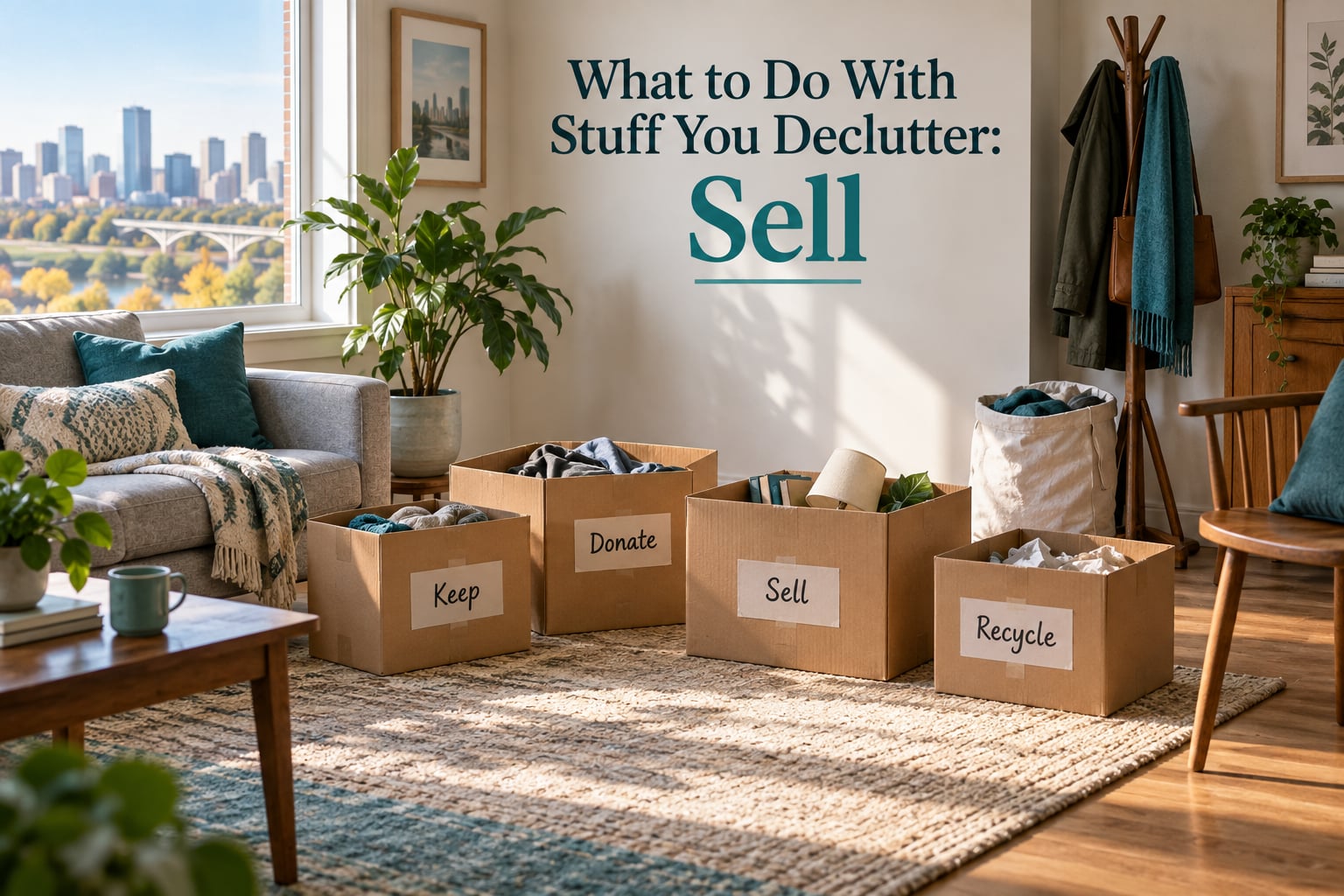
Most decluttering guides never answer the real question. You have a pile of things in front of you that you no longer want, and you need to know where each one goes right now, not a philosophical framework for minimalism. The answer to what to do with stuff you declutter is a three-way split: some items should be sold, some should be donated, and some should be trashed or recycled without a second thought.
I have run this same sorting process with our own house, with my parents’ house before they downsized, and with a neighbour clearing out an estate after her father passed. The same rule came out of every one of them. What matters is not how much you paid for something or how you feel about it. What matters is its condition, its resale value, and how much energy you are genuinely willing to spend on it today.
This guide gives you a routing rule you can apply mid-purge, honest guidance on what charities actually accept in the Edmonton area, and a category-by-category answer for the specific things that always cause arguments: kids’ clothes, old electronics, mattresses, books, tools, and the drawer of sentimental odds and ends nobody will admit to owning.
Table of Contents
- What to Do With Stuff You Declutter: The 30-Second Routing Rule
- Sell It or Donate It? The Two-Condition Test
- How to Price Decluttered Items So They Actually Sell
- Where to Sell: Kijiji vs Facebook Marketplace vs Consignment vs eBay
- The 7/14/30-Day Rule That Ends the Sell Pile
- Where to Donate Stuff in Edmonton and Alberta
- What Charities Will Not Take
- Recycle or Trash: The Middle Ground Most People Skip
- How to Let Go of Sentimental Items Without Regret
- What Not to Declutter, Ever
- Declutter Before a Move: A Four-Week Countdown
- Frequently Asked Questions
- What is the hardest thing to get rid of when decluttering?
- What is the 3-3-3 rule for decluttering?
- What are the 12 things you can’t donate to Goodwill anymore?
- What should I throw away when decluttering?
- What is the fastest way to sell household items?
- How do you decide what to get rid of when decluttering?
- What to sell when decluttering?
- How to sell unnecessary items?
- Is it better to sell or donate?
- The One Rule to Remember
What to Do With Stuff You Declutter: The 30-Second Routing Rule
Here is the whole decision in one block, before anything else:
- Sell it if it works, it is in clean good condition, you can list it in under 10 minutes, and you expect to get back more than about half of what you originally paid.
- Donate it if it is in good working condition and someone else would genuinely want it, but the resale value will not cover your time.
- Recycle or take to a depot if it is electronics, batteries, paint, chemicals, or another household hazardous material.
- Trash it if it is broken, unsafe, stained beyond saving, recalled, or nobody would take it if you gave it away free.
If you cannot decide, the item is telling you something. An object you have held in your hands for thirty seconds without a clear destination is one you have already decided about, you just have not admitted it yet. Put it in the trash bag.
Forum discussion on this topic is remarkably consistent. On r/minimalism, people repeatedly land on the idea that it is not worth it to resell low-value items once you factor in photographing, listing, messaging, and meeting buyers. A Bogleheads poster runs a stricter ladder: try to sell, donate whatever does not sell, recycle next, and treat the landfill as the last option. Both approaches clear a house. Only one of them clears it by the weekend.
Sell It or Donate It? The Two-Condition Test
Selling is a job. Listing is a job, answering messages is a job, and the handoff at the door is a job. Before anything goes on the sell pile, it has to clear two conditions.
Condition one: worth more than the effort
Price the item, then estimate the minutes. A dining table that fetches 90 dollars and takes you two hours to photograph, load, and deliver is a bad trade. A cordless drill that fetches 70 dollars and takes 20 minutes from listing to pickup is a good one.
Use this as your filter: if the expected money is worth less than roughly 20 dollars an hour of your time, donate it instead. Most household clutter falls well under that line. That is not a failure. It is the maths.
Condition two: you will actually do it
Be honest about the follow-through. The sell pile graveyard in your spare room or closet is a real place, and most people have one. If you are not going to photograph it, price it, and post it this week, skip the fantasy and donate it now.
My rule after a few rounds of this: anything that survives one week untouched moves to donate without a guilt check. A commenter on a decluttering blog made the same point from the other direction, deciding to donate all their kitchen items rather than slowly selling dishes one at a time on a marketplace. That is not laziness. It is a decision about what your weekends are for.
The honest comparison of sell versus donate
- Selling wins on: electronics, tools, camping and sports gear, camera equipment, name-brand clothing, furniture in good condition, collectibles, baby gear that sells fast.
- Donating wins on: clothing, linens, kitchenware, non-branded furniture, board games, decor, books beyond a small personal library.
- Neither wins on: broken anything, single-use items, and anything you would not describe as useful to a friend.
If you are wondering whether you should sell everything you declutter, the answer is no, and the people who try to become full-time resellers are the exception rather than the rule. Donating is faster, cleaner, and puts usable goods directly in front of someone who needs them.
How to Price Decluttered Items So They Actually Sell
Start at roughly half of what you originally paid. That number has held up well for us across clothing, small appliances, and housewares. If you no longer remember the original price, search the model number and look at what the current version sells for, then halve it.
Adjust from there with three rules:
- Price lower for textiles and clothing. Used shirts and jeans sell fast but cheap. Price them to move, not to recoup.
- Price higher for recent hardware and appliances. Working electronics with known specs and no visible scratches can go at 60 to 70 percent of the new price.
- Price anything with missing parts at scrap value. A listing that says works but is missing the remote or one wheel will sit forever.
Photograph the item in daylight near a window, on a plain surface, with three shots minimum: the front, any labels or model numbers, and any flaw you are honest about. Buyers filter out listings with one blurry photo, and they zoom in on damage you did not mention. A measured photo in a measuring tape costs nothing and signals a serious seller.
Price it, list it, and set a date. That date is the part most people skip.
Where to Sell: Kijiji vs Facebook Marketplace vs Consignment vs eBay
Each channel suits different items. Picking the wrong one is how a decluttering project turns into a month-long side business.
| Platform | Best for | Time to sold | What to watch |
|---|---|---|---|
| Kijiji | Furniture, appliances, bikes, tools, anything a buyer must see in person | Fast for local items, slow for small trinkets | Buyers are deal hunters and often want a firm no-yes on price |
| Facebook Marketplace | General household items, kids’ gear, sports equipment, bundles | Fast for popular categories, slow for anything obscure | Scams and lowball offers, so keep payments in the app |
| Consignment | Designer clothing, handbags, formalwear, high-end kids’ wear | Slowest, but zero effort after drop-off | The shop takes a large cut, often half or more of the ticket |
| eBay | Collectibles, camera gear, tools, anything with a national market | Varies widely, best for items worth more than a local buyer pays | Shipping and fees eat margin on heavy items |
Our default is simple: local platform first, eBay only when the item is worth more than a local sale. A garage sale still makes sense for a large volume of low-value items, but it only works if the weather cooperates and you commit to the whole weekend. A neighbour once sold a garage of items in one day and described it as a horrible weekend she would happily repeat, because the alternative was two more trips to the transfer station.
The 7/14/30-Day Rule That Ends the Sell Pile
Every unsold listing is borrowing space from a decision you already made. The fix is a deadline, and the deadlines are simple.
- Day 7: anything with zero views gets re-listed once with a better photo and a lower number, or it moves straight to donate.
- Day 14: anything with views but no buyer drops 20 percent. If it still has not sold, it is priced above its market.
- Day 30: everything left goes to donation or recycling with no discussion. You already gave it a month.
List the deadline in your phone calendar the day you post. This is the single change that made the biggest difference in our house, because it converts a decision about objects into a decision about a date.
Pickup is where most listings die. Offer two or three evening or weekend windows in the listing itself, and say up front that you can meet during those times only. It filters out the messages that go nowhere.
Where to Donate Stuff in Edmonton and Alberta
Goodwill and Value Village thrift stores accept clothing, housewares, toys, books, and small furniture at their donation centres, and larger items are often accepted at bigger locations. Habitat for Humanity ReStore outlets take furniture, appliances, and building materials, and they are picky about condition because their resale model depends on it.
For clothing, a charitable clothing drive or a direct partnership with a local shelter often handles items a thrift store will not take. Excess Community Food in the Edmonton area accepts non-perishable food, and organizations such as the Food Bank depend on that stream more than most people realise.
Several charities run free pickup for large donations, which is the difference between donating a wardrobe and donating a bookshelf. Ask when you book, because pickup eligibility usually depends on volume and whether the item works.
| Outlet | Accepts | Pickup | Notes |
|---|---|---|---|
| Goodwill and Value Village donation centres | Clothing, shoes, housewares, toys, books, small furniture | Usually drop-off, some larger sites offer pickup | Textiles must be clean and wearable |
| Habitat ReStore | Furniture, appliances, housewares, building materials | Often available for full loads | Working items only, no broken electronics |
| Shelter and clothing drives | New or gently used clothing, winter gear, linens | Pickup commonly available | Seasonal needs, especially coats, are the priority |
| Excess Community Food and food banks | Non-perishable pantry items | Drop-off | Check the current need list before you pack boxes |
| Community freecycle and buy-nothing groups | Anything usable, no fee, no receipt | Buyer collects | Fast for items in demand locally |
On tax receipts: in Canada, you can claim eligible in-kind donations to registered charities if you can prove the fair market value with a receipt. For most goods, the common threshold is 200 dollars or more, so a bag of clothing will not qualify. For anything expensive such as a piano, boat, or vehicle, get the appraisal and the formal receipt in writing before you hand it over. Rules here are specific and change, so check the Canada Revenue Agency guidance for in-kind donations before you rely on a receipt.
What Charities Will Not Take
This is the part that costs people the most wasted time: loading the car, driving across the city, and being turned away at the counter. The reason is almost always workload, liability, or resale value. An item a charity cannot cheaply resell is an item they cannot afford to sort.
- Worn, stained, or damaged textiles, including sheets, curtains, and towels with holes or bleach damage.
- Exercise mats and gym equipment that are torn or cracked, because of hygiene rules around shared fitness items.
- Recalled car seats and car seats with unknown history, which most organizations cannot legally accept.
- Wet, opened, or unknown paint, along with solvents, fuels, and chemicals of any kind.
- Broken electronics and appliances, including toasters, kettles, and anything with a heating element.
- Household chemicals and aerosols, including pool chemicals and drain cleaner.
- Mattresses and box springs, which most donation centres cannot take for sanitary reasons. Check whether your municipality or a private service offers a dedicated mattress program.
- Textbooks and used books in poor condition, and most encyclopedias.
- Expired, opened, or recalled over-the-counter medication, which must go to a pharmacy take-back program instead.
- Batteries, including lithium packs, which can start fires in a compactor and belong at a depot.
- Single-use items and anything with a shelf life, including opened pantry goods and vitamins.
- Mirrors, large glass, and construction debris, which are too heavy and fragile for volunteer crews.
Call ahead when you have more than a carload. Most centres will tell you in a minute whether they can take your specific item, and that minute is cheaper than the drive.
Recycle or Trash: The Middle Ground Most People Skip
Some of what you pull out of a closet does not belong in a donation bin or a garbage bag. It belongs somewhere with a specific process, and putting it in the wrong one is how people end up hauling the same pile twice.
- Electronics: take TVs, monitors, computers, phones, and printers to an electronics recycling site rather than a charity, since most charities cannot resell them.
- Batteries: tape the terminals of lithium cells and bring them to a household hazardous waste site or a participating retail drop-off. Loose batteries in a garbage or recycling bag are a real fire risk.
- Paint, solvents, and cleaners: household hazardous waste only, never the drain and never the curb.
- Fluorescent bulbs and tubes: these contain mercury and go to hazardous waste, not the blue box.
- Medication: pharmacy take-back programs, or a drug depot if your community has one.
- Styrofoam, tangled plastics, and black plastic trays: check the local program’s accepted list, because the rules differ and a rejected load means a second trip.
In Edmonton, the City of Edmonton transfer stations and the City’s recycling and household hazardous waste programs are the destinations for paint, batteries, electronics, and chemicals. The City also runs community recycling events where you can bring items the regular program does not take. Bring your own containers and separate everything before you go, because unsorted loads get turned away at the scale house.
Junk removal companies will do the hauling for you, and they are a reasonable option for a garage full of heavy mixed material. The cost is charged by volume and by the trip, so it is worth getting two or three quotes, and worth asking whether they separate and recycle. If you skip this section entirely, the odds are good that some of your “trash” belongs in one of the categories above.
How to Let Go of Sentimental Items Without Regret
The hardest things to declutter are rarely the valuable things. They are the small ones: your kid’s baby shoes, a stack of photos, a hand-drawn card, a suitcase your parent carried through one specific winter.
Three techniques have worked for our family. Photograph it thoroughly, print one good copy, and let the object go. Record the story out loud, in your own voice, rather than writing it down, which helps more than it sounds. And give the item to a specific named person rather than a general donation, because a specific recipient keeps the memory alive and a bin rarely does.
There is a question that appears constantly in decluttering forums and is worth sitting with: are you keeping this item, or keeping the guilt of giving it away? One commenter put it as a burden question, asking whether she wants to keep things so her children have to declutter them later. That reframing does more work than any storage solution.
You will also hear the 3-3-3 rule, a popular way to break ties quickly. One version is three years, three months, and three days, a countdown from when you last used something. Another is three items in for every three items out. Use whichever one helps you move, and treat the deadline as a decision tool rather than a moral test.
What Not to Declutter, Ever
A few categories deserve a permanent exemption from the purge.
- Documents: tax returns, insurance, wills, deeds, birth and marriage certificates, and anything tied to a benefit. Scan them, then keep the originals in one labelled folder.
- Heirlooms and one-of-a-kind items: you cannot replace what has no second copy, and the same goes for irreplaceable photos and recipes.
- Tools you own only one of: a single socket, a specific knife sharpener, a specialty wrench. Selling it is renting it back to yourself at a loss.
- Gear you still rotate in and out, such as a sewing machine, camp stove, or camping set you use twice a year.
- Anything you paid off that you use regularly. The purchase is sunk; the use is current.
Sweeping furniture, unpaid student loans, and the money already spent are classic examples of the sunk cost trap. The item is worth what it is worth today, and today it is sitting in your basement.
Declutter Before a Move: A Four-Week Countdown
Move season is when the sell pile graveyard builds fastest, because people expect a move to solve a problem that only sorting solves. A four-week countdown works better than the usual panic.
Four to six weeks out: sort room by room into four boxes, keep, sell, donate, and dispose. Do not list anything yet. The goal is volume and honesty, not money.
Three weeks out: list every sell item in one sitting. Photograph as you go, so you are not hunting for a sold item you already promised to someone.
Two weeks out: everything unsold is already past its 14-day mark. Donate it in one trip, and book pickup for anything too large to carry down the stairs alone.
One week out: take hazardous waste, batteries, and electronics to the depot now, not on moving day. Nothing in those categories belongs in a moving truck, and a full day of it is the most common reason move-out timelines slip.
Plan the last few days for the things nobody sells or donates. When you reserve a truck, decide in advance what happens to the leftover garbage, because a moving day is the worst possible moment to be pricing a garage door.
Frequently Asked Questions
What is the hardest thing to get rid of when decluttering?
Sentimental items are almost always the hardest, and small ones are worse than valuable ones. A baby shoe, a handwritten card, and a stack of photos have no replacement value, so there is no comfort argument to fall back on. The people who move fastest photograph the item in detail, tell the story out loud, and give it to a named person. That keeps the memory and releases the object in the same week.
What is the 3-3-3 rule for decluttering?
It is a decision shortcut with several versions. The most common asks whether you used something in the last three years, three months, and three days. Another counts three items coming in for every three going out. A third is three places an item should live in your home. Use it as a tiebreaker when a sorted item sits on the counter, because its job is to end the debate rather than settle it.
What are the 12 things you can’t donate to Goodwill anymore?
The usual refuse list covers worn or damaged clothing, sheets and towels, exercise mats, recalled or unknown-history car seats, paint and solvents, broken electronics and appliances, mattresses and box springs, most textbooks and encyclopedias, expired or opened medication, batteries, perishable and single-use items, and mirrors or large glass. Most charities cannot resell them or cannot safely handle them. Call ahead with a carload so you are not turned away.
What should I throw away when decluttering?
Throw away anything broken, unsafe, recalled, stained beyond saving, or that nobody would accept if you gave it away free. In practice that means cracked dishes, wobbly furniture, torn gear, dead electronics, and mystery items nobody in the house can identify. Use opaque bags so the pile is out of sight, and take batteries, paint, medication, and electronics to a depot rather than the landfill.
What is the fastest way to sell household items?
Speed comes from three things: clear photos in daylight, a price that matches the market, and pickup windows stated in the listing. Kijiji and Facebook Marketplace are fastest for furniture, appliances, tools, and kids’ gear, while eBay is faster for gear worth more than a local buyer will pay. List everything in one sitting, price at about half of the original cost, and lower it on day 14 if there is no interest.
How do you decide what to get rid of when decluttering?
Ask three questions. Is it in good working condition, is it worth more than the effort of selling it, and would someone else genuinely want it? Good condition and worth the effort means sell. Good condition but low return means donate. Broken, unsafe, or unwanted by anyone means recycle where a program exists and trash otherwise. If the answer takes more than thirty seconds, the item is telling you it goes.
What to sell when decluttering?
Sell what holds its value and sells itself: electronics with working functions, name-brand tools, cameras, camping and sports gear, furniture in good condition, name-brand clothing, and collectibles. Bundling raises your odds, so a set of camping pots or a pair of matched dining chairs sells faster than either alone. Skip clothing without labels, kitchenware, non-branded furniture, and anything that needs parts you no longer have.
How to sell unnecessary items?
Pick one platform, photograph every item against a plain surface in daylight, and write a two-line description covering size, condition, and what is included. State two or three pickup windows so the messages that go nowhere stop. Set a deadline the day you list, because an unsold listing is just stored clutter. Anything unsold after thirty days goes straight to donation without a second round of price cuts.
Is it better to sell or donate?
For most household items, donating is better. Selling only pays when the item fetches more than roughly twenty dollars an hour of your time, which excludes most clothing, kitchenware, books, and small decor. Selling is worth the work for electronics, tools, furniture, name-brand clothing, and collectibles. Donating is faster, frees the item immediately, and puts something usable in front of a person today rather than in a closet for a month.
The One Rule to Remember
Deciding what to do with stuff you declutter comes down to condition, value, and effort. Good condition and worth the effort means sell. Good condition and low return means donate. Broken, unsafe, or unwanted means recycle where a program exists and trash otherwise. Then put a date on the sell pile, because a deadline is what turns a decision about objects into a decision about a calendar.
Start with one room, four boxes, and a Saturday morning. The next room is easier than the first, and the house gets quieter every time a pile leaves it.