
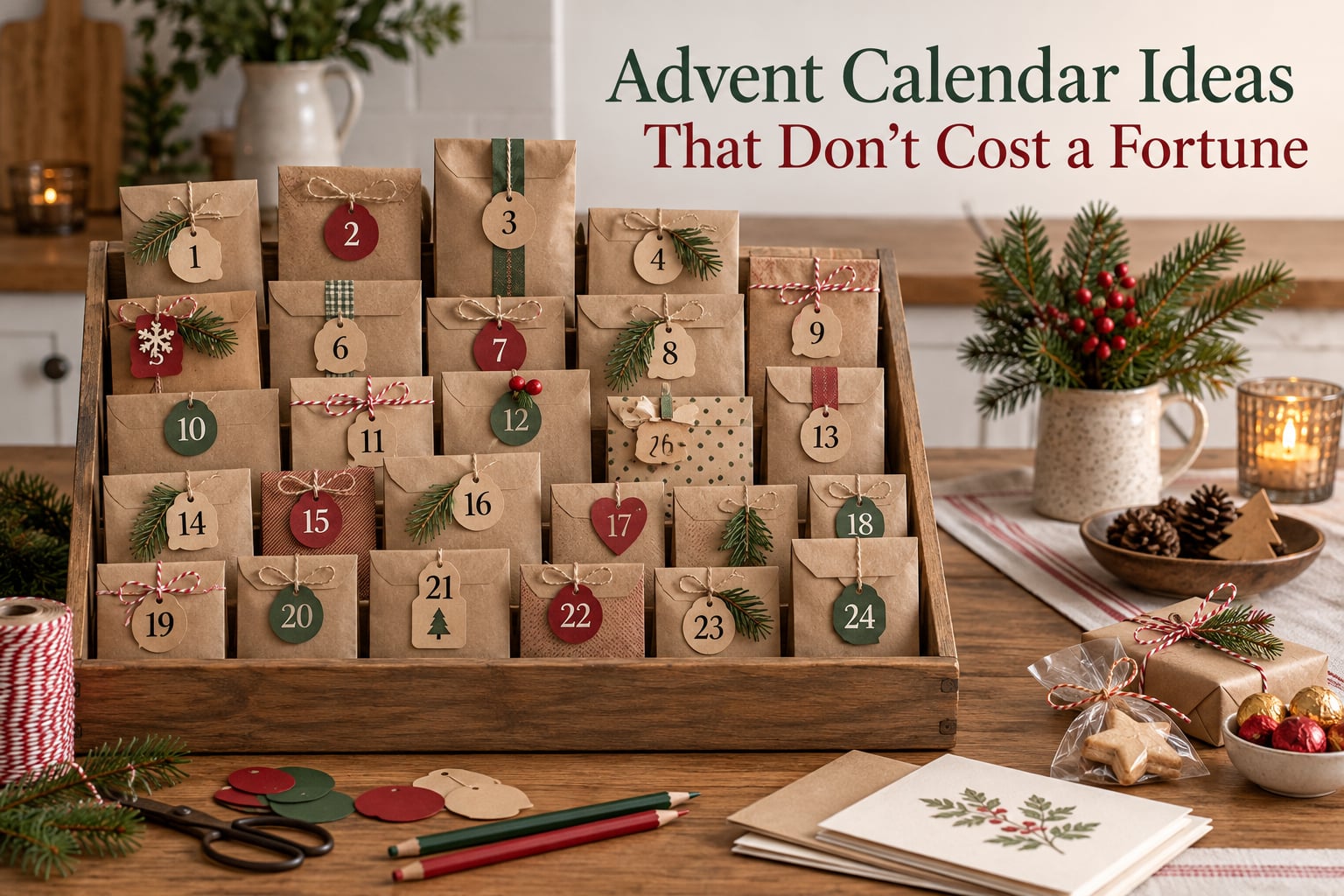
Advent calendar ideas that don’t cost a fortune all share one rule: the calendar holds the tradition and the budget survives the fillers. A handmade countdown built from numbered envelopes, paper bags or a muffin tin can cost anywhere from nothing to about 25 dollars Canadian for a full 24 days, and a base that survives December keeps paying you back every year after that.
Store-bought novelty calendars run two to three times more, get opened once, and land in the trash bin in January. If you have ever bought filler items one at a time at full retail, you already know how that math goes.
Below is everything we tested and priced out: the real cost of a finished calendar, six base designs ranked by difficulty, more than 40 filler ideas grouped by price tier, and where Edmonton families actually find the cheapest supplies. Last updated September 2026.
Table of Contents
- Quick Picks: 12 Budget Advent Calendar Ideas, Cheapest First
- What a Budget Advent Calendar Actually Costs
- How to Make an Advent Calendar Base for Under Five Dollars
- Zero-Cost Advent Calendar Fillers You Can Make Tonight
- Filler Ideas for Under Five Dollars
- Filler Ideas for Under Ten Dollars
- No-Sugar, No-Chocolate and Allergy-Aware Fillers
- Advent Calendar Ideas by Recipient
- Kids: activity cards, jokes and a clue chain work best
- Teens: useful, small and not junk food
- Adults: acts of service and a hot drink
- Partners and couples: coupons that run a full month
- Grandparents and long-distance family: send the calendar, not the object
- Co-workers, Secret Santa and classrooms: keep it identical
- The Reusable Advent Calendar Math: Buy Once, Fill for Years
- Where Edmonton and Canadian Families Buy the Cheapest Fillers
- The Zero-Prep Digital Advent Calendar
- When to Start and How Long Filling Actually Takes
- Frequently Asked Questions
- What are some easy homemade advent calendar ideas?
- What are some ideas for making an empty advent calendar?
- What to fill a DIY advent calendar with?
- What are some cheap ideas for an advent calendar?
- What are some good ideas for small advent calendar fillers?
- What are some ideas for filling a homemade advent calendar?
- What are the best affordable advent calendars?
- What are some good fillers for an advent calendar?
- Wrapping Up Your Budget Countdown to Christmas
Quick Picks: 12 Budget Advent Calendar Ideas, Cheapest First
These are the ideas that survived our comparison of cost, assembly time and how long the calendar lasted. The cheapest one on the list is genuinely free.
- Email or text countdown — 0 dollars CAD, zero prep, works for long-distance family.
- Numbered envelopes on a string — a few dollars for envelopes and ribbon, refillable forever.
- Acts of service coupons — 0 dollars CAD, and the most praised filler in family forums.
- Paper lunch bags in a shoebox — under 3 dollars CAD, the easiest upcycled base.
- Printed joke and riddle cards — 0 dollars CAD once you have a printer and blank card stock.
- Scavenger hunt clue chain — 0 dollars CAD, and the version children remember years later.
- Muffin tin with numbered paper cups — under 5 dollars CAD, survives storage and travel.
- Dollar store mini toys — a few dollars CAD for 24 small items bought in one trip.
- Bulk candy in tiny bags — a few dollars CAD, the classic route, easy to scale.
- Stickers, erasers and temporary tattoos — under 10 dollars CAD, no sugar involved.
- Reusable fabric pocket calendar — a bit more upfront, near-zero cost per year after.
- Daily activity card deck — 0 dollars CAD, printed once and reused for a decade.
What a Budget Advent Calendar Actually Costs
A complete 24-day budget Advent calendar lands between 5 and 25 dollars Canadian depending on how much sweet stuff you add. Here is the honest breakdown of what each approach really costs in Edmonton.
| Approach | Estimated total cost (CAD) | Reusable? | Best for |
|---|---|---|---|
| Digital countdown by email or text | 0 | Yes, every year | Busy families, long-distance relatives |
| All-zero-cost fillers (cards, coupons, clues) | 0 to 2 | Yes | No-sugar households, tightest budgets |
| Paper bags in a upcycled shoebox | 3 to 6 | Base only | Fastest homemade base |
| Numbered envelopes on string or a door | 4 to 9 | Yes, refill pockets each year | Most popular DIY method |
| Muffin tin with paper cups | 5 to 10 | Yes, tins last years | Travel and school-bag durability |
| Dollar store fillers bought in bulk | 6 to 15 added on top | Filler only | Candy, stickers, mini toys |
| Reusable fabric pocket calendar | 12 to 30 once | Yes, 5+ years | Cheapest cost per year after year one |
The table above is the part most guides skip. A homemade calendar is not automatically cheaper — the moment you buy filler items one at a time at full retail, the cost creeps past a store-bought calendar quickly. The trick is buying your fillers in one trip, in bulk, and filling a good share of the pockets with paper instead of plastic.
Our rule of thumb: if your fillers cost more than 40 cents each, you are spending more than you need to. Twenty-four pockets at 40 cents each is under 10 dollars before you have made anything at all.
How to Make an Advent Calendar Base for Under Five Dollars
You do not need craft supplies, a sewing machine or a trip to a specialty store. Most of the best bases come from things already in your kitchen closet.
Pick a container with 24 hiding places
A muffin tin, a shoebox, 24 envelopes, 24 paper lunch bags, a cereal box, or a strip of felt pockets all work. Anything that opens and closes and can be numbered one through 24 gives you a working calendar.
Number every compartment before you fill it
Handwritten numbers work fine. Number labels you print at home cost nothing and make the calendar look finished rather than homemade in a bad way.
Sort fillers into 24 piles before December 1
Lay out newspaper on a table, make 24 piles, then transfer them to the pockets. This is the method that stops you finding an empty pocket on December 19.
Hide the calendar somewhere boring
The back of a bookshelf, a coat pocket, a dresser drawer. Parents in family forums all say the same thing: the calendar loses its magic the moment the child knows exactly where it lives.
Add one piece of chocolate or not, your call
There is no rule that a calendar needs sweets. Plenty of families run a fully paper countdown and never hear a complaint about it.
Keep the base, not the calendar
Store envelopes, pockets or the tin in a labelled bag after Christmas. That single habit is what turns this into a calendar you reuse year after year.
| Container | Cost (CAD) | Difficulty | Reusable | Kid-friendly |
|---|---|---|---|---|
| Numbered envelopes | 4 to 9 | Easiest | Pockets survive, envelopes do not | High |
| Paper lunch bags in a shoebox | 3 to 6 | Easy | Bags do not, shoebox does | High |
| Muffin tin with paper cups | 5 to 10 | Easy | Tin lasts years | Very high |
| Toilet-paper roll halves on a string | 0 to 3 | Easy | Craft wire and rolls do not | Medium |
| Felt pockets on a string | 6 to 20 | Needs sewing | Yes, 5+ years | High |
| Cardboard box with flap doors | 0 to 2 | Medium | No | Very high |
Felt pockets hung on a string and numbered boxes come up again and again in family forums as the versions people describe as simple, attractive and reusable. If you can sew, felt is the best base on this list over a decade. If you cannot, envelopes and paper bags win on effort.
Zero-Cost Advent Calendar Fillers You Can Make Tonight
These fillers cost nothing beyond paper you already own, and they are enough on their own to fill a full 24-day countdown. Print them, cut them up, and you never have to think about fillers again.
- Jokes and riddles — one per pocket, printed on card stock or written on scraps.
- Christmas facts and odd trivia — a fun holiday fact or a piece of odd trivia nobody expects, which is exactly why they get talked about.
- Acts of service coupons your turn to do the dishes, mow the lawn, wash the car, take over bedtime for a week.
- Kindness prompts tell someone something kind, draw a stranger a picture, pay for the person behind you.
- Gratitude notes a family member writes one line about what they are thankful for.
- Scavenger hunt clues a chain where each day points to where tomorrow’s clue is hidden.
- Daily activity cards bake something together, build a fort, walk a different route home.
- Compliment coupons one redeemable compliment per day, redeemable only if the recipient believes it.
- Book coupon one new book for the person opening it.
- Sleep-in pass valid on any morning in December, transferable once.
- Chore pass one skipped chore, no questions, no expiry.
- Family movie pick the opener chooses that night’s film.
- Hot drink of the day recipe card written by hand, which is worth more than the recipe.
- Secret compliment envelope each person secretly writes one note for one other person to open on the 24th.
- Photo from the past a printed picture nobody has seen in years.
- Silly dare cards wear your shirt inside out, do your best impression of a family member.
Forum families are near-unanimous that the cheap-but-meaningful fillers get the most praise: a coupon for a home-cooked meal plus doing the dishes, a massage, a car wash, mowing the lawn, or taking over the bedtime routine. They cost nothing and they get remembered more than anything you could buy in a bin.
Filler Ideas for Under Five Dollars
Small-treat fillers for under five dollars a day still produce a finished calendar in the ten-to-fifteen dollar range. These are the fillers that survive a school bag and a small child.
- Bulk candy buy one large bag and portion it yourself into 24 small bags.
- Mini chocolate bars or coins from the bulk section, which costs a fraction of a novelty calendar’s price per day.
- Erasers and small pencils practical, cheap enough in bulk, and gone by Christmas morning.
- Sticker sheets one sheet per pocket, or one sheet every few pockets for a bigger reveal.
- Miniature toys small cars, animals or figures from a dollar store bin.
- Bubble gum or sweet drops individual wrapped pieces, portioned at home.
- Silly string or a small play item one per pocket, bought in a multi-pack.
- Tea or cocoa packets one for each grown-up pocket, which makes a partner calendar feel personal.
Portioning at home is the single biggest cost lever. A bulk bag you split into 24 gives you a per-day cost that no novelty calendar comes close to.
Filler Ideas for Under Ten Dollars
Under-ten-dollar fillers raise a calendar into the fifteen-to-twenty-five dollar range but add real substance. Pick four or five of these and let the zero-cost list handle the rest of December.
- Bath bombs a multi-pack divided across several pockets.
- Fuzzy socks cheap in December, and a good swap for the small items that end up under the tree.
- Hot chocolate stirrers or mugs a small gift for each adult on your list.
- Colouring books, small puzzles or colouring tins good for a December travel day.
- Candle one for a partner or a hard-to-buy-for adult.
- Movie night passes printed cards, or actual small gift cards for a rental store.
- Small craft kit beads, mini paint pots or a tiny cross-stitch frame.
- Tickets or event vouchers a local attraction or pool pass for teens and adults.
- Books a paperback for a reader, wrapped in tissue paper.
- Tea, coffee or hot chocolate sampler a few small packets for adult calendars.
The trick to staying under budget is mixing tiers, not choosing one. Twelve zero-cost fillers plus eight inexpensive ones keeps the total low and the calendar full.
No-Sugar, No-Chocolate and Allergy-Aware Fillers
A no-chocolate Advent calendar is the easiest kind to build, because none of the fillers need to survive a hot car or wash out of a school bag pocket. Allergy and sensory households get a better calendar from this approach, not a compromise one.
- Stickers, rub-on tattoos and window decals popular because they are flat, cheap and never spoil.
- Bubble tape, sidewalk chalk and glow sticks outdoor and sensory-friendly, no kitchen mess.
- Play-dough portions sealed in small tubs, one per pocket.
- Silly string a pressure-sensitive alternative to glitter and slime for mess-sensitive kids.
- Seed packets a plant for the window, one variety per pocket.
- Paper coupons for experiences a bakery coffee, a museum visit, a skating outing.
- Small puzzle pieces one piece per pocket that assembles into a single image on Christmas Eve.
- Cardboard cutout shapes felt trees, stars and paper snowflakes glued in.
- Tea, herbal tea or cocoa alternatives for adults who avoid chocolate entirely.
- Acts of service and sleep-in passes the fillers that need no ingredients at all.
Two practical notes. Skip anything loose in a calendar that travels in a school bag, and skip food entirely for any household with a diagnosed allergy rather than a preference. Label the calendar if neighbours or grandparents will be opening it too.
Advent Calendar Ideas by Recipient
Different people need different things from a calendar, and the same filler rarely works for everyone on your list. Grouping by recipient is the fastest way to build one calendar for several people at once.
Kids: activity cards, jokes and a clue chain work best
Young children care about the anticipation, not the object. Daily activity cards, a simple two-part scavenger hunt, a silly dare, and a small toy on the weekend days is a complete 24-day calendar at almost no cost.
Teens: useful, small and not junk food
Forum readers say the fillers that land with teenagers are mini cologne or perfume samples, small gift cards, baseball cards, keychains, tiny versions of things, and memes. All of it can be sourced cheaply in the weeks before December.
Adults: acts of service and a hot drink
The most praised adult filler is not a treat at all. A coupon for dinner, a house cleaning, a massage, or a quiet morning with no chores is a gift most grown-ups rank above anything small and sweet.
Partners and couples: coupons that run a full month
One coupon per day works well when each one is slightly bigger than the last. A book, a longer house cleaning, breakfast in bed on a weekend, and a date night for the final pocket.
Grandparents and long-distance family: send the calendar, not the object
Mail a set of numbered cards in one envelope, or run a text countdown where each day delivers a photo, a memory or a small challenge. It is the only version that works at a distance and it costs almost nothing to send.
Co-workers, Secret Santa and classrooms: keep it identical
When every person receives the same thing, cost drops and assembly speeds up. One filler type repeated 24 times, tucked into a paper bag, is a gift people still mention in January.
The Reusable Advent Calendar Math: Buy Once, Fill for Years
Reusability is the biggest cost lever nobody talks about. A calendar that lasts five years divides its cost by five, and a homemade base of envelopes and bags costs almost nothing to refill once you have the habit of storing it.
| Calendar type | Upfront cost (CAD) | Over 3 years | Over 5 years | Over 10 years |
|---|---|---|---|---|
| Store-bought novelty calendar, bought yearly | 12 to 30 | 36 to 90 | 60 to 150 | 120 to 300 |
| DIY paper bags and shoebox | 3 to 6 | 1 to 2 | Under 1 | Under 1 |
| DIY felt pocket calendar | 12 to 30 | 4 to 10 | 2.40 to 6 | 1.20 to 3 |
| Digital countdown | 0 | 0 | 0 | 0 |
Filler costs are excluded from that table on purpose, because they are the same either way. A reusable calendar only pays off if you actually store it, so keep the base, the number labels and the instruction sheet together in one bag and set a reminder the first weekend of January.
Reading it the other way: a felt pocket calendar at 20 dollars that survives five years costs 4 dollars a year. The same calendar bought new every December at 15 dollars costs 75 dollars over the same five years.
Where Edmonton and Canadian Families Buy the Cheapest Fillers
Price differences between Edmonton retailers are large enough to change the total, and almost all of that saving comes from buying in one trip rather than from a single cheaper item.
- Dollar stores the fastest source for mini toys, erasers, pencils and small treats, all in one basket.
- Winners and TK Maxx the best spots for seasonal novelty items, tea lights, small candles and gift sets, especially from late November.
- Big-box craft aisles card stock, paper bags, ribbon, felt and number stickers at the lowest per-unit cost when you buy a pack.
- Your local library many Edmonton branches run free craft and maker programs with supplies included, which turns a paid craft kit into a free afternoon.
- Department store cosmetic counters free fragrance and skincare samples, which teens and adults reliably rate as a great filler.
- The week after Christmas novelty calendars, decorative boxes and ribbon land on clearance, and that is the cheapest moment to build next December’s base.
Two Edmonton-specific notes. Watch the temperature in the car before you transport chocolate, and buy your card stock and envelopes before mid-November when holiday packaging supplies thin out across the city.
The Zero-Prep Digital Advent Calendar
A digital Advent calendar costs nothing and takes no storage, which makes it the right answer for split shifts, travel, small apartments and anyone who finds the 24-pocket fill genuinely overwhelming.
Set up a scheduled email, a group text, or a shared note with one item per day from December 1 to the 24th. Each entry can be a riddle, a recipe, a photo from the past, a scavenger hunt clue, or a coupon redeemable in real life.
For grandparents far away, the text version works better than email because everyone already has a phone and nobody has to find a login. Add one real mailed item in the envelope with the first day’s clue and you get the best of both.
When to Start and How Long Filling Actually Takes
Starting in early December is the most common mistake, and it is the reason families end up with a calendar that opens onto nothing on the 20th. A budget calendar takes about 45 minutes to build and about 20 minutes to fill if you plan properly.
- Late October to early November choose your base and buy containers and card stock, before holiday supplies thin out.
- Mid-November buy your fillers in one trip, sorted into 24 piles as you shop.
- First weekend of December build the base, number it, and transfer each pile to its pocket.
- December 1 hide it somewhere boring and start the countdown.
- Pockets 3, 8, 12, 19 and 24 put something slightly bigger in those pockets so the month has a rhythm.
If you are doing this after December 1, cut the countdown to 12 days and double up nothing. A short calendar that is actually filled beats a 24-day one that runs dry.
Frequently Asked Questions
What are some easy homemade advent calendar ideas?
The easiest homemade Advent calendars use 24 numbered envelopes, paper lunch bags, or a muffin tin lined with paper cups. Number each pocket from 1 to 24, fill it with one small item, and hide the base. The whole base costs between 3 and 10 dollars Canadian and takes about 45 minutes to assemble.
What are some ideas for making an empty advent calendar?
You can turn almost any container into an empty Advent calendar. Popular choices include numbered envelopes on a string, paper bags inside a shoebox, a muffin tin, a cereal box with cut-out doors, toilet-paper roll halves, and felt pockets hung on a ribbon. Each works with paper, toy or treat fillers and can be stored flat for next year.
What to fill a DIY advent calendar with?
Fill a DIY advent calendar with a mix of paper and small items: jokes, riddles, Christmas facts, acts of service coupons, kindness prompts, daily activity cards and scavenger hunt clues cost nothing. Add a modest number of dollar store treats, erasers, stickers and miniature toys for the days that need a physical object. Mixing tiers keeps the total low.
What are some cheap ideas for an advent calendar?
The cheapest calendars are digital, costing nothing at all, followed by all-paper versions built from printed cards, coupons and activities. The cheapest physical option is paper bags in an upcycled shoebox, which runs 3 to 6 dollars Canadian before fillers. A full 24-day calendar with a few small treats usually stays under 15 dollars.
What are some good ideas for small advent calendar fillers?
Good small fillers include bulk candy portioned at home, chocolate coins, erasers, pencils, sticker sheets, miniature toys from a dollar store bin, bubble gum, and small play items from a multi-pack. For adults, a tea or cocoa packet works well. Portioning bulk items into 24 small bags is the single biggest way to cut the per-day cost.
What are some ideas for filling a homemade advent calendar?
Fill a homemade calendar with a graded mix: zero-cost paper fillers on most days, small treats on the rest, and something slightly larger on days 3, 8, 12, 19 and 24. Grouping fillers by recipient helps too, so kids get activity cards, teens get small useful items, and adults get acts of service and hot drinks.
What are the best affordable advent calendars?
The best affordable options fall into three groups. For zero cost, use a digital countdown by email or text. For low cost, build a paper-bag or numbered-envelope base for 3 to 9 dollars Canadian. For the lowest yearly cost, make a reusable felt pocket or muffin tin calendar once and refill it each December, which drops the cost per year to a few dollars.
What are some good fillers for an advent calendar?
Good fillers that are not food include acts of service coupons, sleep-in passes, compliment coupons, gratitude notes, scavenger hunt clues, silly dares, printed trivia, small books, bath bombs, stickers and temporary tattoos. These suit allergy, no-chocolate and sensory-sensitive households, and none of them melt or break in a hot car or a school bag.
Wrapping Up Your Budget Countdown to Christmas
Advent calendar ideas that don’t cost a fortune come down to three habits: build the base from something you already own, fill most pockets with paper, and store the base when Christmas is over. A calendar built that way lands between 5 and 25 dollars Canadian and gets cheaper every year you reuse it.
Start with the quick picks list if you want a decision today. If you have more time, pick one container from the comparison table and one filler tier, then stop. The countdown matters more than what is inside it.