
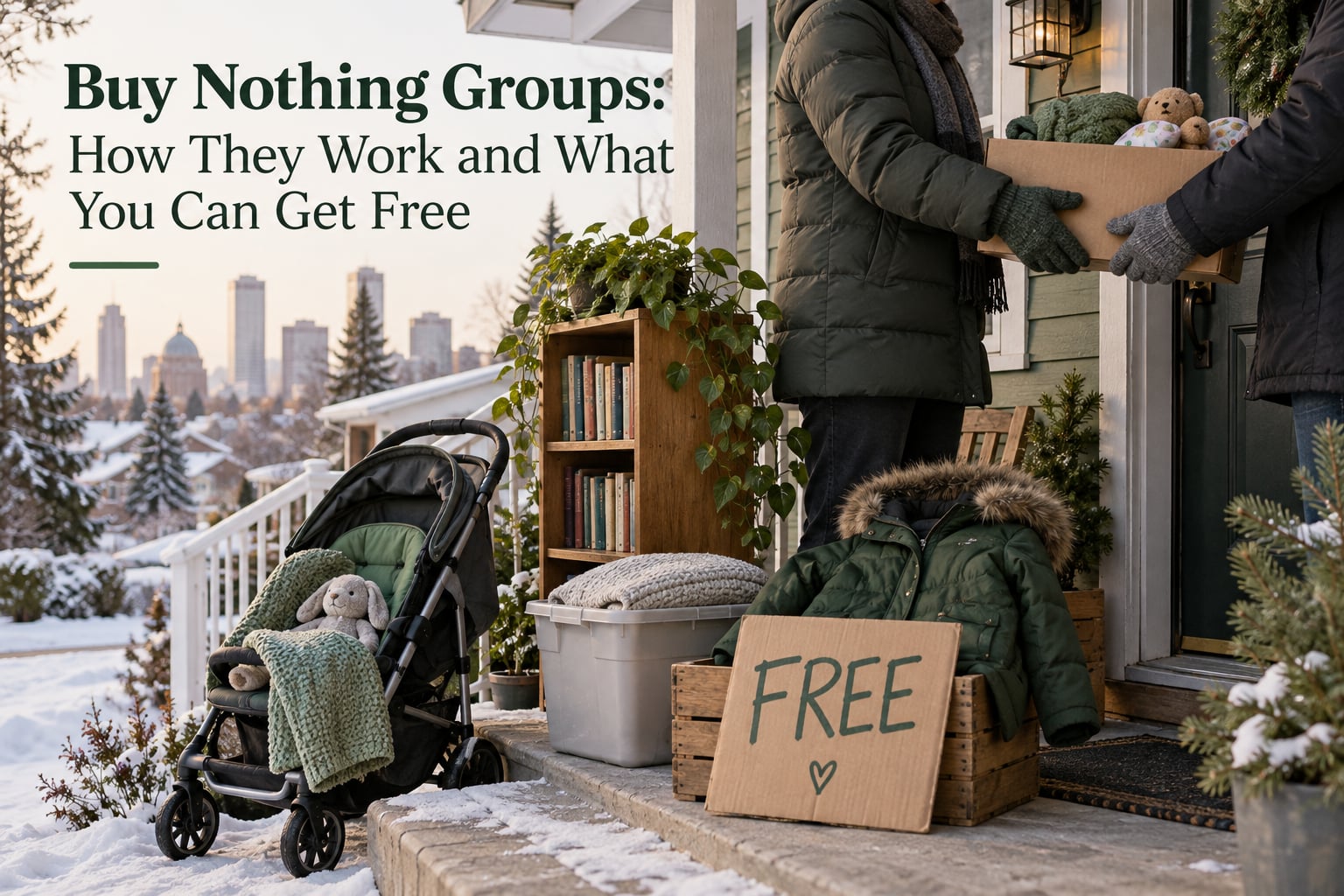
If you have ever wanted a play kitchen, a car seat, or a bookshelf for nothing more than a Facebook post, a buy nothing group is the fastest route to all three. These hyperlocal communities let neighbours give away what they no longer need and ask for what they do, with no money, no trading, and no selling anywhere in the mix. I have pulled together exactly how the groups work, what you can realistically get for free, and how Edmonton neighbours are using them right now.
What surprised me most when I looked into this is how much the rules matter. The give-everything-away idea is simple. The etiquette wrapped around it is what keeps these groups friendly instead of a curb-side free-for-all, and almost nobody explains that part well. This guide covers the loop, the ten rules, the items that are never welcome, how to get approved, and what to do when someone hands you a stranger’s address.
Table of Contents
- What Is a Buy Nothing Group?
- How Buy Nothing Groups Work: The Give, Ask, and Gratitude Loop
- The 10 Rules Every Buy Nothing Group Follows
- What You Can Get for Free
- What You Probably Won’t Get
- How to Find and Join Your Local Buy Nothing Group
- Why Some Buy Nothing Groups Shut Down or Change Their Name
- Buy Nothing Groups in Edmonton, Alberta
- How to Write a Post That Actually Gets Claimed
- Safety Tips for Meeting Strangers from Buy Nothing
- Buy Nothing vs Freecycle, Facebook Marketplace, and Kijiji
- Frequently Asked Questions
- Conclusion
What Is a Buy Nothing Group?
A buy nothing group is a free, hyperlocal online community where neighbours give away items they no longer use and ask for things they need, with no buying, selling, or trading allowed anywhere in the group.
Most of them live on Facebook. Each one is bound to a specific set of neighbourhoods or cross streets, so the people you trade with are people who live a short walk or drive from you. A smaller number now run inside a standalone Buy Nothing app. Membership is free in both cases, and the whole thing is run by volunteer moderators who approve new members and enforce the rules.
It started in 2013 on a ferry commute
Two women, Rebecca Rockefeller and Liesl Clark, started a group on Bainbridge Island, Washington after realising that most of what they were buying new had already been used by a neighbour. The idea spread through other islands and then across the country. It is now a worldwide movement with a stated mission of “buy nothing, waste nothing” and a gift economy at its core.
The principle is deceptively simple. Instead of a transaction, you give from abundance, ask when you have a real need, and post gratitude when something arrives. That third post matters more than most newcomers expect.
Buy Nothing by the numbers
According to the official project site, buynothingproject.org, the network reports more than 14 million members across over 50 countries, over 8,000 Facebook groups, more than 2.6 million items shared every month, and an estimated 162,000 tons diverted from landfill each year. One r/Frugal poster described Buy Nothing as “the only reason why we’re still on Facebook” after seven years of cribs, joggers, and more.
How Buy Nothing Groups Work: The Give, Ask, and Gratitude Loop
A buy nothing group runs on three post types, and understanding them is the whole system. Give posts push items out, ask posts pull wanted items in, and gratitude posts close the loop. Here is how a typical exchange works from start to finish.
- Post a Give. Add photos, an honest description of the condition including flaws, and a clear pickup window. Members whose give posts list photos and note the blemishes are the ones people remember and come back to.
- Post an Ask. Name the specific item, the reason, and the timing. The strongest asks get filled are time-sensitive and concrete: help after a move, a needed crib, a birthday gift that is due next week.
- Wait before you pick. Most groups expect 24 to 72 hours before a recipient is chosen. Members widely describe first-come-first-served as rude, because it turns a gift into a race.
- Choose fairly. The poster either picks the reply that best explains the need or runs a random draw and announces it publicly. Either way, the decision is transparent.
- Arrange the pickup. Porch pickup is the most common method by far and the single biggest convenience members cite. Public meetups and coffee-shop hand-offs are the other options.
- Mark the post gifted and say thank you. Updating a post to “Gifted” tells the rest of the group the item is gone. A public thank-you post afterwards is close to mandatory in most groups.
There is also a post type called a flash give, which is an item going out almost immediately. Groups generally dislike flash gives because they reward whoever happens to be online, so use them sparingly. If your neighbourhood is too big for one group, members may split off smaller “bud groups” that cover a few streets each.
The 10 Rules Every Buy Nothing Group Follows
No money changes hands in a buy nothing group, and the rules below are the reason that stays true. The wording varies slightly from group to group, but these ten show up nearly everywhere.
- Buy nothing. The name is the rule. Nothing is posted as a deal or a discount.
- No selling, ever. Members are not permitted to resell, trade, or flip anything received through the group. This is the most commonly broken rule and the fastest way to lose trust.
- No trading or swapping. If you want a kettle, ask for a kettle. Do not offer your toaster in exchange.
- Never ask for money. No fundraising posts, no “help me buy this,” no Venmo requests attached to an ask.
- Free means free. You may invite a person to collect something, but the item carries no price and no obligation.
- Give with no strings. Do not use a give post as bait to get attention for something else later.
- Describe the condition honestly. Photos plus a truthful note about stains, scratches, odours, or missing parts. Members have reported receiving clothing that smelled like cigarettes.
- Post locally only. The give, ask, and gratitude posts come from within the group boundaries. That hyperlocal limit is the entire point.
- Thank people publicly. Gratitude posts are how the community tracks its own generosity and encourages more giving.
- No bait-and-switch giveaways. You cannot post a free item to harvest contact details or email lists for a business.
One more unwritten rule matters as much as any of the ten: do not take things you will not use. A free item you refuse to make room for simply moves the problem to the next neighbour.
What You Can Get for Free
The most common finds in a buy nothing group are kids’ gear, children’s clothing, books, and furniture. That is not an accident. It is exactly the pile that builds up in a house with a nursery, a playroom, or a school-aged kid, and exactly the pile most families are happy to see leave.
- Baby and maternity gear: cribs, strollers, car seats, high chairs, bouncers, monitors, nursing pillows, and pregnancy or postpartum items that are used for a few months and then stored for years.
- Kids’ clothing and shoes: the highest-frequency category in most groups, especially sizes that grow out overnight. Expect hand-me-downs in good shape, and expect to wash them first.
- Toys, games, and puzzles: from baby gym mats to board games, including big-ticket wooden toys that are rarely worth buying new.
- Books and school supplies: secondhand libraries, chapter books, textbooks, and craft supplies. One member on a strict budget said secondhand books and birthday toys “relieved a lot of stress.”
- Furniture and home decor: bookcases, dressers, dining chairs, patio sets, and moving boxes. Larger items usually require a vehicle and a same-day pickup.
- Kitchen gear: slow cookers, air fryers, stand mixers, specialty tins, and small appliances you would never choose for a first home.
- Tools and equipment: borrowed rather than kept. Several groups allow short-term borrowing of drills, sewing machines, pressure washers, and camping gear.
- Sports and outdoor gear: ski and snow equipment in an Edmonton winter, camping tents, hockey gear, bicycles, and bike trailers.
- Services and gifts of self: a neighbour who will teach you to hem a pant, fix a bike, or bake with your kid. The project calls these gifts of self, and they are as real as the furniture.
- Food pantry surplus: a few members work at food pantries and post surplus. One woman in the group gifts pantry food to members, which is genuinely useful in a hard month.
What shows up and when in Edmonton
Season matters more than most newcomers expect. Late summer brings school supplies, kids’ clothing in larger sizes, and sports equipment. Autumn is peak furniture season because of moving. Winter surfaces skis, snowboards, and heavy-duty parkas that sit in garages for eleven months a year. Spring is baby gear season, as new parents clear out the things they have finished needing.
The savings nobody puts a number on
I do not track a running total, and I would not trust anyone who did, because the value depends entirely on what you would have bought new. But the effect on a household budget is easy to feel in the first month. The bigger win for most families is not the money at all. It is the volume of waste that never enters a landfill, which is the same 162,000 tons the official project tracks annually.
What You Probably Won’t Get
Set realistic expectations and a buy nothing group will rarely disappoint you. Large appliances, electronics you need to test, and anything time-critical are the usual misses. If a group has 5,000 members posting constantly, the popular items are gone within hours.
These are the items most groups refuse or that quietly vanish without explanation.
- Opened food, homemade goods, and homemade cosmetics. Rules here vary wildly. One group allows opened pantry items, another bans them outright, so check your own group’s pinned rules before posting.
- Medications, vitamins, and anything ingestible. Rarely permitted, and legally risky for a moderator to approve.
- Cosmetics and beauty products. Usually declined because of hygiene and liability concerns.
- Live animals. Not accepted anywhere I have seen.
- Anything for resale. Post anything you plan to flip and you will be removed, and the community will remember.
- Airline seats, restricted gift cards, and event tickets. Usually refused, and in some cases they are technically not free anyway.
- Broken large furniture. Some groups will not take bulky items that the recipient cannot physically move alone.
Two behaviours create most of the frustration. Members who dump an entire curb pile with their address attached and say “first come, first served” read as transactional and unsafe rather than generous. And no-shows waste the giver’s time, which is why a firm pickup window in the original post matters so much.
How to Find and Join Your Local Buy Nothing Group
Most groups are neighbourhood-bounded, so you usually need to live inside the covered area to be accepted. Search by cross streets rather than by group name, then read the rules before you request to join.
- Search Facebook for “Buy Nothing” plus your neighbourhood. Try your community name, your postal code prefix, and nearby cross streets. Buy Nothing groups are almost never titled with a clever brand name, so plain search works better than browsing.
- Check the group’s boundary rules. Many groups state the exact cross streets, postal codes, or quadrants they cover. If you sit just outside, some groups let a neighbouring group vouch for you.
- Read the rules and pinned posts first. Look for a “how we work” post, the pickup rules, and the list of refused items. This is also how you spot the groups that allow opened food versus the ones that do not.
- Request to join with a short, real introduction. Say who you are, roughly where you live, and what you hope to give or find. Generic requests get ignored or rejected.
- Be patient and do not re-apply repeatedly. Approval is done by volunteer moderators, often in batches. Members on r/AskNYC report being stuck in approval limbo in a Midtown South group, and the forum advice is consistent: ask one polite question, then wait. Re-requesting repeatedly can get your account flagged.
If there is no group near you
Some Edmonton neighbourhoods have no active group at all. You can search the wider area anyway, and you can start one. The official project provides a start-a-group guide, and the process is mostly a naming decision, a rule set, and a few volunteers willing to moderate. If a bud group splits off from a large area, the parent group usually announces it, so it is worth watching the big local group even if you are outside its boundaries.
Buy Nothing on Facebook vs the standalone app
Facebook groups are free, familiar, and hyperlocal, which is why most people start there. The standalone app connects members across neighbourhood boundaries and follows you when you move or travel, so it works well if you relocate often. The app also has a paid tier with shipping and private communities. The trade-off is real: the app loses the strict boundary rule that makes the local groups feel neighbourly, and the members behind the trademark now running it have been more assertive about the name since late 2025.
Why Some Buy Nothing Groups Shut Down or Change Their Name
If your group vanished or now sits under a slightly different name, you are not imagining it. Since November 2025, the organisation that founded the project began actively enforcing its trademark against independent groups that had used the name freely for years.
Groups that had operated for a decade under the name faced a choice: reapply as officially sanctioned groups, rebrand to something like “Buy Nothing Edmonton” with different wording, or shut down entirely. Some kept the name and added their city. Others changed the name completely and carried on with the same neighbours and the same rules. If yours disappeared, check whether the members simply moved to a new name, because the group itself is often still alive.
There is a second, quieter pressure behind the changes. The project went through an equity overhaul in 2020 that loosened neighbourhood boundaries after critics argued the strict geography disadvantaged certain communities. Older members who valued the cross-streets rule were not all happy about it, and some groups reverted to tighter boundaries on their own.
Buy Nothing Groups in Edmonton, Alberta
Edmonton has active buy nothing groups, and the city has enough density that several neighbourhoods are covered. Edmonton Castle Downs is one of the established ones. A second covers the Albion, Wooloowin and Lutwyche area, grouping together adjacent neighbourhoods the same way groups elsewhere combine districts rather than a single suburb.
That is the pattern across the city. Groups form around the boundaries people actually describe their address with: a quadrant, a handful of cross streets, two or three adjacent neighbourhoods. If your street is not in a group name, look for the nearest group covering the cross streets either side of you and ask about vouching.
Global News Edmonton has covered the community economy angle locally, and the CBC has run the same story out of Thunder Bay, so this is not a fringe idea in Canada. It is a mainstream way of keeping usable stuff in the neighbourhoods that already produced it.
Starting a Buy Nothing group in your Edmonton neighbourhood
If your area has nothing, start small and let the boundaries be generous at first. Pick a name that reads clearly in search, write out the rules you will actually enforce, and find two or three moderators before you open the door. Cross-post an introduction in neighbouring community groups so the first members arrive with the right area code in mind. Expect the first few months to be quiet, and expect a core of about twenty people to be the real engine of the group.
How to Write a Post That Actually Gets Claimed
A post with photos and an honest written description of the flaws is the single biggest factor in whether a give gets claimed. Beyond that, a few habits separate posts that vanish in ten minutes from posts that get a thank-you comment.
- Photograph the item in daylight, including any damage, from more than one angle.
- Name the flaws first. “Crib with a scuffed rail and one slat replaced” gets more replies than “great crib.”
- Give a firm pickup window, like “Thursday 6-8pm or Saturday morning.” Vague timing is the most common reason a claimed item falls through.
- Offer a choice of public meetup, a lobby, or a garage door. Members report trusting givers far more when the meeting spot is not fully their home.
- Mark the post gifted once it is gone, so the next person asking for the same item moves on.
- Post gratitude afterwards. It is good manners, it is the local custom, and it is how the group tracks its own generosity.
On the ask side, one honest sentence beats a paragraph. Say what you need, why, and by when. A member of a family stretching a tight budget will get a faster answer for “need a car seat by the 15th” than for a general request for baby gear.
Safety Tips for Meeting Strangers from Buy Nothing
Yes, buy nothing groups are legit, and the overwhelming majority of exchanges are exactly what they claim to be. But you are arranging a free handover with a stranger, and a few habits remove almost all of the risk.
- Meet somewhere public for a first exchange. A lobby, a garage with the door open, a coffee shop, or a daylight doorstep. Porch pickup is convenient, but it also puts your address online permanently.
- Never go into a closed vehicle or a private home, and never “just pop in” because a poster forgot to send the street number.
- Bring another person or tell a neighbour when you expect a stranger at the door.
- Check the profile before you commit. Long-standing membership and a plausible local posting history are useful signals. A brand-new account asking for expensive gear is not.
- Watch the language. Persistent pressure, flattery, or a request to move to a messaging app outside the group is a reason to walk away.
- Keep kids out of the handover and keep gift cards, banking apps, and passwords to yourself.
A note on curbside piles: if someone dumps a heap of items on the curb with their address posted and “first come first served,” that is a departure from how most groups want to operate. It looks generous, but the abandoned furniture problem and the pile of random strangers at one door is exactly the scenario members complain about in Reddit threads about approvals and safety.
Buy Nothing vs Freecycle, Facebook Marketplace, and Kijiji
Buy Nothing is the only one of these four where money is not part of the interaction at all. The other three are classifieds, which means they are built around a price. That single difference changes who uses them and what happens next.
| Option | Money involved | Local radius | Typical response | Enforced rules |
|---|---|---|---|---|
| Buy Nothing group | None, ever | Your neighbourhood or cross streets | Hours to a day | Strict, no selling or trading |
| Freecycle | Listed prices, often free | Wider, sometimes city-wide | Days | Looser, varies by branch |
| Facebook Marketplace | Seller sets a price | Set by the seller | Minutes | Minimal, seller runs the post |
| Kijiji | Seller sets a price | Set by the seller | Minutes | Minimal, classifieds rules only |
In short, use Buy Nothing when you want to give something away or fill a real need without money, and use a classified when you want a specific thing on your own schedule and do not mind a transaction. Many frugal households use all four, and they do not really compete.
Frequently Asked Questions
How does the Buy Nothing group work?
A buy nothing group runs on three post types. You post a Give with photos and an honest description of the condition, or an Ask naming a specific item you need and when you need it. Most groups expect you to wait 24 to 72 hours before choosing a recipient, then pick the reply that best explains the need or run a random draw. Pickup is usually a porch hand-off or public meetup, and the recipient posts a public thank-you afterwards.
What are the 10 rules of the Buy Nothing Project?
The core rules are: buy nothing, never sell, never trade or swap, never ask for money, and give with no expectation of payment or return. Members also describe items honestly including flaws, post only from within the group boundaries, thank people publicly after receiving a gift, and never use a give post to harvest contact details. Reselling anything received is the fastest way to lose trust in a group.
How can I find a Buy Nothing group?
Search Facebook for Buy Nothing plus your neighbourhood name, your postal code prefix, or nearby cross streets. Read the rules and pinned posts before requesting to join, then send a short real introduction saying roughly where you live and what you hope to give or find. If your area has no group, you can start one using the official start-a-group guide and a small team of volunteer moderators.
Why are Buy Nothing groups being shut down or changing their name?
Since November 2025 the organisation that founded the project has enforced its trademark against independent groups that had used the name freely for years. Groups chose to reapply as sanctioned groups, rebrand with their city or region added, or shut down. Many of the renamed groups are still active with the same members and rules, so if your group disappeared, look for it under a slightly different name before assuming it ended.
What items are not allowed on Buy Nothing?
Most groups refuse opened food, homemade goods and cosmetics, medications and vitamins, live animals, and anything a member plans to resell. Rules on opened pantry items vary by group, so check your own pinned rules. Airline seats and restricted gift cards are usually declined too. Large or broken furniture is not forbidden, but it is often skipped because the recipient cannot move it alone.
Is a Buy Nothing group legit and is it safe?
The groups are real volunteer-run communities, and the great majority of exchanges are genuine gifting with no money involved. Safety comes from a few habits: meet somewhere public for a first exchange, avoid going into a closed vehicle or private home, check the member profile, keep gift cards and banking details to yourself, and set a firm pickup window. Watching for pressure to move off-platform is the clearest warning sign.
Conclusion
A buy nothing group is the simplest version of a gift economy: give what you have, ask when you need, thank people when it arrives, and never let money into the room. That last part is what separates it from every other reuse option on this page.
Join the group that covers your cross streets, read the rules before your first post, and lead with photos and honest condition notes. The first item you give away is usually the one that gets you hooked, because watching something you were about to bin get used by a neighbour two streets over is a better argument for decluttering than any storage system. And if your group vanished recently, it is probably just under a new name.
Edmonton readers: which group are you in, and what is the best thing you have managed to get for free? Tell me in the comments, I read them all.