
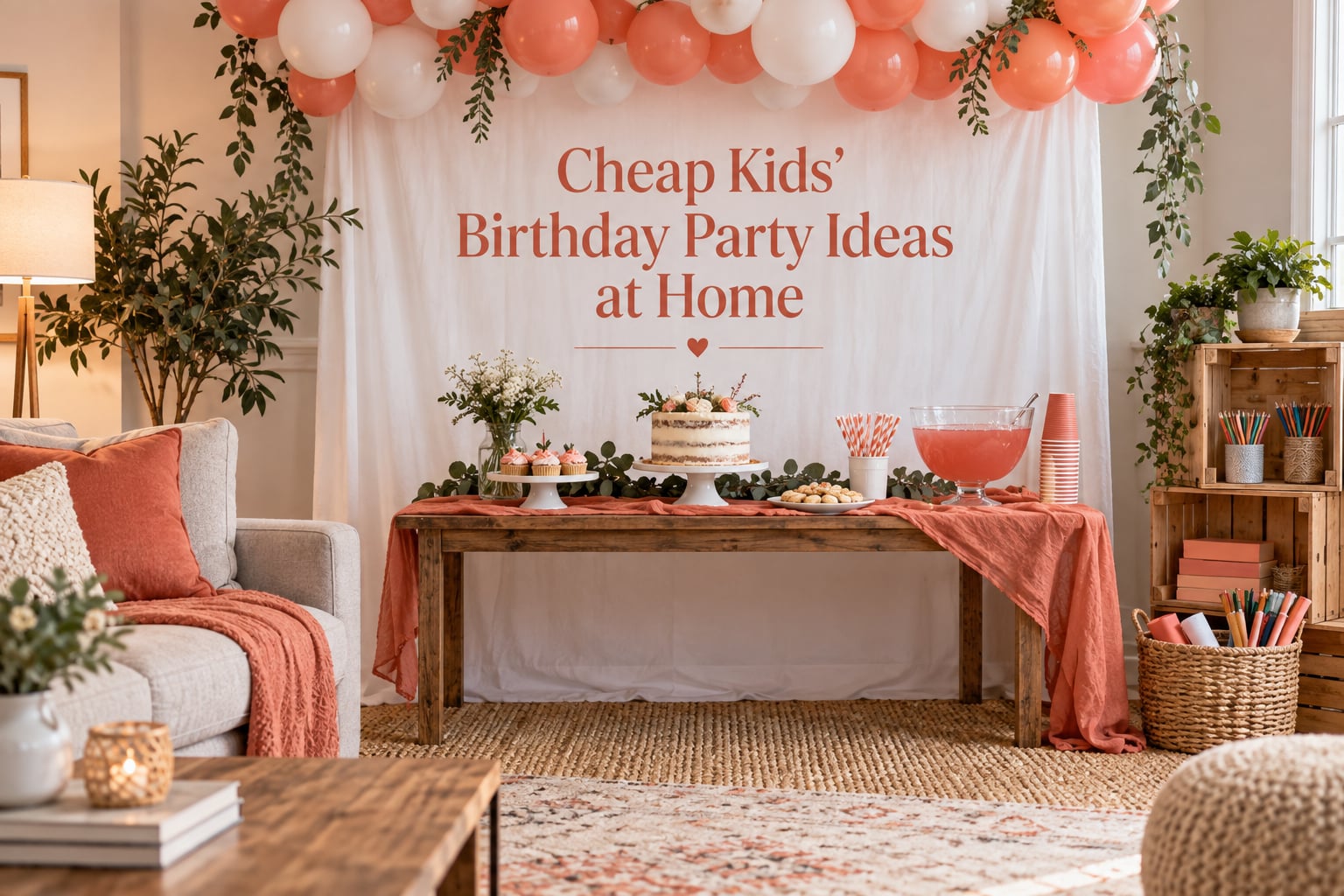
Cheap kids’ birthday party ideas at home are low-cost, do-it-yourself celebrations hosted in your own living room, kitchen, basement, garage or yard, built on pantry staples, free play, a homemade cake and thrifted supplies instead of a rented venue, paid entertainment or a custom-ordered cake. The money you save goes into the two things children actually remember: good food and enough time to play. I have hosted fourteen birthdays in our small Edmonton bungalow over the last six years, and the total spend has never once risen with the guest list in a way I regretted.
This guide covers the whole thing end to end: a six-step planning checklist, twelve party ideas, a category-by-category cost breakdown in three tiers, decor that does not look cheap, food and cake hacks, free games banded by age, crafts that double as favours, party length math, small-space and winter hosting, and where to source supplies locally in Edmonton and Alberta. Updated for 2026.
Table of Contents
- Why Host a Kids’ Party at Home?
- 12 Cheap At-Home Party Ideas at a Glance
- How to Throw a Kids’ Birthday Party on a Budget: 6 Steps
- What Each Party Category Costs: Three Tiers
- Cheap Decorations That Don’t Look Cheap
- Cheap Party Food and Drinks on a Budget
- DIY Cake Hacks That Cost Almost Nothing
- Free Party Games by Age
- Crafts That Double as Party Favours
- How Long Should a Kids’ Party Last, and What Time of Day?
- Hosting in a Small Space or in Bad Weather
- Where to Source Cheap Party Supplies in Edmonton and Alberta
- Mistakes We Made Hosting at Home
- The Reuse Playbook: Making Supplies Pay for Themselves
- Frequently Asked Questions
- How to throw a kids birthday party on a budget?
- How can I throw a cheap kids’ birthday party?
- What are some ideas for hosting a kids’ birthday party at home?
- What are some ideas for affordable birthday party decorations?
- What are some fun and affordable birthday party games I can play at home?
- What are some easy party games for toddlers?
- How can I throw a kids’ party in a small house?
- What is the best time of day to have a birthday party for a 7-year-old?
- Conclusion
Why Host a Kids’ Party at Home?
Hosting at home costs a fraction of what an equivalent venue party costs, and it removes three big variables at once: weather, travel, and facility rules. You control the guest list, the food, the noise level and the start time. Most venue packages price out the room, the tables, the cleanup and often a mandated cake, so the money you save at home is real money you can redirect into the cake and the activities.
Parents on Reddit and Mumsnet, in threads about exactly this topic, say something consistent over and over: their children remember the home parties more fondly than the expensive ones. Free play, laughter and candle-blowing are the memories. Nobody’s recollection of a party includes the matching paper plates.
There are honest trade-offs. Your house gets loud, your floors get sticky, and you will be washing cups at midnight. If you have a small space, a downstairs neighbour with a light sleeper, or a toddler who naps at one, hosting at home needs a plan rather than a blank cheque. The rest of this guide assumes you are willing to do that planning for a fraction of what a venue charges.
What At-Home Parties Remove From Your To-Do List
- Rental fees for a room, tables, chairs and linens
- Travel time, parking and coat logistics
- Weather backup planning, because you own the backup
- Facility time limits and outside-cake restrictions
- Paid entertainment you could instead pay for with craft supplies
12 Cheap At-Home Party Ideas at a Glance
These twelve ideas cover toddlers through tweens, and every one of them can be run in a house, a garage or a small yard. Each costs only the cost of the food plus a small supply kit you will reuse. Pick one anchor activity, then let the rest of the afternoon be free play.
- Free-play party with a treasure hunt. Hide small bags of candy in one concentrated area, not scattered across the neighbourhood. Prize at the end, not at every stop.
- Craft party. One craft, done at a shared table, sent home as the favour. Cookie decorating, paint-a-cardstock crown, or a simple slime station.
- Tie-dye or washable-marker shirt party. One shirt or tote per child, a few washable markers, and a laundry line or drying rack.
- Karaoke party. A TV, a speaker, a phone with a free karaoke app, and a list of songs the kids already know by heart.
- Movie screening with a sheet and a projector. Hang a white sheet, run the projector, lay out blankets and pillows.
- Homemade pizza bar. A flatbread or pita base, jar sauce, shredded cheese, and whatever vegetables are in the crisper.
- Dance party with a DIY photo booth. A sheet backdrop, a cardboard frame, a basket of dress-up props and a phone on a timer.
- Nature party. Backyard bug hunt, pinecone collecting, sidewalk chalk art or a leaf-printing station, with a backup plan for snow.
- Science-sensation party. Baking soda and vinegar, colour-mixing milk in shallow plates, or a cornstarch mixture that feels like solid.
- Glow party. Battery tea lights, a darkened room, glow sticks if you already have them, and a flashlight relay.
- Sports skills party. Beanbag toss to a laundry basket, bowling with a ball and empty bottles, hopscotch in chalk.
- Sleep-under or pajama party. Movie, snacks, crafts, lights out at a stated time, parents collect the next morning.
One honest note on the treasure hunt idea. Reddit commenters who have run it report that spreading clues over too much ground wears kids out before they find anything. Keep the whole hunt within one room or one small yard and the excitement stays high.
How to Throw a Kids’ Birthday Party on a Budget: 6 Steps
To throw a kids’ birthday party on a budget, set a firm total first, keep the guest list between eight and twelve, skip licensed characters, spend on cake and activities instead of decor, and plan one game, one craft, cake and free play. Six steps, and the first one does most of the work.
Step 1: Set a Firm Total and Split It by Category
Write the number down and divide it into five buckets: food and drink, cake, decor, activities and favours, invitations. When a bucket is empty, you are done in that category. A budget you cannot see is a budget you cannot keep.
Step 2: Size the Guest List Small
Eight to twelve children is the sweet spot for a home party. A full kindergarten class in a living room is uncomfortable for adults and overwhelming for a three-year-old. Invite siblings only if you want the headcount, since an uninvited sibling shows up with a friend regardless of your plan.
Step 3: Pick a Date and Time That Works for the Kids, Not the Adults
Weekday afternoons beat weekends for attention, and a start time of ten in the morning keeps a five-year-old’s party inside their good hours. Confirm the date with the invited families before you send anything.
Step 4: Choose a Playable Theme, Not a Licensed One
Underwater, space, dinosaurs, jungle and building themes all work because the kids can act them out with what is already in the house. A licensed character theme forces matching decor, costumes and printed everything, and that is where budgets quietly disappear.
Step 5: Plan One Game, One Craft, Cake, Free Play
That four-beat rhythm covers ninety minutes without you performing. Everything else is unstructured time, which parents consistently report their kids prefer anyway.
Step 6: Do the Shopping in Two Trips
One trip for the dry and packaged items, one trip for fresh food the day before. A day-of shopping trip is how you end up paying convenience prices for milk and forgetting the cups.
What Each Party Category Costs: Three Tiers
Budget parties fall into three practical tiers, and the difference between them is almost entirely cake and activity money, not decor. Use the percentages below as a split for whatever total you set in Step 1.
Tier One: Bare Bones
Decor is whatever is already in the house plus one thrifted find. Food is a savoury tray, fruit, and a homemade sheet cake. Activities are free play and a candy treasure hunt. Favours are a printed group photo in a thrifted frame. This is a fully respectable party, not a fallback.
Tier Two: Middle
Add a balloon garland in two colours, a small craft table with real supplies, one box-mix cake decorated properly, and a printed photo set for every child. This tier is where most families land, and it looks the most like the party pictures parents imagine.
Tier Three: Generous
Everything in the middle tier, plus a custom cake from a local bakery, a proper favour per child from a thrift store, and a projector movie with popcorn. The extra spend buys convenience and a small wow factor, not a better party.
How to Divide a Total by Category
- Food and drink: roughly a third. One filling savoury item, one fruit platter, crackers, and a drink that does not need ice to survive an hour.
- Cake: about a fifth. A box mix with real decorating beats a cheap bakery cake every time.
- Decor: no more than a tenth. Focus it in one spot.
- Activities and favours: the rest. This is where children remember money going.
- Invitations: a free digital invite costs nothing and gets replies within a day.
Cheap Decorations That Don’t Look Cheap
Affordable birthday party decorations work when you commit to one theme and two colours, then focus everything in a single spot. Scattered low-budget decor across a whole house looks unfinished. Concentrated decor looks designed.
- Pick a two-colour palette and buy everything in those colours, including the plates, cups and napkins. Solid-coloured paper goods cost less than printed themed ones and look calmer.
- Decorate one zone behind the cake table, not the whole room. A single focal wall does more work than six little clusters.
- Build a balloon garland with garland tape rather than tying each balloon by hand. A hand pump beats a machine and saves the neighbour from the noise.
- Cut cardstock and poster board for a backdrop, a birthday banner and name cards. Double-sided tape and washi tape do the mounting so there is no drilling.
- Reuse what you own. Halloween decorations work for a zombie party, a Christmas tree and stuffed animals work for a woodland theme, and a paper roll makes a table covering.
- Use the doorway and the ceiling. A streamer across one door frame and a few hanging shapes from the ceiling read as a party from every angle in the room.
- Skip the personalised banner. Hand-lettered store-bought banners and a thrifted picture frame with a printed photo do the same job for a fraction of the cost.
One more trick from decor-focused budget blogs: pick a neutral base such as white or kraft, then add one accent colour. A neutral base makes the accent read as intentional, and the whole look photographs far better than five competing colours.
Cheap Party Food and Drinks on a Budget
Cheap kids’ party food follows one rule: serve a small list well rather than a large list poorly. One filling savoury dish, two no-cook snacks, one fruit platter, one sweet treat and one drink. That is a complete party menu, and most of it needs no cooking.
Finger Foods and No-Cook Snacks
- Cheese and crackers cut into shapes with a cookie cutter
- Veggie sticks with a single dip, in a divided tray to cut prep time
- Sandwich pinwheels or ribbon sandwiches, made the night before
- Mini Caprese skewers with grape tomatoes and mozzarella pearls
- Perrier-style sparkling water with lime slices, or dilute juice with water
One Filling Savoury Dish
Make this the meal if the party lands near lunch or dinner. A baked pasta, a sheet-pan of pizza with jar sauce and shredded cheese, a taco bar with seasoned mince, or a big tray of baked potato wedges. One hot dish means one oven, one pot to wash, and satisfied children.
Sweet Treats
Cookie decorating is the cheapest sweet treat that still feels like an event, because the decorating is the entertainment. Cupcakes from a box mix with store-bought frosting piped on are another reliable option, and they cut cleanly into slices without a knife fight. Store-bought cookies on a decorated plate need no effort at all.
One Drink, Not Five
Pick a single punch or a single diluted juice. If you want the festive look, freeze juice in a tube pan with fruit and float the ring in the punch bowl, which keeps the punch cold without a bucket of ice on the table and turns the bowl into a centrepiece.
Allergies and Dietary Needs
Put a question on the invitation asking about allergies, and reply to every single response before the party day, not on it. Ask the school about its policy on food sent in, because many schools restrict nuts and homemade goods. The simplest safe plan is a savoury tray where every item has a readable label, plus a fruit platter and a dessert the birthday child’s own parent controls.
Parents on forums worry most about being judged for serving cake, ice cream and punch. They are almost never judged. A tidy table, a working hand-washing setup and a visible allergy list do more for your reputation than an elaborate spread.
DIY Cake Hacks That Cost Almost Nothing
A themed birthday cake does not need a bakery. A box mix with sharp decorating reads as homemade effort, and effort is what people notice. If baking feels like too much, buy a plain cake and re-decorate it at home with frosting and sprinkles.
- Box mix plus real decorating. The cake is cheap, the frosting and the decorating are what people see and remember.
- Store-bought cake, redecorated. This is explicitly allowed and nobody will ask. Nobody ever asks.
- A sheet cake for a crowd. A single rectangular cake serves more children per slice and survives a small kitchen with no tiered stacking to worry about.
- Cupcakes for a mess-free party. They are easier to hand out, they need no plates, and they are cheaper per serving than a tiered cake.
- A themed sheet cake. Frost in the theme colour, piped borders, and a topper made from cardstock and taped to a toothpick. This is the entire trick.
Skip the fondant tiered cake. Fondant is expensive, it cracks in dry winter air, and children do not notice it. Iced sponge in the right colour is indistinguishable to a seven-year-old and kinder to your oven.
Free Party Games by Age
Fun and affordable birthday party games you can play at home cost nothing but the objects already in your cupboards. Band them by age so you are not explaining rules to a toddler while a ten-year-old rolls their eyes. Each game should run ten to fifteen minutes, no longer.
Toddlers, Ages One to Two
- Bubble chasing, which needs nothing but a bottle and a little patience
- Pass the parcel, with a squeaky toy as the prize
- Balloon tapping, where nobody’s allowed to pop them before the end
- Simple treasure hunt to a single spot
- Dancing with one song on repeat
Preschool, Ages Three to Five
- Freeze-the-punch ring, where a child retrieves a piece of frozen fruit
- Beanbag toss into a laundry basket
- Cornhole using beanbags and a slanted cushion
- Colour-match relays with coloured paper squares
- Musical statues, which needs no setup at all
Elementary, Ages Six to Nine
- A short treasure hunt kept inside one room
- Bowling with a soft ball and empty bottles
- Hopscotch in sidewalk chalk
- Pin the tail, which works on a large sheet of paper taped to a door
- Hot potato with a soft ball
- A three-station obstacle course through the hallway and yard
Tweens, Ages Ten to Thirteen
- Karaoke, which is the single most reliable tween activity
- Chalk art or a neighbourhood chalk hopscotch trail
- Minute-to-win-it challenges, such as stacking cups or coin balance
- Blind taste tests of three mystery drinks or snacks
- Flashlight tag in a darkened house
- A phone photo scavenger hunt, where the phone does the recording
The Free Play Principle
Free play is the cheapest activity there is, and parents across every forum we looked at report that their children preferred open play over the games they carefully planned. The swing set, the tire swing, the cardboard box and a room with the toys taken out of the cupboard beat a complicated structured circuit every time. Budget twenty minutes for one game, then release the kids into the house and stop directing.
Crafts That Double as Party Favours
Popular birthday party crafts for kids at home cost one craft per child and become the favour, so you pay for the entertainment and the take-home in a single line item. The craft should take fifteen to twenty minutes, need no oven, and dry or set before the child goes home.
- Decorated cookies in a small cellophane bag, tied with a scrap of ribbon
- Paint-a-cardstock crown with a craft punch for the shape
- Simple slime in a small lidded container
- Painted foam tile as a fridge magnet, taped on the back
- Decorated paper bag filled with a small snack from a bulk aisle
- Homemade bookmark from cardstock and a craft punch
- Printed group photo in a thrifted frame for the older children, with a printed copy for the rest
The printed group photo is the most praised default favour in parent threads, and it costs only paper and a frame from a thrift store. Take one phone photo at the start and one at cake time, print them at any photo lab or library service counter, and set them out in small kraft envelopes on the table. Adults keep them for years, which is not true of a bag of candy.
Set out a shallow tray of all craft supplies at once rather than handing them over one at a time. Fewer trips, less supervision, faster clean-up.
How Long Should a Kids’ Party Last, and What Time of Day?
A home kids’ party should run about ninety minutes for preschoolers and up to two hours for elementary-age children, starting in the late morning on a weekday. Beyond that, boredom replaces excitement and the host absorbs the cleanup alone.
A Day-of Timeline in Small Blocks
- Ten minutes: coats, shoes off, free play while the last family arrives
- Fifteen minutes: one game
- Twenty minutes: the craft that doubles as favours
- Fifteen minutes: free play
- Ten minutes: cake, candles, singing, the one good photo
- Ten minutes: favours out, thank-yous said, pickup begins
For a seven-year-old specifically, a ten-in-the-morning start on a weekday is the strongest choice. They are rested, not yet hungry enough to be cranky, and the afternoon is long enough that the party feels like an event rather than an interruption. Saturday mornings work too, but expect a lower turnout and a later, more chaotic finish.
Two scheduling mistakes show up repeatedly in parent discussions. The first is a party that starts too late in the day and runs past naptime. The second is over-scheduling, where adults try to run games back to back and a young child ends up melting down from over-stimulation. Fewer beats, longer gaps.
Hosting in a Small Space or in Bad Weather
To throw a kids’ party in a small house, cut the guest list to six to eight, set up activity stations around the perimeter instead of the centre, clear one room completely, and use the hallway and stairs as the game course. Edmonton winters make indoor hosting the default rather than the backup for much of the year.
Station Setup That Works in a Small Room
- Snack station along one wall, set up before guests arrive so nobody crowds it
- Craft table in a corner, moved to a folding table afterwards
- Game zone in a cleared living room with furniture pushed to the edges
- Quiet corner with cushions, books and a blanket for the child who needs a break, which also gives you somewhere to take a child who is melting down
- Coat zone by the door, with a laundry basket instead of a heap on the floor
Edmonton Weather Contingencies
- Check the forecast seven days out and again the night before, then pick indoor or outdoor and commit
- Have an indoor anchor ready either way, so a switch costs nothing
- Keep an indoor treasure hunt location pre-planned in case the yard is unusable
- For extreme cold, shorten the party and make the food the main event
- For a January or February birthday, lean into the weather with a snow theme and a short outdoor game rather than fighting it
Quiet-Building Apartments and Noise
Pick a mid-morning slot, avoid the evening hours, and tell neighbours in advance. A phone call or a note in the elevator a day ahead does more than anything posted afterwards. For a hard deadline, use one high-energy game early and settle the group into crafts and cake while you still have energy to supervise.
Where to Source Cheap Party Supplies in Edmonton and Alberta
Edmonton families cut party costs the same way most frugal shoppers do, by splitting purchases between dollar stores, thrift stores, grocery bulk aisles and seasonal clearance. The difference is timing, and no competitor covering this topic names local options at all.
Dollar Stores
Balloons, plates, cups, napkins, streamers, craft supplies and table covers all come from dollar stores, and the standard items sit near the one-dollar mark. Buy plates, cups and napkins in your two theme colours so the cheap tableware looks deliberate.
Thrift Stores
Thrift stores are where you find frames, glass jars, cake stands, baskets, tins and dress-up props. Go for the solid-coloured stuff and skip anything with a printed cartoon on it, since a licensed character is the one thing you cannot fake on a budget.
Garage Sales and Clearance Timing
- Early January to mid-February is when post-holiday clearance hits hardest, including wrapping paper, decorations, tins and baking tins.
- Late January is when candy lands in clearance bins, which is favour season.
- Garage sale season is where you find crepe paper, hanging characters and larger decor for pocket change.
- October is when Halloween decorations hit clearance, which covers any spooky or costume party.
Grocery and Hardware
Bulk aisles cover snacks, drinks and paper plates when the number of guests justifies it. Hardware and craft aisles cover poster board, cardstock, double-sided tape, garland tape, craft punches, a hand pump and food colouring. These are the supplies you buy once and reuse for years.
Free and Near-Free Sources Most People Skip
- Library of Things lending programs, which often carry projectors, karaoke machines and board games
- Free digital invitation templates sent by text or email
- Printable craft and decor pages from library and classroom resource sites
- Cake cupcakes sent to the child’s classroom for the whole class, which keeps the home party small and stops anyone feeling excluded
Mistakes We Made Hosting at Home
The most useful thing we learned came from our own failures, and they match what other parents report almost exactly. None of these are expensive mistakes, but all of them added stress that had nothing to do with the budget.
The Treasure Hunt Spread Across Too Much Ground
Our first hunt ran from the basement to three blocks away. By the second clue, the four-year-olds were cold, tired and done. We now run the whole hunt in one room or one small yard, with a small bag of candy as the single prize at the end. It is more fun and it takes ten minutes instead of an hour.
Planning for the Headcount I Hoped For, Not the One I Had
No-shows are normal and unannounced siblings are normal. We now buy supplies for the confirmed number plus two, and we accept that extra siblings get a spare treat. Craft quantities, always the thing you cannot improvise, get the plus-two treatment.
Over-Scheduling Two-Year-Olds
One parent’s description of a three-year-old melting down at a large party with a fancy cake is the most honest thing in our notes. Young children do not tolerate a two-hour schedule of activities. We cap it at one game, one craft, cake, and free play, and the meltdowns stopped.
Trying to Beat Commercial Parties
Competing with a licensed theme party is a losing game and an expensive one. Once we stopped attempting it, the budget stopped being a source of stress, and so did the comments about whether the party was impressive enough.
Buying the Cake Last and in a Hurry
A hurried bakery cake for eight children, ordered on the wrong size, is a small disaster. Order or bake two days ahead. It is the single easiest fix on this list.
The Reuse Playbook: Making Supplies Pay for Themselves
The cheapest party supplies are the ones you already own, so build one kit over a few years and amortize it across every birthday that follows. After the first two parties, most of what you need is in a closet.
- Balloon pump, garland tape and a bag of mixed-colour balloons cover most of four or five parties
- Cardstock, poster board, double-sided tape and washi tape cover backdrops, banners and name cards for years
- One craft punch per theme shape can be swapped rather than repurchased
- A thrifted cake stand, a set of baskets and a few jars reappear in every party
- Unsweetened chocolate and food colouring cover tie-dye, cookies and cake decorations together
Write the kit list on the inside of a cabinet door. When a party is done, put everything back on that list, and the next one takes thirty minutes to set up instead of an afternoon. That reclaimed afternoon is worth more than anything else in this guide.
Frequently Asked Questions
How to throw a kids birthday party on a budget?
Set a firm total and split it by category first: food and drink, cake, decor, activities and favours, invitations. Keep the guest list to eight to twelve children, choose a playable theme instead of a licensed character, and put your money into cake and activities rather than decor. Then run one ten-minute game, one twenty-minute craft that doubles as the favour, cake, and free play for the rest.
How can I throw a cheap kids’ birthday party?
Host it in your own home, use a free digital invitation, and build the menu from pantry staples plus one filling savoury dish, fruit, crackers and a homemade sheet cake. Decorate one focal spot in two colours using balloons, cardstock and streamers rather than covering the whole room. End with free play, which costs nothing and is what children remember most.
What are some ideas for hosting a kids’ birthday party at home?
Pick one anchor activity and let free play fill the rest. Popular at-home formats include a treasure hunt in a small area, a craft party where the craft is the favour, karaoke, tie-dye, cookie decorating, a slime station, a DIY movie screening with a sheet and projector, a homemade pizza bar, a dance party with a photo booth, and a sleep-under. Most need only pantry items and craft supplies you will reuse.
What are some ideas for affordable birthday party decorations?
Choose one theme and two colours, buy all your paper goods in those same colours, and focus the decor in a single spot such as behind the cake table. Use a balloon garland built with garland tape and a hand pump, cut a cardstock or poster board backdrop, and reuse what you own. A neutral base such as white or kraft with one accent colour photographs far better than five competing colours.
What are some fun and affordable birthday party games I can play at home?
Free games that need nothing bought include beanbag toss into a laundry basket, bowling with a soft ball and empty bottles, sidewalk chalk hopscotch, musical statues, freeze-the-punch, and a flashlight relay in a darkened room. For toddlers, bubbles, pass the parcel and balloon tapping work with no setup. Keep every game to ten or fifteen minutes and leave the rest of the time for free play.
What are some easy party games for toddlers?
Toddlers need almost no equipment. Chase bubbles, run pass the parcel with a squeaky toy as the prize, tap balloons without popping them, run a treasure hunt to one spot, and dance to one repeated song. Musical statues works at this age too. Hold games to ten minutes and follow with free play, since over-scheduling is the most common reason a toddler melts down at a party.
How can I throw a kids’ party in a small house?
Cut the guest list to six to eight children and set up activity stations around the perimeter instead of the centre. Clear one room completely and use the hallway as a game course. Put a quiet corner with cushions and books where a child can decompress. In Edmonton, check the forecast a week out and the night before, then commit to indoor or outdoor and keep one indoor plan ready either way.
What is the best time of day to have a birthday party for a 7-year-old?
A ten-in-the-morning start on a weekday is the strongest choice. The child is rested, not yet hungry enough to be cranky, and the afternoon still feels like an occasion. Plan for about two hours, beginning with free play, then one game, one craft, cake and free play again. Avoid a late start that runs into evening tiredness, and skip back-to-back games that over-stimulate.
Conclusion
Cheap kids’ birthday party ideas at home come down to four decisions: a small guest list, a total you split into five buckets, one game, one craft, and free play for everything else. Decorate one spot in two colours, feed them one filling savoury dish and a cake you made, and let the afternoon run for ninety minutes or two.
Start with the checklist above, write your number down, and go. The most common mistake is over-planning, not under-spending.