
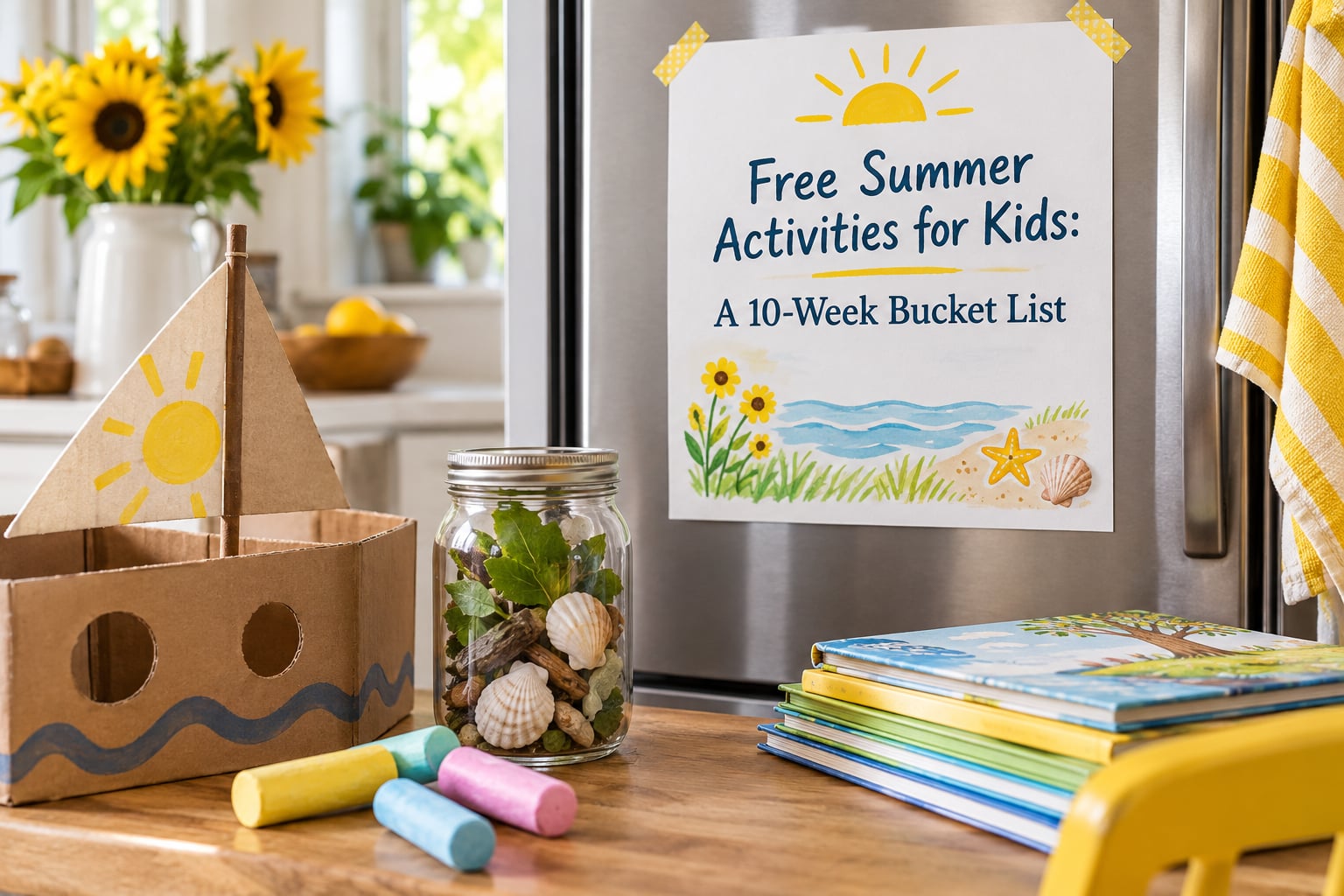
A free summer activities bucket list is a pre-planned schedule of cost-zero things kids can do during summer break, arranged one themed week at a time. Instead of inventing an idea every morning, you read the week you are in, pick three to five activities from that week’s theme, tick them off, and reset on Sunday. That is the whole system, and it is why this list is organised into a 10-week calendar rather than one long undirected pile of ideas.
Summer break in Edmonton runs about ten weeks. That is a long stretch of unstructured time, and parents routinely tell us they run out of ideas somewhere around week three or four, usually right when the novelty of the sprinkler wears off. A week-by-week free summer activities list for kids fixes that specific problem: the plan is made once, in advance, while you are calm, instead of being improvised at 4pm on a Tuesday.
Every activity below carries three tags. Cost tells you whether it is nothing at all or nothing but supplies you already own. Age tells you whether a two-year-old, a kindergartner, or a twelve-year-old can actually do it. Where tells you if it happens indoors, outdoors, or either way. If you only have a small apartment, no yard, or a toddler and a tween at the same time, those tags are how you filter the list down to what your household can actually use.
Last updated: October 2026. Program dates and venue schedules change every year, so I note below how to verify anything time-sensitive before you rely on it.
Table of Contents
- Quick Picks: 10 Zero-Cost Favourites to Start This Week
- The 10-Week Free Summer Activities Bucket List at a Glance
- Week 1: The Slow Start, Where You Set the Rhythm
- Week 2: Water Week
- Week 3: Bugs and Nature Close-Up Week
- Week 4: Build and Tinker Week
- Week 5: Art Week
- Week 6: Library and Reading Week
- Week 7: Neighbourhood Play Week
- Week 8: Explore and Move Week
- Week 9: Give Back Week
- Week 10: Memory and Wrap-Up Week
- Free Things to Do With Kids in Edmonton and Alberta
- How to Make the Summer Last
- What To Do When You Finish the List
- Frequently Asked Questions
- What are some fun summer activities for kids?
- What are some good summer projects for kids?
- What can kids do in free time?
- What to do with kindergarteners during summer?
- What are 100 things I can do when I’m bored in the summer?
- How to have fun with kids without spending money?
- What are some fun summer themed activities for kids?
- Conclusion: How Free Summer Activities for Kids Become Your Easiest Summer Yet
Quick Picks: 10 Zero-Cost Favourites to Start This Week
If you want the short answer to “what are some fun summer activities for kids,” these ten are the ones that come up most often when families tell me what actually worked. Every one of them costs nothing beyond materials already in the house.
- Sidewalk chalk art course – draw a hopscotch that snakes down the sidewalk; cost: none; age: 3-12; where: outdoors.
- Sprinkler and sprinkler-survival obstacle course – run the sprinkler between two patio chairs; cost: none; age: 2-10; where: outdoors.
- Library card and a reading basket – free card, free programs, free magazines; cost: none; age: 2-12; where: either.
- Memory jar – one artefact or photo added every week of summer; cost: none; age: 4-12; where: either.
- Bike or scooter route scavenger hunt – five things to spot, written on a scrap of paper; cost: none; age: 5-12; where: outdoors.
- Fort building from chairs and blankets – one afternoon, one very proud kid; cost: none; age: 3-10; where: indoors or out.
- Cardboard box rocket or city – free boxes from a delivery; cost: none; age: 4-12; where: indoors.
- Free public storytime – no registration, no fee, no catching up on missed weeks; cost: none; age: 0-5; where: indoors.
- Evening stargazing with a free sky app – find the moon’s phases and three planets; cost: none; age: 4-12; where: outdoors.
- Kindness chain around the block – one small free act per neighbour per day; cost: none; age: 4-12; where: outdoors.
The 10-Week Free Summer Activities Bucket List at a Glance
This table is the printable master list. Print it, tape it to the fridge, and read only your own row each week. The age column uses four bands: 2-4 toddler, 5-6 preschool and kindergarten, 7-9 elementary, 10-12 tween.
| Week | Theme | Sample activities | Cost | Best age | Where |
|---|---|---|---|---|---|
| 1 | Slow start | Memory jar, chalk course, library sign-up, evening walk route | None | All bands | Either |
| 2 | Water | Sprinkler obstacle course, sponge relay, sidewalk puddle mapping, laundry line drying | None | 2-10 | Outdoors |
| 3 | Bugs and nature | Bug jar, bark rubbing, dandelion clock, tree sitter, neighbourhood nature bingo | None | 3-12 | Outdoors |
| 4 | Build and tinker | Cardboard box rocket, blanket fort, marble run, maker junk challenge, water rocket | None | 4-12 | Either |
| 5 | Art | Finger painting, mud painting, leaf rubbings, sidewalk gallery, recycled sculpture | None | 2-12 | Either |
| 6 | Library and reading | Reading race, storytime, audiobook road trip, book swap, alphabet game | None | 2-12 | Either |
| 7 | Neighbourhood play | Playdate swap, chalk hopscotch map, night hide and seek, lemonade stand, driveway games | None | 4-12 | Outdoors |
| 8 | Explore and move | Longest-bike ride, geocache hunt, transit treasure hunt, free museum day, hill repeat | None | 5-12 | Outdoors |
| 9 | Give back | Litter patrol, free grocery rescue, compliment chain, plant a tree, thank-you notes | None | 4-12 | Either |
| 10 | Memory and wrap-up | Memory jar pour, summer scrapbook, best-of awards, photo wall, plan next summer | None | All bands | Either |
Here is the same idea as a shopping list: each week has a theme, and the theme decides the activities. That is what keeps a 10-week summer bucket list from turning into the same sprinkler every day.
Week 1: The Slow Start, Where You Set the Rhythm
Week one is deliberately undemanding. You are establishing the routine, not filling every hour, and the goal is that by Sunday everyone knows where the printed list lives.
- Start the memory jar. Any jar, one artefact per week – a leaf, a ticket, a rock, a sketch. Cost: none; age: 4-12; where: either.
- Walk one new route. Pick a street you have never walked end to end and notice five things. Cost: none; age: 2-12; where: outdoors.
- Sign up for a library card for each child. It is free, and it unlocks storytimes, disc kits and magazines. Cost: none; age: 2-12; where: indoors.
- Chalk the first hopscotch. Numbered squares with a twist at the end. Cost: none; age: 3-10; where: outdoors.
- Set the weekly reset. Pick a Sunday evening slot to look at the coming week together. Cost: none; age: all bands; where: either.
- Let a kid choose dinner once. Builds planning skills and costs nothing extra if you cook what is already in the pantry. Cost: none; age: 6-12; where: indoors.
Week 2: Water Week
Water is the single most requested free summer theme, and it costs nothing but a garden hose. On a hot Edmonton afternoon it beats almost anything you could buy.
- Sprinkler obstacle course. Chairs, a hose, and a rule: you are wet until you finish. Cost: none; age: 2-10; where: outdoors.
- Sponge water relay. Two buckets, one soaked sponge, one command. Cost: none; age: 4-12; where: outdoors.
- Map the puddles. Walk the block after rain and note where water collects. Cost: none; age: 3-8; where: outdoors.
- Laundry line science. Wet a bandana, hang it, and chart how long each shape takes to dry. Cost: none; age: 5-12; where: outdoors.
- Splash-pad substitute. A tarp or kiddie pool from home plus the hose makes a serviceable version. Cost: none; age: 2-8; where: outdoors.
- Watercolour wash painting. Brushes, water, paper, no pigment needed if you use tea or coffee. Cost: none; age: 2-10; where: indoors.
- Duck, duck, goose at dusk. Old fashioned, free, and burns energy. Cost: none; age: 3-12; where: outdoors.
Week 3: Bugs and Nature Close-Up Week
Week three is when kids learn to look at the ground instead of through it. A jar and a magnifying glass are the whole supply list.
- Bug jar safari. Catch, observe, photograph, release. Cost: none; age: 3-10; where: outdoors.
- Bark and leaf rubbings. Crayons and paper do the work. Cost: none; age: 3-8; where: outdoors.
- Dandelion clock race. Blow and count; write the scores down. Cost: none; age: 3-9; where: outdoors.
- Tree sitter challenge. Can you name five species on your own street? Cost: none; age: 5-12; where: outdoors.
- Nature bingo. A hand-drawn nine-square card: feather, ant, seed, spider web, puddle, bee, bird, stone, flower. Cost: none; age: 4-10; where: outdoors.
- Sunset sketch. Ten minutes, one pencil, no skill required. Cost: none; age: 5-12; where: outdoors.
Week 4: Build and Tinker Week
Build week uses the most salvage: boxes, tape, string, and whatever the recycling bin holds. It is also the week families most often tell me kept a tween occupied for hours.
- Box rocket. One delivery box, a cardboard nose cone, and a countdown. Cost: none; age: 4-10; where: indoors.
- Blanket and chair fort. Cost: none; age: 3-10; where: either.
- Marble run down the stairs. Cardboard strips and tape, one marble at a time. Cost: none; age: 5-12; where: indoors.
- Maker junk challenge. One cardboard box plus whatever is in the junk drawer. Cost: none; age: 6-12; where: either.
- Water rocket. A bottle, a bike pump, and a grown-up. Cost: none; age: 5-12; where: outdoors.
- Recycled city. Popsicle sticks for roads, bottle caps for cars. Cost: none; age: 4-9; where: indoors.
Rainy day or heatwave backup for Week 4: move water rocket and marble run indoors, and swap the maker junk challenge for a couch-obstacle course built from cushions. A wet week does not have to cost anything extra, because every build-tinker activity in this list has an indoor version.
Week 5: Art Week
Art week is about using what is already in the cupboard: paint, paper, cardboard, soil from the yard, and the ice cube tray.
- Finger painting. Washable paint, a sheet of paper, a tub of water. Cost: none; age: 2-5; where: outdoors or indoors.
- Mud painting. Soil, water, a brush. Cost: none; age: 2-8; where: outdoors.
- Leaf and tree rubbings. Cost: none; age: 3-8; where: outdoors.
- Sidewalk gallery. Each kid claims a square of pavement and signs it. Cost: none; age: 3-12; where: outdoors.
- Ice cube painting. Frozen paint blocks on paper, or frozen water with leaves inside. Cost: none; age: 3-8; where: outdoors.
- Recycled sculpture. Toilet rolls, egg cartons, bottle caps. Cost: none; age: 4-12; where: indoors.
- Portrait swap. Draw your family member, then sit for the drawing. Cost: none; age: 5-12; where: indoors.
Week 6: Library and Reading Week
Free summer reading programs are the easiest money you will ever save. Your card, the storytime schedule and the summer reading challenge are all free, and most run on a drop-in basis you can slip into an already-planned day.
- Summer reading sign-up. Ask your library what challenge is running, then set a reading spot. Cost: none; age: 2-12; where: indoors.
- Drop-in storytime. Free, no registration, and you can leave early. Cost: none; age: 0-5; where: indoors.
- Book swap. Trade with a neighbour or a local school group. Cost: none; age: 4-12; where: indoors.
- Audiobook road trip. Borrow audiobooks and play them in the car. Cost: none; age: 5-12; where: indoors.
- Alphabet hunt. Find one item in the house starting with each letter. Cost: none; age: 4-7; where: indoors.
- Blind date with a book. Wrap five books and let a child unwrap and choose. Cost: none; age: 6-12; where: indoors.
- Read outdoors challenge. Five outdoor reading sessions, logged. Cost: none; age: 5-12; where: outdoors.
Week 7: Neighbourhood Play Week
Week seven is deliberately social. Parents on frugal forums repeat the same request: something that is not the splash pad again. The answer is a playdate swap, where two families take each other’s children for a morning.
- Playdate swap. Trade one morning with another family. Cost: none; age: 3-12; where: either.
- Hopscotch route. Draw a hopscotch path along a quiet sidewalk. Cost: none; age: 3-10; where: outdoors.
- Night hide and seek. With an adult in the yard or on the block. Cost: none; age: 4-10; where: outdoors.
- Driveway games. Bowling with a bottle, four square, hopscotch chalk. Cost: none; age: 4-12; where: outdoors.
- Sidewalk chalk mural. One long drawing down a shared walkway, negotiated with neighbours first. Cost: none; age: 3-12; where: outdoors.
- Kitchen-table board game tournament. Whatever card or board game is already in the drawer. Cost: none; age: 5-12; where: indoors.
- Outdoor concert. Many free summer concerts are listed on local event calendars. Cost: none; age: all bands; where: outdoors.
Week 8: Explore and Move Week
Week eight is the travel week, done on transit and by bike rather than by car. Families with a car that stays in the driveway all summer tend to get the most out of this one.
- Longest ride of the summer. Pick a destination and add five minutes to your usual route. Cost: none; age: 5-12; where: outdoors.
- Geocache hunt. A free app, a walk, and a small surprise at the end. Cost: none; age: 6-12; where: outdoors.
- Transit treasure hunt. Ride the bus or light rail with five things to spot. Cost: none if you already hold a pass; age: 4-12; where: outdoors.
- Free museum day. Most local museums have a free admission day. Cost: none; age: 5-12; where: indoors.
- Hill repeats. Walk to the top of the nearest slope, five times. Cost: none; age: 5-12; where: outdoors.
- Nature photo scavenger hunt. Ten specific things photographed, one phone, no printing. Cost: none; age: 6-12; where: outdoors.
- Night bike or walk with a star app. Cost: none; age: 4-12; where: outdoors.
Rainy day or heatwave backup for Week 8: swap the geocache and photo scavenger hunts for an indoor version, where the same list of ten things includes window plants, a bookshelf lamp, a pet’s water bowl and a shoe in the hallway. Move the museum day forward, and replace hill repeats with stair climbs indoors. Both stay free.
Week 9: Give Back Week
Week nine adds purpose. Helping activities cost nothing, and the best ones use things you would otherwise throw away.
- Litter patrol. Bag, gloves, and a short walk. Cost: none; age: 4-12; where: outdoors.
- Free grocery rescue. Take unclaimed produce from a grocery store bin, with permission. Cost: none; age: 5-12; where: indoors.
- Compliment chain. One free, sincere compliment to a neighbour per day. Cost: none; age: 4-12; where: outdoors.
- Plant a tree. On your own property, or join a municipal planting day. Cost: none; age: 4-12; where: outdoors.
- Thank-you notes. By hand, to someone who helped this summer. Cost: none; age: 6-12; where: indoors.
- Bake and give. Use what is already in the pantry. Cost: none; age: 3-12; where: indoors.
- Donation sort. Kids sort outgrown clothes into keep and give piles. Cost: none; age: 3-10; where: indoors.
Week 10: Memory and Wrap-Up Week
The last week is about capture. Parents consistently tell me the memory capture is the thing that makes a cheap summer feel like a good one, because you are left with something at the end.
- Pour the memory jar. Dump the year on the table and let everyone sort it. Cost: none; age: 4-12; where: indoors.
- Summer scrapbook. Photos, ticket stubs and leaves on card stock. Cost: none; age: 4-12; where: either.
- Best-of awards. Family votes, homemade certificates, one award each. Cost: none; age: all bands; where: indoors.
- Photo wall. One print-free grid on the wall of the whole summer. Cost: none; age: 4-12; where: indoors.
- Summer review dinner. Each person names their best and worst moment. Cost: none; age: all bands; where: indoors.
- Next summer wish list. Kids write down the three things they want next year before school starts. Cost: none; age: 5-12; where: indoors.
- Start next year’s memory jar. Leave it empty and waiting. Cost: none; age: 4-12; where: indoors.
Free Things to Do With Kids in Edmonton and Alberta
The weeks above work anywhere. This section is for Edmonton and the surrounding area, because local schedules are the thing that goes stale fastest on a summer list. Treat every venue below as a category to check rather than a fixed promise, and verify dates before you plan around them.
- Edmonton Public Library branches – free storytimes, summer reading challenges, and free access to magazines, discs and digital collections. There is no fee, but some programs need a library card, so sign up in week one.
- River valley trails and playgrounds – a city-scale outdoor playground system that needs no membership, no fee, and no car if you take transit to a trailhead.
- City festivals and free events – the city’s summer event listings cover street festivals, outdoor concerts and markets that are free to attend. Most run on weekends in July and August.
- Public pools and spray pads – some facilities run free splash pad hours in warm weather. Check the city facility listings for current dates and hours before you go.
- Museum free admission days – several Edmonton museums have regular free or pay-what-you-can days, including family-focused programming.
- Fort Edmonton Park – admission is not free, so treat it as the exception and budget separately. The lesson is that the free list exists precisely so you do not need this kind of exception.
- Alberta Parks and the river valley parks system – day-use parks are free, which makes them a no-cost way to cover the week eight travel theme.
- Public transit as an activity – a day pass paid for once, or a free transfer, turns the bus into the week eight treasure hunt. It is the one line item that can cost money, so plan it.
- Local fruit and community gardens – many run volunteer days where children help for free. Registration is usually required and spots fill, so ask early.
My rule for anything local: check the venue’s own page in the week before you plan to go, not the week before you publish. Schedules for the current season are what the city and library sites publish each spring.
How to Make the Summer Last
The list is the easy part. What makes it work across ten weeks is a small number of habits, and none of them cost money.
- Print it and put it where it is visible. A list on the fridge gets used; a list in your head gets abandoned. One page, one row per week.
- Tick boxes, not intentions. A physical tick changes the feel of the summer more than another activity does. Two or three days a week is a full summer.
- Use a reward chart that is not money. A sticker per completed day, and a small privilege at the end of each week, works better for most families than a cash system.
- Reset on one fixed day. Sunday evening: read next week’s theme, pick three to five activities, write them where kids can see them.
- Keep a busy-hand kit. Cardboard, tape, string, crayons, paper, a jar, a magnifying glass, chalk, a timer. Everything in this list needs items from that kit or a hose.
- Mix solo, sibling and group time. Independent activities let you work or rest; group activities stop siblings from grinding on each other. Aim for two of each per week.
- Plan a weekly kid-free window. Caregivers need their own time. A one-hour block each week where a friend or co-parent takes the kids is the cheapest childcare swap available, and it keeps the whole plan sustainable.
Kindergarteners: simple, low-mess favourites. If your child is starting kindergarten, keep the list to coloring, water play, bug hunting, storytime, and chalk. These need no reading ability, almost no cleanup, which is why they hold up at the end of a long day.
No yard or a small apartment. Swap the outdoor items for the indoor variant in the same week, not for a different week. Water week becomes sponges and a bathtub. Build week becomes a fort over chairs. Bug week becomes a nature bingo card walked at a park, or a bug video lesson plus a jar. Apartment living limits space, not this list.
Low-sensory and neurodiversity-friendly. Swap noisy group games for one-on-one versions: solo scavenger hunts, drawing outdoors instead of sidewalk murals, and a quiet hour before the busy outings. The age tags in the table help here, because a solo activity gives a child control over pace in a way a group game does not.
Screen-tolerant families. You are not required to ban screens to use this list. Treat screen time as a reward activity and a weather backup, and use the free weeks to buy back the habit of the day.
What To Do When You Finish the List
Most families finish a 10-week list well before week ten, and that is the point. Here is the overflow, one line each, for the bored-in-the-summer afternoons.
- Wash the car together with the hose off.
- Camp on the living room floor for one night.
- Build a marble maze in a shoebox.
- Make a newspaper fort in the rain.
- Re-decorate one room for free, from the closet.
- Bake bread and time the rise.
- Sit in the dark and name every sound you can hear.
- Make a family weather forecast chart.
- Turn the clothes dryer into a drum for a minute.
- Give the dog a bath together.
- Learn to whistle, or teach your dog to catch a treat.
- Race the sprinkler, timed.
- Chalk every road name on your street.
- Build a marble run down a long hallway.
- Sleep in a tent indoors for one afternoon.
- Make a comic strip about a day at school.
- Invent a board game with cards and a die.
- Do a puzzle race, fastest first.
- Blind taste test with a sibling.
- Freeze a sock of water and watch it survive the day.
- Roll down every grassy hill you can find.
- Wash the bike and teach them to fix a flat.
- Clean up one park, then name it.
- Make bird silhouettes from freezer paper.
- Read a book in a hammock or a blanket fort.
- Cook something you have never made before.
- Chalk a shadow of a bicycle and see whose grows.
- Make a watercolour from a puddle.
- Learn a card trick.
- Do a scavenger hunt inside a grocery store.
- Sit on the steps at dusk and count the first ten stars.
- Camp out in the backyard under a blanket.
- Make a time capsule for next summer.
- Race plastic cups down a slope of cardboard.
- Draw a map of your neighbourhood from memory.
- Wash rocks, paint them, keep the best one.
- Start a family book that each person adds a page to.
Frequently Asked Questions
What are some fun summer activities for kids?
The most reliable free ones are sidewalk chalk art, a sprinkler obstacle course, scavenger hunts, blanket fort building, cardboard box construction projects, memory jar collections, and free public storytimes. Every item on our 10-week bucket list costs nothing beyond supplies already in the house.
What are some good summer projects for kids?
Cardboard box rockets, marble runs built from box strips, a recycled city made from sticks and bottle caps, a blanket and chair fort, and homemade sidewalk chalk murals are all good projects. They work because they use free materials and end in something the child can show you.
What can kids do in free time?
Keep a busy-hand kit on hand: cardboard, tape, string, crayons, paper, a jar, a magnifying glass, and sidewalk chalk. With that kit plus a hose, a child can build, draw, collect and observe for hours. Rotate one build project, one outdoor game, and one quiet independent activity per half day.
What to do with kindergarteners during summer?
Favour coloring, water play, bug hunting, storytime, sidewalk chalk, and nature bingo. These need no reading ability, almost no cleanup, and run in short blocks. Our age tags mark these for the 5 to 6 band so you can skip the activities that need reading.
What are 100 things I can do when I’m bored in the summer?
Our overflow list above gives 37 more one-line ideas, and the main 10-week list adds more than 60 tagged activities. Boredom usually means the next idea was not written down in advance, so we suggest keeping the printed list visible and ticking off three to five items a week.
How to have fun with kids without spending money?
Use what you own, borrow nothing you can build from the recycling bin, and get free things from the library, parks, trails, and community events. Free summer activities for kids mostly need a hose, cardboard, chalk, and time, so the budget is really a planning problem rather than a spending one.
What are some fun summer themed activities for kids?
Each of our ten weeks has its own theme: slow start, water, bugs and nature, build and tinker, art, library and reading, neighbourhood play, explore and move, give back, and memory. Themed weeks keep a 10-week summer bucket list from repeating the same activity every afternoon.
Conclusion: How Free Summer Activities for Kids Become Your Easiest Summer Yet
Free summer activities for kids are not about impressing anyone. They are about having the next idea already written down, so a weekday afternoon does not start with an argument about being bored. Print the table, read your row, pick three to five, and tick the boxes. The summer does the rest.
And if you get to week six and feel like you have run out, you did not fail. The list was always going to be too small, which is why the overflow is there.