
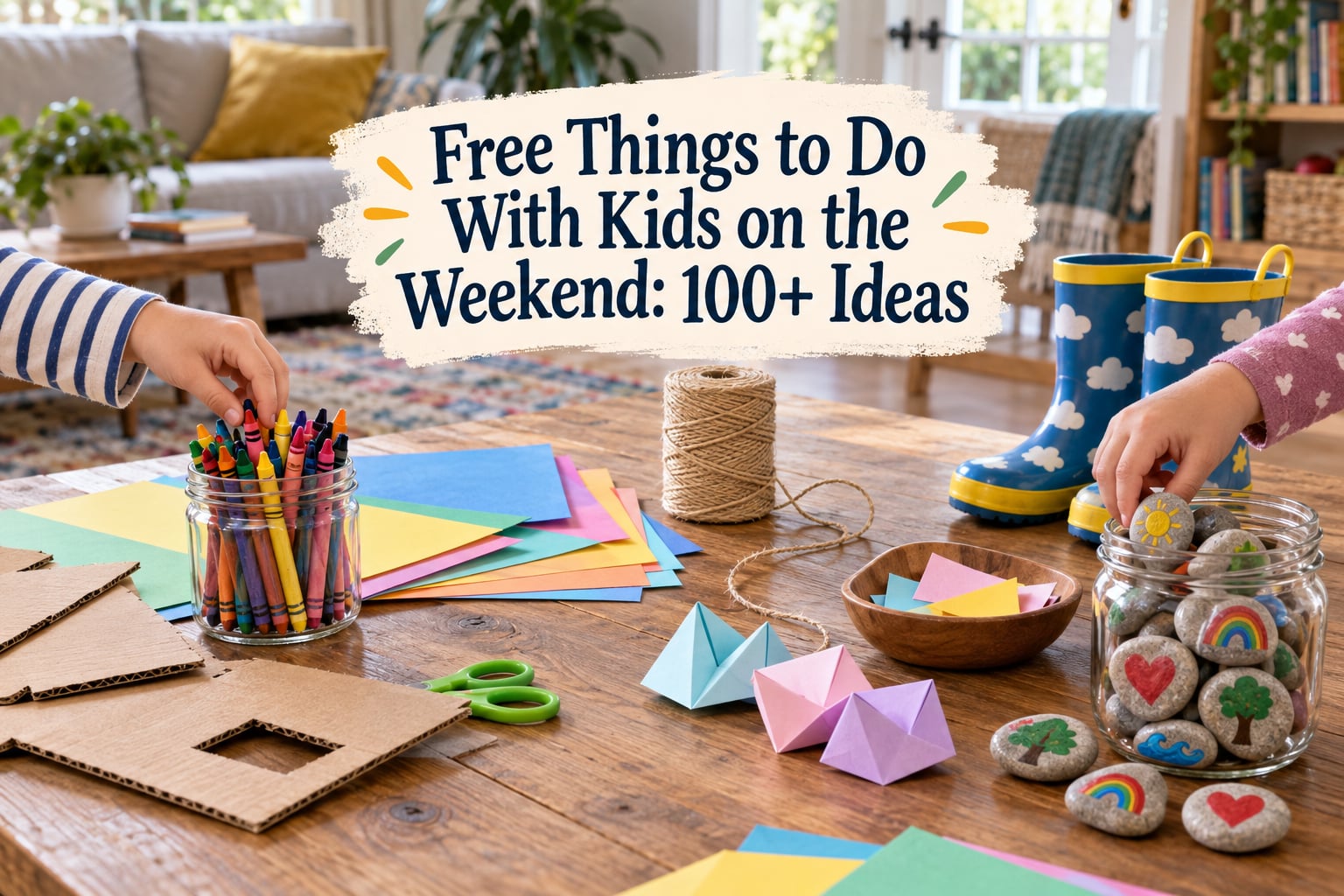
Free things to do with kids on the weekend are family activities that cost nothing at all, using only the materials, spaces and resources you already have access to: your kitchen, your living room, your street, your public library, the park three blocks over. No paid attractions, no memberships, no supply runs. This list holds 101 ideas, every one of them genuinely zero cost, sorted by age, prep time, energy level and weather so you can pick the right one in under a minute.
I have three kids, so the 4:47pm Friday panic where someone announces I’m bored is a familiar low point. That panic is the reason a familiar roundup full of paid events is not much help. Parents in community threads ask each other for suggestions rather than digging through city event calendars, and the answers they get are almost always nature centres, trails and free library programs.
Here is the shortcut. Every entry below names the free thing you already have, so you can verify the cost claim yourself instead of trusting a label. If something needs supplies, they are pantry staples, paper, or things in a junk drawer.
Table of Contents
- 25 Best Free Things to Do With Kids on the Weekend
- Free Things to Do at Home Indoors (Ideas 1-25)
- Free Weekend Activities Outdoors (Ideas 26-47)
- Free Things to Do in the Rain or at Extreme Cold (Ideas 48-62)
- Free Things to Do Around Edmonton on the Weekend (Ideas 63-77)
- Free Screen-Free Ideas for Tweens and Teens (Ideas 78-89)
- Free Things to Do at the Library, Rec Centre and in the Community (Ideas 90-101)
- How to Use This List When the Weather Turns
- Frequently Asked Questions
- Your Weekend Starts Now
25 Best Free Things to Do With Kids on the Weekend
These are the ideas that get chosen most often in our house, and they are the ones readers tell us they came back to. Each one is self-contained, so you can jump straight to a line without reading anything above it.
Blanket fort city. (toddler to tween, 10 min prep, indoors) Drape blankets over two dining chairs, add a flashlight, cushions and a story basket. Our kids turn one living room into a whole neighbourhood before lunch.
Obstacle course down the hallway. (preschool to teen, 10 min prep, indoors or out) Painter tape on the floor for a hopscotch line, a cushion to crawl over, a laundry basket to throw into. Reconfigure it while they are eating lunch so it feels new.
Pantry scavenger hunt. (preschool to tween, 15 min prep, indoors) Write the name of a kitchen staple on a slip of paper for each: cereal, salt, a banana. Send them hunting, then cook whatever turned up.
Free geocaching walk. (school age to adult, 30 min prep, outdoors) Put a geocache app on your phone and walk a trail you would have driven past. Small plastic boxes with a logbook and a few traded trinkets cost nothing to start.
Repurpose the clothes swap. (any age, 0 prep, indoors) Invite three families over, everyone brings five pieces they have outgrown, everyone leaves with five. The coffee and the swapping are the whole event.
Take-apart clock night. (school age to teen, 5 min prep, indoors) A mechanical clock from a junk drawer, a screwdriver set you already own, and an hour on the couch. The pieces go back in a slightly wrong order, which is part of the fun.
Sunset picnic from the cupboard. (any age, 5 min prep, outdoors) Whatever is already in your pantry on crackers, fruit and cheese, a blanket, and the best light of the evening. Nothing to buy and nothing to cook.
Story stones. (preschool, 20 min prep, indoors) Smooth pebbles, a permanent marker, one drawing or character per stone. Draw them once and they become a story prompt kit that lives in a jar by the couch.
Family photo scavenger hunt. (school age to teen, 15 min prep, outdoors) Give each kid a phone and a list: something red, a shadow, a bird, a number, a smile. Whoever fills the list fastest gets to pick dinner.
Bake something and give half away. (any age, 25 min prep, indoors) A batch of muffins or banana bread using flour, eggs and sugar you already own. Kids do the measuring, you do the oven, and the neighbour across the street gets the surprise.
Free museum and gallery day. (school age to teen, 30 min prep, indoors) Many galleries and community museums in this city are free admission. Go once, look at five things properly, and leave before anyone gets tired.
Build a blanket-and-pillow reading fort outside. (any age, 10 min prep, outdoors) On a warm day, move the fort to the yard so you get the same structure with sky above it. Add a book basket and a thermos from the kitchen.
Make a family game tournament. (any age, 10 min prep, indoors) Whatever board or card games already live in the cupboard. Bracket it properly, play best of three, and let the youngest be the scorer.
Cooking show challenge. (tween to teen, 5 min prep, indoors) Everyone picks an ingredient from the fridge, thirty minutes on the clock, no recipe. The rule that makes it work is that you have to eat what you make.
Stargazing from the driveway. (any age, 0 prep, outdoors) Ten minutes out after dark with a blanket. No telescope, no app required beyond a free one. The kids find the first constellation.
Rearrange one room together. (any age, 0 prep, indoors) Pick the room nobody likes. Move everything, put it back differently, and let each child claim one corner to decide. Free entertainment and a tidy house.
Free library card and the whole building. (any age, 20 min, indoors) The children department is free, and so are most programs. Borrowing costs nothing and returning late costs nothing either.
Backyard camping without the tent. (toddler to school age, 20 min prep, outdoors) A tarp or blanket over the patio table, sleeping bags rolled out, a flashlight and a story before dark. Out at dusk, in for the night.
Homemade ice cream, no machine. (any age, 20 min prep, indoors) Cream, sugar and whatever fruit you have, blended and frozen in a shallow container. Stir it twice or you get a block.
Water day. (toddler to tween, 10 min prep, outdoors or in the tub) Sprinklers, a shallow bin of water on a tarp, a watering can, and a change of clothes. The single most popular entry in this list for good reason.
Geologic scavenger hunt. (school age to teen, 15 min prep, outdoors) Hunt for three different rocks, a pinecone, a feather, a mushroom. Look it all up together afterwards on a free reference app or an encyclopedia.
Slow morning, deliberately. (any age, 0 prep, indoors) No plan until lunch. Pajamas, pancakes from the freezer, music in the kitchen. A weekend is allowed to be this quiet.
Drawing together at one table. (any age, 5 min prep, indoors) Paper, pencils, whatever you are each already reading. Nobody draws the same thing, nobody asks to see anybody else’s. The silence is the point.
Neighbourhood postcard run. (school age to teen, 20 min, outdoors) Envelopes, stamps, a list of three grown-ups and three kids, and a walk. Posting a handmade card is an activity, not an errand.
Kitchen dance party. (toddler to teen, 0 prep, indoors) One speaker, a playlist made from whatever is in your library, and the kitchen floor. Works as a five-minute reset between bigger ideas.
Boredom jar. (any age, 20 min to set up, indoors) Write free ideas on slips, a week at a time, and draw one on Saturday morning. It runs itself after the first month and it is the answer to every bored afternoon.
That last one is worth explaining properly, because it turns this whole list into a system. We keep ours on the counter. Any idea that works gets a slip, including the ones your kids suggest themselves, which matters more than it sounds like it should.
Free Things to Do at Home Indoors (Ideas 1-25)
This is the cluster I get emailed about most, usually on a Sunday afternoon when the weather has closed the door on everything else. Everything here works with paper, pantry staples and the contents of a junk drawer.
1. Cardboard box city. (toddler to tween, 20 min prep, indoors) Cut doors and windows into boxes, stand them along a hallway, and run a small car or a small person through the whole thing. Save the boxes; they become a fort, a puppet stage and a car wash.
2. Paper plate masks. (toddler to school age, 10 min prep, indoors) Paper plates, a hole punch, a shoebox for a visor, and whatever markers you own. Ends in an improvised parade around the dining table.
3. Draw a city map together. (school age to teen, 20 min prep, indoors) One sheet of paper, each person adds a street, a park, a bakery, a laundromat. Rule: somebody else has to build a route from one place to another.
4. Cookbook photo recreation. (tween to teen, 10 min prep, indoors) Find a recipe on a free recipe site, set it, and eat the result. It is not the same, which is exactly the interesting part.
5. Five-sentence story chain. (school age to teen, 0 prep, indoors) Each person writes one sentence and passes the paper. When it comes back around, add another. Read the whole thing out loud at the end.
6. Human pinball. (toddler to tween, 15 min prep, indoors) Painter tape lanes, cardboard flippers, a rolled sock as the ball. Rule the tape down before the kids get excited about it.
7. Reuse a cereal box as a marble run. (toddler to tween, 15 min prep, indoors) Tape sections of box at increasing angles to a shelf or a door, and watch what happens to a marble. The tuning is the entire activity.
8. Make play dough. (toddler to preschool, 10 min prep, indoors) Flour, salt, water, a spoon, and a splash of whatever oil is in the cupboard. It lives in a jar on the fridge for a week.
9. Puppet show from a sock drawer. (toddler to school age, 15 min prep, indoors) Old socks, yarn, a cardboard stage taped to the back of two chairs. The kids write the plot, the adults run the curtains.
10. Puzzle swap evening. (any age, 0 prep, indoors) Everyone brings a puzzle of a different difficulty, usually one from the back of a closet. Race the easy one, cooperate on the hard one.
11. Blind taste test. (toddler to tween, 10 min prep, indoors) Three pantry staples, one at a time, eyes closed, guess before you look. Foods your kids claim they hate turn out to be a game, not a problem.
12. Build a marble run down cardboard. (school age to teen, 20 min prep, indoors) Cardboard, tape and a marble, engineered so it actually reaches the bottom. Retry it five times and count the failures as the game.
13. Shadow puppets. (toddler to school age, 5 min prep, indoors) A lamp, a sheet, and hands. Works best with a story your child already knows, so the shapes mean something.
14. Music freeze dance. (toddler to teen, 0 prep, indoors) One song from your own library is playing; when it stops, everyone freezes. Whoever moves is out. Nobody has to like dancing.
15. Books you already own, read backwards. (any age, 0 prep, indoors) Start with the last page of a story and work forward. Younger kids can reverse any picture book, which is usually a better game.
16. Freezer archaeology. (school age to teen, 10 min prep, indoors) Half-frozen peas, unidentified freezer bricks, a magnifying glass. Guess what each one was, then make a meal out of whatever survives.
17. Origami from memory. (any age, 0 prep, indoors) A stack of printer paper and no instructions, only a free tutorial after two failed attempts. Origami cranes are a good weekend project.
18. Cardboard arcade. (tween to teen, 30 min prep, indoors) Boxes, paper, tape and a marker build a skee-ball lane, a dart board and a scoring wall. Play it with cardboard coins.
19. Spicy guessing game. (any age, 10 min prep, indoors) Common pantry items in opaque containers, everyone guesses by smell and by one fact at a time. Family-safe versions work with oats and cinnamon.
20. Craft a cardboard boat and test it. (school age to teen, 20 min prep, indoors) A bathtub, a sink or a bucket of water. Three boats, three shapes, and a prediction before each launch.
21. Perler bead designs. (preschool to school age, 10 min prep, indoors) Melted beads, a pegboard and a printed or free pattern. Adults handle the iron, obviously, or a hair dryer on low.
22. Room-service breakfast in bed. (any age, 5 min prep, indoors) Tray made from a cookie sheet, breakfast you would have made anyway, and a newspaper or free news app for the adult.
23. Sock sorting race. (toddler to tween, 0 prep, indoors) Clean laundry, two baskets, a timer, and a penalty rule of your own invention. It genuinely is a game with a real score.
24. Ice cube rescue. (preschool to tween, 10 min prep, indoors) Freeze small plastic toys in a block overnight, then fish them out with salt water, a spoon and a cup. Best played at the table.
25. Do the thing you used to do. (any age, 0 prep, indoors) Name a game or a ritual from your own childhood, teach it straight, badly and without rules changes. Kids remember this one for years.
Every item in this cluster assumes one rule: nothing leaves the house. That is what makes it the fallback when the weather closes in, and it is why the at-home list sits first.
Free Weekend Activities Outdoors (Ideas 26-47)
Outdoors is where Edmonton spends most of its summer, and where most of these ideas work in every season with a coat on. Nothing here needs a purchase, and all of it can start in a driveway.
26. Chalk the driveway. (toddler to tween, 5 min prep, outdoors) Big shapes, a hopscotch grid, a road with lanes. Rain washes it away, which is a feature, not a failure.
27. Sidewalk chalk art crawl. (any age, 5 min prep, outdoors) One drawing per driveway so the kids have to walk the length of the block to see the whole piece. Neighbours join in within a year.
28. Build a fort from sticks. (toddler to teen, 25 min prep, outdoors) Sticks, fallen branches, leaves and a bedsheet. No nails, no lashing, and a rule that everything stays a tree branch.
29. Free nature walk with a purpose. (toddler to tween, 10 min prep, outdoors) Find three different leaves, two different seeds, and one thing that smells like the season. No collection, just looking.
30. Sled-free toboggan run from grass. (toddler to school age, 0 prep, outdoors) A steep lawn, a towel or cardboard, and a rule about the run-out zone. Cheaper than any ticket and available in most of the year.
31. Leaf rubbings. (preschool to teen, 5 min prep, outdoors) Crayons on paper, leaves on top, rub. Works with leaves, grass, bark and a coarse stone.
32. Ground rules cricket. (toddler to tween, 0 prep, outdoors) A plastic bat and ball, six wickets made of plastic cups, and a street. Actually plays out on a driveway, in a parking lot, or in the park.
33. Bike or scooter route reconnaissance. (school age to teen, 20 min, outdoors) Plan a new route each weekend and tick it off on a paper map. New routes are new weekends for free.
34. Greasy pole substitute: the rope swing. (toddler to tween, 15 min prep, outdoors) A sturdy tree branch, a rope, and a plank or tire. Do this one with a grown-up on the first assembly and inspect the branch twice a season.
35. Outdoor scavenger hunt for young kids. (toddler to preschool, 10 min prep, outdoors) Five things to find and bring back: a pinecone, a smooth stone, a yellow leaf. It is a walk, a mission and a sleep aid.
36. Nature hide and seek. (toddler to school age, 0 prep, outdoors) A tree with a trunk big enough to hide behind, a boundary everyone agrees on, and count-to-fifty for the seeker.
37. Skip to the beat. (toddler to tween, 0 prep, outdoors) A skipping rope or a chalk hopscotch grid on the pavement, plus a song from your own playlist. Fits in a driveway.
38. Barefoot grass walk. (toddler to preschool, 0 prep, outdoors) Five minutes of new texture: grass, sand, gravel, a leaf bed, a puddle if there is one. Shoes come off, socks get wet.
39. Cloud shape naming contest. (toddler to tween, 0 prep, outdoors) Lie on the driveway, name ten clouds, then check which ones held up. The best one wins. Works from a park bench too.
40. Wash the car properly. (toddler to tween, 15 min prep, outdoors) Bucket, sponge, hose on and an old towel. It is a real job that feels like a water game, and the car is genuinely cleaner.
41. Seat covers, sleepover edition. (toddler to tween, 15 min prep, outdoors) Blankets, sleeping bags and pillows built into a fort in the living room or the yard. Indoors when the temperature drops.
42. Spray-paint chalk pots. (preschool to school age, 10 min prep, outdoors) Water and a kitchen whisk make sidewalk paint. Mix dirt and water in a separate bucket for a texture change.
43. Yard olympics. (toddler to teen, 20 min, outdoors) Long jump with a tape line, sock shot-put, a two-handed hop, a relay to the porch. Name the events after whoever is watching.
44. Local creek, stick and stone tour. (school age to teen, 20 min, outdoors) A shallow creek, a stick, a pocket full of flat stones, and a rule against taking anything living home.
45. Nocturnal flashlight walk. (school age to teen, 15 min, outdoors) After dusk, one flashlight each, looking for eyeshine, for a long-horn moth, or for a neighbour’s porch light. Quiet, and mostly successful.
46. Outdoor homework picnic. (toddler to school age, 5 min prep, outdoors) A blanket and a shoebox lid as a desk. It is the schoolwork they have to do anyway, relocated to somewhere they like.
47. Sunset walk with a hot drink. (toddler to adult, 5 min prep, outdoors) Thermoses, a route you have never walked, and no destination. The simplest entry here and the one we use most.
There is one honest limitation to this cluster: it is weather-dependent, and the next section is what to do when the sky decides otherwise.
Free Things to Do in the Rain or at Extreme Cold (Ideas 48-62)
Nobody searches for this the way they search for sunny Saturday ideas, which is exactly why it is useful in February. These fifteen all work indoors, in a hallway, or in a vehicle with the engine off.
48. The hallway car wash. (toddler to tween, 10 min prep, indoors) Balloons, a hose of water, a bucket, and a toy car. The floor gets wet, which is the entire appeal, so set the towels down first.
49. Balloon rocket. (toddler to tween, 10 min prep, indoors) A balloon, a drinking straw, string and a chair. Then make the string longer and see how far it goes. Three variables, endless reruns.
50. Sink or tub boat race. (preschool to tween, 10 min prep, indoors) Foil or paper boats, a stick, and a tub. Record finish times on a sheet of paper for something that is basically nothing.
51. Indoor hopscotch. (toddler to school age, 5 min prep, indoors) Masking tape on the floor, or paper squares taped into a strip. Fingers for tokens, or a rolled sock for a counter.
52. Wrapper quilt. (toddler to tween, 20 min prep, indoors) A plastic tablecloth, bits of torn wrapping paper, double-sided tape. Children do the tearing; the house gets an afternoon of quiet.
53. Cardboard tube marble maze. (school age to teen, 20 min prep, indoors) Toilet roll tubes, shoebox base, a marble. The skill is in the slope, so this takes two attempts and feels like a win both times.
54. Kitchen table science: vinegar and baking soda. (toddler to teen, 5 min prep, indoors) A jar, a balloon on the top, and a genuine reaction that fills the balloon. Then try warm water versus cold.
55. Colour mixing wall. (preschool to school age, 10 min prep, indoors) Two bowls of water, food colouring, a sponge and a big sheet of paper taped up. It is a painting that runs.
56. Build a marble run to a paper cup. (school age to teen, 20 min prep, indoors) Cardboard, tape, straw taped as a rail, a paper cup at the bottom. Competitions use one marble each.
57. Winter indoor obstacle relay. (toddler to teen, 15 min prep, indoors) Crawl under a table, walk between two chairs like rails, jump over a broom, spin ten times. The winter version of yard olympics.
58. Dress up and act out a book. (toddler to school age, 10 min prep, indoors) Choose a storybook that is already on the shelf. Costumes come out of the closet, characters come out of the book.
59. Bubble maths. (preschool to school age, 5 min prep, indoors) A bowl of solution and a wand from a loop of string. Count, predict, and compare bubbles outdoors versus indoors if the rain stops.
60. Hot cocoa, from scratch. (any age, 10 min prep, indoors) Milk, cocoa, sugar, a marshmallow each. The ten minutes of waiting for it to thicken is the activity, with a spoon.
61. Blanket tent, indoors, no chairs. (toddler to tween, 15 min prep, indoors) One blanket, a beanbag, and a flashlight between two couch cushions. Warm, dark, and instantly a different house.
62. Windy day indoor kite. (toddler to school age, 5 min prep, indoors) A plastic bag on a string, run back and forth along a corridor, or hold it over a vent and watch it climb. Also, the forecast becomes a game.
The trick with weather is that you decide at breakfast whether the day is an outside day. Deciding early is the whole difference between a swap that works and a scramble.
Free Things to Do Around Edmonton on the Weekend (Ideas 63-77)
This is the section that turns a list you will read once into a list you will use forever, because the assets are free, weather-proof, and open to anyone with a library card or a resident’s pass. Most of what follows costs nothing to enter; a few indoor arenas are free to residents, so check your own membership before you go.
63. Your local branch library, top to bottom. (toddler to teen, 20 min, indoors) Beyond the books: the children department’s free play spaces, public internet, and a board-game lending shelf in some branches. A library card is free for residents.
64. Free library story time. (toddler to preschool, 5 min, indoors) A recurring free program on the library calendar. Arrive ten minutes early, sit at the front, and let your child pick the second book.
65. Community recreation centre day pass. (school age to teen, 30 min, indoors) Arenas, courts and drop-in programs. Many centres are free for residents, or free at set community hours. Bring your own indoor shoes.
66. Outdoor rinks and free skating. (toddler to adult, 15 min, outdoors) Outdoor rinks across the city are free, unstaffed and open whenever the weather allows. Helmets for anyone learning, or for everyone if that is your rule.
67. River valley trail walk. (toddler to adult, 0 prep, outdoors) The valley path network gives you kilometres of paved, stroller-friendly trail in every direction. Pick a distance before you leave so the walk has a shape.
68. Public art, read as a scavenger hunt. (school age to teen, 30 min, outdoors) Murals, painted utility boxes and public sculpture, all on ordinary sidewalks. Print a free map or just walk a different street each outing.
69. Farmers market for browsing, not buying. (any age, 20 min, outdoors) Go to look, to taste the free samples, and to let a toddler handle a pepper. Keep the shopping for another day, and buy nothing but a bag of something already at home.
70. Free outdoor pools and splash pads. (toddler to tween, 20 min, outdoors) Outdoor pools and splash pads run through the warm months, and admission is low or free. Check the city’s schedule, pack towels, and go at the coolest part of the afternoon.
71. Interpretive trails and public nature areas. (school age to teen, 30 min, outdoors) Paths with signs, birding spots, and short interpretive walks in the valley. Free to enter, and the interpretive panels do the teaching for you.
72. Drop-in free family program at a community centre. (toddler to preschool, 30 min, indoors) Parent-and-tot drop-ins, playgroups and craft sessions are usually free or included in a membership you likely already have. Check the weekly schedule on the city’s recreation page.
73. Public playground with a twist. (toddler to tween, 20 min, outdoors) Pick a playground neither child has used before. The walk there is a quarter of the memory, and a snack from the kitchen is the whole budget.
74. Public library makerspace induction. (tween to adult, 30 min, indoors) Some branches run free induction sessions on 3D printers, sewing machines and vinyl cutters. Book a slot, then build something small and finish it in an afternoon.
75. Free city walking tours and self-guided heritage walks. (any age, 45 min, outdoors) Free self-guided walking tour maps put out by historical societies and the city. One neighbourhood, one afternoon, no admission.
76. Community gardens open to visitors. (toddler to teen, 20 min, outdoors) Some are open to walk-throughs, and public garden tours run in the growing season. Let a child see a tomato plant the way they see it in a book.
77. Free winter public facilities on a cold day. (any age, 30 min, indoors) Indoor arenas, libraries and mall walking loops carry you through the cold parts of the year. Pair one with the rink and you have a full day for nothing.
A note on verifying free: a venue that says free admission and then sells you a ticket is not free, and that has been a real problem in the roundups we read while putting this list together. Before you leave the house, check the venue’s own schedule page, and treat anything ambiguous as not free.
Free Screen-Free Ideas for Tweens and Teens (Ideas 78-89)
Most lists stop at about age eight, which is precisely when a bored teenager becomes the hardest person in the house to entertain. These twelve are built for a kid who thinks fun has to be bought.
78. Take apart something that does not matter. (tween to teen, 30 min, indoors) A remote control, a keyboard, a toaster you are not using. The screwdriver set you already own is the entire tool list.
79. Learn one card trick. (tween to teen, 20 min, indoors) Free tutorials are everywhere. Practice until it works, then perform it badly at dinner. Ambition is the activity.
80. Photography scavenger hunt. (tween to teen, 30 min, outdoors) A borrowed phone camera, ten prompts, one afternoon. Show the best three at dinner. They will shoot forty more on their own after this.
81. Invent a board game. (tween to teen, 45 min, indoors) Components from a junk drawer, a rulebook they write themselves, and a test round. Then actually play it until it works.
82. Cook something with heat and timing. (tween to teen, 40 min, indoors) A skillet recipe or a no-reheat dinner from the pantry. The constraint is that they run the kitchen and you eat the result without editing it.
83. Free self-guided scavenger hunt with GPS. (tween to teen, 20 min, outdoors) Drop pins on a free map app, hide them around the neighbourhood, and swap phones at the far end of it. Walking distance, no equipment.
84. Do a chore-for-a-choice trade. (tween to teen, 10 min, indoors) A chore traded for a decision: the movie, the dinner, the drive. Teens respond well to a real, bounded negotiation.
85. Build a model from recycled card. (tween to teen, 60 min, indoors) Cardboard, glue, a free sketch. An engine, a building, a guitar amplifier. It takes the whole afternoon, on purpose.
86. Learn a song on an instrument you own. (tween to teen, 45 min, indoors) The keyboard in the closet, the guitar, even a free app with a keyboard. Learn the chorus, then perform it badly.
87. Free neighbourhood history walk. (tween to teen, 45 min, outdoors) A self-guided walking tour, an architecture scavenger hunt, a photo of every house over a century old. They research, you walk.
88. Plan a free trip you are not taking. (tween to teen, 45 min, indoors) A day out somewhere, costed at nothing: what is free, what needs a bus, what needs a packed lunch. The planning is the holiday.
89. Volunteer for two hours. (tween to teen, 30 min, outdoors) Many community organizations take teens for a shift. It is free, it is real, and it is the thing teenagers actually remember.
The common thread is that every one of these has a finished object, a finished run, or a finished shift. Teenagers tolerate effort when there is an end point, and stall completely when there is not.
Free Things to Do at the Library, Rec Centre and in the Community (Ideas 90-101)
Free programming is the easiest money a family can save, because it is already paid for out of your taxes. The catch is that it is scattered, so the habit is what pays: check the calendar once a week and put the good ones straight in the family calendar.
90. Free drop-in art time. (toddler to school age, 60 min, indoors) Community centres and libraries run low-cost or free drop-in art sessions. The mess is allowed, the supplies are there, and you are not the one teaching.
91. Free swimming lessons and aquafit for toddlers. (toddler to adult, 60 min, indoors) Some recreation centres include parent-and-tot lessons in resident rates. The swimming itself is the point; the community is the side effect.
92. Free public library tech help. (tween to adult, 45 min, indoors) One-on-one help with a laptop, a scanner, a printer, or a form. Bring the actual problem with you, because the session is short.
93. Free board game library lending. (any age, 30 min, indoors) Some branches lend a board game library for a week. Take one nobody has played at home yet.
94. Free interlibrary book requests. (any age, 15 min, indoors) Your card reaches further than the shelf. Let a child order something obscure, and treat the wait as the weekend’s project.
95. Neighbourhood park clean-up. (school age to adult, 90 min, outdoors) Bring gloves and a bag. It is a small outdoor work party, and a kid who helps clean a park remembers it.
96. Free community holiday and seasonal events. (any age, 90 min, varies) Canada Day programming, free tree planting days, winter light installations, summer festivals. Check the city’s event calendar, which is public and free.
97. Free city council and community association open meetings. (tween to adult, 60 min, indoors) Open council sessions, a recreation advisory board meeting, a community association night. Kids are allowed to sit through it.
98. Free fitness and recreation trial sessions. (any age, 45 min, indoors) Many centres offer a free trial class or a free introduction session. The point is to find out what is on offer, not to sign up.
99. Free indoor playground on a cold day. (toddler to tween, 90 min, indoors) Some indoor play centres run free hours, and community centres run cheaper ones. A last resort that still costs nothing.
100. Free crafting circle at the library. (any age, 60 min, indoors) Knitting circles, quilting bees, craft swaps. Free, drop-in, and usually tea. If the kids will sit in a chair, this is the one.
101. A free family outing with no agenda. (any age, 2 hours, varies) One of the hundred above, or a walk, with nothing to accomplish and nowhere to be at the end of it. The idea is the most reusable one on the list.
That is 101, each one chosen because the cost is genuinely zero, not free-to-enter. If you only take five, take the ones in the quick picks; if you only take one, take the boredom jar, because it keeps working after this weekend is over.
How to Use This List When the Weather Turns
One hundred and one ideas fail in a specific way: they are read at 4:47pm on a Friday and then never used. Four filters fix that, and you should apply them in this order, because skipping to the prep-time filter when the kids are four is how you end up handing a teenager a puzzle.
Step 1: Filter by age first. Toddlers and preschoolers need something they can do alongside you, with no reading, no losing pieces and no small choking hazards. School-age kids can handle a rule set and a kit with twenty pieces. Tweens and teens need a finished object, a challenge or another person in the room, or they will leave.
Step 2: Filter by weather second. Decide at breakfast, not at noon. If it is above about ten degrees and dry, the outdoor cluster is the better bet. If it is rain, snow or well below freezing, use the rain and cold cluster and the at-home cluster and stop looking outdoors. A decision made at breakfast takes two minutes; a decision made at 1pm takes two hours.
Step 3: Filter by prep time third. Under ten minutes: a blanket fort, a dance party, a draw, a walk. Twenty to forty minutes: a cardboard build, a cooking challenge, a photography hunt. Over an hour: the model, the invented board game, the book to act out. Pick based on how much of you is left, not on how ambitious the idea sounds.
Step 4: Filter by energy level last. Some days you are the one who needs the quiet. The drawing table, the reading fort and the slow morning use far less of you than the obstacle course or the water day, and they are not lesser activities. On a Saturday when you are running on empty, pick a quiet one on purpose.
Three framings make the whole list easier to hold in your head. First, what counts as free: a park, a library, a rec centre drop-in, your own kitchen, your own backyard, a borrowed or swapped thing, or a free natural resource like light, water and a park bench. Anything that is free to enter and then charged for is not free, and I have left those out.
Second, the swap principle. The trick to a no-spend weekend is that you are not finding ninety free activities, you are substituting about four experiences and stretching them. A blanket fort, a cardboard city, a scavenger hunt and a cooking afternoon will cover a whole weekend if you let them, and none of them need a shopping trip.
Third, the three substitutions when there is no money at all: use what you own, use what the community provides free, and borrow instead of buying. That covers essentially every idea in this article, including the Edmonton section, and it is the answer to what to do with no money for fun.
For a whole week rather than a weekend, the seven-day no-spend framework works well. Monday is a library trip, Tuesday is a cooking night, Wednesday is a neighbourhood walk, Thursday is a boredom jar draw, Friday is a build, Saturday is the big one from the quick picks, and Sunday is a slow morning with no plan until lunch. One purchase-free day at a time is easier to sell to a child than a whole weekend, which is worth remembering.
On screen-free enforcement, the most useful thing we have learned is to make the offer before the grab, not after. A device request answered with an immediate alternative usually works; the same request answered with a refusal works less well. Have one device-free idea ready in your head as a substitution, not as a reward, and keep the boring ones on hand for the 4pm slump when your best thinking has already been used up.
On the solo-parent case, most of this list is already built for it. Ideas one, fifteen, twenty-two, twenty-three, twenty-five, forty-one and sixty-one all work alone, and the ones that need a second adult can be reframed as things a child can do beside you while you are nearby rather than things you are doing together.
One last filter worth having: the good-enough test. If the day is a bit dull and the kids are calm and the laundry got folded, the weekend worked. You do not need a memorable weekend every time, you need about one in four, and the other three are what pay for it.
Frequently Asked Questions
How to have fun with kids without spending money?
Substitute the experience instead of buying it. Public parks, libraries and community facilities replace paid venues; scavenger hunts, obstacle courses and cardboard builds replace paid games; cooking with pantry staples replaces takeout; and a boredom jar replaces streaming. Pick from the 101 ideas above by age first, then weather, then prep time, and every one of them costs nothing.
What to do with kids for free at home?
Start with the at-home cluster. A blanket fort, an obstacle course taped to the hallway, a cardboard box city, a pantry scavenger hunt, story stones, homemade play dough, a puppet show made from old socks, a sink boat race, and a taped floor hopscotch. All ten use paper, pantry staples and things from a junk drawer, so nothing needs buying.
What are 100 fun activities I can do at home?
This article lists 101 free ideas, and around two thirds of them work indoors. The at-home cluster alone holds 25, the rain and extreme-cold cluster holds 15, and the tween and teen cluster holds 12. Every entry names the free materials it uses, so you can check the cost yourself before committing a Saturday to it.
What to do with no money for fun?
Think in three substitutions rather than in nothing. Use what you own: blankets, cardboard, paper, pantry staples, a junk drawer. Use what the community provides free: libraries, outdoor rinks, trail networks, community centres, public art. And borrow instead of buying, through a clothing swap, a tool borrow or a free toy library. That covers all 101 ideas here.
Where can I take my children for free?
In and around Edmonton: the river valley trail network, public outdoor rinks, outdoor pools and splash pads in season, public playgrounds, farmers markets, and the city’s public art, which is on ordinary sidewalks. Indoors, most branch libraries are free with a resident card, and many community recreation centres run free or included drop-in hours. Verify hours on the venue’s own schedule before you drive out.
What is the 7 7 7 rule for kids?
The 7 7 7 rule is a sleep rule rather than an activity rule: children up to seven should get roughly seven to nine hours of sleep, and that range is about right up to their early teens. It gets mentioned often in searches about spending-free weekends because a no-spend Saturday usually means an earlier bedtime, not a later one. A tired child is the hardest one to entertain for free.
Your Weekend Starts Now
Free things to do with kids on the weekend are not a compromise, as long as you pick them on purpose. The whole list here reduces to three moves: use what you already own, use what your city provides free, and borrow instead of buying.
Start tonight if you want. Pick two from the quick picks for Saturday, one for Sunday, and write them on slips in the boredom jar. The jar is the thing that keeps working after you have forgotten this page.
Which free weekend idea does your family actually do? Tell us in the comments and I will add it to the list.