
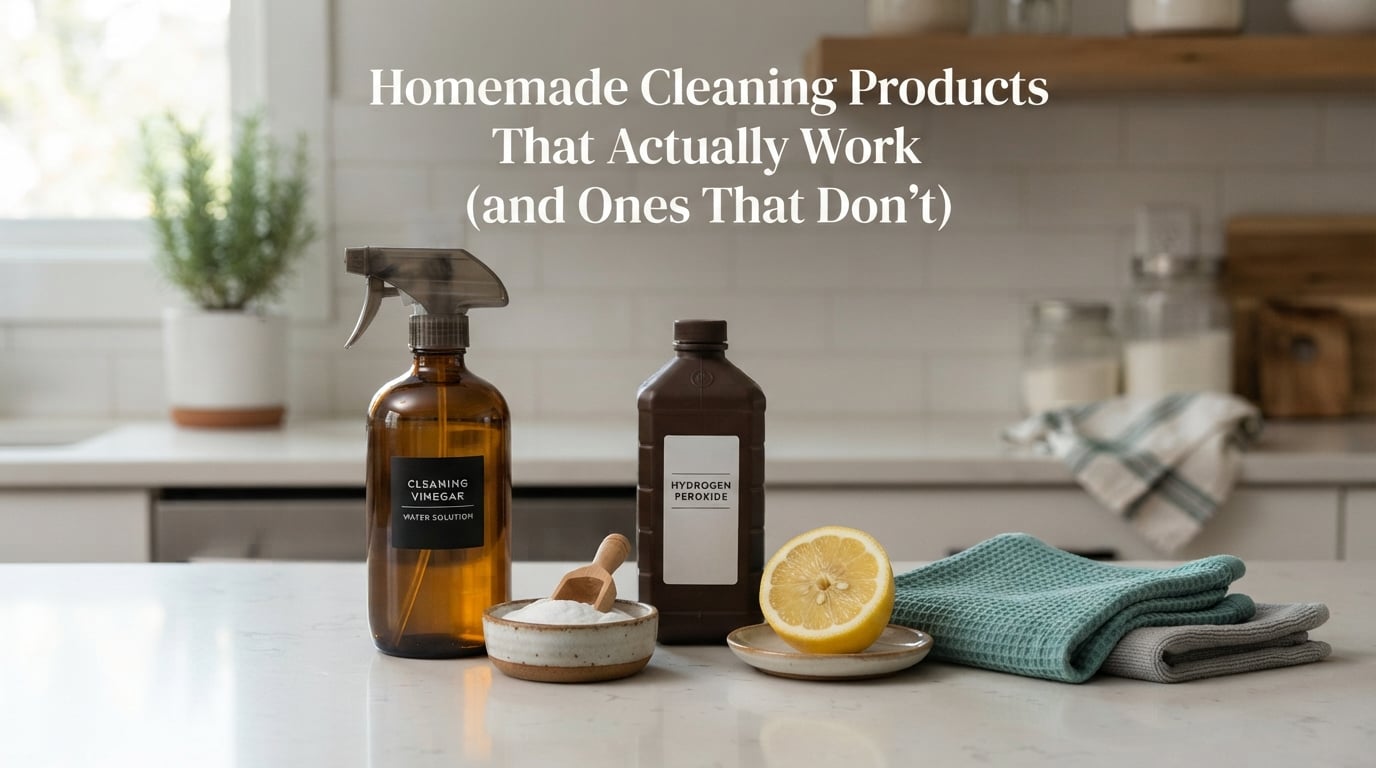
Most homemade cleaning products work well. A handful genuinely do not, and two of the most popular combinations are outright dangerous. Here is the short version: white vinegar, baking soda, hydrogen peroxide and soap-based mixes earn their place in a frugal household. DIY laundry detergent, vinegar-and-baking-soda drain cleaner, and homemade essential-oil disinfectants do not. Vinegar mixed with bleach or with hydrogen peroxide releases gases that can injure you.
That is the whole argument of this guide to homemade cleaning products. Recipes get shared because they sound clever and cost almost nothing, not because anyone tested them on soap scum, checked whether they disinfect, or asked what happened when the two ingredients met in the same bottle. We went through the popular pantry cleaners, pulled apart the chemistry, and matched the results against what people actually report after a year of living with them.
One thing to clear up first, because it decides most of the verdicts below: cleaning and disinfecting are not the same job. A product can remove grease beautifully and still kill nothing at all. If you only ever want one honest sentence about homemade cleaning products, it is this one.
Last reviewed October 2026.
Table of Contents
- Quick Verdicts: What Works, What Fails, What Is Dangerous
- Clean, Sanitize, or Disinfect: The Difference That Decides Everything
- The Base Ingredients: What Each One Actually Does
- Do Vinegar and Baking Soda Actually Kill Germs?
- What Should You Not Clean With White Vinegar?
- What Should You Never Clean With Hydrogen Peroxide?
- Never Mix These: Three Household Combinations That Are Dangerous
- The Recipes That Genuinely Work
- The Ones That Don’t Work
- What Real Households Report
- What We Still Buy in Store, and When That Is the Right Call
- Does DIY Actually Save Anything Once You Count the Time?
- Storage, Labelling and Shelf Life
- Frequently Asked Questions
- What is the best homemade cleaner for everything?
- How to make pure magic cleaner?
- How do you make streak free glass cleaner?
- What should you not clean with white vinegar?
- What should you never clean with vinegar?
- What should you never clean with hydrogen peroxide?
- Do vinegar and baking soda actually kill germs?
- What is the strongest natural disinfectant?
- The Verdict: A Short, Honest List
Quick Verdicts: What Works, What Fails, What Is Dangerous
Here is the at-a-glance answer, and every row gets explained further down. Verdict labels are deliberate: Works means I would mix it again tomorrow, Works with caveats means it does one job well and you need to respect a limitation, and Skip it means the time cost beats any saving.
| Homemade cleaner | What it does well | Where it falls short | Verdict |
|---|---|---|---|
| White vinegar and water | Dissolves grease, mineral deposits, soap scum and hard water scale | Weak against bacteria, and the smell is the number one reason people quit | Works |
| Baking soda paste | Scrubs gently, neutralizes odours, lifts light grease | Very weak on acid-based grime and nothing at all on germs | Works with caveats |
| Hydrogen peroxide, 3 percent | One of only two DIY-capable actives that genuinely disinfects; bleaches stains out | Bleaches colour, can irritate skin, dangerous next to bleach | Works with caveats |
| Castile soap and water | Grease cutting and surfactant action, plant based, cheap | No disinfecting power, scum residue if not rinsed | Works with caveats |
| Dish soap, vinegar and water (“pure magic” style) | The most useful all-purpose mix there is | Foam needs rinsing properly on some finishes | Works |
| Baking soda plus vinegar for drains | Fizzes, smells convincing | Neutralizes both ingredients, so it is weaker than either alone | Skip it |
| DIY laundry detergent | Nothing much | Leaves residue, hardens in the machine, does not strip oil | Skip it |
| Vodka and citrus “disinfectant” | Smells sharp, cuts grease | Far too dilute to disinfect anything | Skip it |
| Essential oil sprays | Nice smell | Not reliable disinfectants at any home dilution; a pet hazard | Skip it |
| Bleach plus vinegar | Nothing worth having | Releases chlorine gas | Dangerous |
| Vinegar plus hydrogen peroxide | Nothing worth having | Forms peracetic acid, which is corrosive | Dangerous |
Clean, Sanitize, or Disinfect: The Difference That Decides Everything
Cleaning removes dirt, grease and some microbes. Disinfecting means killing enough of a listed pathogen to a regulatory standard, proven on a label by a registered authority. The Environmental Protection Agency in the United States and its equivalents elsewhere only recognise a disinfectant after a manufacturer submits test data and receives a registration number.
That registration is the part most DIY recipes quietly skip. Vinegar, lemon juice, essential oils and hydrogen peroxide are not EPA-registered disinfectants at household dilutions, and no home spray carries a registration number. When a recipe blog says vinegar kills bacteria, that is usually true in a laboratory dish at concentrations nobody uses a home spray at.
Then there is contact time. A disinfectant has to stay visibly wet on the surface for the full time printed on its label, usually several minutes, before it is wiped away. Spray-and-wipe defeats the purpose, because the surface dries before the active has done its work. Technique beats ingredients more often than recipe blogs admit: remove the soil first, then disinfect, then respect the clock.
The Base Ingredients: What Each One Actually Does
Almost every homemade cleaner on the internet is a combination of six or seven pantry items. Once you know what each one does on its own, the recipes stop looking like magic and start looking like chemistry.
| Ingredient | Active compound | What it does | Typical dilution |
|---|---|---|---|
| Distilled white vinegar | Acetic acid, about 5 percent | Dissolves grease and mineral scale, deodorizes | 1 part vinegar to 1 part water for general cleaning |
| Baking soda | Sodium bicarbonate | Mild alkali and gentle abrasive, absorbs odour | 1 or 2 tablespoons per bowl of water, or a paste |
| Hydrogen peroxide | 3 percent solution | Oxidizes and bleaches, genuine antimicrobial action | Straight from the bottle, or diluted 1:1 with water |
| Castile soap | Saponin-based surfactant | Lifts grease so water can rinse it away | 1 to 2 tablespoons per 480 mL (2 cups) of water |
| Dish soap | Strong synthetic surfactant | Heavier grease cutting than castile soap | 1 teaspoon per 480 mL (2 cups) of water |
| Lemon juice | Citric acid, about 2 to 5 percent | Mild acid, whitens, smells clean | Equal parts juice and water |
| Salt | Sodium chloride | Hard abrasive for pans and grout | Coarse handful on a wet surface |
White vinegar: the workhorse, with one asterisk
Distilled white vinegar is the single most useful pantry cleaner. Acetic acid at about 5 percent is a genuine degreaser and descaler, which is why it works so well on soap scum, hard water deposits, coffee makers and kettles.
The asterisk is the word disinfectant. Acetic acid is a mild antimicrobial, but it is not a registered disinfectant and it will not replace one during illness. The smell is the other limitation, and it is the limitation people actually give up over.
Baking soda: abrasive, deodorizer, and no more than that
Sodium bicarbonate is a weak alkali. It is a genuinely useful gentle abrasive, it absorbs odours in a fridge or a cat litter tray, and it takes light grease off a stovetop. It is not a degreaser and it is not a disinfectant.
It is also, on its own, too weak to be a real drain cleaner. That is a chemistry problem rather than a strength problem, and it is explained in the next section.
Hydrogen peroxide: the one DIY active that disinfects for real
Along with 70 percent ethyl or isopropyl alcohol, hydrogen peroxide is one of the only two actives you can buy over a counter that reliably kill pathogens at the concentrations used in a home. At 3 percent it is a mild bleach: it oxidizes organic staining, it kills mildew on a damp surface, and it works as a genuine disinfectant when you respect contact time.
It is also the ingredient with the sharpest edges, which we cover twice below.
Castile soap and dish soap: not interchangeable
Any surfactant works by forming a membrane around grease so water can rinse it away. Castile soap is plant based and mildly conditioned, but it is a weak surfactant. Dish soap is a much stronger synthetic one, so the two cannot be swapped one for one at the same volume.
Our view: castile soap earns its place as the base of a general spray, dish soap earns its place in the heavy-duty mixes, and neither one needs anything added to do its job.
Lemon juice, vodka, essential oils and salt
Lemon juice contains citric acid and does a decent light-acid job, but fresh juice also carries sugars and mould that can grow in a bottle, and it is a weaker cleaner than vinegar for the same volume.
Vodka is essentially water plus a little ethanol. Once a recipe dilutes it to a spray strength, the alcohol content drops well below the 70 percent that makes alcohol useful, so it is a scented water.
Essential oils are pleasant and cheap fragrance, not reliable disinfectants at any dilution you would spray in a living room. Tea tree and eucalyptus in particular are a concern around cats, dogs and birds, which is worth knowing before you mist a room.
Salt is a hard abrasive that community recipes have always used. It works well on cast iron and stubborn grout, and it is one of those remedies that shows up constantly on cleaning forums and in almost no polished recipe blog.
Do Vinegar and Baking Soda Actually Kill Germs?
No, and the reason is that they cancel each other out. Acetic acid and sodium bicarbonate react. The acid and the base neutralise into water, carbon dioxide and sodium acetate, which is the salt you might recognise from a chemistry classroom, and which is a mediocre cleaner on its own.
The dramatic fizzing that sells the combination is carbon dioxide being released. It is a gas leaving the mixture, not a cleaning agent entering it. Fizz is the opposite of a useful reaction here, because the two ingredients that could have cleaned separately are consumed together, and you are left with diluted salt water.
So for a drain or a sink: use baking soda to scrub, then flush with vinegar separately, or pick one and skip the other. The same logic applies to any other acid-plus-base pairing in your pantry.
What Should You Not Clean With White Vinegar?
Acid etches anything made of calcium carbonate or soft metal, and the damage is dull permanent haze rather than a stain you can scrub out. These are the surfaces to keep vinegar away from:
- Marble, travertine and most natural stone. Marble is calcium carbonate. One splash leaves a dull patch that no amount of rinsing undoes.
- Granite and quartz counters. Granite is only conditionally safe, because many sealers are limestone-based. Quartz resin is generally fine, but a spot test in a corner costs nothing.
- Natural and unsealed cement, concrete and brick. Acid eats into the surface and can lighten the colour.
- Limestone, slate and chalky finishes. Same problem as marble, less obvious at first.
- Copper, brass and bronze. Acid strips the patina and dulls the metal permanently.
- Steel wool, iron and cast iron. Acid strips oils and can spot rust-prone finishes.
- Wood furniture finished with wax or oil. Vinegar re-wets the finish and dulls it.
- Grout, cement and mortar. Vinegar will happily dissolve grout, which is not what you wanted from a bathroom clean.
- Some screens and coated electronics. Manufacturer guidance beats any recipe here.
Quartz and sealed granite are usually fine after a spot test, which is the whole reason to test first rather than guessing.
What Should You Never Clean With Hydrogen Peroxide?
Peroxide bleaches. That is exactly why it removes organic stains and exactly why it will quietly destroy colour. Keep it away from these:
- Any surface near bleach. Two bleach products in the same sink, even hours apart, can release gas. Use one, rinse the surface thoroughly, and only then use the other.
- Vinegar, in the same bottle or the same sink, unwashed. This forms peracetic acid, which is corrosive.
- Coloured fabrics and anything you cannot patch. It is a bleach with a friendly bottle.
- Brass, copper, bronze and other soft metals. It oxidises and darkens them.
- Unfinished and waxed wood. Peroxide bleaches the wood itself, not just the dirt.
- Your skin, at strength. Repeated exposure is irritating. Dilute to 1:1 with water for most jobs.
- Any surface you cannot rinse well. Contact time needs a wet surface and a rinse afterwards.
Never Mix These: Three Household Combinations That Are Dangerous
Safety transparency is worth more than any recipe on this page, so here are the three pairings to memorise.
- Bleach plus vinegar or any acidic cleaner. Bleach is sodium hypochlorite. Drop the pH and it releases chlorine gas. A closed bathroom with bleach in the toilet and vinegar spray in the same room has put a real number of households in hospital with respiratory burns. This is the single most common accidental poisoning in home cleaning.
- Bleach plus ammonia. Window cleaner and floor cleaner together produce chloramine gas, which causes coughing, burning lungs and chemical pneumonitis. Neither product is as harmless in the mix as it is alone.
- Vinegar plus hydrogen peroxide. This one is the quiet one, because both ingredients are sold as natural alternatives and the reaction is invisible. It forms peracetic acid, a corrosive peroxygen acid that can burn skin and eyes. Only one widely read DIY cleaning guide mentions this pairing, in a single line, and it is worth more than a page of recipes.
Ventilate, wear gloves for the strong mixes, and keep every DIY bottle labelled and out of reach of children and pets. If you have small children in the house, do not keep homemade chemistry on the counter at all.
The Recipes That Genuinely Work
Everyday all-purpose spray
- Pour 240 mL (1 cup) distilled white vinegar into a 480 mL (16 oz) spray bottle.
- Top up with 240 mL (1 cup) water.
- Add 1 teaspoon mild dish soap if you are targeting greasy stovetops or range hoods.
- Shake before every use. Spray, let sit 5 to 10 minutes, wipe, and rinse food surfaces afterwards.
This is the base recipe worth having on the counter permanently. It is safe on counters, tile, glass, stainless steel, toilets, showers and floors that are sealed.
Pure magic cleaner style all-purpose mix
- Combine 2 tablespoons dish soap with 1/3 cup white vinegar in a 480 mL (2 cup) spray bottle.
- Fill the rest of the bottle with water.
- Add 10 to 15 drops of essential oil for fragrance, only if nobody in the house reacts to them.
- Shake hard, spray, and wipe. Rinse glossy surfaces so no film builds up.
This is a formulation that shows up repeatedly on r/CleaningTips, and it works because the dish soap does the grease cutting and the vinegar does the mineral work. Skip the oil if there is a pet, an infant, or anyone with a sensitivity.
Streak-free glass and mirrors
- Mix 2 parts rubbing alcohol with 1 part water in a fine-spray bottle.
- Add 1 drop of mild dish soap per bottle, which stops the alcohol from evaporating too fast.
- Spray onto a microfiber cloth rather than the glass, and wipe in a single direction.
Rubbing alcohol is the trick for streak-free results, and it is also mild enough for many stone counters. A commenter on r/CleaningTips uses about 1/4 cup rubbing alcohol with a few drops of dish soap for stone kitchen counters, and that combination is absent from nearly every recipe guide we read.
Oven and stovetop degreaser
- Spray the all-purpose mix generously onto cooled oven racks and let it stand 15 to 30 minutes.
- Wipe with a microfiber cloth, then a damp second cloth.
- For stubborn burnt patches, make a paste of baking soda and a little water, scrub it on, and leave it 30 minutes before wiping.
Do not pour water onto a hot element. Cleaning a cool oven takes longer but keeps everyone in the kitchen safe.
Hard water deposits, limescale and drains
- Soak coffee makers, kettles and descale parts in 1 part vinegar to 1 part water for 30 to 60 minutes.
- Run two full cycles of plain water through a coffee maker afterwards.
- For a slow drain, pour 240 mL (1 cup) of hot water mixed with 120 mL (1/2 cup) vinegar down the drain, wait 15 minutes, then flush with more hot water.
This is where vinegar genuinely earns its reputation, because limescale is mineral and mineral dissolves in acid. It is also the safest place to be patient rather than clever: baking soda on its own, given time and a plunger, is a better slow-drain fix than either half of the fizzing myth.
The disinfecting step, done properly
- Clean the surface first with your all-purpose spray, so the disinfectant is not fighting a layer of grease.
- Apply 3 percent hydrogen peroxide straight from the bottle, undiluted.
- Keep the surface visibly wet. Reapply if it dries.
- Wait a full 10 minutes, then wipe or rinse.
That sequence is the closest a home gets to real disinfection, and it is still not a substitute for a registered product during illness.
The Ones That Don’t Work
DIY laundry detergent
Laundry needs surfactant to lift body oil out of fabric, and a DIY substitute is almost always castile soap, which is a weak surfactant in hard water. That produces grey residue which re-deposits on clothes, plus a film that builds up inside the machine drum over a few months of cycles.
If you want to cut laundry cost, buying a concentrated liquid in bulk is the lever. Hand-washing dishes with a measured amount of dish soap and water costs less than any recipe and works every time.
Vinegar and baking soda for drains
Covered above, and the fizz myth is the reason it deserves its own entry. The combination is weaker than either ingredient on its own because the reaction consumes both. Pouring it down the drain produces a lot of foam and no useful cleaning.
Vodka and citrus disinfecting sprays
This one is popular because the vodka does not smell like vinegar, which is the actual appeal. The chemistry is simple: a vodka-based spray is diluted far below the alcohol percentage that makes alcohol a disinfectant, and citrus oil added for scent contributes no meaningful antimicrobial action. It is scented water, and it is a worse grease cutter than the dish soap and vinegar mix it imitates.
Essential oil surface sprays
Tea tree, eucalyptus and lavender sprays are among the most common homemade cleaners written about online and among the least useful. The antimicrobial claims in essential oil marketing come from concentrated single-compound laboratory tests, not from a bottle of water with 20 drops in it. A diluted spray will smell good and it will not disinfect anything.
There is a second problem. Tea tree and eucalyptus oils are toxic to cats, dogs and birds, and birds in particular are extremely sensitive. A room-misting recipe in a home with a parrot is a genuine risk.
What Real Households Report
Forum threads on r/CleaningTips, r/Frugal, r/ZeroWaste and r/minimalism are consistent with the chemistry above, and the objections are rarely about money.
The most common complaint is the vinegar smell. It is the reason people quietly go back to store-bought sprays while claiming to prefer natural products, and no competitor recipe page addresses it honestly. The fix is real: use vinegar for descaling and bathroom work where the job suits it, and use alcohol-based glass cleaner for the wide flat surfaces where nobody can smell anything.
Second is time. The argument people raise before abandoning DIY is not cost, it is that mixing, spraying, waiting and rinsing takes longer than the store-bought spray it replaces. The most honest position in those threads is that you should not spend money on DIY recipes at all, because one good store-bought product cleans everything. That minority view is not wrong, and we will come back to it.
Third, people still keep commercial products when the DIY version underperforms. Scrubbing-bubble-style bathroom cleaners get recommended over homemade alternatives in the frugal bathroom threads, and nobody argues with it.
What We Still Buy in Store, and When That Is the Right Call
Store-bought products genuinely win in a few situations, and pretending otherwise is not frugal, it is just risky.
- Someone in the house is ill. A cold, flu, vomiting bug or Norwalk means you need a registered disinfectant that kills that specific pathogen.
- Raw meat, poultry or eggs have been handled. Food contact surfaces need a food-safe sanitizer, not a vinegar spray.
- Bodily fluids, vomit or diarrhoea. This is a sanitation job, not a cleaning job.
- Mould, especially black mould. Surface wiping does not reach behind a wall or under a sink, and the spores need professional remediation.
- Diaper pails, litter trays and drains after illness. Same reason, lower stakes.
- Pet accidents that soaked in. Enzymatic cleaners from the store handle the organic matter that DIY mixtures do not.
Keep one registered disinfectant and one laundry detergent. Mix the rest yourself. That is the version of this advice that survives contact with a real household.
Does DIY Actually Save Anything Once You Count the Time?
Run the math in replacements rather than money, and it becomes clearer. One jug of vinegar diluted one-to-one yields about 16 spray bottles. Baking soda, soap and peroxide all last weeks or months at household use rates, so the marginal cost of each spray after the first purchase is the bottle and the water.
The time cost is different per recipe. The all-purpose spray and the glass cleaner save time, because they do the job once instead of three times, while the oven paste takes longer than the spray it replaces. A recipe that needs 20 minutes of soaking to remove something a commercial spray removes in 60 seconds is not frugal, it is a hobby.
Our rule: if a homemade mix saves you more than two minutes per use and the result is not worse, keep it. Otherwise, buy the product.
Storage, Labelling and Shelf Life
- Label everything with what is inside and the date you mixed it. An unlabelled clear bottle of clear liquid in a home with a toddler is a real hazard.
- Store away from children and pets, ideally in a locked cupboard rather than under the sink.
- Keep vinegar and bleach products in different places, ideally different cupboards, and never in the same spray-bottle drawer.
- Use distilled water where you can. Hard water leaves a film that makes glass and stainless steel look dull and encourages people to add more product than they need.
- Make small batches. Fresh is better and it means a mistake is a small mess rather than a whole jug down the sink.
- Ventilate while spraying, and give hydrogen peroxide and alcohol mixes more air rather than more, especially in a small bathroom.
Frequently Asked Questions
What is the best homemade cleaner for everything?
The best homemade cleaner for general use is one part distilled white vinegar to one part water in a spray bottle, with one teaspoon of mild dish soap added for greasy surfaces. Let it sit 5 to 10 minutes, wipe, and rinse food contact surfaces. It cleans well but it does not disinfect, so it is not the answer during illness or on raw food surfaces.
How to make pure magic cleaner?
Combine 2 tablespoons of dish soap with one third cup of white vinegar in a 480 mL bottle, fill the rest with water, and add 10 to 15 drops of essential oil only if nobody in the house is sensitive. Shake hard before each use, spray, wipe, and rinse glossy surfaces so no film builds up.
How do you make streak free glass cleaner?
Mix two parts rubbing alcohol with one part water and add a single drop of mild dish soap per bottle. Spray the glass cloth rather than the glass and wipe in one direction. The alcohol evaporates without leaving a mark, and the soap slows evaporation enough to stop streaks.
What should you not clean with white vinegar?
Keep white vinegar off marble, travertine, limestone, slate, natural cement and concrete, grout, copper, brass and bronze, steel wool, cast iron, waxed or oiled wood, and coated electronics. Acid etches calcium carbonate surfaces into a dull haze and strips patina from metals, and neither damage can be scrubbed out.
What should you never clean with vinegar?
Never clean with vinegar around a surface or product that contains bleach, and never clean a shower or floor with both in the same session. Bleach plus vinegar releases chlorine gas. Also avoid vinegar on natural stone, grout, soft metals, and wood with a wax or oil finish.
What should you never clean with hydrogen peroxide?
Never use hydrogen peroxide near bleach or vinegar, even on separate surfaces that have not been rinsed. Keep it off coloured fabrics, brass, copper and bronze, unfinished or waxed wood, and skin at full strength. Dilute 1:1 with water for everyday cleaning, keep the surface wet for 10 minutes, then rinse.
Do vinegar and baking soda actually kill germs?
No, and the two cancel each other out. Acetic acid and sodium bicarbonate neutralise into water, carbon dioxide and sodium acetate, so both cleaning ingredients are spent in the reaction. The fizz is carbon dioxide leaving the mixture, which means you are left with diluted salt water rather than a stronger cleaner.
What is the strongest natural disinfectant?
There is no registered natural disinfectant you can mix at home. Hydrogen peroxide at 3 percent and ethyl or isopropyl alcohol at 70 percent are the only two over-the-counter actives that reliably kill pathogens at home strength. Vinegar, lemon juice and essential oils are cleaners, not disinfectants, and carry no registration number.
The Verdict: A Short, Honest List
Keep the vinegar and water spray on the counter, keep the alcohol mix for glass and stone, keep peroxide for mildew and stains, and keep baking soda for scrubbing and odour. Those four cover most of a home on a fraction of the grocery budget.
Drop the fizzing drain combination, the DIY laundry detergent, the vodka and citrus sprays, and every essential oil mix. Learn the three dangerous pairings so you never have to think about them again. And when someone is sick, buy a registered disinfectant rather than pretending a scented bottle did the job.
That is the honest answer to which homemade cleaning products actually work: fewer of them than the internet suggests, and the ones that do are cheaper and faster than the recipes that get shared the most.