
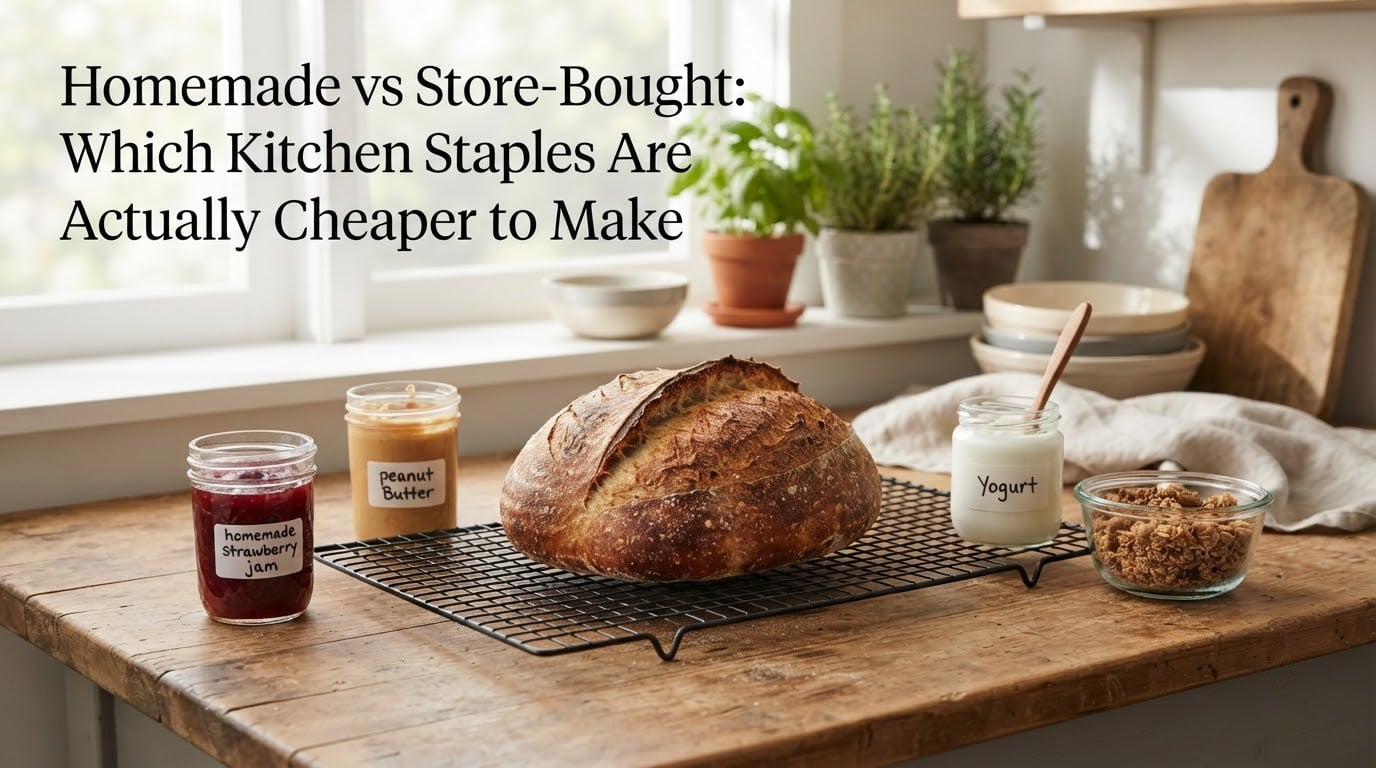
Three years ago I started tracking every kitchen staple I made at home versus bought at the store. I wanted a real answer to the homemade vs store bought kitchen staples cost comparison question, not a listicle with vague claims. After 12 months of receipts, batch logs, and spreadsheet entries, I have actual numbers.
The honest answer surprised me. Some staples save serious money. Others cost more to make than buy, once you factor in everything that matters. This guide breaks down 15 common kitchen staples, shows the real cost per serving for each, and gives you a simple framework to decide which ones are worth your time in 2026.
You will get a master comparison table, category-specific cost breakdowns, the hidden costs nobody else calculates, and three specific scenarios where store-bought actually wins. No fluff, no theoretical savings, just what I learned after a year of testing.
Table of Contents
- Quick Answer: What’s Worth Making From Scratch
- How I Calculated These Numbers (Methodology)
- Bread and Bakery Items That Save Real Money
- Dairy Staples: Yogurt, Butter, and Cream Cheese
- Snacks and Spreads That Beat Store-Bought
- Condiments, Sauces, and Preserves
- The 3-Question Decision Framework: Should I Make or Buy?
- The 4 Hidden Costs That Make Homemade More Expensive
- When Store-Bought Actually Wins (3 Scenarios)
- Equipment ROI: When Does a Stand Mixer Pay for Itself?
- Bulk Buying and Seasonal Strategies That Change the Math
- Frequently Asked Questions
- Final Verdict: My Real Savings After 12 Months
Quick Answer: What’s Worth Making From Scratch
This table ranks 15 kitchen staples by actual savings percentage. I calculated each using current bulk ingredient prices, equipment amortization, utility costs, and typical waste factors. Time investment reflects active hands-on minutes per batch, not total elapsed time.
| Staple | Homemade Cost Per Serving | Store-Bought Per Serving | Savings % | Time | Difficulty |
|---|---|---|---|---|---|
| Bread (sandwich loaf) | $0.38 | $2.40 | 84% | 15 min active | Easy |
| Yogurt (plain) | $0.45 | $1.10 | 59% | 10 min active | Easy |
| Tortillas (flour) | $0.12 | $0.28 | 57% | 20 min active | Easy |
| Peanut Butter | $0.22 | $0.45 | 51% | 5 min | Easy |
| Hummus | $0.35 | $0.70 | 50% | 10 min | Easy |
| Granola | $0.40 | $0.80 | 50% | 15 min | Easy |
| Jam (seasonal berries) | $0.30 | $0.55 | 45% | 30 min | Medium |
| Pita Bread | $0.18 | $0.32 | 44% | 20 min | Medium |
| Salsa (canned tomato base) | $0.25 | $0.45 | 44% | 15 min | Easy |
| Salad Dressing | $0.30 | $0.50 | 40% | 5 min | Easy |
| Butter (heavy cream based) | $0.85 | $1.20 | 29% | 20 min active | Medium |
| Crackers (seed) | $0.45 | $0.60 | 25% | 30 min | Medium |
| Cream Cheese | $1.10 | $1.25 | 12% | 45 min active | Hard |
| Ketchup | $0.60 | $0.55 | -9% | 90 min | Hard |
| Bagels | $0.55 | $0.45 | -22% | 60 min active | Hard |
Two items (ketchup and bagels) actually cost more to make at home once you factor in time and energy. I will explain why in the category breakdowns below.
How I Calculated These Numbers (Methodology)
Most homemade vs store bought cost comparison articles skip the math. They list ingredient prices and call it savings. That approach misses four costs that change the verdict entirely.
Cost per serving, not cost per batch. A batch of bread costs $1.50 in flour, yeast, and energy. That sounds amazing until you divide it by the 20 servings per loaf and realize you spent 90 minutes baking for two days of lunches.
Equipment amortization. That $400 stand mixer has to pay for itself before the bread savings are real. I divide equipment cost by estimated batches over the equipment lifespan. A stand mixer amortizes at about $0.40 per batch. A food processor runs $0.25.
Utility costs. Running an oven costs roughly $0.30 to $0.50 per hour depending on your location and energy source. A loaf of bread uses about 45 minutes of oven time. Stovetop work is cheaper, about $0.10 per hour for an electric burner.
Waste factor. Homemade cooking generates scraps, failed batches, and ingredient spoilage. I apply a 10% waste adjustment to bulk ingredient costs. For dairy and produce, that adjustment rises to 15%.
Regional prices vary 20% to 30% for the same ingredients, so use these numbers as a framework. Adjust based on what you actually pay at your local stores.
Bread and Bakery Items That Save Real Money
Bread is the single biggest win in this homemade vs store bought comparison. A 25-pound bag of all-purpose flour runs around $15.89 at bulk retailers. Two and a quarter teaspoons of yeast costs pennies. Two loaves of sandwich bread costs under $1.50 in ingredients.
The same loaves run $5 to $7 at the grocery store for commercial brands, and $7 to $12 for bakery bread. That is an 84% savings on a staple most families buy every week.
Time reality check: Active hands-on time is 15 minutes per double batch. Total elapsed time including rise is 3 to 4 hours, but you can do other things during the rise.
Tortillas and pita also deliver strong savings. Flour tortillas cost roughly $0.12 per tortilla to make versus $0.28 for store-bought. Pita bread is similarly priced, though the rolling and cooking require slightly more skill.
English muffins, sandwich rolls, and hamburger buns all fall in the same category. Once you have the basic bread technique down, variations are simple. Reddit r/Frugal users consistently report bread as their number one money-saving homemade staple.
One exception: bagels. The boiling and shaping process adds 60 minutes of active work and the result is not dramatically better than store-bought. Bagels cost about $0.55 per serving homemade versus $0.45 for a decent store brand. Skip bagels unless you genuinely enjoy the process.
Dairy Staples: Yogurt, Butter, and Cream Cheese
Yogurt is the second biggest win after bread. A quart of milk plus a small amount of starter culture produces 4 cups of plain yogurt for roughly $1.80 in ingredients. The same 32-ounce tub costs $4.40 at most grocery stores.
The process is mostly hands-off. You heat milk to 180°F, cool it to 110°F, add starter, and wait 6 to 12 hours. Active time is 10 minutes.
Greek yogurt requires straining through cheesecloth, which adds another 2 hours of passive draining time. Even with that extra step, homemade Greek runs about $0.65 per cup versus $1.40 for store-bought Fage or Chobani.
Butter is a borderline case. Heavy cream at bulk prices produces butter for about $0.85 per stick, compared to $1.20 for name-brand store butter. Savings drop to 29% once you account for the 20 minutes of active shaking or churning.
The real appeal of homemade butter is flavor and the bonus buttermilk. If you bake frequently, homemade butter is worth it. If you just need butter for cooking, the savings are not significant enough to justify the effort.
Cream cheese barely saves money. The process requires culturing heavy cream, straining for 12+ hours, and produces inconsistent texture. You save about 12%, which translates to roughly $0.15 per tub. Not worth the 45 minutes of active work.
Reviewers on Reddit r/budgetfood confirm that yogurt and butter are clear wins while cream cheese and sour cream rarely justify the time investment.
Snacks and Spreads That Beat Store-Bought
Peanut butter is one of the easiest wins. Two cups of roasted peanuts, a pinch of salt, and 5 minutes in a food processor produces 16 ounces of peanut butter. Cost per serving lands around $0.22 versus $0.45 for commercial brands.
You control the sugar, salt, and oil. Commercial peanut butter often contains palm oil and added sugars. Homemade is just peanuts, with optional honey or salt.
Hummus delivers 50% savings with minimal effort. A can of chickpeas, tahini, lemon juice, olive oil, and garlic blend in 10 minutes. Cost per serving is roughly $0.35 versus $0.70 for Sabra or similar brands.
Granola works well if you buy oats and nuts in bulk. A standard batch with rolled oats, almonds, honey, and oil runs $0.40 per serving. Store-bought granola at brands like Bear Naked or Nature Valley costs $0.80 or more per serving.
The catch with granola is sugar and dried fruit. If you add a lot of dried cranberries or chocolate chips, costs rise quickly. Stick to the basic recipe and granola is a genuine 50% saver.
Crackers are a mixed bag. Simple seed crackers (just seeds, water, salt) are cheap and easy. Buttery Ritz-style crackers require butter, flour, and careful rolling. Time investment of 30 minutes for $0.15 per serving savings is usually not worth it.
Stick with seed crackers and flatbreads if you want a homemade cracker that actually saves money.
Condiments, Sauces, and Preserves
Jam is a strong winner when berries are in season. A flat of strawberries at $15 produces 8 to 10 half-pint jars of jam. The same jam costs $4 to $6 per jar at the store.
Off-season jam making is less compelling. Frozen berries work but cost more per pound. The savings drop from 45% to around 25% in winter months.
The real benefit of homemade jam is ingredient control. Commercial jams are often 60% sugar by weight. Homemade versions can use less sugar, honey, or alternative sweeteners.
Salsa is one of the easiest wins in the entire comparison. A can of fire-roasted tomatoes, an onion, jalapeño, cilantro, lime juice, and a blender produces restaurant-quality salsa in 15 minutes. Cost per cup is $0.25 versus $0.45 for jarred salsa.
You can roast your own tomatoes when in season and skip the canned route entirely. Fresh summer salsa costs about $0.18 per cup using garden or farmers market tomatoes.
Salad dressing saves 40% with 5 minutes of effort. Olive oil, vinegar, mustard, garlic, and herbs whisk together instantly. Homemade vinaigrette costs $0.30 per serving versus $0.50 for bottled dressings like Newman or Briannas.
The bonus is ingredient quality. Store-bought dressings often contain soybean oil, sugar, and preservatives. Homemade uses olive oil and real ingredients.
Ketchup is the surprise loser. Tomato paste, vinegar, sugar, and spices need to simmer for 90 minutes to develop the right flavor and texture. Cost per bottle lands at $0.60 versus $0.55 for store brands. You pay more and spend more time. Skip homemade ketchup.
The 3-Question Decision Framework: Should I Make or Buy?
Before making anything from scratch, run it through these three questions. This framework is what I use whenever I consider adding a new homemade staple.
Question 1: How often do I use it?
Items used 3+ times per week justify the effort. Bread, yogurt, and peanut butter all qualify. Items used once a month rarely justify homemade production. The setup and cleanup time is not amortized over enough servings.
Question 2: Do I already own the equipment?
If you need to buy a $400 stand mixer to make $3 worth of bread per week, the savings do not pencil out for over two years. If you already own the equipment, the calculus changes completely.
Wait for a birthday or holiday to request equipment, then experiment with homemade versions of high-use staples.
Question 3: Can I buy ingredients in bulk?
Bulk pricing changes everything. Flour at 50 cents per pound versus $1.50 per pound doubles or triples your bread savings. Warehouse stores, restaurant supply shops, and bulk food co-ops all offer significantly lower prices.
If you cannot access bulk ingredients, most homemade staples deliver much smaller savings. Sometimes none at all.
These three questions filter out the items that look like winners but actually lose money once you account for real-world constraints.
The 4 Hidden Costs That Make Homemade More Expensive
Most cost comparison articles ignore these four factors. Once you include them, several “money-saving” staples become money-losers.
Equipment amortization is the biggest hidden cost. A $400 stand mixer spread over 10 years of heavy use costs $0.40 per batch. A $300 dehydrator amortized over 100 batches of jerky or fruit leather costs $3.00 per batch. You need to make a lot of jerky before that dehydrator pays for itself.
Utility costs matter more than people realize. Oven baking for 45 minutes costs roughly $0.25 to $0.40 in electricity or gas. If you bake three loaves per week, you spend $40 to $60 annually just on energy for bread alone.
Waste factor catches beginners off guard. First attempts at bread, yogurt, or jam often fail. A collapsed cake, broken emulsion, or burned batch represents lost ingredients and lost time. I apply a 10% waste adjustment across all homemade staples, 15% for dairy and produce.
Time value is the most controversial hidden cost. If you earn $25 per hour at your job and homemade bread takes 90 minutes of total time per week, the time investment represents $37.50 in opportunity cost. Subtract that from your bread savings and the picture changes.
I do not advocate for full-time hourly wage accounting on every homemade item. But when savings margins are thin (under 30%), time value can flip the verdict.
When Store-Bought Actually Wins (3 Scenarios)
Honest comparison means admitting when store-bought is the smarter choice. These three scenarios favor buying.
Scenario 1: The sale cycle. Grocery stores rotate loss leaders every 6 to 8 weeks. When peanut butter drops to $2.50 per jar or yogurt hits $3 for 32 ounces, buying in bulk and freezing or storing makes sense. Stock up during sales and skip homemade production until prices normalize.
Most homemade staples lose their cost advantage when store-bought prices drop 30% to 40% during sales. Track prices for a few months before committing to regular homemade production.
Scenario 2: Specialty dietary needs. Gluten-free flour costs $5 to $8 per pound versus $1 for wheat flour. The savings on gluten-free bread drop to roughly 30% instead of 80%. Dairy-free yogurt cultures and plant-based milk alternatives also narrow the homemade advantage significantly.
If you follow a restricted diet, calculate savings based on your actual ingredient costs, not generic recipes.
Scenario 3: Low-consumption items. Making a batch of bagels, cream cheese, or ketchup that you only use twice a year is a false economy. The equipment setup, ingredient sourcing, and cleanup exceed any possible savings.
Stick to items you use regularly. Specialty items that sit in the pantry are usually cheaper to buy.
Equipment ROI: When Does a Stand Mixer Pay for Itself?
Equipment is the upfront investment that makes most homemade staples possible. Here is the break-even math for common kitchen tools.
Stand mixer ($400 average). Used for bread, cookies, and pizza dough. At 2 batches per week, it pays for itself in roughly 80 weeks. That is about 18 months of regular use. If you bake less than twice weekly, the mixer takes 3+ years to amortize.
Food processor ($200 average). Used for hummus, peanut butter, pesto, and chopping. At 3 batches per week, it pays for itself in about 60 weeks. Heavy users recoup costs faster.
Dehydrator ($300 average). Used for jerky, fruit leather, and dried herbs. Break-even requires 100+ batches. Most home cooks never hit that threshold. Skip the dehydrator unless you specifically plan to preserve large quantities.
Instant Pot ($100 average). Used for yogurt, beans, and stock. At 4 uses per week, it pays for itself in 25 weeks. The Instant Pot is the fastest-amortizing tool on this list.
Yogurt maker ($50 average). Dedicated yogurt machines produce consistent results but cost less than the Instant Pot method. Break-even is roughly 30 batches. Worth it only if you make yogurt weekly.
The math is simple: divide equipment cost by per-batch savings, and you get the number of batches needed. Track your usage for the first few months to verify your assumptions.
Bulk Buying and Seasonal Strategies That Change the Math
Where you source ingredients matters as much as whether you make or buy. Bulk purchasing and seasonal timing can shift a borderline item into clear savings territory.
Restaurant supply stores offer the lowest flour, sugar, and salt prices. A 50-pound bag of all-purpose flour runs $15 to $20, compared to $40 to $50 for the equivalent in grocery store bags. Restaurant supply stores are open to the public in most areas, though some require a small membership fee.
Costco and warehouse clubs offer competitive prices on oil, nuts, oats, and peanut butter. A 3-pound jar of peanuts at Costco costs roughly half the per-pound price of grocery store peanuts. If you have a membership, bulk nut buying is the single biggest lever for peanut butter and granola savings.
Seasonal produce transforms jam, salsa, and sauce economics. Berries in June cost $1.50 per pint. In January, frozen imports cost $4 per pint. Jam made in summer costs $0.30 per jar. Winter jam costs $0.55 per jar.
Time your preserve-making to peak season. Freeze berries at their cheapest for winter jam projects.
Freezing strategy extends bulk savings year-round. Buy flats of berries during peak season, freeze in 2-cup portions, and make jam in winter. Buy butter during holiday sales and freeze for months. Same approach works for bread flour and yeast.
These strategies compound with the homemade decision. The right sourcing turns a marginal saver into a clear win.
Frequently Asked Questions
What is cheaper to make at home than buy?
Bread, yogurt, tortillas, peanut butter, hummus, granola, jam, and salsa are reliably cheaper to make at home, with savings ranging from 44% to 84%. Items like cream cheese, ketchup, and bagels are usually more expensive to make once you factor in time, equipment, and energy costs.
Is it cheaper to make homemade bread or buy it?
Yes, homemade bread is dramatically cheaper than store-bought. A 25-pound bag of flour at bulk prices costs about 63 cents per pound. Two loaves of sandwich bread cost under 1.50 in total ingredients versus 5 to 12 for commercial or bakery bread. After equipment and energy costs, you still save roughly 80% per loaf.
Is homemade stuff better than store-bought?
Homemade versions typically have fewer preservatives, less added sugar, and fresher ingredients. Taste and texture are usually superior, especially for bread, jam, and salad dressing. However, store-bought wins on convenience, consistency, and shelf life for items like ketchup and crackers.
What are the hidden costs of making food from scratch?
The four hidden costs are equipment amortization, utility costs (oven and stovetop energy), waste from failed batches, and the time value of your labor. A 400 stand mixer adds 0.40 per batch, oven baking costs 0.25 to 0.40 per hour, and a 10% waste adjustment accounts for ingredient loss during production.
Final Verdict: My Real Savings After 12 Months
After a year of tracking every homemade staple, my family saved approximately $1,400 on groceries. The biggest contributors were bread ($480), yogurt ($310), peanut butter ($180), hummus ($140), and granola ($120).
The homemade vs store bought kitchen staples cost comparison comes down to three factors: how often you use the item, whether you already own the equipment, and whether you can buy ingredients in bulk. When all three align, savings are significant. When any factor is missing, the math often flips.
Start with bread. It is the clearest win in this entire comparison and the foundation for most other homemade staples. Once bread is routine, add yogurt, then peanut butter. Build your homemade kitchen gradually and track the actual savings. That is how you turn this guide into real money back in your pocket in 2026.