
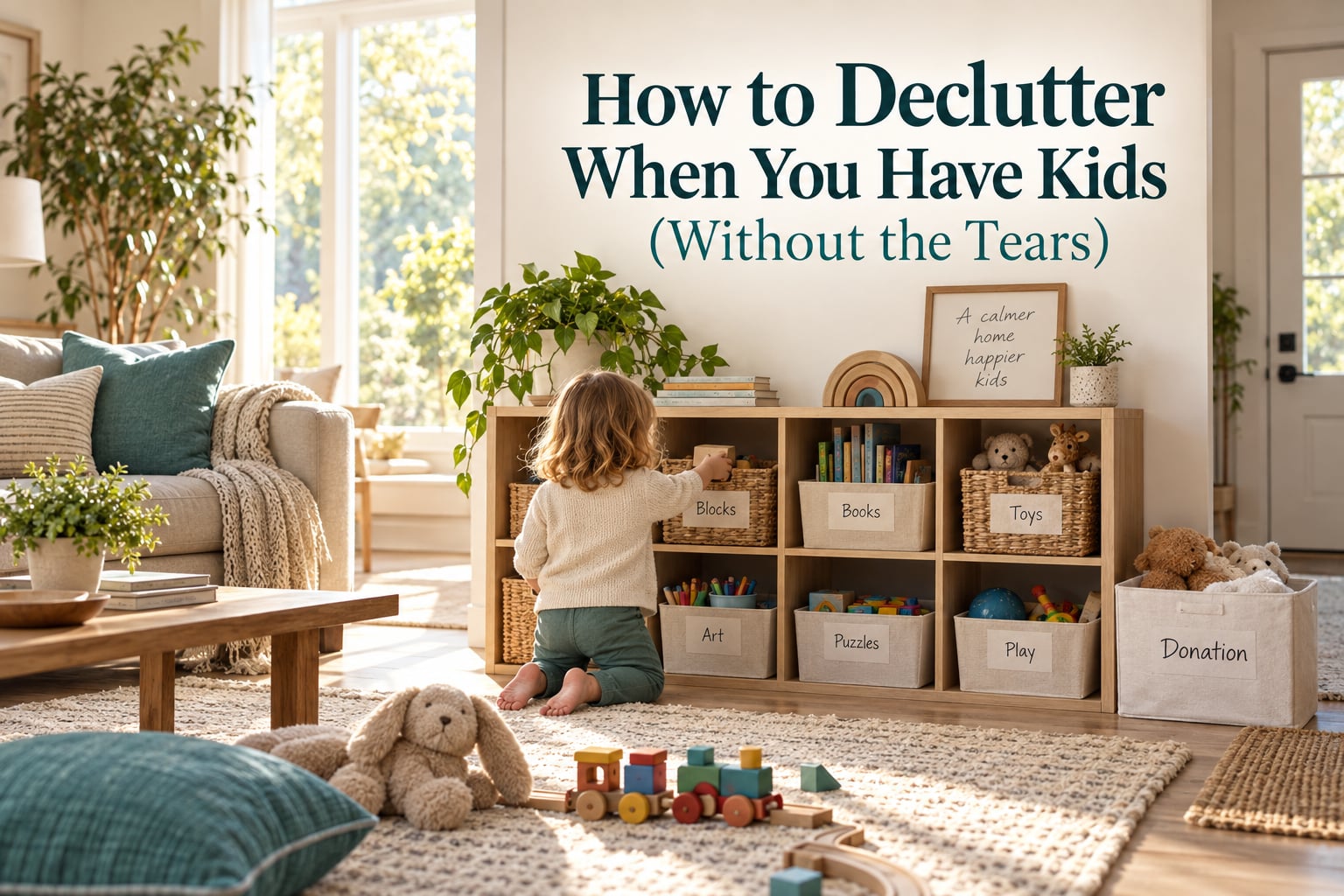
To declutter when you have kids without tears, set a 15-minute timer, pick a calm time of day, sweep out trash and broken toys first with a garbage bag, then gather every toy into one central spot so you can see the total at once. Sort into keep, donate and keep-forever. Let the container decide, not you, so nothing is taken away by force.
That last part is the whole trick. Most decluttering disasters with kids are not about stuff. They are about a parent standing over a heap of plastic saying no while a child says please.
I have three kids and a house that generates clutter on a schedule: birthdays in March and July, Christmas in December, and a steady supply of hand-me-downs from family we cannot say no to. The purge used to end in a standoff, so I changed the method rather than the kids. Here is the system that has held up for us, and it costs nothing.
Table of Contents
- How to Declutter When You Have Kids Without the Tears
- Should You Declutter With Your Kids or While They Are at School?
- The 7-Step Declutter Session, Start to Finish
- What to Say When Your Kid Refuses to Give Something Up
- Storage That Works With Kids: Small Bins and Cubbies, Not Giant Toy Chests
- The 3-3-3, 5-5-5 and 7-7-7 Rules Explained for Kids Belongings
- How Old Does Your Child Need to Be to Help?
- Sentimental Items: What to Keep, What to Photograph
- Where the Purged Toys Actually Go
- The Post-Holiday and Birthday Toy Surge
- Decluttering Before Baby Arrives
- Frequently Asked Questions
- What to Do First Tonight
How to Declutter When You Have Kids Without the Tears
The AI Overview on this question splits the work into two groups, and that framing is genuinely useful: prepare and plan, then sort the toys. Here is what goes in each.
Prepare and Plan
- Set a 15-minute timer and say the number out loud to your child. Short, timed sessions keep a child cooperative far longer than a vague promise of “a big clean-up”.
- Pick the calm window. Do not start when anyone is hungry, overtired or cranky. After a snack and before dinner usually beats after dinner.
- Tie up the trash first. Broken toys, dried-out markers, dead batteries and random paper go straight into a garbage bag with no discussion.
- Get three containers ready before anyone moves: a keep bin, a donate bin and a keep-forever box.
- Do not start in your child’s bedroom. Declutter a common area or your own closet first to prove the method.
Sort the Toys
- Consolidate everything into one central spot, usually the living room floor. You cannot judge volume while toys are still hidden in three rooms.
- Break it into categories: cars, dolls, puzzles, building toys, books, dress-up, outdoor.
- One category at a time, one container at a time. No sorting the whole room at once.
- Every kept object gets a specific home that it can physically fit in.
- Stop when the timer rings, even mid-category. An unfinished session beats a collapsed one.
Should You Declutter With Your Kids or While They Are at School?
Both answers on the internet are right for different children, and neither one tells you which applies to yours. The deciding factor is attachment style, not age alone.
Do the big cull alone if your child has a loose attachment to objects, is younger than about three, or would not notice the difference. Leave a note or tell them the same evening. Parents on the What to Expect boards describe the alone-first approach as faster by a wide margin.
Declutter together if your child leans toward attachment, is old enough to sort and make decisions, or has already watched you remove things and hold on tighter as a result. A Reddit thread on decluttering a child’s belongings with minimal storage lands in the same place: get them involved and the fight mostly disappears.
Doing it secretly is the one approach that backfires reliably. What comes back in the donation bag within thirty days is what people call boomerang clutter, and it teaches your child that disappearing objects reappear. That confusion costs you more than the hour you were trying to save.
The 7-Step Declutter Session, Start to Finish
Run the whole session in this order. Each step is ten minutes or less, which keeps the whole thing under an hour.
Step 1: Set the timer and the goal. Fifteen minutes, one category, one room. Announce both.
Step 2: Garbage-bag sweep. Carry a bag and pick up broken, missing-parts and dried-out items as you move. No sorting, no asking. This is the fastest visible progress and it gets the boring work done first.
Step 3: Consolidate. Everything in that category ends up in one pile on the floor. The pile is the data. Most parents see the true number for the first time here.
Step 4: Sort into three containers. Keep, donate, keep-forever. Four containers including a sell bin is one too many for most homes.
Step 5: Let the container decide. Fill the keep container until it is full, then stop. Whatever has not made it in becomes a donation. Your child is not being told no; the basket is simply full.
Step 6: Give every kept item a home. Small bins and cubbies beat one big chest because a child can return something without help. Label them if your kids can read.
Step 7: Close the loop within 48 hours. Take the donate bin out of the house. Toys sitting in the hallway for a week come back, and that is exactly how boomerang clutter starts.
What to Say When Your Kid Refuses to Give Something Up
No competitor on this topic gives you actual sentences, and that is where the tears come from. These are the phrases we use, and they work because none of them take anything away or make the child a problem.
“The basket is full, so the rest goes.” Then move on. No negotiation, no second look.
“You played with this in January. Want to give it away or have it?” The choice is how it leaves, not whether it leaves.
“Someone smaller will love this more than you do right now.” Reframes donation as generosity rather than loss.
“I will keep this one forever in the memory box.” For the truly precious item. Children accept a keep-forever answer surprisingly often.
“You can keep it in the donate box until our next session.” A delay, not a veto. Hold to it the next time or the rule dies.
“If it is on the floor at bedtime, it goes in the bag.” The consequence that actually works, and one parents report using successfully: the item is swept into the donation bag while the child watches.
When the crying starts, stop talking. Sit on the floor, keep your voice level, and stay until it passes. A meltdown is not the time for reasoning, and continuing the argument teaches nothing. Wait it out, then resume the sort as though nothing happened.
Storage That Works With Kids: Small Bins and Cubbies, Not Giant Toy Chests
A giant toy chest fails for one reason: it lets you store far more than a child can put away. A four-year-old cannot lift a lid and return eleven items before losing interest, so the chest becomes the place toys hide.
The container method inverts that. Every object needs a home, and the home is small enough that returning things is easy. Small bins on open shelving, one low cubby unit per child, and a labelled donation bin that lives near the exit rather than in the closet.
Category storage is the change parents describe as finally making the return rule workable: all sleeping bags in one cupboard, torches in one drawer, gloves in a basket by the front door, cars and character toys in separate boxes. Out of sight does mean out of mind here, but only because you consolidated on purpose first.
The 3-3-3, 5-5-5 and 7-7-7 Rules Explained for Kids Belongings
These numbered rules all do the same job: they replace your opinion with a number, so nobody has to be the bad guy. The 3-3-3 rule means keep only what you used in the past three months, wear in the past three years, or read in the past three years. The 5-5-5 rule extends those windows to five years, which is better for books and clothes.
The 7-7-7 rule uses seven-year windows. For a four-year-old’s belongings it is close to meaningless, since nothing in the house has a seven-year history yet. Use the shortest window the age of the stuff can actually support.
- One-in, one-out. Every new toy requires one toy leaving. Best fit: school age and up. Tear risk is low, provided the child chooses the outgoing toy.
- 3-3-3. Three months used, three years worn, three years read. Best fit for toys, clothes and books. Tear risk is medium on toys, low on outgrown clothes.
- 5-5-5. The same three categories across five years. Best fit for books, keepsakes and craft supplies. Tear risk is low.
- 7-7-7. Seven years across all three categories. Best for adult household items, and rarely relevant to kids. Tear risk is very low.
- Five-minute pickup test. If the room cannot be reset in five minutes, there are too many toys. A diagnostic rather than a rule, so it carries no tear risk at all.
- Container method. The space is full, so the decision is made without you saying no. Works at every age, including toddlers, and has the lowest tear risk of the six.
How Old Does Your Child Need to Be to Help?
- Under 3. They can carry one item to a bin at a time. You make all the decisions and let them be the runner.
- 3 to 5. They can sort by colour, size or type into two bins. You set the limit and let them choose which items leave.
- 6 to 8. They can sort a full category and name their own favourites. Run the container method together.
- 9 and up. They can manage their own donate bin and the one-in one-out rule. Hand over the whole system.
Sentimental Items: What to Keep, What to Photograph
Sentimental guilt is the biggest blocker, and it stalls more purges than any toy volume. The fix is a hard limit with a ritual attached.
One memory item per year, per child, goes into a keep-forever box. Everything else sentimental gets photographed on your phone in one batch and goes to donate. The photo preserves the memory without the floor space, and a decade later nobody remembers which of six identical baby blankets was the one they loved.
Outgrown clothes are the exception most parents get wrong. A coat in a size your child will not wear for three years is not sentimental, it is stored. A worn jumper is sentimental. Different rules, no overlap.
Where the Purged Toys Actually Go
Having a destination before you start is what stops boomerang clutter. Decide in advance whether a category is donation, sale or recycling, and write it on the bin.
Donation centres in the Edmonton area generally accept toys, but rules differ on electronics, books, textiles and anything with a battery. Check before you load the car, and separate working electronics from dead ones rather than dropping them in the same box.
Selling works for higher-value items only, and the time cost is real. A toy library swap is the better option for duplicates, since the point is someone else gets to use them. Skipping all three is acceptable: a labelled donation bin by the door is a perfectly good system on its own.
The Post-Holiday and Birthday Toy Surge
New toys do not go straight onto the floor. They go into the rotation, and something currently in rotation comes out. That is the one-in one-out rule, applied before the wrapping comes off, which is far easier than a purge in the new year.
Thirty days later, check what actually left. Whatever is still sitting in the donation bin went back. Note it quietly, because a rule you do not enforce is not a rule.
Decluttering Before Baby Arrives
Nursery prep is a natural deadline, because you physically need the floor space. Start with the outgrown clothes, which is the easiest category to donate and gives you the biggest volume.
Keep the one-in one-out rule running from that point on. Parents on parenting boards describe the pre-baby clear-out as the one deadline that makes the whole family cooperate, since everyone understands the change.
Frequently Asked Questions
What is the 3-3-3 rule for decluttering?
Keep only what you used or wore in the past three months, read in the past three years, or used in the past three years. Everything else goes. For a child’s belongings, apply three months to toys, three years to clothes and three years to books.
What is the 3-3-3 rule for kids?
The same rule applied to a child’s stuff. Use the past three months to decide on toys, because children cycle through interests quickly, and the past three years for clothes and books. With a young child, the three-month window keeps the volume low enough for them to reset the room in five minutes.
What is the 5 5 5 rule for decluttering?
It extends the 3-3-3 windows to five years, so keep what you used in five months, wore in five years, or read in five years. It suits books, craft supplies and keepsakes better than toys, because five years is a long window to judge a plastic truck by.
What is the 7 7 7 rule for kids?
The longest version, using seven-year windows across used, worn and read. For children’s belongings it is usually too long, since a preschooler’s belongings have no seven-year history. Use the 3-3-3 or 5-5-5 version instead and save 7-7-7 for adult items.
How do I get my kids to declutter?
Set a 15-minute timer, sweep out the trash first, and let a container be full rather than telling them no. Give them the choice of how an item leaves, not whether it leaves. Words that work include asking whether they want to give it away or have it, and offering a keep-forever box for the one truly precious item.
Should I declutter with my kids or without them?
Do the big cull alone if your child is under three or has a loose attachment to objects, and tell them the same evening. Declutter together if they are old enough to sort or lean toward attachment. Never do it secretly, because items that reappear within thirty days create boomerang clutter and teach your child that things come back.
What do you do with sentimental kids’ stuff?
Keep one memory item per year per child in a keep-forever box, and photograph everything else before it goes. Outgrown clothes are stored rather than sentimental unless they are visibly worn. A photo holds the memory without holding the floor space.
What to Do First Tonight
To start how to declutter when you have kids without tears, do one thing: put a 15-minute timer on your phone, get out a garbage bag, and tell your child the timer number before anything else. Trash first, one category, and let a full container be the reason it goes.
Everything else in this guide, from the scripts to the storage, is a refinement of that one habit. Run it every week, all year 2026, and the monthly purge stops being an event. Updated for 2026.