
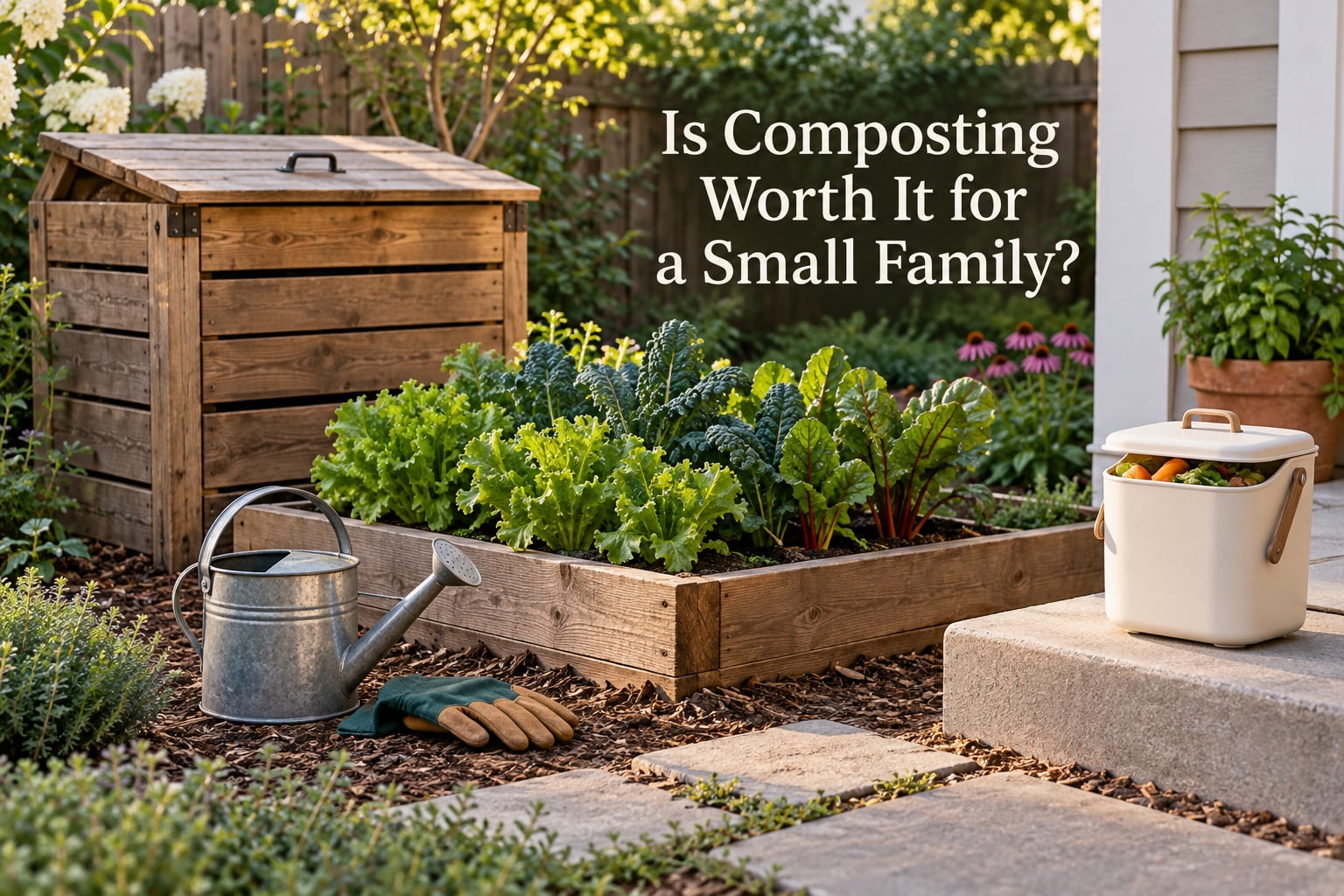
Yes, composting is worth it for most small families — but the payoff depends on which of three returns you actually care about. You cut roughly 30 percent of your household trash, you gain a free soil amendment, and you spend about two hours a month on it. Whether that trade feels good depends almost entirely on your living situation and whether you have anywhere to put the finished compost.
That is the honest version of the answer. Plenty of small households start composting and quietly quit within a season, and the reason is almost never the science. It is that they picked a system built for a bigger household, or they had nowhere to use the output, or one family member kept adding things that made the pile smell.
Here is what I have learned watching Edmonton households run through this, including my own. We will cover the methods side by side, the real time cost, the space you need, what goes in and what stays out, and the situations where composting genuinely is not worth the hassle.
Table of Contents
- Is Composting Worth It for a Small Family? The Honest Answer
- Composting Methods Compared for Small Households
- The Composting Pros and Cons That Decide It
- How Much Space Does a Small Family Compost Bin Need?
- What Can and Cannot Go in a Small Family Compost Bin
- The Honest Downsides of Composting
- When Composting Is NOT Worth It
- How to Start Composting With a Small Family
- Winter Composting in Edmonton and Northern Climates
- Getting Your Family On Board
- What to Do With Finished Compost Without a Garden
- How Long Until You Have Usable Compost?
- Frequently Asked Questions
- What are the downsides to composting?
- What is the laziest way to compost?
- What are 5 items that should not be composted?
- Can I compost in an apartment or condo?
- How much space do I need for a compost bin?
- Do compost bins smell?
- How much compost does a family of four produce?
- Is home composting worth the effort, or should I just buy compost?
- Do I need to turn my compost?
- Can I compost in the winter in Edmonton?
- Is the output from an electric composter real compost?
- What can I do with compost if I have no garden?
- The Verdict on Composting for a Small Family
Is Composting Worth It for a Small Family? The Honest Answer
For a family of two to four, composting is worth it when you have an outdoor space and something growing or an outlet for the compost. It is worth it for the trash reduction alone even without a garden, because food waste is the heaviest and smelliest part of a household bin.
Three reasons drive nearly every case where it works out.
- Trash volume drops measurably. Food scraps and their packaging are a large share of what a family actually throws away. A family of three with three cats who composts reports filling less than one garbage bag a week, according to a r/composting writeup.
- The output has real value if you garden. Compost used as a soil amendment, a top dressing on lawn, or a blend for houseplant soil replaces something you would otherwise buy by the bag.
- The maintenance load is small. Two hours a month is the commonly cited figure, and for a small household that is genuinely one short session a week plus a turning session or two.
Two reasons make it not worth it. The first is having no outlet for finished compost, which turns a useful habit into a hobby that produces a bucket you have to give away. The second is a living situation that forbids outdoor bins, such as many condo units.
The useful way to think about it is a break-even question rather than a yes or no. A trash can with a lid costs nothing, autumn leaves and cardboard are free, and a small household generates a manageable amount of material. The method that fails for a family of six — a large stationary tumbler needing weekly turning — can be overkill for a family of three.
My rule of thumb: if you can commit to one bin, one kitchen collector, and one weekly habit, composting is worth it. If you are hoping a machine will do everything while you ignore it, it is not.
Composting Methods Compared for Small Households
Every method below produces something slightly different, and choosing the wrong one is the most common reason small families give up. A simple yard bin makes crumbly finished compost in months. A countertop machine makes dry food grounds in days, and those grounds are a different product that people constantly confuse with compost.
Here is how the main options compare for a household of two to four.
Yard bin or trash can with lid. Free to low setup cost, 1 to 2 hours per month, about 3 square feet outdoors, and finished compost in 3 to 6 months.
Tumbler. Moderate setup cost, 2 to 3 hours per month, about 6 square feet outdoors, and finished compost in 6 to 8 weeks when turned regularly.
Worm bin. Low setup cost, about 1 hour per month, anywhere from a shoebox to a storage tub indoors or on a balcony, producing worm castings year round.
Bokashi. Low to moderate setup cost, 1 to 2 hours per month, counter or under-sink space using sealed buckets, and fermented pre-compost that must be buried in soil.
Electric countertop composter. Premium setup cost, under 1 hour per month because it is mostly automated, counter space plus a power outlet, and dehydrated food grounds in days.
Composting service pickup. Recurring fee, under 30 minutes per month, one sealed caddy indoors, and finished compost returned to you periodically.
Municipal curbside organics. Program fee or free, under 30 minutes per month, one lidded caddy indoors, and compost handled entirely by the city.
A note on the electric machines, because this is where most buyers get their expectations wrong. The output is a dry, flour-like material made of dehydrated food grounds. It is not finished compost, it will not cure in a bag, and it is not equivalent to what a pile produces. r/composting users debate this distinction constantly, and it is the single most common disappointment among people who buy a machine.
What the machines do deliver is convenience and indoor operation. For a small family that wants the habit without the yard, that trade is often worth making — as long as you know what the jar in the corner actually is.
A quick way to choose: if you have outdoor space and something growing, start with a bin, because it is the cheapest method and the output is real compost. If you have no outdoor space but a permitted indoor corner, go with worms, because they do the work and the castings are usable immediately. If you have neither space nor interest in handling material, a service pickup or a municipal program removes the process from your life entirely. If you are starting with a premium machine, wait until you have run a simple bin for a full season and know you will still be composting.
One more comparison worth making. Tumblers are the method most often bought by first-time composters and most often abandoned, because the turning schedule is frequent and a small household does not generate enough material to justify weekly work. A fixed bin that you fill and forget is the better match for most families of two to four.
The Composting Pros and Cons That Decide It
The pros are concrete and the cons are real. Both matter more than the cheerful version of composting you find in most blog posts.
The pros
- Food waste leaves the garbage, and with it the worst smell in the kitchen between pickups.
- You produce a soil amendment from material you were throwing away.
- Garbage bags and pickups drop. r/composting posters consistently report the bag count falling sharply.
- It is a teachable habit. Kids who handle scraps tend to eat more of what is in the fridge.
- It works year round indoors, which solves the winter problem entirely.
- The setup is genuinely cheap when you start with a bin and free materials.
The cons
- Time and attention. Maintenance is real, and households routinely underestimate it.
- Pest risk. Rodents, flies and neighbourhood animals are attracted to an uncovered or badly managed pile.
- Odour when the balance is wrong, which is common in the first month.
- One person does all the work unless you build the habit deliberately.
- Slow output. A passive pile can take a full season before it is useful.
- No outlet. If nothing grows at your house, the finished compost has nowhere to go.
The community consensus in r/composting is worth repeating because it defuses most of the anxiety: do not overthink it. Most of what people read online is optimising and accelerating a process that will largely happen anyway.
How Much Space Does a Small Family Compost Bin Need?
Less than most people assume. A small household can compost successfully in about three square feet of outdoor space, and indoors in something the size of a storage tub.
Apartment or condo: Check your building rules first, because several municipalities and many condo boards prohibit food composting indoors. Where it is allowed, a worm bin or a sealed bokashi bucket is the realistic option. Both are odour-controlled and pest-proof if set up correctly.
Townhouse or row house with a side yard: A single bin against the back fence works. A worm bin placed under a deck or beside a shed stays cooler and darker, which worms like and which reduces odour.
Small yard with no fence: Use a lidded bin rather than an open pile. Rodents find open food waste easily, and a secure container solves most of that problem before it starts.
Full yard: Two bins are the standard setup, and the second one is not a luxury. One bin cures while the other is actively filling, which stops you from constantly turning a finished batch back into raw material.
On size, there is a real limit. r/vegetablegardening users are blunt that a small bucket is Olympic-level hard work, and one poster suggests the first genuinely easy pile should be a substantial volume rather than a token container. The practical takeaway for a small family is that your bin should hold your household’s output for a full month or two before you need to turn or harvest it. Anything smaller and you will be stirring material more often than you deposit it.
What Can and Cannot Go in a Small Family Compost Bin
The rule people get wrong most often is thinking of compost as a food waste bin. It is a digestion system with a specific appetite.
Greens, the nitrogen side:
- Coffee grounds and paper filters
- Eggshells, crushed
- Fruit and vegetable scraps
- Tea leaves, in a compostable bag or loose
- Fresh grass clippings
- Herb stalks and spent flowers
Browns, the carbon side:
- Dry leaves, shredded if possible
- Plain cardboard, torn and dampened
- Plain paper, including office paper and shredded documents
- Uncoated paper towel and napkins
- Small untreated wood chips or sawdust
The balance matters more than precision. If a pile is wet and slimy you need browns, and if it is dry and dusty you need greens. Small families err toward too much nitrogen because fruit and coffee come in faster than dry leaves do.
Never in a small family bin:
- Meat, fish, dairy and oily foods. They attract pests and predators, and a small bin cannot get hot enough to break them down safely.
- Cooking oils and grease in quantity. A puddle of fat coats everything and stalls the process.
- Dog and cat waste. Human waste carries different risks than pet waste, and pet waste from a household using a compost bin is not something to handle in a standard setup.
- Disposable diapers and baby wipes. Nothing degrades them, which is a real consideration with young children in the house.
- Anything labelled compostable but not BPI certified. Many bin liners, takeaway containers and coated papers claim compostability in industrial facilities that do not exist at home.
Add a sixth if you have them: glossy magazine inserts, and anything coated in wax or plastic. They break down into fragments rather than disappearing.
A useful compromise for families that do not want to police the whole family: keep a small covered caddy on the counter, and have one person empty it. Small households often get more compost done with a rule one person follows than with a system everyone shares.
The Honest Downsides of Composting
Nobody’s household runs perfectly, and the failure modes are worth naming before you start rather than after.
Pests and animals. This is the fear that stops most small families, and it is mostly avoidable. The practical controls are a lidded bin, burying smelly material at least eight inches deep, and never leaving food waste exposed. r/composting threads about rodents almost always trace back to an open pile or a bin loaded on top rather than mixed in.
Odour. A properly mixed pile does not smell. A pile that has more greens than browns, is too wet, or is sealed without airflow will smell within days. The fix is browns and air, not more browns alone.
Time. Forum estimates cluster around two hours a month for a small household, which is real but manageable. The households that quit are the ones who chose a system requiring more attention than they wanted.
Family sabotage. Someone adds a biodegradable pod, or a greasy wrapper, or a whole rotisserie chicken, and the pile suffers. This is a habit and communication problem, not a composting problem.
Slow results. Compost takes six to eight weeks minimum in an actively managed pile, and passive systems take several months. Anyone expecting usable compost in a fortnight will conclude that composting does not work.
Cold weather. In Edmonton, an outdoor pile genuinely does stop in winter. This is a scheduling fact, not a failure, and it is covered in the seasonal section below.
The no-garden problem. This is the barrier competitors rarely address and, for apartment dwellers, the real one. More on it shortly.
When Composting Is NOT Worth It
Composting is not worth it in a few clear situations, and recognising them saves money and frustration.
You generate almost nothing. A household producing around five litres of scraps every two weeks, as one r/composting poster described, does not generate enough material to keep even a small system active. Very low waste households do better buying what they need when they need it.
Your building or municipality forbids it. Indoor food composting attracts flies, and many condo rules ban it. Check before you buy anything.
You have no outlet and no interest in soil. If nothing grows at your home and you will not give the compost away, you are running a production line for a bucket with no destination.
You will not do the small weekly habit. Two minutes a week is the floor. Households that skip it for a month end up restarting from scratch.
Bagged compost is genuinely good and cheap enough. This is the honest counter-argument, raised repeatedly in r/NoTillGrowery and r/composting. A small family that needs a few handfuls a year can buy a better product than it can make, for less hassle.
That last point is the one most articles skip. Composting makes financial sense at household volumes where you would otherwise buy a meaningful quantity of soil amendment. Below that threshold, the argument is environmental, not economic.
How to Start Composting With a Small Family
Start small, start outside if you can, and set the routine before you set the bin up. These six steps get a small household running.
Step 1: Choose the method by your space, not by your ambition. Outdoor space and a garden means a simple bin. A balcony or a permitted indoor corner means a worm bin. A sealed small footprint and low interest in handling material means bokashi or a service pickup.
Step 2: Pick the location first. A lidded bin in shade, close to the kitchen, gets used. A bin at the far end of the yard gets ignored. Near a fence or shrub line also reduces how visible it is to animals and neighbours.
Step 3: Set up a kitchen collector. A container with a lid on the counter catches scraps before they turn into a mess. This single item does more for consistency than the bin itself.
Step 4: Learn the two-line rule. Greens go in, browns go on top, and mix rather than layer when you can. That is genuinely most of composting. Frugal beginners report the same thing: the fear of getting it wrong is a bigger obstacle than getting it slightly wrong.
Step 5: Set a rhythm. Empty the collector when it is about two-thirds full. Turn the bin when you add a significant load, or on a fixed schedule once a month. Small families do better with a date than with a pile you are waiting to fill.
Step 6: Decide the destination before you start. Name the pot, the bed, the neighbour, the community garden, or the bucket where finished compost goes. Households that skip this step are the ones with compost and nowhere to put it.
One more practical tip for a family of two: freeze scraps for a week before adding them. It kills fruit fly attraction in the bin and in the kitchen, and it costs nothing but a freezer bag.
Winter Composting in Edmonton and Northern Climates
You do not have to choose between composting and a cold climate. You just have to change how you do it for five months.
Edmonton sits in a cold climate zone where an outdoor pile goes dormant in late autumn and effectively pauses through the coldest months. Microbial activity drops sharply and the pile does not spoil, it simply waits.
Three approaches work. The simplest is to pause outdoor composting and use a worm bin indoors, which runs year round at a stable temperature. The second is the two-bin rotation, where one bin keeps curing slowly and the other receives kitchen scraps through winter, so you harvest finished compost from the older bin in spring. The third is adding browns in autumn — shredded leaves and cardboard — which insulates the pile and gives it carbon to work with when it wakes up.
What does not work is piling kitchen scraps onto a frozen outdoor heap and hoping. That is a cold, wet, anaerobic mess that smells in spring.
If you would rather not manage any of this, an electric composter is the winter solution. It runs indoors, unaffected by outdoor temperature, and turns kitchen waste into food grounds on a schedule.
Getting Your Family On Board
The most common small-family failure is not a wrong bin. It is one person doing all the work while another person quietly ruins the system by adding the wrong things.
Fixing it takes three things. First, give the rule a home — a note on the compost lid listing what does not go in beats a conversation. Second, assign one person as the owner of the pile so responsibility is clear. Third, for kids, make participation a job rather than a lesson. A child who measures the temperature, counts the worms, or decides when to turn has ownership, and owners stop arguing.
r/composting users who run compost with teenagers report that the reliable approach is to make it a small, defined weekly task with a visible result, not an open-ended household obligation.
What to Do With Finished Compost Without a Garden
This is the question that decides the whole thing for a lot of small families, and it has more answers than most sites admit.
Houseplants. Finished compost mixed at roughly one part compost to several parts potting soil works as a gentle top dressing or refresh. Worm castings are richer in nitrogen than other compost, and gardeners commonly use them at around ten percent of the mix for potted plants.
Indoor seedlings. Compost blended with a seed-starting medium gives young plants a nutrient base without fertiliser.
Lawn top dressing. A thin layer over grass in autumn improves soil structure and moisture retention without any planting at all.
Two honest warnings before you plan around this. Worm castings carry the highest nitrogen content of any compost, and gardeners typically use them at around ten percent of the mix rather than as a pure growing medium, so more is not better. And worm bin compost is not weed seed free, so do not use it straight on a bed you intend to harvest without being prepared for weeding.
Community gardens and neighbours. Most community gardens accept donations, and gardeners with more soil than they need are usually glad to receive it. This is the reliable exit for households with no growing space.
Freeze and store. Finished compost can be bagged and frozen, or kept in a lidded bin in a shed, if your space is seasonal.
Municipal and shared programs. In the Edmonton area, check the City of Edmonton waste guidance and your collection provider for organics programs, and ask your building manager about shared collection points. Program availability changes, so confirm current details before you plan around them.
One last caution applies to the whole bin, not just a scoop of castings: whatever goes into a worm bin comes back out in the finished product, so a bin fed dog food or road-kill-adjacent scraps is a bin you should not use on edible beds.
How Long Until You Have Usable Compost?
Plan in months, not weeks, unless you are turning actively or running an electric machine.
An actively turned pile finishes in roughly six to eight weeks. A passive or cold pile typically needs three to six months. A worm bin produces usable castings continuously rather than in batches, so the question is less about a finish line and more about steady output. Bokashi produces fermented pre-compost quickly, but that material must be buried in soil and left to mature before use.
Four signs compost is finished: it is dark and crumbly, it smells like earth rather than food, it is near ambient temperature in the middle instead of warm, and it no longer resembles what went in. If it still smells like a bin, it needs more browns and more time.
Frequently Asked Questions
What are the downsides to composting?
The real downsides are time, pests, odour and having no outlet for the finished compost. A small household needs roughly two hours a month of attention. Pests are mostly prevented by a lidded bin and burying smelly material. Odour means the pile needs more browns and more air. And if nothing grows at your house, the output has nowhere to go.
What is the laziest way to compost?
The lowest-effort methods are municipal curbside organics collection, a paid pickup service, and a lidded yard bin you fill without turning. All three keep the process out of your hands. A worm bin is the laziest indoor option because worms do the mixing and aeration for you, and an electric composter is the laziest of all, running on a timer and producing food grounds in days.
What are 5 items that should not be composted?
Five items never to compost: meat, fish, dairy and oily foods; cooking oils and grease; disposable diapers and baby wipes; dog and cat waste; and anything labelled compostable but not BPI certified. Items labelled for industrial composting facilities do not break down in a home bin. Each of these either attracts pests, stalls the pile, or leaves fragments behind.
Can I compost in an apartment or condo?
Often yes, but check your building rules and your municipality first, because indoor food composting is restricted in some places. Where it is allowed, a worm bin or a sealed bokashi bucket is the realistic choice. Both stay odour-controlled indoors if set up correctly. Avoid open containers, which attract flies within days.
How much space do I need for a compost bin?
A small household needs about three square feet of outdoor space for a basic lidded bin, and two bins if you want one curing while the other fills. Indoors, a worm bin can be as small as a storage tub. Choose a bin that holds a month or two of your output before turning, because anything smaller needs stirring more often than filling.
Do compost bins smell?
A correctly managed pile should not smell. Odour appears when a pile has more nitrogen-rich greens than carbon-rich browns, sits too wet, or has no airflow. The fix is to add shredded cardboard or dry leaves and to turn the material so air reaches the centre. Sealing a wet pile in a closed bin makes the problem worse, not better.
How much compost does a family of four produce?
A family of four typically generates enough scraps to fill a small bin every few weeks, which works out to a useful bucket or two of finished compost a year from a single-season pile. Most r/composting users with small families report never producing too much compost, and a family of three with three cats reported filling less than one garbage bag a week after starting.
Is home composting worth the effort, or should I just buy compost?
For a household that needs only a few handfuls a year, buying a bag is often the better deal, and that argument comes up constantly in r/NoTillGrowery and r/composting. Home composting pays off financially when you garden enough to use a real volume, or when you want the trash reduction. Below that threshold it is an environmental choice rather than a financial one.
Do I need to turn my compost?
Turning speeds things up and is worth it in warm weather if you want finished compost in about six to eight weeks. It is not required. A passive pile that you never touch still breaks down, it just takes three to six months instead. Small families who want the least effort can fill a lidded bin, close the lid, and only turn it when they want a faster harvest.
Can I compost in the winter in Edmonton?
An outdoor pile pauses over the coldest months because microbial activity drops, but it does not spoil. It resumes in spring. You can also run a worm bin indoors year round, use a two-bin rotation so one batch keeps curing through winter, or add shredded leaves and cardboard in autumn to insulate the pile. Piling fresh kitchen scraps on a frozen heap will not work.
Is the output from an electric composter real compost?
Not exactly. Electric countertop machines produce dry, flour-like dehydrated food grounds within days, not finished compost. The material does not cure the way a pile does and is not a substitute for it in every application. It is a genuinely convenient indoor system, but you need to know the difference between food grounds and finished compost before you buy one.
What can I do with compost if I have no garden?
Use it on houseplants blended into potting soil, mix it into indoor seedling starting medium, top-dress a lawn in autumn, or donate it to a community garden or a neighbour who gardens. You can also bag and freeze it for seasonal storage. The key step is deciding the destination before you start, so the finished compost has a home.
The Verdict on Composting for a Small Family
Is composting worth it for a small family? For most households of two to four, yes — provided you have a spot for a bin and a reason to use what comes out. You will cut your garbage, get a usable soil amendment, and spend about two hours a month maintaining it.
Choose the simplest method your space allows. A lidded bin with a kitchen collector is enough for most families, a worm bin covers apartments and balconies, and an electric machine only makes sense if you want indoor operation and know it produces food grounds rather than finished compost.
Before your first load, decide where the compost will go. Households that name a destination in advance keep going, and households that leave it open tend to end up with a bucket and no plan. If you have no garden and no outlet at all, buy what you need instead — and put your effort into reducing waste another way.
Otherwise, start this week with a bin, a lidded counter container, and a bag of shredded cardboard. That is the whole setup.