
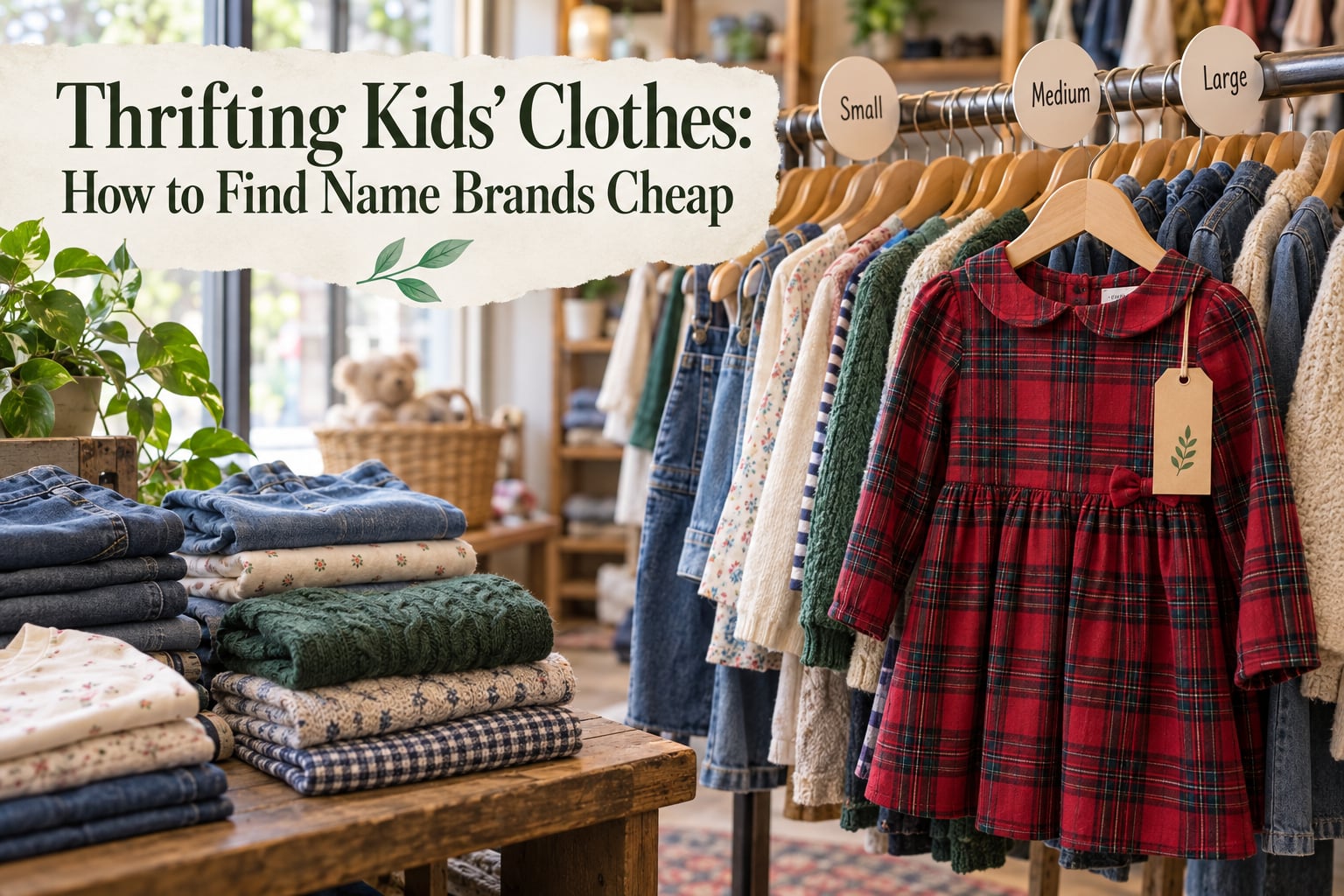
Thrifting kids clothes is simply shopping secondhand for pre-loved children’s clothing, at consignment shops, and on buy-and-sell marketplaces, for a fraction of what the same garment costs new. Kids outgrow clothing faster than any other category, so the same budget stretches much further used. This guide covers how to thrift kids clothes, which name brands are worth hunting for, how to inspect a piece in under two minutes, and what to never buy secondhand.
We have been secondhand shopping for our own three kids in Edmonton for years, and this is the system that finally made it predictable instead of luck. Updated for 2026, and written for families who want name brands without paying retail.
Table of Contents
- How to Thrift Kids Clothes: 8 Steps to Find Name Brands Cheap
- Step 1: Go with a short written list
- Step 2: Go to the kids’ section and the bag sales first
- Step 3: Learn the tag colours
- Step 4: Check the neck label, then the waistband
- Step 5: Inspect before you fall in love
- Step 6: Buy one size up, never two
- Step 7: Wash everything before it is worn
- Step 8: Donate or resell what does not work
- Why Thrifting Kids Clothes Makes Financial Sense
- The 3-3-3 Rule and Other Wardrobe Math
- The Best Kids’ Name Brands to Hunt For
- Where the Label Hides
- How to Inspect a Piece Before You Buy It
- What Never to Buy Secondhand for Kids
- When to Shop: Restock Days and Colour Tag Sales
- Thrift Store vs Consignment vs Online Resale
- Where to Thrift Kids Clothes in Edmonton and Across Canada
- How to Thrift Fast With a Toddler in Tow
- How to Wash and Sanitize Thrifted Kids’ Clothes
- Beyond the Store: Free and Nearly-Free Ways to Get Branded Kids’ Clothes
- Turning Your Haul Into Next Season’s Budget
- Frequently Asked Questions
- Where can I find name brand kids clothes cheap?
- What are the best brands to find while thrifting kids clothes?
- Where can I find the cheapest place to buy kids clothes secondhand?
- How do I get free name brand kids clothes?
- Where can I find cheap thrifted clothes online?
- What is the 3-3-3 rule for clothes?
- Is it cheaper to thrift or shop consignment for kids clothes?
- How do I know if a thrift store kids item is good quality?
- What items should never be bought secondhand for kids?
- How do I thrift shop fast with a toddler?
- Conclusion
How to Thrift Kids Clothes: 8 Steps to Find Name Brands Cheap
Here is the process we use, start to finish. Read it once and you can repeat it on every trip.
Step 1: Go with a short written list
Wandering produces a bag of random things you will never wear. Write down what is actually missing, the size, and roughly how many of each thing you need. A toddler needs about six everyday tops, four bottoms, one warm layer, and a pair of shoes that still fit. Bring the list and refuse to deviate from it.
Step 2: Go to the kids’ section and the bag sales first
Big chains sort donations into clear plastic or brown bags by category, and the tags on those bags are already discounted. The best bag for a family with young kids is the one marked with the largest age range, because the same donation stream feeds a 12-month-old and a 5-year-old. Go there before you browse a single hanger.
Step 3: Learn the tag colours
Most chains run a weekly or seasonal colour tag promotion where a specific tag colour drops to a deeper discount. On a Sunday morning sale, staff often pull that colour first, so a well-known tag can mean the piece is already gone by noon. Ask staff what the tag colour is and shop around it, not in it.
Step 4: Check the neck label, then the waistband
Adults are trained to look at the neck tag. Children’s brands hide theirs: printed inside the back neck, printed on an inside sleeve, stamped on the waistband, or sewn into the side seam. Turn the garment inside out on two items per rack and you will find more real labels than any other method.
Step 5: Inspect before you fall in love
Check the fabric content, the stitching at seams and underarm, the elastic at the waist, and the snaps at the crotch and cuffs. Hold it to the light. Smell it. A piece that fails two or more checks goes back on the rack immediately, before you carry it to the counter.
Step 6: Buy one size up, never two
One size up gives roughly a season of extra wear through a growth spurt. Two sizes up looks hand-me-down on the first day and rarely gets worn at all. For shoes, buy a half size up only if your child is already walking well in them.
Step 7: Wash everything before it is worn
See the washing section below for the full routine. Short version: cold water, detergent, a drying cycle, and a sniff test before the first wear.
Step 8: Donate or resell what does not work
Clothes that do not fit get bagged and returned to the same bins you would shop from, or listed online within 48 hours. That closes the loop and funds the next season’s trip.
Why Thrifting Kids Clothes Makes Financial Sense
The math here is not complicated. A typical thrifted children’s garment costs a small number of dollars and replaces a retail piece in the tens of dollars. One thrift trip on a 2-year-old’s needs can cover an entire season of everyday wear.
Cost-per-wear is the number that actually matters, and secondhand wins on that measure for a specific reason. A toddler wears a 24-month-old shirt for about four months. Retail stores expect that, price it in, and push you toward seasonal replacement. A secondhand shopper gets the same four months of wear for a small fraction of the outlay.
Quality often goes up, not down. Donated adult clothing is a large share of what many thrift chains receive, and those garments are made to survive adult wear. A cotton tee from a decade-old donation was built for a body that does laundry for years. That is a better bet than a new tee designed for a child’s twelve-month warranty.
The honest caveat: thrifting is not always cheaper. Parents on r/Frugal point out that for a specific outfit or a particular brand, mall coupons and clearance racks can undercut a thrift tag. Thrifting wins on volume and on breadth. It does not win on every single item.
The 3-3-3 Rule and Other Wardrobe Math
The 3-3-3 rule for clothes is a simple ownership cap: wear each piece at least three times before you buy anything new, hold no more than three categories of similar items, and give everything a lifetime of at least three years. For a child, the useful version is the first half: a garment should earn three wears before it earns a replacement.
For fast-growing kids, the maths is different anyway. A 3T jacket has a short remaining life regardless of how much you paid, so the cap that matters is: buy at the size your child is now, and only if the piece is something they will actually wear.
Two other numbers help more than 3-3-3 does. The first is the outgrown ratio: assume everything you buy for a child under four is gone within about a year, so the cheapest usable option is usually the right one. The second is the rotation count. Six tops and four bottoms that mix into about twenty outfits beat ten tops that only match two things.
What one thrifted year actually costs
We tracked a full 12-month wardrobe for one 2-year-old: eight everyday tops, five bottoms, two warm layers, one coat, rain gear, and two pairs of shoes. Total spend was under 100 CAD, all secondhand. The same list new at a mid-market kids’ retailer would have run several times that.
The Best Kids’ Name Brands to Hunt For
Brand matters for a specific reason: it predicts how the garment survived its previous life, and whether it will survive yours. These are the labels we look for first, and why. Prices are what we typically pay at a Canadian thrift chain, not retail.
| Brand | Why it holds value | Typical thrift tag | Where the label hides |
|---|---|---|---|
| Cat & Jack (Target) | Built for rough play, survives laundry cycles that ruin cheaper tees | 3 to 8 CAD | Printed inside back neck |
| Old Navy | Reinforced knees and elbows on trousers, wide size range | 2 to 6 CAD | Neck tag, sometimes removed |
| Uniqlo | Higher fabric content than fast-fashion equivalents | 4 to 9 CAD | Neck tag |
| Hanna Andersson | Holds resale value, prints, sought after at pickup lines | 5 to 12 CAD | Neck tag |
| Gymboree | Detailed trims and smocking, common in donations | 4 to 10 CAD | Neck tag |
| Carter’s | Everyday basics, very high donation volume | 2 to 5 CAD | Back neck |
| Okaïdi | Canadian brand, cold-weather outerwear and snow gear | 5 to 14 CAD | Neck tag or inner collar print |
| Columbia | Outdoor shell, the practical choice for a Canadian winter | 8 to 20 CAD | Waistband or neck |
| Patagonia | Durable fleece and outer layers, fits hand-me-downs for years | 10 to 25 CAD | Inside neck or hem |
| Dicks | Winter boots, mitts, snow pants, built for negative temperatures | 6 to 18 CAD | Tongue tag |
| Nike and Adidas | Common enough that there is a market when you resell | 4 to 12 CAD | Neck tag or heel print |
| Mini Boden, Boden | Trademark tartan and floral prints, distinctive prints worth buying big | 6 to 15 CAD | Neck tag |
Two tips from this list. First, buy the durable pieces large. A coat or a pair of snow pants is the exception to the buy-one-size-up rule, because you want it to last two winters. Second, for a growing child, the brands built for active play beat the brands built for photos, because a torn knee hem on a good day beats a pristine dress on a bad one.
Where the Label Hides
Children’s garments rarely carry a big branded neck label. Check the printed text inside the back neck first, then the inside sleeve or inner collar, then the waistband on trousers and leggings, then the care tag for a woven brand tab sewn beside it, and the tongue on shoes. Some vintage pieces have the brand stamped directly on the care tag, which is a stronger signal of an older garment than a neck label would be.
Reading the tag when there is no size tag
Vintage sizing runs small. A vintage size 4T often fits like a modern size 2T, and modern kids’ sizing has grown looser over the last decade. If a piece has no size tag, measure it flat: chest width doubled, and waist to hem length. Compare against a well-fitting outfit your child already wears.
How to Inspect a Piece Before You Buy It
Two minutes of inspection saves a garment you will never wear. Run these checks in order.
- Read the fabric content. 100% cotton and cotton blends wash well and survive a kid’s wardrobe. Avoid anything marked dry clean only, unless you are prepared to pay for it every time. Polyester blends are fine for snow gear and leggings, less ideal for skin-contact basics.
- Look at the stitching. Turn the garment inside out. Check the arm seams, the crotch seam, and the hem. Machine-loose threads mean the garment will not survive another season of playground use. Visible reinforcing tape at stress points, often found on older denim and dungarees, is a good sign.
- Check the elastic. Stretch a waistband and hold it. If it does not snap back, the piece is finished. Kids outgrow elastic before they outgrow the garment, so a loose waistband often means they already grew out of it.
- Check snaps and fasteners. Snaps should close firmly with a click. Missing snaps on infant rompers make the item unusable because they are the fastening point during changes.
- Check for stains, pilling, and fading. Hold it against a light source. Pilling on the torso, fading down one side, or a mystery mark that does not lift with a damp cloth means you are buying a repair job.
- Smell it. Detergent smell, damp storage smell, or smoke scent is a dealbreaker for anything that goes next to skin. Most thrift stores do not wash before donation, so this check is not optional.
- Check the care instructions. A cold wash and a tumble dry is a garment you can actually manage. Anything else is a scheduling problem you do not need with a toddler.
Also check the hardware. Zippers that separate at the base and buttons that are sewn on with a single loose thread are the two most common reasons a nice thrifted coat never gets worn again.
What Never to Buy Secondhand for Kids
This is the section that should stop you at the store, not the washing machine. Some items cannot be safely passed on, no matter how good they look.
- Car seats. Never buy a used car seat. Manufacturing dates and crash history are the entire safety case, and neither is verifiable secondhand. Check Health Canada recalls for the model you already own.
- Cribs and bed rails. Do not use a secondhand crib or a secondhand bed rail. Check Health Canada and provincial safety recalls for the model, and avoid any crib with a drop side.
- Helmets. Bike, skate, and ski helmets are never secondhand. A helmet is designed to absorb one impact and then fail, and a hidden impact means the shell can crack without any visible sign.
- Car booster seats, infant swings, and car seats after any crash. The same logic applies to any item whose protection depends on an intact internal structure.
- Recalled items. Before you buy any gear, check the Health Canada recalls database and the manufacturer page for the model number. Small parts, cords, and lead paint on vintage pieces are the usual reasons a well-loved item gets pulled.
- Anything with a fire risk. Vintage clothing with a loose or missing care tag cannot be tested, and older garments sometimes carry flame-retardant finishes that have degraded.
Clothing itself is low risk when you wash it. The items above are structural, and no amount of cleaning fixes a compromised one.
When to Shop: Restock Days and Colour Tag Sales
Timing is worth more than technique. Donations peak when people declutter, which in Canada means January and the weeks after Christmas, when families clear out holiday-size clothing.
Tuesday and Wednesday mornings after a weekend donation drop tend to be the freshest, because the weekend volume has been sorted but not yet picked over. On a Sunday morning sale at many chains, staff pull the discounted tag colour first and remove those items before the general public arrives, so a known tag colour can work against you.
Colour tag sales mean a particular tag colour is discounted that day or that weekend. Ask at the register what the colour is. Pay-by-the-pound stores, where everything is weighed, surface the highest volume of overstocked and new-with-tags kids’ clothing, and they are worth a dedicated trip when you are restocking a whole size range.
Thrift Store vs Consignment vs Online Resale
These three channels behave differently, and mixing them is the fastest way to a full year of clothes. Here is the honest comparison.
| Channel | Typical cost per item | Selection | Time spent | Best use case |
|---|---|---|---|---|
| Thrift store (chain) | Lowest, a few CAD per piece | Random, high volume, mostly brands you recognise | High, you sort the whole rack | Everyday basics, winter gear, back-to-school volume |
| Pay-by-the-pound store | By weight, so heavier coats cost more | Overstock and new-with-tags | Medium | Buying up a size or two in a brand you love |
| Consignment shop | Highest of the three, often a percentage of what the item would sell for new | Curated, name brand, higher quality on average | Low | One specific outfit, a photo-day piece, a statement skirt |
| Online resale marketplace | Buyer pays shipping plus the asking tag | Anything, including never-worn | Low, but the search is slow | Chasing one specific size or brand |
| Local Buy Nothing or community group | Free | Small but very local, same-day pickup | Lowest | Fill-in pieces between thrift runs |
The consignment caveat matters. R/Frugal users report payouts that sting, with one parent describing a payout of 4 CAD for ten items including Nike and 7 For All Mankind, when the intended cart was well over forty. Consignment works best when you have clean, folded, brand-forward pieces, not when you are clearing out a closet.
Where to Thrift Kids Clothes in Edmonton and Across Canada
In Edmonton, Value Village and Savers give you the volume and the weekly colour tag rhythm, and their bag sales are where the kids’ sizes pile up. Independent and community-run shops around the city tend to be curated rather than sorted by donation stream, so expect a smaller rail with better pieces.
Pay-by-the-pound outlets are the local secret for overstock. The reason winter gear is easier to find here than in many Canadian cities is the climate: everyone donates snow pants, mitts, and boots, because they have had them hard enough that they are done with them. Shop for next winter in the spring, and size generously.
Across Canada, the same chains run the same mechanics, and most publish their promotion schedule in advance. Local Buy Nothing groups, community Facebook groups, and Kijiji run by families rather than stores are the fastest source of same-size hand-me-downs.
How to Thrift Fast With a Toddler in Tow
This is the part nobody writes about. Racks are unorganised, fitting rooms are scarce, and a toddler’s patience runs out in about twenty minutes. Here is what works.
- Go alone when you can. A second adult for childcare buys you a full hour of rack time.
- Go early. Open hours mean you get the pick of the donation sort before the after-school crowd.
- Bring the stroller, a snack, and a tablet mount. Snacking in the stroller buys a focused pocket of time.
- Go to the bag sales first, in one direction. One pass through the bags, one pass through the racks, then the fitting room. No backtracking.
- Time-box it to 45 minutes. Set a timer on your phone. When it goes, you leave, even with a full bag.
- Let your child choose between two items. Parents on r/moderatelygranolamoms describe this as the single biggest change in how thrifted clothes get worn. A garment the kid picked gets worn; one you picked gets resisted.
How to Wash and Sanitize Thrifted Kids’ Clothes
Unwashed donations carry storage smell, not usually germs, but the routine is cheap and settles the question for parents who are uneasy about it.
- Shake each item out outdoors and check the seam lines and pockets for insect evidence before anything goes in the machine.
- Pre-treat any mark with a dab of laundry detergent and leave it for ten minutes.
- Soak stubborn odours in cold water with half a cup of white vinegar for 20 minutes.
- Wash with detergent on a cold cycle. A dryer sheet in the drum softens static and helps release a light odour.
- Dry fully on a low or air-dry cycle, then run your nose along the seams. If the smell returns, wash again before the first wear.
For a wardrobe that gets worn hard, this routine is done once at the start of a season rather than every piece every time.
Beyond the Store: Free and Nearly-Free Ways to Get Branded Kids’ Clothes
If you want name brands for nothing, the answer is a swap loop rather than a store.
- Ask your school, your sport league, and your building’s parent group. A size your child just left is someone’s size next month.
- Join a local Buy Nothing group. Give to get, and both sides stay free.
- Watch community Facebook groups for hand-me-down posts from families with kids at the next size.
- List your outgrown pieces online within 48 hours, while the sizing gap is still current, and bundle ten items at a time to raise the payout.
- Check your own local chain’s rewards and community day programs, which often stack a deeper discount on a promotion day.
Turning Your Haul Into Next Season’s Budget
Reselling is a small but real offset. Bundle like items, photograph them flat in daylight, list the size and brand in the title, and price against what a similar new piece sells for.
Resale value tracks condition, not brand, for the first few dollars. Clean, folded, smoke-free, and photographed well beats an expensive label every time. Many families use the payout from one winter’s coats to fund the following year’s snow gear hunt.
Frequently Asked Questions
Where can I find name brand kids clothes cheap?
Name brand kids clothes are cheapest at thrift store bag sales, pay-by-the-pound stores carrying overstock, and community swap groups. Canadian chains such as Value Village and Savers receive large volumes of adult and child donations, so a recognizable label regularly lands on the kids’ rack for a few dollars. Consignment shops cost more but curate higher quality. Local Buy Nothing groups and school hand-me-down circles are free and same-day.
What are the best brands to find while thrifting kids clothes?
Cat and Jack, Old Navy, Uniqlo, Carter’s, Hanna Andersson, Gymboree, Okaidi, and Columbia come up most often in our hauls. Look for the ones built for active play with reinforced knees and stronger fabric, and buy durable outerwear such as coats, snow pants, and boots in a larger size so they last two winters. Trend-led labels hold resale value but wear less.
Where can I find the cheapest place to buy kids clothes secondhand?
A thrift store chain is the cheapest per item, with most pieces a few dollars and no size accounting. A pay-by-the-pound store is close behind and gives you new-with-tags overstock. A consignment shop costs the most of the three but saves you time. A community swap group is free. Online resale marketplaces add shipping and rarely beat a local bag sale for everyday basics.
How do I get free name brand kids clothes?
Swap loops are the only genuinely free route. Join a local Buy Nothing group, watch community groups for families with kids at the next size, and check your school and sport league groups. Give away your own outgrown pieces the week your child outgrows them, labelled and bagged, because the same week is when another family needs them.
Where can I find cheap thrifted clothes online?
Online resale marketplaces work when you are chasing one specific size, brand, or colour that local racks rarely hold. Use saved searches with the brand and size so alerts land when a listing appears. Filter to items with photos, check the description for stains, and remember to add shipping and sales tax to the asking figure before comparing it with a thrift tag.
What is the 3-3-3 rule for clothes?
The 3-3-3 rule is an ownership cap with three parts: wear each piece at least three times, hold no more than three similar items in a category, and keep it at least three years. For children the first part is the useful one. Because a toddler outgrows a shirt in about four months, judge a garment on whether it will earn three wears before you need a replacement.
Is it cheaper to thrift or shop consignment for kids clothes?
Thrifting is cheaper per item almost every time. Consignment prices an item at a percentage of what the same thing sells for new, so a great piece can cost more secondhand than a plain new one on promotion. The trade is time: consignment is curated and quick to shop, while a thrift store asks you to sort a whole rack. Parents on r/Frugal note that for a specific outfit, clearance at a mid-market kids retailer can undercut both.
How do I know if a thrift store kids item is good quality?
Read the fabric content, turn the garment inside out to check stitching at the arm, crotch, and hem seams, and stretch the waistband to confirm the elastic snaps back. Hold it to the light for pilling and fading, check that snaps close firmly, and smell it. Anything marked dry clean only is a scheduling problem you do not need with a toddler.
What items should never be bought secondhand for kids?
Never buy a used car seat, crib, bed rail, or bike, skate, and ski helmet. Their safety depends on manufacturing date, crash history, or an internal structure that a hidden impact can compromise, none of which is verifiable secondhand. Any gear item should be checked against the Health Canada recalls database using its model number before purchase.
How do I thrift shop fast with a toddler?
Go early, bring a stroller with a snack and a mounted tablet, and hit the bag sales first in one direction before the racks. Time-box the trip to 45 minutes and leave when the timer goes. If you can, go without the kids or with a second adult handling childcare. Let your child choose between two items at the rack so they own the find.
Conclusion
Thrifting kids clothes works when you treat it as a system rather than a treasure hunt. Go with a list, hit the bag sales first, learn where children’s labels hide, inspect every piece in two minutes, and size up by one. Wash everything before the first wear, and return what does not fit so the next family can use it.
Start with one trip for the current size. Pick one name brand from the list above as your target, go on a restock morning, and time-box it to 45 minutes. After one season you will have your own list of what your area donates, and that is when thrifting kids clothes stops being a chore and starts being the cheapest way to dress a growing child.