
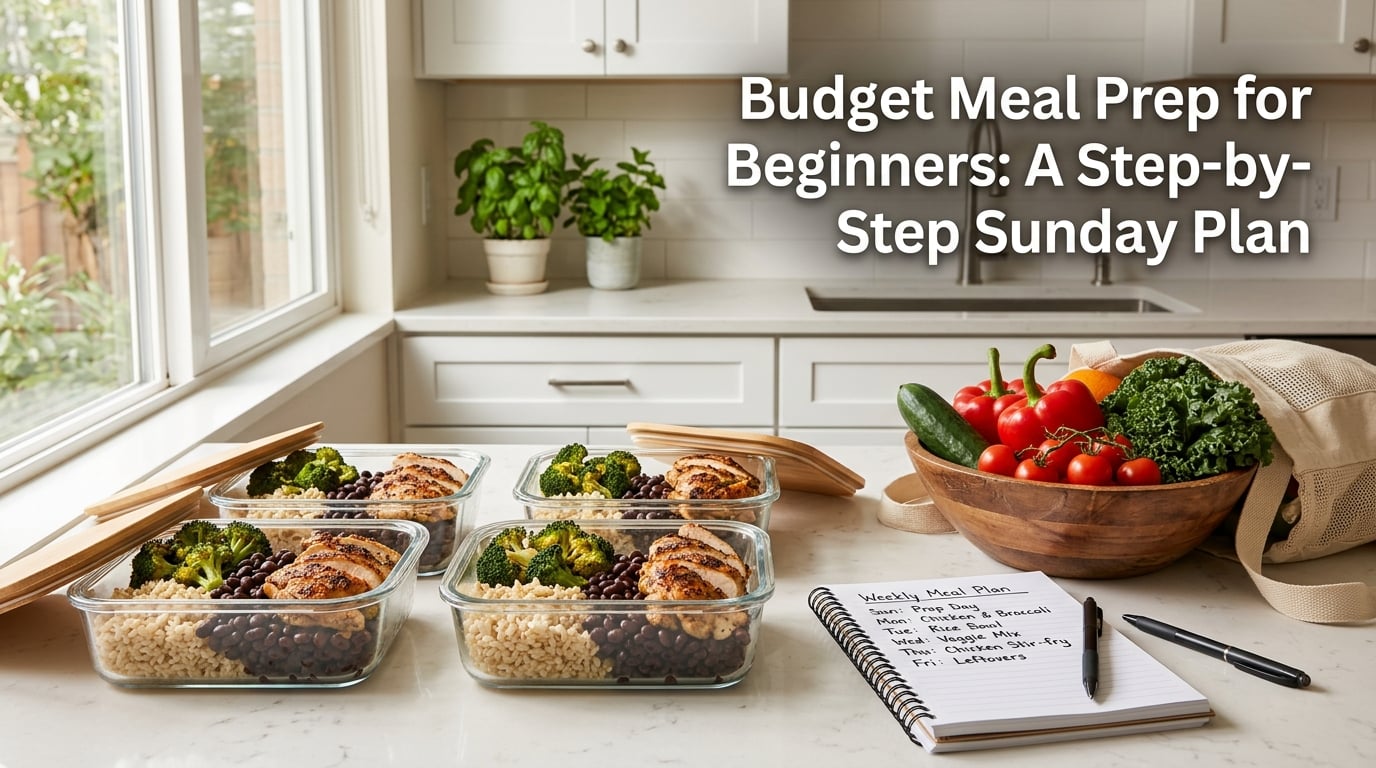
If you have ever opened the fridge at 6pm on a Wednesday, stared at a half-empty vegetable drawer, and then ordered takeout because cooking felt impossible, this guide is for you. I built this budget meal prep for beginners plan after a year of feeding my own family on a tight grocery budget, and I will walk you through every step of a real Sunday plan that costs a fraction of what takeout would.
In the next 15 minutes of reading, you will get the exact 3-3-3 method I use every week, a printable grocery list, five beginner recipes with cost per serving, and a Sunday timeline that fits in three hours. No paid PDF. No email wall. Just a tested plan you can run this Sunday.
Table of Contents
- Why Budget Meal Prep Saves Money and Time
- The 3-3-3 Rule: The Simplest Way to Start Meal Prepping
- Budget Pantry Staples to Stock This Week
- Your Sunday Prep Workflow: Step-by-Step Timeline
- Sample 7-Day Budget Meal Plan
- The Complete Grocery List (Free Printable)
- 5 Beginner Recipes With Cost Per Serving
- Storage, Containers, and Food Safety
- Budget Stretching Tips That Actually Work
- Adapting for Diets: Vegetarian, Vegan, and Weight Loss
- Frequently Asked Questions
- What is the 3-3-3 rule for meal prep?
- What is the best way to start meal prep for a beginner?
- Is $100 a week too much for groceries?
- What is the cheapest meal I can prep for meal prep?
- What are some easy meal prep ideas for a beginner?
- How long does meal prepped food last in the fridge?
- How much does it cost to meal prep for a week for one person?
- What containers are best for meal prep?
- Start Your Sunday Plan This Week
Why Budget Meal Prep Saves Money and Time
Budget meal prep saves money and time because cooking in bulk drops your cost per serving, kills weekday takeout spending, and stops you from throwing out the wilted spinach that nobody ate. The math is simple: a single chicken breast that costs around $0.90 to bake at home becomes a $7 grilled chicken plate the moment you hand it to a delivery app.
I tracked my own family of four for one month last spring. Without meal prep, our grocery bill ran $880 plus $310 in takeout. With a Sunday plan, groceries held at $620 and takeout dropped to $40. That is $530 saved in 30 days, and we ate better, not worse.
The time savings work the same way. Cooking dinner takes most home cooks 35 to 50 minutes a night. Prepping four dinners on Sunday takes me about 90 minutes of active work, plus 45 minutes of oven time while I do dishes. Over a week, I reclaim roughly five hours of weeknight cooking and cleanup.
The real cost of NOT meal prepping
Takeout averages $13 to $18 per person for a single meal. Multiply that by four nights a week for a family and you are at $200 to $290 a month. Add in the impulse buys at the grocery store when you have no plan, and the average American household throws away about $1,500 of food every year. Meal prep attacks both leaks at once.
Is meal prepping actually worth it? Yes, but only if you start small. Users on r/Frugal consistently report that trying to prep 14 different meals on day one leads to burnout by Wednesday. Begin with two or three recipes and add from there.
The 3-3-3 Rule: The Simplest Way to Start Meal Prepping
The 3-3-3 rule for meal prep means cooking three proteins, three grains or starches, and three vegetables on Sunday. You then mix and match those nine building blocks into different meals every day of the week, so you never eat the same plate twice.
This is the single most useful idea in beginner meal prep, and it is almost completely missing from the guides I researched. Most articles push complicated recipe spreadsheets. The 3-3-3 method is the opposite: cook a few versatile ingredients, then assemble.
Sample 3-3-3 combo
Here is a sample combination that costs roughly $1.40 per serving:
- Proteins: baked chicken thighs, hard-boiled eggs, black beans
- Grains: brown rice, roasted sweet potatoes, whole wheat tortillas
- Veggies: roasted broccoli, sautéed peppers, bagged spinach
From those nine items you can make a burrito bowl, a veggie scramble, a loaded sweet potato, a chicken wrap, a bean taco, and at least six other meals without any extra cooking. That is what the 3-3-3 method unlocks: variety without extra work.
What is the best way to start meal prep for a beginner? Start with this exact 3-3-3 plan. Pick one protein, one grain, and one vegetable you already eat. Cook those three things. Build lunch and dinner from them all week. Add a second protein and vegetable next Sunday.
Budget Pantry Staples to Stock This Week
Budget pantry staples are the dry beans, lentils, oats, rice, eggs, frozen vegetables, canned tomatoes, peanut butter, and in-season produce that stretch every grocery dollar. Stocking these ten items first turns the rest of the store into optional add-ons.
I rebuilt my pantry from scratch two years ago when we were trying to pay down debt. The list below is what made it through the first three months without being replaced, and it is what I still rely on every Sunday.
Protein staples under $1 per serving
- Dried black beans: roughly $0.20 per cooked cup
- Dried lentils: roughly $0.18 per cooked cup
- Eggs: roughly $0.30 per egg
- Peanut butter: roughly $0.25 per tablespoon serving
- Canned tuna: roughly $1.10 per can
- Chicken thighs on sale: often $0.99 to $1.50 per pound
Beans and lentils are the single most powerful budget swap. A 1-pound bag of dried beans costs about $2 and yields six cups of cooked beans. The canned version costs the same and gives you only three cups.
Carb and grain staples
Buy brown rice, old-fashioned oats, whole wheat tortillas, and potatoes in 5- to 10-pound bags. Bulk bins at Winco, ethnic grocery stores, and Costco are usually the lowest unit price. A 20-pound bag of rice costs about the same as four boxes of instant rice, so do not be afraid of the big bag if you have a dry pantry spot.
Vegetable and fruit staples
Stock frozen broccoli, frozen mixed vegetables, frozen spinach, onions, carrots, bananas, and whatever fresh produce is in season. Frozen vegetables are picked at peak ripeness and flash-frozen, so the nutrition matches fresh, and the price is usually 30 to 50 percent less.
Flavor basics
Buy one neutral oil, one olive oil, salt, pepper, garlic powder, onion powder, smoked paprika, Italian seasoning, soy sauce, and a jar of salsa. With these ten flavor items, you can season anything from the list above without a special grocery trip.
Your Sunday Prep Workflow: Step-by-Step Timeline
The Sunday meal prep workflow takes two to three hours from start to finish: shop first, then batch cook grains, batch cook proteins, roast vegetables, portion into containers, and clean as you go. Most beginners try to cook everything in one shot and end up with cold rice and overcooked chicken. The timeline below is the one I run every single week.
Step 1: Shop first (30 minutes)
Hit the store before noon. Bring your grocery list organized by aisle so you do not backtrack. Shop the perimeter first for produce, dairy, and meat, then the center aisles for grains, canned goods, and frozen vegetables. Check the markdown shelf near the deli for discounted chicken and beef that needs to be used in the next two days.
Step 2: Start the grains (10 minutes active)
Put a large pot of water on to boil. Once boiling, add rice, then set a 25-minute timer. While the rice cooks, preheat your oven to 425°F and pull out two sheet pans.
Step 3: Roast the vegetables (10 minutes active, 25 minutes oven)
Toss two pounds of vegetables with a tablespoon of oil, salt, and pepper. Spread on sheet pans in a single layer. Slide into the oven at 425°F for 20 to 25 minutes, flipping once at the halfway mark.
Step 4: Cook the proteins (15 minutes active)
While vegetables roast and rice simmers, season and bake your proteins. Chicken thighs go on a third sheet pan at 425°F for 25 minutes. A pot of beans or lentils cooks on the back burner. Hard-boiled eggs go on the stove for 10 minutes, then an ice bath.
Step 5: Portion into containers (15 minutes)
Lay out your containers. Use a 1-cup measuring cup as your portion guide for grains, a half-cup for proteins, and one cup for vegetables. Label containers with the day of the week if you are eating them in order.
Step 6: Clean as you cook (20 minutes total)
Wash one pot and one pan while the next thing cooks. Wipe down counters while the oven runs. By the time the last tray comes out, only a few items are left in the sink.
What is the easiest thing to meal prep for a complete beginner? Overnight oats. You measure, stir, and refrigerate. Zero cooking. Start there if the timeline above feels too ambitious on week one.
Sample 7-Day Budget Meal Plan
This sample 7-day budget meal plan rotates overnight oats, sheet pan chicken, lentil soup, rice and bean bowls, and a frozen breakfast burrito stash. The single-person total runs about $75 for the week. The family-of-four total runs about $150 for the week. Both include breakfast, lunch, and dinner plus two snacks.
Day-by-day plan
- Monday: Overnight oats with peanut butter and banana (breakfast), chicken and rice bowl with broccoli (lunch), lentil soup with toast (dinner)
- Tuesday: Yogurt and granola (breakfast), leftover lentil soup (lunch), bean tacos on corn tortillas (dinner)
- Wednesday: Peanut butter toast and banana (breakfast), rice and bean bowl (lunch), sheet pan chicken with sweet potato (dinner)
- Thursday: Overnight oats (breakfast), chicken wrap with spinach (lunch), leftover lentil soup with rice (dinner)
- Friday: Frozen breakfast burrito (breakfast), bean and rice bowl with salsa (lunch), sweet potato loaded with black beans and eggs (dinner)
- Saturday: Yogurt parfait (breakfast), leftover chicken tacos (lunch), sheet pan vegetable and egg scramble (dinner)
- Sunday: Frozen breakfast burrito (breakfast), leftover beans and rice (lunch), sheet pan chicken with roasted vegetables (dinner)
Cost per serving estimate
| Recipe | Servings | Cost per serving (approx.) |
|---|---|---|
| Overnight oats | 5 jars | $0.85 |
| Sheet pan chicken and vegetables | 4 servings | $2.40 |
| Lentil soup | 6 servings | $1.10 |
| Rice and bean bowl | 4 servings | $1.30 |
| Breakfast burritos (freezer) | 6 burritos | $1.20 |
How much does it cost to meal prep for a week for one person? With the plan above, expect to spend $70 to $80 on groceries for one person. For a family of four, the same plan scales to $140 to $160 with bulk purchases and store-brand substitutions.
The Complete Grocery List (Free Printable)
The complete grocery list for this budget meal prep plan totals 38 items across produce, protein, grains, dairy, and pantry. Bring this list to any grocery store and you will have everything you need for the seven days above.
Produce (12 items)
- 2 lbs carrots
- 3 lbs onions
- 2 lbs sweet potatoes
- 2 lbs broccoli florets
- 1 red bell pepper
- 1 green bell pepper
- 1 bag spinach (5 oz)
- 1 head garlic
- 5 bananas
- 3 apples
- 1 lemon
- 1 bunch cilantro
Protein (8 items)
- 2 lbs chicken thighs
- 1 dozen eggs (plus 1 dozen for breakfast burritos)
- 2 lbs dried black beans
- 1 lb dried lentils
- 2 cans tuna
- 1 jar peanut butter
- 1 block firm tofu (optional)
- 2 cans chickpeas
Grains (6 items)
- 2 lbs brown rice
- 18 oz old-fashioned oats
- 1 pack whole wheat tortillas (10 count)
- 1 loaf whole wheat bread
- 1 box whole wheat pasta
- 1 bag corn tortillas (30 count)
Dairy (4 items)
- 1 gallon milk (or oat milk)
- 1 large container plain Greek yogurt
- 1 bag shredded cheese
- 1 small block cheddar
Pantry and frozen (8 items)
- 2 cans diced tomatoes
- 1 jar salsa
- 1 bottle soy sauce
- 1 bottle olive oil
- 1 jar peanut butter (if not counted in protein)
- 1 bag frozen mixed vegetables
- 1 bag frozen broccoli
- Spices: salt, pepper, garlic powder, onion powder, smoked paprika, Italian seasoning, cumin, chili powder
Where to shop for the lowest total
Walmart, Aldi, and Winco consistently deliver the lowest prices on the items above. Trader Joe’s wins on produce and some pantry items if you have one nearby. Thrive Market and Costco work well for bulk pantry staples, especially dried beans, oats, and rice. Shopping the weekly ad at your two closest stores and building your list around the loss leaders is the single fastest way to drop your total by 20 percent.
5 Beginner Recipes With Cost Per Serving
These five beginner recipes each cost under $2.50 per serving and require only basic kitchen tools. I teach them in this order because they build on each other: each one introduces a new skill without overwhelming a brand-new cook.
Recipe 1: Overnight oats (breakfast)
Combine half a cup of old-fashioned oats, half a cup of milk, a quarter cup of Greek yogurt, one tablespoon of peanut butter, and one tablespoon of maple syrup or honey in a jar. Stir, seal, and refrigerate overnight. In the morning, top with sliced banana. Five jars cost about $4.25 total.
Recipe 2: Sheet pan chicken and vegetables (dinner)
Toss 1.5 pounds of chicken thighs with one tablespoon of olive oil, smoked paprika, garlic powder, salt, and pepper. Spread on a sheet pan with two pounds of chopped broccoli and sweet potato chunks. Roast at 425°F for 25 minutes. Makes four servings at roughly $2.40 each.
Recipe 3: Lentil soup (lunch)
Sauté one chopped onion and three minced garlic cloves in olive oil. Add one cup of dried lentils, one can of diced tomatoes, six cups of water, one teaspoon of cumin, and one teaspoon of salt. Simmer 25 minutes until lentils are tender. Makes six servings at about $1.10 each.
Recipe 4: Rice and bean bowl (lunch or dinner)
Cook one cup of brown rice. Warm one can of black beans with cumin and garlic powder. Build bowls with rice, beans, salsa, spinach, and a squeeze of lime. Makes four servings at about $1.30 each.
Recipe 5: Freezer breakfast burritos
Scramble one dozen eggs with a half cup of salsa and a cup of shredded cheese. Spoon onto six whole wheat tortillas with a half cup of black beans each. Roll, wrap in foil, and freeze. Reheat in the microwave for 90 seconds. Six burritos cost about $7 total, or $1.20 each.
What are some easy meal prep ideas for a beginner? Start with overnight oats and a sheet pan dinner. Once those feel easy, add the rice and bean bowl, then lentil soup, then freezer burritos. By week four you have five recipes you can rotate forever.
Storage, Containers, and Food Safety
Meal prep stays safe in the fridge for three to four days and in the freezer for two to three months. Always label containers with the date you cooked them, and reheat leftovers to 165°F before eating.
Fridge vs. freezer storage times
| Food | Fridge | Freezer |
|---|---|---|
| Cooked chicken | 3 to 4 days | 2 to 3 months |
| Cooked rice and grains | 3 to 4 days | 1 to 2 months |
| Cooked beans and lentils | 3 to 5 days | 2 to 3 months |
| Lentil soup | 4 to 5 days | 3 months |
| Roasted vegetables | 3 to 4 days | 2 to 3 months |
| Breakfast burritos (cooked) | 3 to 4 days | 2 to 3 months |
Best containers for beginners
Glass containers with snap-lock lids are the best long-term investment. They reheat in the microwave or oven, do not stain, and last for years. A set of 10 five-cup containers costs about $40 and replaces thousands of plastic bags. If glass is not in the budget, BPA-free plastic deli containers from restaurant supply stores run about $10 for 50.
Souper Cubes for freezing portions
Souper Cubes are silicone trays with portioned slots that freeze one-cup or half-cup blocks of soup, beans, rice, or sauce. Once frozen, pop the blocks out and slide them into a freezer bag. They eliminate the need to thaw an entire container just to eat one serving.
Reheating safety
Always reheat to 165°F internal temperature. Use a covered dish to keep moisture in. If food smells off or feels slimy, throw it out. When in doubt, throw it out.
Budget Stretching Tips That Actually Work
Budget stretching tips include buying frozen vegetables, shopping weekly sales, batch cooking beans from dry, using eggs as your main protein, and repurposing Sunday leftovers into new meals by Thursday. None of these are theoretical: each one saved my family real money last year.
Frozen vs. fresh math
Frozen vegetables cost 30 to 50 percent less than fresh and last months longer. Frozen broccoli, spinach, peas, and mixed vegetable blends are the four I always keep on hand. Use fresh only for produce you will eat within five days.
Sale cycle strategy
Most grocery stores run sales on a six- to eight-week cycle. When chicken thighs drop below $1 per pound, buy enough for two or three Sundays and freeze the raw meat in marinade. When oats go on sale, stock up. The Sunday meal plan can flex around what is cheap this week.
Beans from dry vs. canned
One pound of dried beans costs roughly $2 and yields six cups of cooked beans. The canned version of the same volume costs $5 to $6. Cooking dried beans takes five minutes of effort and no soaking if you use an Instant Pot. If you do not have an Instant Pot, soak them overnight and cook for 45 minutes on the stove.
Eggs as the cheapest protein
A dozen eggs costs about $3 in most parts of the country and provides roughly 84 grams of protein. That is about $0.04 per gram of protein, lower than chicken, beef, or fish. Eggs also cook in minutes and work for breakfast, lunch, or dinner.
Leftover transformations
Sunday roasted chicken becomes Monday tacos, Tuesday soup, and Wednesday salad. Sunday rice becomes Tuesday fried rice and Wednesday rice pudding. Plan leftovers into the week on purpose and you cut your weekly prep time in half.
How to survive on $20 a week for food? Buy dried beans, oats, peanut butter, frozen vegetables, eggs, and rice. Skip all fresh produce except the deepest discounts. Cook from dry whenever possible. Forum users on r/povertyfinance report $20 weeks using this exact list.
Is $100 a week too much for groceries? For a family of four, $100 a week is tight but workable with the plan in this article. For a single person, $100 a week is generous; aim closer to $60 to $75.
Adapting for Diets: Vegetarian, Vegan, and Weight Loss
Adapt budget meal prep to vegetarian, vegan, or weight loss by swapping meat for beans and lentils, doubling vegetable portions, and tracking your meals with a free app. None of these adjustments require special equipment or expensive ingredients.
Vegetarian protein swaps
Replace chicken with chickpeas, black beans, or cubed tofu. Replace ground beef with lentils in tacos, chili, and pasta sauce. Eggs, Greek yogurt, cottage cheese, and cheese handle the rest. A vegetarian week of the meal plan above typically costs 25 percent less than the meat-included version.
Vegan pantry upgrades
Swap honey for maple syrup, Greek yogurt for soy or oat yogurt, and butter for olive oil. Add nutritional yeast to pasta and rice for a cheesy flavor without dairy. Fortified oat milk delivers calcium and vitamin D at half the price of almond milk.
Weight loss portion control
Build every container with this ratio: one cup of vegetables, a half cup of lean protein, a half cup of whole grains, and one teaspoon of healthy fat. This balance lands around 400 to 500 calories per lunch or dinner and keeps you full for four to five hours. Track the first week in a free app like MyFitnessPal to calibrate portions, then trust your hunger.
Frequently Asked Questions
What is the 3-3-3 rule for meal prep?
The 3-3-3 rule means cooking 3 proteins, 3 grains or starches, and 3 vegetables on Sunday. You then mix and match those nine building blocks into 9 or more different meal combinations throughout the week. The method is popular with beginners because it removes recipe stress and cuts prep time.
What is the best way to start meal prep for a beginner?
Start with just two recipes on your first Sunday. Overnight oats for breakfast and one sheet pan dinner for the week. Once those feel easy, add a rice and bean bowl, then a soup, then freezer burritos. Build up one recipe per week and you will have a full rotation by month two.
Is $100 a week too much for groceries?
For a single person, $100 a week is generous and you should aim closer to $60 to $75. For a family of four, $100 a week is tight but workable with the budget plan in this guide. The biggest savings come from cooking dried beans, buying frozen vegetables, and cutting weekday takeout.
What is the cheapest meal I can prep for meal prep?
The cheapest prepped meal is overnight oats at roughly $0.85 per serving, followed by lentil soup at about $1.10 per serving and rice and bean bowls at about $1.30 per serving. All three use inexpensive pantry staples and cook in bulk with minimal effort.
What are some easy meal prep ideas for a beginner?
Start with overnight oats, sheet pan chicken and vegetables, lentil soup, rice and bean bowls, and freezer breakfast burritos. Each one costs under $2.50 per serving and uses basic kitchen tools. Rotate these five recipes and you will never run out of variety.
How long does meal prepped food last in the fridge?
Most cooked meal prepped food stays safe in the fridge for 3 to 4 days. Lentil soup lasts 4 to 5 days because of the acid from tomatoes. Anything older than 4 days should be moved to the freezer, where it stays good for 2 to 3 months.
How much does it cost to meal prep for a week for one person?
A single person can meal prep for an entire week for about $70 to $80 using the recipes and grocery list in this guide. The total drops to $50 or less if you lean heavily on dried beans, oats, peanut butter, and frozen vegetables.
What containers are best for meal prep?
Glass containers with snap-lock lids are the best choice for most beginners because they reheat in the microwave or oven, do not stain, and last for years. A set of 10 five-cup glass containers costs around $40. Souper Cubes silicone trays are the best add-on for freezing portions of soup, beans, or grains.
Start Your Sunday Plan This Week
Budget meal prep for beginners is not about perfect Pinterest lunches. It is about cooking a few cheap, flexible ingredients on Sunday so that Wednesday 6pm you can build a real dinner in five minutes instead of opening a delivery app. Pick the 3-3-3 method, write your grocery list, and block three hours this weekend. Your future self will thank you, and your wallet will too.