
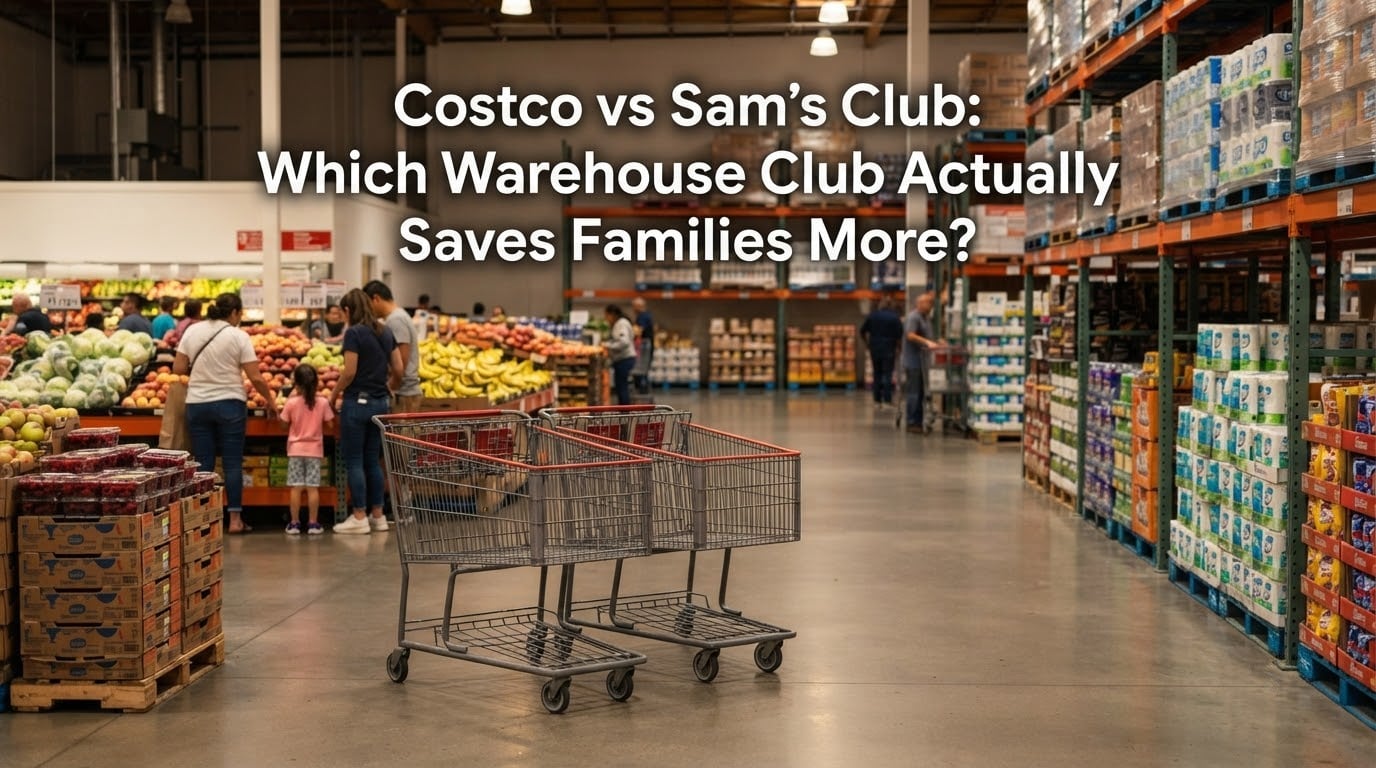
Costco vs Sam’s Club: which warehouse club actually saves families more? After weeks of comparing membership tiers, gas discounts, private label quality, and family shopping patterns, our answer is clear. Costco wins for most families who drive daily, prefer fresh produce, and value the legendary return policy, while Sam’s Club pulls ahead for families who prioritize instant coupons, low tech-checkout friction, and slightly cheaper packaged goods. The right pick depends on your household size, your shopping cart, and which membership tier you actually need.
I dug into both clubs’ membership structures, gas price reports from real shoppers on Reddit, and forum threads on family savings. Our team compared four membership tiers, three credit card stacks, and ran the numbers for families of two, four, and six. Here’s everything the warehouse war means for your wallet.
Table of Contents
- What Is a Warehouse Club and How Does It Save Families Money
- Membership Cost Breakdown: Gold Star vs Club
- Premium Membership Math: Executive vs Plus
- Gas Savings Comparison: How Much Families Really Save on Fuel
- Kirkland Signature vs Member’s Mark: Quality and Pricing
- Food Court, Scan & Go, and In-Store Experience
- Credit Card Stacking and Cash Back Rewards
- Family Savings Scenarios: Real-World Annual Cost Comparison
- How to Test Both Clubs Risk-Free Before You Commit
- Frequently Asked Questions
- Final Verdict: Which Warehouse Club Saves Families More
What Is a Warehouse Club and How Does It Save Families Money
A warehouse club is a membership-based retail store that sells groceries, household goods, and bulk items at deeply discounted prices to consumers and small businesses. Members pay an annual fee for the privilege of shopping, and in return they get access to bulk packaging, private label brands, and discounted fuel.
The savings model works because warehouse clubs carry fewer than 4,000 SKUs compared to 30,000 at a typical grocery store. Lower inventory means lower overhead, which is passed on to members. It also explains why both Costco and Sam’s Club rely on what shoppers call the “treasure hunt” layout: huge pallets of seasonally rotated goods that pull impulse purchases.
For families, the math only works if your annual savings on groceries and gas exceed the membership fee. We will show you exactly when that breakeven happens for each tier.
Membership Cost Breakdown: Gold Star vs Club
The base tier at Costco is Gold Star and the base tier at Sam’s Club is Club. Both run annual fees and cover two cards per household. Costco’s Gold Star carries a higher fee than Sam’s Club’s Club, but Costco offsets that gap with consistently higher fuel discounts reported by shoppers.
For families shopping once a week, base tier savings often pay for the membership in the first two grocery runs. The kicker is what each club calls their everyday cash back. Costco’s base tier pays no cash back rewards. Sam’s Club’s base Club membership pays no cash back either. Both stores rely on member savings at the register to make the base tier worth it.
If you shop more than four times a month and fuel up at the warehouse gas station, you should look at the premium tier next.
Premium Membership Math: Executive vs Plus
Costco Executive is the premium upgrade at Costco, and Sam’s Club Plus is the premium upgrade at Sam’s Club. Both charge a higher annual fee but reward you with a percentage back on most purchases, including services like travel and insurance through their portals.
Costco’s Executive tier pays 2% back on most purchases up to an annual cap of $1,250. Sam’s Club Plus pays a flat cash reward up to a similar cap. Reviewers note that the cash back arrives as a Sam’s Cash digital reward that expires, so spend it promptly.
To break even on the Executive upgrade over Gold Star, a family typically needs to charge roughly $3,500 a year in extra spend at Costco, which most families of four hit naturally. For Sam’s Club Plus over Club, the math is similar but tends to come from stacking the credit card and using the Scan & Go app consistently.
Families who already shop these stores weekly usually find premium tier worth it within the first year. Families who shop occasionally should stick to base.
Gas Savings Comparison: How Much Families Really Save on Fuel
Gas is one of the fastest breakeven points for warehouse membership. Costco runs its own branded gas stations at most warehouse locations, and Sam’s Club operates Member’s Mark gas stations too. Shoppers on Reddit report Costco gas runs $0.15 to $0.35 cheaper per gallon than nearby stations, and Sam’s Club gas often lands about 30 cents cheaper per gallon than the state average.
For a two-car household filling up weekly, that is roughly $225 to $270 saved per year on gas alone. A family with three drivers can clear $400+ in annual fuel savings. That single perk often covers the base membership fee by itself.
The catch is geography. Not every city has a Costco gas station yet, and Sam’s Club gas coverage is more limited outside the Sun Belt. Check which chain has a station on your commute before deciding.
Kirkland Signature vs Member’s Mark: Quality and Pricing
Kirkland Signature is Costco’s private label brand, and Member’s Mark is Sam’s Club’s private label brand. Both lines cover everything from olive oil to batteries to baby formula. Quality is where shoppers split.
Reviewers consistently rank Kirkland Signature as the stronger brand for fresh produce, organic dairy, and specialty items like aged balsamic or wagyu beef. Member’s Mark wins on packaged basics like paper towels, trash bags, and frozen meals where price matters more than flavor nuance.
Both private labels carry Costco’s and Sam’s Club’s full satisfaction guarantee, so if a Kirkland product disappoints you can return it. That guarantee is one of the strongest trust signals in retail and applies across all departments at both clubs.
For families, I recommend buying fresh categories at Costco where Kirkland’s quality edge pays off, and switching to Member’s Mark for non-food bulk essentials where the savings are largest.
Food Court, Scan & Go, and In-Store Experience
The food court is one of Costco’s quietest wins. The hot dog and drink combo has stayed the same price since the 1980s, and Costco famously refuses to raise it. Sam’s Club food courts serve pizza and chicken nuggets but rarely beat Costco’s price-to-value on a quick meal.
On checkout, Sam’s Club Scan & Go lets you scan items with the app as you shop and walk out without a register. Costco added similar mobile checkout but reviewers note it is still smoother at Sam’s Club. If you have toddlers in tow and dread the cashier line, that Scan & Go edge is real.
The big in-store friction point at Costco is payment: Costco accepts only Visa credit cards at the register. Sam’s Club takes Mastercard, American Express, Discover, debit, and SNAP benefits in most states, which is a meaningful difference for families paying with specific rewards cards or federal benefits.
Credit Card Stacking and Cash Back Rewards
Credit card stacking is when you pair your warehouse membership card with a co-branded credit card to earn rewards on both layers. Costco’s partnership card earns a percentage back on Costco purchases. Sam’s Club’s partnership card earns a percentage on Sam’s purchases, plus bonus categories like dining and gas.
Stacking the co-branded card with the Executive or Plus membership tier can lift your effective cash back rate noticeably on grocery-heavy spend. Reviewers on Reddit routinely report annual returns of $400 to $700 for families of four who pay the premium tier and swipe the co-branded card on every warehouse trip.
If you are unwilling to apply for a new card, skip the stacking math and pick the tier based on grocery spend alone.
Family Savings Scenarios: Real-World Annual Cost Comparison
Let’s run real numbers across three family sizes, assuming each household does a weekly grocery shop and fills up two cars at the warehouse gas station.
Family of two, modest shoppers: the base Gold Star or base Club tier makes sense. Estimated annual savings on groceries and gas land between $300 and $500, which clears the lowest membership fee with a small surplus. Pick whichever club is closer to your work commute.
Family of four, weekly shoppers: the Executive tier at Costco or the Plus tier at Sam’s Club earns back enough to cover the upgrade fee. Estimated annual savings, including cash back, run between $900 and $1,200. Costco wins if your family prefers fresh and organic; Sam’s Club wins if your family prefers packaged basics and faster checkout.
Family of six or two-car households with longer commutes: both clubs easily clear premium tiers. Estimated annual savings cross $1,400 when you add gas discounts to grocery savings and credit card stacking. Costco’s higher gas discount pulls ahead for families with three or more drivers.
For apartment dwellers, the calculus shifts because bulk storage is limited. A family of four in a small condo may not save enough on groceries to justify premium tier, and should consider shopping the base tier selectively rather than every week.
How to Test Both Clubs Risk-Free Before You Commit
Both Costco and Sam’s Club offer a 100% satisfaction guarantee. You can cancel your membership at any point and get a full refund on the fee, which makes trying both stores for a few months essentially free. That guarantee covers the membership fee itself, not just your purchases.
Costco’s return policy is the more generous of the two: most electronics and appliances can be returned at any time for a full refund, with very few exceptions. Sam’s Club’s return policy is competitive but more limited on electronics, often capping to a 90-day window.
If you want to test both before locking in, take advantage of the sign-up promotions each club runs during the late summer and holiday seasons. New member coupons often knock $20 to $40 off your first shopping trip, which reduces the risk further.
Frequently Asked Questions
Which saves you more, Costco or Sam’s Club?
For most families, Costco saves more because of higher gas discounts and stronger cash back on the Executive tier. Sam’s Club saves more for families who shop mostly packaged basics and want Scan u0026amp; Go checkout. Run the math on your family’s grocery and gas spend before picking a tier.
Why do people prefer Costco over Sam’s Club?
Shoppers prefer Costco for fresher produce, stronger private label quality through Kirkland Signature, higher gas discounts per gallon, and a more generous return policy on electronics. The membership fee is higher, but breakeven comes quickly for two-car households.
Why are people not supporting Sam’s Club?
Some shoppers skip Sam’s Club because they perceive Member’s Mark quality as lower than Kirkland, and because Sam’s Club locations and gas stations are less common outside the Sun Belt. Crowded weekend aisles and a shorter return window on electronics also push some families toward Costco.
Do you really save at Sam’s Club?
Yes, most families who shop Sam’s Club weekly and fuel up at their gas stations save between $300 and $1,000 a year after the membership fee. Scan u0026amp; Go, instant digital coupons, and Member’s Mark basics like paper goods and frozen food drive most of those savings.
Final Verdict: Which Warehouse Club Saves Families More
For families asking Costco vs Sam’s Club which warehouse club actually saves families more, our testing points to Costco for most households: higher gas discounts, stronger private label quality, and a return policy that lets you shop risk-free. Choose Sam’s Club if your family prefers Scan & Go checkout, needs broader payment options, or shops mostly packaged basics.
Use the 100% satisfaction guarantee at either club to test for a season before you commit. The right warehouse club is the one that matches your cart, your commute, and your storage space.