
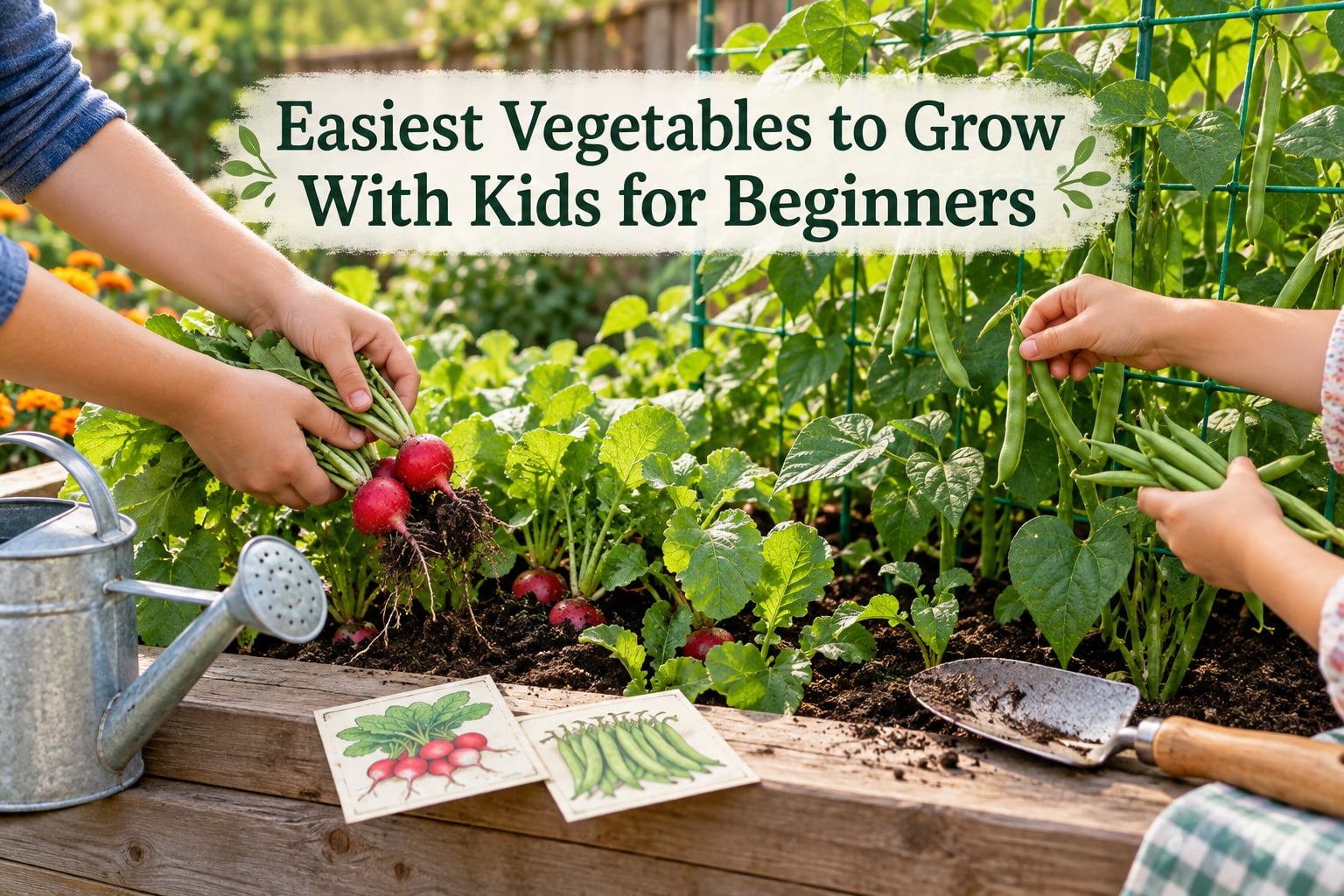
The easiest vegetables to grow with kids are the fast, forgiving ones a child can actually harvest: radishes, lettuce, snap peas, green beans and cherry tomatoes. They sprout within days, they need almost no equipment, and they survive imperfect watering better than most other crops.
That matters more than it sounds. A kid-friendly garden does not need to be the garden of a magazine spread. It needs to end in a handful of things a small person can hold in their fist and eat standing in the sun.
I have three kids and a Zone 3b backyard, and the gardens that work in our house are the ones with short feedback loops. Sow on Sunday, see green by Thursday, eat by the end of the month. When a crop takes three weeks to show nothing, interest dies before the seed does.
This guide covers the ten crops worth starting with, how each one actually grows in a short northern season, which crop suits which age, and how to pick a growing space if you have a balcony instead of a yard. It is written for a cold-climate reader who is starting from nothing.
Table of Contents
- Quick Answer: the five fastest vegetables to grow with kids
- The 10 easiest vegetables at a glance
- How to grow the 10 easiest vegetables with kids
- 1. Radishes: the fastest win in the whole garden
- 2. Lettuce: the forgiving one
- 3. Snap peas: a trellis that grows all summer
- 4. Green beans: the crop that survives children
- 5. Cherry tomatoes: start with a plant, not a seed
- 6. Scallions: the ones that come back
- 7. Swiss chard: the one that keeps producing
- 8. Cucumbers: vertical saves space
- 9. Zucchini: enormous output, enormous space
- 10. Carrots: worth it, but not for year one
- Which crops suit which age
- Container, raised bed, or windowsill: choosing your growing space
- A short-season planting calendar for a cold climate
- How to water so kids do not kill the plants
- What to do when a plant dies
- Keeping kids engaged from seed to plate
- Frequently Asked Questions
- The bottom line
Quick Answer: the five fastest vegetables to grow with kids
- Radishes sprout in 3-5 days and can be pulled in 24-30 days, which makes them the fastest reward a child can plant.
- Lettuce germinates in about a week and gives you a first cutting roughly 30-45 days after sowing.
- Snap peas take 55-70 days but climb a trellis all summer, so there is visible progress almost every week.
- Green beans produce their first pick around 50-60 days and then keep handing you beans until the frost comes.
- Cherry tomatoes are the slowest of the five at roughly 60-80 days from seed, so most families buy a started plant and let the child do the rest.
If you only have room for two this year, make them radishes and bush beans. Radishes prove the whole idea in under a month, and beans are the one crop that survives enthusiastic children.
The 10 easiest vegetables at a glance
Here are the ten crops in this guide compared side by side. Days to harvest are counted from sowing seed, and they shift with your frost dates, so treat them as the good-case number rather than a promise.
| Crop | Days to harvest | Sun | Minimum pot size | Support needed | Kid appeal |
|---|---|---|---|---|---|
| Radishes | 24-30 | Full sun | 15 cm deep | No | Very high |
| Lettuce | 30-45 | Full sun to part shade | 15 cm deep | No | Very high |
| Snap peas | 55-70 | Full sun | 30 cm deep, long trellis | Yes | High |
| Green beans | 50-60 | Full sun | 30 cm deep | Bush types: no | High |
| Cherry tomatoes | 60-80 from seed | Full sun | 40 cm deep, large | Yes, cage or stake | Very high |
| Scallions | 55-70 | Full sun to part shade | 20 cm deep | No | Medium |
| Swiss chard | 50-60 | Full sun | 30 cm deep | No | High |
| Cucumbers | 55-70 | Full sun | 40 cm deep | Yes, trellis | High |
| Zucchini | 45-60 | Full sun | 60 cm deep, very large | No | High |
| Carrots | 60-80 | Full sun | 30 cm deep, deep pot | No | High |
Two things jump out. Only three crops need something to climb on, so you can skip trellis building for most of the season. And nine of the ten will grow in a pot, which means no yard is not a dealbreaker.
How to grow the 10 easiest vegetables with kids
1. Radishes: the fastest win in the whole garden
Radishes are the classic starter because they sprout in 3-5 days and can be pulled within about four weeks. A child who planted a seed on Sunday can hold a whole radish in their hand before the month is out.
Sow them directly where they will grow. Radishes resent being moved, and the taproot forks or goes woody if you transplant them. Push each seed about 1 cm deep, cover, water, and keep the surface damp until they come up.
Give them 5 cm of space in a row. Crowding is the number one reason radishes come out as one hard green fuzz rather than a round red bulb, and that is exactly the disappointment a child will remember.
What goes wrong: heat. Above roughly 25 C radishes bolt and go woody, so in a hot summer sow a new short row in early August instead of fighting it.
2. Lettuce: the forgiving one
Lettuce is the lowest-effort crop on this list and the one forum gardeners recommend most often for a first family patch. Scatter seeds liberally across the surface rather than spacing them precisely, then cover with a light dusting of soil.
Pick a loose-leaf or butterhead type. Leaf types regrow after you cut the outer leaves and come back two or three times, which means one sowing feeds a family for weeks. Head types give you one whole salad and then stop.
In a short season it is a spring and fall crop. Sow it as soon as the ground can be worked, then sow again about two weeks before your first frost for a second flush.
What goes wrong: letting it bolt. Once a hot spell hits, lettuce turns bitter and grows a tall central stem. Pull those plants out rather than leaving them, and sow a new batch.
3. Snap peas: a trellis that grows all summer
Peas are the crop parents hand to kids on purpose, because a child can find, pick and eat them without you. They are also one of the most forgiving seeds there is, which is why experienced gardeners keep naming them first for beginners.
Sugar snap peas climb, so give them something to hold: netting on canes, twine on a tripod, or a fence panel. Without support they flop and the pods grow on the ground where nobody will find them.
Direct sow them early, as soon as the soil is workable, because peas are a cool-weather crop. They stop producing in hot weather and often do not restart until the weather cools in late summer.
What goes wrong: planting too late. Peas sown after the last frost in a short season often barely set pods before the first fall frost.
4. Green beans: the crop that survives children
Green beans are perfect for a family garden because they withstand a variety of weather, ignore a missed watering, and keep producing for weeks. Parents with kids report beans as the one thing that survives enthusiastic involvement.
Choose a bush type for a container or a small bed. Bush beans need no support, stand about 30 cm tall, and give you a concentrated two or three week harvest. Pole beans climb and keep producing longer, but they need a structure tall enough to matter.
Sow directly, 2 cm deep, after the last frost has passed. Bean soil does not need much feeding, and rich soil just produces leaves at the expense of pods.
What goes wrong: cold soil. Beans sown too early sit in damp ground and rot. Wait until the soil is warm to the touch and nights are reliably above 10 C.
5. Cherry tomatoes: start with a plant, not a seed
Cherry tomatoes have the highest kid appeal of anything on this list, and the most frustration for beginners who start from seed in a short season. Sixty to eighty days from sowing is a lot of waiting for a four-year-old.
Buy a started plant in late spring and let your child pot it up. That is not cheating. It puts the interesting part, the daily tending and the picking, in their hands instead of on a windowsill in March.
Use the largest pot you can manage, at least 40 cm across, and give the plant a cage or a stake. A caged plant resists wind, holds fruit off the ground, and is much easier for a child to reach into.
What goes wrong: inconsistent watering. A tomato that dries out and then gets soaked repeatedly splits its fruit and drops blossoms. Water little and often, at the same time each day.
6. Scallions: the ones that come back
Scallions are underrated with children because they are visible quickly, they stand up straight, and you can cut them and leave the plant. Cut the outer leaves and the crown sends up more.
Sow a small patch rather than a full row. One packet of seed produces far more onions than a family eats, and scallions store well in the soil for weeks after harvest.
They are one of the few crops on this list that genuinely tolerates partial shade, which makes them a good choice for a spot that gets only a few hours of direct light.
What goes wrong: crowding, again. Scallions left tight together stay small and pale. Thin them to 5 cm apart, which is also a good job for a child with scissors.
7. Swiss chard: the one that keeps producing
Swiss chard is a reliable cool-season crop that regrows after every cut and gives a family greens for the better part of two months. It is forgiving of a wide temperature range and needs no support.
The stalks come in colours that children find genuinely exciting, which turns it from a vegetable into a display. It is also one of the best vegetables to grow for a family that wants a continuous harvest rather than one busy weekend.
Sow in spring as soon as the ground works, and again in midsummer for a fall crop. It is a heavy feeder compared to radishes or beans, so mix compost into the soil at planting time.
What goes wrong: older leaves turning bitter in heat. Cut the whole outer set and let the inner crown regrow rather than picking single leaves.
8. Cucumbers: vertical saves space
Cucumbers grow fast, produce a lot, and are one of the most satisfying things to hand a child straight off the plant. The only real requirement is space, and a trellis solves most of it.
Grow them up a mesh fence panel or netting and the fruit hangs clear, stays cleaner, and takes up almost no ground area. In containers, look for a compact or patio type rather than a standard long vine.
Sow directly after the last frost, or start seedlings indoors three to four weeks before. They are sensitive to cold and will not move well if transplanted too young.
What goes wrong: bitterness from stress and slugs. Uneven watering and dry soil make cucumbers bitter, and a slug can take a young plant overnight.
9. Zucchini: enormous output, enormous space
Zucchini is one of the most productive vegetables per square metre you can grow, and it is why experienced gardeners recommend it to beginners. One or two plants will feed a family more squash than they can eat.
The trade-off is size. A zucchini plant needs a genuinely large container, roughly 60 cm across, or a corner of a raised bed it can sprawl across. Do not put it in a small pot.
Sow two seeds per spot and keep the stronger one. Many families end up giving squash away, which is a fine outcome for a first season and a common one among people who start out with too many plants.
What goes wrong: blossom end rot, which looks alarming but is simply a watering problem. The fruit develops a dark, leathery end because the plant could not move enough water into a fruit growing too fast.
10. Carrots: worth it, but not for year one
Here is where honest guides disagree. Some list carrots among the easiest beginner crops, others push them to a second season. Both are right, for different reasons.
Carrots are easy once they are up, and they are one of the crops children most enjoy pulling. They are hard before that: they germinate slowly, take two to three weeks to show anything, and a child who planted them will usually have lost interest before the first green appears.
They also need a deep, loose container. A standard nursery pot makes carrots fork, and forked carrots are the size of your little finger. Use a pot at least 30 cm deep, keep the soil loose, and sow a short row you can cover with a board until something emerges.
Our compromise: grow two or three carrots for the novelty of pulling one out of the ground, and let an adult handle the sowing and thinning. Save the full carrot bed for year two.
Which crops suit which age
Toddlers, preschoolers and school-age children do not need different vegetables so much as different jobs. The table below maps the common ages to the crops that work and the task each age can genuinely own.
| Age group | Best crops | Task they can own | Plants they can manage |
|---|---|---|---|
| Toddler (1-3) | Radishes, scallions, lettuce | Watering can with a rose, harvesting, washing | 2-3 pots total |
| Preschool (3-5) | Radishes, lettuce, bush beans, chard | Sowing, thinning, weeding, picking | 4-6 pots |
| School age (6-12) | Snap peas, cherry tomatoes, cucumbers, carrots | Daily watering, feeding with compost, trellis building, pest patrol | 8-12 plants |
That last column answers the question parents ask most often on gardening forums and that almost nobody addresses: how many plants can one child keep alive. The answer is far fewer than the seed packets suggest.
Start with fewer than feels reasonable. Six plants a child is fully responsible for will still be alive in three weeks. Thirty plants they helped start will not.
Container, raised bed, or windowsill: choosing your growing space
Any of these three spaces can grow half the crops on this list, and the honest answer is that the container wins for a first season. Containers warm up faster in spring, which matters enormously when your last frost is in late May, and they are far easier to move when a child needs to reach them.
Windowsill growing is more limited than most articles admit. It works for lettuce, radishes, scallions and microgreens, and it fails for anything fruiting, because a windowsill rarely gets the six to eight hours of direct sun a tomato or cucumber needs. If your only space is indoors, grow salad greens and stop there.
Raised beds give you room for the crops that sprawl, namely zucchini, cucumbers and carrots, but they are the slowest option in spring because cold soil sits deep in them. In a short season, that delay can eat your entire tomato window.
Whatever you choose, use a real container with drainage holes and do not skip it. A pot without holes holds water at the roots and kills more seedlings than any other single mistake. Fill it with a quality potting mix rather than garden soil, which compacts and drains badly in a pot.
The one-pot-one-start rule: when you are unsure how much room something needs, give it its own pot with more space than you think it needs. Crowding causes failure far more often than cold, hunger or neglect.
A short-season planting calendar for a cold climate
Almost every general gardening article is written for a long, mild season, which is why so much of the advice fails in northern climates. In Zone 3 and Zone 4, planning around the last frost date in late May and the first frost in late September is not optional. It is the whole game.
- April: Work the soil as soon as it is workable. Direct sow radishes, lettuce, peas and scallions outdoors, or in a cold frame if you have one. Keep everything covered with a row cover overnight, because late frosts are common.
- May: Keep sowing radishes and lettuce every two weeks for succession planting. Around the last frost date, roughly the last week of May, start tomatoes, cucumbers and squash indoors on a sunny windowsill.
- June: Once nights stay above 10 C, harden off your indoor seedlings for a few days and plant them out. Direct sow bush beans, radishes and a second round of lettuce. Set up trellises for peas and cucumbers now rather than later.
- July: Sow a second and third row of bush beans so the harvest spreads over weeks instead of one afternoon. Water deeply twice a week in heat. Re-sow radishes and lettuce for a fall crop.
- August: Sow lettuce, radishes and spinach for autumn. Harvest beans, chard and tomatoes heavily. A slug will take more of a late row of lettuce than any weather will.
- September: Pick everything you can before the first frost. The first light frost usually ends the tomatoes, but peas, chard and late lettuce often survive one or two frosts and keep producing.
Succession planting is the habit that separates a garden that gives you something every week from one that gives you everything in a single exhausting fortnight. Sowing a small new row every two weeks costs you nothing but a minute and a jar lid of seeds.
How to water so kids do not kill the plants
The single most reported beginner failure on every gardening forum I have read is overwatering. Children are enthusiastic, and enthusiastic children pour a full watering can into a pot that was already damp.
The fix is to teach them one test, not one rule. Push a finger two or three knuckles deep into the soil. If it comes out cool and damp, do not water. If it comes out dry and hot, water now. That single check replaces every watering schedule anyone has ever tried to teach a child.
Give your child a watering can with a rose, the sprinkler head kind. It slows the flow down so a five-year-old can actually control it, and it stops the soil washing out of the pot in one blast.
Water in the morning when the ground has not heated up, and water the soil, not the leaves. Wet leaves in a humid evening invite fungal problems, and a plant stressed by a hot afternoon struggles to absorb a cold drink.
Learn the warning signs together. Yellowing lower leaves, a soft stem, and soil that stays wet for days all point the same direction: too much water, not too little. Most plants will tell you they are thirsty by wilting, which is far harder to miss.
What to do when a plant dies
Something will die. Children notice this more than adults assume, and the wrong response ends the interest for good. The right response turns it into the most interesting part of the summer.
Work through four questions with your child instead of replacing the plant silently. Was the soil wet or dry? Had the leaves gone yellow, or gone straight brown? Was there anything on the underside of the leaves? Had anything eaten a stem at ground level?
Almost every failure has one of four causes: too much water, too little, too cold, or something ate it. A slug will take an entire row of lettuce overnight, and birds will clear a strawberry patch in an afternoon, so look at ground level before you blame the watering.
Then replant the same day and move on. Radishes are perfect for this because you can sow a new row immediately and have it in the ground before the disappointment has time to settle.
Keep a failures jar at the end of the bed. Every dead stem goes in, labelled with the date and what the child thinks happened. Come back to it in the fall and the garden teaches its own course.
Keeping kids engaged from seed to plate
Engagement is a scheduling problem more than a persuasion problem. A child who sows six different things on the same day will watch all six, because the fastest one is always about to be ready.
Sow in pairs rather than one large row. Two short rows of radishes beat one long row, because the end of a short row is close enough to walk to.
Let each child own one crop completely, start to finish, including the failures. Ownership is what turns a garden chore into a project, and it is the difference between a child who helps you and a child who gardens.
Then close the loop with seed-to-plate eating. Most of these crops need no cooking at all: raw snap peas straight off the vine, cherry tomatoes still warm, radishes with a little butter, lettuce with a drizzle of dressing. Children are far more willing to eat something they chose, watched, and pulled than the same vegetable served on a plate.
On budget, the frugal maths is simple and worth doing before you buy anything. A single packet of radish or bean seed costs about as much as one radish or one bunch of beans from the store, and it produces dozens. Pots, potting mix, a watering can and a trowel are a one-time outlay that lasts years, and a five-dollar bag of compost is what makes the difference between a plant that sulks and one that crops.
Start with five crops, not ten. Add three more once the first round is harvested and you know which plants your child actually wants to touch again.
Frequently Asked Questions
What are the easiest vegetables to grow for kids?
Radishes, lettuce, snap peas, green beans and cherry tomatoes are the classic starting five. Radishes and lettuce give a harvest in 24-45 days, which is fast enough to hold a child’s attention. Snap peas and green beans need a trellis but keep producing for weeks. Cherry tomatoes are usually bought as started plants in a short season so the child does not wait two months for the first fruit.
What is the easiest plant to grow with kids?
Radishes. They sprout in 3-5 days and can be pulled in 24-30 days, need no support and no feeding, tolerate imperfect watering better than almost any other crop, and grow in a container 15 cm deep. That speed-to-reward ratio is what keeps a child interested through a full season.
What are the most kid friendly vegetables?
The most kid friendly vegetables are the ones eaten raw straight from the plant: cherry tomatoes, snap peas, radishes, cucumber and green beans. All of them can be harvested and eaten without a knife, a recipe or an adult’s help, which is exactly what makes them popular with children.
What vegetables can grow in 4 weeks?
Radishes are the reliable four-week crop at 24-30 days. Leaf lettuce can give a first cutting around 30-45 days depending on variety and weather. Some quick salad mixes and microgreens can be cut in under a month. Faster than that, you are growing sprouts rather than vegetables.
What are some easy vegetables for kids to learn?
Start with crops that have visible stages: radishes and lettuce for a fast first success, bush beans for a long harvest they can pick themselves, and snap peas for climbing. Zucchini and cucumber teach scale and care because they need more space and water. Leave carrots and squash for the second year.
Why are my kid’s plants dying?
Overwatering is the most common cause. Test the soil with a finger two or three knuckles deep and only water when it comes out dry. Other frequent causes are cold soil, crowding, poor drainage in a pot without holes, and slugs or birds. Yellow lower leaves and a soft stem point to too much water rather than too little.
What is the 70/30 rule in gardening?
It is a simple planting ratio: grow about 70 percent of what your family definitely eats, and spend the remaining 30 percent on experimental crops for fun. It stops a first garden turning into fifteen plants of one thing nobody wants while the crop everyone actually eats is missing.
The bottom line
The easiest vegetables to grow with kids are radishes, lettuce, snap peas, green beans and cherry tomatoes, and everything else on this list is a bonus. Sow two short rows rather than one long one, teach the finger test before the first watering can appears, and start with fewer plants than you think a child can keep alive.
Plan around the last frost in late May, sow something new every two weeks, and let the first harvest happen early enough this summer that your child is still asking for a second one. This page was updated for 2026, and the calendar above assumes a Zone 3 or Zone 4 season.