
Last updated: September 2026
The short answer: how to decorate a rental on a budget without losing your deposit comes down to one system. Every change you make falls into one of three tiers. Green changes are fully reversible. Yellow changes need a lease check and a careful read of the product instructions. Red changes need written landlord permission before you touch anything. Everything else is guesswork with your deposit on the line.
My rule is that if I cannot unhang it in under a minute without a tool, it does not go up. That one habit has kept me from ever arguing about a hook hole, and it is why I now measure the wall twice before I even open the packaging.
Renters lose deposits to preventable things all the time: a scuff, an adhesive mark, a hole from a picture hook, residue from peel-and-stick wallpaper that sat too long. None of that is normal wear. It is damage, and a landlord can deduct for it.
This guide is built for Edmonton and Alberta rentals, where the Residential Tenancies Act sets a standard of care that most tenants never learn until move-out. I have broken the process into the same three tiers that experienced renters use, plus the documentation habit that decides who wins an argument with a landlord six months from now.
Table of Contents
- The Green, Yellow, and Red Rule for Renter-Friendly Decorating
- Read Your Lease Before You Buy a Single Thing
- Photograph Every Wall on Day One
- Renter-Friendly Decorating Ideas, Room by Room
- Removable Adhesive Products: Surface, Weight, and Removal Rules
- Where Edmonton Renters Find Budget Decor
- What Landlords Actually Deduct From Your Deposit
- The Move-Out Restoration Checklist
- Edmonton-Specific Cautions: Heat, Vents, and Winter
- Frequently Asked Questions
- Can a landlord take from your deposit for scuffed wall paint?
- Can I paint the walls in my rented apartment?
- Do you have to paint to get deposit back?
- Do Command strips damage paint?
- What can I not change in a rental apartment?
- How do I decorate a rental apartment on a tight budget?
- Where can Edmonton renters find cheap furniture and decor?
- Do I need written permission to make a change in my rental?
- Decorate the Place You Actually Live In
The Green, Yellow, and Red Rule for Renter-Friendly Decorating
Renter-friendly decorating means making changes to a rental that can be fully reversed at move-out. You use freestanding furniture, removable adhesive products, and reusable textiles instead of paint, drilling, or fixture swaps.
Here is the framework, and it is worth memorizing because it answers almost every decorating question before you ask it.
Green — reversible, go ahead:
- Freestanding furniture that never touches a wall
- Removable adhesive strips on sound, cured painted walls
- Peel-and-stick wallpaper applied carefully and removed promptly
- Tension-mounted curtain rods and tension shelves
- Area rugs with a non-slip pad underneath
- Window clings and removable decals for the bathroom
- Paintable removable wall decals on painted drywall
Yellow — check the lease and the instructions:
- Peel-and-stick wallpaper, especially on textured or sun-faded walls
- Any adhesive hook or strip used on a wall that is already scuffed
- Cabinet knobs and drawer pulls you plan to reinstall at move-out
- Furniture placed against walls in a moisture-prone basement suite
- Shelf brackets or picture frames hung with drywall anchors
- Light fixtures or switch plates of any kind
Red — written permission only:
- Any paint, on any wall, for any reason
- Holes of any size, including small picture hooks and drywall anchors
- Curtain rods screwed into drywall or window casings
- Mounting a television to the wall
- Changing locks, light fixtures, or blinds permanently
- Wall-to-wall carpet, wainscoting, or any wall covering
The tiering matters because the failure modes are different. Green items come off cleanly by design. Yellow items come off cleanly only if the surface is in the right condition. Red items do not come off at all without a repair, and a repair is exactly what a deposit deduction pays for.
Here is how a typical renter budget maps onto the tiers. The lowest tier buys textiles and hardware: a thrifted rug, a set of secondhand cabinet knobs, a tension rod, and one curated thrifted piece of furniture. The middle tier buys one strong focal point, usually an accent wall, plus window treatments for both looks and drafts. The top tier buys freestanding storage that reads as a built-in, a full set of window treatments, and the small repair kit you keep for move-out.
Read Your Lease Before You Buy a Single Thing
Renters trust the lease clause list more than any other piece of advice, and the r/Apartmentliving threads about first-apartment decorating repeat it constantly: read the lease before buying anything. Ten minutes with a highlighter saves a month of decorating you might have to undo.
Search your lease for these terms and read what each one says about your unit:
- Alterations — the blanket clause covering any change to the premises
- Painting — whether it is flatly banned or allowed with written approval and repainting at move-out
- Nails, screws, and holes — the size limit, if any
- Wall coverings — wallpaper, paneling, borders, decals
- Shelving and fixtures — whether freestanding units are treated differently from mounted ones
- TV mounting — very often a separate and specific clause
- Curtain rods and window treatments — sometimes permitted, sometimes explicitly excluded
- Adhesive products — a few landlords name hooks and strips directly
- Security deposit and deductions — how the deposit is held and what may be claimed against it
- Move-out requirements — cleaning, patching, restoration, and notice deadlines
- Insects, mould, and pets clauses — relevant if you plan any textiles near a baseboard
A verbal yes in the hallway is not permission. Email is permission. A text message is arguably permission. A signed addendum is unambiguous permission. Get it in writing, and keep it. Forum threads on renter advice are full of people who remember agreeing to something that nobody can now recall.
Photograph Every Wall on Day One
Skipping move-in photos is the single most-regretted omission renters describe. It takes fifteen minutes with a phone, and it is the only evidence that survives a disagreement a year later.
Capture all eight of these, and do it before the first box is unpacked:
- Walls — pan each wall corner to corner in good light, including scuffs, chips, and nail holes already there
- Floors — hardwood, tile, and carpet, including marks near the entry and under the fridge
- Doors and frames — the door face, the hinges, and the frame edges
- Cabinets and counters — inside and out, including hardware and any water staining
- Fixtures — light fixtures, switch plates, faucets, toilet, shower
- Existing holes — a close shot of every one, with a coin or ruler in frame for scale
- Appliances and heating — the fridge, the range, the baseboard heater and vents
- Smoke detectors and windows — including any seal failure or condensation stains
Send the set to yourself by email the same day, so there is a timestamped copy outside your phone. Keep the file until the deposit is settled, not just until move-out day. A move-in condition report or adverse condition report is a separate document your landlord may provide, and if one is offered, read it line by line and note anything you disagree with in writing before you sign.
Renter-Friendly Decorating Ideas, Room by Room
This is the fun half of the query, and it is where budget renter decorating actually happens. The rule for every item below is the same: it must come off, or it must have never touched the wall.
Living room: build a focal wall instead of repainting one
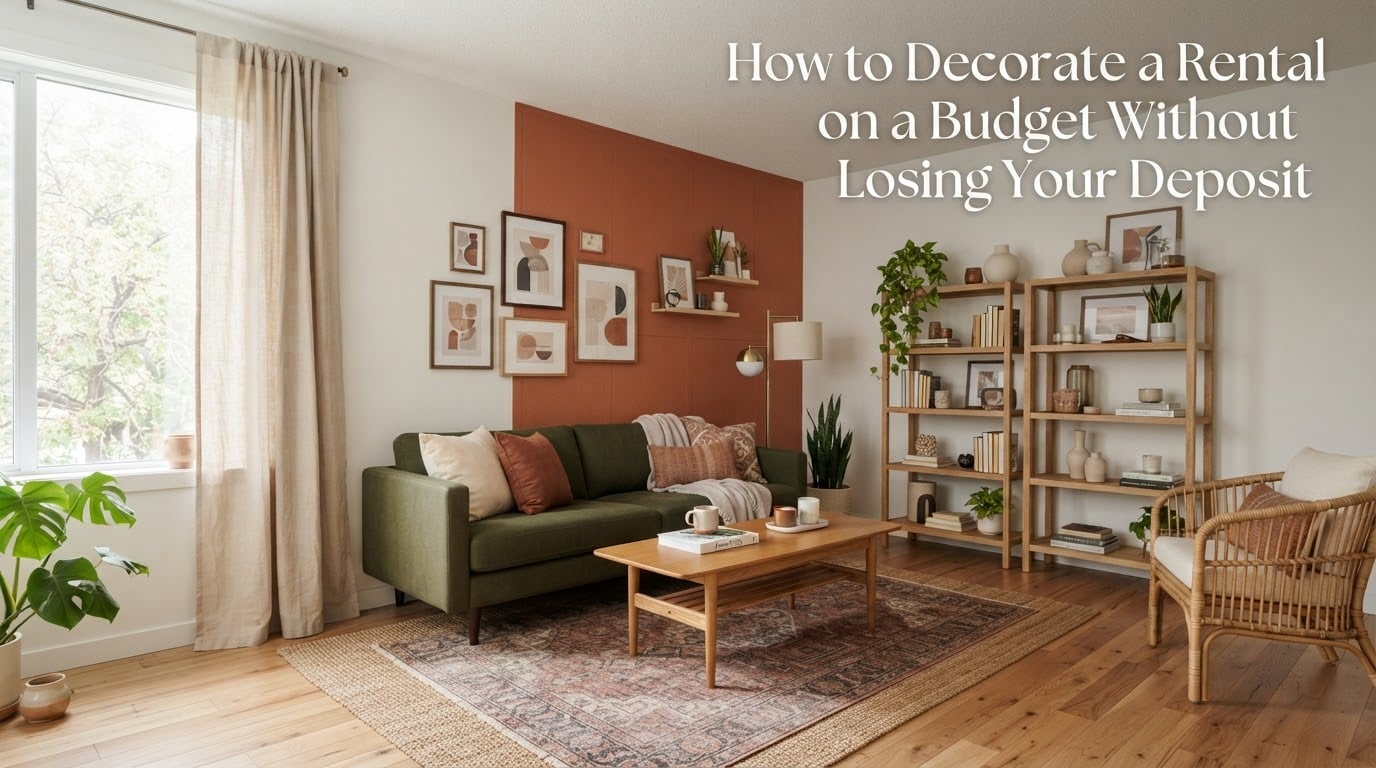
The single highest-return upgrade in a rental is a removable accent wall. Peel-and-stick wallpaper gives you a real colour story on one wall and leaves the rest of the room neutral, which is exactly what makes a space feel deliberate rather than half-finished.
Install it properly, because the difference between clean removal and adhesive residue is technique, not product. Wipe the wall with a damp cloth and let it dry fully. Roll it in sections, working from the centre outward. Never stretch the sheet to fit, because stretched adhesive grips harder. Once it is on, leave it alone.
To make a corner read as a built-in without a single hole, stand a pair of simple shelving units side by side and push them together, then style them as one unit. Add a runner, a framed piece leaning against the wall, and a small lamp on top. It reads as joinery from across the room and it walks out the door with you.
Layer two rugs rather than buying one large one when you are furnishing on a budget. A large area rug under a smaller one is visually richer and lets you thrift both. Put a non-slip rug pad under everything, and lift the edges periodically to check the floor underneath, because a rug that never gets lifted for a year hides dents, moisture, and a scuff you would rather find early.
Bedroom: soft goods, freestanding storage, and good light
Bedrooms are where most of a decorating budget quietly goes, and almost none of it needs permission. Bedside tables with legs rather than wall-hung shelves. A thrifted headboard instead of a headboard bolted to the wall. A gallery wall held up with adhesive strips in a grid you plan before you peel anything.
For storage, a slim freestanding wardrobe or an open shelving cube stack behind the door adds capacity without a stud finder and a drill. Lamps do more for a room at night than any wall decoration, and swapping a bulb to a warmer tone changes the entire feel of a space you did not paint.
Kitchen and bathroom: the hardware swap
Replacing cabinet knobs and drawer pulls is the cheapest meaningful upgrade in any rental, and it is reversible if you plan it. Photograph every existing knob before removal, unscrew rather than yank, and put every screw and fitting straight into a labeled bag. The bag is the part people skip, and a labeled bag of original hardware is repeatedly described in renter forums as the thing that saves real money at move-out.
For the bathroom, a tension rod shower curtain, a peel-and-stick mirror frame, and a replaceable bath mat change the entire room. Nothing in that list touches a wall. Window decals work well above a backsplash where steam and humidity are not a problem.
Entry and hallway: the easiest room to improve
A hallway needs almost nothing. A narrow freestanding console, a hook rail that stands on the floor rather than mounts to the wall, and a runner rug cover more ground per dollar than any other area of the home. A single piece of secondhand art leaned on the shelf finishes it.
Windows: the upgrade that pays for itself in Edmonton
Window treatments do double duty. They soften a hard room and they cut drafts, which matters across an Edmonton winter. A thermal curtain hung on a tension rod can be moved room to room, which makes it a portable upgrade rather than a fixture.
Layering is what makes it look deliberate: a sheer panel that softens the light, a blackout layer for bedrooms, and a thermal liner behind both if the room sits on an exterior wall.
Removable Adhesive Products: Surface, Weight, and Removal Rules
Here is the honest truth about Command strips, hooks, and peel-and-stick wallpaper. Manufacturers do not promise damage-free removal, and experienced commenters check the instructions before they buy rather than trusting the word removable. A widely shared r/TIFU post describes a landlord banning all holes, the renter relying on adhesive strips, and a chunk of paint coming off a nearly new wall at move-out. That outcome is a technique failure more than a product failure, but it is your deposit either way.
Five rules reduce the odds to near zero:
- Check the weight limit and respect it. Every strip and hook has a rated weight, and the rating assumes the surface is prepared as directed.
- Check the surface list. Adhesive does not bond reliably to textured, freshly painted, sun-faded, or flaking surfaces. Paint must be fully cured, which is why the widely repeated advice is to wait about seven days after a fresh paint job before applying anything.
- Never apply over a scuff. An already-marked area is exactly where lifting adhesive will take a layer of paint with it.
- Remove slowly, downward. Stretch the removal strip as slowly as you can and pull straight down along the surface, not out at an angle. Fast outward tugs are the main cause of paint lifting.
- Set a removal date. Peel-and-stick left for a year behaves more like glue. When your lease end date is known, put it in your calendar with a month of margin.
One more caution worth repeating: text, comments, and forum threads all describe the same pattern of heavy adhesive use followed by repaint charges at move-out. The fix is not a better adhesive. It is using less of it.
Where Edmonton Renters Find Budget Decor
The second most common question in renter forums is simply where to buy cheaply, and this is where local knowledge actually beats generic advice.
Kijiji and Facebook Marketplace are the two workhorses. Search by neighbourhood and set an alert, because the good pieces go in hours. Furnishings often list free, and a free bookshelf is a green-tier item that still has to be cleaned before it goes against a wall.
Garage sales and curb finds are underrated in Edmonton. Most of what people want at these is hardware, frames, glass, and small wood items, all of which reappear in a rental as a hardware swap or a thrifted frame. Look for brass and glass cabinet pulls, which is where the secondhand finds are genuinely good.
Thrift stores deliver curtain panels, table lamps, area rugs, and frames at a fraction of new. Buy curtains in pairs and hem them yourself if the length is wrong, which is a fifteen-minute job with a sewing machine or a hand stitch.
Landlord and property surplus auctions exist in the Edmonton market when buildings are turned over, and they are a place to find matching sets of hardware, light fixtures, and even identical cabinet pulls in quantity.
The sourcing principle that saves the most money is dual-purpose furniture. A storage ottoman, a bar cart that doubles as an end table, a sofa bed, and a dining table that seats six and folds flat all do two jobs, which is how a small budget covers a full list of rooms.
And reupholstery still works. A thrifted chair in dated fabric with good bones can be recovered for less than a new one, using a removable slipcover if you want to stay reversible.
What Landlords Actually Deduct From Your Deposit
Landlords can only deduct from a security deposit for damage beyond ordinary wear and tear. In Alberta, the Residential Tenancies Act sets the standard of care a tenant is held to, and ordinary wear and tear is not the same thing as damage. A wall that fades slightly with sun exposure, a floor that has scuffs from normal foot traffic, and a door that has a minor mark from a shoe are wear. A hole, a new scuff you made, an adhesive stain, a missing fixture, and a carpet that was not cleaned are damage.
The deduction is a repair cost, not a punishment, which is why the numbers sting. A whole-room repaint, a carpet steam clean, and drywall patching are the three most common line items an Edmonton tenant sees, and a carpet clean or a partial repaint alone can take a meaningful bite out of a month’s rent.
Two rules protect you here. First, only damage beyond ordinary wear and tear may be claimed, so anything that existed on day one is not yours to pay for, which is why the move-in photographs matter. Second, a deduction is not a final verdict; a landlord is expected to provide an accounting of what was charged, and you can respond with your own evidence and your own quotes in writing before the money is gone.
This is also where the answers to the most-searched deposit questions live. Can a landlord take from your deposit for scuffed wall paint? Yes, if the scuff is damage rather than wear, and the standard of care decides which one it is. Can a landlord charge you for painting after you move out? Yes, if the walls were painted without permission, or if you caused damage requiring repaint beyond ordinary wear.
Keep a paper trail of any cleaning you do, any repair you arrange, and any conversation about the condition of the unit. Send requests in writing, and keep your replies.
The Move-Out Restoration Checklist
Start the walkthrough about three weeks before you leave, so there is time to fix anything small. Take new photos of every wall and floor to match against your move-in set.
- Remove everything you installed, adhesive items first, pulled slowly and downward. Heat from a hair dryer on low can help a stubborn strip release without a hard tug.
- Check for residue and marks. Look at the wall in angled light, which reveals adhesive shadow and scuffs that a straight-on photo hides.
- Fill small nail holes with spackle, sand, and touch up with a paint colour matched from a closet or a low-traffic corner. Do not fill a hole you are not certain was yours.
- Clean floors and take up rugs to check the surface underneath, then vacuum or mop as the lease requires.
- Reinstall original hardware from the labeled bag, and confirm every screw, bracket, and fitting is back where it started.
- Confirm the last utilities and forwarding details, and request your move-out inspection in writing with a date.
When something is damaged, you get a choice, and the decision is usually simple. If a small defect costs a few dollars in spackle and a touch-up, fix it. If a professional repair costs more than the deduction you would face, it is often cheaper to let the landlord deduct and keep the difference. Either way, do it in writing and ask for the invoice. And never try to fix damage by making it worse, which is how a scuff turns into a repaint charge.
Edmonton-Specific Cautions: Heat, Vents, and Winter
Cold-climate rentals add a few rules that generic decorating advice never mentions. Never block a baseboard heater, a floor register, or a wall vent, including with a rug, a bed, or a shelving unit, because restricted airflow turns into a heat and drying problem that a landlord can inspect. Keep furniture a hand-span away from baseboard heaters.
Winter also makes drafts visible, so window treatments pull double duty as energy savings. And in cold months, be careful with plants near hardwood: a heavy pot of soil that gets knocked over, or a watering that runs under a saucer, can warp a floor in ways that look like a leak, and floors are expensive to replace.
Sun-faded walls are worth flagging during summer inspection. Adhesive on a sun-bleached wall is a weaker bond, and paint that has been repainted by a previous tenant at a different time can hold more aggressively than the surrounding original coat.
Frequently Asked Questions
Can a landlord take from your deposit for scuffed wall paint?
Yes, if the scuff is damage rather than ordinary wear and tear. A landlord may only deduct from a security deposit for damage beyond normal wear, so sun fading, foot traffic marks and minor aging are not chargeable. A scuff you caused, a mark from furniture, or paint lifted by adhesive generally is. Protect yourself by photographing every wall on move-in day and keeping that dated set until the deposit is settled.
Can I paint the walls in my rented apartment?
Only with written landlord permission, and rarely on a standard lease. Painting is one of the most common clauses that landlords address by name. Where it is allowed, the permission usually specifies which rooms, which colours, and whether you must repaint to the original colour at move-out. Painting without written approval is the single easiest way to lose an entire month’s rent from a deposit.
Do you have to paint to get deposit back?
No. Ordinary wear and tear is not chargeable, so you are not required to repaint a room simply because you lived in it. You may be asked to patch and touch up damage you caused, such as nail holes or scuffs, using a colour matched from an untouched corner. Ask for any deduction in writing with an itemised breakdown before the deposit is returned.
Do Command strips damage paint?
They can, and no manufacturer guarantees damage-free removal. The risk drops sharply when you respect the weight limit, apply only to clean and fully cured paint, avoid walls that are already scuffed or sun-faded, wait about seven days after any fresh paint, and remove slowly by stretching the removal strip and pulling straight down. Fast outward tugs are the usual cause of paint lifting.
What can I not change in a rental apartment?
In most leases the red-tier list is short and predictable: paint, holes of any size, curtain rods screwed into drywall, wall-mounted televisions, light fixtures, switch plates, locks, blinds, wall coverings such as wallpaper or paneling, and any structural change. Freestanding furniture, tension rods, rugs, adhesive products on sound walls, and removable textiles generally fall outside that list. Your lease wording overrides any general advice.
How do I decorate a rental apartment on a tight budget?
Start with the three-tier rule: green items are fully reversible, yellow items need a lease check and careful product instructions, and red items need written permission. Then spend your money in order. Textiles and thrifted hardware first, a freestanding focal piece or layered rug second, and one removable accent wall or freestanding shelving unit third. Adhesive is the last resort, not the first.
Where can Edmonton renters find cheap furniture and decor?
Kijiji and Facebook Marketplace are the fastest sources, especially for shelving, tables and lamps, and both work best with saved searches and alerts. Garage sales and thrift stores supply curtain panels, frames, rugs and cabinet hardware. Turnover and property surplus auctions in the Edmonton area can yield matching sets of pulls and fixtures. Reupholstering or slipcovering a thrifted piece often costs less than buying new.
Do I need written permission to make a change in my rental?
For anything in the red tier, yes, and it should be written. Email is the easiest defensible form, since it leaves a dated record you can attach later. A text message is stronger than a hallway conversation, and a signed addendum is unambiguous. Renters routinely lose deposits because nobody could recall agreeing to something. Photograph or save the message the same day you receive it.
Decorate the Place You Actually Live In
To decorate a rental on a budget without losing your deposit, the order of operations is everything. Classify each project green, yellow, or red before you buy. Read the lease clause by clause. Photograph every wall before the first box is unpacked, and keep that dated set until the money is back in your account. Store the original hardware in a labeled bag. Use as little adhesive as you can get away with, and remove it slowly.
Do those five things and your deposit stops being the thing you are afraid of. Start tonight, with the lease and your phone camera.